Understanding Culture
Society and Politics
Quarter 1: Week 6 - Module
6
Specific Learning objectives
 1. understand the meaning of social groups;
 2. examine the sociological perspectives about
social groups;
 3. differentiate the various forms of social groups;
 4. analyze the functions of social groups; and
 5. determine your social groups.
Think about it?
 1. Do you believe that man is a social animal?
Why or why not?
 2. How does man becomes a social animal
based on the essay?
 3. How important is human interaction in
building the nation?
SOCIETY
 A society is mostly characterized as an organized interrelated
group of people who act together for collective living, as
they share the same language, territory, and culture.
However, a group of individuals in a certain place does not
instantly make a social group. This group may just be
individuals who happen to be in one place asserting theirs
commonality. Simply stated, when human relation begins, a
group starts to be organized. There are sociological theories
that can explain various aspects of social group existence.
Sociological Perspective of Society
 Social groups are fundamental parts of human life.
They are a multitude of people who see each other
often and think of themselves as part of a group. There
appears to be groups of people everywhere. We could
be a member of a church group, college class,
workplace, sports team, club, and others. The discipline
of Sociology focuses primarily on the study of social
groups in a society.
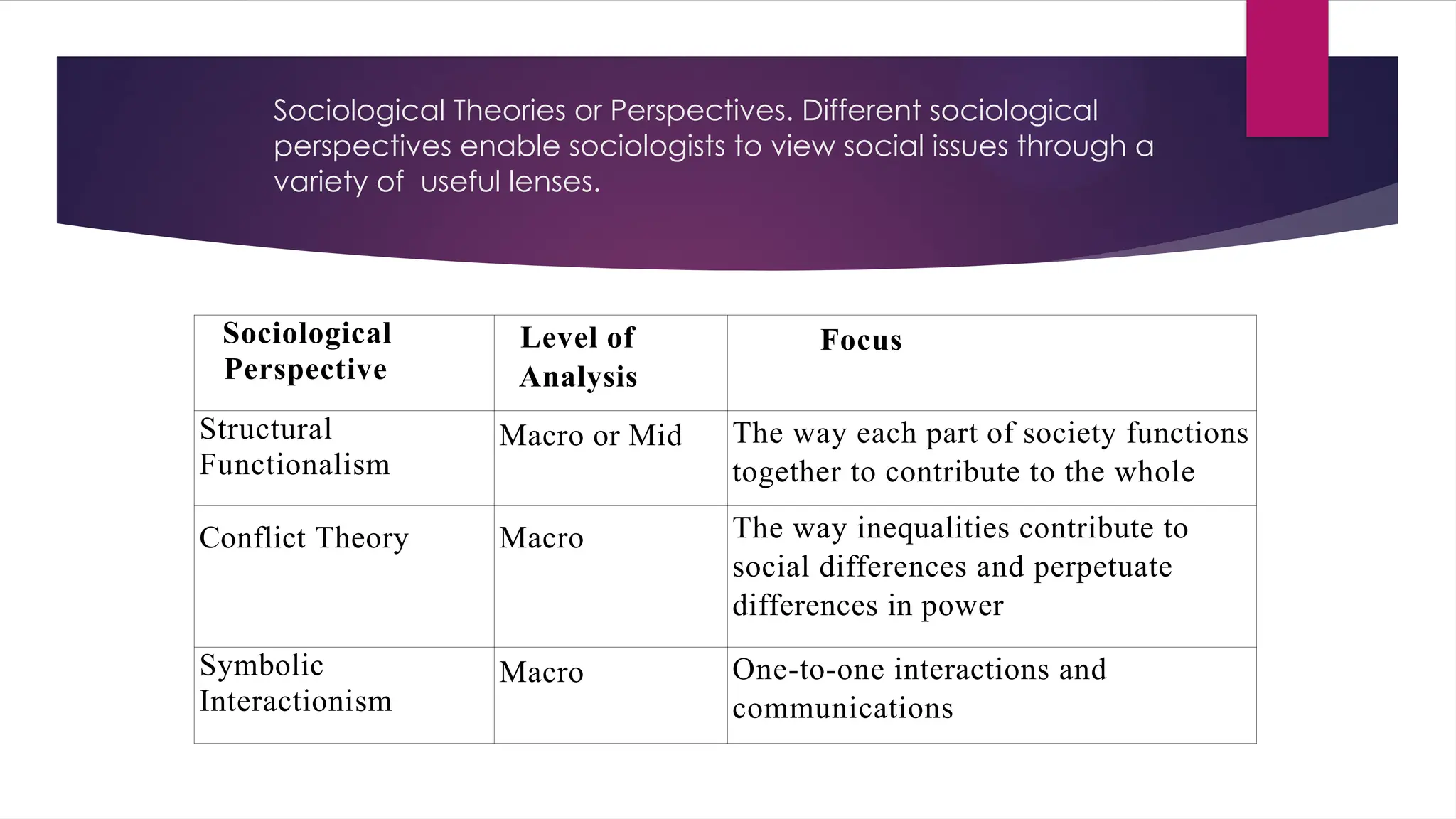
Sociological Theories or Perspectives. Different sociological
perspectives enable sociologists to view social issues through a
variety of useful lenses.
Sociological
Perspective
Level of
Analysis
Focus
Structural
Functionalism
Macro or Mid The way each part of society functions
together to contribute to the whole
Conflict Theory Macro The way inequalities contribute to
social differences and perpetuate
differences in power
Symbolic
Interactionism
Macro One-to-one interactions and
communications
Structural – Functional Theory
 Structural-functional theory, also called functionalism, sees society as a
structure with interrelated parts designed to meet the biological and social
needs of the individuals in that society. Functionalism grew out of the writings
of English philosopher and biologist, Hebert Spencer (1820–1903), who
saw similarities between society and the human body. He argued that just
as the various organs of the body work together to keep the body
functioning, the various parts of society work together to keep society
functioning (Spencer 1898). The parts of society that Spencer referred to
were the social institutions, or patterns of beliefs and behaviors focused on
meeting social needs, such as government, education, family, healthcare,
religion, and the economy.
 Émile Durkheim, another early sociologist, applied Spencer’s theory to explain
how societies change and survive over time. Durkheim believed that society is
a complex system of interrelated and interdependent parts that work together
to maintain stability (Durkheim 1893), and that society is held together by
shared values, languages, and symbols. Durkheim believed that individuals
may make up society, but in order to study society, sociologists have to look
beyond individuals to social facts. Social facts are the laws, morals, values,
religious beliefs, customs, fashions, rituals, and all of the cultural rules that
govern social life (Durkheim 1895). Each of these social facts serves one or
more functions within a society. For example, one function of a society’s laws
may be to protect society from violence, while another is to punish criminal
behavior, while another is to preserve public safety.
 Although suicide is generally considered an individual phenomenon,
Émile Durkheim was interested in studying the social factors that
affect it. He studied social ties within a group, or social solidarity, and
hypothesized that differences in suicide rates might be explained by
religion-based differences. Durkheim gathered a large amount of
data about Europeans who had ended their lives, and he did indeed
find differences based on religion. Protestants were more likely to
commit suicide than Catholics in Durkheim’s society, and his work on
this topic demonstrated the utility of theory for sociological research.
 Another noted structural functionalist, Robert Merton (1910–2003), pointed out that
social processes often have many functions. Manifest functions are the
consequences of a social process that are sought or anticipated, while latent
functions are the unsought consequences of a social process. A manifest function
of college education, for example, includes gaining knowledge, preparing for a
career, and finding a good job that utilizes that education. Latent functions of your
college years include meeting new people, participating in extracurricular activities,
or even finding a spouse or partner. Another latent function of education is creating
a hierarchy of employment based on the level of education attained. Latent
functions can be beneficial, neutral, or harmful. Social processes that have
undesirable consequences for the operation of society are called dysfunctions. In
education, examples of dysfunction include getting bad grades, truancy, dropping
out, not graduating, and not finding suitable employment.
Conflict Theory
 Conflict theory looks at society as a competition for limited resources.
This perspective is a macro-level approach most identified with the
writings of German philosopher and sociologist Karl Marx (1818–1883),
who saw society as being made up of two classes, the bourgeoisie
(capitalist) and the proletariat (workers), who must compete for
social, material, and political resources such as food and housing,
employment, education, and leisure time. Social institutions like
government, education, and religion reflect this competition in their
inherent inequalities and help maintain the unequal social structure.
 In the economic sphere, Marx focused on the “mode of production” (e.g.,
the industrial factory) and “relations of production” (e.g., unequal
power between workers and factory owners). The bourgeoisie owns and
controls the means of production, which leads to exploitation due to the
profit motive. In this arrangement, proletarians have only their labor to sell,
and do not own or control capital. False consciousness is Marx’s term for the
proletarian’s inability to see her real position within the class system, a mis-
recognition that is complicated by the control that the bourgeoisie often
exerts over the media outlets that disseminate and normalize information.
These are just some of the structural constrains that prevent workers from
joining together in what Marx called class consciousness, or a common
group identity as exploited proletarians and potential revolutionaries.
German sociologist Max Weber agreed with some of Marx’s main ideas,
but also believed that in addition to economic inequalities, there were
inequalities of political power and social structure that caused conflict.
Weber noted that different groups were affected differently based on
education, race, and gender, and that people’s reactions to inequality
were moderated by class differences and rates of social mobility, as
well as by perceptions about the legitimacy of those in power.
 Ida B. Wells articulated the conflict perspective when she theorized a
connection between an increase in lynching and an increase in black
socio-economic mobility in the United States from the late 1800s into the
mid-20th century. She also examined competition within the feminist
movement as women fought for the right to vote, yet the presumably
egalitarian mainstream suffragist movements were headed by white
women who excluded black women from suffrage. W.E.B. DuBois also
examined race in the U.S. and in U.S. colonies from a conflict perspective,
and emphasized the importance of a reserve labor force, made up of
black men. Race conflict paradigms will be examined later in the course in
the module devoted to race and ethnicity.
Symbolic Interactionist Theory
 Symbolic Interactionist Theory is a micro-level theory
that focuses on meanings attached to human interaction,
both verbal and non-verbal, and to symbols. Communication
—the exchange of meaning through language and
symbols—is believed to be the way in which people make
sense of their social worlds
 a mirror, so Cooley theorized that we “see” ourselves when we
interact with others. Charles Horton Cooley introduced the
looking-glass self (1902) to describe how a person’s self of self
grows out of interactions with others, and he proposed a
threefold process for this development:
1) we see how others react to us,
2) we interpret that reaction (typically as positive or negative) and
3) we develop a sense of self based on those interpretations.
“Looking-glass” is an archaic term for
 George Herbert Mead (1863–1931) is considered a founder of symbolic
interactionism, though he never published his work on this subject (LaRossa and Reitzes
1993). Mead’s student, Herbert Blumer, actually coined the term “symbolic
interactionism” and outlined these basic premises: humans interact with things based
on meanings ascribed to those things; the ascribed meaning of things comes from our
interactions with others and society; the meanings of things are interpreted by a person
when dealing with things in specific circumstances (Blumer 1969). This sounds close to
Cooley’s looking-glass self, but Mead’s contribution was really to the development of
self, especially in childhood, which we’ll discuss in more detail when we address theories
of socialization. If you love books, for example, a symbolic interactionist might propose
that you learned that books are good or important in the interactions you had with
family, friends, school, or church; maybe your family had a special reading time each
week, getting your library card was treated as a special event, or bedtime stories were
associated with warmth and comfort.
 Social scientists who apply symbolic-interactionist thinking look for
patterns of interaction between individuals. Their studies often
involve observation of one-on- one interactions. For example, while
a conflict theorist studying a political protest might focus on class
difference, a symbolic interactionist would be more interested in
how individuals in the protesting group interact, as well as the signs
and symbols protesters use to communicate their message and to
negotiate and thus develop shared meanings.
 The focus on the importance of interaction in building a society
led sociologists like Erving Goffman (1922–1982) to develop
a technique called dramaturgical analysis. Goffman used
theater as an analogy for social interaction and recognized that
people’s interactions showed patterns of cultural “scripts.” Since it
can be unclear what part a person may play in a given situation, as
we all occupy multiple roles in a given day (i.e., student, friend, son/
daughter, employee, etc.), one has to improvise his or her role as the
situation unfolds (Goffman 1958).
Forms of Social Group
 Groups are formed as an assemblage of people who often
interact with each other on the basis of a common outlook
concerning behavior and a sense of common identity. A
social group may consist of two or more individuals who do
things together with a common goal and interest.
 Group- is any collection of people who interact on the basis of shared expectations
regarding one another’s behavior ( Kornblum, 2003).
- is consist of two or more people who are bound together in relatively stable patterns of
social interaction and who share a feeling of unity ( Hughes and Kroeler, 2009)
- is comprised of two or more persons who are in social interaction, who are guided by
similar norms, values and expectations, and who maintain a stable pattern of relationship over
a period of time.
- Is a specified number of individuals where each recognizes members from non-member;
- it is a collection of individuals characterize by:
a) Communication
b) Recognition
c) Specialized roles
Three Requirements for a group
1. There must be two or more people.
2. There must be interaction.
3. The members must be together
physically.
 Factors that influence Groups
 1. Motivational base shared by individuals (based on needs,
interests, desires, noble activities, insecurities, or problems)
 2. Size of the group
 3. Type of group goals
 4. The kind of a group cohesion/unity (the capability to function and
interact collectively in the direction of their goals)
General Characteristics of a Group
 Group is characterized by the following:
 1. A group has identity identifiable by both its members
and outsiders.
 2. A group has a social structure in the sense that each
part or member has a position related to other positions.
 3. Each member in a group has roles to play.
 4. There is mutual reciprocity among members in a group.
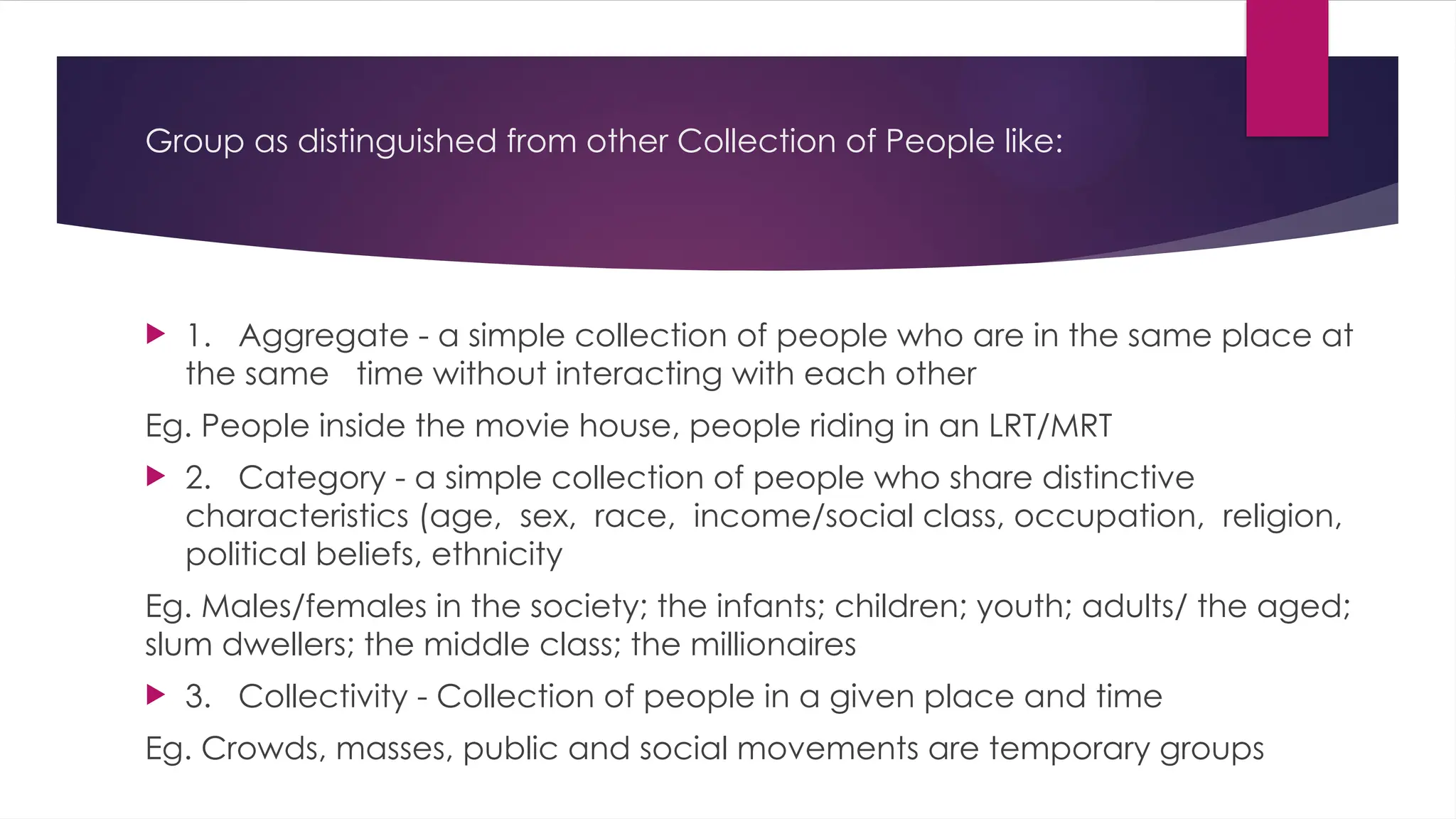
Group as distinguished from other Collection of People like:
 1. Aggregate - a simple collection of people who are in the same place at
the same time without interacting with each other
Eg. People inside the movie house, people riding in an LRT/MRT
 2. Category - a simple collection of people who share distinctive
characteristics (age, sex, race, income/social class, occupation, religion,
political beliefs, ethnicity
Eg. Males/females in the society; the infants; children; youth; adults/ the aged;
slum dwellers; the middle class; the millionaires
 3. Collectivity - Collection of people in a given place and time
Eg. Crowds, masses, public and social movements are temporary groups
IMPORTANCE OF A GROUP
 1. A group is a major source of solidarity and cohesion.
 2. A group reinforces and strengthens our integration into
society.
 3. A group shares basic survival and problem-solving
techniques to satisfy personal and emotional needs.
 4. A group gives meaning and support to an individual.
HOW IS A GROUP FORMED?
 1. The desire to achieve an objective
 2. To meet the needs of the individual member
 3. People are treated alike by others
CLASSIFICATION OF GROUPS
A. PRIMARY GROUPS B. SECONDARY GROUPS
- personal and intimate relationship
- face to face communication
- permanence duration
- a strong sense of loyalty or “we”
feeling
- small in size
- informal structure
- traditionalor non-rational
decision-making
- Large
- impersonal, aloof relationship
- indirect communication
- temporary duration
- weak group cohesiveness based
on self-interest
- rational decision-making
- formal structure
GROUP BOUNDARIES
 A. IN- GROUP
- group with which the individual identifies and which
gives him sense of belonging, solidarity, camaraderie,
esprit de corps, and a protective attitude toward the other
members.
- The members are loyal to each other and share
common norms, activities, goals and background.
 B. OUT-GROUP
- viewed as outsiders by the in-group;
- Any member of the in-group has insufficient contact with
the members of the out-group
- Members of the in-group have feelings of strangeness,
dislikes, avoidance,antagonism, indifference and even hatred
toward the out-group
 C. REFERENCE GROUP
- Group that is significant to us as models even though we ourselves
may not be a part of the group.
- Is one which an individual does not only have a high regard for but
one after which he or she patterns his/her life
- Its central aspect is self-identification rather than actual
membership
TYPES OF GROUP BOUNDARIES
 A. FORMAL GROUP BOUNDARIES
- groups in which duties and privileges are clearly defined and
expectations are prescribed, independent of the person who happens
to occupy a given position
- Individual roles are explicitly designed as president, v-president,
secretary, and treasurer
- With constitution or set of by-laws
 B. INFORMAL GROUP BOUNDARIES
 - Arises spontaneously out of the interactions of two or more people
 - They are unplanned, have no explicit rules for membership, and do not
have
 specific objectives to be attained
 - The members exchange confidences, share a feeling of intimacy and
acquire a sense of belongingness.
CONSEQUENCES OF GROUP BOUNDARIES
a. people gain a clearer sense of their
diversity
b. ethnocentrism may grow
c. serious personal and social problems may
arise
Functions of Social Groups
 We typically belong to a certain type of social group, with each group
having its own functions.
 The primary group plays a vital part in the socialization process. It forms
the social nature and ideals of individuals especially in shaping the
culture and personality where a person learns social norms, beliefs,
morals, and values. On the other hand, secondary group members tend
to relate to others only in specific roles and for practical reasons. This
group helps in fulfilling various types of human needs and brings about
social awareness and social change. Also, this group helps fulfill various
special interests in such fields as sports, dance, music, and others.
Functions of Social Groups
 An in-group may form within our secondary group such as our workmates,
group mates, or assembly which functions as a group of people who can
connect with each other because of their sense of identity and belongingness
while out group functions as a competitor or rival group that an individual is
opposed to.
 Reference group provides a standard of measurement. This group has a strong
impact on how a person thinks and acts as it may serve as guide to a member’s
behavior and social norms. Thus, networks function as a social media influencer.
 Social networks are influential in a wide range of online platforms used for
building social relationships with other people including sharing of political
opinions, likes and dislikes, and can even show trending societal issues or
personalities.
UCSP Module 6. understanding culture pptx

UCSP Module 6. understanding culture pptx

  • 1.
    Understanding Culture Society andPolitics Quarter 1: Week 6 - Module 6
  • 2.
    Specific Learning objectives 1. understand the meaning of social groups;  2. examine the sociological perspectives about social groups;  3. differentiate the various forms of social groups;  4. analyze the functions of social groups; and  5. determine your social groups.
  • 3.
    Think about it? 1. Do you believe that man is a social animal? Why or why not?  2. How does man becomes a social animal based on the essay?  3. How important is human interaction in building the nation?
  • 4.
    SOCIETY  A societyis mostly characterized as an organized interrelated group of people who act together for collective living, as they share the same language, territory, and culture. However, a group of individuals in a certain place does not instantly make a social group. This group may just be individuals who happen to be in one place asserting theirs commonality. Simply stated, when human relation begins, a group starts to be organized. There are sociological theories that can explain various aspects of social group existence.
  • 5.
    Sociological Perspective ofSociety  Social groups are fundamental parts of human life. They are a multitude of people who see each other often and think of themselves as part of a group. There appears to be groups of people everywhere. We could be a member of a church group, college class, workplace, sports team, club, and others. The discipline of Sociology focuses primarily on the study of social groups in a society.
  • 6.
    Sociological Theories orPerspectives. Different sociological perspectives enable sociologists to view social issues through a variety of useful lenses. Sociological Perspective Level of Analysis Focus Structural Functionalism Macro or Mid The way each part of society functions together to contribute to the whole Conflict Theory Macro The way inequalities contribute to social differences and perpetuate differences in power Symbolic Interactionism Macro One-to-one interactions and communications
  • 7.
    Structural – FunctionalTheory  Structural-functional theory, also called functionalism, sees society as a structure with interrelated parts designed to meet the biological and social needs of the individuals in that society. Functionalism grew out of the writings of English philosopher and biologist, Hebert Spencer (1820–1903), who saw similarities between society and the human body. He argued that just as the various organs of the body work together to keep the body functioning, the various parts of society work together to keep society functioning (Spencer 1898). The parts of society that Spencer referred to were the social institutions, or patterns of beliefs and behaviors focused on meeting social needs, such as government, education, family, healthcare, religion, and the economy.
  • 8.
     Émile Durkheim,another early sociologist, applied Spencer’s theory to explain how societies change and survive over time. Durkheim believed that society is a complex system of interrelated and interdependent parts that work together to maintain stability (Durkheim 1893), and that society is held together by shared values, languages, and symbols. Durkheim believed that individuals may make up society, but in order to study society, sociologists have to look beyond individuals to social facts. Social facts are the laws, morals, values, religious beliefs, customs, fashions, rituals, and all of the cultural rules that govern social life (Durkheim 1895). Each of these social facts serves one or more functions within a society. For example, one function of a society’s laws may be to protect society from violence, while another is to punish criminal behavior, while another is to preserve public safety.
  • 9.
     Although suicideis generally considered an individual phenomenon, Émile Durkheim was interested in studying the social factors that affect it. He studied social ties within a group, or social solidarity, and hypothesized that differences in suicide rates might be explained by religion-based differences. Durkheim gathered a large amount of data about Europeans who had ended their lives, and he did indeed find differences based on religion. Protestants were more likely to commit suicide than Catholics in Durkheim’s society, and his work on this topic demonstrated the utility of theory for sociological research.
  • 10.
     Another notedstructural functionalist, Robert Merton (1910–2003), pointed out that social processes often have many functions. Manifest functions are the consequences of a social process that are sought or anticipated, while latent functions are the unsought consequences of a social process. A manifest function of college education, for example, includes gaining knowledge, preparing for a career, and finding a good job that utilizes that education. Latent functions of your college years include meeting new people, participating in extracurricular activities, or even finding a spouse or partner. Another latent function of education is creating a hierarchy of employment based on the level of education attained. Latent functions can be beneficial, neutral, or harmful. Social processes that have undesirable consequences for the operation of society are called dysfunctions. In education, examples of dysfunction include getting bad grades, truancy, dropping out, not graduating, and not finding suitable employment.
  • 11.
    Conflict Theory  Conflicttheory looks at society as a competition for limited resources. This perspective is a macro-level approach most identified with the writings of German philosopher and sociologist Karl Marx (1818–1883), who saw society as being made up of two classes, the bourgeoisie (capitalist) and the proletariat (workers), who must compete for social, material, and political resources such as food and housing, employment, education, and leisure time. Social institutions like government, education, and religion reflect this competition in their inherent inequalities and help maintain the unequal social structure.
  • 12.
     In theeconomic sphere, Marx focused on the “mode of production” (e.g., the industrial factory) and “relations of production” (e.g., unequal power between workers and factory owners). The bourgeoisie owns and controls the means of production, which leads to exploitation due to the profit motive. In this arrangement, proletarians have only their labor to sell, and do not own or control capital. False consciousness is Marx’s term for the proletarian’s inability to see her real position within the class system, a mis- recognition that is complicated by the control that the bourgeoisie often exerts over the media outlets that disseminate and normalize information. These are just some of the structural constrains that prevent workers from joining together in what Marx called class consciousness, or a common group identity as exploited proletarians and potential revolutionaries.
  • 13.
    German sociologist MaxWeber agreed with some of Marx’s main ideas, but also believed that in addition to economic inequalities, there were inequalities of political power and social structure that caused conflict. Weber noted that different groups were affected differently based on education, race, and gender, and that people’s reactions to inequality were moderated by class differences and rates of social mobility, as well as by perceptions about the legitimacy of those in power.
  • 14.
     Ida B.Wells articulated the conflict perspective when she theorized a connection between an increase in lynching and an increase in black socio-economic mobility in the United States from the late 1800s into the mid-20th century. She also examined competition within the feminist movement as women fought for the right to vote, yet the presumably egalitarian mainstream suffragist movements were headed by white women who excluded black women from suffrage. W.E.B. DuBois also examined race in the U.S. and in U.S. colonies from a conflict perspective, and emphasized the importance of a reserve labor force, made up of black men. Race conflict paradigms will be examined later in the course in the module devoted to race and ethnicity.
  • 15.
    Symbolic Interactionist Theory Symbolic Interactionist Theory is a micro-level theory that focuses on meanings attached to human interaction, both verbal and non-verbal, and to symbols. Communication —the exchange of meaning through language and symbols—is believed to be the way in which people make sense of their social worlds
  • 16.
     a mirror,so Cooley theorized that we “see” ourselves when we interact with others. Charles Horton Cooley introduced the looking-glass self (1902) to describe how a person’s self of self grows out of interactions with others, and he proposed a threefold process for this development: 1) we see how others react to us, 2) we interpret that reaction (typically as positive or negative) and 3) we develop a sense of self based on those interpretations. “Looking-glass” is an archaic term for
  • 17.
     George HerbertMead (1863–1931) is considered a founder of symbolic interactionism, though he never published his work on this subject (LaRossa and Reitzes 1993). Mead’s student, Herbert Blumer, actually coined the term “symbolic interactionism” and outlined these basic premises: humans interact with things based on meanings ascribed to those things; the ascribed meaning of things comes from our interactions with others and society; the meanings of things are interpreted by a person when dealing with things in specific circumstances (Blumer 1969). This sounds close to Cooley’s looking-glass self, but Mead’s contribution was really to the development of self, especially in childhood, which we’ll discuss in more detail when we address theories of socialization. If you love books, for example, a symbolic interactionist might propose that you learned that books are good or important in the interactions you had with family, friends, school, or church; maybe your family had a special reading time each week, getting your library card was treated as a special event, or bedtime stories were associated with warmth and comfort.
  • 18.
     Social scientistswho apply symbolic-interactionist thinking look for patterns of interaction between individuals. Their studies often involve observation of one-on- one interactions. For example, while a conflict theorist studying a political protest might focus on class difference, a symbolic interactionist would be more interested in how individuals in the protesting group interact, as well as the signs and symbols protesters use to communicate their message and to negotiate and thus develop shared meanings.
  • 19.
     The focuson the importance of interaction in building a society led sociologists like Erving Goffman (1922–1982) to develop a technique called dramaturgical analysis. Goffman used theater as an analogy for social interaction and recognized that people’s interactions showed patterns of cultural “scripts.” Since it can be unclear what part a person may play in a given situation, as we all occupy multiple roles in a given day (i.e., student, friend, son/ daughter, employee, etc.), one has to improvise his or her role as the situation unfolds (Goffman 1958).
  • 20.
    Forms of SocialGroup  Groups are formed as an assemblage of people who often interact with each other on the basis of a common outlook concerning behavior and a sense of common identity. A social group may consist of two or more individuals who do things together with a common goal and interest.
  • 21.
     Group- isany collection of people who interact on the basis of shared expectations regarding one another’s behavior ( Kornblum, 2003). - is consist of two or more people who are bound together in relatively stable patterns of social interaction and who share a feeling of unity ( Hughes and Kroeler, 2009) - is comprised of two or more persons who are in social interaction, who are guided by similar norms, values and expectations, and who maintain a stable pattern of relationship over a period of time. - Is a specified number of individuals where each recognizes members from non-member; - it is a collection of individuals characterize by: a) Communication b) Recognition c) Specialized roles
  • 22.
    Three Requirements fora group 1. There must be two or more people. 2. There must be interaction. 3. The members must be together physically.
  • 23.
     Factors thatinfluence Groups  1. Motivational base shared by individuals (based on needs, interests, desires, noble activities, insecurities, or problems)  2. Size of the group  3. Type of group goals  4. The kind of a group cohesion/unity (the capability to function and interact collectively in the direction of their goals)
  • 24.
    General Characteristics ofa Group  Group is characterized by the following:  1. A group has identity identifiable by both its members and outsiders.  2. A group has a social structure in the sense that each part or member has a position related to other positions.  3. Each member in a group has roles to play.  4. There is mutual reciprocity among members in a group.
  • 25.
    Group as distinguishedfrom other Collection of People like:  1. Aggregate - a simple collection of people who are in the same place at the same time without interacting with each other Eg. People inside the movie house, people riding in an LRT/MRT  2. Category - a simple collection of people who share distinctive characteristics (age, sex, race, income/social class, occupation, religion, political beliefs, ethnicity Eg. Males/females in the society; the infants; children; youth; adults/ the aged; slum dwellers; the middle class; the millionaires  3. Collectivity - Collection of people in a given place and time Eg. Crowds, masses, public and social movements are temporary groups
  • 26.
    IMPORTANCE OF AGROUP  1. A group is a major source of solidarity and cohesion.  2. A group reinforces and strengthens our integration into society.  3. A group shares basic survival and problem-solving techniques to satisfy personal and emotional needs.  4. A group gives meaning and support to an individual.

  • 27.
    HOW IS AGROUP FORMED?  1. The desire to achieve an objective  2. To meet the needs of the individual member  3. People are treated alike by others
  • 28.
    CLASSIFICATION OF GROUPS A.PRIMARY GROUPS B. SECONDARY GROUPS - personal and intimate relationship - face to face communication - permanence duration - a strong sense of loyalty or “we” feeling - small in size - informal structure - traditionalor non-rational decision-making - Large - impersonal, aloof relationship - indirect communication - temporary duration - weak group cohesiveness based on self-interest - rational decision-making - formal structure
  • 29.
  • 30.
     A. IN-GROUP - group with which the individual identifies and which gives him sense of belonging, solidarity, camaraderie, esprit de corps, and a protective attitude toward the other members. - The members are loyal to each other and share common norms, activities, goals and background.
  • 31.
     B. OUT-GROUP -viewed as outsiders by the in-group; - Any member of the in-group has insufficient contact with the members of the out-group - Members of the in-group have feelings of strangeness, dislikes, avoidance,antagonism, indifference and even hatred toward the out-group
  • 32.
     C. REFERENCEGROUP - Group that is significant to us as models even though we ourselves may not be a part of the group. - Is one which an individual does not only have a high regard for but one after which he or she patterns his/her life - Its central aspect is self-identification rather than actual membership
  • 33.
    TYPES OF GROUPBOUNDARIES
  • 34.
     A. FORMALGROUP BOUNDARIES - groups in which duties and privileges are clearly defined and expectations are prescribed, independent of the person who happens to occupy a given position - Individual roles are explicitly designed as president, v-president, secretary, and treasurer - With constitution or set of by-laws
  • 35.
     B. INFORMALGROUP BOUNDARIES  - Arises spontaneously out of the interactions of two or more people  - They are unplanned, have no explicit rules for membership, and do not have  specific objectives to be attained  - The members exchange confidences, share a feeling of intimacy and acquire a sense of belongingness.
  • 36.
    CONSEQUENCES OF GROUPBOUNDARIES a. people gain a clearer sense of their diversity b. ethnocentrism may grow c. serious personal and social problems may arise
  • 37.
    Functions of SocialGroups  We typically belong to a certain type of social group, with each group having its own functions.  The primary group plays a vital part in the socialization process. It forms the social nature and ideals of individuals especially in shaping the culture and personality where a person learns social norms, beliefs, morals, and values. On the other hand, secondary group members tend to relate to others only in specific roles and for practical reasons. This group helps in fulfilling various types of human needs and brings about social awareness and social change. Also, this group helps fulfill various special interests in such fields as sports, dance, music, and others.
  • 38.
    Functions of SocialGroups  An in-group may form within our secondary group such as our workmates, group mates, or assembly which functions as a group of people who can connect with each other because of their sense of identity and belongingness while out group functions as a competitor or rival group that an individual is opposed to.  Reference group provides a standard of measurement. This group has a strong impact on how a person thinks and acts as it may serve as guide to a member’s behavior and social norms. Thus, networks function as a social media influencer.  Social networks are influential in a wide range of online platforms used for building social relationships with other people including sharing of political opinions, likes and dislikes, and can even show trending societal issues or personalities.