Ladies and gentlemen, today´s performing….“ the self “
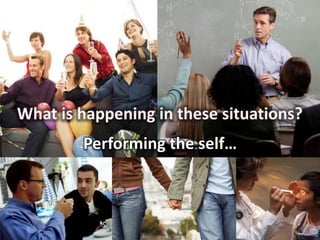
What is happening in these situations?Performing the self…
What is happening in these situations?People are giving a performance, showing one of their fronts in a face to face encounter.
DramaturgicalapproachAristotle or Goethe
More systematic work: Kenneth Burke
Idea of dramatism, “terministic screens”
Distinction of action and motion (things move, men act)
Men are “symbol using animals”. They build symbolic structures adding art to life.DramaturgicalapproachSociety is a drama in which actions, in terms of social symbols, are the crucial events.
Examples: politics, mass communications, leadership, social movements, rituals, ceremonies
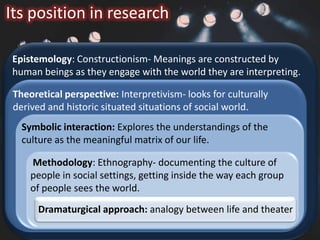
Erving Goffman:  What is going on in social interaction?Its position in researchEpistemology:Constructionism- Meanings are constructed by human beings as they engage with the world they are interpreting. Theoretical perspective:Interpretivism- looks for culturally derived and historic situated situations of social world.Symbolic interaction: Explores the understandings of the culture as the meaningful matrix of our life.Methodology: Ethnography- documenting the culture of people in social settings, getting inside the way each group of people sees the world.Dramaturgical approach: analogy between life and theater
About Erving GoffmanBorn in 1922 in Alberta, CanadaUniversity of Toronto, University of ChicagoMost incisive contributions to social psychology Interested in exploring the borders: writing on total institutions, stigma, gender relations, role distance and frames
About Erving GoffmanVeryconcernedwiththemicrosociologyEverything people did on face to face interactionsThe self is the central organizing feature of all social encountersGiddens and Habermas -very influenced  by Goffman
About Erving GoffmanHis mayor publicationsThe presentation of self in everyday life‎, 1959Asylums: essays on the social situation of mental patients and other inmates, 1961Encounters: two essays in the sociology of interaction‎, 1961Stigma: notes on the management of spoiled identity‎, 1963Behavior in public places: Notes on the social organization of gatherings, 1963Interaction ritual: essays in face-to-face behavior‎, 1967Strategic interaction, 1969Relations in public: microstudies of the public order, 1971Frame analysis: an essay on the organization of experience, 1974Gender advertisements: 1979Forms of talk, 1981Articles, Essays, Monographs published as books
About Erving GoffmanHis basic categories of themes are:Social orderSocial structureOrganizationSocial interaction
The self
Social order
He shows a very subversive writing
Authors of:  gender, madness, politics, communication, and society have written about Goffman, and there is a wide range of interest in his writings. What exactly Goffman tells us about his view of the world?What is going on in social interaction?
Where individuals present themselves to one another?
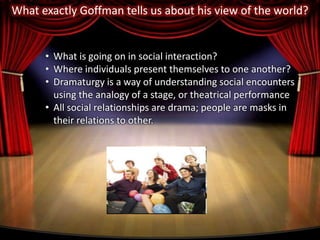
Dramaturgy is a way of understanding social encounters using the analogy of a stage, or theatrical performance
All social relationships are drama; people are masks in their relations to other. What exactly Goffman tells us about his view of the world?All we can know about a person´s self is what the person show us
Impression management	The manipulation of cues to control and organize the impression we give to others Focus: Interactions with a high level of performance
Small scale interactions more than a bigger stage
More in the individual, rather than in the situationThe  presentation of the self in every dayRules of social interaction and modes of self presentationWhen an individual presents himself before others, they commonly seek to acquire information about him. They will be interested in their status, his conception of self, his attitude toward them, and his trustworthiness… Information about the individual helps to define the situation, enabling others to know what expect of him.
The  presentation of the self in every dayFront

Erving Goffman - Dramaturgical Approach Presentation

  • 1.
    Ladies and gentlemen,today´s performing….“ the self “
  • 2.
    What is happeningin these situations?Performing the self…
  • 3.
    What is happeningin these situations?People are giving a performance, showing one of their fronts in a face to face encounter.
  • 4.
  • 5.
  • 6.
    Idea of dramatism,“terministic screens”
  • 7.
    Distinction of actionand motion (things move, men act)
  • 8.
    Men are “symbolusing animals”. They build symbolic structures adding art to life.DramaturgicalapproachSociety is a drama in which actions, in terms of social symbols, are the crucial events.
  • 9.
    Examples: politics, masscommunications, leadership, social movements, rituals, ceremonies
  • 10.
    Erving Goffman: What is going on in social interaction?Its position in researchEpistemology:Constructionism- Meanings are constructed by human beings as they engage with the world they are interpreting. Theoretical perspective:Interpretivism- looks for culturally derived and historic situated situations of social world.Symbolic interaction: Explores the understandings of the culture as the meaningful matrix of our life.Methodology: Ethnography- documenting the culture of people in social settings, getting inside the way each group of people sees the world.Dramaturgical approach: analogy between life and theater
  • 11.
    About Erving GoffmanBornin 1922 in Alberta, CanadaUniversity of Toronto, University of ChicagoMost incisive contributions to social psychology Interested in exploring the borders: writing on total institutions, stigma, gender relations, role distance and frames
  • 12.
    About Erving GoffmanVeryconcernedwiththemicrosociologyEverythingpeople did on face to face interactionsThe self is the central organizing feature of all social encountersGiddens and Habermas -very influenced by Goffman
  • 13.
    About Erving GoffmanHismayor publicationsThe presentation of self in everyday life‎, 1959Asylums: essays on the social situation of mental patients and other inmates, 1961Encounters: two essays in the sociology of interaction‎, 1961Stigma: notes on the management of spoiled identity‎, 1963Behavior in public places: Notes on the social organization of gatherings, 1963Interaction ritual: essays in face-to-face behavior‎, 1967Strategic interaction, 1969Relations in public: microstudies of the public order, 1971Frame analysis: an essay on the organization of experience, 1974Gender advertisements: 1979Forms of talk, 1981Articles, Essays, Monographs published as books
  • 14.
    About Erving GoffmanHisbasic categories of themes are:Social orderSocial structureOrganizationSocial interaction
  • 15.
  • 16.
  • 17.
    He shows avery subversive writing
  • 18.
    Authors of: gender, madness, politics, communication, and society have written about Goffman, and there is a wide range of interest in his writings. What exactly Goffman tells us about his view of the world?What is going on in social interaction?
  • 19.
    Where individuals presentthemselves to one another?
  • 20.
    Dramaturgy is away of understanding social encounters using the analogy of a stage, or theatrical performance
  • 21.
    All social relationshipsare drama; people are masks in their relations to other. What exactly Goffman tells us about his view of the world?All we can know about a person´s self is what the person show us
  • 22.
    Impression management The manipulationof cues to control and organize the impression we give to others Focus: Interactions with a high level of performance
  • 23.
    Small scale interactionsmore than a bigger stage
  • 24.
    More in theindividual, rather than in the situationThe presentation of the self in every dayRules of social interaction and modes of self presentationWhen an individual presents himself before others, they commonly seek to acquire information about him. They will be interested in their status, his conception of self, his attitude toward them, and his trustworthiness… Information about the individual helps to define the situation, enabling others to know what expect of him.
  • 25.
    The presentationof the self in every dayFront