5 SOCIAL INTERACTION AND SOCIAL STRUCTURE
Chapter Outline Social Interaction and Reality Elements of Social Structure Social Structure in Global Perspective Social Policy and Social Structure: The AIDS Crisis
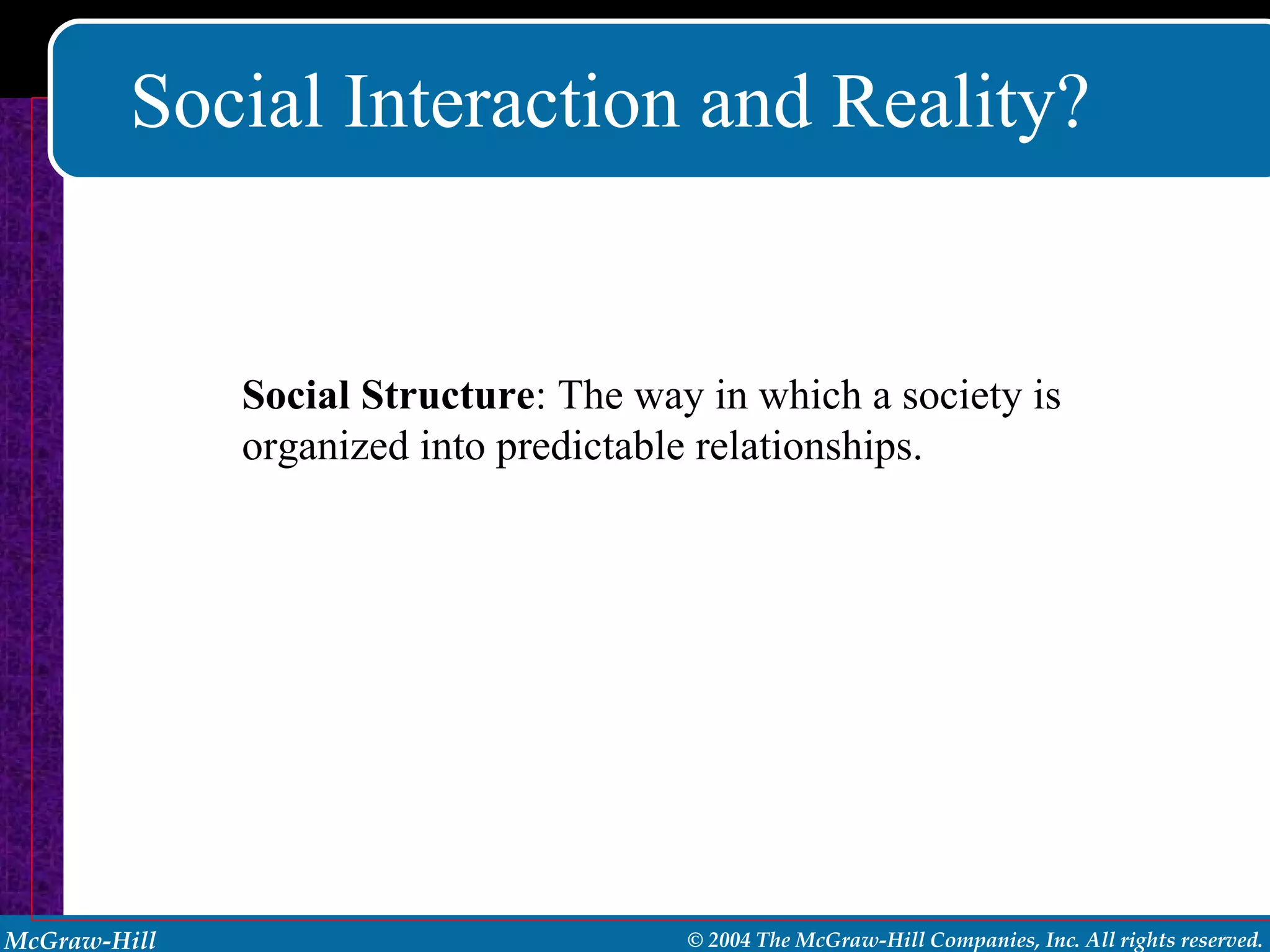
Social Interaction and Reality? Social Structure : The way in which a society is organized into predictable relationships.
Social Interaction and Reality? Human beings interpret or  define  each other’s actions. The ability to define social reality reflects a group’s power within society. Defining and Reconstructing Reality
Social Interaction and Reality? -- Negotiated order  is a social structure that derives its existence from the social interactions through which people define and redefine its character. --People reshape reality by  negotiating  changes in patterns of social interaction. --Negotiation  is the attempt to reach agreement with others concerning the same objective. Negotiated Order
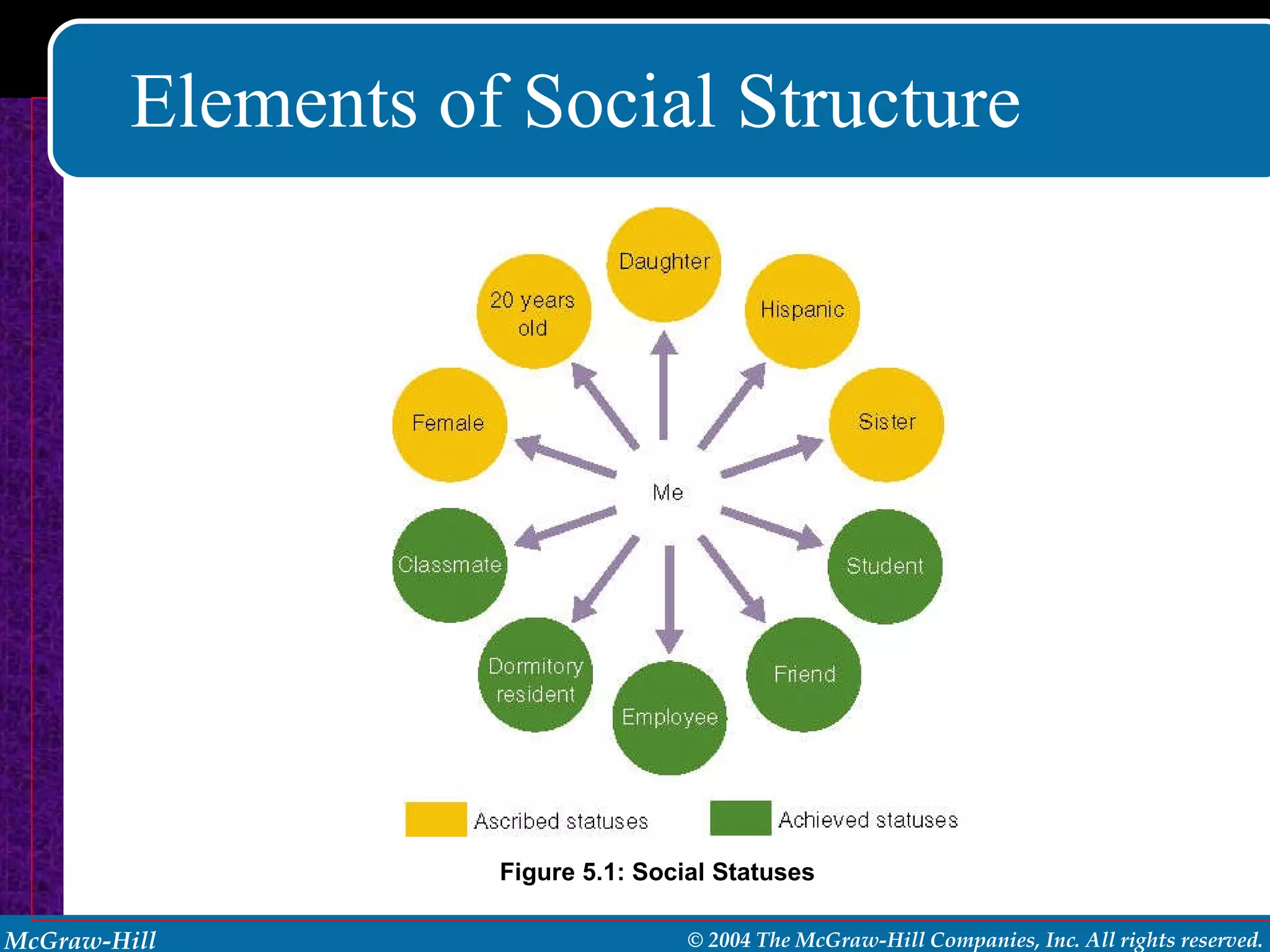
Elements of Social Structure Status   -- Status  refers to any of the socially defined positions within a large group or society. --A person holds more than one status simultaneously. --Examples of statuses: president daughter student neighbor Statuses
Elements of Social Structure Ascribed and Achieved Status -- Ascribed status  is a status one is born with. -- Achieved status  is a status one earns. Master Status -- Master status  is a status that dominates others and determines a person’s general position in society. Statuses
Elements of Social Structure Figure 5.1: Social Statuses
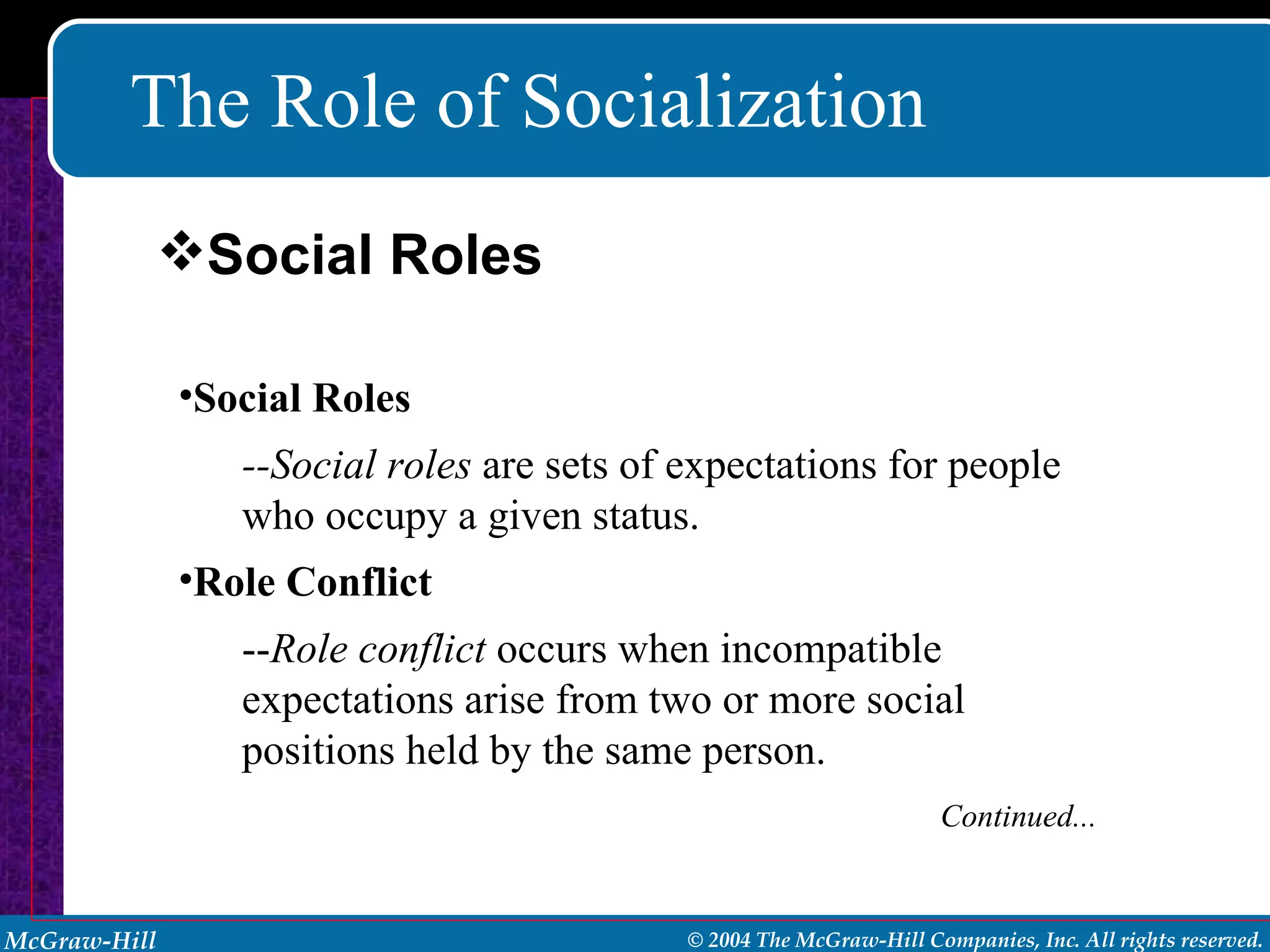
The Role of Socialization Social Roles --Social roles  are sets of expectations for people who occupy a given status. Role Conflict -- Role conflict  occurs when incompatible expectations arise from two or more social positions held by the same person. Continued... Social Roles
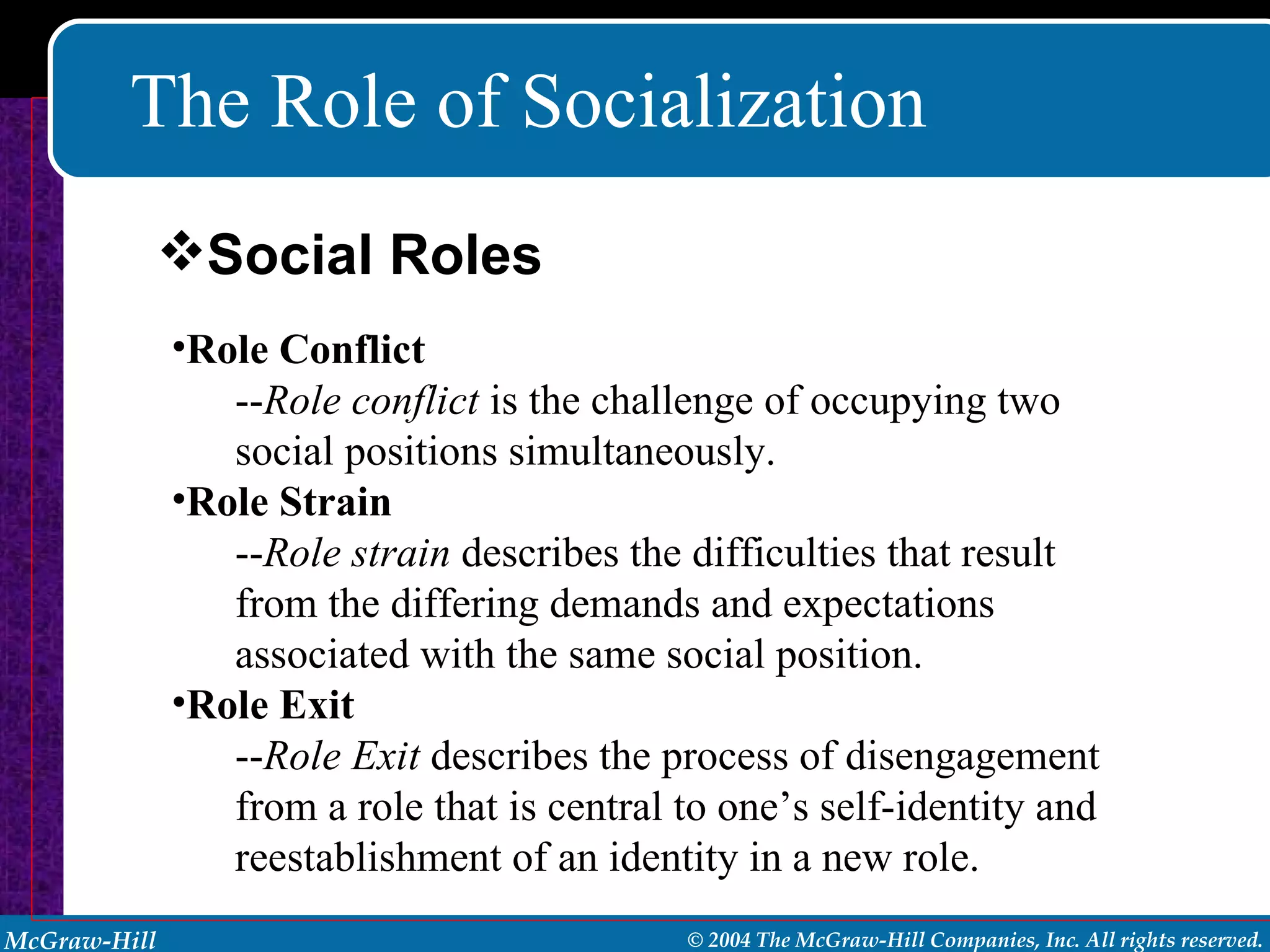
The Role of Socialization Role Conflict -- Role conflict  is the challenge of occupying two social positions simultaneously. Role Strain -- Role strain  describes the difficulties that result from the differing demands and expectations associated with the same social position. Role Exit -- Role Exit  describes the process of disengagement from a role that is central to one’s self-identity and reestablishment of an identity in a new role. Social Roles
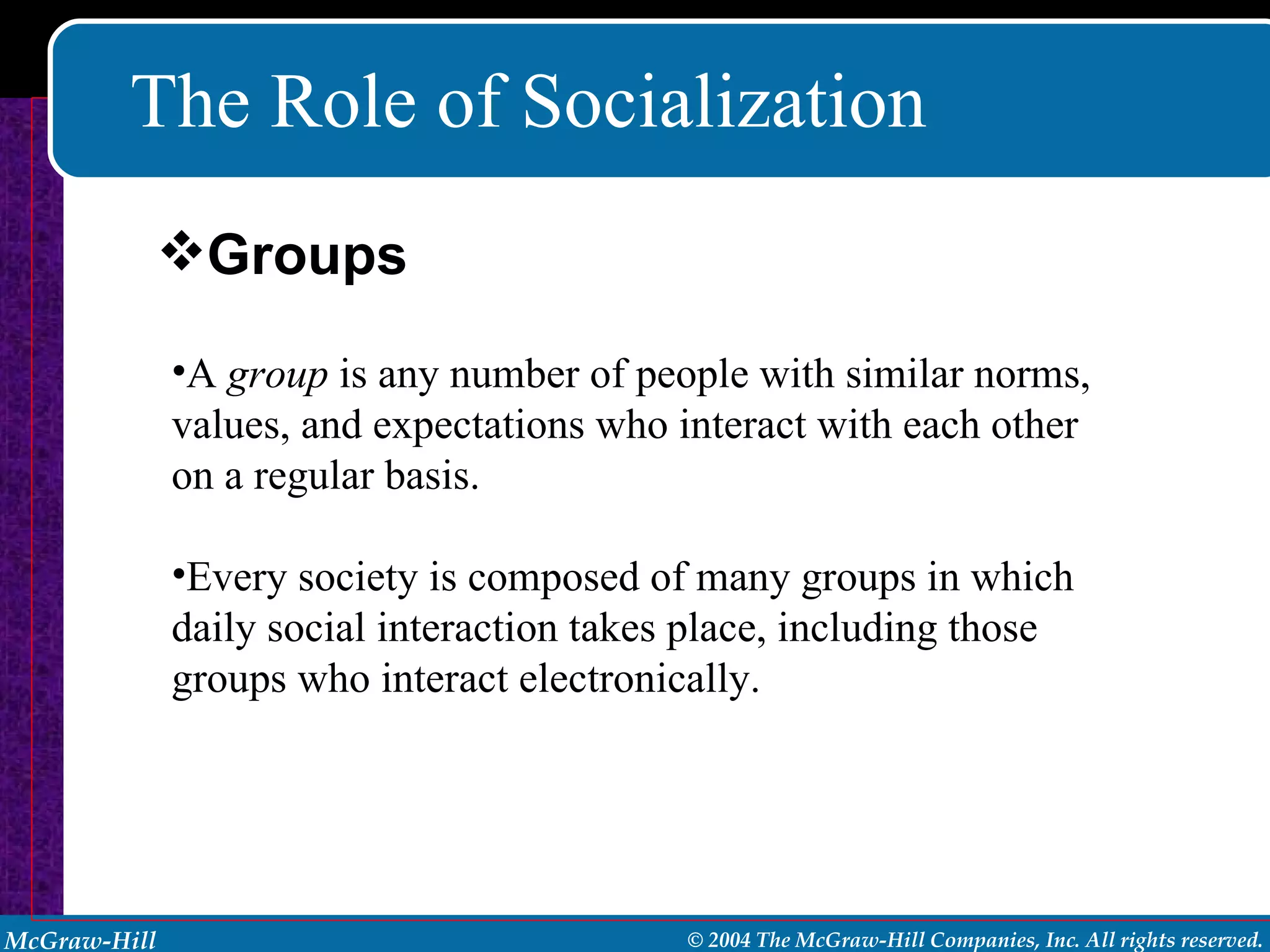
The Role of Socialization A  group  is any number of people with similar norms, values, and expectations who interact with each other on a regular basis. Every society is composed of many groups in which daily social interaction takes place, including those groups who interact electronically. Groups
The Role of Socialization Social Network --A  Social Network  is a series of social relationships that links a person directly to others and through them indirectly to still more people. Social Networks and Technology
The Role of Socialization Social institutions  are organized patterns of beliefs and behavior centered on basic social needs. Social institutions provide insight into the structure of society. Social Institutions
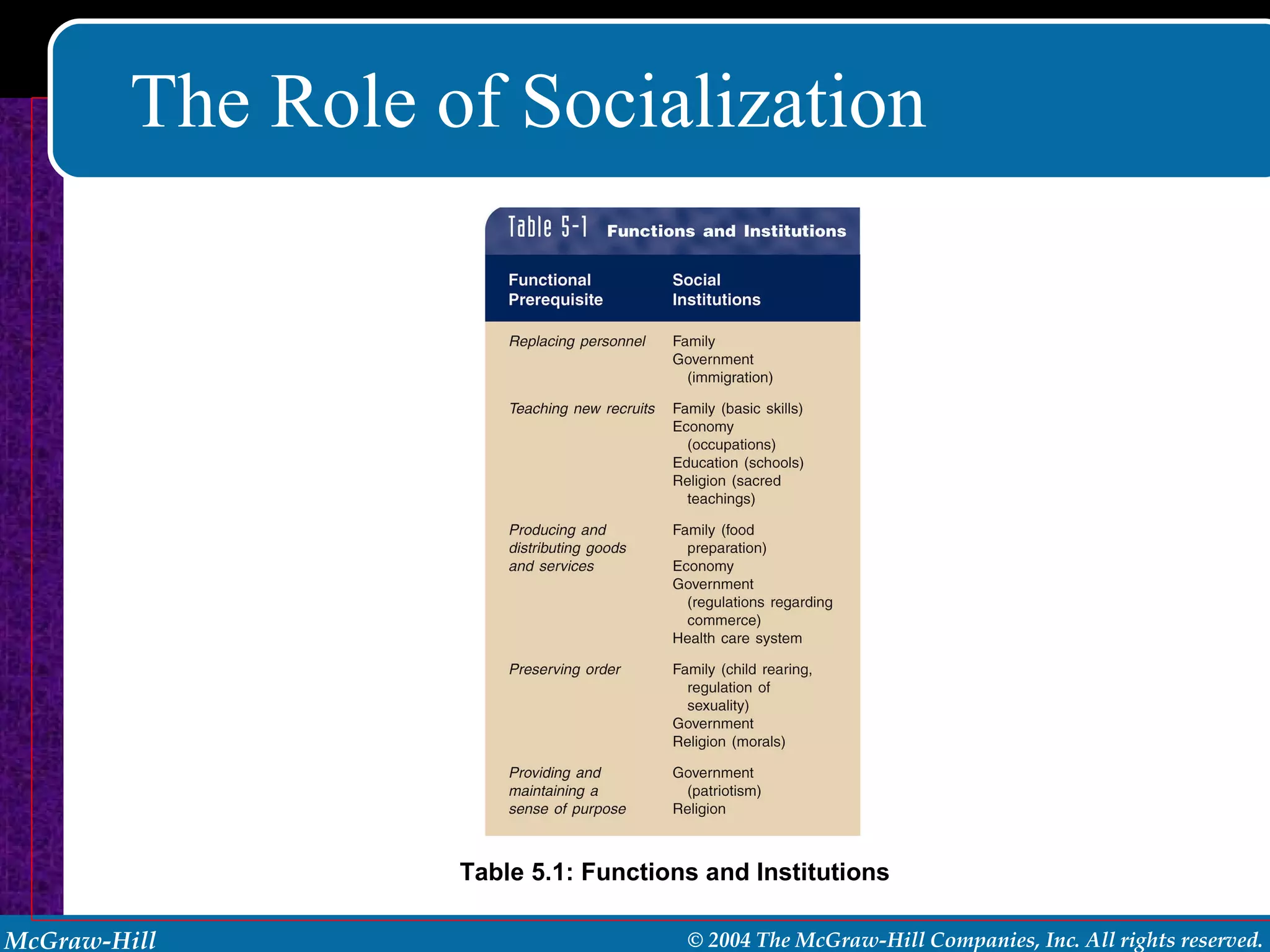
The Role of Socialization Table 5.1: Functions and Institutions
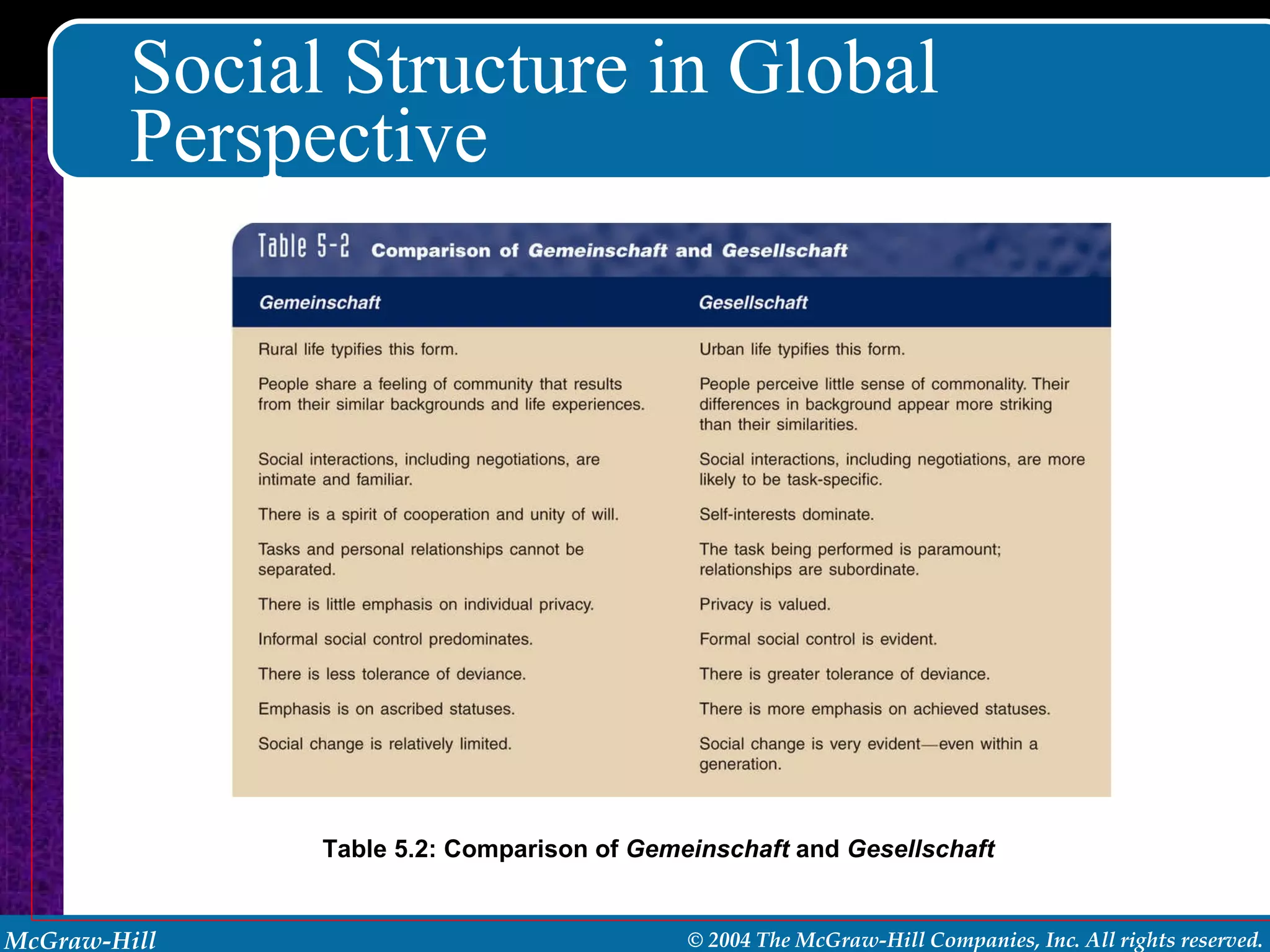
Social Structure in Global Perspective Gemeinschaft  (guh-MINE-shoft) The  Gemeinschaft  is defined as a small community in which people have similar backgrounds and life experiences. Gesellschaft (guh-ZELL-shoft) The  Gesellschaft  is defined as a large community in which people are strangers and feel little in common with other community residents. Tönnie’s  Gemeinschaft  and  Gesellschaft
Social Structure in Global Perspective Table 5.2: Comparison of  Gemeinschaft  and  Gesellschaft
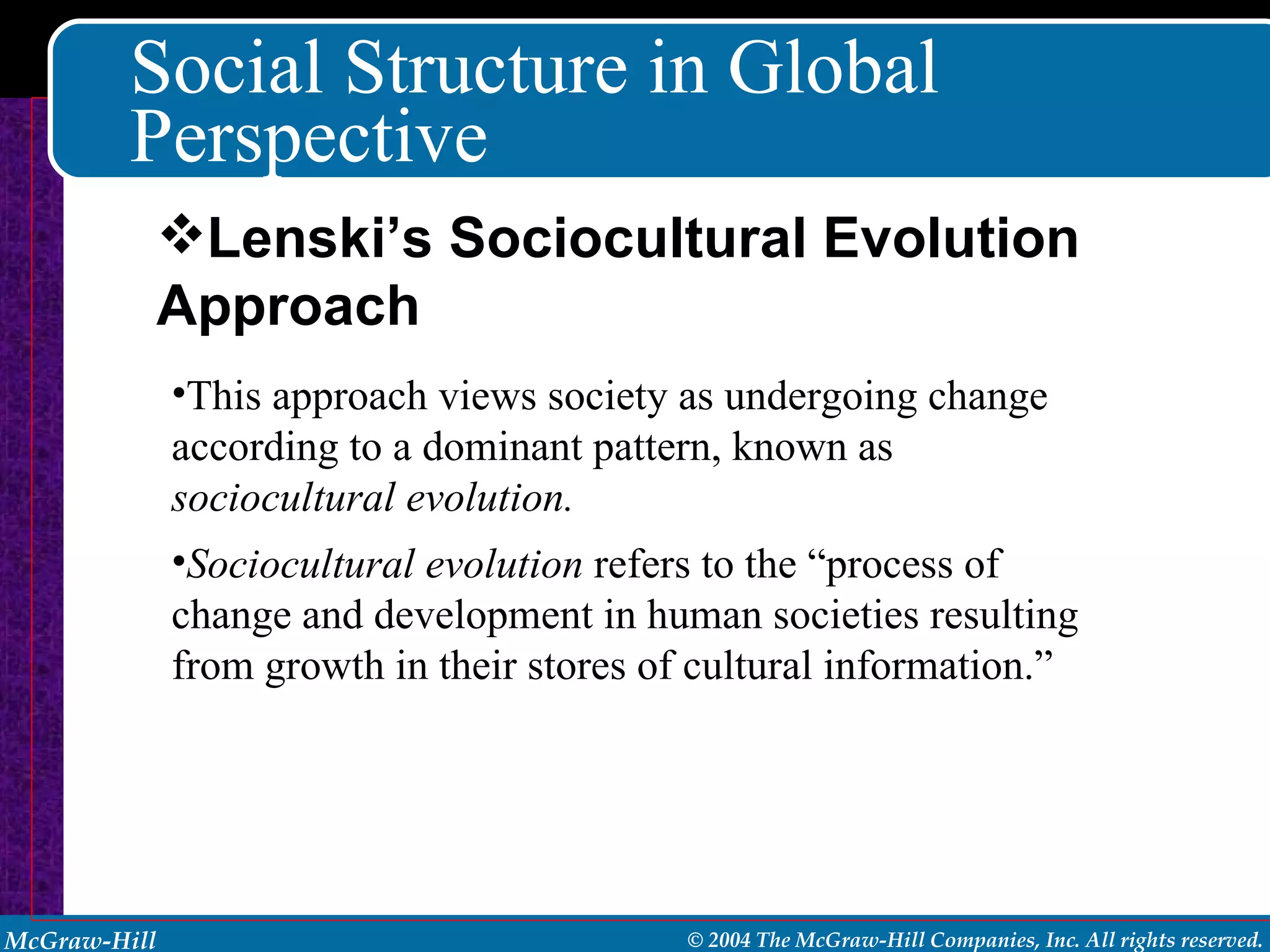
Social Structure in Global Perspective This approach views society as undergoing change according to a dominant pattern, known as  sociocultural evolution. Sociocultural evolution  refers to the “process of change and development in human societies resulting from growth in their stores of cultural information.” Lenski’s Sociocultural Evolution Approach
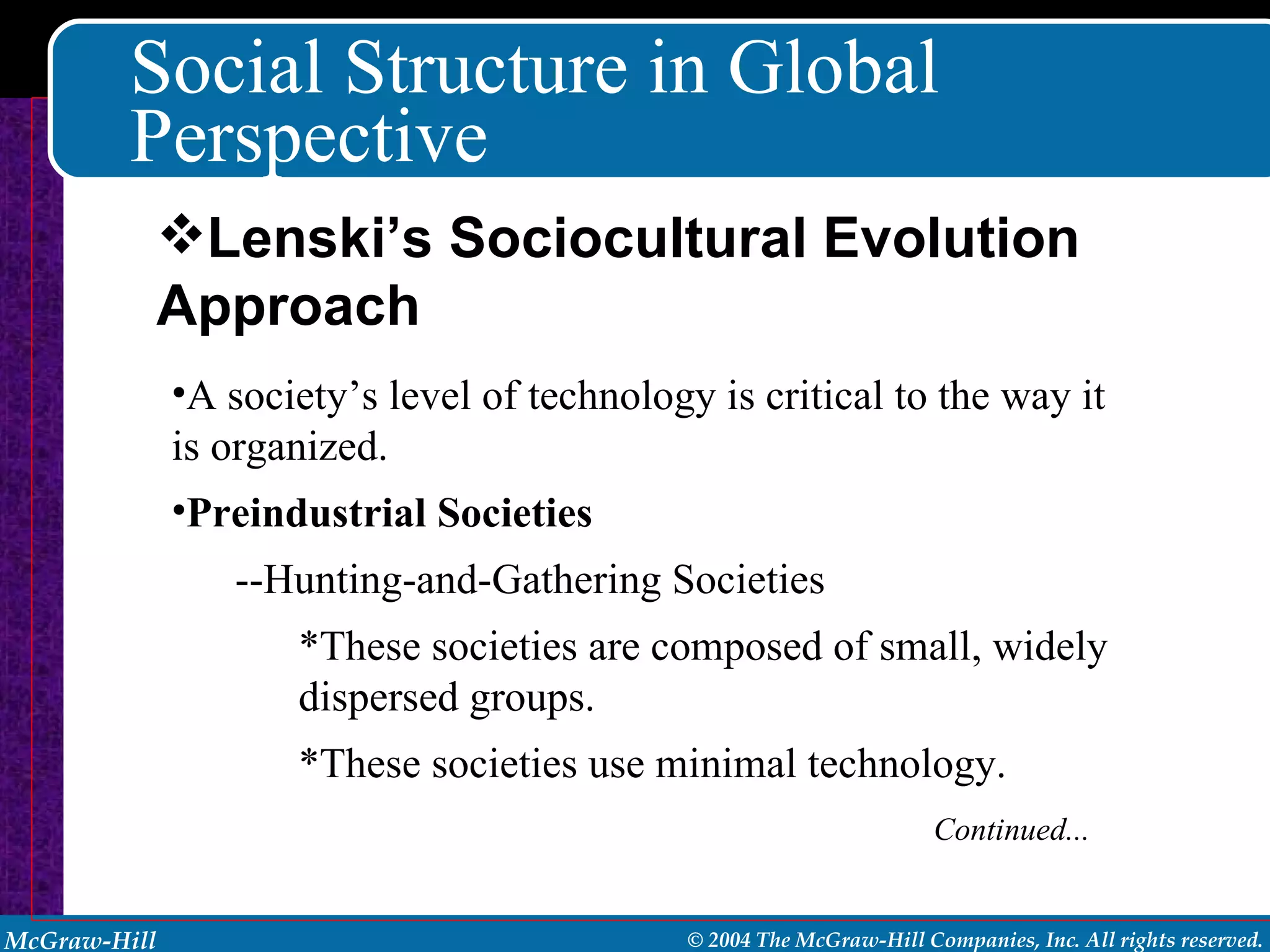
Social Structure in Global Perspective A society’s level of technology is critical to the way it is organized. Preindustrial Societies --Hunting-and-Gathering Societies *These societies are composed of small, widely dispersed groups. *These societies use minimal technology. Continued... Lenski’s Sociocultural Evolution Approach
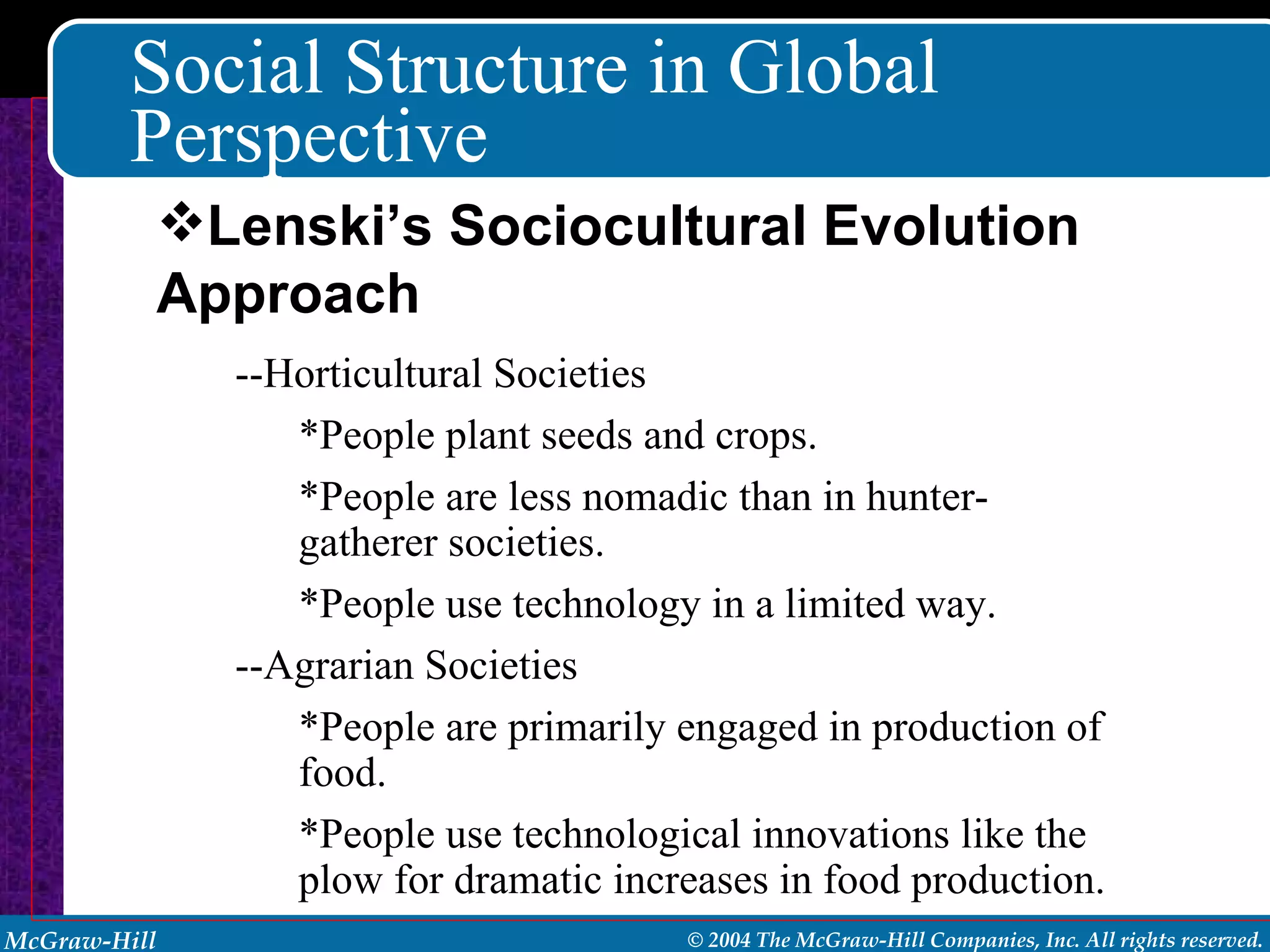
Social Structure in Global Perspective --Horticultural Societies *People plant seeds and crops. *People are less nomadic than in hunter-gatherer societies. *People use technology in a limited way. --Agrarian Societies *People are primarily engaged in production of food. *People use technological innovations like the plow for dramatic increases in food production. Lenski’s Sociocultural Evolution Approach
Social Structure in Global Perspective Industrial Societies --These societies depend on mechanization to produce its goods and services. --These societies rely on inventions and energy sources that facilitate agricultural and industrial production. --These societies change the function of the family as a self-sufficient unit. Lenski’s Sociocultural Evolution Approach
Social Structure in Global Perspective Postindustrial and Postmodern Societies --Postindustrial Society *A postindustrial society is one whose economic system is engaged primarily in the processing and control of information. *The main output of postindustrial society is services. Continued... Lenski’s Sociocultural Evolution Approach
Social Structure in Global Perspective --Postmodern Society *A postmodern society is a technologically sophisticated society preoccupied with consumer goods and media images. Lenski’s Sociocultural Evolution Approach
Social Policy and Social Structure The Issue --While there are encouraging new ways to treat people, there is currently no way to eradicate AIDS by medical means.  --How can people be protected and whose responsibility is it? The AIDS Crisis
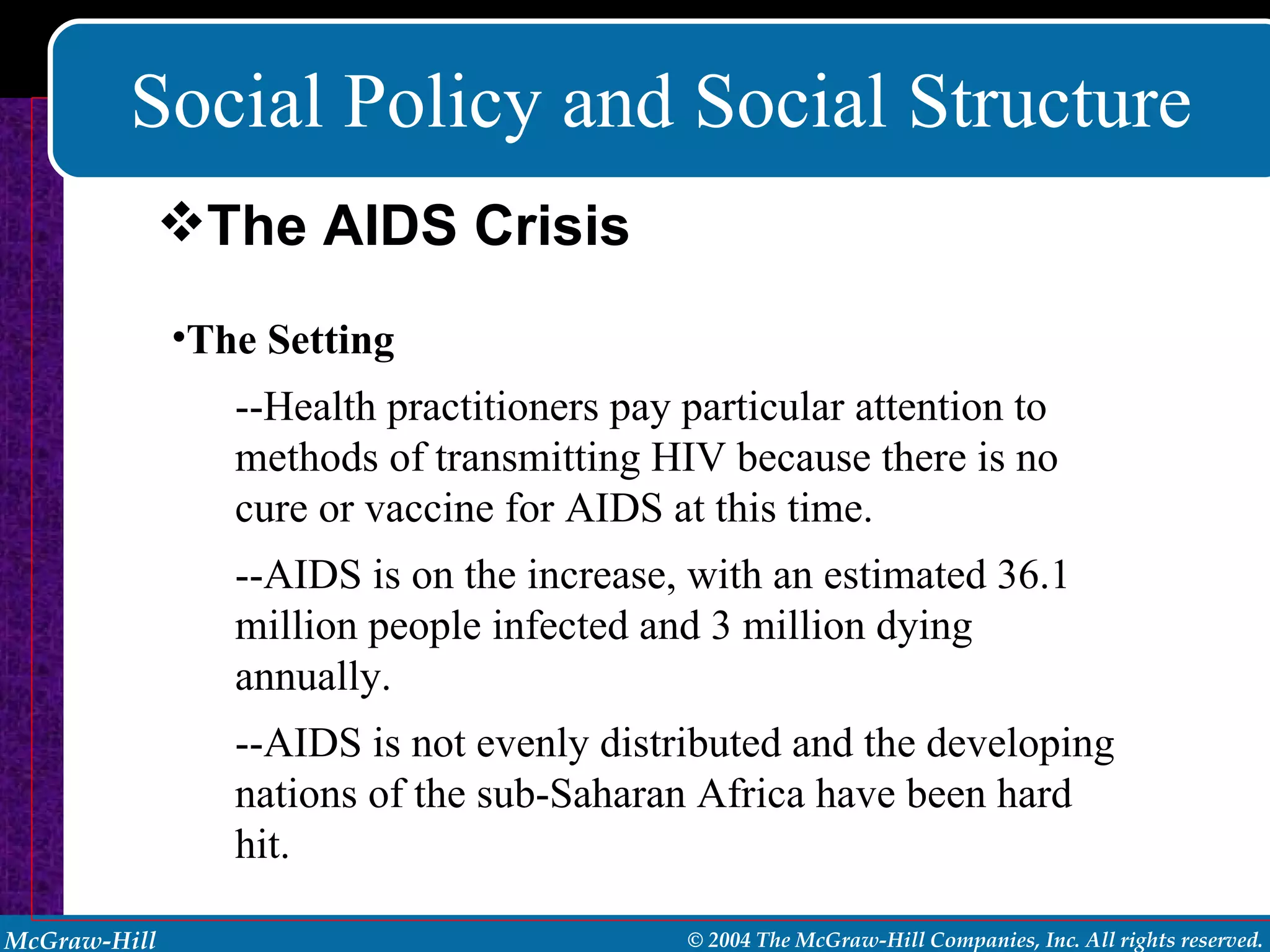
Social Policy and Social Structure The Setting --Health practitioners pay particular attention to methods of transmitting HIV because there is no cure or vaccine for AIDS at this time. --AIDS is on the increase, with an estimated 36.1 million people infected and 3 million dying annually. --AIDS is not evenly distributed and the developing nations of the sub-Saharan Africa have been hard hit. The AIDS Crisis
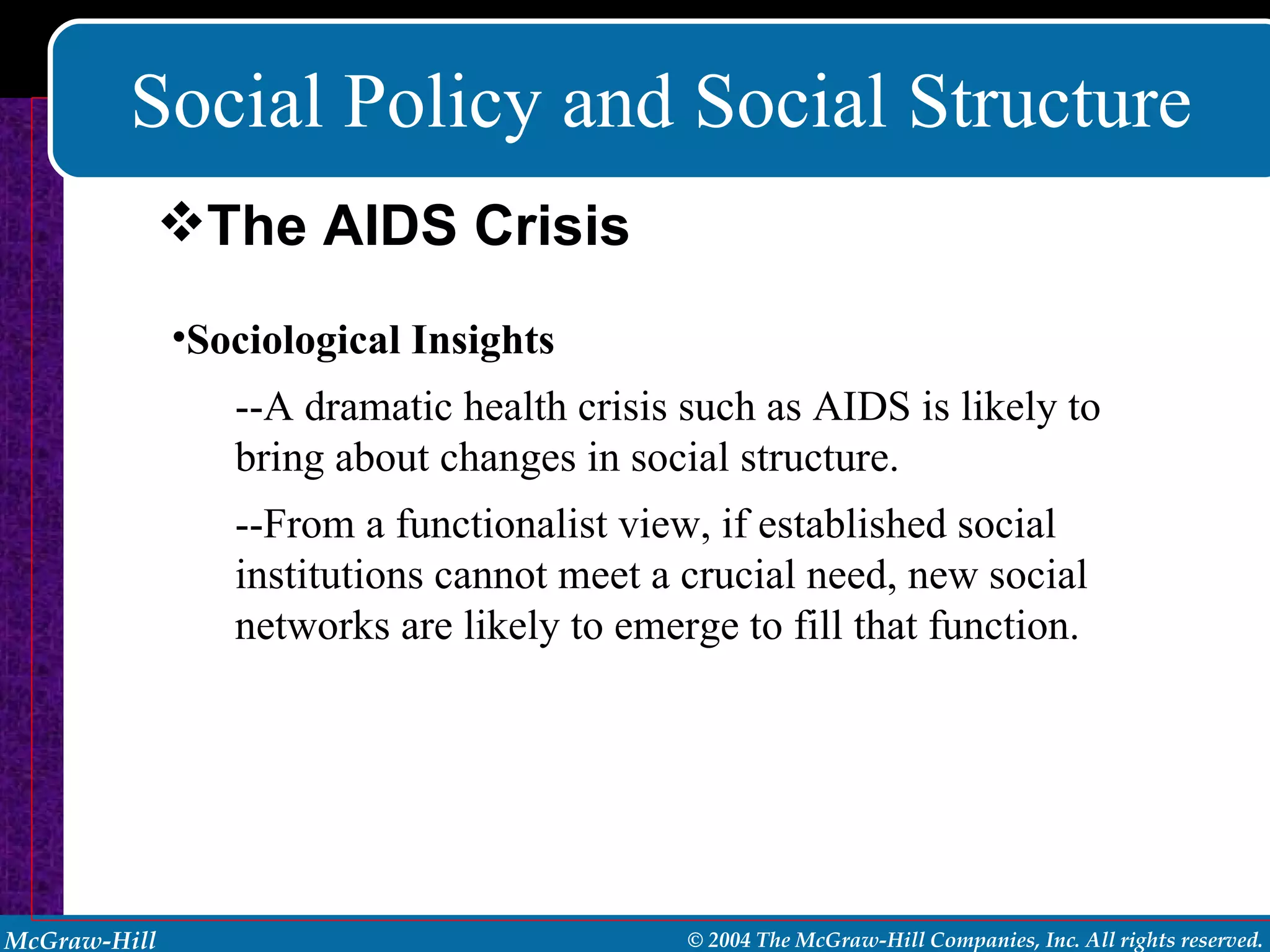
Social Policy and Social Structure Sociological Insights --A dramatic health crisis such as AIDS is likely to bring about changes in social structure. --From a functionalist view, if established social institutions cannot meet a crucial need, new social networks are likely to emerge to fill that function. The AIDS Crisis
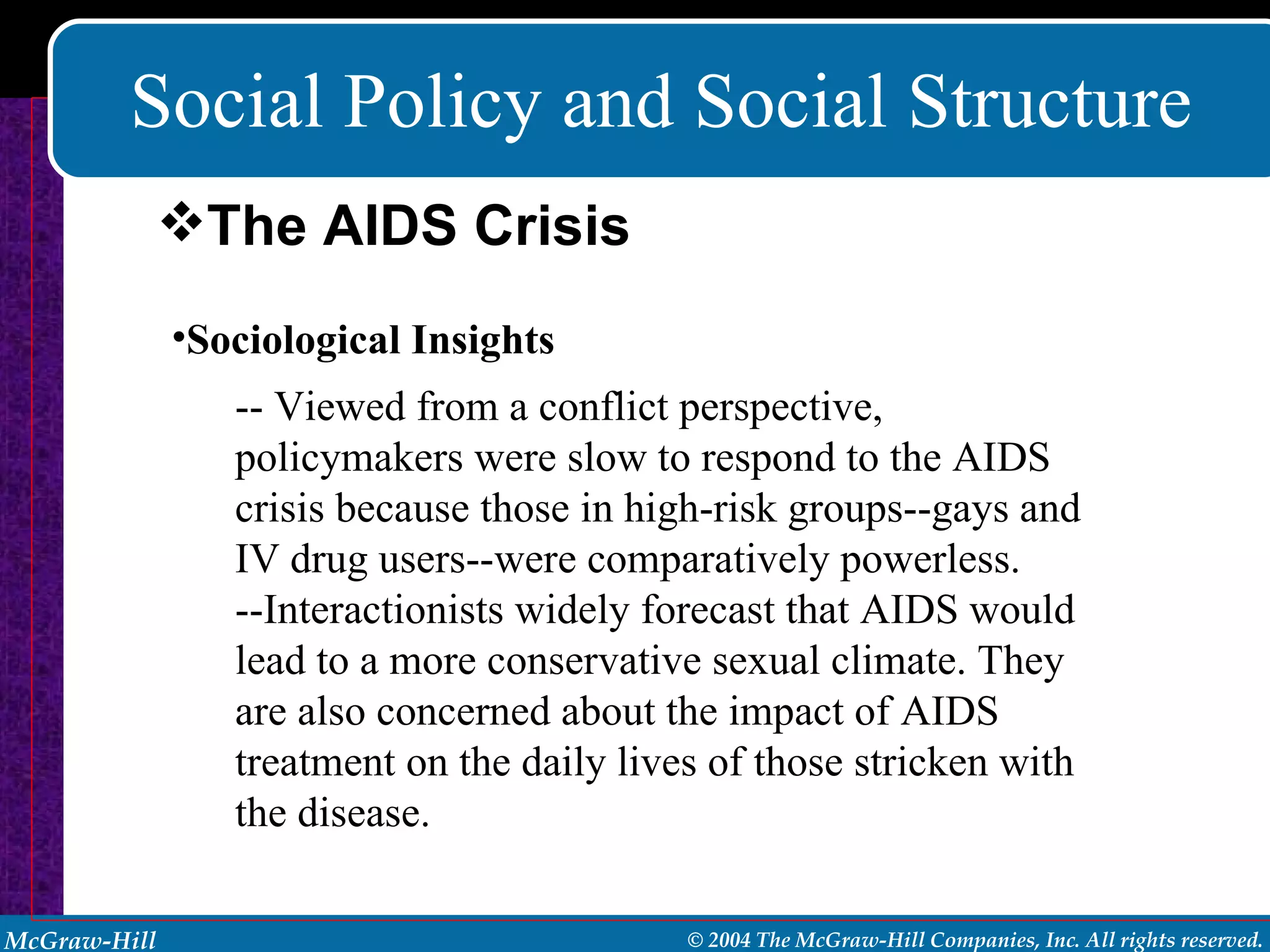
Social Policy and Social Structure Sociological Insights -- Viewed from a conflict perspective, policymakers were slow to respond to the AIDS crisis because those in high-risk groups--gays and IV drug users--were comparatively powerless. --Interactionists widely forecast that AIDS would lead to a more conservative sexual climate. They are also concerned about the impact of AIDS treatment on the daily lives of those stricken with the disease. The AIDS Crisis
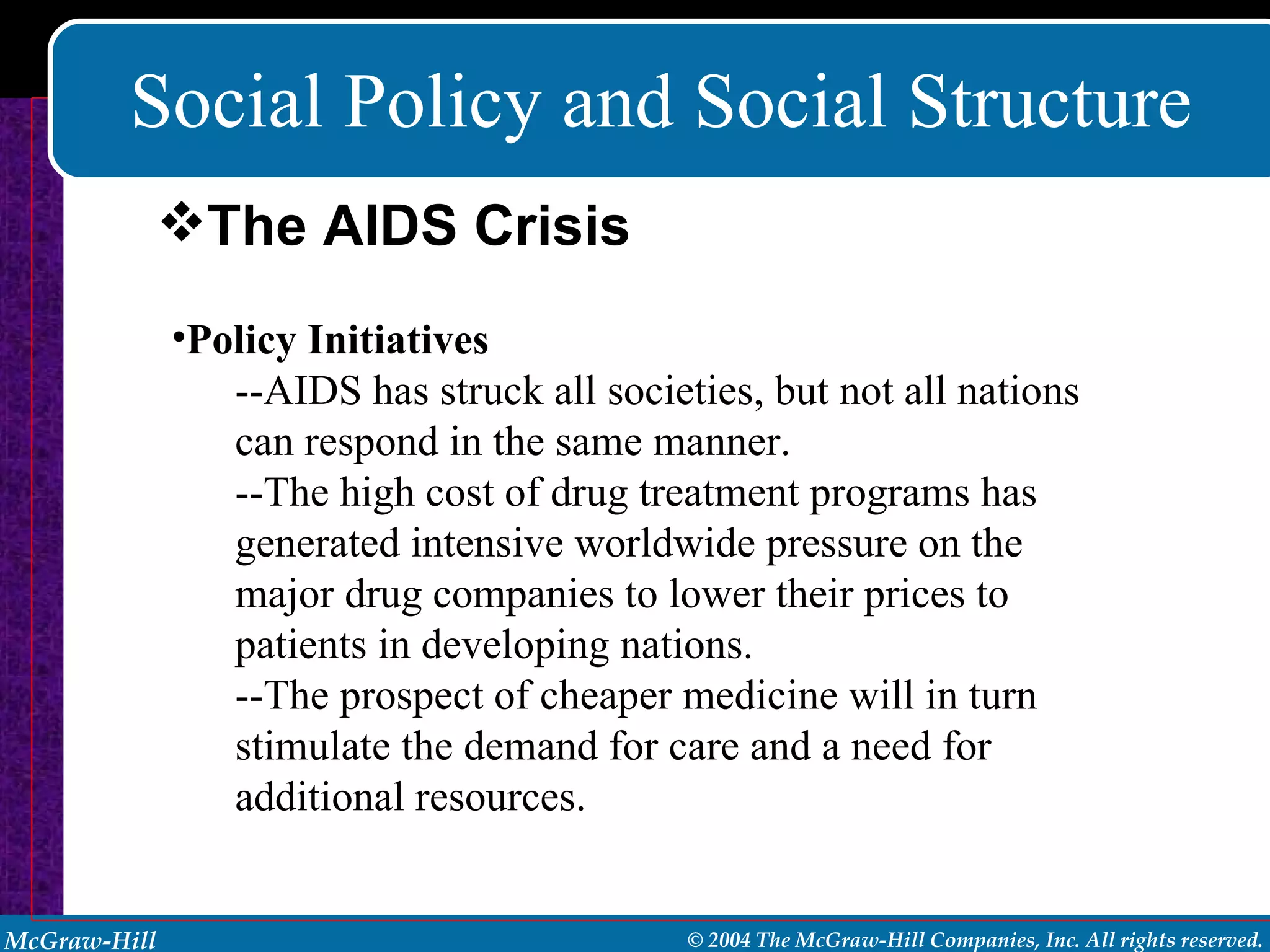
Social Policy and Social Structure Policy Initiatives --AIDS has struck all societies, but not all nations can respond in the same manner. --The high cost of drug treatment programs has generated intensive worldwide pressure on the major drug companies to lower their prices to patients in developing nations. --The prospect of cheaper medicine will in turn stimulate the demand for care and a need for additional resources. The AIDS Crisis
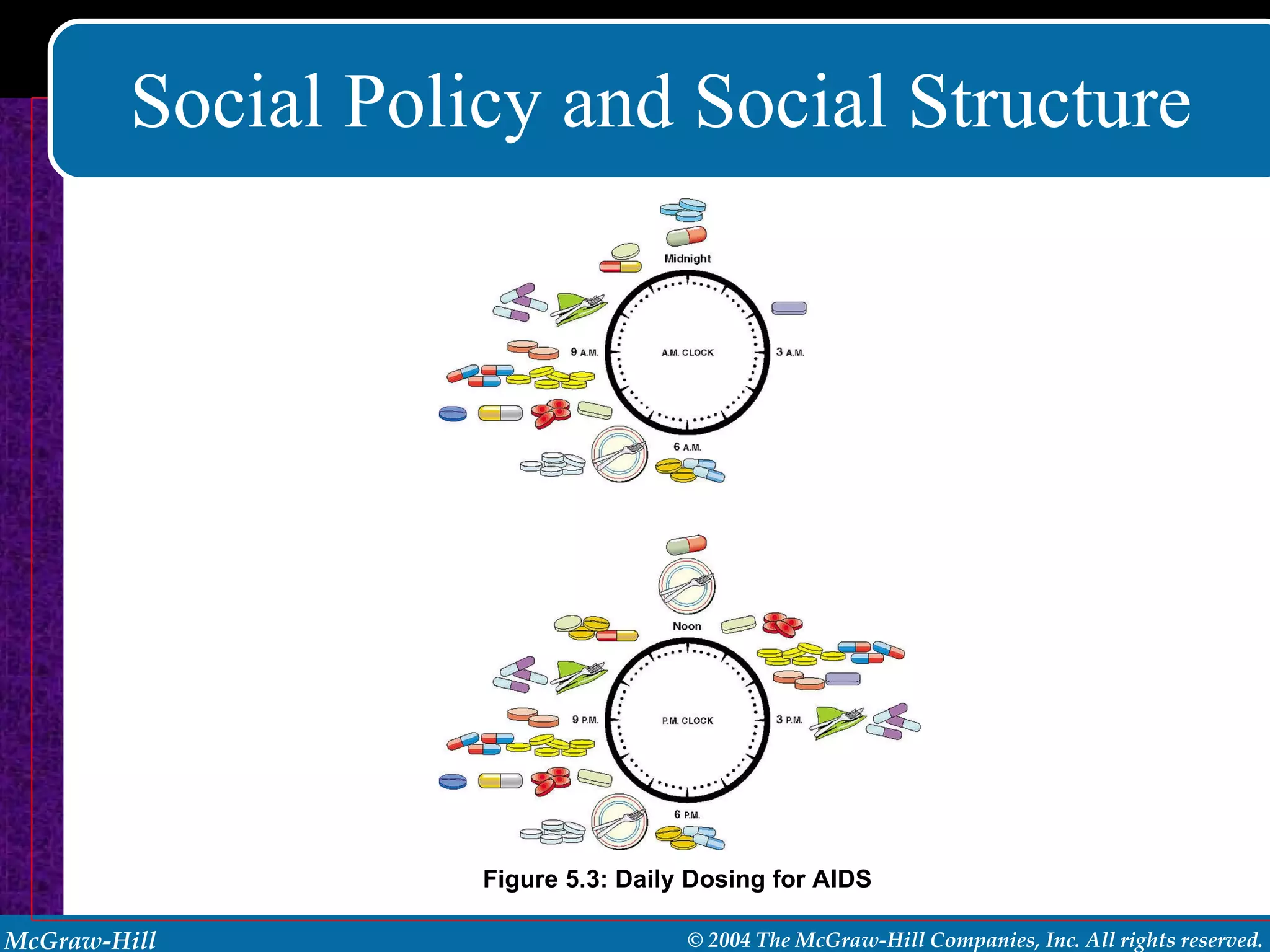
Social Policy and Social Structure Figure 5.3: Daily Dosing for AIDS
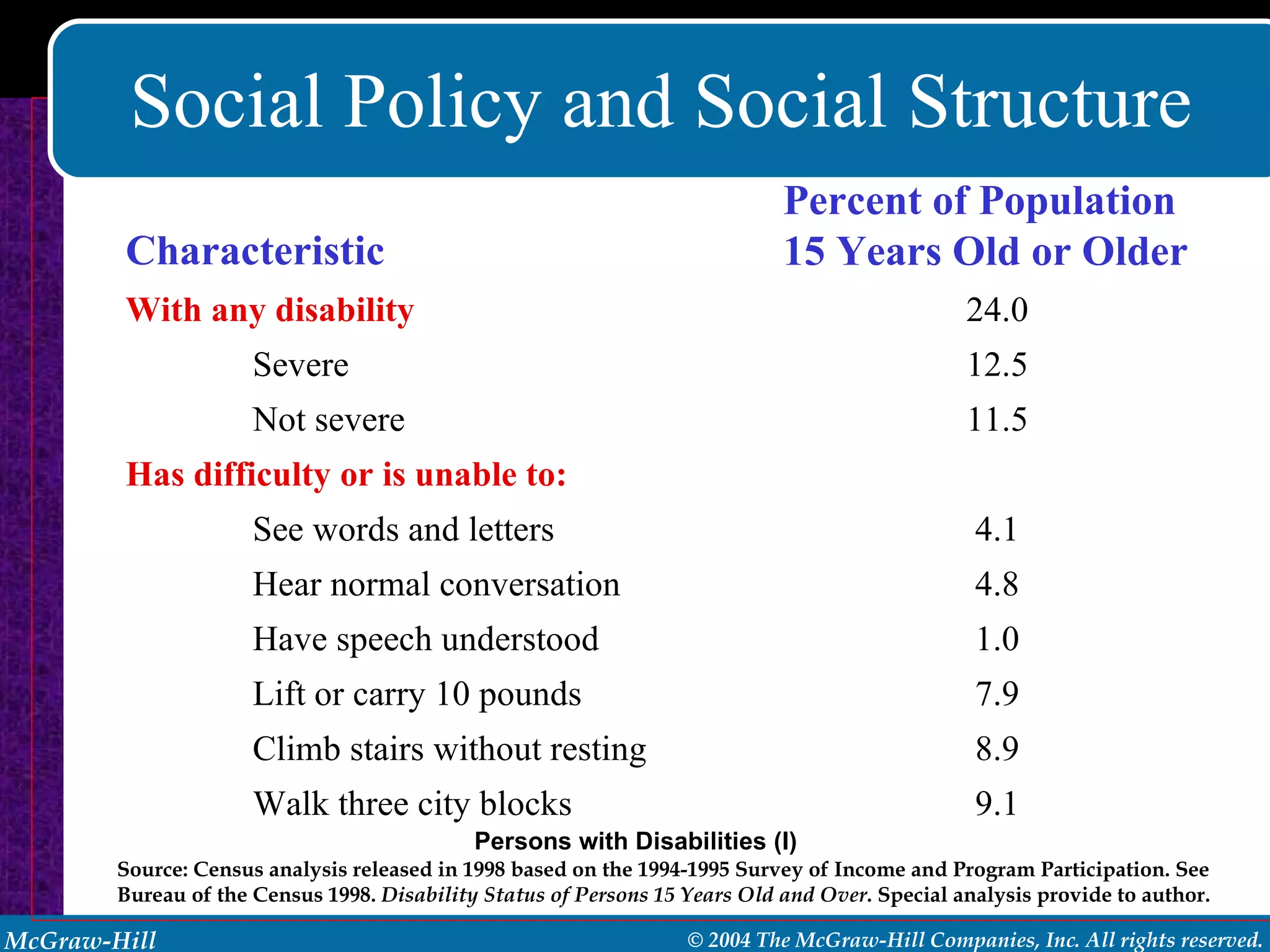
Social Policy and Social Structure Persons with Disabilities (I) Source: Census analysis released in 1998 based on the 1994-1995 Survey of Income and Program Participation. See Bureau of the Census 1998.  Disability Status of Persons 15 Years Old and Over . Special analysis provide to author. 9.1 Walk three city blocks 8.9 Climb stairs without resting 7.9 Lift or carry 10 pounds 1.0 Have speech understood 4.8 Hear normal conversation 4.1 See words and letters  Has difficulty or is unable to: 11.5 Not severe 12.5 Severe 24.0 With any disability Percent of Population 15 Years Old or Older Characteristic
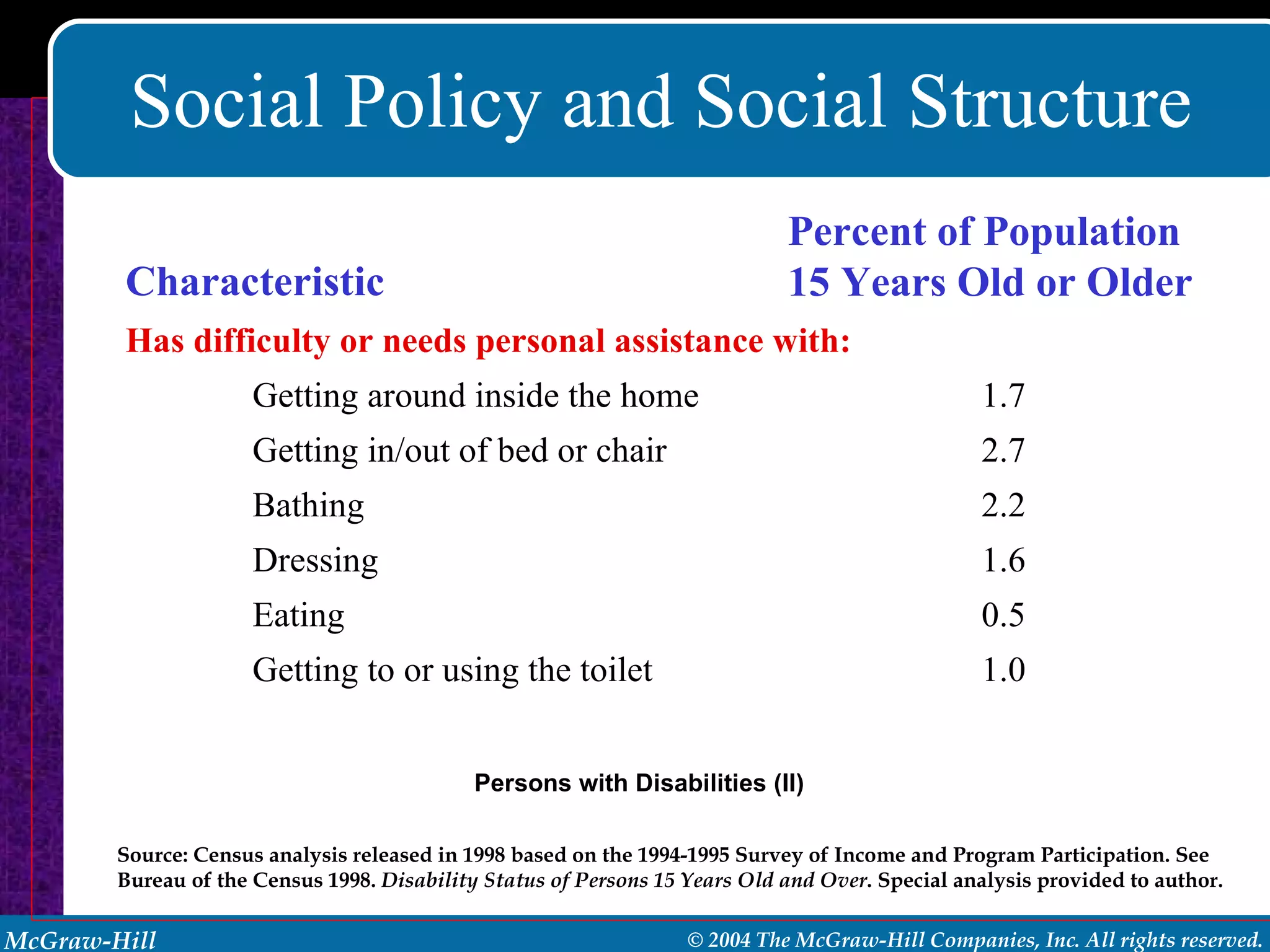
Social Policy and Social Structure Persons with Disabilities (II) Source: Census analysis released in 1998 based on the 1994-1995 Survey of Income and Program Participation. See Bureau of the Census 1998.  Disability Status of Persons 15 Years Old and Over . Special analysis provided to author. 1.0 Getting to or using the toilet 0.5 Eating 1.6 Dressing 2.2 Bathing 2.7 Getting in/out of bed or chair 1.7 Getting around inside the home Has difficulty or needs personal assistance with: Percent of Population 15 Years Old or Older Characteristic
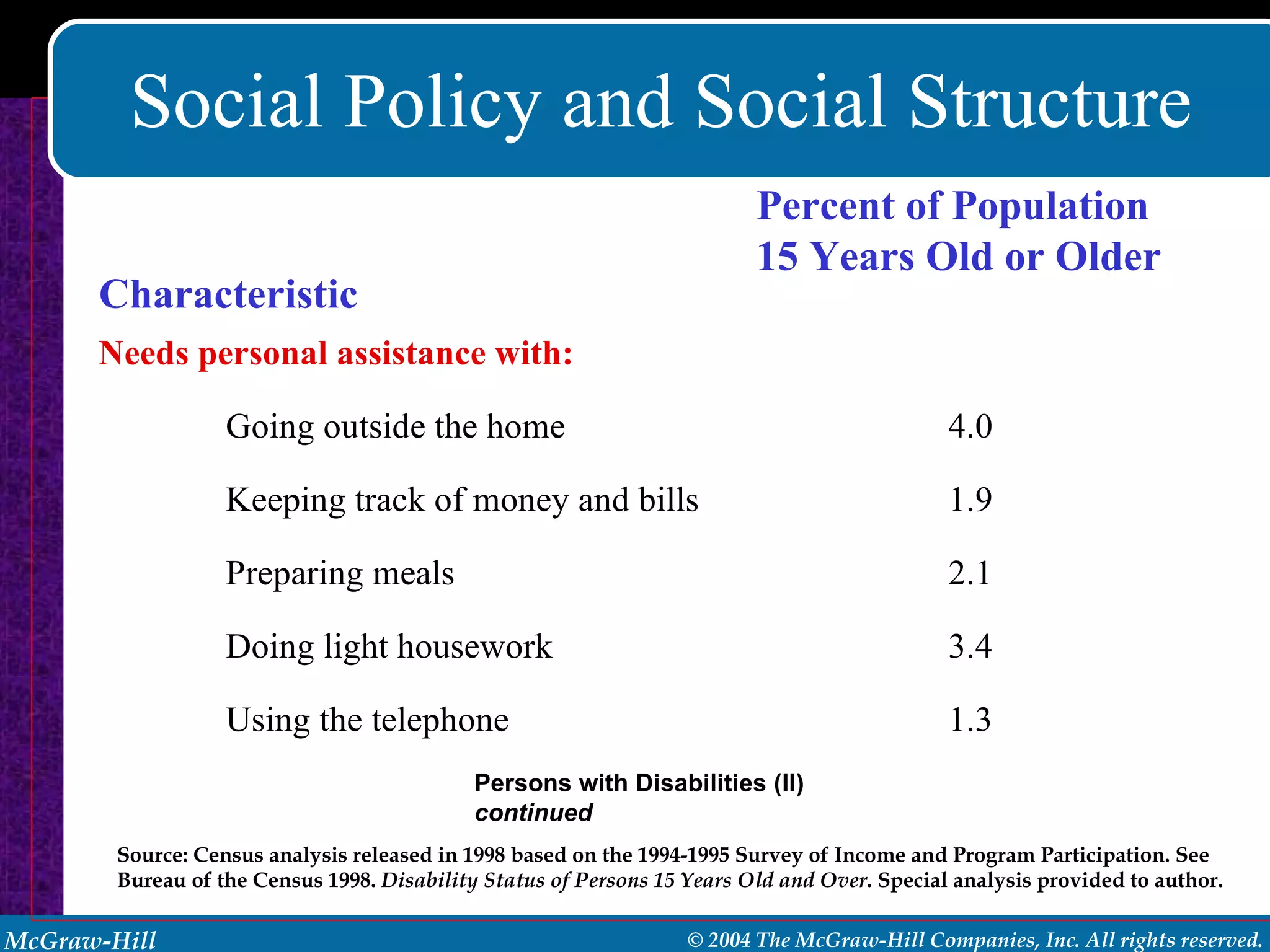
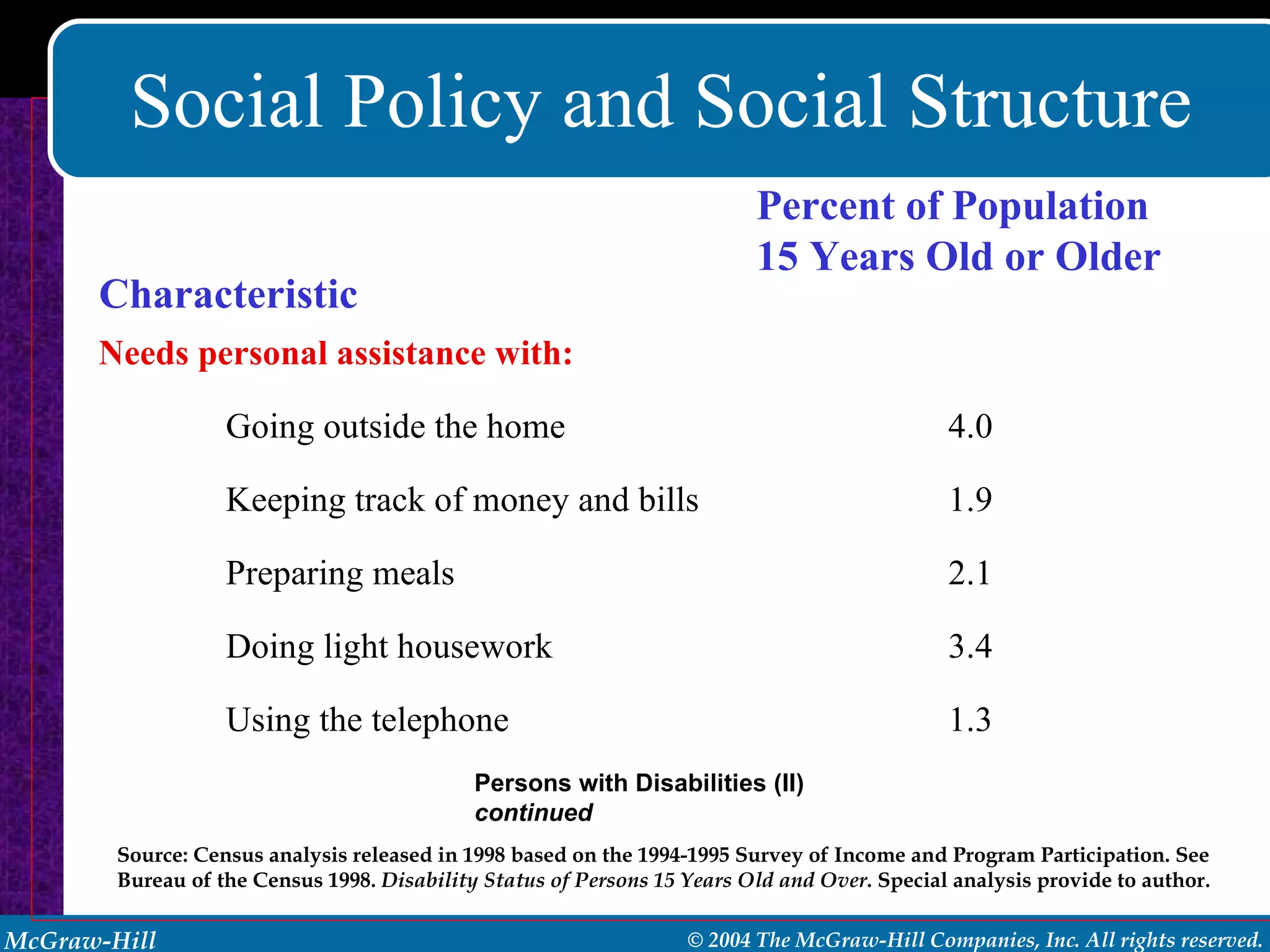
Social Policy and Social Structure Persons with Disabilities (II)  continued Source: Census analysis released in 1998 based on the 1994-1995 Survey of Income and Program Participation. See Bureau of the Census 1998.  Disability Status of Persons 15 Years Old and Over . Special analysis provided to author. 1.3 Using the telephone 3.4 Doing light housework 2.1 Preparing meals 1.9 Keeping track of money and bills 4.0 Going outside the home Needs personal assistance with: Percent of Population 15 Years Old or Older Characteristic
Social Policy and Social Structure Persons with Disabilities (II)  continued Source: Census analysis released in 1998 based on the 1994-1995 Survey of Income and Program Participation. See Bureau of the Census 1998.  Disability Status of Persons 15 Years Old and Over . Special analysis provide to author. 1.3 Using the telephone 3.4 Doing light housework 2.1 Preparing meals 1.9 Keeping track of money and bills 4.0 Going outside the home Needs personal assistance with: Percent of Population 15 Years Old or Older Characteristic
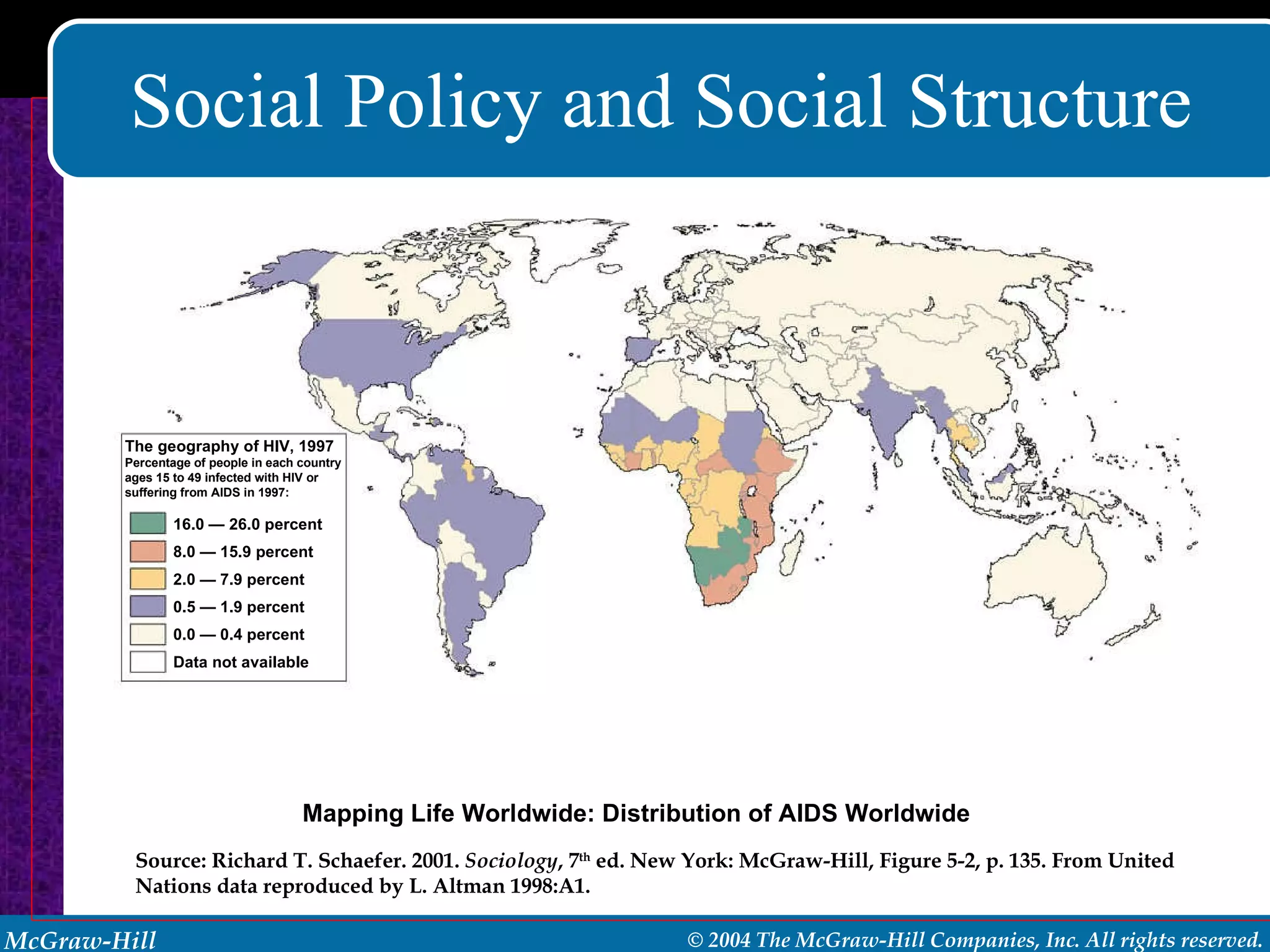
Social Policy and Social Structure Mapping Life Worldwide: Distribution of AIDS Worldwide Source: Richard T. Schaefer. 2001.  Sociology , 7 th  ed. New York: McGraw-Hill, Figure 5-2, p. 135. From United Nations data reproduced by L. Altman 1998:A1. The geography of HIV, 1997 Percentage of people in each country ages 15 to 49 infected with HIV or suffering from AIDS in 1997: 16.0 — 26.0 percent 8.0 — 15.9 percent 2.0 — 7.9 percent 0.5 — 1.9 percent 0.0 — 0.4 percent Data not available

Chapter05

  • 1.
  • 2.
    5 SOCIAL INTERACTIONAND SOCIAL STRUCTURE
  • 3.
    Chapter Outline SocialInteraction and Reality Elements of Social Structure Social Structure in Global Perspective Social Policy and Social Structure: The AIDS Crisis
  • 4.
    Social Interaction andReality? Social Structure : The way in which a society is organized into predictable relationships.
  • 5.
    Social Interaction andReality? Human beings interpret or define each other’s actions. The ability to define social reality reflects a group’s power within society. Defining and Reconstructing Reality
  • 6.
    Social Interaction andReality? -- Negotiated order is a social structure that derives its existence from the social interactions through which people define and redefine its character. --People reshape reality by negotiating changes in patterns of social interaction. --Negotiation is the attempt to reach agreement with others concerning the same objective. Negotiated Order
  • 7.
    Elements of SocialStructure Status -- Status refers to any of the socially defined positions within a large group or society. --A person holds more than one status simultaneously. --Examples of statuses: president daughter student neighbor Statuses
  • 8.
    Elements of SocialStructure Ascribed and Achieved Status -- Ascribed status is a status one is born with. -- Achieved status is a status one earns. Master Status -- Master status is a status that dominates others and determines a person’s general position in society. Statuses
  • 9.
    Elements of SocialStructure Figure 5.1: Social Statuses
  • 10.
    The Role ofSocialization Social Roles --Social roles are sets of expectations for people who occupy a given status. Role Conflict -- Role conflict occurs when incompatible expectations arise from two or more social positions held by the same person. Continued... Social Roles
  • 11.
    The Role ofSocialization Role Conflict -- Role conflict is the challenge of occupying two social positions simultaneously. Role Strain -- Role strain describes the difficulties that result from the differing demands and expectations associated with the same social position. Role Exit -- Role Exit describes the process of disengagement from a role that is central to one’s self-identity and reestablishment of an identity in a new role. Social Roles
  • 12.
    The Role ofSocialization A group is any number of people with similar norms, values, and expectations who interact with each other on a regular basis. Every society is composed of many groups in which daily social interaction takes place, including those groups who interact electronically. Groups
  • 13.
    The Role ofSocialization Social Network --A Social Network is a series of social relationships that links a person directly to others and through them indirectly to still more people. Social Networks and Technology
  • 14.
    The Role ofSocialization Social institutions are organized patterns of beliefs and behavior centered on basic social needs. Social institutions provide insight into the structure of society. Social Institutions
  • 15.
    The Role ofSocialization Table 5.1: Functions and Institutions
  • 16.
    Social Structure inGlobal Perspective Gemeinschaft (guh-MINE-shoft) The Gemeinschaft is defined as a small community in which people have similar backgrounds and life experiences. Gesellschaft (guh-ZELL-shoft) The Gesellschaft is defined as a large community in which people are strangers and feel little in common with other community residents. Tönnie’s Gemeinschaft and Gesellschaft
  • 17.
    Social Structure inGlobal Perspective Table 5.2: Comparison of Gemeinschaft and Gesellschaft
  • 18.
    Social Structure inGlobal Perspective This approach views society as undergoing change according to a dominant pattern, known as sociocultural evolution. Sociocultural evolution refers to the “process of change and development in human societies resulting from growth in their stores of cultural information.” Lenski’s Sociocultural Evolution Approach
  • 19.
    Social Structure inGlobal Perspective A society’s level of technology is critical to the way it is organized. Preindustrial Societies --Hunting-and-Gathering Societies *These societies are composed of small, widely dispersed groups. *These societies use minimal technology. Continued... Lenski’s Sociocultural Evolution Approach
  • 20.
    Social Structure inGlobal Perspective --Horticultural Societies *People plant seeds and crops. *People are less nomadic than in hunter-gatherer societies. *People use technology in a limited way. --Agrarian Societies *People are primarily engaged in production of food. *People use technological innovations like the plow for dramatic increases in food production. Lenski’s Sociocultural Evolution Approach
  • 21.
    Social Structure inGlobal Perspective Industrial Societies --These societies depend on mechanization to produce its goods and services. --These societies rely on inventions and energy sources that facilitate agricultural and industrial production. --These societies change the function of the family as a self-sufficient unit. Lenski’s Sociocultural Evolution Approach
  • 22.
    Social Structure inGlobal Perspective Postindustrial and Postmodern Societies --Postindustrial Society *A postindustrial society is one whose economic system is engaged primarily in the processing and control of information. *The main output of postindustrial society is services. Continued... Lenski’s Sociocultural Evolution Approach
  • 23.
    Social Structure inGlobal Perspective --Postmodern Society *A postmodern society is a technologically sophisticated society preoccupied with consumer goods and media images. Lenski’s Sociocultural Evolution Approach
  • 24.
    Social Policy andSocial Structure The Issue --While there are encouraging new ways to treat people, there is currently no way to eradicate AIDS by medical means. --How can people be protected and whose responsibility is it? The AIDS Crisis
  • 25.
    Social Policy andSocial Structure The Setting --Health practitioners pay particular attention to methods of transmitting HIV because there is no cure or vaccine for AIDS at this time. --AIDS is on the increase, with an estimated 36.1 million people infected and 3 million dying annually. --AIDS is not evenly distributed and the developing nations of the sub-Saharan Africa have been hard hit. The AIDS Crisis
  • 26.
    Social Policy andSocial Structure Sociological Insights --A dramatic health crisis such as AIDS is likely to bring about changes in social structure. --From a functionalist view, if established social institutions cannot meet a crucial need, new social networks are likely to emerge to fill that function. The AIDS Crisis
  • 27.
    Social Policy andSocial Structure Sociological Insights -- Viewed from a conflict perspective, policymakers were slow to respond to the AIDS crisis because those in high-risk groups--gays and IV drug users--were comparatively powerless. --Interactionists widely forecast that AIDS would lead to a more conservative sexual climate. They are also concerned about the impact of AIDS treatment on the daily lives of those stricken with the disease. The AIDS Crisis
  • 28.
    Social Policy andSocial Structure Policy Initiatives --AIDS has struck all societies, but not all nations can respond in the same manner. --The high cost of drug treatment programs has generated intensive worldwide pressure on the major drug companies to lower their prices to patients in developing nations. --The prospect of cheaper medicine will in turn stimulate the demand for care and a need for additional resources. The AIDS Crisis
  • 29.
    Social Policy andSocial Structure Figure 5.3: Daily Dosing for AIDS
  • 30.
    Social Policy andSocial Structure Persons with Disabilities (I) Source: Census analysis released in 1998 based on the 1994-1995 Survey of Income and Program Participation. See Bureau of the Census 1998. Disability Status of Persons 15 Years Old and Over . Special analysis provide to author. 9.1 Walk three city blocks 8.9 Climb stairs without resting 7.9 Lift or carry 10 pounds 1.0 Have speech understood 4.8 Hear normal conversation 4.1 See words and letters Has difficulty or is unable to: 11.5 Not severe 12.5 Severe 24.0 With any disability Percent of Population 15 Years Old or Older Characteristic
  • 31.
    Social Policy andSocial Structure Persons with Disabilities (II) Source: Census analysis released in 1998 based on the 1994-1995 Survey of Income and Program Participation. See Bureau of the Census 1998. Disability Status of Persons 15 Years Old and Over . Special analysis provided to author. 1.0 Getting to or using the toilet 0.5 Eating 1.6 Dressing 2.2 Bathing 2.7 Getting in/out of bed or chair 1.7 Getting around inside the home Has difficulty or needs personal assistance with: Percent of Population 15 Years Old or Older Characteristic
  • 32.
    Social Policy andSocial Structure Persons with Disabilities (II) continued Source: Census analysis released in 1998 based on the 1994-1995 Survey of Income and Program Participation. See Bureau of the Census 1998. Disability Status of Persons 15 Years Old and Over . Special analysis provided to author. 1.3 Using the telephone 3.4 Doing light housework 2.1 Preparing meals 1.9 Keeping track of money and bills 4.0 Going outside the home Needs personal assistance with: Percent of Population 15 Years Old or Older Characteristic
  • 33.
    Social Policy andSocial Structure Persons with Disabilities (II) continued Source: Census analysis released in 1998 based on the 1994-1995 Survey of Income and Program Participation. See Bureau of the Census 1998. Disability Status of Persons 15 Years Old and Over . Special analysis provide to author. 1.3 Using the telephone 3.4 Doing light housework 2.1 Preparing meals 1.9 Keeping track of money and bills 4.0 Going outside the home Needs personal assistance with: Percent of Population 15 Years Old or Older Characteristic
  • 34.
    Social Policy andSocial Structure Mapping Life Worldwide: Distribution of AIDS Worldwide Source: Richard T. Schaefer. 2001. Sociology , 7 th ed. New York: McGraw-Hill, Figure 5-2, p. 135. From United Nations data reproduced by L. Altman 1998:A1. The geography of HIV, 1997 Percentage of people in each country ages 15 to 49 infected with HIV or suffering from AIDS in 1997: 16.0 — 26.0 percent 8.0 — 15.9 percent 2.0 — 7.9 percent 0.5 — 1.9 percent 0.0 — 0.4 percent Data not available