Bureaucracy and Formal OrganizationsChapter 7
“The idea that efficiency and practical results should dominate human affairs.”The Rationalization of Society
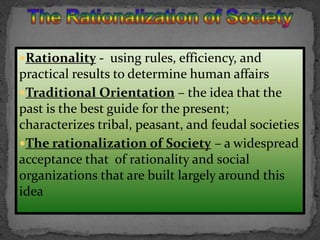
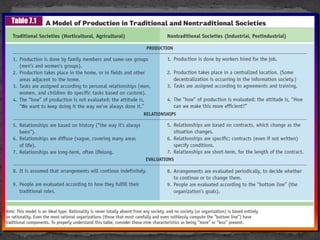
The Rationalization of SocietyRationality -  using rules, efficiency, and practical results to determine human affairsTraditional Orientation– the idea that the past is the best guide for the present; characterizes tribal, peasant, and feudal societiesThe rationalization of Society – a widespread acceptance that  of rationality and social organizations that are built largely around this idea
Capitalism – an economic system characterized by the private ownership of the means of production, the pursuit of profit, and market competitionThe Rationalization of Society
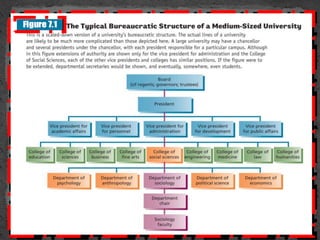
Formal Organizations – a secondary group designed to achieve explicit objectivesBureaucracy – a formal organization with a hierarchy of authority, a clear division a of labor, an impersonality of positions, and an emphasis of written rules, communications, and records Formal Organizations & Bureaucracies
Alienation – Marx’s term for workers’ lack of connection to the product of their labor (being assigned repetitive tasks on a small part of a product leads to a sense of powerlessness and normlessness); others use the term in the general sense of not feeling a part of somethingPeter Principle– a tongue in cheek observation that the members of an organization are promoted for their accomplishments until they reach their level of incompetence; there they cease to be promoted, remaining at a level at which they can no longer do good workFormal Organizations & Bureaucracies
Shared InterestsGoal Displacement – the adoption of new goals by an organization; also known as goal replacementEx. March of Dimes organized in 1930’s to find a cure Polio, when the need depleted, they reorganized for other causes  (page 187)Voluntary Association – a group made up of people who voluntarily organize on the basis of some mutual interest; also known as voluntary memberships and voluntary organizationsEx. Boy Scouts, Elks, political parties
The Iron Law of Oligarchy The Iron Law of Oligarchy  – Robert Michel's term for  the tendency of formal organizations to be dominated by a small, self-perpetuating eliteA significant aspect of voluntary organizations is that its key members, its inner circle, often grown distant from its regular members.Ex. VFW (page 190)
Humanizing the Work SettingHumanizing the Work Setting  – organizing a workplace in such a way that it develops rather than impedes human potential (page 193)Access to OpportunitiesDistribute Power More EvenlyWork TeamsCorporate Day CareEmployee Stock Ownership
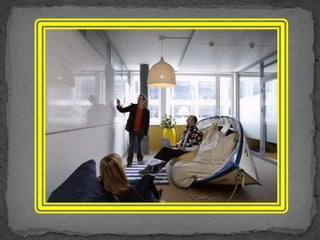
Google is an example of a workplace that goes out of its way to develop potential.  They have elaborate, stimulating decorating and have special break rooms to allow stress free time, even short napping.  The next several pictures are of their various offices.Google
Chapter 7    Bureaucracy And  Formal  Organizations

Chapter 7 Bureaucracy And Formal Organizations

  • 1.
    Bureaucracy and FormalOrganizationsChapter 7
  • 2.
    “The idea thatefficiency and practical results should dominate human affairs.”The Rationalization of Society
  • 3.
    The Rationalization ofSocietyRationality - using rules, efficiency, and practical results to determine human affairsTraditional Orientation– the idea that the past is the best guide for the present; characterizes tribal, peasant, and feudal societiesThe rationalization of Society – a widespread acceptance that of rationality and social organizations that are built largely around this idea
  • 5.
    Capitalism – aneconomic system characterized by the private ownership of the means of production, the pursuit of profit, and market competitionThe Rationalization of Society
  • 6.
    Formal Organizations –a secondary group designed to achieve explicit objectivesBureaucracy – a formal organization with a hierarchy of authority, a clear division a of labor, an impersonality of positions, and an emphasis of written rules, communications, and records Formal Organizations & Bureaucracies
  • 8.
    Alienation – Marx’sterm for workers’ lack of connection to the product of their labor (being assigned repetitive tasks on a small part of a product leads to a sense of powerlessness and normlessness); others use the term in the general sense of not feeling a part of somethingPeter Principle– a tongue in cheek observation that the members of an organization are promoted for their accomplishments until they reach their level of incompetence; there they cease to be promoted, remaining at a level at which they can no longer do good workFormal Organizations & Bureaucracies
  • 9.
    Shared InterestsGoal Displacement– the adoption of new goals by an organization; also known as goal replacementEx. March of Dimes organized in 1930’s to find a cure Polio, when the need depleted, they reorganized for other causes (page 187)Voluntary Association – a group made up of people who voluntarily organize on the basis of some mutual interest; also known as voluntary memberships and voluntary organizationsEx. Boy Scouts, Elks, political parties
  • 10.
    The Iron Lawof Oligarchy The Iron Law of Oligarchy – Robert Michel's term for the tendency of formal organizations to be dominated by a small, self-perpetuating eliteA significant aspect of voluntary organizations is that its key members, its inner circle, often grown distant from its regular members.Ex. VFW (page 190)
  • 11.
    Humanizing the WorkSettingHumanizing the Work Setting – organizing a workplace in such a way that it develops rather than impedes human potential (page 193)Access to OpportunitiesDistribute Power More EvenlyWork TeamsCorporate Day CareEmployee Stock Ownership
  • 12.
    Google is anexample of a workplace that goes out of its way to develop potential. They have elaborate, stimulating decorating and have special break rooms to allow stress free time, even short napping. The next several pictures are of their various offices.Google