Social Classes and Consumer
Behaviour
Fahim akhtar
Social ClassSocial Class
The division of members of a society into a
hierarchy of distinct status classes, so that members of each
class have either higher or lower status than members of
other classes.
Karl Marx
German philosopher and
revolutionary socialist Karl Marx
published The Communist
Manifesto and Das Kapital,
anticapitalist works that form the
basis of Marxism.
Ruling Class
owns and controls the forces of production, the
social class in power uses the non-economic institutions to
uphold its authority and position.
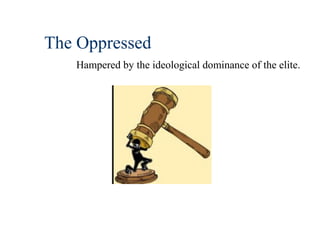
The Oppressed
Hampered by the ideological dominance of the elite.
Characteristics of Social Class
 Is hierarchical
 Is a natural form of segmentation
 Provides a frame of reference for consumer behaviour
 Reflects a person’s relative social status
Social Class and Social Status
Status is frequently thought of as the relative rankings
of members of each social class
 wealth
 power
 prestige
Social Comparison Theory
States that individuals compare their own possessions
against those of others to determine their relative social
standing.
To determine how good an artist I am, I will compare
myself with a competent friend rather than a famous artist
11-10
Status Consumption
The process by which consumers actively increase
their social standing through higher consumption or better
possessions
Social Class Measurement
 Subjective Measures: individuals are asked to estimate
their own social-class positions
 Reputational Measures: informants make judgments
concerning the social-class membership of others within
the community
 Objective Measures: individuals answer specific
socioeconomic questions and then are categorized
according to answers
Objective Measures
variable
 Occupation
 Education
 Income
 Other Variables
Index of Status Characteristics (ISC)Index of Status Characteristics (ISC)
A composite measure of social class that combines
occupation, source of income (not amount), house type /
dwelling area into a single weighted index of social class
standing.
Socioeconomic Status Score (SES)Socioeconomic Status Score (SES)
A multivariable social class measure used by the
United States Bureau of the Census that combines
occupational status, family income, and educational
attainment into a single measure of social class standing.
11-17
Elite class
 Less than 1% in number
 Control resources and have inherited wealth
 Travel frequently
 Educate their wards taking international platform
 Live in networked environment
 Difficult to be convinced in marketing
Upper class
 Less than 10 % in number
 Assertive, skilled and motivated
 Travel on need and for business support
 Spending well balanced
 Keen to grow more and enter in elite class
 Often work out their edge when subject to marketing
Upper Middle class
 More than 10 % in number
 White coloured and managing their live style depicting the
best
 Spend more on dress, living and social status maintenance
 Spending well balanced
 In touch with technology and development
 Calculative in spending other than mentioned earlier
 Own good living conditions and mobility means
Lower Middle Class
 Own reasonable living conditions
 Dependent on community mobility means
 Job and employment is their basic concern
 Spend more on education of their children
 Do multiple jobs or over time employment
 Easy target for marketer
Working class
 Live in rented accommodation
 Larger families internal structure
 Employment not permanent
 Spending aggressive
 Spend some portion on education
Poor class
 No living owned
 Unemployed mostly
 uneducated
 Spending pattern not supported by rational
 Live in fallacies
Social Class and Marketing Strategy
 Clothing, Fashion, and Shopping
 Where one shops
 External point of identification
 The Pursuit of Leisure
 Type of leisure activities differ
Social Class and Marketing Strategy
 Saving, Spending, and Credit
– Level of immediate gratification sought varies
 Responses to marketing communication
– Upper classes have a broader and more general view of
the world
– Regional variations in language rise as we move down
the social ladder
– Exposure to media varies by social class
Limitations of Social Class
 Social class is more difficult to measure than income
 Many purchase behaviours are related more to income
than social class
 Consumers often use expected social class for their
consumption patterns
 Dual incomes have changed consumption patterns
 Individual dimensions of social class are sometimes better
predictors of consumer behaviour
Group Activity
 Assume you are a travel agent selling vacation packages to different
social classes.
 Discuss and create a plan for:
– (1) vacation packages to offer (destination, accommodations, food,
etc.)
– (2) advertising and appeals used
– (3) media location
 Do this for (a) upper class, (b) middle class, and (c) working class.
 Discuss if YOUR product is better suited for upper, middle, or
working class and why.
 Write down your ideas and be prepared to share with the class.

Social Classes

  • 1.
    Social Classes andConsumer Behaviour Fahim akhtar
  • 3.
    Social ClassSocial Class Thedivision of members of a society into a hierarchy of distinct status classes, so that members of each class have either higher or lower status than members of other classes.
  • 4.
    Karl Marx German philosopherand revolutionary socialist Karl Marx published The Communist Manifesto and Das Kapital, anticapitalist works that form the basis of Marxism.
  • 5.
    Ruling Class owns andcontrols the forces of production, the social class in power uses the non-economic institutions to uphold its authority and position.
  • 6.
    The Oppressed Hampered bythe ideological dominance of the elite.
  • 7.
    Characteristics of SocialClass  Is hierarchical  Is a natural form of segmentation  Provides a frame of reference for consumer behaviour  Reflects a person’s relative social status
  • 8.
    Social Class andSocial Status Status is frequently thought of as the relative rankings of members of each social class  wealth  power  prestige
  • 9.
    Social Comparison Theory Statesthat individuals compare their own possessions against those of others to determine their relative social standing.
  • 10.
    To determine howgood an artist I am, I will compare myself with a competent friend rather than a famous artist 11-10
  • 11.
    Status Consumption The processby which consumers actively increase their social standing through higher consumption or better possessions
  • 12.
    Social Class Measurement Subjective Measures: individuals are asked to estimate their own social-class positions  Reputational Measures: informants make judgments concerning the social-class membership of others within the community  Objective Measures: individuals answer specific socioeconomic questions and then are categorized according to answers
  • 13.
    Objective Measures variable  Occupation Education  Income  Other Variables
  • 14.
    Index of StatusCharacteristics (ISC)Index of Status Characteristics (ISC) A composite measure of social class that combines occupation, source of income (not amount), house type / dwelling area into a single weighted index of social class standing.
  • 15.
    Socioeconomic Status Score(SES)Socioeconomic Status Score (SES) A multivariable social class measure used by the United States Bureau of the Census that combines occupational status, family income, and educational attainment into a single measure of social class standing.
  • 17.
  • 18.
    Elite class  Lessthan 1% in number  Control resources and have inherited wealth  Travel frequently  Educate their wards taking international platform  Live in networked environment  Difficult to be convinced in marketing
  • 19.
    Upper class  Lessthan 10 % in number  Assertive, skilled and motivated  Travel on need and for business support  Spending well balanced  Keen to grow more and enter in elite class  Often work out their edge when subject to marketing
  • 20.
    Upper Middle class More than 10 % in number  White coloured and managing their live style depicting the best  Spend more on dress, living and social status maintenance  Spending well balanced  In touch with technology and development  Calculative in spending other than mentioned earlier  Own good living conditions and mobility means
  • 21.
    Lower Middle Class Own reasonable living conditions  Dependent on community mobility means  Job and employment is their basic concern  Spend more on education of their children  Do multiple jobs or over time employment  Easy target for marketer
  • 22.
    Working class  Livein rented accommodation  Larger families internal structure  Employment not permanent  Spending aggressive  Spend some portion on education
  • 23.
    Poor class  Noliving owned  Unemployed mostly  uneducated  Spending pattern not supported by rational  Live in fallacies
  • 24.
    Social Class andMarketing Strategy  Clothing, Fashion, and Shopping  Where one shops  External point of identification  The Pursuit of Leisure  Type of leisure activities differ
  • 26.
    Social Class andMarketing Strategy  Saving, Spending, and Credit – Level of immediate gratification sought varies  Responses to marketing communication – Upper classes have a broader and more general view of the world – Regional variations in language rise as we move down the social ladder – Exposure to media varies by social class
  • 27.
    Limitations of SocialClass  Social class is more difficult to measure than income  Many purchase behaviours are related more to income than social class  Consumers often use expected social class for their consumption patterns  Dual incomes have changed consumption patterns  Individual dimensions of social class are sometimes better predictors of consumer behaviour
  • 28.
    Group Activity  Assumeyou are a travel agent selling vacation packages to different social classes.  Discuss and create a plan for: – (1) vacation packages to offer (destination, accommodations, food, etc.) – (2) advertising and appeals used – (3) media location  Do this for (a) upper class, (b) middle class, and (c) working class.  Discuss if YOUR product is better suited for upper, middle, or working class and why.  Write down your ideas and be prepared to share with the class.