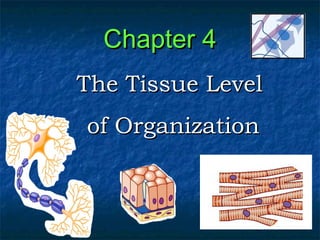
Chapter 4Chapter 4
The Tissue LevelThe Tissue Level
of Organizationof Organization
 Tissues are a group of cells with a commonTissues are a group of cells with a common
embryonic origin that function together toembryonic origin that function together to
carry out specialized activities.carry out specialized activities.
TissuesTissues
 Histology is the study of the microscopicHistology is the study of the microscopic
anatomy of cells and tissues – it is a branchanatomy of cells and tissues – it is a branch
of pathology.of pathology.
TissuesTissues
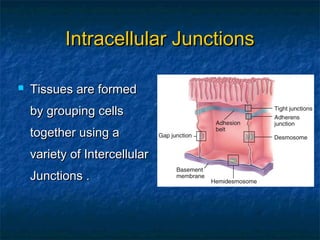
 Tissues are formedTissues are formed
by grouping cellsby grouping cells
together using atogether using a
variety of Intercellularvariety of Intercellular
Junctions .Junctions .
Intracellular JunctionsIntracellular Junctions
 Tight JunctionsTight Junctions are found where aare found where a
leakproof seal is needed between cells.leakproof seal is needed between cells.
Intracellular JunctionsIntracellular Junctions
 Adherens JunctionsAdherens Junctions make an adhesion belt (like the beltmake an adhesion belt (like the belt
on your pants) that keeps tissues from separating as theyon your pants) that keeps tissues from separating as they
stretch and contract.stretch and contract.
 Cadherin is a glycoproteinCadherin is a glycoprotein
that forms the belt-likethat forms the belt-like
““plaque”.plaque”.
Intracellular JunctionsIntracellular Junctions
 DesmosomesDesmosomes act as “spot welds”. They alsoact as “spot welds”. They also
use cadherin glycoprotein (plus intermediateuse cadherin glycoprotein (plus intermediate
filaments) to hook into the cytoplasm.filaments) to hook into the cytoplasm.
Intracellular JunctionsIntracellular Junctions
 HemidesmosomesHemidesmosomes are half-welds thatare half-welds that
join cells to the basement membrane.join cells to the basement membrane.
Intracellular JunctionsIntracellular Junctions
 Gap JunctionsGap Junctions are poresare pores
(connexons) that allow(connexons) that allow
small substances like ionssmall substances like ions
to pass between cells. Ifto pass between cells. If
one of the cells gets sick orone of the cells gets sick or
dies, these seal like adies, these seal like a
hatch to prevent damage tohatch to prevent damage to
other cells.other cells.
Intracellular JunctionsIntracellular Junctions
 Of all the cells in the body, they combine toOf all the cells in the body, they combine to
make only 4 basic tissue types:make only 4 basic tissue types:
 Epithelial tissuesEpithelial tissues
 Connective tissuesConnective tissues
 Muscular tissuesMuscular tissues
 Nervous tissuesNervous tissues
The 4 Basic TissuesThe 4 Basic Tissues
 Epithelial tissuesEpithelial tissues cover body surfaces and formcover body surfaces and form
glands and line hollow organs, body cavities, andglands and line hollow organs, body cavities, and
ducts.ducts.
The 4 Basic TissuesThe 4 Basic Tissues
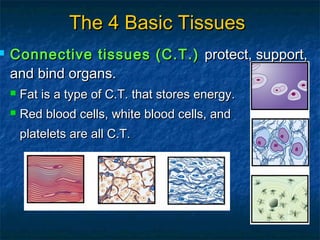
 Connective tissues (C.T.)Connective tissues (C.T.) protect, support,protect, support,
and bind organs.and bind organs.
 Fat is a type of C.T. that stores energy.Fat is a type of C.T. that stores energy.
 Red blood cells, white blood cells, andRed blood cells, white blood cells, and
platelets are all C.T.platelets are all C.T.
The 4 Basic TissuesThe 4 Basic Tissues
 Muscular tissuesMuscular tissues generate the physicalgenerate the physical
force needed to make body structuresforce needed to make body structures
move. They also generate heat used bymove. They also generate heat used by
the body.the body.
 Nervous tissuesNervous tissues detect changes in thedetect changes in the
body and respond by generating nervebody and respond by generating nerve
impulses.impulses.
The 4 Basic TissuesThe 4 Basic Tissues
 Tissues of the body develop from three primary germ layers:Tissues of the body develop from three primary germ layers:
Endoderm, Mesoderm, and EctodermEndoderm, Mesoderm, and Ectoderm
 Epithelial tissues fromEpithelial tissues from
all three germ layersall three germ layers
 C.T. and muscle areC.T. and muscle are
derived from mesoderm.derived from mesoderm.
 Nervous tissueNervous tissue
develops fromdevelops from
ectoderm.ectoderm.
The 4 Basic TissuesThe 4 Basic Tissues
EpitheliumEpithelium
 Epithelium is used to line surfaces andEpithelium is used to line surfaces and
form protective barriers. Epithelium is alsoform protective barriers. Epithelium is also
good at secreting things like mucous,good at secreting things like mucous,
hormones, andhormones, and
other substances .other substances .
 All epithelia have aAll epithelia have a
free apical surfacefree apical surface
and an attachedand an attached
basal surface.basal surface.
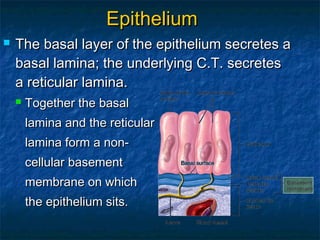
 The basal layer of the epithelium secretes aThe basal layer of the epithelium secretes a
basal lamina; the underlying C.T. secretesbasal lamina; the underlying C.T. secretes
a reticular lamina.a reticular lamina.
 Together the basalTogether the basal
lamina and the reticularlamina and the reticular
lamina form a non-lamina form a non-
cellular basementcellular basement
membrane on whichmembrane on which
the epithelium sits.the epithelium sits.
EpitheliumEpithelium
 Epithelia areEpithelia are namednamed according to theaccording to the
shape of their cells, and the thickness orshape of their cells, and the thickness or
arrangement of their layers (of cells).arrangement of their layers (of cells).
EpitheliumEpithelium
 Naming epithelia according toNaming epithelia according to shapeshape
EpitheliumEpithelium
Flat, wide “paving
stone” cells
Cells as tall as they are
wide
Cells taller than they are
wide
One layer. All cells in
contact with
basement membrane
Appears to have layers,
but in reality all cells go
from the apex to the base
Two or more layers.
Only basal layer in
contact with basement
membrane
 Naming epithelia according toNaming epithelia according to
arrangementarrangement
EpitheliumEpithelium
 Naming epitheliaNaming epithelia
 Three different cell shapesThree different cell shapes xx three different cellthree different cell
arrangements = nine possibilities. Two of thesearrangements = nine possibilities. Two of these
are not used. Add transitional (cells that changeare not used. Add transitional (cells that change
shape), and we’re back up to eight possibleshape), and we’re back up to eight possible
combinations.combinations.
 If different shapes are present in layers of cells,If different shapes are present in layers of cells,
the epithelium is always named by the shape ofthe epithelium is always named by the shape of
cells in the apical (outermost) layer.cells in the apical (outermost) layer.
EpitheliumEpithelium
simple
squamous
pseudostratified
squamous
stratified squamous
simple cuboidal
pseudostratified
cuboidal
stratified cuboidal
simple columnar
pseudostratified
columnar
stratified columnar
transitional
 Simple Squamous EpitheliumSimple Squamous Epithelium isis
composed of a single layer of flat cells found:composed of a single layer of flat cells found:
 In the air sacs of lungsIn the air sacs of lungs
 In the lining of bloodIn the lining of blood
vessels, the heart, and lymphatic vesselsvessels, the heart, and lymphatic vessels
 In all capillaries, including those of the kidneyIn all capillaries, including those of the kidney
 As the major part of aAs the major part of a
serous membraneserous membrane
EpitheliumEpithelium
 Simple Cuboidal EpitheliumSimple Cuboidal Epithelium isis
composed of a single layer of cubecomposed of a single layer of cube
shaped cells.shaped cells.
 It is often found liningIt is often found lining
the tubules of thethe tubules of the
kidneys and manykidneys and many
other glands.other glands.
EpitheliumEpithelium
simple squamous
pseudostratified
squamous
stratified squamous
simple
cuboidal
pseudostratified
cuboidal
stratified cuboidal
simple columnar
pseudostratified
columnar
stratified columnar
transitional
 Simple Columnar EpitheliumSimple Columnar Epithelium forms aforms a
single layer of column-like cells, ± cilia, ±single layer of column-like cells, ± cilia, ±
microvilli, ± mucous (goblet cells).microvilli, ± mucous (goblet cells).
 Goblet cells are simpleGoblet cells are simple
columnar cells thatcolumnar cells that
have differentiated tohave differentiated to
acquire the ability toacquire the ability to
secrete mucous.secrete mucous.
EpitheliumEpithelium
simple squamous
pseudostratified
squamous
stratified squamous
simple cuboidal
pseudostratified
cuboidal
stratified cuboidal
simple
columnar
pseudostratified
columnar
stratified columnar
transitional
 Pseudostratified Columnar EpitheliumPseudostratified Columnar Epithelium appearsappears
to have layers, due to nuclei which are at variousto have layers, due to nuclei which are at various
depths. In reality, all cells are attached to thedepths. In reality, all cells are attached to the
basementbasement
membrane in a singlemembrane in a single
layer, but some do notlayer, but some do not
extend to the apical surface.extend to the apical surface.simple squamous
pseudostratified
squamous
stratified squamous
simple cuboidal pseudostratified cuboidal stratified cuboidal
simple columnar
pseudostratified
columnar
stratified columnar
transitional
EpitheliumEpithelium
 Stratified Squamous EpitheliumStratified Squamous Epithelium has an apical surfacehas an apical surface
that is made up of squamous (flat) cells.that is made up of squamous (flat) cells.
 The other layers have differentThe other layers have different
shapes, but the name is basedshapes, but the name is based
on the apical layer.on the apical layer.
 The many layers are ideal forThe many layers are ideal for
protection againstprotection against
strong frictionstrong friction
forces.forces.
simple squamous
pseudostratified
squamous
stratified
squamous
simple cuboidal
pseudostratified
cuboidal
stratified cuboidal
simple columnar
pseudostratified
columnar
stratified columnar
transitional
EpitheliumEpithelium
 Stratified Cuboidal EpitheliumStratified Cuboidal Epithelium has anhas an
apical surface made up of two or more layersapical surface made up of two or more layers
of cube-shaped cells.of cube-shaped cells.
 Locations include the sweatLocations include the sweat
glands and part of theglands and part of the
♂♂ urethraurethra
 Stratified Columnar EpitheliumStratified Columnar Epithelium is veryis very
rare, and forrare, and for ourour
purposes, hardlypurposes, hardly
worth mentioning.worth mentioning.
EpitheliumEpithelium
simple squamous
pseudostratified
squamous
stratified squamous
simple cuboidal
pseudostratified
cuboidal
stratified
cuboidal
simple columnar
pseudostratified
columnar
stratified
columnar
transitional
simple squamous
pseudostratified
squamous
stratified squamous
simple cuboidal
pseudostratified
cuboidal
stratified cuboidal
simple columnar
pseudostratified
columnar
stratified columnar
transitional
 The cells ofThe cells of Transitional EpitheliumTransitional Epithelium change shapechange shape
depending on the state of stretch in the tissue.depending on the state of stretch in the tissue.
EpitheliumEpithelium
 Simple squamous makes up epithelial membranes and lines theSimple squamous makes up epithelial membranes and lines the
blood vessels.blood vessels.
 Columnar is common in the digestive tract.Columnar is common in the digestive tract.
 Pseudostratified ciliatedPseudostratified ciliated
columnar is characteristiccolumnar is characteristic
of the upper respiratory tract.of the upper respiratory tract.
 Transitional is found inTransitional is found in
the bladder.the bladder.
 Cuboidal lines ducts andCuboidal lines ducts and
sweat glands.sweat glands.
EpitheliumEpithelium
 Connective Tissues are the most abundant andConnective Tissues are the most abundant and
widely distributed tissues in the body.widely distributed tissues in the body.
 They perform numerous functions:They perform numerous functions:
• Bind tissues togetherBind tissues together
• Support and strengthen tissueSupport and strengthen tissue
• Protect and insulate internal organsProtect and insulate internal organs
• Compartmentalize and transportCompartmentalize and transport
• Energy reserves and immune responsesEnergy reserves and immune responses
Connective TissueConnective Tissue
 Collagen is the main protein of C.T. and the mostCollagen is the main protein of C.T. and the most
abundant protein in the body, making up aboutabundant protein in the body, making up about
25% of total protein content.25% of total protein content.
 Connective tissue is usuallyConnective tissue is usually
highly vascular and suppliedhighly vascular and supplied
with many nerves.with many nerves.
 The exception is cartilage andThe exception is cartilage and
tendon - both have little or notendon - both have little or no
blood supply and no nerves.blood supply and no nerves.
Connective TissuesConnective Tissues
 Although they are a varied group, all C.T.Although they are a varied group, all C.T.
share a common “theme”:share a common “theme”:
 Sparse cellsSparse cells
 Surrounded by anSurrounded by an extracellular matrixextracellular matrix
 The extracellular matrix is a non-cellularThe extracellular matrix is a non-cellular
material located between and around the cells.material located between and around the cells.
 It consists ofIt consists of protein fibersprotein fibers andand groundground
substancesubstance (the ground substance may be fluid,(the ground substance may be fluid,
semifluid, gelatinous, or calcified.)semifluid, gelatinous, or calcified.)
Connective TissuesConnective Tissues
 Common C.T. cellsCommon C.T. cells
 FibroblastsFibroblasts are the most numerous cell ofare the most numerous cell of
connective tissues. These cells secreteconnective tissues. These cells secrete
protein fibers (collagen, elastin, & reticularprotein fibers (collagen, elastin, & reticular
fibers) and afibers) and a
““ground substance”ground substance”
which varies fromwhich varies from
one C.T. to another.one C.T. to another.
Cells Of Connective TissuesCells Of Connective Tissues
 Of the other common C.T. cells:Of the other common C.T. cells:
 ChondrocytesChondrocytes make the various cartilaginousmake the various cartilaginous
C.T.C.T.
 AdipocytesAdipocytes store triglycerides.store triglycerides.
 OsteocytesOsteocytes make bone.make bone.
 White blood cellsWhite blood cells are part of the blood.are part of the blood.
Cells of Connective TissuesCells of Connective Tissues
 C.T. cells secrete 3 common fibers:C.T. cells secrete 3 common fibers:
 Collagen fibersCollagen fibers
 Elastin fibersElastin fibers
 Reticular fibersReticular fibers
Connective TissuesConnective Tissues
 This graphic represents a collage ofThis graphic represents a collage of
different C.T. elements (cells and fibers)different C.T. elements (cells and fibers)
and not a specific C.T.and not a specific C.T.
Connective TissuesConnective Tissues
 Embryonic connective tissueEmbryonic connective tissue
 MesenchymeMesenchyme
 Mucous connective tissueMucous connective tissue
 Mature connective tissueMature connective tissue
 Loose connective tissueLoose connective tissue
 Dense connective tissueDense connective tissue
 CartilageCartilage
 BoneBone
 LiquidLiquid
Connective TissueConnective Tissue
ClassificationClassification
 There are 2 Embryonic Connective Tissues:There are 2 Embryonic Connective Tissues:
 MesenchymeMesenchyme gives rise to all other connectivegives rise to all other connective
tissues.tissues.
 Mucous C.T.Mucous C.T. (Wharton's Jelly) is a gelatinous(Wharton's Jelly) is a gelatinous
substance within the umbilical cord and is a richsubstance within the umbilical cord and is a rich
source of stem cells.source of stem cells.
Embryonic ConnectiveEmbryonic Connective
TissuesTissues
 Loose Connective TissuesLoose Connective Tissues
 Areolar Connective TissueAreolar Connective Tissue is the most widelyis the most widely
distributed in the body. It contains several types ofdistributed in the body. It contains several types of
cells and all three fiber types.cells and all three fiber types.
 AdiposeAdipose
 ReticularReticular
Mature Connective TissuesMature Connective Tissues
 Loose Connective TissuesLoose Connective Tissues
 Loose areolarLoose areolar
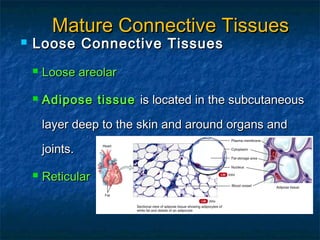
 Adipose tissueAdipose tissue is located in the subcutaneousis located in the subcutaneous
layer deep to the skin and around organs andlayer deep to the skin and around organs and
joints.joints.
 ReticularReticular
Mature Connective TissuesMature Connective Tissues
 Loose Connective TissuesLoose Connective Tissues
 Loose areolarLoose areolar
 AdiposeAdipose
 Reticular connective tissueReticular connective tissue is a network ofis a network of
interlacing reticular fibers and cells.interlacing reticular fibers and cells.
Mature Connective TissuesMature Connective Tissues
 Dense Connective TissuesDense Connective Tissues
 Dense Irregular Connective TissueDense Irregular Connective Tissue
consists predominantly of fibroblasts andconsists predominantly of fibroblasts and
collagen fibers randomly arranged.collagen fibers randomly arranged.
 Dense regularDense regular
 ElasticElastic
Mature Connective TissuesMature Connective Tissues
 Dense Connective TissuesDense Connective Tissues
 Dense IrregularDense Irregular
 Dense regular Connective TissueDense regular Connective Tissue comprisecomprise
tendons, ligaments, and other strong attachmentstendons, ligaments, and other strong attachments
where the need for strength along one axis iswhere the need for strength along one axis is
mandatory (a muscle pulling on a bone).mandatory (a muscle pulling on a bone).
 ElasticElastic
Mature ConnectiveMature Connective
TissuesTissues
 Dense Connective TissuesDense Connective Tissues
 Dense IrregularDense Irregular
 Dense regularDense regular
 Elastic Connective TissueElastic Connective Tissue consistsconsists
predominantly of fibroblasts and freely branchingpredominantly of fibroblasts and freely branching
elastic fibers.elastic fibers.
Mature Connective TissuesMature Connective Tissues
 CartilageCartilage is a tissue with poor blood supplyis a tissue with poor blood supply
that grows slowly. When injured or inflamed,that grows slowly. When injured or inflamed,
repair is slow.repair is slow.
 Hyaline cartilageHyaline cartilage is the most abundant type ofis the most abundant type of
cartilage; it covers the ends of long bones and partscartilage; it covers the ends of long bones and parts
of the ribs, nose, trachea, bronchi, and larynx.of the ribs, nose, trachea, bronchi, and larynx.
 FibrocartilageFibrocartilage
 Elastic cartilageElastic cartilage
Mature Connective TissuesMature Connective Tissues
 CartilageCartilage
 Hyaline cartilageHyaline cartilage
 Fibrocartilage,Fibrocartilage, with its thick bundles ofwith its thick bundles of
collagen fibers, is a very strong, tough cartilage.collagen fibers, is a very strong, tough cartilage.
 Elastic cartilageElastic cartilage
Mature ConnectiveMature Connective
TissuesTissues
 CartilageCartilage
 Hyaline cartilageHyaline cartilage
 FibrocartilageFibrocartilage
 Elastic cartilageElastic cartilage consists of chondrocytesconsists of chondrocytes
located in a threadlike network of elastic fibers.located in a threadlike network of elastic fibers.
Mature Connective TissuesMature Connective Tissues
 BoneBone is a connective tissue with a calcified intracellularis a connective tissue with a calcified intracellular
matrix. In the right circumstances, the chondrocytes ofmatrix. In the right circumstances, the chondrocytes of
cartilage are capable of turning into the osteocytes thatcartilage are capable of turning into the osteocytes that
make up bone tissue.make up bone tissue.
 We will study bone in detail in Chapter 6.We will study bone in detail in Chapter 6.
Mature Connective TissuesMature Connective Tissues
 Blood and lymphBlood and lymph are atypical liquidare atypical liquid
connective tissues that we will study inconnective tissues that we will study in
Chapters 19 and 22. As we have seen,Chapters 19 and 22. As we have seen,
blood has many cells. It also has fibersblood has many cells. It also has fibers
(such as fibrin that makes blood clot).(such as fibrin that makes blood clot).
Mature Connective TissuesMature Connective Tissues
Summary of Mature ConnectiveSummary of Mature Connective
TissuesTissues
 Combining two tissues creates an organ. However, most ofCombining two tissues creates an organ. However, most of
the organs and all of the organs systems studied this yearthe organs and all of the organs systems studied this year
contain all 4 basic types of tissues.contain all 4 basic types of tissues.
 Epithelial membranes are the simplest organs in the body,Epithelial membranes are the simplest organs in the body,
constructed ofconstructed of onlyonly epithelium and a little bit of connectiveepithelium and a little bit of connective
tissue.tissue.
Epithelial MembranesEpithelial Membranes
 Epithelial membranes = epithelium +Epithelial membranes = epithelium +
connective tissueconnective tissue
 Mucous membranesMucous membranes
 Serous membranesSerous membranes
 Cutaneous membrane = skinCutaneous membrane = skin
Epithelial MembranesEpithelial Membranes
 Mucous membranes line “interior” body surfaces open to theMucous membranes line “interior” body surfaces open to the
outside:outside:
 Digestive tractDigestive tract
 Respiratory tractRespiratory tract
 Reproductive tractReproductive tract
 Serous membranes line some internal surfaces:Serous membranes line some internal surfaces:
 Parietal layer next to body wallParietal layer next to body wall
 Serous fluid between layersSerous fluid between layers
 Visceral layer next to organVisceral layer next to organ
Epithelial MembranesEpithelial Membranes
 Skin as a cutaneous membrane isSkin as a cutaneous membrane is
studied in Chapter 5.studied in Chapter 5.
Epithelial MembranesEpithelial Membranes
 Synovial membranes enclose certain joints andSynovial membranes enclose certain joints and
are made ofare made of connective tissue only.connective tissue only.
Synovial MembranesSynovial Membranes
 Muscles and nerve tissues are the last of the 4 basic tissueMuscles and nerve tissues are the last of the 4 basic tissue
types. Neurons and muscle fibers are consideredtypes. Neurons and muscle fibers are considered
excitable cellsexcitable cells because they exhibitbecause they exhibit electricalelectrical
excitability,excitability, the ability to respond to certain stimuli bythe ability to respond to certain stimuli by
producing electrical signals such asproducing electrical signals such as action potentials.action potentials.
 Action potentials can propagate (travel) along the plasmaAction potentials can propagate (travel) along the plasma
membrane of a neuron or muscle fiber due to themembrane of a neuron or muscle fiber due to the
presence of specific voltage-gated ion channels.presence of specific voltage-gated ion channels.
 Each will be studied in depth in upcoming chapters.Each will be studied in depth in upcoming chapters.
Muscle and Nerve TissuesMuscle and Nerve Tissues

Chapter 4

  • 1.
    Chapter 4Chapter 4 TheTissue LevelThe Tissue Level of Organizationof Organization
  • 2.
     Tissues area group of cells with a commonTissues are a group of cells with a common embryonic origin that function together toembryonic origin that function together to carry out specialized activities.carry out specialized activities. TissuesTissues
  • 3.
     Histology isthe study of the microscopicHistology is the study of the microscopic anatomy of cells and tissues – it is a branchanatomy of cells and tissues – it is a branch of pathology.of pathology. TissuesTissues
  • 4.
     Tissues areformedTissues are formed by grouping cellsby grouping cells together using atogether using a variety of Intercellularvariety of Intercellular Junctions .Junctions . Intracellular JunctionsIntracellular Junctions
  • 5.
     Tight JunctionsTightJunctions are found where aare found where a leakproof seal is needed between cells.leakproof seal is needed between cells. Intracellular JunctionsIntracellular Junctions
  • 6.
     Adherens JunctionsAdherensJunctions make an adhesion belt (like the beltmake an adhesion belt (like the belt on your pants) that keeps tissues from separating as theyon your pants) that keeps tissues from separating as they stretch and contract.stretch and contract.  Cadherin is a glycoproteinCadherin is a glycoprotein that forms the belt-likethat forms the belt-like ““plaque”.plaque”. Intracellular JunctionsIntracellular Junctions
  • 7.
     DesmosomesDesmosomes actas “spot welds”. They alsoact as “spot welds”. They also use cadherin glycoprotein (plus intermediateuse cadherin glycoprotein (plus intermediate filaments) to hook into the cytoplasm.filaments) to hook into the cytoplasm. Intracellular JunctionsIntracellular Junctions
  • 8.
     HemidesmosomesHemidesmosomes arehalf-welds thatare half-welds that join cells to the basement membrane.join cells to the basement membrane. Intracellular JunctionsIntracellular Junctions
  • 9.
     Gap JunctionsGapJunctions are poresare pores (connexons) that allow(connexons) that allow small substances like ionssmall substances like ions to pass between cells. Ifto pass between cells. If one of the cells gets sick orone of the cells gets sick or dies, these seal like adies, these seal like a hatch to prevent damage tohatch to prevent damage to other cells.other cells. Intracellular JunctionsIntracellular Junctions
  • 10.
     Of allthe cells in the body, they combine toOf all the cells in the body, they combine to make only 4 basic tissue types:make only 4 basic tissue types:  Epithelial tissuesEpithelial tissues  Connective tissuesConnective tissues  Muscular tissuesMuscular tissues  Nervous tissuesNervous tissues The 4 Basic TissuesThe 4 Basic Tissues
  • 11.
     Epithelial tissuesEpithelialtissues cover body surfaces and formcover body surfaces and form glands and line hollow organs, body cavities, andglands and line hollow organs, body cavities, and ducts.ducts. The 4 Basic TissuesThe 4 Basic Tissues
  • 12.
     Connective tissues(C.T.)Connective tissues (C.T.) protect, support,protect, support, and bind organs.and bind organs.  Fat is a type of C.T. that stores energy.Fat is a type of C.T. that stores energy.  Red blood cells, white blood cells, andRed blood cells, white blood cells, and platelets are all C.T.platelets are all C.T. The 4 Basic TissuesThe 4 Basic Tissues
  • 13.
     Muscular tissuesMusculartissues generate the physicalgenerate the physical force needed to make body structuresforce needed to make body structures move. They also generate heat used bymove. They also generate heat used by the body.the body.  Nervous tissuesNervous tissues detect changes in thedetect changes in the body and respond by generating nervebody and respond by generating nerve impulses.impulses. The 4 Basic TissuesThe 4 Basic Tissues
  • 14.
     Tissues ofthe body develop from three primary germ layers:Tissues of the body develop from three primary germ layers: Endoderm, Mesoderm, and EctodermEndoderm, Mesoderm, and Ectoderm  Epithelial tissues fromEpithelial tissues from all three germ layersall three germ layers  C.T. and muscle areC.T. and muscle are derived from mesoderm.derived from mesoderm.  Nervous tissueNervous tissue develops fromdevelops from ectoderm.ectoderm. The 4 Basic TissuesThe 4 Basic Tissues
  • 15.
    EpitheliumEpithelium  Epithelium isused to line surfaces andEpithelium is used to line surfaces and form protective barriers. Epithelium is alsoform protective barriers. Epithelium is also good at secreting things like mucous,good at secreting things like mucous, hormones, andhormones, and other substances .other substances .  All epithelia have aAll epithelia have a free apical surfacefree apical surface and an attachedand an attached basal surface.basal surface.
  • 16.
     The basallayer of the epithelium secretes aThe basal layer of the epithelium secretes a basal lamina; the underlying C.T. secretesbasal lamina; the underlying C.T. secretes a reticular lamina.a reticular lamina.  Together the basalTogether the basal lamina and the reticularlamina and the reticular lamina form a non-lamina form a non- cellular basementcellular basement membrane on whichmembrane on which the epithelium sits.the epithelium sits. EpitheliumEpithelium
  • 17.
     Epithelia areEpitheliaare namednamed according to theaccording to the shape of their cells, and the thickness orshape of their cells, and the thickness or arrangement of their layers (of cells).arrangement of their layers (of cells). EpitheliumEpithelium
  • 18.
  • 19.
     Naming epitheliaaccording toNaming epithelia according to shapeshape EpitheliumEpithelium Flat, wide “paving stone” cells Cells as tall as they are wide Cells taller than they are wide
  • 20.
    One layer. Allcells in contact with basement membrane Appears to have layers, but in reality all cells go from the apex to the base Two or more layers. Only basal layer in contact with basement membrane  Naming epithelia according toNaming epithelia according to arrangementarrangement EpitheliumEpithelium
  • 21.
     Naming epitheliaNamingepithelia  Three different cell shapesThree different cell shapes xx three different cellthree different cell arrangements = nine possibilities. Two of thesearrangements = nine possibilities. Two of these are not used. Add transitional (cells that changeare not used. Add transitional (cells that change shape), and we’re back up to eight possibleshape), and we’re back up to eight possible combinations.combinations.  If different shapes are present in layers of cells,If different shapes are present in layers of cells, the epithelium is always named by the shape ofthe epithelium is always named by the shape of cells in the apical (outermost) layer.cells in the apical (outermost) layer. EpitheliumEpithelium
  • 22.
    simple squamous pseudostratified squamous stratified squamous simple cuboidal pseudostratified cuboidal stratifiedcuboidal simple columnar pseudostratified columnar stratified columnar transitional  Simple Squamous EpitheliumSimple Squamous Epithelium isis composed of a single layer of flat cells found:composed of a single layer of flat cells found:  In the air sacs of lungsIn the air sacs of lungs  In the lining of bloodIn the lining of blood vessels, the heart, and lymphatic vesselsvessels, the heart, and lymphatic vessels  In all capillaries, including those of the kidneyIn all capillaries, including those of the kidney  As the major part of aAs the major part of a serous membraneserous membrane EpitheliumEpithelium
  • 23.
     Simple CuboidalEpitheliumSimple Cuboidal Epithelium isis composed of a single layer of cubecomposed of a single layer of cube shaped cells.shaped cells.  It is often found liningIt is often found lining the tubules of thethe tubules of the kidneys and manykidneys and many other glands.other glands. EpitheliumEpithelium simple squamous pseudostratified squamous stratified squamous simple cuboidal pseudostratified cuboidal stratified cuboidal simple columnar pseudostratified columnar stratified columnar transitional
  • 24.
     Simple ColumnarEpitheliumSimple Columnar Epithelium forms aforms a single layer of column-like cells, ± cilia, ±single layer of column-like cells, ± cilia, ± microvilli, ± mucous (goblet cells).microvilli, ± mucous (goblet cells).  Goblet cells are simpleGoblet cells are simple columnar cells thatcolumnar cells that have differentiated tohave differentiated to acquire the ability toacquire the ability to secrete mucous.secrete mucous. EpitheliumEpithelium simple squamous pseudostratified squamous stratified squamous simple cuboidal pseudostratified cuboidal stratified cuboidal simple columnar pseudostratified columnar stratified columnar transitional
  • 25.
     Pseudostratified ColumnarEpitheliumPseudostratified Columnar Epithelium appearsappears to have layers, due to nuclei which are at variousto have layers, due to nuclei which are at various depths. In reality, all cells are attached to thedepths. In reality, all cells are attached to the basementbasement membrane in a singlemembrane in a single layer, but some do notlayer, but some do not extend to the apical surface.extend to the apical surface.simple squamous pseudostratified squamous stratified squamous simple cuboidal pseudostratified cuboidal stratified cuboidal simple columnar pseudostratified columnar stratified columnar transitional EpitheliumEpithelium
  • 26.
     Stratified SquamousEpitheliumStratified Squamous Epithelium has an apical surfacehas an apical surface that is made up of squamous (flat) cells.that is made up of squamous (flat) cells.  The other layers have differentThe other layers have different shapes, but the name is basedshapes, but the name is based on the apical layer.on the apical layer.  The many layers are ideal forThe many layers are ideal for protection againstprotection against strong frictionstrong friction forces.forces. simple squamous pseudostratified squamous stratified squamous simple cuboidal pseudostratified cuboidal stratified cuboidal simple columnar pseudostratified columnar stratified columnar transitional EpitheliumEpithelium
  • 27.
     Stratified CuboidalEpitheliumStratified Cuboidal Epithelium has anhas an apical surface made up of two or more layersapical surface made up of two or more layers of cube-shaped cells.of cube-shaped cells.  Locations include the sweatLocations include the sweat glands and part of theglands and part of the ♂♂ urethraurethra  Stratified Columnar EpitheliumStratified Columnar Epithelium is veryis very rare, and forrare, and for ourour purposes, hardlypurposes, hardly worth mentioning.worth mentioning. EpitheliumEpithelium simple squamous pseudostratified squamous stratified squamous simple cuboidal pseudostratified cuboidal stratified cuboidal simple columnar pseudostratified columnar stratified columnar transitional
  • 28.
    simple squamous pseudostratified squamous stratified squamous simplecuboidal pseudostratified cuboidal stratified cuboidal simple columnar pseudostratified columnar stratified columnar transitional  The cells ofThe cells of Transitional EpitheliumTransitional Epithelium change shapechange shape depending on the state of stretch in the tissue.depending on the state of stretch in the tissue. EpitheliumEpithelium
  • 29.
     Simple squamousmakes up epithelial membranes and lines theSimple squamous makes up epithelial membranes and lines the blood vessels.blood vessels.  Columnar is common in the digestive tract.Columnar is common in the digestive tract.  Pseudostratified ciliatedPseudostratified ciliated columnar is characteristiccolumnar is characteristic of the upper respiratory tract.of the upper respiratory tract.  Transitional is found inTransitional is found in the bladder.the bladder.  Cuboidal lines ducts andCuboidal lines ducts and sweat glands.sweat glands. EpitheliumEpithelium
  • 30.
     Connective Tissuesare the most abundant andConnective Tissues are the most abundant and widely distributed tissues in the body.widely distributed tissues in the body.  They perform numerous functions:They perform numerous functions: • Bind tissues togetherBind tissues together • Support and strengthen tissueSupport and strengthen tissue • Protect and insulate internal organsProtect and insulate internal organs • Compartmentalize and transportCompartmentalize and transport • Energy reserves and immune responsesEnergy reserves and immune responses Connective TissueConnective Tissue
  • 31.
     Collagen isthe main protein of C.T. and the mostCollagen is the main protein of C.T. and the most abundant protein in the body, making up aboutabundant protein in the body, making up about 25% of total protein content.25% of total protein content.  Connective tissue is usuallyConnective tissue is usually highly vascular and suppliedhighly vascular and supplied with many nerves.with many nerves.  The exception is cartilage andThe exception is cartilage and tendon - both have little or notendon - both have little or no blood supply and no nerves.blood supply and no nerves. Connective TissuesConnective Tissues
  • 32.
     Although theyare a varied group, all C.T.Although they are a varied group, all C.T. share a common “theme”:share a common “theme”:  Sparse cellsSparse cells  Surrounded by anSurrounded by an extracellular matrixextracellular matrix  The extracellular matrix is a non-cellularThe extracellular matrix is a non-cellular material located between and around the cells.material located between and around the cells.  It consists ofIt consists of protein fibersprotein fibers andand groundground substancesubstance (the ground substance may be fluid,(the ground substance may be fluid, semifluid, gelatinous, or calcified.)semifluid, gelatinous, or calcified.) Connective TissuesConnective Tissues
  • 33.
     Common C.T.cellsCommon C.T. cells  FibroblastsFibroblasts are the most numerous cell ofare the most numerous cell of connective tissues. These cells secreteconnective tissues. These cells secrete protein fibers (collagen, elastin, & reticularprotein fibers (collagen, elastin, & reticular fibers) and afibers) and a ““ground substance”ground substance” which varies fromwhich varies from one C.T. to another.one C.T. to another. Cells Of Connective TissuesCells Of Connective Tissues
  • 34.
     Of theother common C.T. cells:Of the other common C.T. cells:  ChondrocytesChondrocytes make the various cartilaginousmake the various cartilaginous C.T.C.T.  AdipocytesAdipocytes store triglycerides.store triglycerides.  OsteocytesOsteocytes make bone.make bone.  White blood cellsWhite blood cells are part of the blood.are part of the blood. Cells of Connective TissuesCells of Connective Tissues
  • 35.
     C.T. cellssecrete 3 common fibers:C.T. cells secrete 3 common fibers:  Collagen fibersCollagen fibers  Elastin fibersElastin fibers  Reticular fibersReticular fibers Connective TissuesConnective Tissues
  • 36.
     This graphicrepresents a collage ofThis graphic represents a collage of different C.T. elements (cells and fibers)different C.T. elements (cells and fibers) and not a specific C.T.and not a specific C.T. Connective TissuesConnective Tissues
  • 37.
     Embryonic connectivetissueEmbryonic connective tissue  MesenchymeMesenchyme  Mucous connective tissueMucous connective tissue  Mature connective tissueMature connective tissue  Loose connective tissueLoose connective tissue  Dense connective tissueDense connective tissue  CartilageCartilage  BoneBone  LiquidLiquid Connective TissueConnective Tissue ClassificationClassification
  • 38.
     There are2 Embryonic Connective Tissues:There are 2 Embryonic Connective Tissues:  MesenchymeMesenchyme gives rise to all other connectivegives rise to all other connective tissues.tissues.  Mucous C.T.Mucous C.T. (Wharton's Jelly) is a gelatinous(Wharton's Jelly) is a gelatinous substance within the umbilical cord and is a richsubstance within the umbilical cord and is a rich source of stem cells.source of stem cells. Embryonic ConnectiveEmbryonic Connective TissuesTissues
  • 39.
     Loose ConnectiveTissuesLoose Connective Tissues  Areolar Connective TissueAreolar Connective Tissue is the most widelyis the most widely distributed in the body. It contains several types ofdistributed in the body. It contains several types of cells and all three fiber types.cells and all three fiber types.  AdiposeAdipose  ReticularReticular Mature Connective TissuesMature Connective Tissues
  • 40.
     Loose ConnectiveTissuesLoose Connective Tissues  Loose areolarLoose areolar  Adipose tissueAdipose tissue is located in the subcutaneousis located in the subcutaneous layer deep to the skin and around organs andlayer deep to the skin and around organs and joints.joints.  ReticularReticular Mature Connective TissuesMature Connective Tissues
  • 41.
     Loose ConnectiveTissuesLoose Connective Tissues  Loose areolarLoose areolar  AdiposeAdipose  Reticular connective tissueReticular connective tissue is a network ofis a network of interlacing reticular fibers and cells.interlacing reticular fibers and cells. Mature Connective TissuesMature Connective Tissues
  • 42.
     Dense ConnectiveTissuesDense Connective Tissues  Dense Irregular Connective TissueDense Irregular Connective Tissue consists predominantly of fibroblasts andconsists predominantly of fibroblasts and collagen fibers randomly arranged.collagen fibers randomly arranged.  Dense regularDense regular  ElasticElastic Mature Connective TissuesMature Connective Tissues
  • 43.
     Dense ConnectiveTissuesDense Connective Tissues  Dense IrregularDense Irregular  Dense regular Connective TissueDense regular Connective Tissue comprisecomprise tendons, ligaments, and other strong attachmentstendons, ligaments, and other strong attachments where the need for strength along one axis iswhere the need for strength along one axis is mandatory (a muscle pulling on a bone).mandatory (a muscle pulling on a bone).  ElasticElastic Mature ConnectiveMature Connective TissuesTissues
  • 44.
     Dense ConnectiveTissuesDense Connective Tissues  Dense IrregularDense Irregular  Dense regularDense regular  Elastic Connective TissueElastic Connective Tissue consistsconsists predominantly of fibroblasts and freely branchingpredominantly of fibroblasts and freely branching elastic fibers.elastic fibers. Mature Connective TissuesMature Connective Tissues
  • 45.
     CartilageCartilage isa tissue with poor blood supplyis a tissue with poor blood supply that grows slowly. When injured or inflamed,that grows slowly. When injured or inflamed, repair is slow.repair is slow.  Hyaline cartilageHyaline cartilage is the most abundant type ofis the most abundant type of cartilage; it covers the ends of long bones and partscartilage; it covers the ends of long bones and parts of the ribs, nose, trachea, bronchi, and larynx.of the ribs, nose, trachea, bronchi, and larynx.  FibrocartilageFibrocartilage  Elastic cartilageElastic cartilage Mature Connective TissuesMature Connective Tissues
  • 46.
     CartilageCartilage  HyalinecartilageHyaline cartilage  Fibrocartilage,Fibrocartilage, with its thick bundles ofwith its thick bundles of collagen fibers, is a very strong, tough cartilage.collagen fibers, is a very strong, tough cartilage.  Elastic cartilageElastic cartilage Mature ConnectiveMature Connective TissuesTissues
  • 47.
     CartilageCartilage  HyalinecartilageHyaline cartilage  FibrocartilageFibrocartilage  Elastic cartilageElastic cartilage consists of chondrocytesconsists of chondrocytes located in a threadlike network of elastic fibers.located in a threadlike network of elastic fibers. Mature Connective TissuesMature Connective Tissues
  • 48.
     BoneBone isa connective tissue with a calcified intracellularis a connective tissue with a calcified intracellular matrix. In the right circumstances, the chondrocytes ofmatrix. In the right circumstances, the chondrocytes of cartilage are capable of turning into the osteocytes thatcartilage are capable of turning into the osteocytes that make up bone tissue.make up bone tissue.  We will study bone in detail in Chapter 6.We will study bone in detail in Chapter 6. Mature Connective TissuesMature Connective Tissues
  • 49.
     Blood andlymphBlood and lymph are atypical liquidare atypical liquid connective tissues that we will study inconnective tissues that we will study in Chapters 19 and 22. As we have seen,Chapters 19 and 22. As we have seen, blood has many cells. It also has fibersblood has many cells. It also has fibers (such as fibrin that makes blood clot).(such as fibrin that makes blood clot). Mature Connective TissuesMature Connective Tissues
  • 50.
    Summary of MatureConnectiveSummary of Mature Connective TissuesTissues
  • 51.
     Combining twotissues creates an organ. However, most ofCombining two tissues creates an organ. However, most of the organs and all of the organs systems studied this yearthe organs and all of the organs systems studied this year contain all 4 basic types of tissues.contain all 4 basic types of tissues.  Epithelial membranes are the simplest organs in the body,Epithelial membranes are the simplest organs in the body, constructed ofconstructed of onlyonly epithelium and a little bit of connectiveepithelium and a little bit of connective tissue.tissue. Epithelial MembranesEpithelial Membranes
  • 52.
     Epithelial membranes= epithelium +Epithelial membranes = epithelium + connective tissueconnective tissue  Mucous membranesMucous membranes  Serous membranesSerous membranes  Cutaneous membrane = skinCutaneous membrane = skin Epithelial MembranesEpithelial Membranes
  • 53.
     Mucous membranesline “interior” body surfaces open to theMucous membranes line “interior” body surfaces open to the outside:outside:  Digestive tractDigestive tract  Respiratory tractRespiratory tract  Reproductive tractReproductive tract  Serous membranes line some internal surfaces:Serous membranes line some internal surfaces:  Parietal layer next to body wallParietal layer next to body wall  Serous fluid between layersSerous fluid between layers  Visceral layer next to organVisceral layer next to organ Epithelial MembranesEpithelial Membranes
  • 54.
     Skin asa cutaneous membrane isSkin as a cutaneous membrane is studied in Chapter 5.studied in Chapter 5. Epithelial MembranesEpithelial Membranes
  • 55.
     Synovial membranesenclose certain joints andSynovial membranes enclose certain joints and are made ofare made of connective tissue only.connective tissue only. Synovial MembranesSynovial Membranes
  • 56.
     Muscles andnerve tissues are the last of the 4 basic tissueMuscles and nerve tissues are the last of the 4 basic tissue types. Neurons and muscle fibers are consideredtypes. Neurons and muscle fibers are considered excitable cellsexcitable cells because they exhibitbecause they exhibit electricalelectrical excitability,excitability, the ability to respond to certain stimuli bythe ability to respond to certain stimuli by producing electrical signals such asproducing electrical signals such as action potentials.action potentials.  Action potentials can propagate (travel) along the plasmaAction potentials can propagate (travel) along the plasma membrane of a neuron or muscle fiber due to themembrane of a neuron or muscle fiber due to the presence of specific voltage-gated ion channels.presence of specific voltage-gated ion channels.  Each will be studied in depth in upcoming chapters.Each will be studied in depth in upcoming chapters. Muscle and Nerve TissuesMuscle and Nerve Tissues
  • 57.
    Muscle and NerveTissuesMuscle and Nerve Tissues