Copyright © John Wiley & Sons, Inc. All rights reserved.
Chapter 13
The Spinal Cord
and Spinal Nerves
Copyright © John Wiley & Sons, Inc. All rights reserved.
Introduction to the Spinal Cord
 About 100 million neurons and even more neuroglia
comprise the spinal cord, the part of the central nervous
system that extends from the brain.
 The spinal cord and its associated spinal nerves contain
reflex circuits that control some of your most rapid
reactions to environmental changes.
 The gray matter of the cord is a site for integration of
postsynaptic potentials (IPSPs and EPSPs).
 The white matter of the cord contains major sensory
and motor tracts to and from the brain.
Copyright © John Wiley & Sons, Inc. All rights reserved.
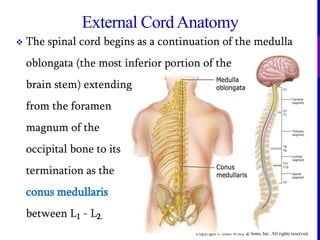
 The spinal cord begins as a continuation of the medulla
oblongata (the most inferior portion of the
brain stem) extending
from the foramen
magnum of the
occipital bone to its
termination as the
conus medullaris
between L1 - L2.
External CordAnatomy
Copyright © John Wiley & Sons, Inc. All rights reserved.
External CordAnatomy
 The spinal cord is oval in shape and slightly flattened
anteriorly and posteriorly.
 Two types of connective tissue
coverings protect the cord
and provide physical stability:
The bony vertebral column
provides the backbone.
The spinal meninges surround
the cord as a continuation of
the cranial meninges that encircle the brain.
Copyright © John Wiley & Sons, Inc. All rights reserved.
External CordAnatomy
 These three membranes (each called a meninx) are
labeled from superficial to deep as follows:
The outermost dura mater (tough mother) forms a sac that
encloses the entire cord.
The middle meninx is a delicate avascular covering
called the arachnoid mater. It is attached to the inside
of the dura and forms the roof of the subarachnoid space
(SAS) in which cerebral spinal fluid (CSF) circulates.
The transparent pia mater is pressed-up against the cord
and is filled with blood vessels that supply nutrients to it.
Copyright © John Wiley & Sons, Inc. All rights reserved.
 The epidural space runs between the dura mater and the
more superficial ligamentum flavum (which lines the
underside of the bony vertebral lamina).
 The subdural space lies between the dura and the
arachnoid. In the spinal column, the dura and arachnoid
membranes
are held firmly together
so that the subdural
space is often no more
than a potential space.
External CordAnatomy
Copyright © John Wiley & Sons, Inc. All rights reserved.
 The pia mater has 21 pairs of denticulate ligaments which
attach it to the arachnoid and dura maters. Named for
their tooth-like appearance, the denticulate ligaments are
traditionally believed to provide stability for the spinal
cord against sudden
shock and
displacement within
the vertebral column.
External CordAnatomy
Copyright © John Wiley & Sons, Inc. All rights reserved.
 Arising from the conus medullaris is the filum terminale,
an extension of the pia mater that extends inferiorly and
blends with the
arachnoid and dura to
anchor the spinal cord to
the coccyx.
 The cauda equina or “horses
tail” are the roots of the
lower spinal nerves that angle
down alongside the filum terminale.
External CordAnatomy
Copyright © John Wiley & Sons, Inc. All rights reserved.
External CordAnatomy
 The spinal cord has two enlargements, one in the cervical
area from C4–T1, and another in the lumbar area between
T9–T12.
 The cervical enlargement
correlates with the sensory
input and motor output to the
upper extremities.
 The lumbar enlargement handles
motor output and sensory input
to and from the legs.
Copyright © John Wiley & Sons, Inc. All rights reserved.
External CordAnatomy
 From superior to inferior, the
spinal cord becomes progressively
smaller.
Copyright © John Wiley & Sons, Inc. All rights reserved.
 Two bundles of axons, called roots, connect each spinal
nerve to a segment of the cord by even smaller bundles of
axons called rootlets.
 The posterior (dorsal) root and rootlets contain only
sensory axons, which conduct
nerve impulses from sensory
receptors in the skin, muscles,
and internal organs into the
central nervous system.
External CordAnatomy
Copyright © John Wiley & Sons, Inc. All rights reserved.
External CordAnatomy
 Each posterior root has a swelling, the posterior (dorsal)
root ganglion, which contains the cell bodies of sensory
neurons. The anterior (ventral) root and rootlets contain
axons of motor neurons, which conduct nerve impulses
from the CNS to
effectors (muscles
and glands).
Copyright © John Wiley & Sons, Inc. All rights reserved.
EpiduralAnesthesia
 Epidural anesthesia is commonly administered to women
about to go into labor. In this procedure, a needle is
placed between the bones of the posterior spine until it
just penetrates the ligamentum flavum yet remains
superficial to the dura mater.
 Local anesthetic is used to provide pain relief –
even complete anesthesia if a cesarean section is required.
Copyright © John Wiley & Sons, Inc. All rights reserved.
Lumbar Puncture
 The site used for most lumbar punctures is between the 3rd
and 4th (or 4th and 5th) lumbar vertebrae - below the
termination of the actual cord in the region of the cauda
equina. With the needle in the SAS, CSF can be sampled.
 Anesthetics can also
be given in this way,
but using 1/10 the
dose required for
epidural anesthesia.
Copyright © John Wiley & Sons, Inc. All rights reserved.
Internal CordAnatomy
 In the spinal cord, the white matter is on the outside, and
the gray matter is on the inside. In the brain the white
matter is on the inside, and the gray matter is on the
outside.
Copyright © John Wiley & Sons, Inc. All rights reserved.
 The white matter of the cord consists of millions of nerve
fibers which transmit electrical information between the
limbs, trunk and organs of the body, and the brain.
 Internal to this peripheral region, and surrounding the
central canal, is the
butterfly-shaped
central region made
up of nerve cell
bodies (gray matter –
here stained brown).
Internal CordAnatomy
Copyright © John Wiley & Sons, Inc. All rights reserved.
Internal CordAnatomy
 Anterior (ventral) gray horns consist of somatic motor
neurons.
 Posterior (dorsal) gray horns consist of somatic and
autonomic sensory nuclei.
 The posterior gray horn is the site of synapse between
first-order sensory neurons coming in from the
periphery, and second-order neurons which either
ascend in the cord or exit back out as parts of reflex
arcs.
Copyright © John Wiley & Sons, Inc. All rights reserved.
Internal CordAnatomy
 The lateral gray horns are found only in the thoracic,
upper lumbar, and sacral segments of the cord.
 They contain cell bodies of autonomic motor neurons
• Some of these fibers ascend outside the dura but close
to the cord to supply sympathetic
innervation to the head.
• Others travel in sympathetic
trunks to the organs and
glands of the thorax, abdomen,
and pelvis.
Copyright © John Wiley & Sons, Inc. All rights reserved.
Internal CordAnatomy
 Other notable features visualized on a transected cord are
the anterior median fissure, the posterior median sulcus,
the gray and white commissures, and the central canal.
 The central canal extends the entire length of the spinal
cord and
is filled
with CSF.
Copyright © John Wiley & Sons, Inc. All rights reserved.
Internal CordAnatomy
 A tract is a bundle of
neuronal axons that are all
located in a specific area of
the cord and all traveling
to the same place (higher
or lower in the brain or
cord).
Copyright © John Wiley & Sons, Inc. All rights reserved.
Internal CordAnatomy
 The white matter of the cord is divided into anterior,
posterior, and lateral columns in which ascending sensory
tracts are traveling to someplace in the brain and
descending motor tracts (red) are traveling to a location in
the cord.
The afferent tracts are noted here in blue, while the efferent tracts are shown in red.
Copyright © John Wiley & Sons, Inc. All rights reserved.
Internal CordAnatomy
 Names of tracts are formed by using compound words that
denote the origin of the tract, and the place where it ends.
 The spinothalamic tract goes from the spinal cord to the
brain – it is an afferent tract.
 The corticospinal tract goes from the cortex of the brain
to the spinal cord – it is an efferent tract.
 The vestibulospinal tract originates from an area in the
brain which you probably don’t recognize; however,
you can recognize the destination in the spine, and
therefore deduce that it is a motor tract.
Copyright © John Wiley & Sons, Inc. All rights reserved.
Internal CordAnatomy
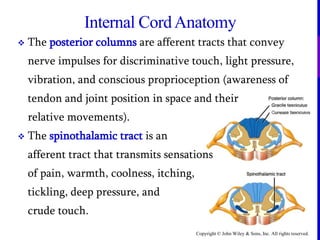
 The posterior columns are afferent tracts that convey
nerve impulses for discriminative touch, light pressure,
vibration, and conscious proprioception (awareness of
tendon and joint position in space and their
relative movements).
 The spinothalamic tract is an
afferent tract that transmits sensations
of pain, warmth, coolness, itching,
tickling, deep pressure, and
crude touch.
Copyright © John Wiley & Sons, Inc. All rights reserved.
Internal CordAnatomy
 The lateral and anterior corticospinal tracts are major
pathways for carrying signals from the cerebral cortex
that result in voluntary movement of skeletal muscles.
 Other motor tracts convey nerve impulses from the
brain stem that coordinate
visual stimuli with body
movements, maintain
posture and regulate
skeletal muscle tone.
Copyright © John Wiley & Sons, Inc. All rights reserved.
 A dermatome is an area of skin that is
innervated by a single spinal nerve,
indicated by the letters and number of a
particular segmental nerve.
 Important dermatomes include:
 C6/C7 - thumb and index
finger (“six-shooter”)
 T4 - nipple line
 T10 - umbilicus
 L1-L5 - lower extremities
“L for legs”)
Dermatomes
Copyright © John Wiley & Sons, Inc. All rights reserved.
Damage to the Cord
 “Transection” of the spinal cord means that ascending and
descending tracts are partially or completely severed.
 If transection occurs, say in a motor vehicle or diving
accident, paralysis will occur depending on the level of the
injury. Transection:
 at the base of skull results in death by asphyxiation
 in the upper cervical area results in quadriplegia
 between the cord enlargements results in some form of
paraplegia
Copyright © John Wiley & Sons, Inc. All rights reserved.
Peripheral Nerves
Copyright © John Wiley & Sons, Inc. All rights reserved.
Peripheral Nerves
 Spinal nerves are the paths of communication between
the spinal cord and specific regions of the body.
 Nerves are arranged in fascicles surrounded by a
perineurium, with the entire nerve sheathed by a CT
epineurium.
Copyright © John Wiley & Sons, Inc. All rights reserved.
Peripheral Nerves
 31 left-right pairs of spinal nerves emerge from the cord
at regular intervals (called segments). Except for the first
cervical pair the spinal nerves leave the vertebral column
from the intervertebral foramen between adjoining
vertebrae – the first pair leaves between the
skull and the first cervical vertebrae .
Cervical – 8 pairs, C1-C8
Thoracic – 12 pairs, T1-T12
Lumbar – 5 pairs, L1-L5
Sacral - 5 pairs, S1-S5
Coccygeal – 1 nerve pair
Copyright © John Wiley & Sons, Inc. All rights reserved.
 Piercing the dura, the segmental (spinal) nerves exit the
central nervous system into the peripheral nervous system
and almost immediately split into 3 major branches: An
anterior ramus, posterior ramus, and rami communicantes
(connections to
sympathetic
ganglia).
Peripheral Nerves
Copyright © John Wiley & Sons, Inc. All rights reserved.
Peripheral Nerves
 The anterior rami of the segmental nerves may travel
alone (such as the intercostal nerves which run
underneath each of the 12 ribs), or they can join together
to form large “braided ropes” – a plexus of nerves.
 There are a number of major nerve plexuses, all formed
from anterior rami of spinal nerves, and all located
anterior to the spine: The cervical plexus, brachial
plexus, celiac (solar) plexus, lumbar plexus, sacral
plexus, and coccygeal plexus
Copyright © John Wiley & Sons, Inc. All rights reserved.
Nerve Plexuses
 The cervical plexus, formed by the anterior rami of C1-C5,
serves the head, neck, and diaphragm.
 The phrenic nerves arise from the cervical plexus to
supply the major muscle of
respiration (“C3,4,5 keep
the diaphragm alive”).
Copyright © John Wiley & Sons, Inc. All rights reserved.
Nerve Plexuses
 The brachial plexus is formed
by the anterior rami of C5-C8
and T1. It is divided into
roots → trunks → divisions
→ cords → nerves.
 The nerves from the
brachial plexus supply the
shoulders and upper limbs.
Copyright © John Wiley & Sons, Inc. All rights reserved.
 Some of the major nerves that arise from the brachial
plexuses are the:
 musculocutaneous
nerve
 axillary nerve
 radial nerve
 median nerve
 ulnar nerve
 long thoracic nerve
Nerve Plexuses
Copyright © John Wiley & Sons, Inc. All rights reserved.
Nerve Plexuses
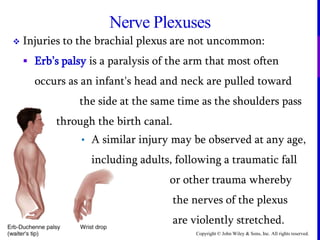
 Injuries to the brachial plexus are not uncommon:
 Erb’s palsy is a paralysis of the arm that most often
occurs as an infant's head and neck are pulled toward
the side at the same time as the shoulders pass
through the birth canal.
• A similar injury may be observed at any age,
including adults, following a traumatic fall
or other trauma whereby
the nerves of the plexus
are violently stretched.
Copyright © John Wiley & Sons, Inc. All rights reserved.
Nerve Plexuses
 Injuries to the brachial plexus or peripheral nerves:
 Median nerve injury, either at the plexus or occurring
more distally, results in numbness, tingling and pain in
the palm and fingers.
• Carpal tunnel syndrome is a common type of median
nerve injury that is seen in people who perform
repetitive motions of the hand and
wrist like typing on a computer
keyboard.
Copyright © John Wiley & Sons, Inc. All rights reserved.
 The ulnar nerve is the largest unprotected (by muscle or
bone) nerve in the human body. It emerges from the
medial and lateral cords of the brachial plexus to supply
the medial half of the hand. Striking the medial
epicondyle of the humerus where the nerve is exposed
is referred to as bumping one’s “funny bone”.
 Damage to the nerve leads to
abnormal sensations in the 4–5th
fingers and an inability to abduct
or adduct the little and ring fingers.
Nerve Plexuses
Copyright © John Wiley & Sons, Inc. All rights reserved.
Nerve Plexuses
 The long thoracic nerve emerges from the cords of the
brachial plexus to supply the serratus anterior muscle.
 Because of its long, relatively superficial course, it is
susceptible to injury either through direct trauma or
stretch of the plexus. Injury (resulting in
a “winged scapula” in which the
arm cannot be abducted beyond the
horizontal position) has been reported
in almost all sports.
Copyright © John Wiley & Sons, Inc. All rights reserved.
Nerve Plexuses
 The lumbar plexus is formed by the anterior rami of L1-L4
to supply the anterolateral abdominal wall, external
genitalia, and part of the lower limbs.
 The femoral and obturator
nerves come from the
lumbar plexus.
Copyright © John Wiley & Sons, Inc. All rights reserved.
Nerve Plexuses
 The sacral plexus is formed by the anterior rami of L4-L5
and S1-S4. It supplies the buttocks, perineum, and part of
the lower limbs.
 It gives rise to the largest
nerve in the body, the
sciatic nerve.
Copyright © John Wiley & Sons, Inc. All rights reserved.
Nerve Plexuses
 The coccygeal plexus is formed by the anterior rami of S4-
S5 and the coccygeal nerves. It is a small plexus from
which the anococcygeal nerve exits to supply a small area
of skin in the
coccygeal region.
Copyright © John Wiley & Sons, Inc. All rights reserved.
Nerve Terminology Summary
 Rootlets  roots (ant. and post.)  segmental nerves 
 anterior ramus  form large nerve plexuses
 posterior ramus
 rami communicantes
Copyright © John Wiley & Sons, Inc. All rights reserved.
Reflexes
 A reflex is a fast, involuntary response to a stimulus. In a
spinal reflex the integration takes place in the spinal cord,
not the brain.
 Spinal reflexes can be monosynaptic (sensory neuron
with motor neuron) or polysynaptic (involving
interneurons), and they can go in and out on the same,
or on the opposite
side of the
cord.
Copyright © John Wiley & Sons, Inc. All rights reserved.
Reflexes
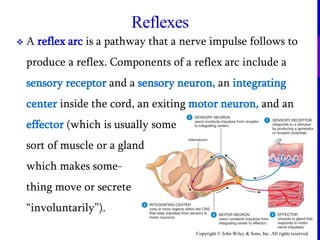
 A reflex arc is a pathway that a nerve impulse follows to
produce a reflex. Components of a reflex arc include a
sensory receptor and a sensory neuron, an integrating
center inside the cord, an exiting motor neuron, and an
effector (which is usually some
sort of muscle or a gland
which makes some-
thing move or secrete
“involuntarily”).
Copyright © John Wiley & Sons, Inc. All rights reserved.
Reflexes
 Sensory receptors involved in reflex arcs are specifically
adapted to perceive the stimulus and initiate an impulse.
 The motor neuron
becomes stimulated
without any processing
in the brain (that comes
later)… first you kick the
person examining you
(patellar reflex), then you feel
the tap of the hammer!
Copyright © John Wiley & Sons, Inc. All rights reserved.
 Reflex arcs can be ipsilateral (all neurons and effectors on
the same side of the body) or contralateral (the receptors
and afferent neurons are on the opposite
side of the body as the efferent
neurons and effectors.)
The flexor (withdrawal)
reflex is a good example
of a contralateral reflex
(stepping on a tack).
Reflexes
Copyright © John Wiley & Sons, Inc. All rights reserved.
Reflexes
 In addition to initiating the flexor
reflex that causes you to
withdraw the limb, the pain
impulses from stepping
on the tack also
initiate a crossed-
extensor reflex to
help you maintain
your balance.
Copyright © John Wiley & Sons, Inc. All rights reserved.
Reflexes
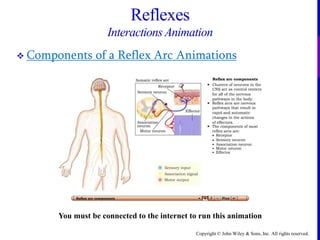
InteractionsAnimation
 Components of a Reflex Arc Animations
You must be connected to the internet to run this animation
Copyright © John Wiley & Sons, Inc. All rights reserved.
Reflexes
 Some important spinal reflexes include:
 The patellar reflex in which the leg extends in response
to stretch of the patellar tendon. This reflex can be
blocked by damage in the corticospinal tracts from
diabetes, neurosyphilis, or damage to the lumbar region
of the spinal cord.
 The Achilles reflex causes contraction of the calf when
a force is applied to the Achilles tendon. It is absent
after damage to the lower cord or lumbosacral plexus.
Copyright © John Wiley & Sons, Inc. All rights reserved.
Reflexes
 Some important spinal reflexes include:
 The Babinski, or plantar flexion reflex is considered
normal in adults if they flex (curl) the big toe when the
sole of the foot is stimulated. If the sole of the foot is
stimulated and the patient extends the big toe, it would
indicate damage in the corticospinal tract.
 Infants normally extend their toes when stimulated in
this way; so an “abnormal Babinski” does not indicate
any disease or damage in this age group.

Chapter 13

  • 1.
    Copyright © JohnWiley & Sons, Inc. All rights reserved. Chapter 13 The Spinal Cord and Spinal Nerves
  • 2.
    Copyright © JohnWiley & Sons, Inc. All rights reserved. Introduction to the Spinal Cord  About 100 million neurons and even more neuroglia comprise the spinal cord, the part of the central nervous system that extends from the brain.  The spinal cord and its associated spinal nerves contain reflex circuits that control some of your most rapid reactions to environmental changes.  The gray matter of the cord is a site for integration of postsynaptic potentials (IPSPs and EPSPs).  The white matter of the cord contains major sensory and motor tracts to and from the brain.
  • 3.
    Copyright © JohnWiley & Sons, Inc. All rights reserved.  The spinal cord begins as a continuation of the medulla oblongata (the most inferior portion of the brain stem) extending from the foramen magnum of the occipital bone to its termination as the conus medullaris between L1 - L2. External CordAnatomy
  • 4.
    Copyright © JohnWiley & Sons, Inc. All rights reserved. External CordAnatomy  The spinal cord is oval in shape and slightly flattened anteriorly and posteriorly.  Two types of connective tissue coverings protect the cord and provide physical stability: The bony vertebral column provides the backbone. The spinal meninges surround the cord as a continuation of the cranial meninges that encircle the brain.
  • 5.
    Copyright © JohnWiley & Sons, Inc. All rights reserved. External CordAnatomy  These three membranes (each called a meninx) are labeled from superficial to deep as follows: The outermost dura mater (tough mother) forms a sac that encloses the entire cord. The middle meninx is a delicate avascular covering called the arachnoid mater. It is attached to the inside of the dura and forms the roof of the subarachnoid space (SAS) in which cerebral spinal fluid (CSF) circulates. The transparent pia mater is pressed-up against the cord and is filled with blood vessels that supply nutrients to it.
  • 6.
    Copyright © JohnWiley & Sons, Inc. All rights reserved.  The epidural space runs between the dura mater and the more superficial ligamentum flavum (which lines the underside of the bony vertebral lamina).  The subdural space lies between the dura and the arachnoid. In the spinal column, the dura and arachnoid membranes are held firmly together so that the subdural space is often no more than a potential space. External CordAnatomy
  • 7.
    Copyright © JohnWiley & Sons, Inc. All rights reserved.  The pia mater has 21 pairs of denticulate ligaments which attach it to the arachnoid and dura maters. Named for their tooth-like appearance, the denticulate ligaments are traditionally believed to provide stability for the spinal cord against sudden shock and displacement within the vertebral column. External CordAnatomy
  • 8.
    Copyright © JohnWiley & Sons, Inc. All rights reserved.  Arising from the conus medullaris is the filum terminale, an extension of the pia mater that extends inferiorly and blends with the arachnoid and dura to anchor the spinal cord to the coccyx.  The cauda equina or “horses tail” are the roots of the lower spinal nerves that angle down alongside the filum terminale. External CordAnatomy
  • 9.
    Copyright © JohnWiley & Sons, Inc. All rights reserved. External CordAnatomy  The spinal cord has two enlargements, one in the cervical area from C4–T1, and another in the lumbar area between T9–T12.  The cervical enlargement correlates with the sensory input and motor output to the upper extremities.  The lumbar enlargement handles motor output and sensory input to and from the legs.
  • 10.
    Copyright © JohnWiley & Sons, Inc. All rights reserved. External CordAnatomy  From superior to inferior, the spinal cord becomes progressively smaller.
  • 11.
    Copyright © JohnWiley & Sons, Inc. All rights reserved.  Two bundles of axons, called roots, connect each spinal nerve to a segment of the cord by even smaller bundles of axons called rootlets.  The posterior (dorsal) root and rootlets contain only sensory axons, which conduct nerve impulses from sensory receptors in the skin, muscles, and internal organs into the central nervous system. External CordAnatomy
  • 12.
    Copyright © JohnWiley & Sons, Inc. All rights reserved. External CordAnatomy  Each posterior root has a swelling, the posterior (dorsal) root ganglion, which contains the cell bodies of sensory neurons. The anterior (ventral) root and rootlets contain axons of motor neurons, which conduct nerve impulses from the CNS to effectors (muscles and glands).
  • 13.
    Copyright © JohnWiley & Sons, Inc. All rights reserved. EpiduralAnesthesia  Epidural anesthesia is commonly administered to women about to go into labor. In this procedure, a needle is placed between the bones of the posterior spine until it just penetrates the ligamentum flavum yet remains superficial to the dura mater.  Local anesthetic is used to provide pain relief – even complete anesthesia if a cesarean section is required.
  • 14.
    Copyright © JohnWiley & Sons, Inc. All rights reserved. Lumbar Puncture  The site used for most lumbar punctures is between the 3rd and 4th (or 4th and 5th) lumbar vertebrae - below the termination of the actual cord in the region of the cauda equina. With the needle in the SAS, CSF can be sampled.  Anesthetics can also be given in this way, but using 1/10 the dose required for epidural anesthesia.
  • 15.
    Copyright © JohnWiley & Sons, Inc. All rights reserved. Internal CordAnatomy  In the spinal cord, the white matter is on the outside, and the gray matter is on the inside. In the brain the white matter is on the inside, and the gray matter is on the outside.
  • 16.
    Copyright © JohnWiley & Sons, Inc. All rights reserved.  The white matter of the cord consists of millions of nerve fibers which transmit electrical information between the limbs, trunk and organs of the body, and the brain.  Internal to this peripheral region, and surrounding the central canal, is the butterfly-shaped central region made up of nerve cell bodies (gray matter – here stained brown). Internal CordAnatomy
  • 17.
    Copyright © JohnWiley & Sons, Inc. All rights reserved. Internal CordAnatomy  Anterior (ventral) gray horns consist of somatic motor neurons.  Posterior (dorsal) gray horns consist of somatic and autonomic sensory nuclei.  The posterior gray horn is the site of synapse between first-order sensory neurons coming in from the periphery, and second-order neurons which either ascend in the cord or exit back out as parts of reflex arcs.
  • 18.
    Copyright © JohnWiley & Sons, Inc. All rights reserved. Internal CordAnatomy  The lateral gray horns are found only in the thoracic, upper lumbar, and sacral segments of the cord.  They contain cell bodies of autonomic motor neurons • Some of these fibers ascend outside the dura but close to the cord to supply sympathetic innervation to the head. • Others travel in sympathetic trunks to the organs and glands of the thorax, abdomen, and pelvis.
  • 19.
    Copyright © JohnWiley & Sons, Inc. All rights reserved. Internal CordAnatomy  Other notable features visualized on a transected cord are the anterior median fissure, the posterior median sulcus, the gray and white commissures, and the central canal.  The central canal extends the entire length of the spinal cord and is filled with CSF.
  • 20.
    Copyright © JohnWiley & Sons, Inc. All rights reserved. Internal CordAnatomy  A tract is a bundle of neuronal axons that are all located in a specific area of the cord and all traveling to the same place (higher or lower in the brain or cord).
  • 21.
    Copyright © JohnWiley & Sons, Inc. All rights reserved. Internal CordAnatomy  The white matter of the cord is divided into anterior, posterior, and lateral columns in which ascending sensory tracts are traveling to someplace in the brain and descending motor tracts (red) are traveling to a location in the cord. The afferent tracts are noted here in blue, while the efferent tracts are shown in red.
  • 22.
    Copyright © JohnWiley & Sons, Inc. All rights reserved. Internal CordAnatomy  Names of tracts are formed by using compound words that denote the origin of the tract, and the place where it ends.  The spinothalamic tract goes from the spinal cord to the brain – it is an afferent tract.  The corticospinal tract goes from the cortex of the brain to the spinal cord – it is an efferent tract.  The vestibulospinal tract originates from an area in the brain which you probably don’t recognize; however, you can recognize the destination in the spine, and therefore deduce that it is a motor tract.
  • 23.
    Copyright © JohnWiley & Sons, Inc. All rights reserved. Internal CordAnatomy  The posterior columns are afferent tracts that convey nerve impulses for discriminative touch, light pressure, vibration, and conscious proprioception (awareness of tendon and joint position in space and their relative movements).  The spinothalamic tract is an afferent tract that transmits sensations of pain, warmth, coolness, itching, tickling, deep pressure, and crude touch.
  • 24.
    Copyright © JohnWiley & Sons, Inc. All rights reserved. Internal CordAnatomy  The lateral and anterior corticospinal tracts are major pathways for carrying signals from the cerebral cortex that result in voluntary movement of skeletal muscles.  Other motor tracts convey nerve impulses from the brain stem that coordinate visual stimuli with body movements, maintain posture and regulate skeletal muscle tone.
  • 25.
    Copyright © JohnWiley & Sons, Inc. All rights reserved.  A dermatome is an area of skin that is innervated by a single spinal nerve, indicated by the letters and number of a particular segmental nerve.  Important dermatomes include:  C6/C7 - thumb and index finger (“six-shooter”)  T4 - nipple line  T10 - umbilicus  L1-L5 - lower extremities “L for legs”) Dermatomes
  • 26.
    Copyright © JohnWiley & Sons, Inc. All rights reserved. Damage to the Cord  “Transection” of the spinal cord means that ascending and descending tracts are partially or completely severed.  If transection occurs, say in a motor vehicle or diving accident, paralysis will occur depending on the level of the injury. Transection:  at the base of skull results in death by asphyxiation  in the upper cervical area results in quadriplegia  between the cord enlargements results in some form of paraplegia
  • 27.
    Copyright © JohnWiley & Sons, Inc. All rights reserved. Peripheral Nerves
  • 28.
    Copyright © JohnWiley & Sons, Inc. All rights reserved. Peripheral Nerves  Spinal nerves are the paths of communication between the spinal cord and specific regions of the body.  Nerves are arranged in fascicles surrounded by a perineurium, with the entire nerve sheathed by a CT epineurium.
  • 29.
    Copyright © JohnWiley & Sons, Inc. All rights reserved. Peripheral Nerves  31 left-right pairs of spinal nerves emerge from the cord at regular intervals (called segments). Except for the first cervical pair the spinal nerves leave the vertebral column from the intervertebral foramen between adjoining vertebrae – the first pair leaves between the skull and the first cervical vertebrae . Cervical – 8 pairs, C1-C8 Thoracic – 12 pairs, T1-T12 Lumbar – 5 pairs, L1-L5 Sacral - 5 pairs, S1-S5 Coccygeal – 1 nerve pair
  • 30.
    Copyright © JohnWiley & Sons, Inc. All rights reserved.  Piercing the dura, the segmental (spinal) nerves exit the central nervous system into the peripheral nervous system and almost immediately split into 3 major branches: An anterior ramus, posterior ramus, and rami communicantes (connections to sympathetic ganglia). Peripheral Nerves
  • 31.
    Copyright © JohnWiley & Sons, Inc. All rights reserved. Peripheral Nerves  The anterior rami of the segmental nerves may travel alone (such as the intercostal nerves which run underneath each of the 12 ribs), or they can join together to form large “braided ropes” – a plexus of nerves.  There are a number of major nerve plexuses, all formed from anterior rami of spinal nerves, and all located anterior to the spine: The cervical plexus, brachial plexus, celiac (solar) plexus, lumbar plexus, sacral plexus, and coccygeal plexus
  • 32.
    Copyright © JohnWiley & Sons, Inc. All rights reserved. Nerve Plexuses  The cervical plexus, formed by the anterior rami of C1-C5, serves the head, neck, and diaphragm.  The phrenic nerves arise from the cervical plexus to supply the major muscle of respiration (“C3,4,5 keep the diaphragm alive”).
  • 33.
    Copyright © JohnWiley & Sons, Inc. All rights reserved. Nerve Plexuses  The brachial plexus is formed by the anterior rami of C5-C8 and T1. It is divided into roots → trunks → divisions → cords → nerves.  The nerves from the brachial plexus supply the shoulders and upper limbs.
  • 34.
    Copyright © JohnWiley & Sons, Inc. All rights reserved.  Some of the major nerves that arise from the brachial plexuses are the:  musculocutaneous nerve  axillary nerve  radial nerve  median nerve  ulnar nerve  long thoracic nerve Nerve Plexuses
  • 35.
    Copyright © JohnWiley & Sons, Inc. All rights reserved. Nerve Plexuses  Injuries to the brachial plexus are not uncommon:  Erb’s palsy is a paralysis of the arm that most often occurs as an infant's head and neck are pulled toward the side at the same time as the shoulders pass through the birth canal. • A similar injury may be observed at any age, including adults, following a traumatic fall or other trauma whereby the nerves of the plexus are violently stretched.
  • 36.
    Copyright © JohnWiley & Sons, Inc. All rights reserved. Nerve Plexuses  Injuries to the brachial plexus or peripheral nerves:  Median nerve injury, either at the plexus or occurring more distally, results in numbness, tingling and pain in the palm and fingers. • Carpal tunnel syndrome is a common type of median nerve injury that is seen in people who perform repetitive motions of the hand and wrist like typing on a computer keyboard.
  • 37.
    Copyright © JohnWiley & Sons, Inc. All rights reserved.  The ulnar nerve is the largest unprotected (by muscle or bone) nerve in the human body. It emerges from the medial and lateral cords of the brachial plexus to supply the medial half of the hand. Striking the medial epicondyle of the humerus where the nerve is exposed is referred to as bumping one’s “funny bone”.  Damage to the nerve leads to abnormal sensations in the 4–5th fingers and an inability to abduct or adduct the little and ring fingers. Nerve Plexuses
  • 38.
    Copyright © JohnWiley & Sons, Inc. All rights reserved. Nerve Plexuses  The long thoracic nerve emerges from the cords of the brachial plexus to supply the serratus anterior muscle.  Because of its long, relatively superficial course, it is susceptible to injury either through direct trauma or stretch of the plexus. Injury (resulting in a “winged scapula” in which the arm cannot be abducted beyond the horizontal position) has been reported in almost all sports.
  • 39.
    Copyright © JohnWiley & Sons, Inc. All rights reserved. Nerve Plexuses  The lumbar plexus is formed by the anterior rami of L1-L4 to supply the anterolateral abdominal wall, external genitalia, and part of the lower limbs.  The femoral and obturator nerves come from the lumbar plexus.
  • 40.
    Copyright © JohnWiley & Sons, Inc. All rights reserved. Nerve Plexuses  The sacral plexus is formed by the anterior rami of L4-L5 and S1-S4. It supplies the buttocks, perineum, and part of the lower limbs.  It gives rise to the largest nerve in the body, the sciatic nerve.
  • 41.
    Copyright © JohnWiley & Sons, Inc. All rights reserved. Nerve Plexuses  The coccygeal plexus is formed by the anterior rami of S4- S5 and the coccygeal nerves. It is a small plexus from which the anococcygeal nerve exits to supply a small area of skin in the coccygeal region.
  • 42.
    Copyright © JohnWiley & Sons, Inc. All rights reserved. Nerve Terminology Summary  Rootlets  roots (ant. and post.)  segmental nerves   anterior ramus  form large nerve plexuses  posterior ramus  rami communicantes
  • 43.
    Copyright © JohnWiley & Sons, Inc. All rights reserved. Reflexes  A reflex is a fast, involuntary response to a stimulus. In a spinal reflex the integration takes place in the spinal cord, not the brain.  Spinal reflexes can be monosynaptic (sensory neuron with motor neuron) or polysynaptic (involving interneurons), and they can go in and out on the same, or on the opposite side of the cord.
  • 44.
    Copyright © JohnWiley & Sons, Inc. All rights reserved. Reflexes  A reflex arc is a pathway that a nerve impulse follows to produce a reflex. Components of a reflex arc include a sensory receptor and a sensory neuron, an integrating center inside the cord, an exiting motor neuron, and an effector (which is usually some sort of muscle or a gland which makes some- thing move or secrete “involuntarily”).
  • 45.
    Copyright © JohnWiley & Sons, Inc. All rights reserved. Reflexes  Sensory receptors involved in reflex arcs are specifically adapted to perceive the stimulus and initiate an impulse.  The motor neuron becomes stimulated without any processing in the brain (that comes later)… first you kick the person examining you (patellar reflex), then you feel the tap of the hammer!
  • 46.
    Copyright © JohnWiley & Sons, Inc. All rights reserved.  Reflex arcs can be ipsilateral (all neurons and effectors on the same side of the body) or contralateral (the receptors and afferent neurons are on the opposite side of the body as the efferent neurons and effectors.) The flexor (withdrawal) reflex is a good example of a contralateral reflex (stepping on a tack). Reflexes
  • 47.
    Copyright © JohnWiley & Sons, Inc. All rights reserved. Reflexes  In addition to initiating the flexor reflex that causes you to withdraw the limb, the pain impulses from stepping on the tack also initiate a crossed- extensor reflex to help you maintain your balance.
  • 48.
    Copyright © JohnWiley & Sons, Inc. All rights reserved. Reflexes InteractionsAnimation  Components of a Reflex Arc Animations You must be connected to the internet to run this animation
  • 49.
    Copyright © JohnWiley & Sons, Inc. All rights reserved. Reflexes  Some important spinal reflexes include:  The patellar reflex in which the leg extends in response to stretch of the patellar tendon. This reflex can be blocked by damage in the corticospinal tracts from diabetes, neurosyphilis, or damage to the lumbar region of the spinal cord.  The Achilles reflex causes contraction of the calf when a force is applied to the Achilles tendon. It is absent after damage to the lower cord or lumbosacral plexus.
  • 50.
    Copyright © JohnWiley & Sons, Inc. All rights reserved. Reflexes  Some important spinal reflexes include:  The Babinski, or plantar flexion reflex is considered normal in adults if they flex (curl) the big toe when the sole of the foot is stimulated. If the sole of the foot is stimulated and the patient extends the big toe, it would indicate damage in the corticospinal tract.  Infants normally extend their toes when stimulated in this way; so an “abnormal Babinski” does not indicate any disease or damage in this age group.