Chapter 2
The Chemical Level of
Organization
Introduction
Since chemicals compose your body
(and all body activities are chemical
in nature), it is important to become
familiar with the language and
fundamental concepts of chemistry.
How Matter is Organized
 All forms of matter are composed of chemical elements
which are substances that cannot be split into simpler
substances by ordinary chemical means.
– Elements are given letter abbreviations called chemical
symbols.
– Trace elements are
elements in our
bodies, present in
tiny amounts .
Structure of Atoms
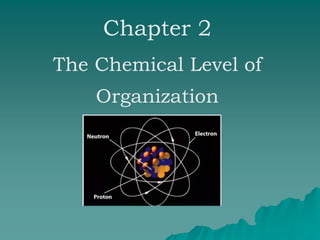
 Units of matter of all chemical elements are called
atoms. An element is a quantity of matter composed
of atoms of the same type. Atoms contain:
 Nucleus: protons (p+)
& neutrons (no)
 Electrons (e-)
surround the nucleus
as a cloud
 Electrons are very small and
light (mass about 1/2000th
that of proton or neutron),
often represented as a
“planet” orbiting the “sun”
(atomic nucleus). In reality,
they are found in a “cloud”
of probability. This concept,
however, made even
Einstein’s head hurt – we
can use the planets-orbiting-
the-sun model for this
course!
Structure of Atoms
 Mass is measured as a dalton (atomic mass unit).
– Masses of subatomic particles
Neutron - mass of 1.008 daltons
Proton - mass of
1.007 daltons
Electron has mass of
0.0005 dalton
Structure of Atoms
– Atomic number is the number of protons in an
atom.
– Mass number is the sum of protons and neutrons
in an atom and indicates how much the atoms
“weighs”—this is always a whole number.
– Atomic mass (atomic weight) is the average
mass of all naturally occurring isotopes—since this
is an average, it is not exactly a whole number.
Structure of Atoms
Structure of Atoms
Ions, Molecules, & Compounds
 Ions are atoms that have given up or gained
an electron in their outer electron shell (also
called the valence shell).
–Written with its chemical symbol and (+)
or (–)
Ions, Molecules, & Compounds
 Molecules are formed when atoms share electrons.
– Written as a molecular formula showing the number of
atoms of each element (H2O)
– The oxygen gas in the atmosphere we breath is really not
oxygen the atom, but a pair of oxygen atoms linked together
into an oxygen molecule (O2) .
 Compound
 A free radical is an electrically charged atom or group of
atoms with an unpaired electron in its outermost shell.
 Antioxidants are substances that inactivate oxygen-
derived free radicals.
Ions, Molecules, & Compounds
Chemical Bonds
 The atoms of a molecule are held together by
forces of attraction called chemical bonds.
 Valence shell.
Ionic Bond Formation
Chemical Bonds
 Covalent bonds are formed by the atoms of
molecules sharing one, two, or three pairs of their
valence electrons.
– Covalent bonds are the strongest chemical bonds.
– Single, double, or triple covalent bonds are
formed by sharing one, two, or three pairs
of electrons, respectively.
Chemical Bonds
 Hydrogen bonds are weak interactions (approximately 5% as
strong as covalent bonds) between hydrogen and adjacent
electronegative atoms like oxygen or sulfur.
Chemical Bonds
 Hydrogen bonds are useful in establishing links
between molecules or between distant parts of a
very large molecule. Large 3-D molecules (like
proteins) are often held together by a great many
hydrogen bonds.
In water, hydrogen bonding provides considerable
cohesion which creates a very high surface tension
(as this bug demonstrates).
Chemical Bonds
Chemical Reactions
 Chemical reactions occur when electrons in
the valence shell are shared or transferred.
New bonds form and/or old bonds are
broken.
 Metabolism is the “sum of all the chemical
reactions in the body”.
 Law of conservation of energy:
–The total mass of reactants equals the
total mass of the products .
 Energy (the capacity to do work) is
transferred in a chemical reaction.
 Kinetic energy is the energy of
matter in motion.
 Potential energy is energy stored by
matter - due to an object’s position in
space, or stored in chemical bonds.
Chemical Reactions
 Exergonic reactions
 Endergonic reactions
Chemical Reactions
 Activation
Energy is the
energy
required to
break
chemical
bonds in the
reactant
molecules so
a reaction can
start.
Chemical Reactions
 Factors that cause a collision
- temperature
-concentration of the reactants,
-presence or absence of a catalyst.
 Catalysts are chemical compounds that
speed up chemical reactions by lowering
the activation energy needed for a reaction
to occur.
Chemical Reactions
 In a chemical reaction, a catalyst helps to properly
orient the colliding particles
Chemical Reactions
 Types of chemical reactions can be broadly classified as:
– Synthesis reactions – Anabolism
 A + B ➙ AB
– Decomposition reactions – Catabolism
 AB ➙ A + B
– Exchange reactions
 AB + CD ➙ AD + CB
– Reversible reactions
 AC ↔ A + C
Chemical Reactions
Inorganic & Organic Compounds
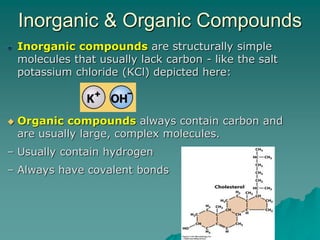
Inorganic compounds are structurally simple
molecules that usually lack carbon - like the salt
potassium chloride (KCl) depicted here:
 Organic compounds always contain carbon and
are usually large, complex molecules.
– Usually contain hydrogen
– Always have covalent bonds
 Water is the most important and abundant
inorganic compound in all living systems.
 Water’s most important property is polarity, the
uneven sharing of valence electrons that enables
reactants to collide to form products.
Inorganic Compounds
Inorganic Compounds
Sodium and Chloride ions dissolve in the polar water
molecules.
 Water as a solvent:
– In a solution, the solvent dissolves the solute.
– Substances which contain polar covalent bonds and
dissolve in water are hydrophilic, while substances
which contain non-polar covalent bonds are
hydrophobic.
– Water’s role as a solvent makes it essential for
health and survival.
Inorganic Compounds
 Water has a high heat capacity, meaning it can
absorb or release a relatively large amount of heat
with only a modest change in its own temperature.
 This property is due to the large number of
hydrogen ions in water.
Heat of vaporization (amount of heat needed to
change from a liquid to a gas) is also high.
– Evaporation of water from the skin removes large
amounts of heat.
Inorganic Compounds
 A mixture is a combination of elements or compounds
that are physically blended together but are not bound
by chemical bonds.
 In a solution, a substance called the solvent dissolves
another substance called the solute. Usually there is
more solvent than solute in a solution.
– In our bodies, the most common solvent is water: We
are 65-80% water (depending on age - babies are
very “wet”… as anyone who has had one can attest.)
Three Common Mixtures
 A colloid differs from a solution mainly on
the basis of the size of its particles, with the
particles in the colloid being large enough
to scatter light (milk).
 In a suspension, the suspended material
may mix with the liquid or suspending
medium for some time, but it will
eventually settle out (blood is a
suspension.)
Three Common Mixtures
 The convenience is that one mole of hydrogen
atoms weighs 1.01 grams, the same in grams
as the atomic mass of hydrogen in Daltons.
– 1 mole of oxygen atoms = 15.999 grams
– 1 mole of sodium atoms = 22.989 grams
– 1 mole of any atom or molecule is found in the
atomic mass of that element, or the molecular
mass of that compound.
Methods of Measurement
 The concentration of a molecule is a way of
stating the amount of that molecule in solution.
 Percent gives the relative mass of a solute found in
100 ml of solution (usually water).
 A mole is just a convenient way of counting large
numbers of small things (like atoms or molecules).
– 1 mole is 6.02 x 10²³ of something just like 1
dozen is 12 of something.
Methods of Measurement
 The concentration of a molecule is a way of
stating the amount of that molecule in solution.
 Percent gives the relative mass of a solute found in
100 ml of solution (usually water).
 A mole is just a convenient way of counting large
numbers of small things (like atoms or molecules).
– 1 mole is 6.02 x 10²³ of something just like 1
dozen is 12 of something.
Methods of Measurement
 Acid – Dissociates into one more hydrogen ions
 Base – Dissociates into one or more hydroxide ions
 Salt – Dissociates into cations and anions
Inorganic acids and bases
pH = –log[H+] (concentration of H+ in
moles/l)
It is a scale that runs from 0 to 14
Acids, Bases and Buffers
pH < 7 is acidic ([H+] >
[OH-]);
pH > 7 is alkaline ([H+]
< [OH-])
A salt (like KCl) is
neutral
The pH values of different parts of the
body are maintained fairly constant by
buffer systems, which usually consist
of a weak acid and a weak base.
–Buffers convert strong acids and strong
bases into weak acids and weak bases.
They do this by “hiding” excess H+ ions or
excess OH– ions as other molecules (like
HCO3
– ) .
–The major buffer system in the body is
carbonic acid-bicarbonate buffer system.
Acids, Bases and Buffers
Functional groups are certain molecular
configurations which are easy to recognize.
They are found attached to the carbon skeleton
and impart certain properties to the organic
molecule.
Some of the more common
functional groups are:
– Esters, amino, carboxyl, phosphate groups
– Others are found on the following chart
(next slide)
Organic Compounds
Organic Compounds
Organic Compounds
Organic Compounds
 Very large molecules are called macromolecules (or
“polymers” if all the monomer subunits are
similar).
 Isomers have the same
molecular formulas but different
structures (glucose & galactose
are both C6H12O6).
Organic Compounds
Carbohydrates provide most of the
energy
Some carbohydrates are converted to
other substances which are used to
build structures and to generate ATP.
Other carbohydrates function as food
reserves.
Carbohydrates are divided into three
major groups based on their size:
monosaccharides, disaccharides, and
polysaccharides .
Organic Compounds
 Monosaccharides (Carbohydrates)
are the simplest sugars:
– 5 carbon sugars are used in
nucleic acids.
– 6 carbon sugars are the most
easily recognizable in our diet.
Organic Compounds
 Disaccharides are made by combining 2
monosaccharides by removing a water
molecule (dehydration synthesis):
sucrose = glucose + fructose
lactose = glucose + galactose
Organic Compounds
 Polysaccharides are the largest
carbohydrates and may contain hundreds of
monosaccharides.
 The principal polysaccharide in the human
body is glycogen, which is stored in the liver
or skeletal muscles.
Organic Compounds
 Lipids are another major group of organic molecules.
– Like carbohydrates, they contain carbon, hydrogen, and
oxygen; unlike carbohydrates, they do not have a 2:1 ratio
of hydrogen to oxygen.
Organic Compounds
 Triglycerides are the most plentiful lipids
in the body and provide protection,
insulation, and energy (both immediate and
stored).
–At room temperature, triglycerides may be
either solid (fats) or liquid (oils).
–Triglyceride storage is virtually unlimited.
–Excess dietary carbohydrates, proteins,
fats, and oils are deposited in adipose
tissue as triglycerides.
Organic Compounds
Triglycerides provide more than twice as much energy
per gram as either carbohydrates or proteins.
Organic Compounds
 Phospholipids are important membrane
components.
 Both polar and nonpolar regions make them
soluble in both water and fats (this is called
amphipathic—they are both hydrophilic and
lipophilic.)
–They have a polar head formed from a
phosphate group (PO4
-3) & a glycerol
molecule (forms H-bonds with water), and
2 nonpolar fatty acid tails that interact
only with lipids.
Organic Compounds
Phospholipids have a polar head and 2 non-polar tails:
Organic Compounds
Steroids are lipids molecules that
have four rings of carbon atoms. They
include:
–Sex hormones
–Bile salts
–Some vitamins
–Cholesterol, which serves as an important
component of cell membranes and as
starting material for synthesizing other
steroids
Organic Compounds
 Steroids are based on the lipid cholesterol molecule.
– They include the molecules used as sex hormones,
as well as other hormones used in coping with
stress (cortisol).
Organic Compounds
 Proteins are large molecules that contain
carbon, hydrogen, oxygen, and nitrogen.
 This graphic is a model of an
enzyme protein.
Organic Compounds
 Proteins are constructed from combinations of
different amino acids.
 The structures of 6 of the 20 human amino acids
are depicted below:
– All amino acids (a.a.)have the same basic structure
– only the “R” group changes.
Proteins
 Dipeptides are formed from 2 amino acids
joined by a covalent bond called a peptide
bond.
–This process involves dehydration
synthesis.
 Polypeptide chains contain 10 to 2000
amino acids.
Proteins
 There are 4 levels at which proteins are structurally
organized :
– Primary
– Secondary
– Tertiary
– Quaternary
 The resulting shape of the protein greatly
influences its ability to recognize and bind to other
molecules.
Proteins
 The 4 levels of protein structural organization are depicted:
– Denaturation (loss of protein structure) by a hostile
environment causes loss of
its characteristic shape
and function.
– An egg white turning
solid white when exposed
to high temperatures is an
example of protein
denaturation.
Proteins
 Enzymes are special proteins that catalyze
(speed up) metabolic reaction in all living
cells.
 The substrate is the substance upon which
an enzyme has its effect. In this regard,
enzymes are highly specific.
 Enzymes are subject to a variety of cellular
controls.
 Enzymes speed up chemical reactions by
increasing frequency of collisions, lowering
activation energy, and properly orienting
colliding molecules.
Proteins
 Nucleic acids are huge organic molecules
composed of monomeric nucleotides (like the one
shown below):
– They contain carbon, hydrogen, oxygen, nitrogen,
and phosphorus, and form the principle molecules
that contain our genetic code –
DNA and RNA.
Organic Compounds
 Nucleic acids are universal in living things.
These molecules carry genetic information
as deoxyribonucleic acid (DNA) and
ribonucleic acid (RNA).
– By controlling the formation of
proteins, the genetic code
regulates most of the activities
that take place in our cells
throughout a lifetime.
Nucleic Acids
Nucleic Acids
 DNA molecules remain inside the nucleus
of cells and are the “master” template of
our genetic code.
 RNA is a slightly different nucleic acid
macromolecule that relays instructions from
the nucleus to guide assembly of amino
acids into proteins in the cytoplasm.
 The basic units of nucleic acids are
nucleotides, composed of a nitrogenous
base, a pentose sugar, and a phosphate.
 The nucleotides of DNA and RNA are joined to a “sugar-
phosphate” backbone to make a long chain.
 There are 2 sugar-phosphate strands of DNA, joined in the
middle by hydrogen bonds from one nucleotide to another.
Nucleic Acids
 RNA structure differs from DNA in that it is single
stranded (instead of double stranded), ribose
replaces the sugar deoxyribose, and uracil is the
nitrogenous base that replaces thymine.
 There are 3 types of RNA within the cell,
each with a specific function:
– Messenger RNA
– Ribosomal RNA
– Transfer RNA
Nucleic Acids
 ATP is often called the “molecular unit of currency”
of intracellular energy transfer.
 Synthesis of ATP is catalyzed by the ATP synthase
enzyme which adds the terminal high energy
phosphate bond (often depicted as ~P as opposed to
a regular –P bond) to ADP.
– Energy from 1 glucose molecule is used during
both anaerobic and aerobic respiration to create
36 to 38 molecules of ATP.
Nucleic Acids
Nucleic Acids
 When needed, the high energy phosphate
is hydrolyzed by the enzyme ATPase to
release the stored energy, leaving ADP
(adenosine diphosphate).
 A human will use up his/her body weight
of ATP over the course of the day. This
means that each ATP molecule is recycled
1500 times during a single day.
Nucleic Acids

Chapter 2

  • 1.
    Chapter 2 The ChemicalLevel of Organization
  • 2.
    Introduction Since chemicals composeyour body (and all body activities are chemical in nature), it is important to become familiar with the language and fundamental concepts of chemistry.
  • 3.
    How Matter isOrganized  All forms of matter are composed of chemical elements which are substances that cannot be split into simpler substances by ordinary chemical means. – Elements are given letter abbreviations called chemical symbols. – Trace elements are elements in our bodies, present in tiny amounts .
  • 4.
    Structure of Atoms Units of matter of all chemical elements are called atoms. An element is a quantity of matter composed of atoms of the same type. Atoms contain:  Nucleus: protons (p+) & neutrons (no)  Electrons (e-) surround the nucleus as a cloud
  • 5.
     Electrons arevery small and light (mass about 1/2000th that of proton or neutron), often represented as a “planet” orbiting the “sun” (atomic nucleus). In reality, they are found in a “cloud” of probability. This concept, however, made even Einstein’s head hurt – we can use the planets-orbiting- the-sun model for this course! Structure of Atoms
  • 6.
     Mass ismeasured as a dalton (atomic mass unit). – Masses of subatomic particles Neutron - mass of 1.008 daltons Proton - mass of 1.007 daltons Electron has mass of 0.0005 dalton Structure of Atoms
  • 7.
    – Atomic numberis the number of protons in an atom. – Mass number is the sum of protons and neutrons in an atom and indicates how much the atoms “weighs”—this is always a whole number. – Atomic mass (atomic weight) is the average mass of all naturally occurring isotopes—since this is an average, it is not exactly a whole number. Structure of Atoms
  • 8.
  • 9.
    Ions, Molecules, &Compounds  Ions are atoms that have given up or gained an electron in their outer electron shell (also called the valence shell). –Written with its chemical symbol and (+) or (–)
  • 10.
    Ions, Molecules, &Compounds  Molecules are formed when atoms share electrons. – Written as a molecular formula showing the number of atoms of each element (H2O) – The oxygen gas in the atmosphere we breath is really not oxygen the atom, but a pair of oxygen atoms linked together into an oxygen molecule (O2) .  Compound
  • 11.
     A freeradical is an electrically charged atom or group of atoms with an unpaired electron in its outermost shell.  Antioxidants are substances that inactivate oxygen- derived free radicals. Ions, Molecules, & Compounds
  • 12.
    Chemical Bonds  Theatoms of a molecule are held together by forces of attraction called chemical bonds.  Valence shell.
  • 13.
  • 14.
     Covalent bondsare formed by the atoms of molecules sharing one, two, or three pairs of their valence electrons. – Covalent bonds are the strongest chemical bonds. – Single, double, or triple covalent bonds are formed by sharing one, two, or three pairs of electrons, respectively. Chemical Bonds
  • 15.
     Hydrogen bondsare weak interactions (approximately 5% as strong as covalent bonds) between hydrogen and adjacent electronegative atoms like oxygen or sulfur. Chemical Bonds
  • 16.
     Hydrogen bondsare useful in establishing links between molecules or between distant parts of a very large molecule. Large 3-D molecules (like proteins) are often held together by a great many hydrogen bonds. In water, hydrogen bonding provides considerable cohesion which creates a very high surface tension (as this bug demonstrates). Chemical Bonds
  • 17.
    Chemical Reactions  Chemicalreactions occur when electrons in the valence shell are shared or transferred. New bonds form and/or old bonds are broken.  Metabolism is the “sum of all the chemical reactions in the body”.  Law of conservation of energy: –The total mass of reactants equals the total mass of the products .
  • 18.
     Energy (thecapacity to do work) is transferred in a chemical reaction.  Kinetic energy is the energy of matter in motion.  Potential energy is energy stored by matter - due to an object’s position in space, or stored in chemical bonds. Chemical Reactions
  • 19.
     Exergonic reactions Endergonic reactions Chemical Reactions
  • 20.
     Activation Energy isthe energy required to break chemical bonds in the reactant molecules so a reaction can start. Chemical Reactions
  • 21.
     Factors thatcause a collision - temperature -concentration of the reactants, -presence or absence of a catalyst.  Catalysts are chemical compounds that speed up chemical reactions by lowering the activation energy needed for a reaction to occur. Chemical Reactions
  • 22.
     In achemical reaction, a catalyst helps to properly orient the colliding particles Chemical Reactions
  • 23.
     Types ofchemical reactions can be broadly classified as: – Synthesis reactions – Anabolism  A + B ➙ AB – Decomposition reactions – Catabolism  AB ➙ A + B – Exchange reactions  AB + CD ➙ AD + CB – Reversible reactions  AC ↔ A + C Chemical Reactions
  • 24.
    Inorganic & OrganicCompounds Inorganic compounds are structurally simple molecules that usually lack carbon - like the salt potassium chloride (KCl) depicted here:  Organic compounds always contain carbon and are usually large, complex molecules. – Usually contain hydrogen – Always have covalent bonds
  • 25.
     Water isthe most important and abundant inorganic compound in all living systems.  Water’s most important property is polarity, the uneven sharing of valence electrons that enables reactants to collide to form products. Inorganic Compounds
  • 26.
    Inorganic Compounds Sodium andChloride ions dissolve in the polar water molecules.
  • 27.
     Water asa solvent: – In a solution, the solvent dissolves the solute. – Substances which contain polar covalent bonds and dissolve in water are hydrophilic, while substances which contain non-polar covalent bonds are hydrophobic. – Water’s role as a solvent makes it essential for health and survival. Inorganic Compounds
  • 28.
     Water hasa high heat capacity, meaning it can absorb or release a relatively large amount of heat with only a modest change in its own temperature.  This property is due to the large number of hydrogen ions in water. Heat of vaporization (amount of heat needed to change from a liquid to a gas) is also high. – Evaporation of water from the skin removes large amounts of heat. Inorganic Compounds
  • 29.
     A mixtureis a combination of elements or compounds that are physically blended together but are not bound by chemical bonds.  In a solution, a substance called the solvent dissolves another substance called the solute. Usually there is more solvent than solute in a solution. – In our bodies, the most common solvent is water: We are 65-80% water (depending on age - babies are very “wet”… as anyone who has had one can attest.) Three Common Mixtures
  • 30.
     A colloiddiffers from a solution mainly on the basis of the size of its particles, with the particles in the colloid being large enough to scatter light (milk).  In a suspension, the suspended material may mix with the liquid or suspending medium for some time, but it will eventually settle out (blood is a suspension.) Three Common Mixtures
  • 31.
     The convenienceis that one mole of hydrogen atoms weighs 1.01 grams, the same in grams as the atomic mass of hydrogen in Daltons. – 1 mole of oxygen atoms = 15.999 grams – 1 mole of sodium atoms = 22.989 grams – 1 mole of any atom or molecule is found in the atomic mass of that element, or the molecular mass of that compound. Methods of Measurement
  • 32.
     The concentrationof a molecule is a way of stating the amount of that molecule in solution.  Percent gives the relative mass of a solute found in 100 ml of solution (usually water).  A mole is just a convenient way of counting large numbers of small things (like atoms or molecules). – 1 mole is 6.02 x 10²³ of something just like 1 dozen is 12 of something. Methods of Measurement  The concentration of a molecule is a way of stating the amount of that molecule in solution.  Percent gives the relative mass of a solute found in 100 ml of solution (usually water).  A mole is just a convenient way of counting large numbers of small things (like atoms or molecules). – 1 mole is 6.02 x 10²³ of something just like 1 dozen is 12 of something. Methods of Measurement
  • 33.
     Acid –Dissociates into one more hydrogen ions  Base – Dissociates into one or more hydroxide ions  Salt – Dissociates into cations and anions Inorganic acids and bases
  • 34.
    pH = –log[H+](concentration of H+ in moles/l) It is a scale that runs from 0 to 14 Acids, Bases and Buffers pH < 7 is acidic ([H+] > [OH-]); pH > 7 is alkaline ([H+] < [OH-]) A salt (like KCl) is neutral
  • 35.
    The pH valuesof different parts of the body are maintained fairly constant by buffer systems, which usually consist of a weak acid and a weak base. –Buffers convert strong acids and strong bases into weak acids and weak bases. They do this by “hiding” excess H+ ions or excess OH– ions as other molecules (like HCO3 – ) . –The major buffer system in the body is carbonic acid-bicarbonate buffer system. Acids, Bases and Buffers
  • 36.
    Functional groups arecertain molecular configurations which are easy to recognize. They are found attached to the carbon skeleton and impart certain properties to the organic molecule. Some of the more common functional groups are: – Esters, amino, carboxyl, phosphate groups – Others are found on the following chart (next slide) Organic Compounds
  • 37.
  • 38.
  • 39.
  • 40.
     Very largemolecules are called macromolecules (or “polymers” if all the monomer subunits are similar).  Isomers have the same molecular formulas but different structures (glucose & galactose are both C6H12O6). Organic Compounds
  • 41.
    Carbohydrates provide mostof the energy Some carbohydrates are converted to other substances which are used to build structures and to generate ATP. Other carbohydrates function as food reserves. Carbohydrates are divided into three major groups based on their size: monosaccharides, disaccharides, and polysaccharides . Organic Compounds
  • 42.
     Monosaccharides (Carbohydrates) arethe simplest sugars: – 5 carbon sugars are used in nucleic acids. – 6 carbon sugars are the most easily recognizable in our diet. Organic Compounds
  • 43.
     Disaccharides aremade by combining 2 monosaccharides by removing a water molecule (dehydration synthesis): sucrose = glucose + fructose lactose = glucose + galactose Organic Compounds
  • 44.
     Polysaccharides arethe largest carbohydrates and may contain hundreds of monosaccharides.  The principal polysaccharide in the human body is glycogen, which is stored in the liver or skeletal muscles. Organic Compounds
  • 45.
     Lipids areanother major group of organic molecules. – Like carbohydrates, they contain carbon, hydrogen, and oxygen; unlike carbohydrates, they do not have a 2:1 ratio of hydrogen to oxygen. Organic Compounds
  • 46.
     Triglycerides arethe most plentiful lipids in the body and provide protection, insulation, and energy (both immediate and stored). –At room temperature, triglycerides may be either solid (fats) or liquid (oils). –Triglyceride storage is virtually unlimited. –Excess dietary carbohydrates, proteins, fats, and oils are deposited in adipose tissue as triglycerides. Organic Compounds
  • 47.
    Triglycerides provide morethan twice as much energy per gram as either carbohydrates or proteins. Organic Compounds
  • 48.
     Phospholipids areimportant membrane components.  Both polar and nonpolar regions make them soluble in both water and fats (this is called amphipathic—they are both hydrophilic and lipophilic.) –They have a polar head formed from a phosphate group (PO4 -3) & a glycerol molecule (forms H-bonds with water), and 2 nonpolar fatty acid tails that interact only with lipids. Organic Compounds
  • 49.
    Phospholipids have apolar head and 2 non-polar tails: Organic Compounds
  • 50.
    Steroids are lipidsmolecules that have four rings of carbon atoms. They include: –Sex hormones –Bile salts –Some vitamins –Cholesterol, which serves as an important component of cell membranes and as starting material for synthesizing other steroids Organic Compounds
  • 51.
     Steroids arebased on the lipid cholesterol molecule. – They include the molecules used as sex hormones, as well as other hormones used in coping with stress (cortisol). Organic Compounds
  • 52.
     Proteins arelarge molecules that contain carbon, hydrogen, oxygen, and nitrogen.  This graphic is a model of an enzyme protein. Organic Compounds
  • 53.
     Proteins areconstructed from combinations of different amino acids.  The structures of 6 of the 20 human amino acids are depicted below: – All amino acids (a.a.)have the same basic structure – only the “R” group changes. Proteins
  • 54.
     Dipeptides areformed from 2 amino acids joined by a covalent bond called a peptide bond. –This process involves dehydration synthesis.  Polypeptide chains contain 10 to 2000 amino acids. Proteins
  • 55.
     There are4 levels at which proteins are structurally organized : – Primary – Secondary – Tertiary – Quaternary  The resulting shape of the protein greatly influences its ability to recognize and bind to other molecules. Proteins
  • 56.
     The 4levels of protein structural organization are depicted: – Denaturation (loss of protein structure) by a hostile environment causes loss of its characteristic shape and function. – An egg white turning solid white when exposed to high temperatures is an example of protein denaturation. Proteins
  • 57.
     Enzymes arespecial proteins that catalyze (speed up) metabolic reaction in all living cells.  The substrate is the substance upon which an enzyme has its effect. In this regard, enzymes are highly specific.  Enzymes are subject to a variety of cellular controls.  Enzymes speed up chemical reactions by increasing frequency of collisions, lowering activation energy, and properly orienting colliding molecules. Proteins
  • 58.
     Nucleic acidsare huge organic molecules composed of monomeric nucleotides (like the one shown below): – They contain carbon, hydrogen, oxygen, nitrogen, and phosphorus, and form the principle molecules that contain our genetic code – DNA and RNA. Organic Compounds
  • 59.
     Nucleic acidsare universal in living things. These molecules carry genetic information as deoxyribonucleic acid (DNA) and ribonucleic acid (RNA). – By controlling the formation of proteins, the genetic code regulates most of the activities that take place in our cells throughout a lifetime. Nucleic Acids
  • 60.
    Nucleic Acids  DNAmolecules remain inside the nucleus of cells and are the “master” template of our genetic code.  RNA is a slightly different nucleic acid macromolecule that relays instructions from the nucleus to guide assembly of amino acids into proteins in the cytoplasm.  The basic units of nucleic acids are nucleotides, composed of a nitrogenous base, a pentose sugar, and a phosphate.
  • 61.
     The nucleotidesof DNA and RNA are joined to a “sugar- phosphate” backbone to make a long chain.  There are 2 sugar-phosphate strands of DNA, joined in the middle by hydrogen bonds from one nucleotide to another. Nucleic Acids
  • 62.
     RNA structurediffers from DNA in that it is single stranded (instead of double stranded), ribose replaces the sugar deoxyribose, and uracil is the nitrogenous base that replaces thymine.  There are 3 types of RNA within the cell, each with a specific function: – Messenger RNA – Ribosomal RNA – Transfer RNA Nucleic Acids
  • 63.
     ATP isoften called the “molecular unit of currency” of intracellular energy transfer.  Synthesis of ATP is catalyzed by the ATP synthase enzyme which adds the terminal high energy phosphate bond (often depicted as ~P as opposed to a regular –P bond) to ADP. – Energy from 1 glucose molecule is used during both anaerobic and aerobic respiration to create 36 to 38 molecules of ATP. Nucleic Acids
  • 64.
  • 65.
     When needed,the high energy phosphate is hydrolyzed by the enzyme ATPase to release the stored energy, leaving ADP (adenosine diphosphate).  A human will use up his/her body weight of ATP over the course of the day. This means that each ATP molecule is recycled 1500 times during a single day. Nucleic Acids