Chapter 20
The Heart
Location and Size of Heart
• Located in thoracic
cavity in mediastinum
• About same size as
closed fist
– base is the wider
anterior portion
– apex is tip or point
Pericardium: Heart Covering
Fibrous Pericardium
• Rests on and is
attached to diaphragm
• Tough, inelastic sac of
fibrous connective
tissue
• Continuous with blood
vessels entering,
leaving heart at base
• Protects, anchors heart,
prevents overstretching
Parietal (Outer) Serous Pericardium
• Thin layer adhered to
inside of fibrous
pericardium
• Secretes serous
(watery) lubricating fluid
Layers of the Heart Wall
• The wall of the heart is composed of three
distinct layers. From superficial to deep
they are:
– The epicardium
– The myocardium
– The endocardium
Layers of the Heart Wall
Chambers of the Heart
• The heart has 4
Chambers:
– The upper 2 are the
right and left atria.
– The lower 2 are the
right and left
ventricles.
Chambers of the Heart
Valves of the Heart
• Function to prevent
backflow of blood
into/through heart
• Open, close in response
to changes in pressure
in heart
• Four valves
Heart Valves
Valves
• In contrast to the delicate, leafy folds of the
AV valves, the Outflow valves have rather
firm cusps that each look like a semi-full
moon
(semilunar).
– Each cusp makes up
about a third of
the valve.
Valves
Valves
Valves
Valves
• Surprisingly, perhaps, there are no valves guarding the junction
between the venae cavae and the right atrium or the pulmonary veins
and the left atrium. As the atria contract, a small amount of blood does
flow backward into these vessels, but
it is minimized by the way the atria
contract, which compresses,
and nearly collapses the
venous entry points.
Heart Valves
Blood Flow
• The body’s blood flow can best be understood as two
circuits arranged in series. The output of one becomes the
input of the other:
– Pulmonary circuit ejects blood into the pulmonary trunk
and is powered by the right side of the heart.
– Systemic circuit ejects blood into the aorta, systemic
arteries, and arterioles and is powered by the left side of
the heart.
The right-sided Pulmonary Circulation
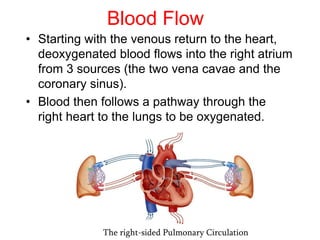
• Starting with the venous return to the heart,
deoxygenated blood flows into the right atrium
from 3 sources (the two vena cavae and the
coronary sinus).
• Blood then follows a pathway through the
right heart to the lungs to be oxygenated.
Blood Flow
The left-sided Systemic Circulation
Blood Flow
• Oxygenated blood returns to the left heart
to be pumped through the outflow tract of
the systemic circulation.
Coronary Vessels
– The myocardium (and other tissues of the thick cardiac walls) must
get nutrients from blood flowing through the coronary circulation.
• Starting at the aortic root, the direction of blood flow is from the aorta
to the left and right coronary arteries (LCA, RCA):
– LCA to anterior interventricular
and circumflex branches
– RCA to marginal and
posterior atrioventricular
branches
Coronary Vessels
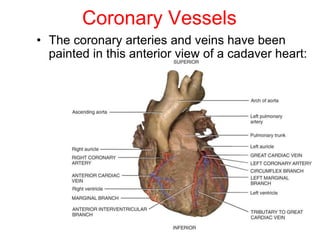
• The coronary arteries and veins have been
painted in this anterior view of a cadaver heart:
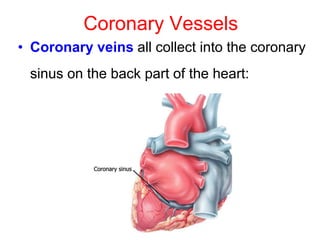
• Coronary veins all collect into the coronary
sinus on the back part of the heart:
Coronary Vessels
Arteries and Veins
• Arteries are vessels that always conduct blood
away from the heart – with just a few exceptions,
arteries contain oxygenated blood.
• Most arteries in the body
are thick-walled and
exposed to high pressures
and friction forces.
Arteries and Veins
• Veins are vessels that always bring blood back
to the heart - with just a few exceptions, veins
contain deoxygenated blood.
• Most veins in the body
are thin-walled and
exposed to low
pressures and minimal
friction forces.
Arteries and Veins
View of the front of the heart
Arteries and Veins
• Cardiac muscle, like skeletal muscle, is striated. Unlike
skeletal muscle, its fibers are shorter, they branch, and
they have only one (usually centrally located) nucleus.
• Cardiac muscle cells connect to and communicate with
neighboring cells through gap junctions in intercalated
discs.
Cardiac Muscle Tissue
Autorhythmicity
• The rhythmical electrical activity
produced in heart is called
autorhythmicity. Because heart
muscle is autorhythmic, it does not rely
on the central nervous system to
sustain a lifelong heartbeat.
• During embryonic development, about 1% of all of the
muscle cells of the heart form a network or pathway called
the cardiac conduction system. This specialized group
of myocytes
is unusual in that
they have the ability
to spontaneously
depolarize.
Autorhythmicity
Membrane of two cells clearly seen. The spread of ions through gap
junctions of the Intercalated discs (I) allows the AP to pass from cell to cell
Autorhythmicity
• Autorhythmic cells spontaneously depolarize at a given
rate, some groups faster, some groups slower. Once a
group of autorhythmic cells reaches threshold and starts an
action potential (AP), all of the cells in that area of the heart
also depolarize.
Cardiac Conduction
• The self-excitable myocytes that "act like nerves" have the
2 important roles of forming the conduction system of
the heart and acting as pacemakers within that system.
• Because it has the fastest rate of depolarization, the
normal pacemaker of the heart is the
sinoatrial (SA) node, located in the
right atrial wall just below
where the superior vena
cava enters the chamber.
Cardiac Conduction
Spontaneous
Depolarization of autorhythmic fibers in the SA node
firing about once every 0.8 seconds, or 75 action
potentials per minute
Frontal plane
Right atrium
Right ventricle
Left atrium
Left ventricle
Anterior view of frontal section
Frontal plane
Left atrium
Left ventricle
Anterior view of frontal section
SINOATRIAL (SA) NODE1
Right atrium
Right ventricle
Frontal plane
Left atrium
Left ventricle
Anterior view of frontal section
SINOATRIAL (SA) NODE
ATRIOVENTRICULAR
(AV) NODE
1
2
Right atrium
Right ventricle
Frontal plane
Left atrium
Left ventricle
Anterior view of frontal section
SINOATRIAL (SA) NODE
ATRIOVENTRICULAR
(AV) NODE
ATRIOVENTRICULAR (AV)
BUNDLE (BUNDLE OF HIS)
1
2
3
Right atrium
Right ventricle
Frontal plane
Left atrium
Left ventricle
Anterior view of frontal section
SINOATRIAL (SA) NODE
ATRIOVENTRICULAR
(AV) NODE
ATRIOVENTRICULAR (AV)
BUNDLE (BUNDLE OF HIS)
RIGHT AND LEFT
BUNDLE BRANCHES
1
2
3
4
Right atrium
Right ventricle
Frontal plane
SINOATRIAL (SA) NODE
ATRIOVENTRICULAR
(AV) NODE
Left atrium
Left ventricle
Anterior view of frontal section
ATRIOVENTRICULAR (AV)
BUNDLE (BUNDLE OF HIS)
RIGHT AND LEFT
BUNDLE BRANCHES
PURKINJE FIBERS
1
2
3
4
5
Right atrium
Right ventricle
• Although anatomically the heart consist of individual cells,
the bands of muscle wind around the heart and work as a
unit – forming a “functional syncytium” .
– This allows the top
and bottom parts to
contract in their own
unique way.
Coordinating Contractions
• The atrial muscle syncytium contracts as a single
unit to force blood down into the ventricles.
• The syncytium of ventricular muscle starts
contracting at the apex (inferiorly), squeezing
blood upward to exit the outflow tracts.
ANS Innervation
• Although the heart does not rely on outside
nerves for its basic rhythm, there is abundant
sympathetic and parasympathetic
innervation which alters the rate and force of
heart contractions.
ANS Innervation
• The action potential (AP) initiated by the SA node travels
through the conduction system to excite the “working”
contractile muscle fibers in the atria and ventricles.
• Unlike autorhythmic fibers, contractile fibers have a stable
RMP of –90mV.
– The AP propagates
throughout the heart
by opening and closing
Na+
and K+
channels.
Cardiac Muscle Action Potential
Depolarization Repolarization
Refractory period
Contraction
Membrane
potential (mV) Rapid depolarization due to
Na+ inflow when voltage-gated
fast Na+ channels open
0.3 sec
+ 20
0
–20
–40
– 60
– 80
–100
11
Depolarization Repolarization
Refractory period
Contraction
Membrane
potential (mV) Rapid depolarization due to
Na+ inflow when voltage-gated
fast Na+ channels open
Plateau (maintained depolarization) due to Ca2+ inflow
when voltage-gated slow Ca2+ channels open and
K+ outflow when some K+ channels open
0.3 sec
+ 20
0
–20
–40
– 60
– 80
–100
2
11
2
Depolarization Repolarization
Refractory period
Contraction
Membrane
potential (mV)
Repolarization due to closure
of Ca2+ channels and K+ outflow
when additional voltage-gated
K+ channels open
Rapid depolarization due to
Na+ inflow when voltage-gated
fast Na+ channels open
Plateau (maintained depolarization) due to Ca2+ inflow
when voltage-gated slow Ca2+ channels open and
K+ outflow when some K+ channels open
0.3 sec
+ 20
0
–20
–40
– 60
– 80
–100
2
1
3
1
2
3
Cardiac Muscle Action Potential
• Unlike skeletal muscle, the refractory period in cardiac
muscle lasts longer than the contraction itself - another
contraction cannot begin until relaxation is well underway.
• For this reason, tetanus (maintained contraction) cannot
occur in cardiac muscle, leaving sufficient time between
contractions for the chambers to fill with blood.
• If heart muscle could undergo tetanus, blood flow would
cease!
The Electrocardiogram
• An ECG is a recording of the electrical
changes on the surface of the body
resulting from the depolarization and
repolarization of the myocardium.
• ECG recordings measure the presence or
absence of certain waveforms (deflections),
the size of the waves, and the time intervals
of the cardiac cycle.
– By measuring the ECG, we can quantify and
correlate, electrically, the mechanical activities
of the heart.
The Electrocardiogram
1 Depolarization of atrial
contractile fibers
produces P wave
0.20
Seconds
Action potential
in SA node
P
1
Atrial systole
(contraction)
Depolarization of atrial
contractile fibers
produces P wave
0.20
Seconds
0.20
Seconds
Action potential
in SA node
P
P
2
1
Depolarization of
ventricular contractile
fibers produces QRS
complex
Atrial systole
(contraction)
Depolarization of atrial
contractile fibers
produces P wave
0.2 0.40
Seconds
0.20
Seconds
0.20
Seconds
Action potential
in SA node
R
S
Q
P
P
2
3
P
1
Ventricular
systole
(contraction)
Depolarization of
ventricular contractile
fibers produces QRS
complex
Atrial systole
(contraction)
Depolarization of atrial
contractile fibers
produces P wave
0.2 0.40
Seconds
0.2 0.40
Seconds
0.20
Seconds
0.20
Seconds
Action potential
in SA node
R
S
Q
P
P
P
2
3
4
P
1
5Repolarization of
ventricular contractile
fibers produces T
wave
Ventricular
systole
(contraction)
Depolarization of
ventricular contractile
fibers produces QRS
complex
Atrial systole
(contraction)
Depolarization of atrial
contractile fibers
produces P wave
0.60.2 0.40
Seconds
0.2 0.40
Seconds
0.2 0.40
Seconds
0.20
Seconds
0.20
Seconds
Action potential
in SA node
R
S
Q
P
P
P
P
T
2
3
4
5
P
1
6Ventricular diastole
(relaxation)
5Repolarization of
ventricular contractile
fibers produces T
wave
Ventricular
systole
(contraction)
Depolarization of
ventricular contractile
fibers produces QRS
complex
Atrial systole
(contraction)
Depolarization of atrial
contractile fibers
produces P wave
0.60.2 0.40 0.8
Seconds
0.60.2 0.40
Seconds
0.2 0.40
Seconds
0.2 0.40
Seconds
0.20
Seconds
0.20
Seconds
Action potential
in SA node
R
S
Q
P
P
P
P
T
P
2
3
4
5
6
P
• Blood Pressure is usually measured in the larger
conducting arteries where the high and low pulsations of
the heart can be detected – usually the brachial artery.
– Systolic BP is the higher pressure measured during left
ventricular systole when the
aortic valve is open.
– Diastolic BP is the lower pressure
measured during left ventricular
diastole when the valve is closed.
Blood Pressure
Blood Pressure
• Normal BP varies by age, but is approximately 120 mm
Hg systolic over 80 mmHg diastolic in a healthy young
adult ( in females, the pressures are often 8–10 mm Hg
less.)
• It is often best to refer to the blood pressure as a single
number, called the mean arterial pressure (MAP) .
– MAP is roughly 1/3 of the way between the diastolic and
systolic BP. It is defined as 1/3 (systolic BP – diastolic
BP) + diastolic BP.
Blood Pressure
• In a person with a BP of 120/80 mm Hg, MAP = 1/3 (120-
80) + 80 = 93.3 mm Hg.
• In the smaller arterioles,
capillaries, and veins,
the BP pulsations are not
detectable, and only a
mean BP is measurable
(see the purple and blue
areas of this figure).
Cardiac Cycle
• The cardiac cycle includes all events
associated with one heartbeat, including
diastole (relaxation phase) and systole
(contraction phase) of both the atria and the
ventricles.
• In each cycle, atria and ventricles
alternately contract and relax.
– During atrial systole, the ventricles are relaxed.
– During ventricle systole, the atria are relaxed.
Cardiac Cycle
• Since ventricular function matters most to the body, the
two principal events of the cycle for us to understand are
ventricular filling (during ventricular diastole), and
ventricular ejection (during ventricular systole).
– The blood pressure that we measure in the arm is a
reflection of the pressure developed by the left ventricle,
before and after left ventricular systole.
– Pulmonary blood pressure is a result of right ventricular
function, but is not easily measured.
Cardiac Cycle
Valves
AV SL Outflow
Ventricular
diastole
Open Closed
Atrial
systole
Ventricular
systole
Closed Open
Early atrial
diastole
Ventricular
diastole
Open Closed
Late atrial
diastole
Cardiac Cycle
• During the cardiac cycle, all 4 of the heart valves have a
chance to open and close. Listening (usually with a
stethoscope) to the sounds the heart makes is called
auscultation.
• Valve opening is usually
silent. The “lubb dupp”
we associate with
heart auscultation is
produced by valve closure (in pairs – see p. 740 left side).
Cardiac Cycle
Cardiac Cycle
• The average time required to complete the
cardiac cycle is usually less than one
second (about 0.8 seconds at a heart rate
of 75 beats/minute).
– 0.1 seconds – atria contract (atrial “kick”),
ventricles are relaxed
– 0.3 seconds – atria relax, ventricles contract
– 0.4 seconds – relaxation period for all
Cardiac Output
• The stroke volume (SV) is the volume of
blood ejected from the left (or right) ventricle
every beat. The cardiac output (CO) is the
SV x heart rate (HR).
– In a resting male, CO = 70mL/beat x 75
beats/min = 5.25L/min.
• On average, a person’s entire blood volume
flows through the pulmonary and systemic
circuits each minute.
Cardiac Output
• The cardiac reserve is the difference
between the CO at rest and the maximum
CO the heart can generate.
– Average cardiac reserve is 4-5 times resting
value.
• Exercise draws upon the cardiac reserve to meet the
body’s increased physiological demands and maintain
homeostasis.
Cardiac Output
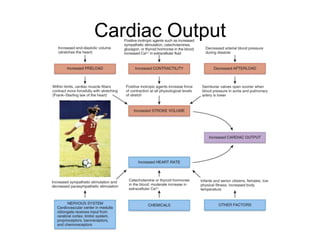
• The cardiac output is affected by changes in SV, heart
rate, or both.
• There are 3 important factors that affect SV
– The amount of ventricular filling before contraction
(called the preload)
– The contractility of the ventricle
– The resistance in the blood vessels (aorta) or valves
(aortic valve, when damaged) the heart is pumping into
(called the afterload)
Cardiac Output
• The more the heart muscle is stretched (filled) before
contraction (preload), the more forcefully the heart will
contract. This phenomenon is known as Starling’s Law
of the heart.
– Stimulation of the sympathetic
nervous system during
exercise increases venous
return, stretches the heart
muscle, and increases CO.
Cardiac Output

Chapter 20

  • 1.
  • 2.
    Location and Sizeof Heart • Located in thoracic cavity in mediastinum • About same size as closed fist – base is the wider anterior portion – apex is tip or point
  • 3.
  • 4.
    Fibrous Pericardium • Restson and is attached to diaphragm • Tough, inelastic sac of fibrous connective tissue • Continuous with blood vessels entering, leaving heart at base • Protects, anchors heart, prevents overstretching
  • 5.
    Parietal (Outer) SerousPericardium • Thin layer adhered to inside of fibrous pericardium • Secretes serous (watery) lubricating fluid
  • 6.
    Layers of theHeart Wall • The wall of the heart is composed of three distinct layers. From superficial to deep they are: – The epicardium – The myocardium – The endocardium
  • 7.
    Layers of theHeart Wall
  • 8.
    Chambers of theHeart • The heart has 4 Chambers: – The upper 2 are the right and left atria. – The lower 2 are the right and left ventricles.
  • 9.
  • 10.
  • 11.
    Valves of theHeart • Function to prevent backflow of blood into/through heart • Open, close in response to changes in pressure in heart • Four valves
  • 12.
  • 13.
    Valves • In contrastto the delicate, leafy folds of the AV valves, the Outflow valves have rather firm cusps that each look like a semi-full moon (semilunar). – Each cusp makes up about a third of the valve.
  • 14.
  • 15.
  • 16.
  • 17.
    Valves • Surprisingly, perhaps,there are no valves guarding the junction between the venae cavae and the right atrium or the pulmonary veins and the left atrium. As the atria contract, a small amount of blood does flow backward into these vessels, but it is minimized by the way the atria contract, which compresses, and nearly collapses the venous entry points.
  • 18.
  • 19.
    Blood Flow • Thebody’s blood flow can best be understood as two circuits arranged in series. The output of one becomes the input of the other: – Pulmonary circuit ejects blood into the pulmonary trunk and is powered by the right side of the heart. – Systemic circuit ejects blood into the aorta, systemic arteries, and arterioles and is powered by the left side of the heart.
  • 20.
    The right-sided PulmonaryCirculation • Starting with the venous return to the heart, deoxygenated blood flows into the right atrium from 3 sources (the two vena cavae and the coronary sinus). • Blood then follows a pathway through the right heart to the lungs to be oxygenated. Blood Flow
  • 21.
    The left-sided SystemicCirculation Blood Flow • Oxygenated blood returns to the left heart to be pumped through the outflow tract of the systemic circulation.
  • 23.
    Coronary Vessels – Themyocardium (and other tissues of the thick cardiac walls) must get nutrients from blood flowing through the coronary circulation. • Starting at the aortic root, the direction of blood flow is from the aorta to the left and right coronary arteries (LCA, RCA): – LCA to anterior interventricular and circumflex branches – RCA to marginal and posterior atrioventricular branches
  • 24.
    Coronary Vessels • Thecoronary arteries and veins have been painted in this anterior view of a cadaver heart:
  • 25.
    • Coronary veinsall collect into the coronary sinus on the back part of the heart: Coronary Vessels
  • 26.
    Arteries and Veins •Arteries are vessels that always conduct blood away from the heart – with just a few exceptions, arteries contain oxygenated blood. • Most arteries in the body are thick-walled and exposed to high pressures and friction forces.
  • 27.
    Arteries and Veins •Veins are vessels that always bring blood back to the heart - with just a few exceptions, veins contain deoxygenated blood. • Most veins in the body are thin-walled and exposed to low pressures and minimal friction forces.
  • 28.
    Arteries and Veins Viewof the front of the heart
  • 29.
  • 30.
    • Cardiac muscle,like skeletal muscle, is striated. Unlike skeletal muscle, its fibers are shorter, they branch, and they have only one (usually centrally located) nucleus. • Cardiac muscle cells connect to and communicate with neighboring cells through gap junctions in intercalated discs. Cardiac Muscle Tissue
  • 31.
    Autorhythmicity • The rhythmicalelectrical activity produced in heart is called autorhythmicity. Because heart muscle is autorhythmic, it does not rely on the central nervous system to sustain a lifelong heartbeat.
  • 32.
    • During embryonicdevelopment, about 1% of all of the muscle cells of the heart form a network or pathway called the cardiac conduction system. This specialized group of myocytes is unusual in that they have the ability to spontaneously depolarize. Autorhythmicity
  • 33.
    Membrane of twocells clearly seen. The spread of ions through gap junctions of the Intercalated discs (I) allows the AP to pass from cell to cell Autorhythmicity • Autorhythmic cells spontaneously depolarize at a given rate, some groups faster, some groups slower. Once a group of autorhythmic cells reaches threshold and starts an action potential (AP), all of the cells in that area of the heart also depolarize.
  • 34.
    Cardiac Conduction • Theself-excitable myocytes that "act like nerves" have the 2 important roles of forming the conduction system of the heart and acting as pacemakers within that system. • Because it has the fastest rate of depolarization, the normal pacemaker of the heart is the sinoatrial (SA) node, located in the right atrial wall just below where the superior vena cava enters the chamber.
  • 35.
    Cardiac Conduction Spontaneous Depolarization ofautorhythmic fibers in the SA node firing about once every 0.8 seconds, or 75 action potentials per minute
  • 36.
    Frontal plane Right atrium Rightventricle Left atrium Left ventricle Anterior view of frontal section Frontal plane Left atrium Left ventricle Anterior view of frontal section SINOATRIAL (SA) NODE1 Right atrium Right ventricle Frontal plane Left atrium Left ventricle Anterior view of frontal section SINOATRIAL (SA) NODE ATRIOVENTRICULAR (AV) NODE 1 2 Right atrium Right ventricle Frontal plane Left atrium Left ventricle Anterior view of frontal section SINOATRIAL (SA) NODE ATRIOVENTRICULAR (AV) NODE ATRIOVENTRICULAR (AV) BUNDLE (BUNDLE OF HIS) 1 2 3 Right atrium Right ventricle Frontal plane Left atrium Left ventricle Anterior view of frontal section SINOATRIAL (SA) NODE ATRIOVENTRICULAR (AV) NODE ATRIOVENTRICULAR (AV) BUNDLE (BUNDLE OF HIS) RIGHT AND LEFT BUNDLE BRANCHES 1 2 3 4 Right atrium Right ventricle Frontal plane SINOATRIAL (SA) NODE ATRIOVENTRICULAR (AV) NODE Left atrium Left ventricle Anterior view of frontal section ATRIOVENTRICULAR (AV) BUNDLE (BUNDLE OF HIS) RIGHT AND LEFT BUNDLE BRANCHES PURKINJE FIBERS 1 2 3 4 5 Right atrium Right ventricle
  • 37.
    • Although anatomicallythe heart consist of individual cells, the bands of muscle wind around the heart and work as a unit – forming a “functional syncytium” . – This allows the top and bottom parts to contract in their own unique way. Coordinating Contractions
  • 38.
    Coordinating Contractions • Theatrial muscle syncytium contracts as a single unit to force blood down into the ventricles. • The syncytium of ventricular muscle starts contracting at the apex (inferiorly), squeezing blood upward to exit the outflow tracts.
  • 39.
    ANS Innervation • Althoughthe heart does not rely on outside nerves for its basic rhythm, there is abundant sympathetic and parasympathetic innervation which alters the rate and force of heart contractions.
  • 40.
  • 41.
    • The actionpotential (AP) initiated by the SA node travels through the conduction system to excite the “working” contractile muscle fibers in the atria and ventricles. • Unlike autorhythmic fibers, contractile fibers have a stable RMP of –90mV. – The AP propagates throughout the heart by opening and closing Na+ and K+ channels. Cardiac Muscle Action Potential
  • 42.
    Depolarization Repolarization Refractory period Contraction Membrane potential(mV) Rapid depolarization due to Na+ inflow when voltage-gated fast Na+ channels open 0.3 sec + 20 0 –20 –40 – 60 – 80 –100 11 Depolarization Repolarization Refractory period Contraction Membrane potential (mV) Rapid depolarization due to Na+ inflow when voltage-gated fast Na+ channels open Plateau (maintained depolarization) due to Ca2+ inflow when voltage-gated slow Ca2+ channels open and K+ outflow when some K+ channels open 0.3 sec + 20 0 –20 –40 – 60 – 80 –100 2 11 2 Depolarization Repolarization Refractory period Contraction Membrane potential (mV) Repolarization due to closure of Ca2+ channels and K+ outflow when additional voltage-gated K+ channels open Rapid depolarization due to Na+ inflow when voltage-gated fast Na+ channels open Plateau (maintained depolarization) due to Ca2+ inflow when voltage-gated slow Ca2+ channels open and K+ outflow when some K+ channels open 0.3 sec + 20 0 –20 –40 – 60 – 80 –100 2 1 3 1 2 3 Cardiac Muscle Action Potential
  • 43.
    Cardiac Muscle ActionPotential • Unlike skeletal muscle, the refractory period in cardiac muscle lasts longer than the contraction itself - another contraction cannot begin until relaxation is well underway. • For this reason, tetanus (maintained contraction) cannot occur in cardiac muscle, leaving sufficient time between contractions for the chambers to fill with blood. • If heart muscle could undergo tetanus, blood flow would cease!
  • 44.
    The Electrocardiogram • AnECG is a recording of the electrical changes on the surface of the body resulting from the depolarization and repolarization of the myocardium. • ECG recordings measure the presence or absence of certain waveforms (deflections), the size of the waves, and the time intervals of the cardiac cycle. – By measuring the ECG, we can quantify and correlate, electrically, the mechanical activities of the heart.
  • 45.
  • 46.
    1 Depolarization ofatrial contractile fibers produces P wave 0.20 Seconds Action potential in SA node P 1 Atrial systole (contraction) Depolarization of atrial contractile fibers produces P wave 0.20 Seconds 0.20 Seconds Action potential in SA node P P 2 1 Depolarization of ventricular contractile fibers produces QRS complex Atrial systole (contraction) Depolarization of atrial contractile fibers produces P wave 0.2 0.40 Seconds 0.20 Seconds 0.20 Seconds Action potential in SA node R S Q P P 2 3 P 1 Ventricular systole (contraction) Depolarization of ventricular contractile fibers produces QRS complex Atrial systole (contraction) Depolarization of atrial contractile fibers produces P wave 0.2 0.40 Seconds 0.2 0.40 Seconds 0.20 Seconds 0.20 Seconds Action potential in SA node R S Q P P P 2 3 4 P 1 5Repolarization of ventricular contractile fibers produces T wave Ventricular systole (contraction) Depolarization of ventricular contractile fibers produces QRS complex Atrial systole (contraction) Depolarization of atrial contractile fibers produces P wave 0.60.2 0.40 Seconds 0.2 0.40 Seconds 0.2 0.40 Seconds 0.20 Seconds 0.20 Seconds Action potential in SA node R S Q P P P P T 2 3 4 5 P 1 6Ventricular diastole (relaxation) 5Repolarization of ventricular contractile fibers produces T wave Ventricular systole (contraction) Depolarization of ventricular contractile fibers produces QRS complex Atrial systole (contraction) Depolarization of atrial contractile fibers produces P wave 0.60.2 0.40 0.8 Seconds 0.60.2 0.40 Seconds 0.2 0.40 Seconds 0.2 0.40 Seconds 0.20 Seconds 0.20 Seconds Action potential in SA node R S Q P P P P T P 2 3 4 5 6 P
  • 47.
    • Blood Pressureis usually measured in the larger conducting arteries where the high and low pulsations of the heart can be detected – usually the brachial artery. – Systolic BP is the higher pressure measured during left ventricular systole when the aortic valve is open. – Diastolic BP is the lower pressure measured during left ventricular diastole when the valve is closed. Blood Pressure
  • 48.
    Blood Pressure • NormalBP varies by age, but is approximately 120 mm Hg systolic over 80 mmHg diastolic in a healthy young adult ( in females, the pressures are often 8–10 mm Hg less.) • It is often best to refer to the blood pressure as a single number, called the mean arterial pressure (MAP) . – MAP is roughly 1/3 of the way between the diastolic and systolic BP. It is defined as 1/3 (systolic BP – diastolic BP) + diastolic BP.
  • 49.
    Blood Pressure • Ina person with a BP of 120/80 mm Hg, MAP = 1/3 (120- 80) + 80 = 93.3 mm Hg. • In the smaller arterioles, capillaries, and veins, the BP pulsations are not detectable, and only a mean BP is measurable (see the purple and blue areas of this figure).
  • 50.
    Cardiac Cycle • Thecardiac cycle includes all events associated with one heartbeat, including diastole (relaxation phase) and systole (contraction phase) of both the atria and the ventricles. • In each cycle, atria and ventricles alternately contract and relax. – During atrial systole, the ventricles are relaxed. – During ventricle systole, the atria are relaxed.
  • 51.
    Cardiac Cycle • Sinceventricular function matters most to the body, the two principal events of the cycle for us to understand are ventricular filling (during ventricular diastole), and ventricular ejection (during ventricular systole). – The blood pressure that we measure in the arm is a reflection of the pressure developed by the left ventricle, before and after left ventricular systole. – Pulmonary blood pressure is a result of right ventricular function, but is not easily measured.
  • 52.
    Cardiac Cycle Valves AV SLOutflow Ventricular diastole Open Closed Atrial systole Ventricular systole Closed Open Early atrial diastole Ventricular diastole Open Closed Late atrial diastole
  • 53.
    Cardiac Cycle • Duringthe cardiac cycle, all 4 of the heart valves have a chance to open and close. Listening (usually with a stethoscope) to the sounds the heart makes is called auscultation. • Valve opening is usually silent. The “lubb dupp” we associate with heart auscultation is produced by valve closure (in pairs – see p. 740 left side).
  • 54.
  • 55.
    Cardiac Cycle • Theaverage time required to complete the cardiac cycle is usually less than one second (about 0.8 seconds at a heart rate of 75 beats/minute). – 0.1 seconds – atria contract (atrial “kick”), ventricles are relaxed – 0.3 seconds – atria relax, ventricles contract – 0.4 seconds – relaxation period for all
  • 56.
    Cardiac Output • Thestroke volume (SV) is the volume of blood ejected from the left (or right) ventricle every beat. The cardiac output (CO) is the SV x heart rate (HR). – In a resting male, CO = 70mL/beat x 75 beats/min = 5.25L/min. • On average, a person’s entire blood volume flows through the pulmonary and systemic circuits each minute.
  • 57.
    Cardiac Output • Thecardiac reserve is the difference between the CO at rest and the maximum CO the heart can generate. – Average cardiac reserve is 4-5 times resting value. • Exercise draws upon the cardiac reserve to meet the body’s increased physiological demands and maintain homeostasis.
  • 58.
    Cardiac Output • Thecardiac output is affected by changes in SV, heart rate, or both. • There are 3 important factors that affect SV – The amount of ventricular filling before contraction (called the preload) – The contractility of the ventricle – The resistance in the blood vessels (aorta) or valves (aortic valve, when damaged) the heart is pumping into (called the afterload)
  • 59.
    Cardiac Output • Themore the heart muscle is stretched (filled) before contraction (preload), the more forcefully the heart will contract. This phenomenon is known as Starling’s Law of the heart. – Stimulation of the sympathetic nervous system during exercise increases venous return, stretches the heart muscle, and increases CO.
  • 60.