HARBOUR ENGINEERING
Presented by
Mr.Shankaregowda
Assistant Professor
Department of Civil Engineering
Maharaja Institute of Technology Mysore
CONTENTS
• INTRODUCTION
• HARBOUR AND PORT
• LAYOUT OF HARBOUR
• COMPONENTS OF HARBOUR
• REQUIREMENTS OF GOOD HARBOUR
• CLASSIFICATION OF HARBOURS
• SITE SELECTION FOR HARBOUR
• PLANNING AND DESIGNING OF HARBOUR
• COASTAL STRUCTURES
INTRODUCTION
WATER TRANSPORTATION
The water transportation divided into two categories
 Inland Water Transportation
Inland water transportation either in the form of river
transportation or canal transportation.
 Ocean Water Transportation
• Ocean water transportation is adopted for trade and
commerce.
• It is estimated that 75% of international trade is carried out
by shipping.
• The development of navy force is intended for national
defense.
• Ocean water transportation has an limitation and it
possesses high flexibility.
ADVANTAGES OF WATER TRANSPORTATION
 Provides means of defense
 Cheapest mode
 Leads to overall development of commerce,
industry and international trade
 High load carrying capacity
 Encourages consumption of foreign goods
 Requires cheap motive power for its working
 Brought countries separated by ocean very near
DISADVANTAGES OF WATER TRANSPORTATION
 Slow in operation, consumes more time
 Useful only when water is available as a mode
of transport
 May lead to accident incase of frequent ocean
storms
 More chances of attack by other countries
 The fluctuations in water level causes rubbing
of ships against the berths
HARBOUR AND PORT
 A harbour can be defined as a sheltered area of the sea in
which vessels could be launched, built or taken for repair;
or could seek refuge in time of storm; or provide for loading
and unloading of cargo and boarding and un boarding of
passengers.
 A port is a harbour where marine terminal facilities are
provided.
 A port is a place which regularly provides
accommodation for the transfer of cargo and passengers to
and from the ships.
 Port = Harbour + Storage Facility + Communication
Facility + Other Terminal Facility.
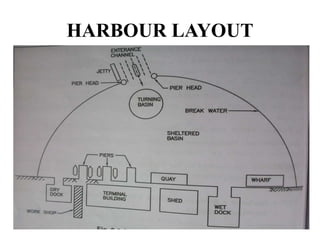
HARBOUR LAYOUT
Entrance Channel
Break Water
Turning Basin
Shelter Basin
Pier
Wharf
Quay
Dry Dock
Wet Dock
Jetty
 ENTRANCE CHANNEL:-
Water area from which ships enter in the harbour and it should
have sufficient width, 100 m for small harbour, 100 to 160m for medium
and 160 to 260m for large harbour.
 BREAK WATER:-
A protective barrier made up of Concrete or Course Rubble
Masonry constructed from shore towards the sea to enclose harbour .
 TURNING BASIN:-
It is water area which is required for maneuvering the ship after
entering to the harbour and it is large enough to permit free turning.
 SHELTER BASIN:-
It is area protected by shore and breakwater.
 PIER:-
It is a solid platform at which berthing of ships on both the sides
are possible.
 WHARF:-
It is a docking platform constructed parallel to shoreline providing
berthing facility on one side only.
 QUAY:-
It is also dock parallel to the shore which is solid structure
providing berthing on one side and retaining the earth on the other.
 DRY DOCK:-
It is a chamber provided for maintenance, repairs and
construction of ships. It includes walls, floor and gate.
 WET DOCK:-
Due to variation in tidal level, an enclosed basin is provided where
in number of ships can be berthed. It has an entrance which is controlled by a
lock gate.
 JETTY:-
It is a solid platform constructed perpendicular to the shoreline for
berthing of ships.
Requirements Of Good Harbour
 It should be connected with roadway and railway.
 Surrounding land should be fertile and densely populated.
 Ship channels must have sufficient depth for draft or vessel.
 Breakwaters must be provided to protect against destructive
wave action.
Requirements Of Good Harbour
 The bottom should furnished secure anchorage to hold ships
against the wind force.
 Numbers of quay, piers and wharfs should be sufficient for
loading and unloading cargo.
 It should have facilities like fuel, repair and etc. for ships.
 Harbour area should be sufficiently large.
 It should have enough cold storage.
Classification Of Harbours
 CLASSIFICATION BASED ON THE PROTECTION
NEEDED
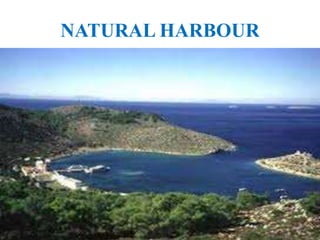
Natural Harbour:-
Harbour protected by storms and waves by natural
land contours, rocky out crops, or island that is called
Natural Contour. (Eg. Kandla port, Cochin port &
Mumbai Harbour)
NATURAL HARBOUR
Classification Of Harbours
 CLASSIFICATION BASED ON THE PROTECTION
NEEDED
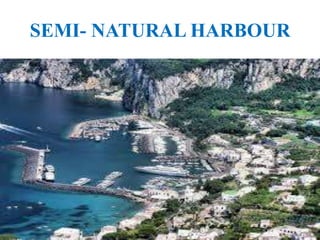
Semi - Natural Harbour:-
A semi – natural harbour is protected on the sides
by the contours of land and requires manmade
protection only to the entrance. (Eg-Visakhapatnam
port)
SEMI- NATURAL HARBOUR
Classification Of Harbours
 CLASSIFICATION BASED ON THE PROTECTION
NEEDED
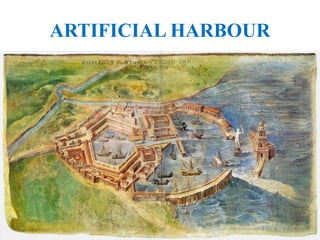
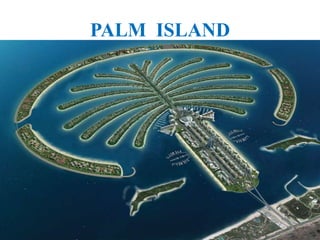
Artificial Harbour:-
An artificial harbour is one which is manmade and
protected from storms and waves by engineering works.
(Eg. Chennai Harbour)
ARTIFICIAL HARBOUR
PALM ISLAND
Classification Of Harbours
 CLASSIFICATION BASED ON UTILITY
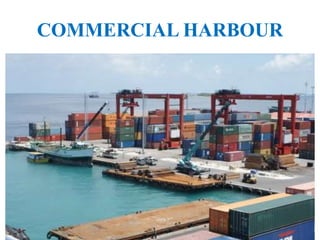
Commercial Harbour:-
It is an harbour in which docks are provided with
necessary facilities for loading and unloading of cargo.
(Eg. Chennai Harbour)
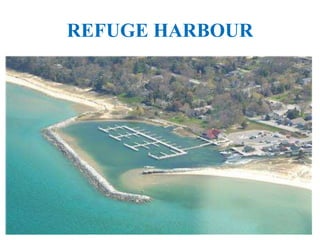
Refuge Harbour:-
These are used as a heaven for ships in a storm or
it may be part of a commercial harbour.
(Eg. Chennai Harbour & Visakhapatnam Harbour)
REFUGE HARBOUR
COMMERCIAL HARBOUR
Classification Of Harbours
 CLASSIFICATION BASED ON UTILITY
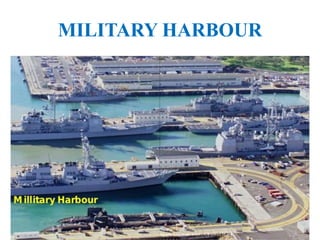
Military Harbour:-
It is a naval base for the purpose of
accommodating naval ships or vessels and it serves as a
supply depot.
(Eg. Mumbai Harbour & Cochin Harbour)
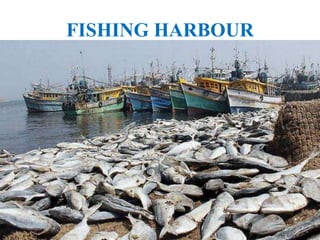
Fishing Harbour:-
These harbours have facilities for departure and
arrival of fishing ships. They have also necessary
arrangement to catch fish.
MILITARY HARBOUR
FISHING HARBOUR
Classification Of Harbours
 CLASSIFICATION BASED ON UTILITY
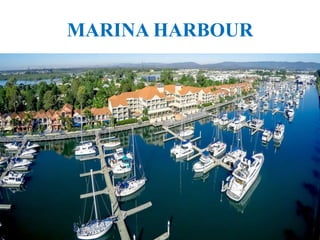
 Marina Harbour:-These are the harbours providing
facilities of fuel, food, showers, telephone, etc. for
small boat owners having temporary or permanent
berths.
Classification
 Large Marinas- have 200 or more berths.
 Small Marinas- have less than 100 berths.
MARINA HARBOUR
Classification Of Harbours
 CLASSIFICATION BASED ON LOCATION
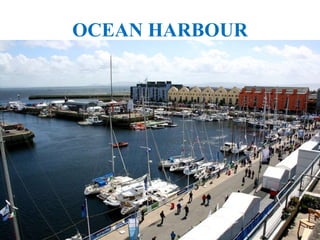
Ocean Harbour:-Harbour located on the coast of sea or
ocean.
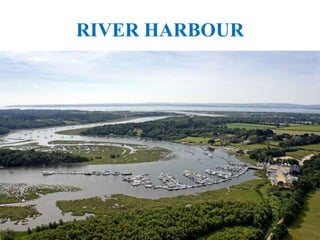
River Harbour:-Harbour constructed along the banks of
river.
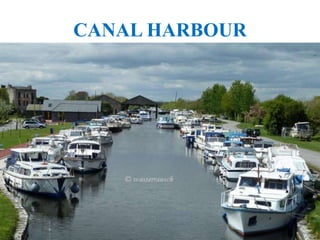
Canal Harbour:-Harbour located along the canals for sea
navigations.
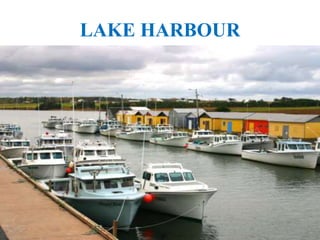
Lake Harbour:-Harbour constructed along the shore of
lake.
OCEAN HARBOUR
RIVER HARBOUR
CANAL HARBOUR
LAKE HARBOUR
SITE SELECTION FOR HARBOUR
The guiding factors which play a great role in
choice of site for a harbour are:
Availability of cheap land and construction materials
Transport and communication facilities
Natural protection from winds and waves
Industrial development of the locality
Sea-bed subsoil and foundation conditions
Traffic potentiality of harbour
Availability of electrical energy and fresh water
Favorable marine conditions
Defense and strategic aspects
PLANNING AND DESIGNING OF HARBOUR
Collection of Necessary Information:
It is necessary to carry out a thorough survey of
the neighborhood including the foreshore and
the depths of water in the vicinity
The borings on land should also be made so as
to know the probable subsurface conditions on
land. It will be helpful in locating the harbour
works correctly
The nature of the harbour, whether sheltered or
not, should be studied.
PLANNING AND DESIGNING OF HARBOUR
The existence of sea insect undermine the
foundations should be noted.
The problem of silting or erosion of coastline
should be carefully studied.
The natural metrological phenomenon should be
studied at site especially with respect to frequency
of storms, rainfall, range of tides, maximum and,
minimum temperature and of winds, humidity,
direction and velocity of currents, etc.
PLANNING AND DESIGNING OF HARBOUR
Identify the Area Required:
• The size and number of ships to be accommodated
in the harbour at a time.
• The length and width needed for movement of
ships to and from berths.
• Type of cargo carried.
COASTAL STRUCTURES
• Coastal structures can be anything human-
made in the coastal area. They are
constructed principally to protect the coast
line.
• More than 70 percent of all coastal structures
are on the shoreline for protection from
probable damage by storm surge or coastal
erosion called Shoreline protection
COASTAL STRUCTURES
On the basis of purposes there are different
types of Coastal structures, they are-
Revetments
Bulkheads &seawalls
Breakwaters
Groins &jetties
Coastal bridges &piers
Dikes &levees.
COASTAL STRUCTURES
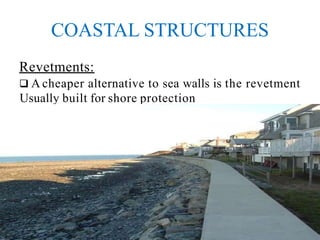
Revetments:
 A cheaper alternative to sea walls is the revetment
Usually built for shore protection
COASTAL STRUCTURES
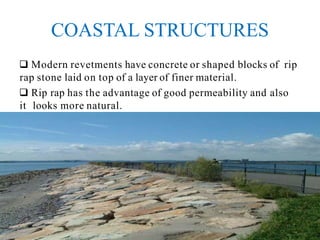
 Modern revetments have concrete or shaped blocks of rip
rap stone laid on top of a layer of finer material.
 Rip rap has the advantage of good permeability and also
it looks more natural.
COASTAL STRUCTURES
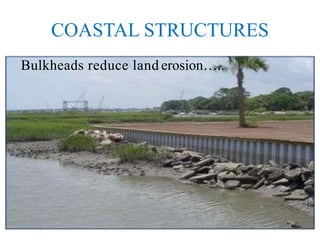
Bulkheads:
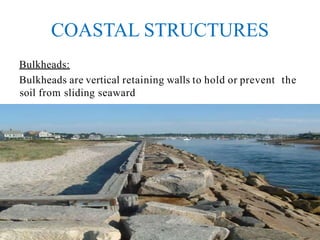
Bulkheads are vertical retaining walls to hold or prevent the
soil from sliding seaward
COASTAL STRUCTURES
Bulkheads reduce land erosion…..
COASTAL STRUCTURES
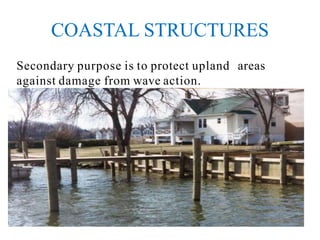
Secondary purpose is to protect upland areas
against damage from wave action.
COASTAL STRUCTURES
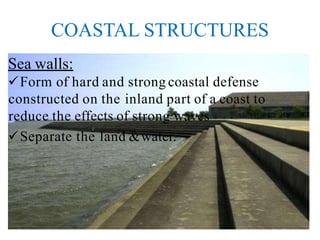
Sea walls:
Form of hard and strong coastal defense
constructed on the inland part of a coast to
reduce the effects of strong waves
Separate the land &water.
COASTAL STRUCTURES
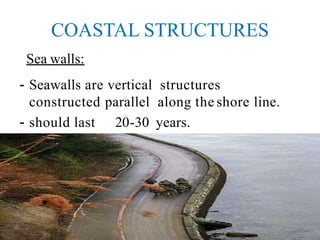
Sea walls:
- Seawalls are vertical structures
constructed parallel along the shore line.
- should last 20-30 years.
COASTAL STRUCTURES
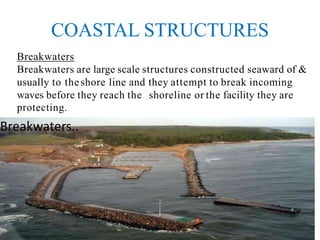
Breakwaters..
Breakwaters
Breakwaters are large scale structures constructed seaward of &
usually to theshore line and they attempt to break incoming
waves before they reach the shoreline or the facility they are
protecting.
COASTAL STRUCTURES
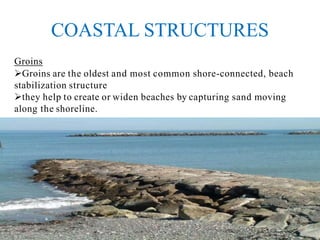
Groins
Groins are the oldest and most common shore-connected, beach
stabilization structure
they help to create or widen beaches by capturing sand moving
along the shoreline.
COASTAL STRUCTURES
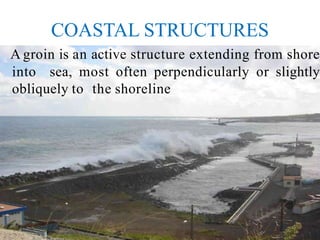
A groin is an active structure extending from shore
into sea, most often perpendicularly or slightly
obliquely to the shoreline
COASTAL STRUCTURES
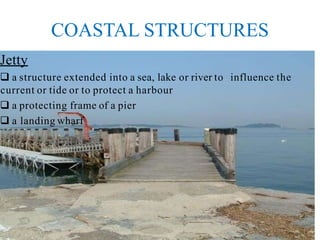
Jetty
 a structure extended into a sea, lake or river to influence the
current or tide or to protect a harbour
 a protecting frame of a pier
 a landing wharf
COASTAL STRUCTURES
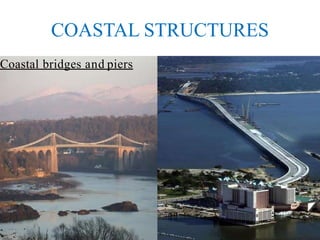
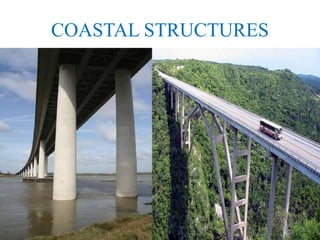
Coastal bridges and piers
COASTAL STRUCTURES
COASTAL STRUCTURES
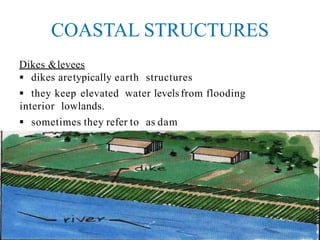
Dikes &levees
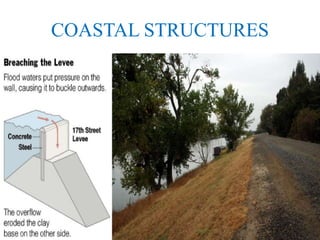
 dikes aretypically earth structures
 they keep elevated water levelsfrom flooding
interior lowlands.
 sometimes they refer to as dam
COASTAL STRUCTURES
COASTAL STRUCTURES
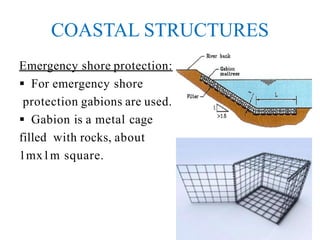
Emergency shore protection:
 For emergency shore
protection gabions are used.
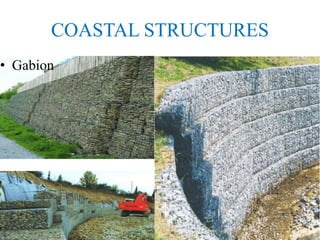
 Gabion is a metal cage
filled with rocks, about
1mx1m square.
COASTAL STRUCTURES
• Gabion
WAVE ACTION ON COASTAL STRUCTURES
Waves:These are periodic undulations of the sea
surface. Water waves are generated by transfer of
energy from air moving over the water.
Causes of Sea Waves:-
– Wind
– Revolution of the earth
– Gravitational force of the moon and sun
– Earthquake
– Land slide and seashore
WAVE ACTION ON COASTAL STRUCTURES
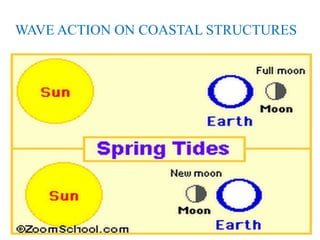
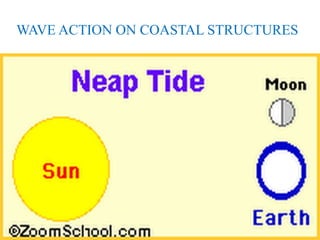
Tides: Due to gravitational force of sun and moon
there is rise and fall in ocean waters called Tides.
The rise in water level is called high tide and fall
in water level is called low tides.
Types of Tides:
– Spring Tide:- These are highest tides which occur
when sun, moon and earth fall in line.
– Neap Tide:- These are lowest tides which occur when
the lines connecting the earth with the sun and the
moon form right angle.
WAVE ACTION ON COASTAL STRUCTURES
Currents: Horizontal movement of water is
called current.
Causes of Currents:-
–Tides
–Wind blowing over ocean
–Difference in temperature
–Turbidity of water
–Wave breaking at an angle of a beach.
WAVE ACTION ON COASTAL STRUCTURES
Effects of Waves or Tides or Currents on Coastal
Structures:
– Scouring and erosion
– Deposition(silting)
– Increase in corrosion rate
– Delay in construction operations
– Significant forces on marine structure
– Loads on moored vessels.
ANY QUERRIES?????
THANK YOU

Harbour engineering by Shankaregowda MIT Mysore

  • 1.
    HARBOUR ENGINEERING Presented by Mr.Shankaregowda AssistantProfessor Department of Civil Engineering Maharaja Institute of Technology Mysore
  • 2.
    CONTENTS • INTRODUCTION • HARBOURAND PORT • LAYOUT OF HARBOUR • COMPONENTS OF HARBOUR • REQUIREMENTS OF GOOD HARBOUR • CLASSIFICATION OF HARBOURS • SITE SELECTION FOR HARBOUR • PLANNING AND DESIGNING OF HARBOUR • COASTAL STRUCTURES
  • 3.
    INTRODUCTION WATER TRANSPORTATION The watertransportation divided into two categories  Inland Water Transportation Inland water transportation either in the form of river transportation or canal transportation.  Ocean Water Transportation • Ocean water transportation is adopted for trade and commerce. • It is estimated that 75% of international trade is carried out by shipping. • The development of navy force is intended for national defense. • Ocean water transportation has an limitation and it possesses high flexibility.
  • 4.
    ADVANTAGES OF WATERTRANSPORTATION  Provides means of defense  Cheapest mode  Leads to overall development of commerce, industry and international trade  High load carrying capacity  Encourages consumption of foreign goods  Requires cheap motive power for its working  Brought countries separated by ocean very near
  • 5.
    DISADVANTAGES OF WATERTRANSPORTATION  Slow in operation, consumes more time  Useful only when water is available as a mode of transport  May lead to accident incase of frequent ocean storms  More chances of attack by other countries  The fluctuations in water level causes rubbing of ships against the berths
  • 6.
    HARBOUR AND PORT A harbour can be defined as a sheltered area of the sea in which vessels could be launched, built or taken for repair; or could seek refuge in time of storm; or provide for loading and unloading of cargo and boarding and un boarding of passengers.  A port is a harbour where marine terminal facilities are provided.  A port is a place which regularly provides accommodation for the transfer of cargo and passengers to and from the ships.  Port = Harbour + Storage Facility + Communication Facility + Other Terminal Facility.
  • 7.
  • 8.
    Entrance Channel Break Water TurningBasin Shelter Basin Pier Wharf Quay Dry Dock Wet Dock Jetty
  • 9.
     ENTRANCE CHANNEL:- Waterarea from which ships enter in the harbour and it should have sufficient width, 100 m for small harbour, 100 to 160m for medium and 160 to 260m for large harbour.  BREAK WATER:- A protective barrier made up of Concrete or Course Rubble Masonry constructed from shore towards the sea to enclose harbour .  TURNING BASIN:- It is water area which is required for maneuvering the ship after entering to the harbour and it is large enough to permit free turning.  SHELTER BASIN:- It is area protected by shore and breakwater.
  • 10.
     PIER:- It isa solid platform at which berthing of ships on both the sides are possible.  WHARF:- It is a docking platform constructed parallel to shoreline providing berthing facility on one side only.  QUAY:- It is also dock parallel to the shore which is solid structure providing berthing on one side and retaining the earth on the other.  DRY DOCK:- It is a chamber provided for maintenance, repairs and construction of ships. It includes walls, floor and gate.  WET DOCK:- Due to variation in tidal level, an enclosed basin is provided where in number of ships can be berthed. It has an entrance which is controlled by a lock gate.  JETTY:- It is a solid platform constructed perpendicular to the shoreline for berthing of ships.
  • 11.
    Requirements Of GoodHarbour  It should be connected with roadway and railway.  Surrounding land should be fertile and densely populated.  Ship channels must have sufficient depth for draft or vessel.  Breakwaters must be provided to protect against destructive wave action.
  • 12.
    Requirements Of GoodHarbour  The bottom should furnished secure anchorage to hold ships against the wind force.  Numbers of quay, piers and wharfs should be sufficient for loading and unloading cargo.  It should have facilities like fuel, repair and etc. for ships.  Harbour area should be sufficiently large.  It should have enough cold storage.
  • 13.
    Classification Of Harbours CLASSIFICATION BASED ON THE PROTECTION NEEDED Natural Harbour:- Harbour protected by storms and waves by natural land contours, rocky out crops, or island that is called Natural Contour. (Eg. Kandla port, Cochin port & Mumbai Harbour)
  • 14.
  • 15.
    Classification Of Harbours CLASSIFICATION BASED ON THE PROTECTION NEEDED Semi - Natural Harbour:- A semi – natural harbour is protected on the sides by the contours of land and requires manmade protection only to the entrance. (Eg-Visakhapatnam port)
  • 16.
  • 17.
    Classification Of Harbours CLASSIFICATION BASED ON THE PROTECTION NEEDED Artificial Harbour:- An artificial harbour is one which is manmade and protected from storms and waves by engineering works. (Eg. Chennai Harbour)
  • 18.
  • 19.
  • 20.
    Classification Of Harbours CLASSIFICATION BASED ON UTILITY Commercial Harbour:- It is an harbour in which docks are provided with necessary facilities for loading and unloading of cargo. (Eg. Chennai Harbour) Refuge Harbour:- These are used as a heaven for ships in a storm or it may be part of a commercial harbour. (Eg. Chennai Harbour & Visakhapatnam Harbour)
  • 21.
  • 22.
  • 23.
    Classification Of Harbours CLASSIFICATION BASED ON UTILITY Military Harbour:- It is a naval base for the purpose of accommodating naval ships or vessels and it serves as a supply depot. (Eg. Mumbai Harbour & Cochin Harbour) Fishing Harbour:- These harbours have facilities for departure and arrival of fishing ships. They have also necessary arrangement to catch fish.
  • 24.
  • 25.
  • 26.
    Classification Of Harbours CLASSIFICATION BASED ON UTILITY  Marina Harbour:-These are the harbours providing facilities of fuel, food, showers, telephone, etc. for small boat owners having temporary or permanent berths. Classification  Large Marinas- have 200 or more berths.  Small Marinas- have less than 100 berths.
  • 27.
  • 28.
    Classification Of Harbours CLASSIFICATION BASED ON LOCATION Ocean Harbour:-Harbour located on the coast of sea or ocean. River Harbour:-Harbour constructed along the banks of river. Canal Harbour:-Harbour located along the canals for sea navigations. Lake Harbour:-Harbour constructed along the shore of lake.
  • 29.
  • 30.
  • 31.
  • 32.
  • 33.
    SITE SELECTION FORHARBOUR The guiding factors which play a great role in choice of site for a harbour are: Availability of cheap land and construction materials Transport and communication facilities Natural protection from winds and waves Industrial development of the locality Sea-bed subsoil and foundation conditions Traffic potentiality of harbour Availability of electrical energy and fresh water Favorable marine conditions Defense and strategic aspects
  • 34.
    PLANNING AND DESIGNINGOF HARBOUR Collection of Necessary Information: It is necessary to carry out a thorough survey of the neighborhood including the foreshore and the depths of water in the vicinity The borings on land should also be made so as to know the probable subsurface conditions on land. It will be helpful in locating the harbour works correctly The nature of the harbour, whether sheltered or not, should be studied.
  • 35.
    PLANNING AND DESIGNINGOF HARBOUR The existence of sea insect undermine the foundations should be noted. The problem of silting or erosion of coastline should be carefully studied. The natural metrological phenomenon should be studied at site especially with respect to frequency of storms, rainfall, range of tides, maximum and, minimum temperature and of winds, humidity, direction and velocity of currents, etc.
  • 36.
    PLANNING AND DESIGNINGOF HARBOUR Identify the Area Required: • The size and number of ships to be accommodated in the harbour at a time. • The length and width needed for movement of ships to and from berths. • Type of cargo carried.
  • 37.
    COASTAL STRUCTURES • Coastalstructures can be anything human- made in the coastal area. They are constructed principally to protect the coast line. • More than 70 percent of all coastal structures are on the shoreline for protection from probable damage by storm surge or coastal erosion called Shoreline protection
  • 38.
    COASTAL STRUCTURES On thebasis of purposes there are different types of Coastal structures, they are- Revetments Bulkheads &seawalls Breakwaters Groins &jetties Coastal bridges &piers Dikes &levees.
  • 39.
    COASTAL STRUCTURES Revetments:  Acheaper alternative to sea walls is the revetment Usually built for shore protection
  • 40.
    COASTAL STRUCTURES  Modernrevetments have concrete or shaped blocks of rip rap stone laid on top of a layer of finer material.  Rip rap has the advantage of good permeability and also it looks more natural.
  • 41.
    COASTAL STRUCTURES Bulkheads: Bulkheads arevertical retaining walls to hold or prevent the soil from sliding seaward
  • 42.
  • 43.
    COASTAL STRUCTURES Secondary purposeis to protect upland areas against damage from wave action.
  • 44.
    COASTAL STRUCTURES Sea walls: Formof hard and strong coastal defense constructed on the inland part of a coast to reduce the effects of strong waves Separate the land &water.
  • 45.
    COASTAL STRUCTURES Sea walls: -Seawalls are vertical structures constructed parallel along the shore line. - should last 20-30 years.
  • 46.
    COASTAL STRUCTURES Breakwaters.. Breakwaters Breakwaters arelarge scale structures constructed seaward of & usually to theshore line and they attempt to break incoming waves before they reach the shoreline or the facility they are protecting.
  • 47.
    COASTAL STRUCTURES Groins Groins arethe oldest and most common shore-connected, beach stabilization structure they help to create or widen beaches by capturing sand moving along the shoreline.
  • 48.
    COASTAL STRUCTURES A groinis an active structure extending from shore into sea, most often perpendicularly or slightly obliquely to the shoreline
  • 49.
    COASTAL STRUCTURES Jetty  astructure extended into a sea, lake or river to influence the current or tide or to protect a harbour  a protecting frame of a pier  a landing wharf
  • 50.
  • 51.
  • 52.
    COASTAL STRUCTURES Dikes &levees dikes aretypically earth structures  they keep elevated water levelsfrom flooding interior lowlands.  sometimes they refer to as dam
  • 53.
  • 54.
    COASTAL STRUCTURES Emergency shoreprotection:  For emergency shore protection gabions are used.  Gabion is a metal cage filled with rocks, about 1mx1m square.
  • 55.
  • 56.
    WAVE ACTION ONCOASTAL STRUCTURES Waves:These are periodic undulations of the sea surface. Water waves are generated by transfer of energy from air moving over the water. Causes of Sea Waves:- – Wind – Revolution of the earth – Gravitational force of the moon and sun – Earthquake – Land slide and seashore
  • 57.
    WAVE ACTION ONCOASTAL STRUCTURES Tides: Due to gravitational force of sun and moon there is rise and fall in ocean waters called Tides. The rise in water level is called high tide and fall in water level is called low tides. Types of Tides: – Spring Tide:- These are highest tides which occur when sun, moon and earth fall in line. – Neap Tide:- These are lowest tides which occur when the lines connecting the earth with the sun and the moon form right angle.
  • 58.
    WAVE ACTION ONCOASTAL STRUCTURES
  • 59.
    WAVE ACTION ONCOASTAL STRUCTURES
  • 60.
    WAVE ACTION ONCOASTAL STRUCTURES Currents: Horizontal movement of water is called current. Causes of Currents:- –Tides –Wind blowing over ocean –Difference in temperature –Turbidity of water –Wave breaking at an angle of a beach.
  • 61.
    WAVE ACTION ONCOASTAL STRUCTURES Effects of Waves or Tides or Currents on Coastal Structures: – Scouring and erosion – Deposition(silting) – Increase in corrosion rate – Delay in construction operations – Significant forces on marine structure – Loads on moored vessels.
  • 62.
  • 63.