Linear wave theory assumes wave amplitudes are small, allowing second-order effects to be ignored. It accurately describes real wave behavior including refraction, diffraction, shoaling and breaking. Waves are described by their amplitude, wavelength, frequency, period, wavenumber and phase/group velocities. Phase velocity is the speed at which the wave profile propagates, while group velocity (always lower) is the speed at which wave energy is transmitted. Wave energy is proportional to the square of the amplitude and is divided equally between kinetic and potential components on average.
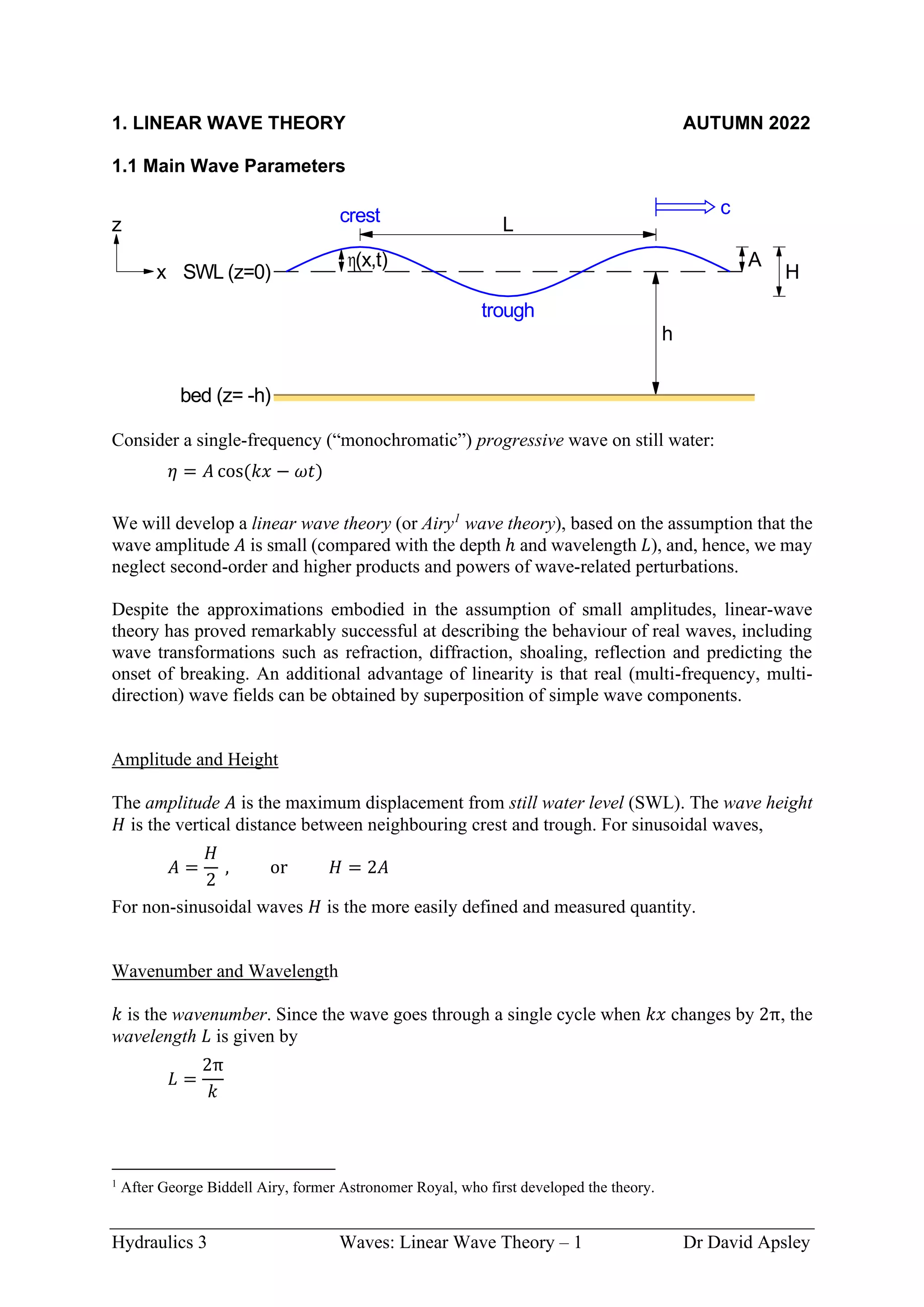
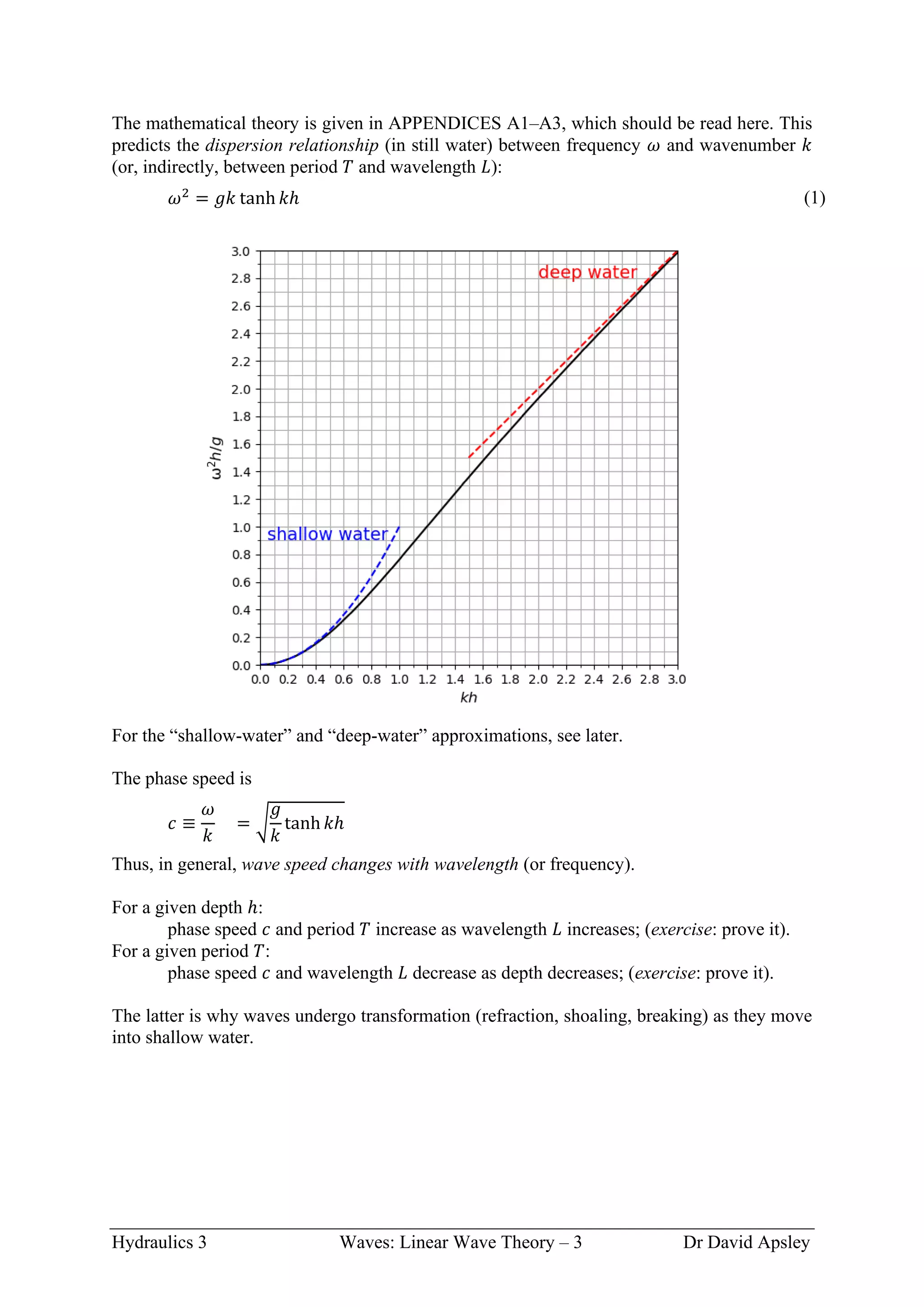
![Hydraulics 3 Waves: Linear Wave Theory – 2 Dr David Apsley
Frequency and Period
𝜔 is the wave angular frequency. Since the wave goes through a single cycle in time when 𝜔𝑇
changes by 2π, the period 𝑇 is given by
𝑇 =
2𝜋
𝜔
with actual frequency 𝑓 (in cycles per second, or Hertz) given by
𝑓 =
1
𝑇
=
𝜔
2𝜋
Wave Speed (Phase Velocity, or “Celerity”)
The wave profile above can also be written
𝜂 = 𝐴 cos[𝑘(𝑥 − c𝑡)]
where
𝑐 =
𝜔
𝑘
𝜂 is the same for 𝑥 − 𝑐𝑡 = constant, or 𝑥 = 𝑐𝑡 + constant, so 𝑐 represents the velocity of
travel of a pure sinusoidal wave (the speed at which its crest moves forward), also called the
phase velocity, or celerity. It can be computed by any of
𝑐 =
𝜔
𝑘
=
𝐿
𝑇
(
wavelength
period
)
= 𝑓𝐿 (frequency × wavelength)
𝜔 and 𝑘 are not independent, but are related via a dispersion relation, saying how wavelength
changes with frequency. Later we shall see that for a collection of waves or wave packet the
natural velocity of energy transport is not the phase velocity 𝑐 but the group velocity
𝑐𝑔 =
d𝜔
d𝑘
Note that 𝑐 represents the speed of the wave form, not the individual fluid particles, whose
velocity, as we shall see, is considerably smaller.
1.2 Dispersion Relationship
At a given depth, waves of different frequencies (hence of different wavelengths) travel at
different speeds. This phenomenon is called dispersion.
For a given frequency, the wavelength, and hence wave speed, must change with depth.](https://image.slidesharecdn.com/waveslinear-230728170141-1916418b/75/WavesLinear-pdf-2-2048.jpg)


![Hydraulics 3 Waves: Linear Wave Theory – 6 Dr David Apsley
1.4 Wave Energy
Wave energy is of two forms: kinetic and potential. The amount of each (per unit horizontal
area) can be found by integrating over the water column and averaging over a period and
wavelength. This is done in APPENDIX A4. The result is (with the small-amplitude wave
assumption):
KE = ∫
1
2
𝜌(𝑢2 + 𝑤2) d𝑧
𝜂
𝑧=−ℎ
̅̅̅̅̅̅̅̅̅̅̅̅̅̅̅̅̅̅̅̅̅̅̅̅̅̅̅̅
=
1
4
𝜌𝑔𝐴2
PE = ∫ 𝜌𝑔𝑧 d𝑧
𝜂
𝑧=−ℎ
̅̅̅̅̅̅̅̅̅̅̅̅̅̅̅̅
=
1
4
𝜌𝑔𝐴2
+ constant
It is seen that (under linear wave theory) the average wave-related kinetic and potential energies
are equal. The total energy (per unit horizontal area) is the sum of these:
𝐸 =
1
2
𝜌𝑔𝐴2
or, in terms of wave height, 𝐸 =
1
8
𝜌𝑔𝐻2
IMPORTANT: wave energy varies as the square of the wave height.
1.5 Group Velocity
Real wave fields do not consist of individual harmonic components, but wave packets
comprised of a combination of waves of different frequency.
Consider first two superposed waves of similar amplitude 𝑎 but different frequencies 𝜔 ± Δ𝜔
and corresponding wavenumbers 𝑘 ± Δ𝑘:
𝜂 = 𝑎 cos[(𝑘 + Δ𝑘)𝑥 − (𝜔 + Δ𝜔)𝑡]
⏟
component 1
+ 𝑎 cos[(𝑘 − Δ𝑘)𝑥 − (𝜔 − Δ𝜔)𝑡]
⏟
component 2
Using the trigonometric formula cos 𝛼 + cos 𝛽 = 2 cos
𝛼+𝛽
2
cos
𝛼−𝛽
2
, we find
𝜂 = 2𝑎 cos(𝑘𝑥 − 𝜔𝑡) cos(Δ𝑘. 𝑥 − Δ𝜔. 𝑡)
This represents (see the figure) an underlying fast-varying wave motion cos(𝑘𝑥 − 𝜔𝑡) with the
phase velocity 𝑐 = 𝜔/𝑘 , but modulated by an envelope with time-varying amplitude:
𝐴(𝑡) = 2𝑎 cos(Δ𝑘 𝑥 − Δ𝜔 𝑡)
This amplitude function represents a wave with smaller wavenumber and frequency (i.e. longer
wavelength and period), travelling at speed
Δ𝜔
Δ𝑘](https://image.slidesharecdn.com/waveslinear-230728170141-1916418b/75/WavesLinear-pdf-6-2048.jpg)
![Hydraulics 3 Waves: Linear Wave Theory – 7 Dr David Apsley
In general, real wave packets are formed from not just two but a continuous spread of
wavenumbers. It may be shown mathematically2
that, for a wave packet strongly peaked around
one wavenumber 𝑘, the packet as a whole travels with the group velocity
𝑐𝑔 =
d𝜔
d𝑘
For regular waves, using the dispersion relation 𝜔2
= 𝑔𝑘 tanh 𝑘ℎ (see APPENDIX A5):
𝑐𝑔 =
1
2
[1 +
2𝑘ℎ
sinh 2𝑘ℎ
]
𝜔
𝑘
or
𝑐𝑔 = 𝑛𝑐
where
𝑛 =
1
2
[1 +
2𝑘ℎ
sinh 2𝑘ℎ
] , 𝑐 =
𝜔
𝑘
𝑛 is the ratio of group velocity to phase velocity. It is always between ½ and 1; the group
velocity is always less than the phase velocity.
1.6 Energy Transfer (Wave Power)
Since wave energy depends on the square of the amplitude, and the amplitude envelope travels
at the group velocity, the latter also represents the velocity at which energy is transferred.
• Phase velocity, 𝑐, represents the speed at which the wave form propagates.
• Group velocity, 𝑐𝑔, represents the speed at which the wave transmits energy.
The rate at which wave energy is transferred is called the energy flux or wave power 𝑃 and is
usually expressed as the (average) wave energy passing a location per unit length of wave crest
per unit time. Heuristically it may be deduced by noting that, if wave energy does travel at
velocity 𝑐𝑔, then the energy in area 𝑐𝑔Δ𝑡 crosses such a line in time Δ𝑡, so 𝑃Δ𝑡 = 𝐸 × 𝑐𝑔Δ𝑡, or
𝑃 = 𝐸𝑐𝑔
where 𝐸 =
1
2
𝜌𝑔𝐴2
is the wave energy per unit area of surface and 𝑐𝑔 is the group velocity.
A more formal derivation (see APPENDIX A6) is to integrate the rate of working by pressure
forces (i.e. pressure area velocity), over the depth of the water column and then average in
time.
Example.
A sea-bed pressure transducer in 9 m of water records a sinusoidal signal with amplitude
5.9 kPa and period 7.5 s. Find the wave height, energy density and wave power per metre of
crest.
2
Google “Method of stationary phase”.](https://image.slidesharecdn.com/waveslinear-230728170141-1916418b/75/WavesLinear-pdf-7-2048.jpg)


![Hydraulics 3 Waves: Linear Wave Theory – 12 Dr David Apsley
1.9 Waves on Currents
Until now we have considered waves on still water. In many cases waves at sea coexist with a
background steady current 𝑈. The formulae then continue to hold in a frame of reference
moving with the current; i.e. 𝑥 is replaced by a value (subscript r):
𝑥𝑟 = 𝑥 − 𝑈𝑡
In particular,
𝜂 = 𝐴 cos(𝑘𝑥𝑟 − 𝜔𝑟𝑡)
= 𝐴 cos[𝑘𝑥 − (𝜔𝑟 + 𝑘𝑈)𝑡]
= 𝐴 cos[𝑘{𝑥 − (
𝜔𝑟
𝑘
+ 𝑈)𝑡}]
Hence, in an absolute frame (subscript a) which is fixed; i.e. not moving with the current:
• wavenumber 𝑘 and wavelength 𝐿 are unchanged; (if you took a photograph from above,
the fact that the waves are advected with the current doesn’t change their length);
• the current is simply added to the wave speed (which you could probably have guessed):
𝑐𝑎 = 𝑐𝑟 + 𝑈
• the perceived frequency 𝜔 and period 𝑇 are changed:
𝜔𝑎 = 𝜔𝑟 + 𝑘𝑈
e.g. if waves and current are in the same direction, then the absolute frequency 𝜔𝑎 is
larger, and the absolute period 𝑇𝑎 is smaller than their “relative” counterparts (those
moving with the current). This is because the current shortens the time between
successive wave crests passing a point.
Note, however, that it is the relative frequency
𝜔𝑟 = 𝜔𝑎 − 𝑘𝑈
that appears in the dispersion formula, and hence:
(𝜔𝑎 − 𝑘𝑈)2
= 𝜔𝑟
2
= 𝑔𝑘 tanh 𝑘ℎ
The change of apparent frequency in a fixed reference frame due to the motion of the source
or transmitting medium is called a Doppler shift.
Note: be careful about absolute velocities (phase or group):
𝑐𝑎 =
𝐿
𝑇𝑎
=
𝜔𝑟
𝑘
+ 𝑈
To use the second form you would need to find 𝜔𝑟 = 𝜔𝑎 − 𝑘𝑈 once you have solved for 𝑘.
Example.
An acoustic depth sounder indicates regular surface waves with apparent period 8 s in water of
depth 12 m. Find the wavelength and absolute phase speed of the waves when there is:
(a) no mean current;
(b) a current of 3 m s–1
in the same direction as the waves;
(c) a current of 3 m s–1
in the opposite direction to the waves.](https://image.slidesharecdn.com/waveslinear-230728170141-1916418b/75/WavesLinear-pdf-12-2048.jpg)


![N. Schlager - Study Materials for MIT Course [8.02T] - Electricity and Magnet...](https://cdn.slidesharecdn.com/ss_thumbnails/n-220816122236-e96ce117-thumbnail.jpg?width=640&height=640&fit=bounds)


