Chapter 3: Communication Skills
Big part of training is communication.
Before we move to Train the Trainer methods, we
need to ensure we communicate properly. So lets go
through some communication points.
As much as communication is made easy with nowadays technology, it is also becoming difficult due to participants
expectations.
People nowadays are fast pace with a lot of information and experiences at their finger tips. Most of them are
technology savvy. Their senses are used to high tech devices like TV, Mobile, and game consoles plus high tech
software like web browsers, social media, games, and online webinars.
In other words, there is a lot of noise and it is difficult to get them excited to your training.
Noise Surrounding Face To Face
Training
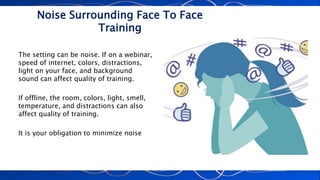
The setting can be noise. If on a webinar,
speed of internet, colors, distractions,
light on your face, and background
sound can affect quality of training.
If offline, the room, colors, light, smell,
temperature, and distractions can also
affect quality of training.
It is your obligation to minimize noise
You can also observe noise factors and ensure
they are not happening either before and during
the training. For example, putting everyone on
mute in a webinar unless you want one or more
participants to speak up. Then you unmute them.
In physical setting, arrive early and ensure that
the room comfortable then set some rules like no
smoking and no phones.
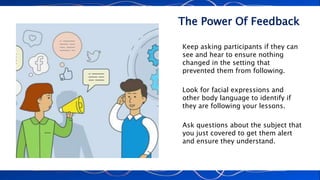
The Power Of Feedback
Keep asking participants if they can
see and hear to ensure nothing
changed in the setting that
prevented them from following.
Look for facial expressions and
other body language to identify if
they are following your lessons.
Ask questions about the subject that
you just covered to get them alert
and ensure they understand.
Barriers To Successful Communication
I. Message Overload
Message overload is when you have too many ideas in a message for example asking
someone too many questions together or giving too many instructions at the same
time
II. Message Complexity
Breaking complex messages into smaller & simple ones can help your participants
follow with ease. An example is taking 10 steps of doing something and showing one
at a time. Once you are sure participants got the one, you can move to the next. Giving
examples also simplifies training points that could be complex to understand.
Distortion Mechanisms
• Inattention: It can be identified with body language or not being able to answer
questions. Participation is key here.
• Lack of common vocabulary: Make sure participants understand your vocabulary
before moving on. An example is that non-tech participants may not know what UI
and UX mean. Explain the difference before moving on.
• Speed: If training is slow, participants get bored. If it too faster than they will miss
points that might affect their learning. Check with people in face to face training.
Give right for speed control in the self-paced training. This way, participants can
move at their own pace.
• Know exactly what you want to communicate
• Introduce yourself up front
• Practice developing a good handshake
• Make eye contact (Speaking & Listening)
• Use clear, simple, specific message using common vocabulary
• Perform accuracy check checks and get feedback
• Listen, ensure you understand, and remember names
• Talk positively (share enjoyment)
• Empathize with others and learn discretion (They can trust you with their
confidences)
• Be service oriented not self oriented
• Spend as much time as necessary to communicate
Tips To Better Communication
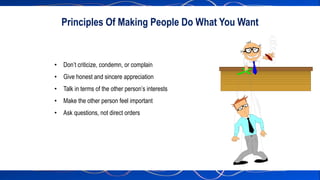
• Don’t criticize, condemn, or complain
• Give honest and sincere appreciation
• Talk in terms of the other person’s interests
• Make the other person feel important
• Ask questions, not direct orders
Principles Of Making People Do What You Want
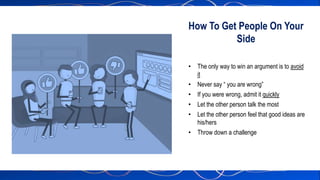
• The only way to win an argument is to avoid
it
• Never say “ you are wrong”
• If you were wrong, admit it quickly
• Let the other person talk the most
• Let the other person feel that good ideas are
his/hers
• Throw down a challenge
How To Get People On Your
Side
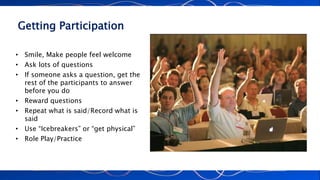
Getting Participation
• Smile, Make people feel welcome
• Ask lots of questions
• If someone asks a question, get the
rest of the participants to answer
before you do
• Reward questions
• Repeat what is said/Record what is
said
• Use “Icebreakers” or “get physical”
• Role Play/Practice
Survival Questions
• Why is that important?
• What do the rest of you think about that?
• Ahmad, what do you think?
• Can you give me an example of that?
• Tell me more. Go on.
• Can anyone add to that?
• Any other ideas on the subject?
• Would someone please demonstrate for
us?

Chapter 3: Communication Skills

  • 1.
  • 2.
    Big part oftraining is communication. Before we move to Train the Trainer methods, we need to ensure we communicate properly. So lets go through some communication points.
  • 3.
    As much ascommunication is made easy with nowadays technology, it is also becoming difficult due to participants expectations. People nowadays are fast pace with a lot of information and experiences at their finger tips. Most of them are technology savvy. Their senses are used to high tech devices like TV, Mobile, and game consoles plus high tech software like web browsers, social media, games, and online webinars. In other words, there is a lot of noise and it is difficult to get them excited to your training.
  • 4.
    Noise Surrounding FaceTo Face Training The setting can be noise. If on a webinar, speed of internet, colors, distractions, light on your face, and background sound can affect quality of training. If offline, the room, colors, light, smell, temperature, and distractions can also affect quality of training. It is your obligation to minimize noise
  • 5.
    You can alsoobserve noise factors and ensure they are not happening either before and during the training. For example, putting everyone on mute in a webinar unless you want one or more participants to speak up. Then you unmute them. In physical setting, arrive early and ensure that the room comfortable then set some rules like no smoking and no phones.
  • 6.
    The Power OfFeedback Keep asking participants if they can see and hear to ensure nothing changed in the setting that prevented them from following. Look for facial expressions and other body language to identify if they are following your lessons. Ask questions about the subject that you just covered to get them alert and ensure they understand.
  • 7.
    Barriers To SuccessfulCommunication I. Message Overload Message overload is when you have too many ideas in a message for example asking someone too many questions together or giving too many instructions at the same time II. Message Complexity Breaking complex messages into smaller & simple ones can help your participants follow with ease. An example is taking 10 steps of doing something and showing one at a time. Once you are sure participants got the one, you can move to the next. Giving examples also simplifies training points that could be complex to understand.
  • 8.
    Distortion Mechanisms • Inattention:It can be identified with body language or not being able to answer questions. Participation is key here. • Lack of common vocabulary: Make sure participants understand your vocabulary before moving on. An example is that non-tech participants may not know what UI and UX mean. Explain the difference before moving on. • Speed: If training is slow, participants get bored. If it too faster than they will miss points that might affect their learning. Check with people in face to face training. Give right for speed control in the self-paced training. This way, participants can move at their own pace.
  • 9.
    • Know exactlywhat you want to communicate • Introduce yourself up front • Practice developing a good handshake • Make eye contact (Speaking & Listening) • Use clear, simple, specific message using common vocabulary • Perform accuracy check checks and get feedback • Listen, ensure you understand, and remember names • Talk positively (share enjoyment) • Empathize with others and learn discretion (They can trust you with their confidences) • Be service oriented not self oriented • Spend as much time as necessary to communicate Tips To Better Communication
  • 10.
    • Don’t criticize,condemn, or complain • Give honest and sincere appreciation • Talk in terms of the other person’s interests • Make the other person feel important • Ask questions, not direct orders Principles Of Making People Do What You Want
  • 11.
    • The onlyway to win an argument is to avoid it • Never say “ you are wrong” • If you were wrong, admit it quickly • Let the other person talk the most • Let the other person feel that good ideas are his/hers • Throw down a challenge How To Get People On Your Side
  • 12.
    Getting Participation • Smile,Make people feel welcome • Ask lots of questions • If someone asks a question, get the rest of the participants to answer before you do • Reward questions • Repeat what is said/Record what is said • Use “Icebreakers” or “get physical” • Role Play/Practice
  • 13.
    Survival Questions • Whyis that important? • What do the rest of you think about that? • Ahmad, what do you think? • Can you give me an example of that? • Tell me more. Go on. • Can anyone add to that? • Any other ideas on the subject? • Would someone please demonstrate for us?