Message and Media Training:   How to build a message and stick to it Part II. Public Relations Workshop
 
When the media calls you Find out: who is calling, what the specific story is about, what they want a comment on and when their deadline is. FOUR SACRED WORDS:  I’ll call you back (or, I’m on the other line right now, I have a couple of people in my office, I need to  get more information, let me talk to someone who is more familiar with the issue.) Be prompt and prepared  in your response. NEVER “No Comment” Try a bounce list
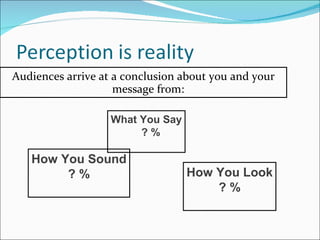
Audiences arrive at a conclusion about you and your message from: How You Look ? % How You Sound ? % What You Say ? %
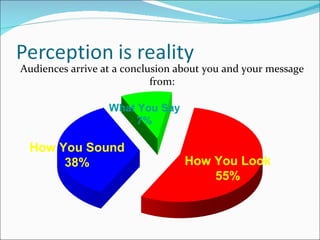
Audiences arrive at a conclusion about you and your message from: How You Look 55% How You Sound 38% What You Say 7%
Appearance
Appearance
Appearance
Appearance
Appearance
Common Reporter Techniques Hypothetical Not the Expert False Facts Phantom Authority Dart Thrower Machine Gun The Interrupter Paraphrase Negative Questions A or B Silence
Be prepared! Talking points Pick two or three messages to cover Answer worst questions in advance Use your credibility as an educator
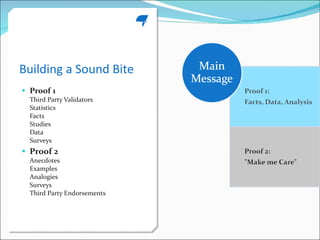
Building a Sound Bite Proof 1 Third Party Validators  Statistics Facts Studies Data Surveys Proof 2 Anecdotes Examples Analogies Surveys Third Party Endorsements
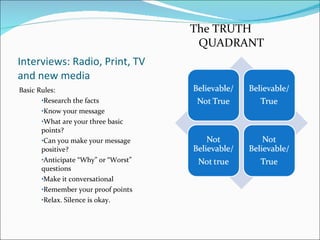
Interviews: Radio, Print, TV and new media Basic Rules: Research the facts Know your message What are your three basic points? Can you make your message positive? Anticipate “Why” or “Worst” questions Make it conversational Remember your proof points Relax. Silence is okay. The TRUTH QUADRANT
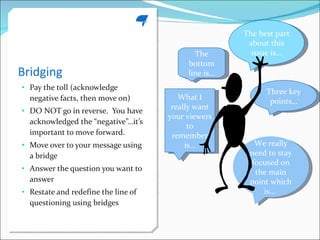
Bridging Pay the toll (acknowledge negative facts, then move on) DO NOT go in reverse.  You have acknowledged the “negative”…it’s important to move forward. Move over to your message using a bridge Answer the question you want to answer Restate and redefine the line of questioning using bridges The bottom line is… The best part about this issue is... Three key points… What I really want your viewers to remember is… We really need to stay focused on the main point which is…
Radio Interviews: Tips Put energy in your voice Respond in complete sentences Don’t step on reporter’s questions Don’t use the reporter’s name in the answer Conducted on the phone or in person Using new media to promote radio communication Consider  “Radio Tours”
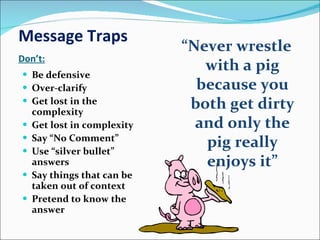
Message Traps Don’t: Be defensive Over-clarify Get lost in the complexity Get lost in complexity Say “No Comment” Use “silver bullet” answers Say things that can be taken out of context Pretend to know the answer “ Never wrestle with a pig because you both get dirty and only the pig really enjoys it”
Thank You! [email_address]

Message Training Part II

  • 1.
    Message and MediaTraining: How to build a message and stick to it Part II. Public Relations Workshop
  • 2.
  • 3.
    When the mediacalls you Find out: who is calling, what the specific story is about, what they want a comment on and when their deadline is. FOUR SACRED WORDS: I’ll call you back (or, I’m on the other line right now, I have a couple of people in my office, I need to get more information, let me talk to someone who is more familiar with the issue.) Be prompt and prepared in your response. NEVER “No Comment” Try a bounce list
  • 4.
    Audiences arrive ata conclusion about you and your message from: How You Look ? % How You Sound ? % What You Say ? %
  • 5.
    Audiences arrive ata conclusion about you and your message from: How You Look 55% How You Sound 38% What You Say 7%
  • 6.
  • 7.
  • 8.
  • 9.
  • 10.
  • 11.
    Common Reporter TechniquesHypothetical Not the Expert False Facts Phantom Authority Dart Thrower Machine Gun The Interrupter Paraphrase Negative Questions A or B Silence
  • 12.
    Be prepared! Talkingpoints Pick two or three messages to cover Answer worst questions in advance Use your credibility as an educator
  • 13.
    Building a SoundBite Proof 1 Third Party Validators Statistics Facts Studies Data Surveys Proof 2 Anecdotes Examples Analogies Surveys Third Party Endorsements
  • 14.
    Interviews: Radio, Print,TV and new media Basic Rules: Research the facts Know your message What are your three basic points? Can you make your message positive? Anticipate “Why” or “Worst” questions Make it conversational Remember your proof points Relax. Silence is okay. The TRUTH QUADRANT
  • 15.
    Bridging Pay thetoll (acknowledge negative facts, then move on) DO NOT go in reverse. You have acknowledged the “negative”…it’s important to move forward. Move over to your message using a bridge Answer the question you want to answer Restate and redefine the line of questioning using bridges The bottom line is… The best part about this issue is... Three key points… What I really want your viewers to remember is… We really need to stay focused on the main point which is…
  • 16.
    Radio Interviews: TipsPut energy in your voice Respond in complete sentences Don’t step on reporter’s questions Don’t use the reporter’s name in the answer Conducted on the phone or in person Using new media to promote radio communication Consider “Radio Tours”
  • 17.
    Message Traps Don’t:Be defensive Over-clarify Get lost in the complexity Get lost in complexity Say “No Comment” Use “silver bullet” answers Say things that can be taken out of context Pretend to know the answer “ Never wrestle with a pig because you both get dirty and only the pig really enjoys it”
  • 18.

Editor's Notes

  • #7 These outfits are inappropriate for television. The colors are pale and create what is called “burning.” That means the iris of the camera is closing down and letting in less light. This is not good for a person with dark skin or dark features because their face gets dark and their outfit gets bright. The colors are also very weak. They are not power colors. They look nice in person, but on camera they wash out the person wearing the outfit
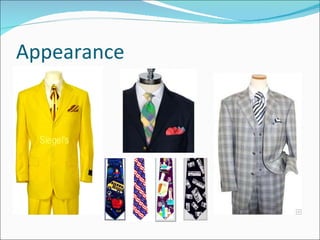
  • #8 These outfits are inappropriate for on camera interviews. The colors are loud and distracting. The ties are too bold. When you wear outfits like these on camera, you may not connect with your audience because they may be looking at your clothes instead of listening to your message.
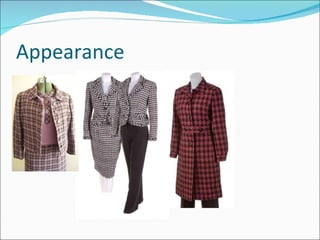
  • #9 These are deceiving outfits. They look great in person but are horrible for television. They are inappropriate for on-camera interviews because hounds tooth prints create awkward, visible lines on camera. The print has a certain reaction with the electronic equipment.
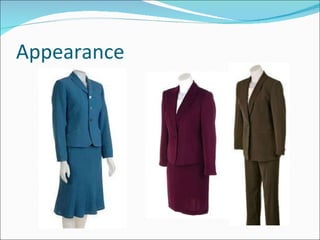
  • #10 These outfits are appropriate for on-camera interviews. They are simple, professional, conservative and well cut. The colors work for the camera because they are bold enough to “pop,” but not bold enough to distract the viewer. These suits can be worn with simple jewelry for a polished look.
  • #11 These outfits are appropriate for on-camera interviews. They are nicely tailored. The colors “pop,” but are not distracting. The ties add a splash of color but they are not distracting or too bold.