Trainer Foundations 1
Communication Basics
“Listen effectively and speak
confidently”
Trainer Foundations 2
Agenda
• Communicate From the Heart
• Tame the Fear Monster
• Attitudes Speak Louder Than Words
• Trainer –Know Thyself
• Out on a Limb
Trainer Foundations 3
COMMUNICATING FROM THE
HEART
Trainer Foundations 4
Zeal for the Subject
• Caring isn’t enough. Substantial, current content must be passed
along in an applicable way.
• Good trainers are ones who integrate their knowledge into their
lives, are excited about it, and enthusiastic about it.
• That kind of enthusiasm is contagious because it communicates, it
vibrates, and its authenticity engages learners and keeps them
interested.
• Memorable teachers are masters at making their subjects live for
their students.
Trainer Foundations 5
Cont’d
• The best trainers take time to connect with the learners who are in
their trucks, classes, workshops, and seminars.
• These trainers are life changing teachers, because they teach from
the heart.
• Communication is about connecting. It is all about connecting.
Trainer Foundations 6
TAME THE FEAR MONSTER
Trainer Foundations 7
The Power of Fear
• Even the most experienced presenter gets a bit of stage fright. Part
of the anxiety is caused by adrenaline.
• Fear can prevent you from:
– answering questions clearly.
– focusing on the participants.
– thinking logically.
– connecting with people on more than a superficial level.
Trainer Foundations 8
Cont’d
• Fear can cause you to:
– communicate a lack of confidence on the material and in
yourself.
– separate yourself from the participants.
– appear to be aloof and cold.
– seem to be disorganized.
– fail to cover key points in the training.
• As a trainer you want the participants to leave with a feeling of
confidence, ready to put to use the skills and knowledge they’ve
gained.
Trainer Foundations 9
Cont’d
• If you communicate a lack of confidence, their
attitude upon leaving will be one of uncertainty.
• At worst, they’ll be angry about the time they’ve
wasted and will have no real desire to implement
the things you’ve taught or presented.
• Four Steps to Success
– Focus on the Participants.
• Remember, your training isn’t ever about you. The training experience is
always about the learners.
• Training is always about the participants. By focusing on them and their
needs, you can conquer fear.
Trainer Foundations 10
Cont’d
– Special or other needs: these may come to you private
conversation or on paper.
– Comfortable and not alienated: As you are gathering
information, pay close attention to your participants. What will
pave the way for them to feel comfortable in your training and
what may make them feel alienated?
– Accommodate adequate number of breaks; restroom, food,
drink, smoke, phone, etc.
– Ask your student, “What is your biggest fear of Phase II ?
• Asking this question will allow you to put the student at
ease.
Trainer Foundations 11
Cont’d
• Focus on the Content
– Know your material.
• Focus on the Structure
– Time Management.
– Communicate confidence to your student’s. You are essentially leading
your students through alien territory with the goal of coming out
successfully on the other side.
– You cannot lead if you don’t know where you are going; and if you
cannot lead, you cannot be confident. And if you are not confident,
they will not be either.
– Confidence on the part of the trainer goes a long way toward helping
the participants absorb and apply the material.
Trainer Foundations 12
Review
• Learners won’t care how much you know until
they see how much you care.
• Get your eyes off of yourself and on the learner.
• Training isn’t about you!
• Just to be clear – training isn’t about you; it’s
about the learner!
• You can not, not communicate – so
communicate confidence.
Trainer Foundations 13
ATTITUDES SPEAK LOUDER
THAN WORDS
Exercise 3-1 pg 26-27
Trainer Foundations 14
Effective Communication
• Effective communication is not just the ability to talk
well or often. It also includes the ability to:
– hear what is really being said rather than what
may be said on the surface.
– read nonverbal behavior.
– communicate nonverbally (and appropriately) in
return.
Trainer Foundations 15
Personal Power
• Personal power is not:
– power over another person
– loud voices and shouting
– put-downs of other people
– antagonistic or aggressive behavior
• Personal power is the quiet strength that comes from
knowing who you are, what you want, and what you are
about.
Trainer Foundations 16
Personal Power
• Individuals with personal power are not demeaned or
belittled by others, nor do they demean or belittle
others.
• A trainer with personal power can:
– Be humble
– Authoritative
– Be funny
– Be firm and to the point
– Communicate respect with a glance or a word-and receive it in
return.
Trainer Foundations 17
TRAINER, KNOW THYSELF
Trainer Foundations 18
Keeping up Appearances
• 80-90 percent of communication is non-
verbal.
• What does your appearance communicate?
• What does the cleanliness of you truck
communicate?
• How often have you made decisions about
others based on appearance? Of their truck or
their person?
Trainer Foundations 19
Setting the tone
• What is an expectation?
• Who can have them?
• What are common errors regarding
expectations?
– Inconsistent
– Unclear
– Impractical
– Unspoken
Trainer Foundations 20
Building in Interactivity
• Interaction is a powerful way to enhance learning
because many people process information through
questions and discussion.
– YOU HAVE TO TALK!
• Interaction can be an excellent way to reinforce the
concepts you are presenting and also obtain
feedback from the participants about their
understanding and acceptance of the information.
– YOU HAVE TO LISTEN!
Trainer Foundations 21
OUT ON A LIMB
Trainer Foundations 22
Transparency
• Accept that you will make errors during
training.
• Accept that you are on display.
• Accept that your “personal” space is now
invaded.
• Accept that you are visible and can’t hide.
• Don’t act like you are “above it all”. Show
some humility.
Trainer Foundations 23
HOW IS MORE IMPORTANT THAN
WHAT
Trainer Foundations 24
A Quick Check
• Some trainers confuse laughter with agreement. They think
that if participants are laughing they are having fun and that
participants who are having fun are more inclined to learn.
• The key is to encourage participants without embarrassing
them in the process.
• Although it is tempting to use humor, especially in response to
off-the-wall suggestions and ideas, doing so is dangerous.
• Unless the participant is very strong, your attempts at humor
may increase that individual’s hesitation to participate and
may also dampen their willingness. Use humor with caution.
Trainer Foundations 25
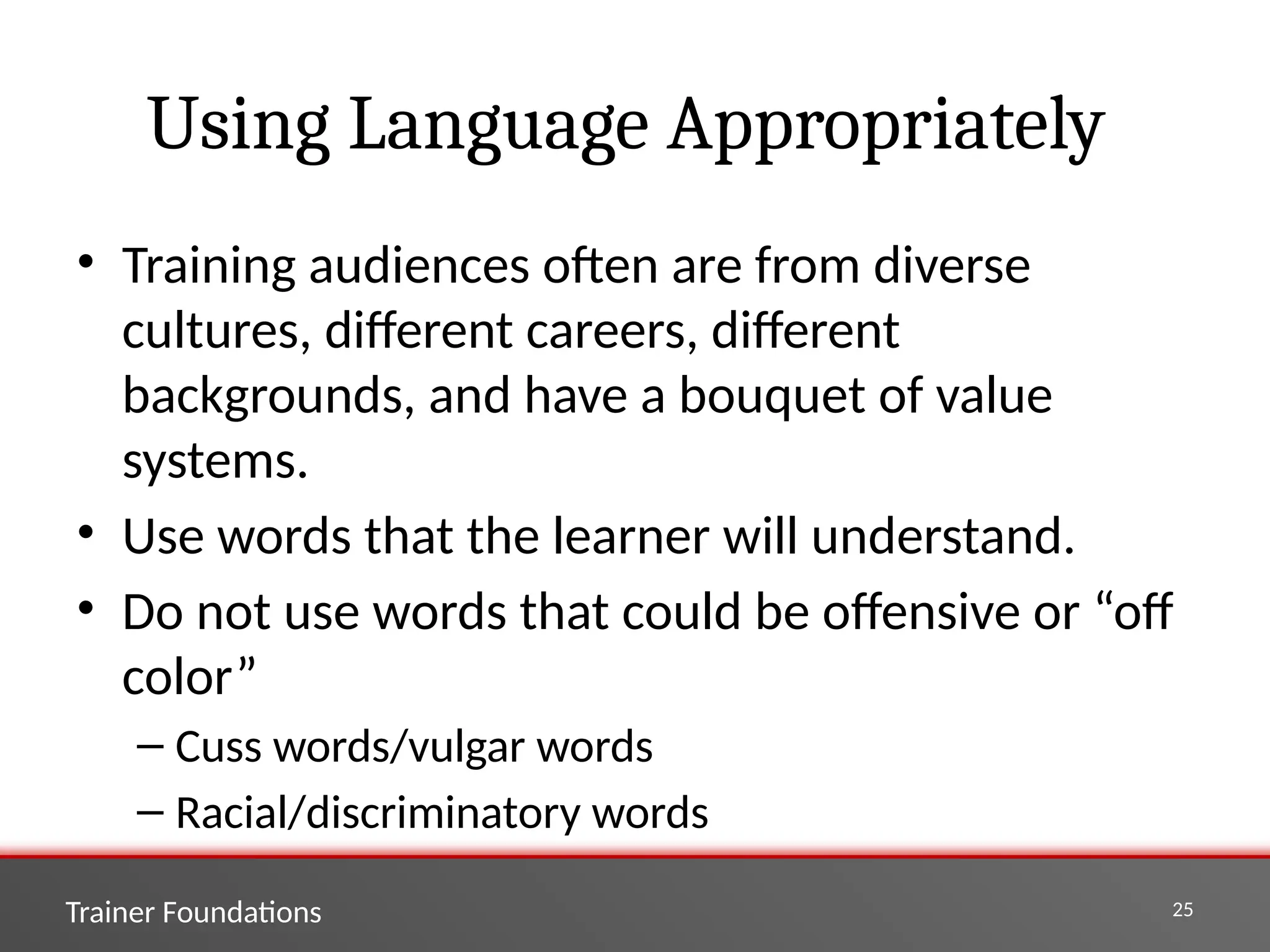
Using Language Appropriately
• Training audiences often are from diverse
cultures, different careers, different
backgrounds, and have a bouquet of value
systems.
• Use words that the learner will understand.
• Do not use words that could be offensive or “off
color”
– Cuss words/vulgar words
– Racial/discriminatory words
Trainer Foundations 26
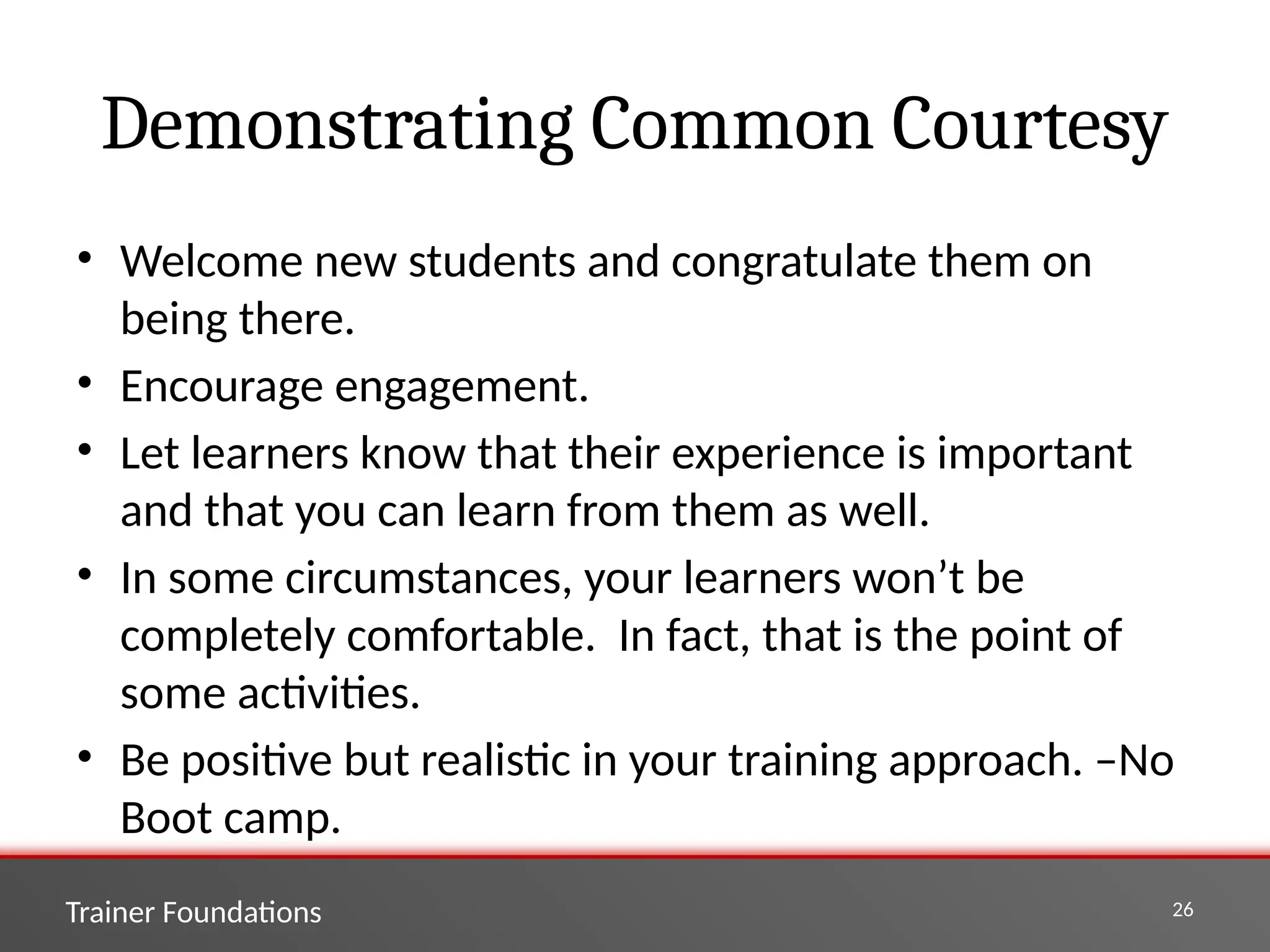
Demonstrating Common Courtesy
• Welcome new students and congratulate them on
being there.
• Encourage engagement.
• Let learners know that their experience is important
and that you can learn from them as well.
• In some circumstances, your learners won’t be
completely comfortable. In fact, that is the point of
some activities.
• Be positive but realistic in your training approach. –No
Boot camp.
Trainer Foundations 27
BOUNDARIES
Trainer Foundations 28
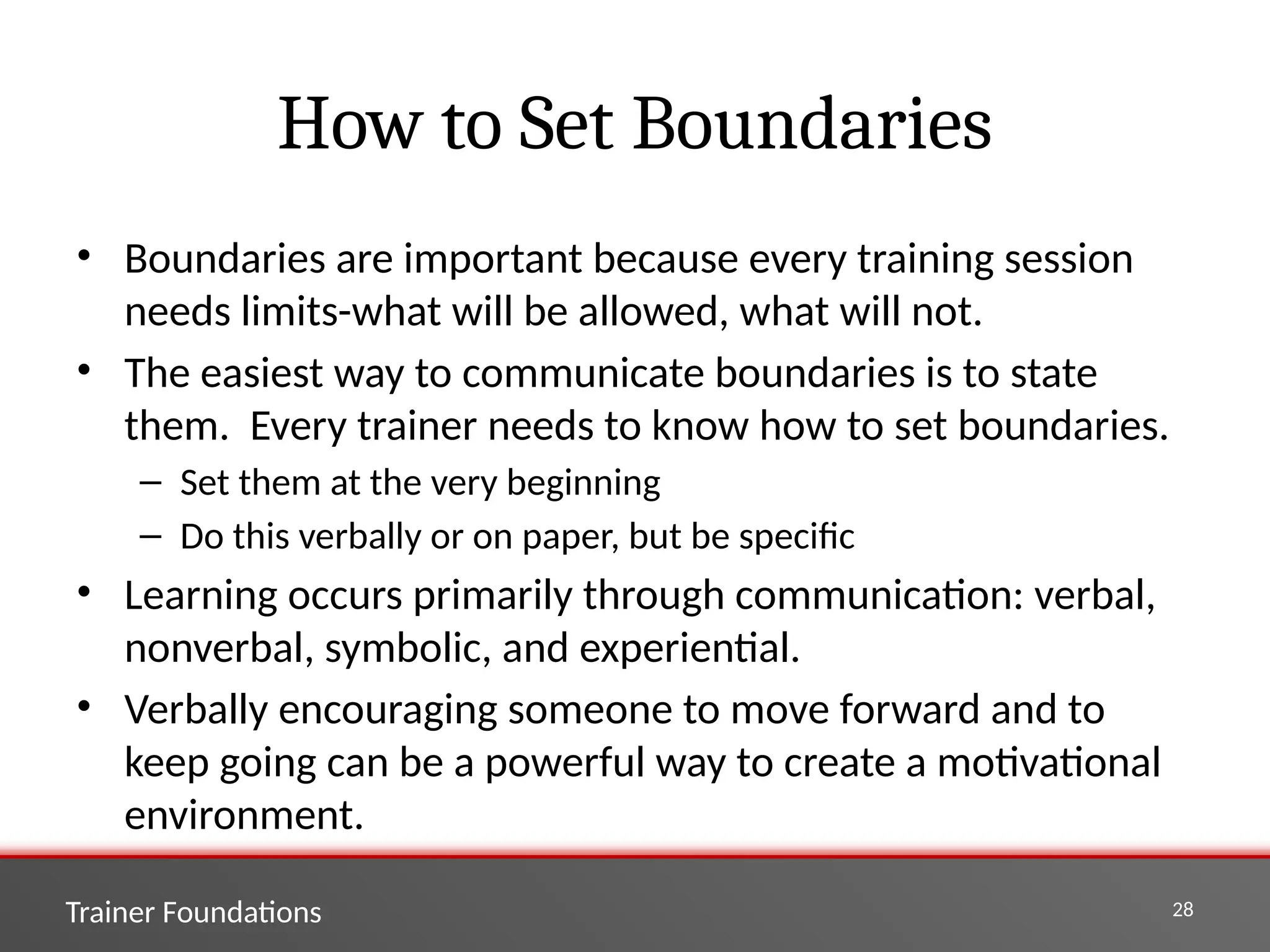
How to Set Boundaries
• Boundaries are important because every training session
needs limits-what will be allowed, what will not.
• The easiest way to communicate boundaries is to state
them. Every trainer needs to know how to set boundaries.
– Set them at the very beginning
– Do this verbally or on paper, but be specific
• Learning occurs primarily through communication: verbal,
nonverbal, symbolic, and experiential.
• Verbally encouraging someone to move forward and to
keep going can be a powerful way to create a motivational
environment.
Trainer Foundations 29
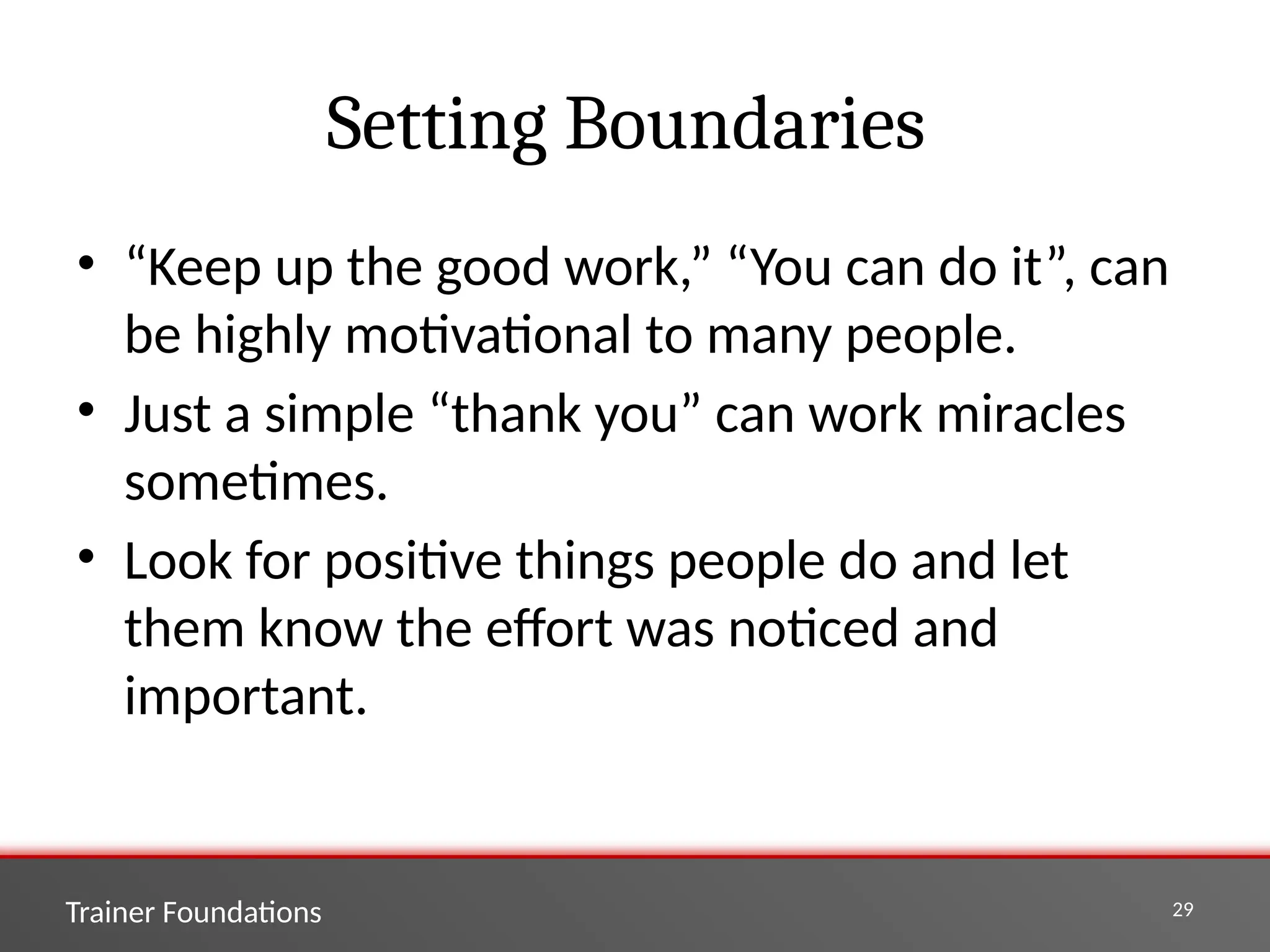
Setting Boundaries
• “Keep up the good work,” “You can do it”, can
be highly motivational to many people.
• Just a simple “thank you” can work miracles
sometimes.
• Look for positive things people do and let
them know the effort was noticed and
important.
Trainer Foundations 30
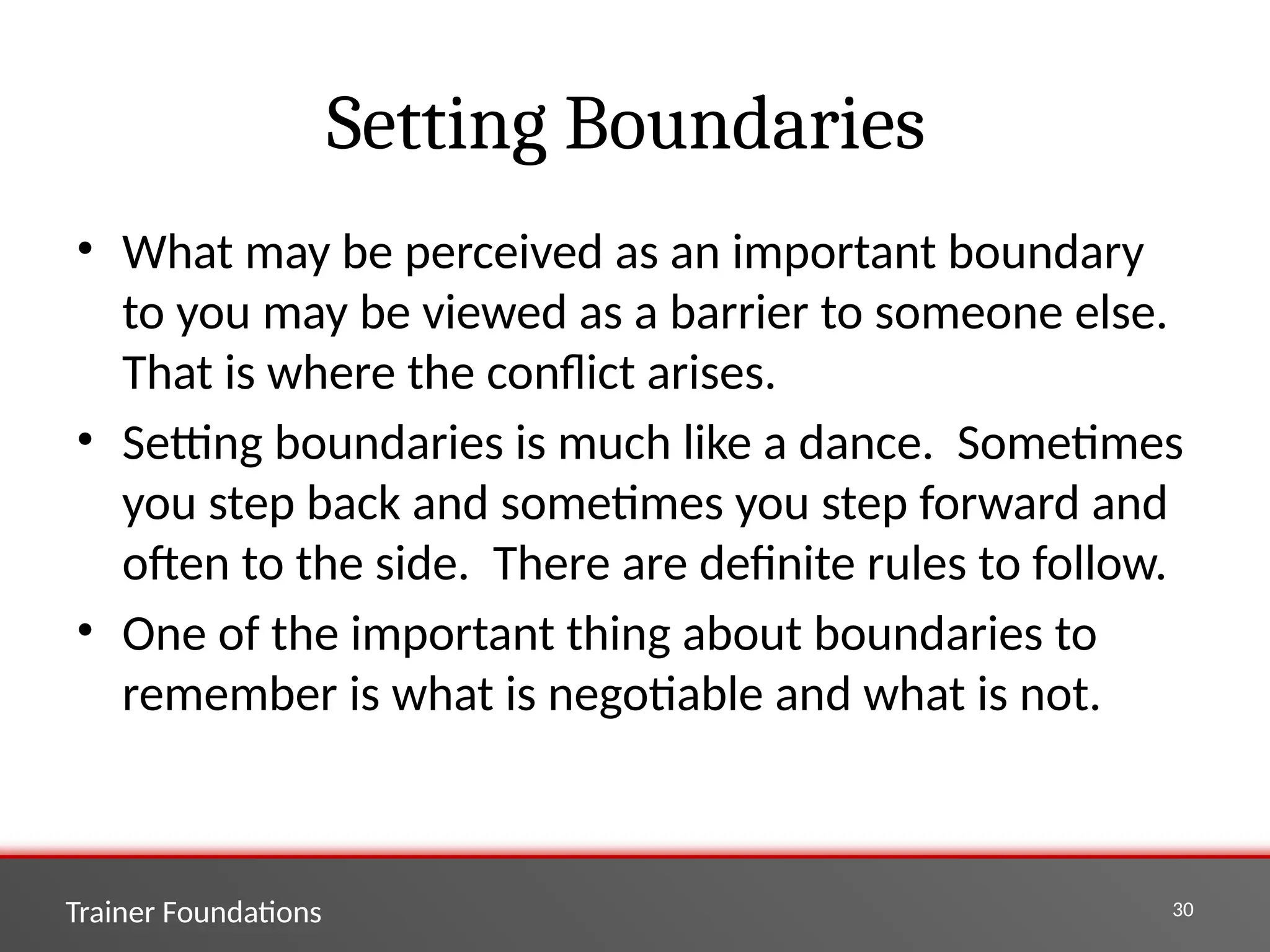
Setting Boundaries
• What may be perceived as an important boundary
to you may be viewed as a barrier to someone else.
That is where the conflict arises.
• Setting boundaries is much like a dance. Sometimes
you step back and sometimes you step forward and
often to the side. There are definite rules to follow.
• One of the important thing about boundaries to
remember is what is negotiable and what is not.
Trainer Foundations 31
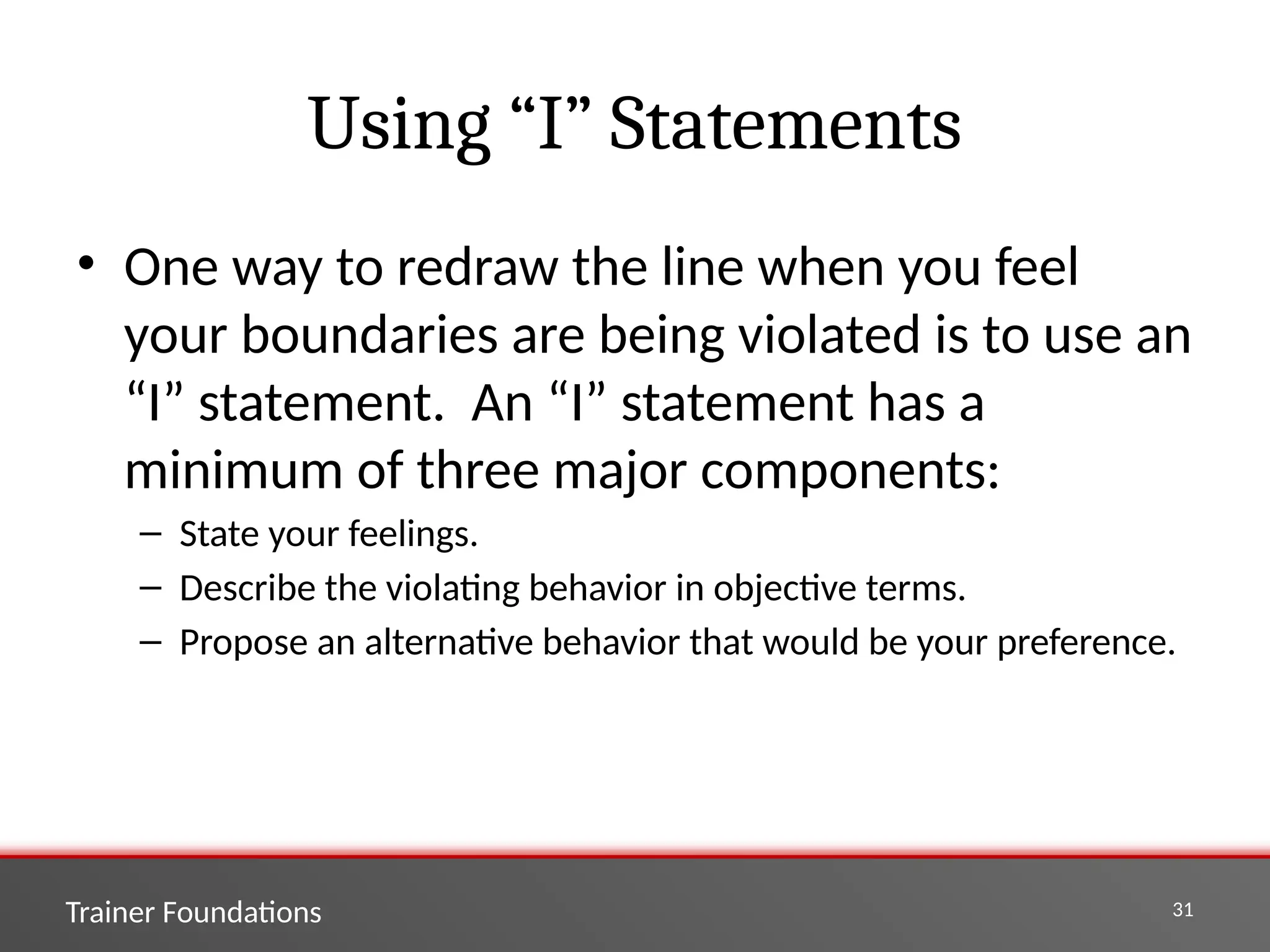
Using “I” Statements
• One way to redraw the line when you feel
your boundaries are being violated is to use an
“I” statement. An “I” statement has a
minimum of three major components:
– State your feelings.
– Describe the violating behavior in objective terms.
– Propose an alternative behavior that would be your preference.
Trainer Foundations 32
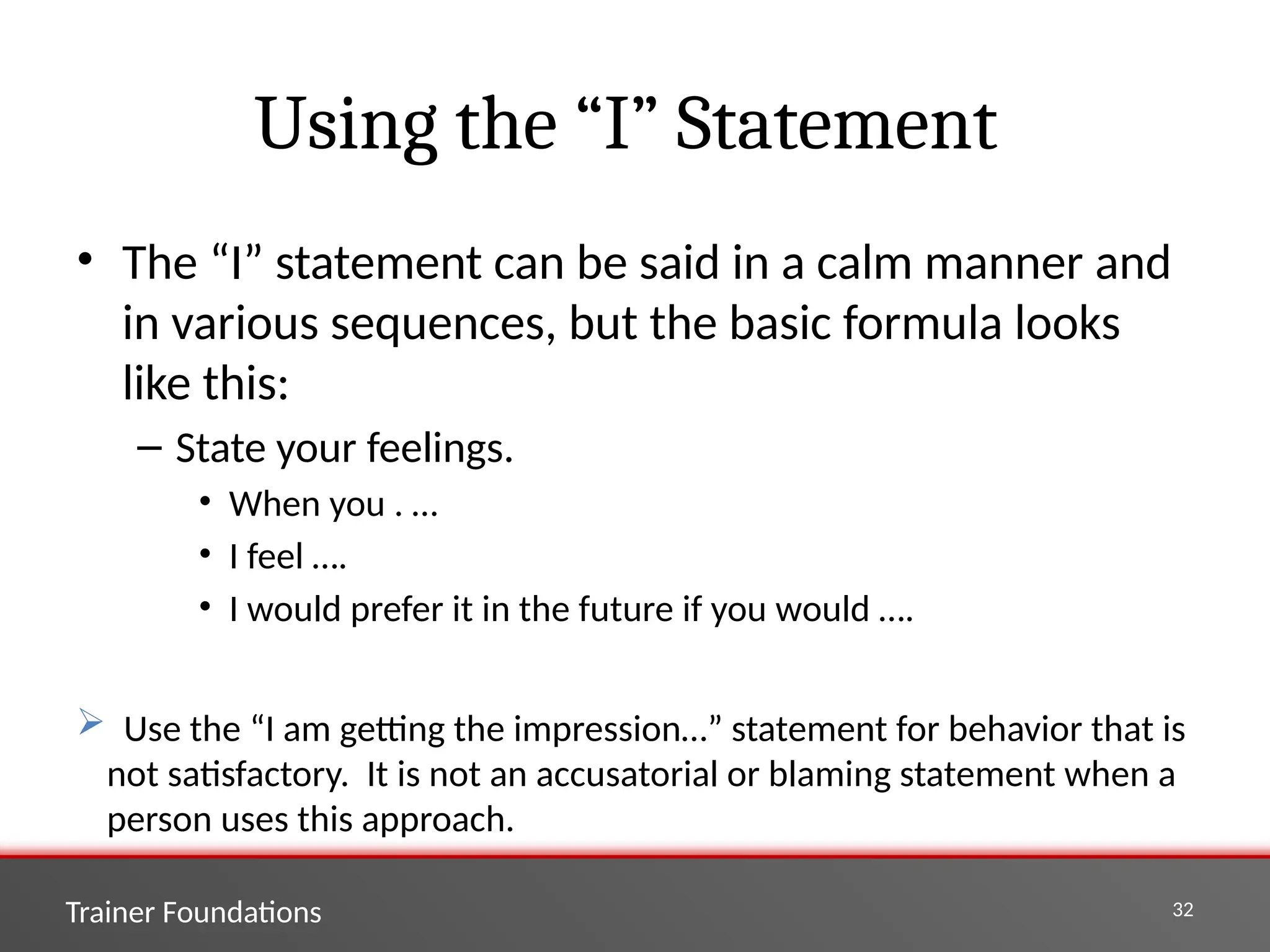
Using the “I” Statement
• The “I” statement can be said in a calm manner and
in various sequences, but the basic formula looks
like this:
– State your feelings.
• When you . …
• I feel ….
• I would prefer it in the future if you would ….
 Use the “I am getting the impression…” statement for behavior that is
not satisfactory. It is not an accusatorial or blaming statement when a
person uses this approach.
Trainer Foundations 33
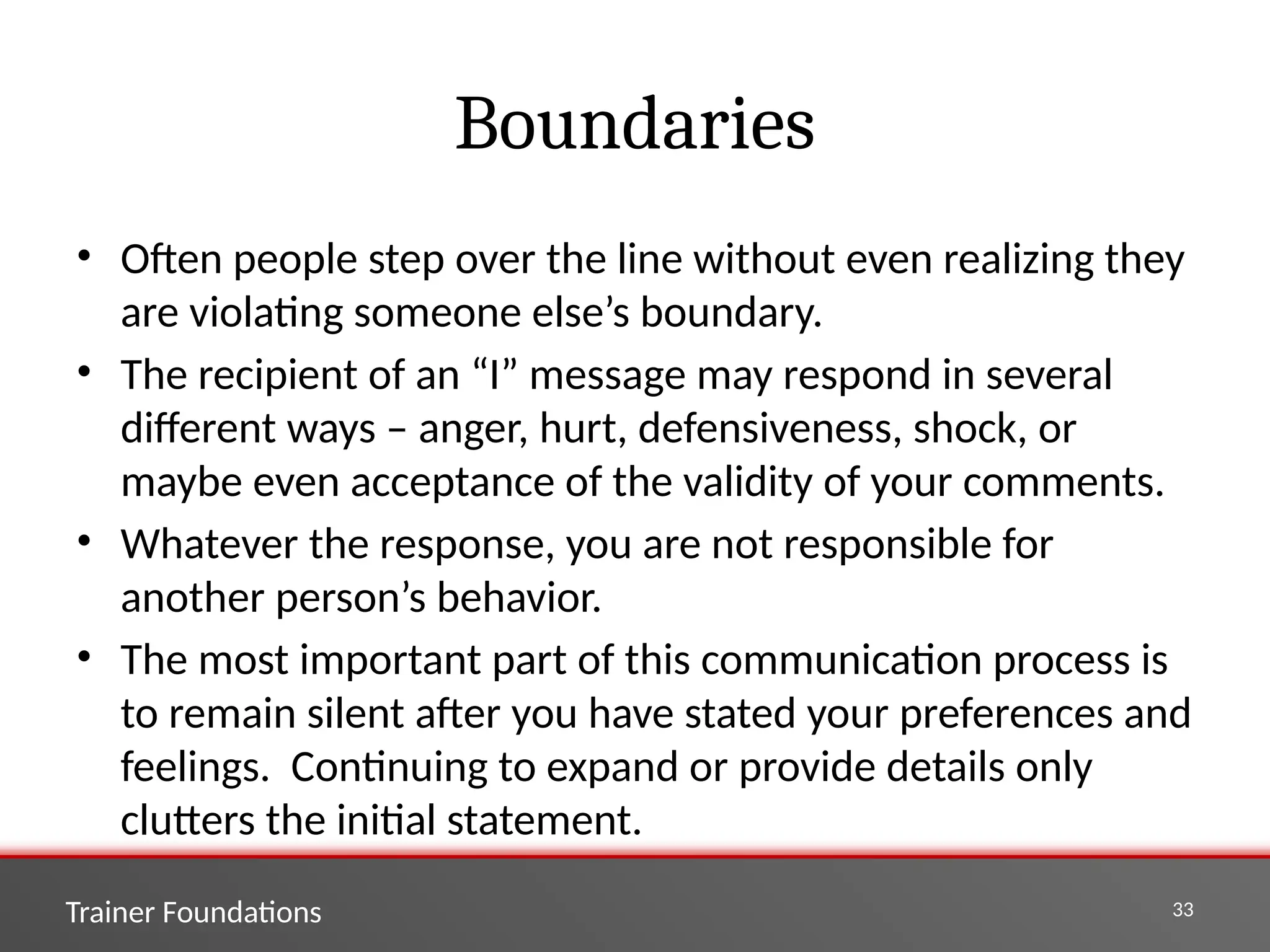
Boundaries
• Often people step over the line without even realizing they
are violating someone else’s boundary.
• The recipient of an “I” message may respond in several
different ways – anger, hurt, defensiveness, shock, or
maybe even acceptance of the validity of your comments.
• Whatever the response, you are not responsible for
another person’s behavior.
• The most important part of this communication process is
to remain silent after you have stated your preferences and
feelings. Continuing to expand or provide details only
clutters the initial statement.
Trainer Foundations 34
Handling Difficult Situations
• There’s at least one in every group: a participant who
loves to whine, become combative, talk nonstop, or
set himself or herself up as an overeager superstar.
• Some ways to reset boundaries:
– Take a break –a time out. Step back, reflect on the source
of the tensions.
– Guard against engaging in a one-on-one debate with at
person who is overly verbal. Pause and repeat to other
person what he/she said. It gives you time to collect your
thoughts and de-compress.
Trainer Foundations 35
TRAINERS AS GURU
Trainer Foundations 36
Communicating Authority
• Instructor Do Not’s
– Lack of listening behavior.
– Impatient nodding when participant is talking.
– A tendency to hurry along the learners.
– Sarcasm or humor at the expense of others.
– Little real consideration of learners’ suggestions or
comments.
– A tendency to take offense or put down a comment
that seems to challenge or contradict the validity of
what the trainer is presenting.
Trainer Foundations 37
Communicating Authority
• A trainer who has real authority is able to flex as
needed to suit the needs of the learners.
• This trainer communicates confidence by exhibiting
the following types of behaviors:
– Authentic listening to trainee comments and questions.
– Respectful steering of the discussion back to the topic.
– Willingness to discard a task or shorten a segment if
another is more important.
– Openness to introduction of new information.
Trainer Foundations 38
Guru?
• The best trainers are not gurus, but coaches –
partners in learning with the participants.
• By partnering with your learners, you can
avoid the temptation to open their heads and
pour in knowledge.
Trainer Foundations 39
Barriers and Distractions
• Doing any of the following sets up barriers and
distractions:
– Countering the speaker’s point with a contrary
opinion.
– Interrupting and cutting the speaker off before he
or she has finished the thought.
– Making a demeaning comment about the
speaker’s past thoughts or behaviors
Trainer Foundations 40
Barriers and Distractions
• Doing any of the following sets up barriers and
distractions:
– Analyzing the speaker’s statement with logic or facts.
– Intellectualizing about the comments and putting your
own interpretation on the comment.
– Invalidating the speaker’s statement with logic or facts.
– Intellectualizing about the comments.
• Skilled Listening is a critical part of the training
process, one that often takes a back seat to
presenting and facilitating.
Trainer Foundations 41
NON-VERBAL CUES
Trainer Foundations 42
Non-Verbal Cues
• More than 80% of communication is delivered and
received without words, hence the expression “Actions
speak louder that words”
• As a trainer, it is your responsibility to model desirable
workplace interaction. You can help create a much more
productive work environment if you give people a
chance:
– Listen first.
– ask questions second.
– Try to find common ground.
Trainer Foundations 43
Nonverbal Cues
• As a trainer, you want to be sure your nonverbal cues say
what you want them to. Many times, when we think we
are sending one message, the other person receives
something quite different. (Ex. of misread
non-verbals/common errors)
• It is not enough to talk the talk, you’ve got to walk the
walk
• You are judged by your behavior, not your intentions
Trainer Foundations 44
TO INFINITY AND BEYOND
Trainer Foundations 45
3 Step Training Method
• Step 1 –Tell them what you are going to tell
them.
• Step 2 –Tell them.
• Step 3 –Tell them what you told them.
Trainer Foundations 46
Tell Them Again
• Give your learners an attitude of success. Let
them know that they can master this
information.
• Have an attitude of gratitude. Be thankful for
the opportunity to invest in someone else.
• Every person sitting in front of you represents
an opportunity for you to make a difference.

Communication Basics Power Point - Comm. Basics

  • 1.
    Trainer Foundations 1 CommunicationBasics “Listen effectively and speak confidently”
  • 2.
    Trainer Foundations 2 Agenda •Communicate From the Heart • Tame the Fear Monster • Attitudes Speak Louder Than Words • Trainer –Know Thyself • Out on a Limb
  • 3.
  • 4.
    Trainer Foundations 4 Zealfor the Subject • Caring isn’t enough. Substantial, current content must be passed along in an applicable way. • Good trainers are ones who integrate their knowledge into their lives, are excited about it, and enthusiastic about it. • That kind of enthusiasm is contagious because it communicates, it vibrates, and its authenticity engages learners and keeps them interested. • Memorable teachers are masters at making their subjects live for their students.
  • 5.
    Trainer Foundations 5 Cont’d •The best trainers take time to connect with the learners who are in their trucks, classes, workshops, and seminars. • These trainers are life changing teachers, because they teach from the heart. • Communication is about connecting. It is all about connecting.
  • 6.
  • 7.
    Trainer Foundations 7 ThePower of Fear • Even the most experienced presenter gets a bit of stage fright. Part of the anxiety is caused by adrenaline. • Fear can prevent you from: – answering questions clearly. – focusing on the participants. – thinking logically. – connecting with people on more than a superficial level.
  • 8.
    Trainer Foundations 8 Cont’d •Fear can cause you to: – communicate a lack of confidence on the material and in yourself. – separate yourself from the participants. – appear to be aloof and cold. – seem to be disorganized. – fail to cover key points in the training. • As a trainer you want the participants to leave with a feeling of confidence, ready to put to use the skills and knowledge they’ve gained.
  • 9.
    Trainer Foundations 9 Cont’d •If you communicate a lack of confidence, their attitude upon leaving will be one of uncertainty. • At worst, they’ll be angry about the time they’ve wasted and will have no real desire to implement the things you’ve taught or presented. • Four Steps to Success – Focus on the Participants. • Remember, your training isn’t ever about you. The training experience is always about the learners. • Training is always about the participants. By focusing on them and their needs, you can conquer fear.
  • 10.
    Trainer Foundations 10 Cont’d –Special or other needs: these may come to you private conversation or on paper. – Comfortable and not alienated: As you are gathering information, pay close attention to your participants. What will pave the way for them to feel comfortable in your training and what may make them feel alienated? – Accommodate adequate number of breaks; restroom, food, drink, smoke, phone, etc. – Ask your student, “What is your biggest fear of Phase II ? • Asking this question will allow you to put the student at ease.
  • 11.
    Trainer Foundations 11 Cont’d •Focus on the Content – Know your material. • Focus on the Structure – Time Management. – Communicate confidence to your student’s. You are essentially leading your students through alien territory with the goal of coming out successfully on the other side. – You cannot lead if you don’t know where you are going; and if you cannot lead, you cannot be confident. And if you are not confident, they will not be either. – Confidence on the part of the trainer goes a long way toward helping the participants absorb and apply the material.
  • 12.
    Trainer Foundations 12 Review •Learners won’t care how much you know until they see how much you care. • Get your eyes off of yourself and on the learner. • Training isn’t about you! • Just to be clear – training isn’t about you; it’s about the learner! • You can not, not communicate – so communicate confidence.
  • 13.
    Trainer Foundations 13 ATTITUDESSPEAK LOUDER THAN WORDS Exercise 3-1 pg 26-27
  • 14.
    Trainer Foundations 14 EffectiveCommunication • Effective communication is not just the ability to talk well or often. It also includes the ability to: – hear what is really being said rather than what may be said on the surface. – read nonverbal behavior. – communicate nonverbally (and appropriately) in return.
  • 15.
    Trainer Foundations 15 PersonalPower • Personal power is not: – power over another person – loud voices and shouting – put-downs of other people – antagonistic or aggressive behavior • Personal power is the quiet strength that comes from knowing who you are, what you want, and what you are about.
  • 16.
    Trainer Foundations 16 PersonalPower • Individuals with personal power are not demeaned or belittled by others, nor do they demean or belittle others. • A trainer with personal power can: – Be humble – Authoritative – Be funny – Be firm and to the point – Communicate respect with a glance or a word-and receive it in return.
  • 17.
  • 18.
    Trainer Foundations 18 Keepingup Appearances • 80-90 percent of communication is non- verbal. • What does your appearance communicate? • What does the cleanliness of you truck communicate? • How often have you made decisions about others based on appearance? Of their truck or their person?
  • 19.
    Trainer Foundations 19 Settingthe tone • What is an expectation? • Who can have them? • What are common errors regarding expectations? – Inconsistent – Unclear – Impractical – Unspoken
  • 20.
    Trainer Foundations 20 Buildingin Interactivity • Interaction is a powerful way to enhance learning because many people process information through questions and discussion. – YOU HAVE TO TALK! • Interaction can be an excellent way to reinforce the concepts you are presenting and also obtain feedback from the participants about their understanding and acceptance of the information. – YOU HAVE TO LISTEN!
  • 21.
  • 22.
    Trainer Foundations 22 Transparency •Accept that you will make errors during training. • Accept that you are on display. • Accept that your “personal” space is now invaded. • Accept that you are visible and can’t hide. • Don’t act like you are “above it all”. Show some humility.
  • 23.
    Trainer Foundations 23 HOWIS MORE IMPORTANT THAN WHAT
  • 24.
    Trainer Foundations 24 AQuick Check • Some trainers confuse laughter with agreement. They think that if participants are laughing they are having fun and that participants who are having fun are more inclined to learn. • The key is to encourage participants without embarrassing them in the process. • Although it is tempting to use humor, especially in response to off-the-wall suggestions and ideas, doing so is dangerous. • Unless the participant is very strong, your attempts at humor may increase that individual’s hesitation to participate and may also dampen their willingness. Use humor with caution.
  • 25.
    Trainer Foundations 25 UsingLanguage Appropriately • Training audiences often are from diverse cultures, different careers, different backgrounds, and have a bouquet of value systems. • Use words that the learner will understand. • Do not use words that could be offensive or “off color” – Cuss words/vulgar words – Racial/discriminatory words
  • 26.
    Trainer Foundations 26 DemonstratingCommon Courtesy • Welcome new students and congratulate them on being there. • Encourage engagement. • Let learners know that their experience is important and that you can learn from them as well. • In some circumstances, your learners won’t be completely comfortable. In fact, that is the point of some activities. • Be positive but realistic in your training approach. –No Boot camp.
  • 27.
  • 28.
    Trainer Foundations 28 Howto Set Boundaries • Boundaries are important because every training session needs limits-what will be allowed, what will not. • The easiest way to communicate boundaries is to state them. Every trainer needs to know how to set boundaries. – Set them at the very beginning – Do this verbally or on paper, but be specific • Learning occurs primarily through communication: verbal, nonverbal, symbolic, and experiential. • Verbally encouraging someone to move forward and to keep going can be a powerful way to create a motivational environment.
  • 29.
    Trainer Foundations 29 SettingBoundaries • “Keep up the good work,” “You can do it”, can be highly motivational to many people. • Just a simple “thank you” can work miracles sometimes. • Look for positive things people do and let them know the effort was noticed and important.
  • 30.
    Trainer Foundations 30 SettingBoundaries • What may be perceived as an important boundary to you may be viewed as a barrier to someone else. That is where the conflict arises. • Setting boundaries is much like a dance. Sometimes you step back and sometimes you step forward and often to the side. There are definite rules to follow. • One of the important thing about boundaries to remember is what is negotiable and what is not.
  • 31.
    Trainer Foundations 31 Using“I” Statements • One way to redraw the line when you feel your boundaries are being violated is to use an “I” statement. An “I” statement has a minimum of three major components: – State your feelings. – Describe the violating behavior in objective terms. – Propose an alternative behavior that would be your preference.
  • 32.
    Trainer Foundations 32 Usingthe “I” Statement • The “I” statement can be said in a calm manner and in various sequences, but the basic formula looks like this: – State your feelings. • When you . … • I feel …. • I would prefer it in the future if you would ….  Use the “I am getting the impression…” statement for behavior that is not satisfactory. It is not an accusatorial or blaming statement when a person uses this approach.
  • 33.
    Trainer Foundations 33 Boundaries •Often people step over the line without even realizing they are violating someone else’s boundary. • The recipient of an “I” message may respond in several different ways – anger, hurt, defensiveness, shock, or maybe even acceptance of the validity of your comments. • Whatever the response, you are not responsible for another person’s behavior. • The most important part of this communication process is to remain silent after you have stated your preferences and feelings. Continuing to expand or provide details only clutters the initial statement.
  • 34.
    Trainer Foundations 34 HandlingDifficult Situations • There’s at least one in every group: a participant who loves to whine, become combative, talk nonstop, or set himself or herself up as an overeager superstar. • Some ways to reset boundaries: – Take a break –a time out. Step back, reflect on the source of the tensions. – Guard against engaging in a one-on-one debate with at person who is overly verbal. Pause and repeat to other person what he/she said. It gives you time to collect your thoughts and de-compress.
  • 35.
  • 36.
    Trainer Foundations 36 CommunicatingAuthority • Instructor Do Not’s – Lack of listening behavior. – Impatient nodding when participant is talking. – A tendency to hurry along the learners. – Sarcasm or humor at the expense of others. – Little real consideration of learners’ suggestions or comments. – A tendency to take offense or put down a comment that seems to challenge or contradict the validity of what the trainer is presenting.
  • 37.
    Trainer Foundations 37 CommunicatingAuthority • A trainer who has real authority is able to flex as needed to suit the needs of the learners. • This trainer communicates confidence by exhibiting the following types of behaviors: – Authentic listening to trainee comments and questions. – Respectful steering of the discussion back to the topic. – Willingness to discard a task or shorten a segment if another is more important. – Openness to introduction of new information.
  • 38.
    Trainer Foundations 38 Guru? •The best trainers are not gurus, but coaches – partners in learning with the participants. • By partnering with your learners, you can avoid the temptation to open their heads and pour in knowledge.
  • 39.
    Trainer Foundations 39 Barriersand Distractions • Doing any of the following sets up barriers and distractions: – Countering the speaker’s point with a contrary opinion. – Interrupting and cutting the speaker off before he or she has finished the thought. – Making a demeaning comment about the speaker’s past thoughts or behaviors
  • 40.
    Trainer Foundations 40 Barriersand Distractions • Doing any of the following sets up barriers and distractions: – Analyzing the speaker’s statement with logic or facts. – Intellectualizing about the comments and putting your own interpretation on the comment. – Invalidating the speaker’s statement with logic or facts. – Intellectualizing about the comments. • Skilled Listening is a critical part of the training process, one that often takes a back seat to presenting and facilitating.
  • 41.
  • 42.
    Trainer Foundations 42 Non-VerbalCues • More than 80% of communication is delivered and received without words, hence the expression “Actions speak louder that words” • As a trainer, it is your responsibility to model desirable workplace interaction. You can help create a much more productive work environment if you give people a chance: – Listen first. – ask questions second. – Try to find common ground.
  • 43.
    Trainer Foundations 43 NonverbalCues • As a trainer, you want to be sure your nonverbal cues say what you want them to. Many times, when we think we are sending one message, the other person receives something quite different. (Ex. of misread non-verbals/common errors) • It is not enough to talk the talk, you’ve got to walk the walk • You are judged by your behavior, not your intentions
  • 44.
    Trainer Foundations 44 TOINFINITY AND BEYOND
  • 45.
    Trainer Foundations 45 3Step Training Method • Step 1 –Tell them what you are going to tell them. • Step 2 –Tell them. • Step 3 –Tell them what you told them.
  • 46.
    Trainer Foundations 46 TellThem Again • Give your learners an attitude of success. Let them know that they can master this information. • Have an attitude of gratitude. Be thankful for the opportunity to invest in someone else. • Every person sitting in front of you represents an opportunity for you to make a difference.