Communication Skills
Overview:
Communication skillsare a
critical element in delivering
effective training.
Trainers must be able to use a
variety of communication
techniques in order to create an
environment that enables
participants to engage actively
in the learning process.
3.
Session Objectives
By theend of the session, the participant will be able to:
Describe reasons that communication fails
List and discuss strategies to enhance
communication
Paraphrase and summarize conversations
Use appropriate questioning techniques to
lead discussions and to assist learning
4.
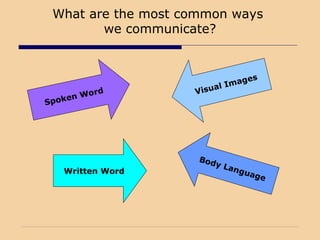
What are themost common ways
we communicate?
Spoken Word
Written Word
Visual Images
Body Language
5.
All communication methodsare important
in training but our emphasis will be upon
the spoken word... since
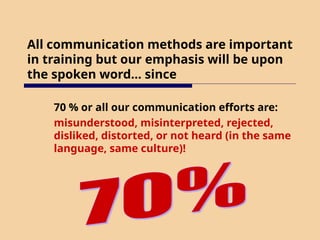
70 % or all our communication efforts are:
misunderstood, misinterpreted, rejected,
disliked, distorted, or not heard (in the same
language, same culture)!
6.
Group facilitation requiresfrequent and
high quality communication with others
A skilled facilitator
must be a
successful communicator
Trainers are facilitators
of learning and
communicating new
ideas is the main point
of training
7.
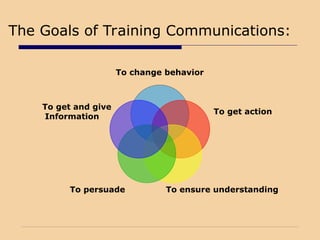
The Goals ofTraining Communications:
To change behavior
To get action
To ensure understanding
To persuade
To get and give
Information
8.
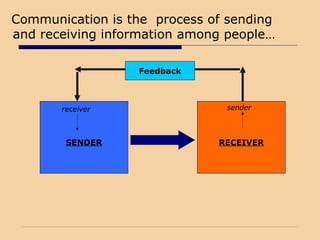
Communication is theprocess of sending
and receiving information among people…
SENDER RECEIVER
Feedback
receiver sender
9.
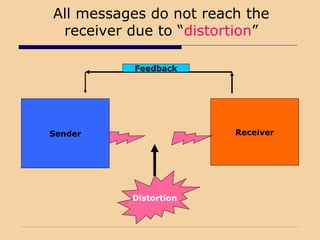
All messages donot reach the
receiver due to “distortion”
Sender Receiver
Feedback
Distortion
10.
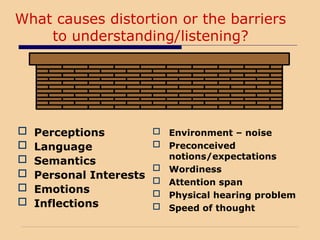
What causes distortionor the barriers
to understanding/listening?
Perceptions
Language
Semantics
Personal Interests
Emotions
Inflections
Environment – noise
Preconceived
notions/expectations
Wordiness
Attention span
Physical hearing problem
Speed of thought
11.
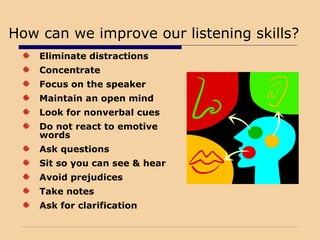
How can weimprove our listening skills?
Eliminate distractions
Concentrate
Focus on the speaker
Maintain an open mind
Look for nonverbal cues
Do not react to emotive
words
Ask questions
Sit so you can see & hear
Avoid prejudices
Take notes
Ask for clarification
12.
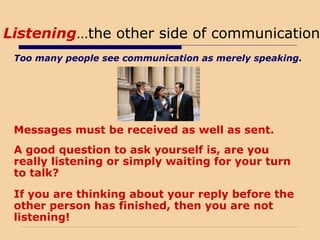
Listening…the other sideof communication
Messages must be received as well as sent.
A good question to ask yourself is, are you
really listening or simply waiting for your turn
to talk?
If you are thinking about your reply before the
other person has finished, then you are not
listening!
Too many people see communication as merely speaking.
13.
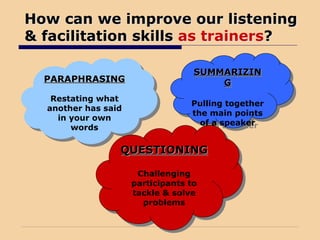
How can weimprove our listening
& facilitation skills as trainers?
PARAPHRASING
PARAPHRASING
Restating what
another has said
in your own
words
SUMMARIZIN
SUMMARIZIN
G
G
Pulling together
the main points
of a speaker
QUESTIONING
QUESTIONING
Challenging
participants to
tackle & solve
problems
14.
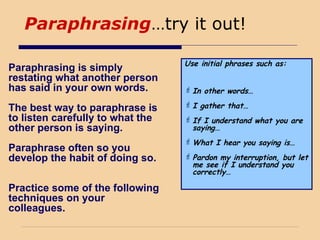
Paraphrasing…try it out!
Paraphrasingis simply
restating what another person
has said in your own words.
The best way to paraphrase is
to listen carefully to what the
other person is saying.
Paraphrase often so you
develop the habit of doing so.
Practice some of the following
techniques on your
colleagues.
Use initial phrases such as:
In other words…
I gather that…
If I understand what you are
saying…
What I hear you saying is…
Pardon my interruption, but let
me see if I understand you
correctly…
15.
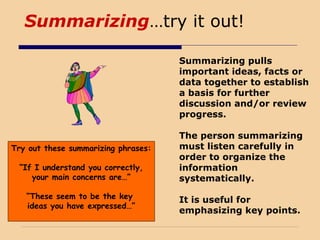
Summarizing…try it out!
Summarizingpulls
important ideas, facts or
data together to establish
a basis for further
discussion and/or review
progress.
The person summarizing
must listen carefully in
order to organize the
information
systematically.
It is useful for
emphasizing key points.
Try out these summarizing phrases:
“If I understand you correctly,
your main concerns are…”
“These seem to be the key
ideas you have expressed…”
16.
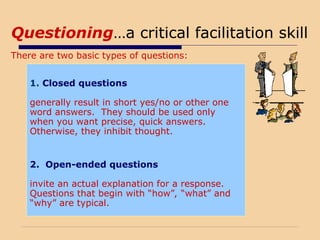
Questioning…a critical facilitationskill
1. Closed questions
generally result in short yes/no or other one
word answers. They should be used only
when you want precise, quick answers.
Otherwise, they inhibit thought.
2. Open-ended questions
invite an actual explanation for a response.
Questions that begin with “how”, “what” and
“why” are typical.
There are two basic types of questions:
17.
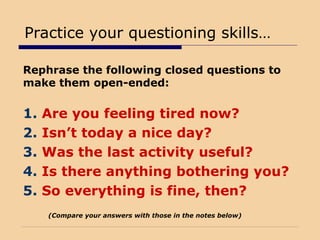
Practice your questioningskills…
Rephrase the following closed questions to
make them open-ended:
1. Are you feeling tired now?
2. Isn’t today a nice day?
3. Was the last activity useful?
4. Is there anything bothering you?
5. So everything is fine, then?
(Compare your answers with those in the notes below)
18.
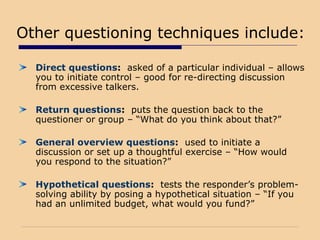
Other questioning techniquesinclude:
Direct questions: asked of a particular individual – allows
you to initiate control – good for re-directing discussion
from excessive talkers.
Return questions: puts the question back to the
questioner or group – “What do you think about that?”
General overview questions: used to initiate a
discussion or set up a thoughtful exercise – “How would
you respond to the situation?”
Hypothetical questions: tests the responder’s problem-
solving ability by posing a hypothetical situation – “If you
had an unlimited budget, what would you fund?”
19.
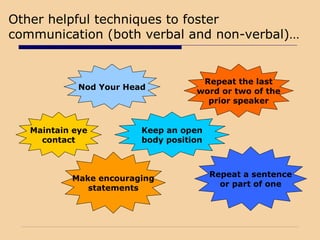
Other helpful techniquesto foster
communication (both verbal and non-verbal)…
Maintain eye
contact
Make encouraging
statements
Nod Your Head
Keep an open
body position
Repeat a sentence
or part of one
Repeat the last
word or two of the
prior speaker
20.
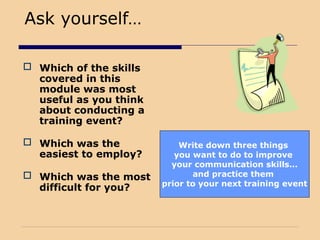
Write down threethings
you want to do to improve
your communication skills…
and practice them
prior to your next training event
Ask yourself…
Which of the skills
covered in this
module was most
useful as you think
about conducting a
training event?
Which was the
easiest to employ?
Which was the most
difficult for you?
Editor's Notes
#10 See handout “Barriers to Verbal Communication” for elaboration
#12 See Handout “ Aids to Effective Listening” for further information.
#17 What tires you out?
What kind of weather are we having today?
How was the last activity useful?
Tell me what is on your mind.
Why are you looking so happy?
#18 See handout “Questioning Techniques” for more ideas.