Minimum Spanning Tree
Minimum Spanning Trees (MST)
2
Minimum Spanning Trees
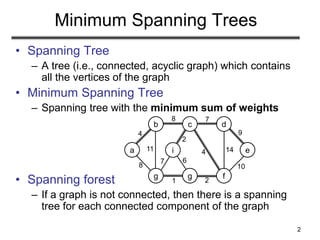
• Spanning Tree
– A tree (i.e., connected, acyclic graph) which contains
all the vertices of the graph
• Minimum Spanning Tree
– Spanning tree with the minimum sum of weights
• Spanning forest
– If a graph is not connected, then there is a spanning
tree for each connected component of the graph
a
b c d
e
g g f
i
4
8 7
8
11
1 2
7
2
4 14
9
10
6
3
Applications of MST
– Find the least expensive way to connect a set of
cities, terminals, computers, etc.
4
Example
Problem
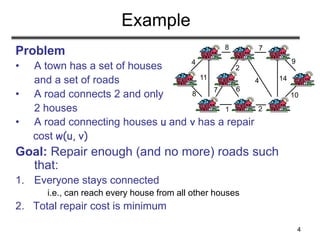
• A town has a set of houses
and a set of roads
• A road connects 2 and only
2 houses
• A road connecting houses u and v has a repair
cost w(u, v)
Goal: Repair enough (and no more) roads such
that:
1. Everyone stays connected
i.e., can reach every house from all other houses
2. Total repair cost is minimum
a
b c d
e
h g f
i
4
8 7
8
11
1 2
7
2
4 14
9
10
6
5
Minimum Spanning Trees
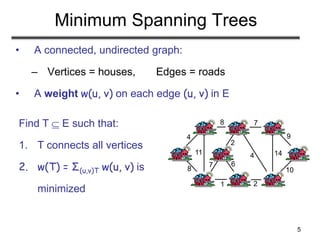
• A connected, undirected graph:
– Vertices = houses, Edges = roads
• A weight w(u, v) on each edge (u, v) in E
a
b c d
e
h g f
i
4
8 7
8
11
1 2
7
2
4 14
9
10
6
Find T  E such that:
1. T connects all vertices
2. w(T) = Σ(u,v)T w(u, v) is
minimized
6
Properties of Minimum Spanning Trees
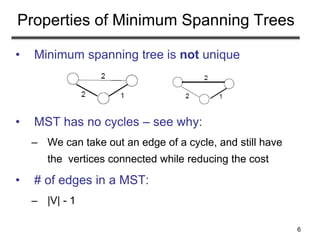
• Minimum spanning tree is not unique
• MST has no cycles – see why:
– We can take out an edge of a cycle, and still have
the vertices connected while reducing the cost
• # of edges in a MST:
– |V| - 1
7
Growing a MST – Generic Approach
a
b c d
e
h g f
i
4
8 7
8
11
1 2
7
2
4 14
9
10
6
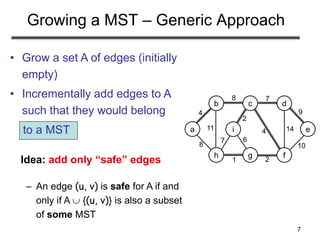
• Grow a set A of edges (initially
empty)
• Incrementally add edges to A
such that they would belong
to a MST
– An edge (u, v) is safe for A if and
only if A  {(u, v)} is also a subset
of some MST
Idea: add only “safe” edges
8
Generic MST algorithm
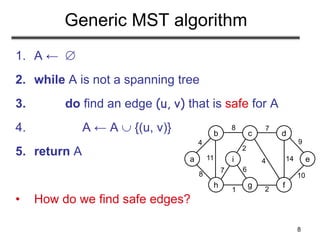
1. A ← 
2. while A is not a spanning tree
3. do find an edge (u, v) that is safe for A
4. A ← A  {(u, v)}
5. return A
• How do we find safe edges?
a
b c d
e
h g f
i
4
8 7
8
11
1 2
7
2
4 14
9
10
6
9
S
V - S
Finding Safe Edges
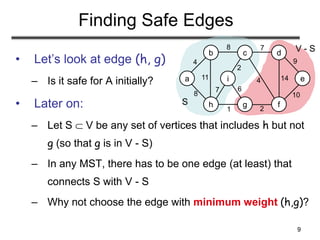
• Let’s look at edge (h, g)
– Is it safe for A initially?
• Later on:
– Let S  V be any set of vertices that includes h but not
g (so that g is in V - S)
– In any MST, there has to be one edge (at least) that
connects S with V - S
– Why not choose the edge with minimum weight (h,g)?
a
b c d
e
h g f
i
4
8 7
8
11
1 2
7
2
4 14
9
10
6
10
Definitions
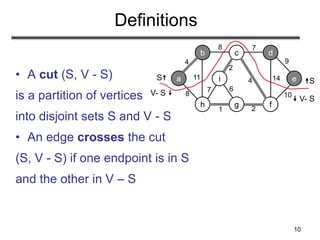
• A cut (S, V - S)
is a partition of vertices
into disjoint sets S and V - S
• An edge crosses the cut
(S, V - S) if one endpoint is in S
and the other in V – S
a
b c d
e
h g f
i
4
8 7
8
11
1 2
7
2
4 14
9
10
6
S
V- S 
S
 V- S
11
Definitions (cont’d)
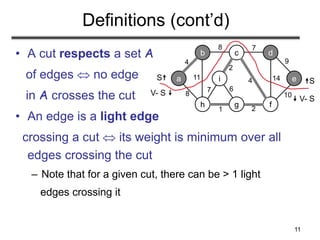
• A cut respects a set A
of edges  no edge
in A crosses the cut
• An edge is a light edge
crossing a cut  its weight is minimum over all
edges crossing the cut
– Note that for a given cut, there can be > 1 light
edges crossing it
a
b c d
e
h g f
i
4
8 7
8
11
1 2
7
2
4 14
9
10
6
S
V- S 
S
 V- S
12
Theorem
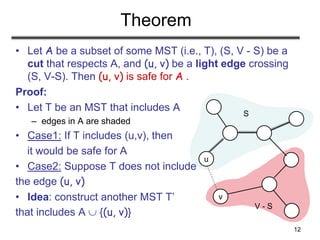
• Let A be a subset of some MST (i.e., T), (S, V - S) be a
cut that respects A, and (u, v) be a light edge crossing
(S, V-S). Then (u, v) is safe for A .
Proof:
• Let T be an MST that includes A
– edges in A are shaded
• Case1: If T includes (u,v), then
it would be safe for A
• Case2: Suppose T does not include
the edge (u, v)
• Idea: construct another MST T’
that includes A  {(u, v)}
u
v
S
V - S
13
u
v
S
V - S
Theorem - Proof
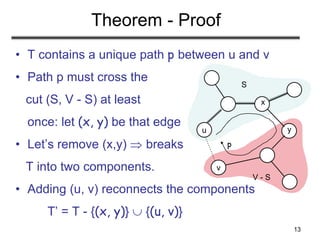
• T contains a unique path p between u and v
• Path p must cross the
cut (S, V - S) at least
once: let (x, y) be that edge
• Let’s remove (x,y)  breaks
T into two components.
• Adding (u, v) reconnects the components
T’ = T - {(x, y)}  {(u, v)}
x
y
p
14
Theorem – Proof (cont.)
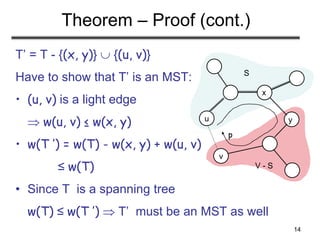
T’ = T - {(x, y)}  {(u, v)}
Have to show that T’ is an MST:
• (u, v) is a light edge
 w(u, v) ≤ w(x, y)
• w(T ’) = w(T) - w(x, y) + w(u, v)
≤ w(T)
• Since T is a spanning tree
w(T) ≤ w(T ’)  T’ must be an MST as well
u
v
S
V - S
x
y
p
15
Theorem – Proof (cont.)
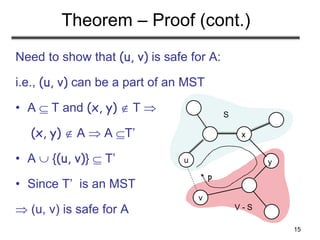
Need to show that (u, v) is safe for A:
i.e., (u, v) can be a part of an MST
• A  T and (x, y)  T 
(x, y)  A  A T’
• A  {(u, v)}  T’
• Since T’ is an MST
 (u, v) is safe for A
u
v
S
V - S
x
y
p
16
Prim’s Algorithm
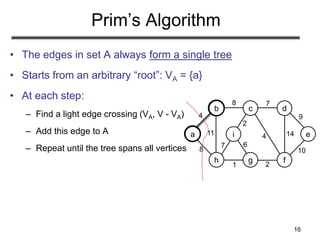
• The edges in set A always form a single tree
• Starts from an arbitrary “root”: VA = {a}
• At each step:
– Find a light edge crossing (VA, V - VA)
– Add this edge to A
– Repeat until the tree spans all vertices
a
b c d
e
h g f
i
4
8 7
8
11
1 2
7
2
4 14
9
10
6
17
How to Find Light Edges Quickly?
Use a priority queue Q:
• Contains vertices not yet
included in the tree, i.e., (V – VA)
– VA = {a}, Q = {b, c, d, e, f, g, h, i}
• We associate a key with each vertex v:
key[v] = minimum weight of any edge (u, v)
connecting v to VA
a
b c d
e
h g f
i
4
8 7
8
11
1 2
7
2
4 14
9
10
6
w1
w2
Key[a]=min(w1,w2)
a
18
How to Find Light Edges Quickly?
(cont.)
• After adding a new node to VA we update the weights of all
the nodes adjacent to it
e.g., after adding a to the tree, k[b]=4 and k[h]=8
• Key of v is  if v is not adjacent to any vertices in VA
a
b c d
e
h g f
i
4
8 7
8
11
1 2
7
2
4 14
9
10
6
19
Example
0        
Q = {a, b, c, d, e, f, g, h, i}
VA = 
Extract-MIN(Q)  a
a
b c d
e
h g f
i
4
8 7
8
11
1 2
7
2
4 14
9
10
6
a
b c d
e
h g f
i
4
8 7
8
11
1 2
7
2
4 14
9
10
6
key [b] = 4  [b] = a
key [h] = 8  [h] = a
4      8 
Q = {b, c, d, e, f, g, h, i} VA = {a}
Extract-MIN(Q)  b
  
 
  
 
 
 

4

8
20
4 

8  
8

Example
a
b c d
e
h g f
i
4
8 7
8
11
1 2
7
2
4 14
9
10
6
key [c] = 8  [c] = b
key [h] = 8  [h] = a - unchanged
8     8 
Q = {c, d, e, f, g, h, i} VA = {a, b}
Extract-MIN(Q)  c
a
b c d
e
h g f
i
4
8 7
8
11
1 2
7
2
4 14
9
10
6
key [d] = 7  [d] = c
key [f] = 4  [f] = c
key [i] = 2  [i] = c
7  4  8 2
Q = {d, e, f, g, h, i} VA = {a, b, c}
Extract-MIN(Q)  i


4 

8  
8
7
4
2
21
Example
a
b c d
e
h g f
i
4
8 7
8
11
1 2
7
2
4 14
9
10
6
key [h] = 7  [h] = i
key [g] = 6  [g] = i
7  4 6 8
Q = {d, e, f, g, h} VA = {a, b, c, i}
Extract-MIN(Q)  f
a
b c d
e
h g f
i
4
8 7
8
11
1 2
7
2
4 14
9
10
6
key [g] = 2  [g] = f
key [d] = 7  [d] = c unchanged
key [e] = 10  [e] = f
7 10 2 8
Q = {d, e, g, h} VA = {a, b, c, i, f}
Extract-MIN(Q)  g
4 7

8  4
8
2
7 6
4 7

7 6 4
8
2
2
10
22
Example
a
b c d
e
h g f
i
4
8 7
8
11
1 2
7
2
4 14
9
10
6
key [h] = 1  [h] = g
7 10 1
Q = {d, e, h} VA = {a, b, c, i, f, g}
Extract-MIN(Q)  h
a
b c d
e
h g f
i
4
8 7
8
11
1 2
7
2
4 14
9
10
6
7 10
Q = {d, e} VA = {a, b, c, i, f, g, h}
Extract-MIN(Q)  d
4 7
10
7 2 4
8
2
1
4 7
10
1 2 4
8
2
23
Example
a
b c d
e
h g f
i
4
8 7
8
11
1 2
7
2
4 14
9
10
6
key [e] = 9  [e] = f
9
Q = {e} VA = {a, b, c, i, f, g, h, d}
Extract-MIN(Q)  e
Q =  VA = {a, b, c, i, f, g, h, d, e}
4 7
10
1 2 4
8
2 9
24
PRIM(V, E, w, r)
1. Q ← 
2. for each u  V
3. do key[u] ← ∞
4. π[u] ← NIL
5. INSERT(Q, u)
6. DECREASE-KEY(Q, r, 0) ► key[r] ← 0
7. while Q  
8. do u ← EXTRACT-MIN(Q)
9. for each v  Adj[u]
10. do if v  Q and w(u, v) < key[v]
11. then π[v] ← u
12. DECREASE-KEY(Q, v, w(u, v))
O(V) if Q is implemented
as a min-heap
Executed |V| times
Takes O(lgV)
Min-heap
operations:
O(VlgV)
Executed O(E) times total
Constant
Takes O(lgV)
O(ElgV)
Total time: O(VlgV + ElgV) = O(ElgV)
O(lgV)
25
Using Fibonacci Heaps
• Depending on the heap implementation, running time
could be improved!
26
Prim’s Algorithm
• Prim’s algorithm is a “greedy” algorithm
– Greedy algorithms find solutions based on a sequence
of choices which are “locally” optimal at each step.
• Nevertheless, Prim’s greedy strategy produces a
globally optimum solution!
– See proof for generic approach (i.e., slides 12-15)
27
Problem 4
• (Exercise 23.2-2, page 573) Analyze Prim’s
algorithm assuming:
(a) an adjacency-list representation of G
O(ElgV)
(b) an adjacency-matrix representation of G
O(ElgV+V2)
28
PRIM(V, E, w, r)
1. Q ← 
2. for each u  V
3. do key[u] ← ∞
4. π[u] ← NIL
5. INSERT(Q, u)
6. DECREASE-KEY(Q, r, 0) ► key[r] ← 0
7. while Q  
8. do u ← EXTRACT-MIN(Q)
9. for each v  Adj[u]
10. do if v  Q and w(u, v) < key[v]
11. then π[v] ← u
12. DECREASE-KEY(Q, v, w(u, v))
O(V) if Q is implemented
as a min-heap
Executed |V| times
Takes O(lgV)
Min-heap
operations:
O(VlgV)
Executed O(E) times
Constant
Takes O(lgV)
O(ElgV)
Total time: O(VlgV + ElgV) = O(ElgV)
O(lgV)
29
PRIM(V, E, w, r)
1. Q ← 
2. for each u  V
3. do key[u] ← ∞
4. π[u] ← NIL
5. INSERT(Q, u)
6. DECREASE-KEY(Q, r, 0) ► key[r] ← 0
7. while Q  
8. do u ← EXTRACT-MIN(Q)
9. for (j=0; j<|V|; j++)
10. if (A[u][j]=1)
11. if v  Q and w(u, v) < key[v]
12. then π[v] ← u
13. DECREASE-KEY(Q, v, w(u, v))
O(V) if Q is implemented
as a min-heap
Executed |V| times
Takes O(lgV)
Min-heap
operations:
O(VlgV)
Executed O(V2) times total
Constant
Takes O(lgV) O(ElgV)
Total time: O(VlgV + ElgV+V2) = O(ElgV+V2)
O(lgV)
30
Problem 5
• Find an algorithm for the “maximum” spanning
tree. That is, given an undirected weighted
graph G, find a spanning tree of G of maximum
cost. Prove the correctness of your algorithm.
– Consider choosing the “heaviest” edge (i.e., the edge
associated with the largest weight) in a cut. The
generic proof can be modified easily to show that this
approach will work.
– Alternatively, multiply the weights by -1 and apply
either Prim’s or Kruskal’s algorithms without any
modification at all!
31
Problem 6
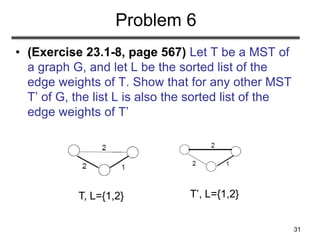
• (Exercise 23.1-8, page 567) Let T be a MST of
a graph G, and let L be the sorted list of the
edge weights of T. Show that for any other MST
T’ of G, the list L is also the sorted list of the
edge weights of T’
T, L={1,2} T’, L={1,2}

Unit 5 session 2 MinimumSpanningTrees.ppt

  • 1.
    Minimum Spanning Tree MinimumSpanning Trees (MST)
  • 2.
    2 Minimum Spanning Trees •Spanning Tree – A tree (i.e., connected, acyclic graph) which contains all the vertices of the graph • Minimum Spanning Tree – Spanning tree with the minimum sum of weights • Spanning forest – If a graph is not connected, then there is a spanning tree for each connected component of the graph a b c d e g g f i 4 8 7 8 11 1 2 7 2 4 14 9 10 6
  • 3.
    3 Applications of MST –Find the least expensive way to connect a set of cities, terminals, computers, etc.
  • 4.
    4 Example Problem • A townhas a set of houses and a set of roads • A road connects 2 and only 2 houses • A road connecting houses u and v has a repair cost w(u, v) Goal: Repair enough (and no more) roads such that: 1. Everyone stays connected i.e., can reach every house from all other houses 2. Total repair cost is minimum a b c d e h g f i 4 8 7 8 11 1 2 7 2 4 14 9 10 6
  • 5.
    5 Minimum Spanning Trees •A connected, undirected graph: – Vertices = houses, Edges = roads • A weight w(u, v) on each edge (u, v) in E a b c d e h g f i 4 8 7 8 11 1 2 7 2 4 14 9 10 6 Find T  E such that: 1. T connects all vertices 2. w(T) = Σ(u,v)T w(u, v) is minimized
  • 6.
    6 Properties of MinimumSpanning Trees • Minimum spanning tree is not unique • MST has no cycles – see why: – We can take out an edge of a cycle, and still have the vertices connected while reducing the cost • # of edges in a MST: – |V| - 1
  • 7.
    7 Growing a MST– Generic Approach a b c d e h g f i 4 8 7 8 11 1 2 7 2 4 14 9 10 6 • Grow a set A of edges (initially empty) • Incrementally add edges to A such that they would belong to a MST – An edge (u, v) is safe for A if and only if A  {(u, v)} is also a subset of some MST Idea: add only “safe” edges
  • 8.
    8 Generic MST algorithm 1.A ←  2. while A is not a spanning tree 3. do find an edge (u, v) that is safe for A 4. A ← A  {(u, v)} 5. return A • How do we find safe edges? a b c d e h g f i 4 8 7 8 11 1 2 7 2 4 14 9 10 6
  • 9.
    9 S V - S FindingSafe Edges • Let’s look at edge (h, g) – Is it safe for A initially? • Later on: – Let S  V be any set of vertices that includes h but not g (so that g is in V - S) – In any MST, there has to be one edge (at least) that connects S with V - S – Why not choose the edge with minimum weight (h,g)? a b c d e h g f i 4 8 7 8 11 1 2 7 2 4 14 9 10 6
  • 10.
    10 Definitions • A cut(S, V - S) is a partition of vertices into disjoint sets S and V - S • An edge crosses the cut (S, V - S) if one endpoint is in S and the other in V – S a b c d e h g f i 4 8 7 8 11 1 2 7 2 4 14 9 10 6 S V- S  S  V- S
  • 11.
    11 Definitions (cont’d) • Acut respects a set A of edges  no edge in A crosses the cut • An edge is a light edge crossing a cut  its weight is minimum over all edges crossing the cut – Note that for a given cut, there can be > 1 light edges crossing it a b c d e h g f i 4 8 7 8 11 1 2 7 2 4 14 9 10 6 S V- S  S  V- S
  • 12.
    12 Theorem • Let Abe a subset of some MST (i.e., T), (S, V - S) be a cut that respects A, and (u, v) be a light edge crossing (S, V-S). Then (u, v) is safe for A . Proof: • Let T be an MST that includes A – edges in A are shaded • Case1: If T includes (u,v), then it would be safe for A • Case2: Suppose T does not include the edge (u, v) • Idea: construct another MST T’ that includes A  {(u, v)} u v S V - S
  • 13.
    13 u v S V - S Theorem- Proof • T contains a unique path p between u and v • Path p must cross the cut (S, V - S) at least once: let (x, y) be that edge • Let’s remove (x,y)  breaks T into two components. • Adding (u, v) reconnects the components T’ = T - {(x, y)}  {(u, v)} x y p
  • 14.
    14 Theorem – Proof(cont.) T’ = T - {(x, y)}  {(u, v)} Have to show that T’ is an MST: • (u, v) is a light edge  w(u, v) ≤ w(x, y) • w(T ’) = w(T) - w(x, y) + w(u, v) ≤ w(T) • Since T is a spanning tree w(T) ≤ w(T ’)  T’ must be an MST as well u v S V - S x y p
  • 15.
    15 Theorem – Proof(cont.) Need to show that (u, v) is safe for A: i.e., (u, v) can be a part of an MST • A  T and (x, y)  T  (x, y)  A  A T’ • A  {(u, v)}  T’ • Since T’ is an MST  (u, v) is safe for A u v S V - S x y p
  • 16.
    16 Prim’s Algorithm • Theedges in set A always form a single tree • Starts from an arbitrary “root”: VA = {a} • At each step: – Find a light edge crossing (VA, V - VA) – Add this edge to A – Repeat until the tree spans all vertices a b c d e h g f i 4 8 7 8 11 1 2 7 2 4 14 9 10 6
  • 17.
    17 How to FindLight Edges Quickly? Use a priority queue Q: • Contains vertices not yet included in the tree, i.e., (V – VA) – VA = {a}, Q = {b, c, d, e, f, g, h, i} • We associate a key with each vertex v: key[v] = minimum weight of any edge (u, v) connecting v to VA a b c d e h g f i 4 8 7 8 11 1 2 7 2 4 14 9 10 6 w1 w2 Key[a]=min(w1,w2) a
  • 18.
    18 How to FindLight Edges Quickly? (cont.) • After adding a new node to VA we update the weights of all the nodes adjacent to it e.g., after adding a to the tree, k[b]=4 and k[h]=8 • Key of v is  if v is not adjacent to any vertices in VA a b c d e h g f i 4 8 7 8 11 1 2 7 2 4 14 9 10 6
  • 19.
    19 Example 0        Q = {a, b, c, d, e, f, g, h, i} VA =  Extract-MIN(Q)  a a b c d e h g f i 4 8 7 8 11 1 2 7 2 4 14 9 10 6 a b c d e h g f i 4 8 7 8 11 1 2 7 2 4 14 9 10 6 key [b] = 4  [b] = a key [h] = 8  [h] = a 4      8  Q = {b, c, d, e, f, g, h, i} VA = {a} Extract-MIN(Q)  b                4  8
  • 20.
    20 4   8  8  Example a b c d e h g f i 4 8 7 8 11 1 2 7 2 4 14 9 10 6 key [c] = 8  [c] = b key [h] = 8  [h] = a - unchanged 8     8  Q = {c, d, e, f, g, h, i} VA = {a, b} Extract-MIN(Q)  c a b c d e h g f i 4 8 7 8 11 1 2 7 2 4 14 9 10 6 key [d] = 7  [d] = c key [f] = 4  [f] = c key [i] = 2  [i] = c 7  4  8 2 Q = {d, e, f, g, h, i} VA = {a, b, c} Extract-MIN(Q)  i   4   8   8 7 4 2
  • 21.
    21 Example a b c d e hg f i 4 8 7 8 11 1 2 7 2 4 14 9 10 6 key [h] = 7  [h] = i key [g] = 6  [g] = i 7  4 6 8 Q = {d, e, f, g, h} VA = {a, b, c, i} Extract-MIN(Q)  f a b c d e h g f i 4 8 7 8 11 1 2 7 2 4 14 9 10 6 key [g] = 2  [g] = f key [d] = 7  [d] = c unchanged key [e] = 10  [e] = f 7 10 2 8 Q = {d, e, g, h} VA = {a, b, c, i, f} Extract-MIN(Q)  g 4 7  8  4 8 2 7 6 4 7  7 6 4 8 2 2 10
  • 22.
    22 Example a b c d e hg f i 4 8 7 8 11 1 2 7 2 4 14 9 10 6 key [h] = 1  [h] = g 7 10 1 Q = {d, e, h} VA = {a, b, c, i, f, g} Extract-MIN(Q)  h a b c d e h g f i 4 8 7 8 11 1 2 7 2 4 14 9 10 6 7 10 Q = {d, e} VA = {a, b, c, i, f, g, h} Extract-MIN(Q)  d 4 7 10 7 2 4 8 2 1 4 7 10 1 2 4 8 2
  • 23.
    23 Example a b c d e hg f i 4 8 7 8 11 1 2 7 2 4 14 9 10 6 key [e] = 9  [e] = f 9 Q = {e} VA = {a, b, c, i, f, g, h, d} Extract-MIN(Q)  e Q =  VA = {a, b, c, i, f, g, h, d, e} 4 7 10 1 2 4 8 2 9
  • 24.
    24 PRIM(V, E, w,r) 1. Q ←  2. for each u  V 3. do key[u] ← ∞ 4. π[u] ← NIL 5. INSERT(Q, u) 6. DECREASE-KEY(Q, r, 0) ► key[r] ← 0 7. while Q   8. do u ← EXTRACT-MIN(Q) 9. for each v  Adj[u] 10. do if v  Q and w(u, v) < key[v] 11. then π[v] ← u 12. DECREASE-KEY(Q, v, w(u, v)) O(V) if Q is implemented as a min-heap Executed |V| times Takes O(lgV) Min-heap operations: O(VlgV) Executed O(E) times total Constant Takes O(lgV) O(ElgV) Total time: O(VlgV + ElgV) = O(ElgV) O(lgV)
  • 25.
    25 Using Fibonacci Heaps •Depending on the heap implementation, running time could be improved!
  • 26.
    26 Prim’s Algorithm • Prim’salgorithm is a “greedy” algorithm – Greedy algorithms find solutions based on a sequence of choices which are “locally” optimal at each step. • Nevertheless, Prim’s greedy strategy produces a globally optimum solution! – See proof for generic approach (i.e., slides 12-15)
  • 27.
    27 Problem 4 • (Exercise23.2-2, page 573) Analyze Prim’s algorithm assuming: (a) an adjacency-list representation of G O(ElgV) (b) an adjacency-matrix representation of G O(ElgV+V2)
  • 28.
    28 PRIM(V, E, w,r) 1. Q ←  2. for each u  V 3. do key[u] ← ∞ 4. π[u] ← NIL 5. INSERT(Q, u) 6. DECREASE-KEY(Q, r, 0) ► key[r] ← 0 7. while Q   8. do u ← EXTRACT-MIN(Q) 9. for each v  Adj[u] 10. do if v  Q and w(u, v) < key[v] 11. then π[v] ← u 12. DECREASE-KEY(Q, v, w(u, v)) O(V) if Q is implemented as a min-heap Executed |V| times Takes O(lgV) Min-heap operations: O(VlgV) Executed O(E) times Constant Takes O(lgV) O(ElgV) Total time: O(VlgV + ElgV) = O(ElgV) O(lgV)
  • 29.
    29 PRIM(V, E, w,r) 1. Q ←  2. for each u  V 3. do key[u] ← ∞ 4. π[u] ← NIL 5. INSERT(Q, u) 6. DECREASE-KEY(Q, r, 0) ► key[r] ← 0 7. while Q   8. do u ← EXTRACT-MIN(Q) 9. for (j=0; j<|V|; j++) 10. if (A[u][j]=1) 11. if v  Q and w(u, v) < key[v] 12. then π[v] ← u 13. DECREASE-KEY(Q, v, w(u, v)) O(V) if Q is implemented as a min-heap Executed |V| times Takes O(lgV) Min-heap operations: O(VlgV) Executed O(V2) times total Constant Takes O(lgV) O(ElgV) Total time: O(VlgV + ElgV+V2) = O(ElgV+V2) O(lgV)
  • 30.
    30 Problem 5 • Findan algorithm for the “maximum” spanning tree. That is, given an undirected weighted graph G, find a spanning tree of G of maximum cost. Prove the correctness of your algorithm. – Consider choosing the “heaviest” edge (i.e., the edge associated with the largest weight) in a cut. The generic proof can be modified easily to show that this approach will work. – Alternatively, multiply the weights by -1 and apply either Prim’s or Kruskal’s algorithms without any modification at all!
  • 31.
    31 Problem 6 • (Exercise23.1-8, page 567) Let T be a MST of a graph G, and let L be the sorted list of the edge weights of T. Show that for any other MST T’ of G, the list L is also the sorted list of the edge weights of T’ T, L={1,2} T’, L={1,2}