This document describes algorithms for finding minimum spanning trees in graphs. It discusses Prim's algorithm and Kruskal's algorithm, which are greedy algorithms used to find minimum spanning trees in undirected weighted graphs. It compares the time complexity of the two algorithms and notes that Prim's algorithm has lower time complexity and is simpler to implement. The document also outlines applications of minimum spanning trees and provides examples of applying Prim's and Kruskal's algorithms to find the minimum spanning tree of sample graphs.
![© IJCIRAS | ISSN (O) - 2581-5334
January 2018 | Vol. 1 Issue. 8
IJCIRAS1101 WWW.IJCIRAS.COM 36
3. MST ALGORITHM
There are various algorithms for minimum spanning
trees. Prim’s, kruskal’s algorithm is the greedy algorithm
which are used to find MST of an undirected weighted
graph, which minimise weight and the number of edges.
3.1. PRIM’S ALGORITHM
The prim’s algorithm was developed in 1930 by Jarnik
and was later rediscovered by Robert C. Prim in 1957
and then again rediscovered by Edsger Dijkstra in 1959.
It is also known as the DJP (Dijkstra-Jarnik Problem)
algorithm, or the Jarnik algorithm, or the Prim–Jarnik
algorithm.
The prim’s algorithm is the greedy algorithm used to
find the minimum cost spanning tree for an undirected
weighted graph.
3.1.1. STEPS IN PRIM’S ALGORITHM
1. Initialise the tree with a single vertex from a given
graph.
2. Choose the shortest outgoing edge from the node
and add this to the tree.
3. The edge formed by the two vertices is treated as a
single node, we check for the shortest adjacent edge
to the node and add this to the tree.
4. Repeat the steps until all the vertices are added to
the tree.
3.1.2. Pseudo code
Algorithm: PRIM (G)
Input: A weighted graph G
Output: A minimum spanning tree T for graph G.
1. Make a queue (Q) for all vertices of the graph G.
2. Set the priority to infinity to all the vertices except
for the starting vertex whose priority is set to 0.
3. Pick any vertex v from G.
4. v
5. D[u] 0
6. E[u] ← ∅
7. while Q ≠ ∅
8. u ← Q.removeMinElement()
9. add vertex u and edge (u,E[u]) to T
10. for each vertex z adjacent to u do
11. if z is in Q
12. if weight(u, z) < D[z] then
13. D[z] ← weight(u, z)
14. E[z] ← (u, z)
15. change the key of z in Q to D[z]
16. return tree T
Example:
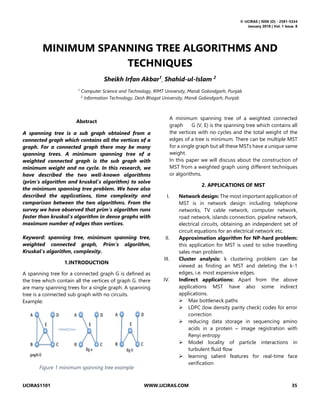
G= {V, E}
V= {A, B, C, D, E, F}
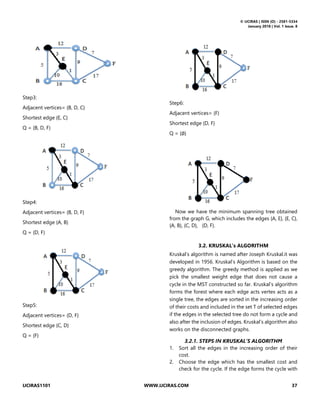
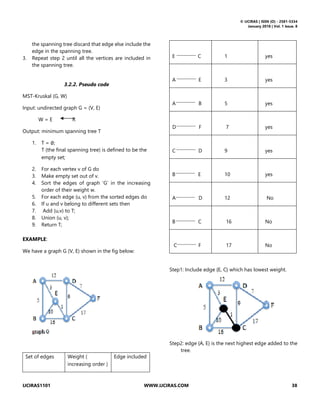
Step1: choose a source vertex A from the above graph.
Q = {B, C, D, E, F)
Step2: vertex A is the source vertex v.
Adjacent vertices= {B, D, E}
Choose edge {A, E}
Q = {B, D, E, F)](https://image.slidesharecdn.com/ijciras1101-191217181014/85/Ijciras1101-2-320.jpg)
![© IJCIRAS | ISSN (O) - 2581-5334
January 2018 | Vol. 1 Issue. 8
IJCIRAS1101 WWW.IJCIRAS.COM 40
made improvements which reduces the time complexity
to O(m log log n). With the invention of Fibonacci heaps,
the complexity was further reduced. In the worst case, m
= O(n) and the running time is O(m log∗ m). The
complexity was further minimised to O(m log β(m, n)) by
Harold N. Gabow, Thomas H. Spencer, and Robert
Tarjan. David Karger, Philip Klein, and Robert Tarjan
proposed a randomized linear-time algorithm for
finding a minimum spanning tree in the restricted
random-access model. Robert Tarjan gave a linear-time
algorithm by using path compression. J´anos Koml´os
showed that we can verify the minimum spanning tree
in linear number of comparisons. Dixon, Monika Rauch,
and Robert Tarjan gave the first linear-time verification
algorithm .linear time algorithm for finding the
minimum spanning tree remains an open problem.
6. CONCLUSION
In this paper we have discussed about well-known
algorithms to construct and find the minimum spanning
tree of an undirected and connected graph: Prim’s
algorithm, and Kruskal’s algorithm. It is observed that
the time complexity of prim’s algorithm is less than
kruskal’s algorithm. The prim’s algorithm is simple to
implement. Prim’s algorithm and kruskal’s algorithms
are mostly used for solving MST problem among the
other algorithms. We are further looking to reduce the
time complexity of MST algorithms.
REFERENCES
[1] Abhilasha.R, “Minimum Cost Spanning Tree Using
Prim’s Algorithm,” International Journal of Advance
Research in computer science and management studies,
vol. 1, june 2013.
[2] D. K. M. Patel, Nimesh Patel, “A Survey on:
Enhancement of Minimum Spanning Tree,” Nimesh
Patel International Journal of Engineering Research and
Applications, vol. 5, january 2015.
[3] Jayanta Dutta. S.C.Pal, Ardhendu Mandal, “A New
Efficient Technique to Construct a Minimum Spanning
Tree,” International Journal of Advanced Research in
Computer Science and Software Engineering, oct, 2012.
[4] Neetu Rawat, “AN Algorithmic Approach To Graph
Theory,” in International Conference on Advances in
Engineering & Technology,, Goa,INDIA, 2014.
[5] R.Kalaivani, Dr.D vijayalakshmir, “Minimum Cost
Spanning Tree using Matrix Algorithm,” International
Journal of Scientific and Research Publications, vol. 4,
september 2014.](https://image.slidesharecdn.com/ijciras1101-191217181014/85/Ijciras1101-6-320.jpg)


![DAA-seminar-1[1].pptx Design and Analysis Of The Algorithm](https://cdn.slidesharecdn.com/ss_thumbnails/daa-seminar-11-250921155526-8ea0ea04-thumbnail.jpg?width=640&height=640&fit=bounds)


