
Audit
Evidence

 Basic principle
 sources
1. Audit evidence

 Independence
 Integrity
 Objectivity
 Professional behavior
 Technical standard
Basic Principles

 Nature (oral,written,visual)
 Evaluation
 Direct or indirect
 Internal or External
SOURCES

Factors
 Audit risk
 The nature of internal control
 Reliance on effective controls
 (cake) cumulative audit knowledge and experience
 Materiality
 Audit findings
 Source and reliability of info
2. Sufficient

 Derived from understanding the business its
environment and controls
Audit risk

The nature of control should be applied
Computerised or manual
The nature of internal
control

 It includes preliminary understandings and its
evalutions.
Reliance on effective
controls

 Immaterial items require little ,if any, evidence (e.g.
“reasonableness test”)
Materiality

 Its includes error may require further audit work to
be carry out.
Audit findings

How persuasive is the evidence ? Does all the evidence
point to the same conclusion ?
Source and reliability of
info
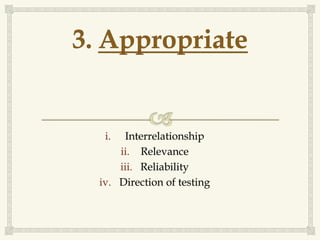
i. Interrelationship
ii. Relevance
iii. Reliability
iv. Direction of testing

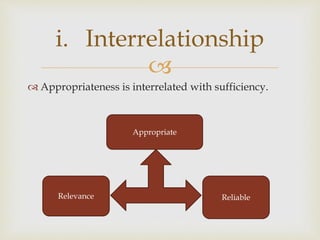
 Appropriateness is interrelated with sufficiency.
i. Interrelationship
Appropriate
Relevance Reliable

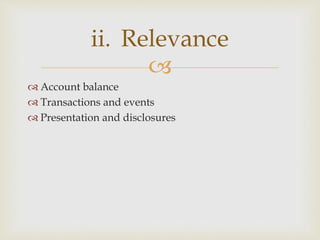
 Account balance
 Transactions and events
 Presentation and disclosures
ii. Relevance

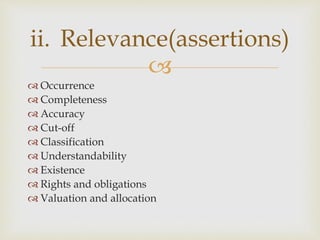
 Occurrence
 Completeness
 Accuracy
 Cut-off
 Classification
 Understandability
 Existence
 Rights and obligations
 Valuation and allocation
ii. Relevance(assertions)

Reliability general assumptions:
 External & internal
 Direct & indirect
 Written & oral
 consistency
iii.Reliability

 Overstatement
 understatement
iv.Direction of testing

Procedures for Gathering
Evidence
Types of Audit Evidence

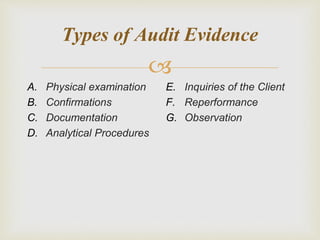
Types of Audit Evidence
A. Physical examination
B. Confirmations
C. Documentation
D. Analytical Procedures
E. Inquiries of the Client
F. Reperformance
G. Observation

Physical
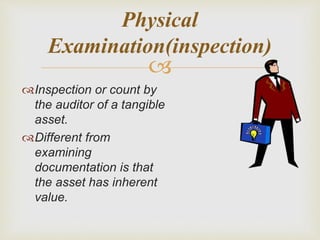
Examination(inspection)
Inspection or count by
the auditor of a tangible
asset.
Different from
examining
documentation is that
the asset has inherent
value.

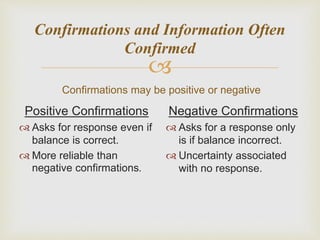
Confirmations and Information Often
Confirmed
Confirmations may be positive or negative
Positive Confirmations
 Asks for response even if
balance is correct.
 More reliable than
negative confirmations.
Negative Confirmations
 Asks for a response only
is if balance incorrect.
 Uncertainty associated
with no response.

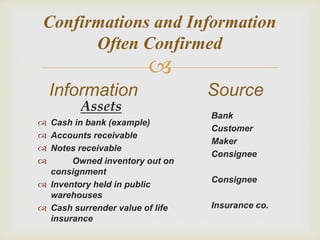
Confirmations and Information
Often Confirmed
Information
Assets
 Cash in bank (example)
 Accounts receivable
 Notes receivable
 Owned inventory out on
consignment
 Inventory held in public
warehouses
 Cash surrender value of life
insurance
Source
Bank
Customer
Maker
Consignee
Consignee
Insurance co.
Documentation
 Types of Documents
 Document Vouching
 Document Tracing

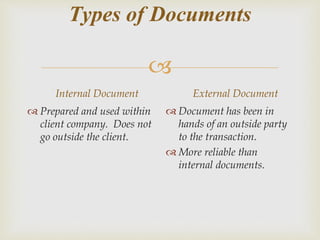
Types of Documents
Internal Document
 Prepared and used within
client company. Does not
go outside the client.
External Document
 Document has been in
hands of an outside party
to the transaction.
 More reliable than
internal documents.

Analytical procedures are one of many financial
audit processes which help an auditor understand
the client's business and changes in the business,
and to identify potential risk areas to plan other audit
procedures
Analytical Procedures

 Auditor obtains information from the
client in response to questions.
 Although much evidence is obtained
through inquiry, it can not be regarded
as conclusive and may be biased in the
client’s favor.
Inquiries

Financial statement assertions are management's explanation
about the recognition, measurement, presentation and disclosure of
information in the financial statements.
Financial Statement Assertions(cont.)

Existence; an asset or liability exists at a given data . e.g.
1).A computer is recorded on the asset register. Does it really exist?
Occurrence; The transaction or event actually took place during the
period. e.g.
1).Revenue was recorded . Did the organization really make the sale?
2).Expense was recorded. Was the expense actually incurred?
Financial Statement
Assertions(cont.)

Cutoff; Transactions and events have been recorded in the
correct accounting period.
Classification; The transaction have been recorded in the
proper account.
Completeness; all transaction that should have been
recorded.
Accuracy; The transaction were recorded at the proper
amount or revenue or with out any error.
Financial Statement Assertions

Substantive procedures are designed to detect
material misstatements at the assertion level.
They comprise tests of details and
substantive analytical procedures.
5. Substantive
procedures

Procedures consist of the evaluation of financial
information in audit, made by a study of
pausible relationships among both financial
and non-financial data.
Analytical Procedure -
Definition
Substantive Procedures
 Aim
 Tests of account balances
 Tests of classes of transactions
 Tests of disclosures
 One may change the scope of audit procedures by
changing the (NTE, or re-ordered as NET):
 Nature (type and form)
 Timing (when performed)
 Extent (quantity of evidence obtained)

Holding the extent of procedures constant, one may
increase the scope of procedures (make them more
effective) by either changing the
 Nature-- obtain more reliable evidence
 often externally generated evidence.
 Timing--wait until year-end to obtain evidence from
entire set of transactions as contrasted to performing
interim testing, say two months prior to year-end and
simply updating those procedures.
Nature and Timing of Procedures

Holding other factors such as the nature and timing of
procedures constant:
 The greater the risk of material misstatement, the greater
the needed extent of substantive procedures
 The main way to increase the extent of audit procedures is
to examine more items
 Sample sizes should reduce detection risk so as to restrict
audit risk to a low level
Extent of Procedures

The End

Audit Evidence Presentation

  • 1.
  • 2.
      Basic principle sources 1. Audit evidence
  • 3.
      Independence  Integrity Objectivity  Professional behavior  Technical standard Basic Principles
  • 4.
      Nature (oral,written,visual) Evaluation  Direct or indirect  Internal or External SOURCES
  • 5.
     Factors  Audit risk The nature of internal control  Reliance on effective controls  (cake) cumulative audit knowledge and experience  Materiality  Audit findings  Source and reliability of info 2. Sufficient
  • 6.
      Derived fromunderstanding the business its environment and controls Audit risk
  • 7.
     The nature ofcontrol should be applied Computerised or manual The nature of internal control
  • 8.
      It includespreliminary understandings and its evalutions. Reliance on effective controls
  • 9.
      Immaterial itemsrequire little ,if any, evidence (e.g. “reasonableness test”) Materiality
  • 10.
      Its includeserror may require further audit work to be carry out. Audit findings
  • 11.
     How persuasive isthe evidence ? Does all the evidence point to the same conclusion ? Source and reliability of info
  • 12.
    i. Interrelationship ii. Relevance iii.Reliability iv. Direction of testing
  • 13.
      Appropriateness isinterrelated with sufficiency. i. Interrelationship Appropriate Relevance Reliable
  • 14.
      Account balance Transactions and events  Presentation and disclosures ii. Relevance
  • 15.
      Occurrence  Completeness Accuracy  Cut-off  Classification  Understandability  Existence  Rights and obligations  Valuation and allocation ii. Relevance(assertions)
  • 16.
     Reliability general assumptions: External & internal  Direct & indirect  Written & oral  consistency iii.Reliability
  • 17.
  • 19.
  • 20.
     Types of AuditEvidence A. Physical examination B. Confirmations C. Documentation D. Analytical Procedures E. Inquiries of the Client F. Reperformance G. Observation
  • 21.
     Physical Examination(inspection) Inspection or countby the auditor of a tangible asset. Different from examining documentation is that the asset has inherent value.
  • 22.
     Confirmations and InformationOften Confirmed Confirmations may be positive or negative Positive Confirmations  Asks for response even if balance is correct.  More reliable than negative confirmations. Negative Confirmations  Asks for a response only is if balance incorrect.  Uncertainty associated with no response.
  • 23.
     Confirmations and Information OftenConfirmed Information Assets  Cash in bank (example)  Accounts receivable  Notes receivable  Owned inventory out on consignment  Inventory held in public warehouses  Cash surrender value of life insurance Source Bank Customer Maker Consignee Consignee Insurance co.
  • 24.
    Documentation  Types ofDocuments  Document Vouching  Document Tracing
  • 25.
     Types of Documents InternalDocument  Prepared and used within client company. Does not go outside the client. External Document  Document has been in hands of an outside party to the transaction.  More reliable than internal documents.
  • 26.
     Analytical procedures areone of many financial audit processes which help an auditor understand the client's business and changes in the business, and to identify potential risk areas to plan other audit procedures Analytical Procedures
  • 27.
      Auditor obtainsinformation from the client in response to questions.  Although much evidence is obtained through inquiry, it can not be regarded as conclusive and may be biased in the client’s favor. Inquiries
  • 28.
     Financial statement assertionsare management's explanation about the recognition, measurement, presentation and disclosure of information in the financial statements. Financial Statement Assertions(cont.)
  • 29.
     Existence; an assetor liability exists at a given data . e.g. 1).A computer is recorded on the asset register. Does it really exist? Occurrence; The transaction or event actually took place during the period. e.g. 1).Revenue was recorded . Did the organization really make the sale? 2).Expense was recorded. Was the expense actually incurred? Financial Statement Assertions(cont.)
  • 30.
     Cutoff; Transactions andevents have been recorded in the correct accounting period. Classification; The transaction have been recorded in the proper account. Completeness; all transaction that should have been recorded. Accuracy; The transaction were recorded at the proper amount or revenue or with out any error. Financial Statement Assertions
  • 31.
     Substantive procedures aredesigned to detect material misstatements at the assertion level. They comprise tests of details and substantive analytical procedures. 5. Substantive procedures
  • 32.
     Procedures consist ofthe evaluation of financial information in audit, made by a study of pausible relationships among both financial and non-financial data. Analytical Procedure - Definition
  • 33.
    Substantive Procedures  Aim Tests of account balances  Tests of classes of transactions  Tests of disclosures  One may change the scope of audit procedures by changing the (NTE, or re-ordered as NET):  Nature (type and form)  Timing (when performed)  Extent (quantity of evidence obtained)
  • 34.
     Holding the extentof procedures constant, one may increase the scope of procedures (make them more effective) by either changing the  Nature-- obtain more reliable evidence  often externally generated evidence.  Timing--wait until year-end to obtain evidence from entire set of transactions as contrasted to performing interim testing, say two months prior to year-end and simply updating those procedures. Nature and Timing of Procedures
  • 35.
     Holding other factorssuch as the nature and timing of procedures constant:  The greater the risk of material misstatement, the greater the needed extent of substantive procedures  The main way to increase the extent of audit procedures is to examine more items  Sample sizes should reduce detection risk so as to restrict audit risk to a low level Extent of Procedures
  • 36.