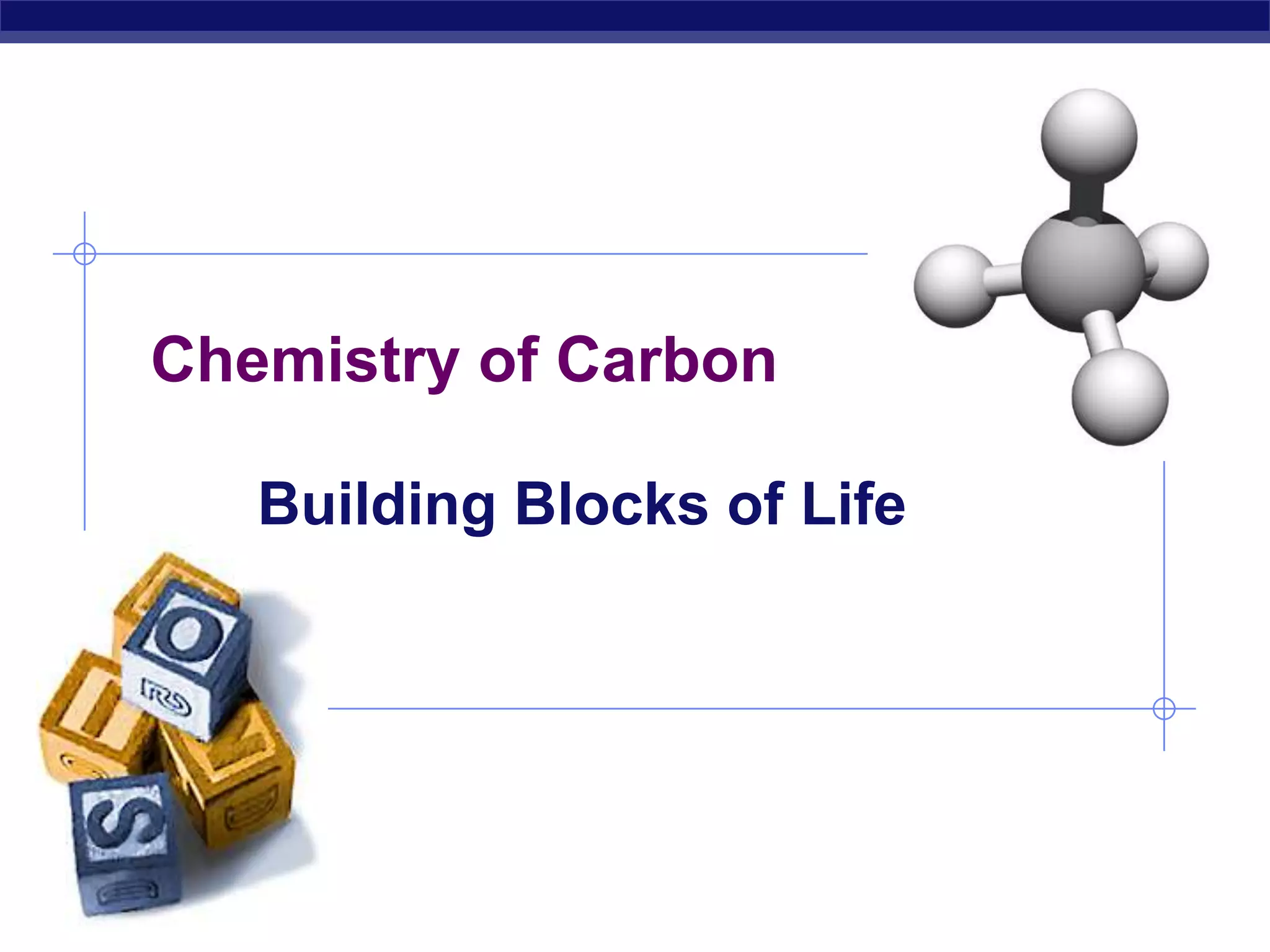
Chemistry of CarbonBuilding Blocks of Life
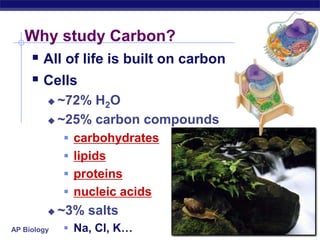
Why study Carbon?All of life is built on carbon Cells~72% H2O ~25% carbon compoundscarbohydrateslipidsproteins nucleic acids~3% salts Na, Cl, K…
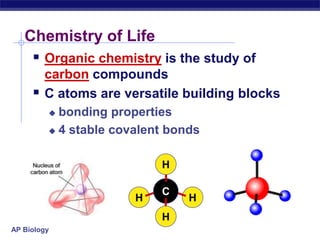
Chemistry of LifeOrganic chemistry is the study of  carboncompoundsC atoms are versatile building blocksbonding properties4 stable covalent bondsHCHHH
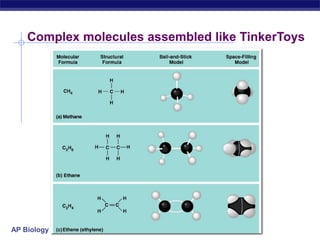
Complex molecules assembled like TinkerToys
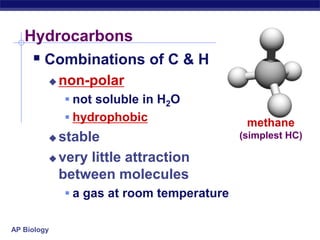
HydrocarbonsCombinations of C & Hnon-polarnot soluble in H2Ohydrophobicstablevery little attraction between moleculesa gas at room temperaturemethane(simplest HC)
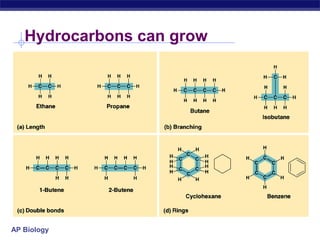
Hydrocarbons can grow
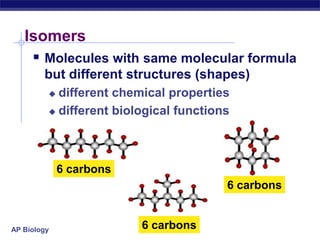
IsomersMolecules with same molecular formula but different structures (shapes) different chemical propertiesdifferent biological functions6 carbons6 carbons6 carbons
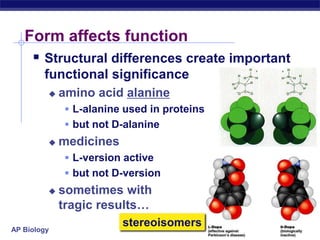
Form affects functionStructural differences create important functional significanceamino acid alanineL-alanine used in proteinsbut not D-alaninemedicinesL-version activebut not D-versionsometimes withtragic results…stereoisomers
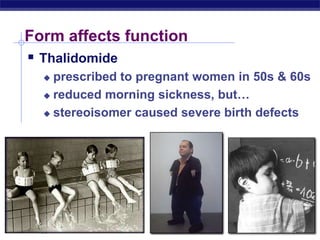
Form affects functionThalidomide prescribed to pregnant women in 50s & 60s reduced morning sickness, but…stereoisomer caused severe birth defects
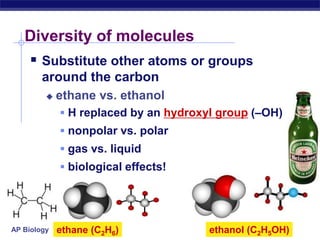
Diversity of moleculesSubstitute other atoms or groups around the carbonethane vs. ethanolH replaced by an hydroxyl group (–OH)nonpolar vs. polargas vs. liquidbiological effects!ethanol (C2H5OH)ethane (C2H6)
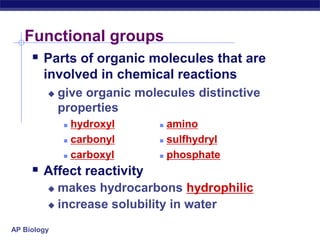
Functional groupsParts of organic molecules that are involved in chemical reactionsgive organic molecules distinctive propertieshydroxylaminocarbonylsulfhydrylcarboxylphosphateAffect reactivitymakes hydrocarbonshydrophilicincrease solubility in water
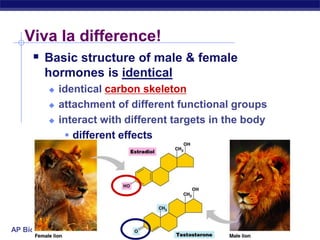
Viva la difference!Basic structure of male & female hormones is identicalidentical carbon skeletonattachment of different functional groupsinteract with different targets in the bodydifferent effects
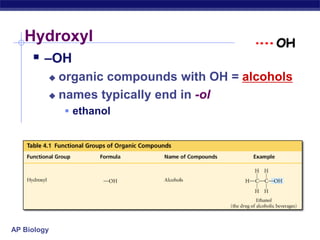
Hydroxyl–OHorganic compounds with OH = alcoholsnames typically end in -olethanol
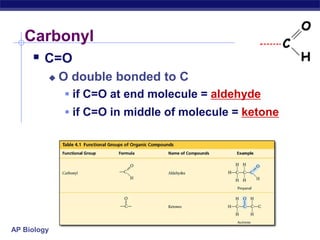
CarbonylC=O O double bonded to Cif C=O at end molecule = aldehydeif C=O in middle of molecule = ketone
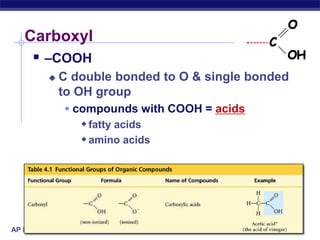
Carboxyl –COOH C double bonded to O & single bonded to OH groupcompounds with COOH = acidsfatty acidsamino acids
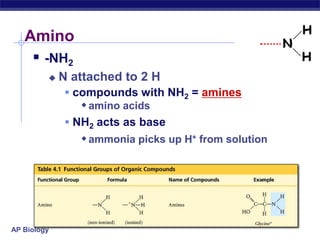
Amino-NH2N attached to 2 Hcompounds with NH2 = aminesamino acidsNH2 acts as baseammonia picks up H+ from solution
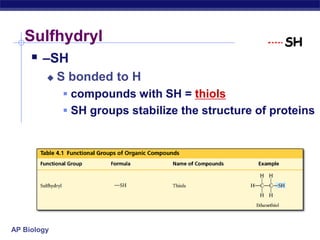
Sulfhydryl –SHS bonded to Hcompounds with SH = thiolsSH groups stabilize the structure of proteins
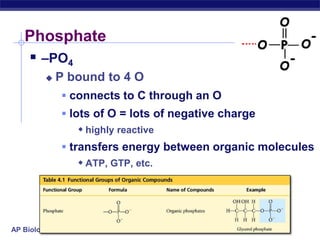
Phosphate –PO4P bound to 4 Oconnects to C through an Olots of O = lots of negative chargehighly reactivetransfers energy between organic molecules ATP, GTP, etc.
MacromoleculesBuilding Blocksof Life
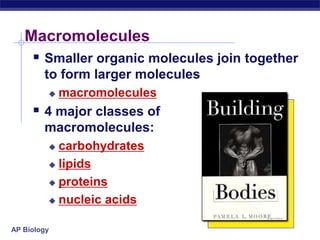
MacromoleculesSmaller organic molecules join together to form larger moleculesmacromolecules4 major classes of macromolecules:carbohydrateslipidsproteinsnucleic acids
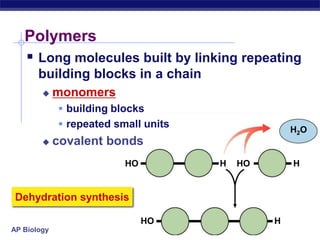
H2OHOHHHOHOH PolymersLong molecules built by linking repeating building blocks in a chain monomersbuilding blocksrepeated small units covalent bondsDehydration synthesis
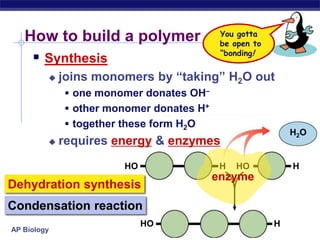
H2OHOHHHOenzymeHOH How to build a polymerYou gotta be open to“bonding!Synthesisjoins monomers by “taking” H2O outone monomer donates OH–other monomer donates H+together these form H2Orequires energy & enzymesDehydration synthesisCondensationreaction
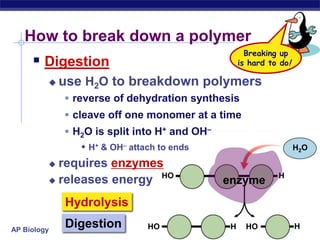
H2OHOHenzymeHHOHHOHow to break down a polymerBreaking upis hard to do!Digestionuse H2O to breakdown polymers reverse of dehydration synthesiscleave off one monomer at a timeH2O is split into H+ and OH–H+ & OH– attach to endsrequires enzymesreleases energyHydrolysisDigestion
Any Questions??

21 ch03macromolecules2010

  • 1.
  • 2.
    Why study Carbon?Allof life is built on carbon Cells~72% H2O ~25% carbon compoundscarbohydrateslipidsproteins nucleic acids~3% salts Na, Cl, K…
  • 3.
    Chemistry of LifeOrganicchemistry is the study of carboncompoundsC atoms are versatile building blocksbonding properties4 stable covalent bondsHCHHH
  • 4.
  • 5.
    HydrocarbonsCombinations of C& Hnon-polarnot soluble in H2Ohydrophobicstablevery little attraction between moleculesa gas at room temperaturemethane(simplest HC)
  • 6.
  • 7.
    IsomersMolecules with samemolecular formula but different structures (shapes) different chemical propertiesdifferent biological functions6 carbons6 carbons6 carbons
  • 8.
    Form affects functionStructuraldifferences create important functional significanceamino acid alanineL-alanine used in proteinsbut not D-alaninemedicinesL-version activebut not D-versionsometimes withtragic results…stereoisomers
  • 9.
    Form affects functionThalidomideprescribed to pregnant women in 50s & 60s reduced morning sickness, but…stereoisomer caused severe birth defects
  • 10.
    Diversity of moleculesSubstituteother atoms or groups around the carbonethane vs. ethanolH replaced by an hydroxyl group (–OH)nonpolar vs. polargas vs. liquidbiological effects!ethanol (C2H5OH)ethane (C2H6)
  • 11.
    Functional groupsParts oforganic molecules that are involved in chemical reactionsgive organic molecules distinctive propertieshydroxylaminocarbonylsulfhydrylcarboxylphosphateAffect reactivitymakes hydrocarbonshydrophilicincrease solubility in water
  • 12.
    Viva la difference!Basicstructure of male & female hormones is identicalidentical carbon skeletonattachment of different functional groupsinteract with different targets in the bodydifferent effects
  • 13.
    Hydroxyl–OHorganic compounds withOH = alcoholsnames typically end in -olethanol
  • 14.
    CarbonylC=O O doublebonded to Cif C=O at end molecule = aldehydeif C=O in middle of molecule = ketone
  • 15.
    Carboxyl –COOH Cdouble bonded to O & single bonded to OH groupcompounds with COOH = acidsfatty acidsamino acids
  • 16.
    Amino-NH2N attached to2 Hcompounds with NH2 = aminesamino acidsNH2 acts as baseammonia picks up H+ from solution
  • 17.
    Sulfhydryl –SHS bondedto Hcompounds with SH = thiolsSH groups stabilize the structure of proteins
  • 18.
    Phosphate –PO4P boundto 4 Oconnects to C through an Olots of O = lots of negative chargehighly reactivetransfers energy between organic molecules ATP, GTP, etc.
  • 19.
  • 20.
    MacromoleculesSmaller organic moleculesjoin together to form larger moleculesmacromolecules4 major classes of macromolecules:carbohydrateslipidsproteinsnucleic acids
  • 21.
    H2OHOHHHOHOH PolymersLong moleculesbuilt by linking repeating building blocks in a chain monomersbuilding blocksrepeated small units covalent bondsDehydration synthesis
  • 22.
    H2OHOHHHOenzymeHOH How tobuild a polymerYou gotta be open to“bonding!Synthesisjoins monomers by “taking” H2O outone monomer donates OH–other monomer donates H+together these form H2Orequires energy & enzymesDehydration synthesisCondensationreaction
  • 23.
    H2OHOHenzymeHHOHHOHow to breakdown a polymerBreaking upis hard to do!Digestionuse H2O to breakdown polymers reverse of dehydration synthesiscleave off one monomer at a timeH2O is split into H+ and OH–H+ & OH– attach to endsrequires enzymesreleases energyHydrolysisDigestion
  • 24.