BIOLOGICAL
OXIDATION AND
REDUCTION
BY;
WISHAL
BUTT
OXIDATION
• Loss of electrons by an atom,
ions or molecule during a
chemical reaction & increase
its oxidation state.
REDUCTION
• Gain of electrons by an
atom , ion or molecule
during a chemical reaction
& decrease in its oxidation
state
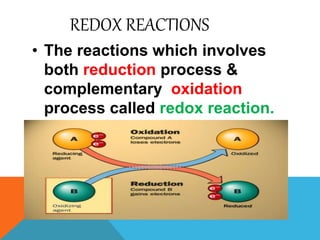
REDOX REACTIONS
• The reactions which involves
both reduction process &
complementary oxidation
process called redox reaction.
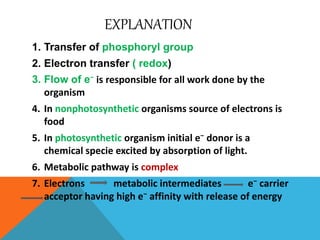
EXPLANATION
1. Transfer of phosphoryl group
2. Electron transfer ( redox)
3. Flow of e⁻ is responsible for all work done by the
organism
4. In nonphotosynthetic organisms source of electrons is
food
5. In photosynthetic organism initial e⁻ donor is a
chemical specie excited by absorption of light.
6. Metabolic pathway is complex
7. Electrons metabolic intermediates e⁻ carrier
acceptor having high e⁻ affinity with release of energy
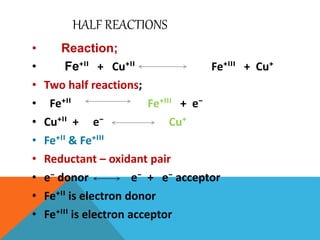
HALF REACTIONS
• Reaction;
• Fe⁺ᴵᴵ + Cu⁺ᴵᴵ Fe⁺ᴵᴵᴵ + Cu⁺
• Two half reactions;
• Fe⁺ᴵᴵ Fe⁺ᴵᴵᴵ + e⁻
• Cu⁺ᴵᴵ + e⁻ Cu⁺
• Fe⁺ᴵᴵ & Fe⁺ᴵᴵᴵ
• Reductant – oxidant pair
• e⁻ donor e⁻ + e⁻ acceptor
• Fe⁺ᴵᴵ is electron donor
• Fe⁺ᴵᴵᴵ is electron acceptor
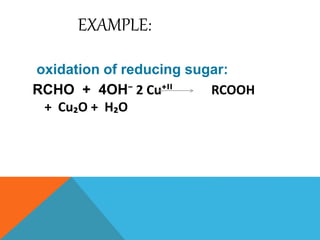
EXAMPLE:
oxidation of reducing sugar:
RCHO + 4OH⁻ 2 Cu⁺ᴵᴵ RCOOH
+ Cu₂O + H₂O
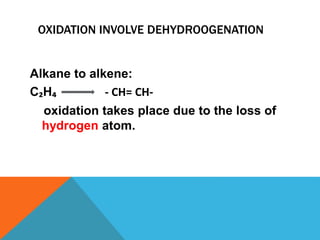
OXIDATION INVOLVE DEHYDROOGENATION
Alkane to alkene:
C₂H₄ - CH= CH-
oxidation takes place due to the loss of
hydrogen atom.
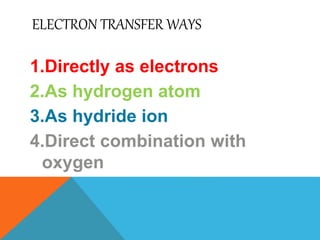
ELECTRON TRANSFER WAYS
1.Directly as electrons
2.As hydrogen atom
3.As hydride ion
4.Direct combination with
oxygen
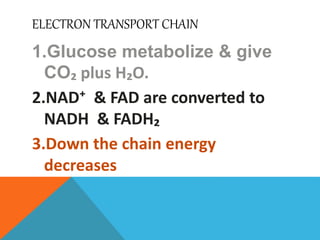
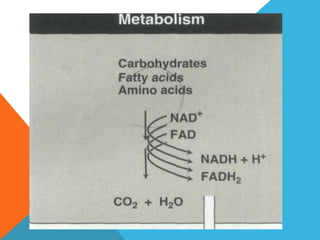
ELECTRON TRANSPORT CHAIN
1.Glucose metabolize & give
CO₂ plus H₂O.
2.NAD⁺ & FAD are converted to
NADH & FADH₂
3.Down the chain energy
decreases
MITOCHONDRION
ETC is present in the inner
mitochondrial membrane.
electron trans port and ATP
synthesis occurs continuously in
all cells having mitochondria.
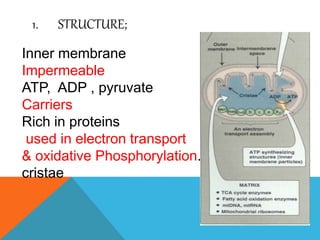
1. STRUCTURE;
Inner membrane
Impermeable
ATP, ADP , pyruvate
Carriers
Rich in proteins
used in electron transport
& oxidative Phosphorylation.
cristae
2. ATP SYNTHASE COMPLEX
* Protein complexes reffered as inner membrane
particles.
* Attached on inner surface
• Appear as sphere
3. MATRIX;
* Gel like soln. 50% protein
* Enzymes for oxidation of pyruvate , aa, fatty acids, &
carboxylic acid cycle.
* Urea & heme
* NAD⁺, FAD, ADP, Pi
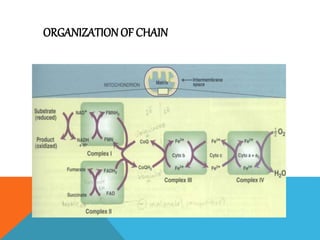
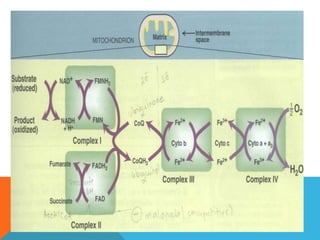
ORGANIZATION OF CHAIN
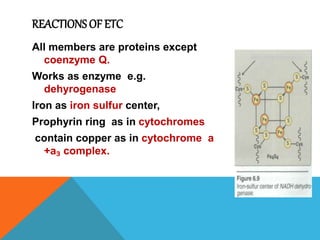
REACTIONS OF ETC
All members are proteins except
coenzyme Q.
Works as enzyme e.g.
dehyrogenase
Iron as iron sulfur center,
Prophyrin ring as in cytochromes
contain copper as in cytochrome a
+a₃ complex.
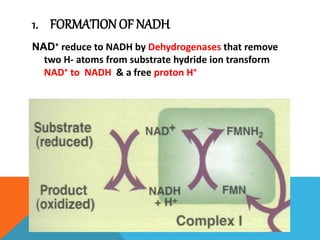
1. FORMATION OF NADH
NAD⁺ reduce to NADH by Dehydrogenases that remove
two H- atoms from substrate hydride ion transform
NAD⁺ to NADH & a free proton H⁺
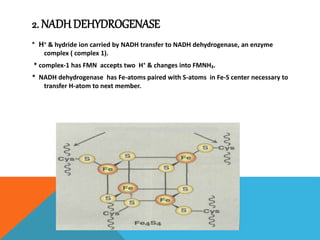
2. NADH DEHYDROGENASE
* H⁺ & hydride ion carried by NADH transfer to NADH dehydrogenase, an enzyme
complex ( complex 1).
* complex-1 has FMN accepts two H⁺ & changes into FMNH₂.
* NADH dehydrogenase has Fe-atoms paired with S-atoms in Fe-S center necessary to
transfer H-atom to next member.
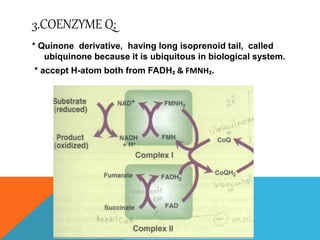
3.COENZYME Q;
* Quinone derivative, having long isoprenoid tail, called
ubiquinone because it is ubiquitous in biological system.
* accept H-atom both from FADH₂ & FMNH₂.
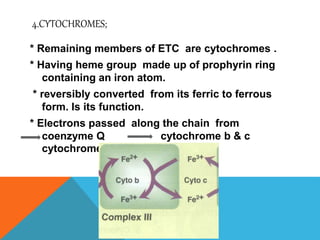
4.CYTOCHROMES;
* Remaining members of ETC are cytochromes .
* Having heme group made up of prophyrin ring
containing an iron atom.
* reversibly converted from its ferric to ferrous
form. Is its function.
* Electrons passed along the chain from
coenzyme Q cytochrome b & c
cytochrome a + a₃ .
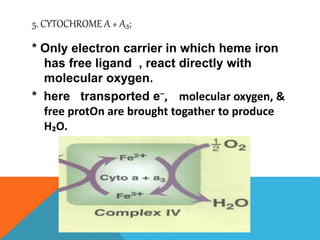
5. CYTOCHROME A + A₃;
* Only electron carrier in which heme iron
has free ligand , react directly with
molecular oxygen.
* here transported e⁻, molecular oxygen, &
free protOn are brought togather to produce
H₂O.
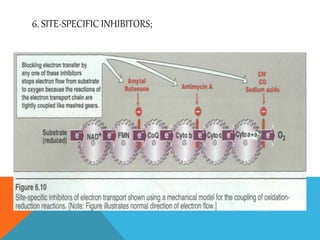
6. SITE-SPECIFIC INHIBITORS;
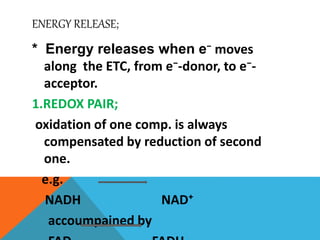
ENERGY RELEASE;
* Energy releases when e⁻ moves
along the ETC, from e⁻-donor, to e⁻-
acceptor.
1.REDOX PAIR;
oxidation of one comp. is always
compensated by reduction of second
one.
e.g.
NADH NAD⁺
accoumpained by
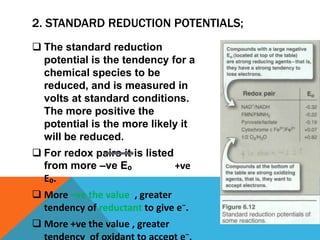
2. STANDARD REDUCTION POTENTIALS;
 The standard reduction
potential is the tendency for a
chemical species to be
reduced, and is measured in
volts at standard conditions.
The more positive the
potential is the more likely it
will be reduced.
 For redox pairs it is listed
from more –ve E₀ +ve
E₀.
 More –ve the value , greater
tendency of reductant to give e⁻.
 More +ve the value , greater
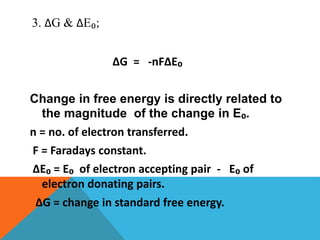
3. ΔG & ΔE₀;
ΔG = -nFΔE₀
Change in free energy is directly related to
the magnitude of the change in E₀.
n = no. of electron transferred.
F = Faradays constant.
ΔE₀ = E₀ of electron accepting pair - E₀ of
electron donating pairs.
ΔG = change in standard free energy.
REFERENCES;
Biological oxidation and reduction

Biological oxidation and reduction

  • 1.
  • 2.
    OXIDATION • Loss ofelectrons by an atom, ions or molecule during a chemical reaction & increase its oxidation state.
  • 3.
    REDUCTION • Gain ofelectrons by an atom , ion or molecule during a chemical reaction & decrease in its oxidation state
  • 4.
    REDOX REACTIONS • Thereactions which involves both reduction process & complementary oxidation process called redox reaction.
  • 5.
    EXPLANATION 1. Transfer ofphosphoryl group 2. Electron transfer ( redox) 3. Flow of e⁻ is responsible for all work done by the organism 4. In nonphotosynthetic organisms source of electrons is food 5. In photosynthetic organism initial e⁻ donor is a chemical specie excited by absorption of light. 6. Metabolic pathway is complex 7. Electrons metabolic intermediates e⁻ carrier acceptor having high e⁻ affinity with release of energy
  • 6.
    HALF REACTIONS • Reaction; •Fe⁺ᴵᴵ + Cu⁺ᴵᴵ Fe⁺ᴵᴵᴵ + Cu⁺ • Two half reactions; • Fe⁺ᴵᴵ Fe⁺ᴵᴵᴵ + e⁻ • Cu⁺ᴵᴵ + e⁻ Cu⁺ • Fe⁺ᴵᴵ & Fe⁺ᴵᴵᴵ • Reductant – oxidant pair • e⁻ donor e⁻ + e⁻ acceptor • Fe⁺ᴵᴵ is electron donor • Fe⁺ᴵᴵᴵ is electron acceptor
  • 7.
    EXAMPLE: oxidation of reducingsugar: RCHO + 4OH⁻ 2 Cu⁺ᴵᴵ RCOOH + Cu₂O + H₂O
  • 8.
    OXIDATION INVOLVE DEHYDROOGENATION Alkaneto alkene: C₂H₄ - CH= CH- oxidation takes place due to the loss of hydrogen atom.
  • 9.
    ELECTRON TRANSFER WAYS 1.Directlyas electrons 2.As hydrogen atom 3.As hydride ion 4.Direct combination with oxygen
  • 10.
    ELECTRON TRANSPORT CHAIN 1.Glucosemetabolize & give CO₂ plus H₂O. 2.NAD⁺ & FAD are converted to NADH & FADH₂ 3.Down the chain energy decreases
  • 12.
    MITOCHONDRION ETC is presentin the inner mitochondrial membrane. electron trans port and ATP synthesis occurs continuously in all cells having mitochondria.
  • 13.
    1. STRUCTURE; Inner membrane Impermeable ATP,ADP , pyruvate Carriers Rich in proteins used in electron transport & oxidative Phosphorylation. cristae
  • 14.
    2. ATP SYNTHASECOMPLEX * Protein complexes reffered as inner membrane particles. * Attached on inner surface • Appear as sphere 3. MATRIX; * Gel like soln. 50% protein * Enzymes for oxidation of pyruvate , aa, fatty acids, & carboxylic acid cycle. * Urea & heme * NAD⁺, FAD, ADP, Pi
  • 15.
  • 16.
    REACTIONS OF ETC Allmembers are proteins except coenzyme Q. Works as enzyme e.g. dehyrogenase Iron as iron sulfur center, Prophyrin ring as in cytochromes contain copper as in cytochrome a +a₃ complex.
  • 17.
    1. FORMATION OFNADH NAD⁺ reduce to NADH by Dehydrogenases that remove two H- atoms from substrate hydride ion transform NAD⁺ to NADH & a free proton H⁺
  • 18.
    2. NADH DEHYDROGENASE *H⁺ & hydride ion carried by NADH transfer to NADH dehydrogenase, an enzyme complex ( complex 1). * complex-1 has FMN accepts two H⁺ & changes into FMNH₂. * NADH dehydrogenase has Fe-atoms paired with S-atoms in Fe-S center necessary to transfer H-atom to next member.
  • 19.
    3.COENZYME Q; * Quinonederivative, having long isoprenoid tail, called ubiquinone because it is ubiquitous in biological system. * accept H-atom both from FADH₂ & FMNH₂.
  • 20.
    4.CYTOCHROMES; * Remaining membersof ETC are cytochromes . * Having heme group made up of prophyrin ring containing an iron atom. * reversibly converted from its ferric to ferrous form. Is its function. * Electrons passed along the chain from coenzyme Q cytochrome b & c cytochrome a + a₃ .
  • 21.
    5. CYTOCHROME A+ A₃; * Only electron carrier in which heme iron has free ligand , react directly with molecular oxygen. * here transported e⁻, molecular oxygen, & free protOn are brought togather to produce H₂O.
  • 23.
  • 24.
    ENERGY RELEASE; * Energyreleases when e⁻ moves along the ETC, from e⁻-donor, to e⁻- acceptor. 1.REDOX PAIR; oxidation of one comp. is always compensated by reduction of second one. e.g. NADH NAD⁺ accoumpained by
  • 25.
    2. STANDARD REDUCTIONPOTENTIALS;  The standard reduction potential is the tendency for a chemical species to be reduced, and is measured in volts at standard conditions. The more positive the potential is the more likely it will be reduced.  For redox pairs it is listed from more –ve E₀ +ve E₀.  More –ve the value , greater tendency of reductant to give e⁻.  More +ve the value , greater
  • 26.
    3. ΔG &ΔE₀; ΔG = -nFΔE₀ Change in free energy is directly related to the magnitude of the change in E₀. n = no. of electron transferred. F = Faradays constant. ΔE₀ = E₀ of electron accepting pair - E₀ of electron donating pairs. ΔG = change in standard free energy.
  • 27.