Chapter 14
Labor Relations and
Collective Bargaining
Fundamentals of Human Resource Management, 10/e, DeCenzo/Robbins Chapter 14, slide 2
Introduction
Ø a union is an organization of workers, acting
collectively, seeking to promote and protect its
mutual interests through collective bargaining
Ø only 12% of the private sector workforce is
unionized
Ø labor contracts typically stipulate:
Ø wages
Ø hours
Ø terms and conditions of employment
See
http://www.aflcio.org/joinaunion/why/uniondifference/uniondiff16.cfm
for a breakdown of union membership by state.
Fundamentals of Human Resource Management, 10/e, DeCenzo/Robbins Chapter 14, slide 3
Introduction
Union Membership
Percentage of Workforce
▪ Total - 12.5%
▪ Public sector - 36.5%
▪ Private sector - 7.8%
Demographics
▪ Age 16 - 24 - 4.6%
▪ 25 - 34 - 10.7%
▪ 35 - 44 - 13.7%
▪ 45 - 54 - 16.5%
▪ 55 - 64 - 16.5%
▪ 65 and over - 8.9%
▪ Women - 11.3%
▪ Men - 13.5%
Wikipedia (USDL, retrieved 1/28/09)
For a comprehensive history of labor unions see
http://en.wikipedia.org/wiki/Labor_unions_in_the_United_States
Fundamentals of Human Resource Management, 10/e, DeCenzo/Robbins Chapter 14, slide 4
Why Employees Join Unions
Øhigher wages and benefits: the strength of large
numbers and negotiating skills of professional bargainers
give unions an advantage over individuals
Øgreater job security: collective bargaining contracts
limit management’s ability to arbitrarily hire, promote, or fire
Øinfluence over work rules: unions represent workers
and define channels for complaints and concerns
Watch Solidarity Forever sung by Pete Seeger
http://www.youtube.com/watch?v=kYiKdJoSsb8
for a feel of what unions meant to people at the turn of the 20th
century, when labor laws were almost nonexistent.
Fundamentals of Human Resource Management, 10/e, DeCenzo/Robbins Chapter 14, slide 5
Why Employees Join Unions
Ø union shops require that all employees hired into positions
covered under the collective-bargaining agreement must join
the union
Ø agency shops require nonunion employees to pay an
amount equal to union fees and dues
Ø open shops allow union membership to be totally voluntary
Ø maintenance of membership clauses require union
members to remain for the duration of the contract
Ø dues checkoff provisions require employers to withhold
union dues from members’ paychecks
Compulsory Membership
Fundamentals of Human Resource Management, 10/e, DeCenzo/Robbins Chapter 14, slide 6
Labor Legislation
www.nlrb.gov
The Wagner Act
Ø “bill of rights” for unions, guaranteeing right
to organize and bargain collectively
Ø National Labor Relations Board (NLRB):
Ø also known as the National Labor Relations Act
Ø determines bargaining units
Ø conducts elections
Ø prevents or corrects unfair labor practices
Fundamentals of Human Resource Management, 10/e, DeCenzo/Robbins Chapter 14, slide 7
Labor Legislation
Unfair labor practices include:
Øinterfering with an employee’s right to bargain
collectively
ØInterfering with or discriminating against anyone
because of union activity
Ødiscriminating against employee who gave
testimony under the act
Ørefusing to bargain collectively with employee
representatives
The Wagner Act
Fundamentals of Human Resource Management, 10/e, DeCenzo/Robbins Chapter 14, slide 8
Labor Legislation
Ø also known as the Labor-Management Relations Act
Ø amended Wagner to address employer concerns
Ø specified unfair union labor practices
1. coercion of employees to join the union
2. refusing to bargain collectively
3. engaging in illegal strikes and boycotts
4. obtaining compensation for services not performed
Ø prohibited closed shops, secondary boycotts, and gave
the president power to issue a cooling-off period
Ø created Federal Mediation and Conciliation Service
(FMCS) to help labor and management settle disputes
Taft-Hartley Act
Fundamentals of Human Resource Management, 10/e, DeCenzo/Robbins Chapter 14, slide 9
Labor Legislation
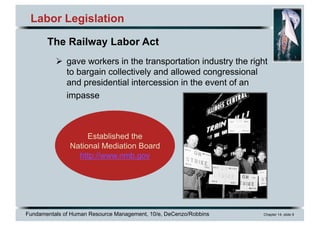
Ø gave workers in the transportation industry the right
to bargain collectively and allowed congressional
and presidential intercession in the event of an
impasse
Established the
National Mediation Board
http://www.nmb.gov
The Railway Labor Act
Fundamentals of Human Resource Management, 10/e, DeCenzo/Robbins Chapter 14, slide 10
Labor Legislation
Ø also known as the Labor and Management
Reporting and Disclosure Act
Ø made union officials accountable for funds,
elections, and other business and
representational matters
Ø required annual filing of information by unions
and by individuals employed by unions
Ø required that all members be allowed to vote
by secret ballot
Landrum-Griffin Act
Fundamentals of Human Resource Management, 10/e, DeCenzo/Robbins Chapter 14, slide 11
Labor Legislation
Racketeering Influenced and Corrupt
Organizations Act (RICO) of 1970
Ø prohibits payment and loans in the form of bribery, kickbacks,
or extortion
Ø has been used to oust labor officials with organized crime ties
Executive Orders 10988 and 11491
Ø permitted federal employees to join unions and established
the Federal Labor Relations Council (FLRC)
The Department of Labor’s inspector general investigates union and
organized crime activity
http://www.oig.dol.gov/laborracprogram.htm
Fundamentals of Human Resource Management, 10/e, DeCenzo/Robbins Chapter 14, slide 12
Labor Legislation
Ø replaced executive orders as basic law governing
labor relations for federal employees.
Ø established the Federal Labor Relations Authority
www.flra.gov
Ø broad-scope grievance procedure
Civil Service Reform Act of 1978
Fundamentals of Human Resource Management, 10/e, DeCenzo/Robbins Chapter 14, slide 13
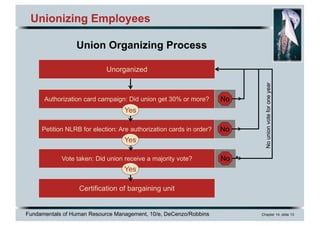
Certification of bargaining unit
Unionizing Employees
Union Organizing Process
Petition NLRB for election: Are authorization cards in order?
Vote taken: Did union receive a majority vote?
Authorization card campaign: Did union get 30% or more?
Unorganized
No
Nounionvoteforoneyear
Yes
No
No
Yes
Yes
Fundamentals of Human Resource Management, 10/e, DeCenzo/Robbins Chapter 14, slide 14
Unionizing Employees
Employees want to form a union. Now what?
Ø thirty percent of employees must sign
authorization cards indicating their interest in
having an election
Ø with a representation certification (RC), a
secret-ballot election is held
Ø if the union is accepted by a majority of eligible
voting workers, the union becomes the workers’
legal representative
Fundamentals of Human Resource Management, 10/e, DeCenzo/Robbins Chapter 14, slide 15
Unionizing Employees
Ø once the National Labor Relations Board certifies
a union, each worker must abide by the
negotiated contract
Ø most organizations’ managements will try to
influence workers against voting for union
representation
Ø representation decertification (RD) elections can
be held to vote unions out
Ø RMs are decertification elections initiated by
management
Ø most agreements bar the use of decertification
elections during the term of a contract
Fundamentals of Human Resource Management, 10/e, DeCenzo/Robbins Chapter 14, slide 16
Collective Bargaining
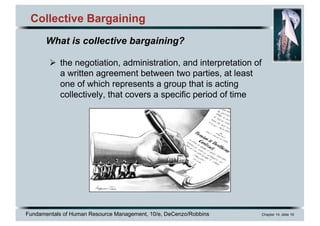
Ø the negotiation, administration, and interpretation of
a written agreement between two parties, at least
one of which represents a group that is acting
collectively, that covers a specific period of time
What is collective bargaining?
Fundamentals of Human Resource Management, 10/e, DeCenzo/Robbins Chapter 14, slide 17
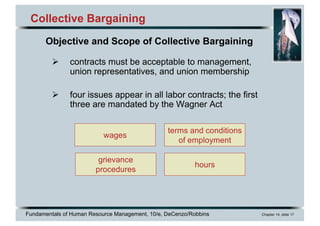
Collective Bargaining
Ø contracts must be acceptable to management,
union representatives, and union membership
Ø four issues appear in all labor contracts; the first
three are mandated by the Wagner Act
Objective and Scope of Collective Bargaining
wages
grievance
procedures
hours
terms and conditions
of employment
Fundamentals of Human Resource Management, 10/e, DeCenzo/Robbins Chapter 14, slide 18
Collective Bargaining
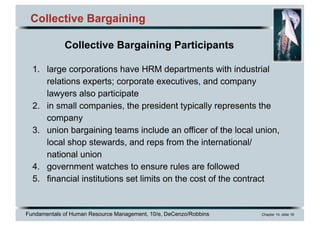
Collective Bargaining Participants
1. large corporations have HRM departments with industrial
relations experts; corporate executives, and company
lawyers also participate
2. in small companies, the president typically represents the
company
3. union bargaining teams include an officer of the local union,
local shop stewards, and reps from the international/
national union
4. government watches to ensure rules are followed
5. financial institutions set limits on the cost of the contract
Fundamentals of Human Resource Management, 10/e, DeCenzo/Robbins Chapter 14, slide 19
Collective Bargaining
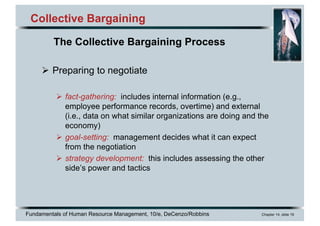
Ø Preparing to negotiate
Ø fact-gathering: includes internal information (e.g.,
employee performance records, overtime) and external
(i.e., data on what similar organizations are doing and the
economy)
Ø goal-setting: management decides what it can expect
from the negotiation
Ø strategy development: this includes assessing the other
side’s power and tactics
The Collective Bargaining Process
Fundamentals of Human Resource Management, 10/e, DeCenzo/Robbins Chapter 14, slide 20
Collective Bargaining
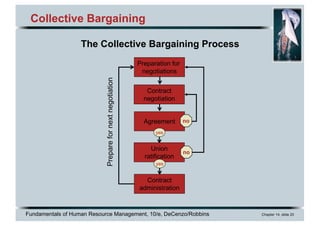
The Collective Bargaining Process
Preparefornextnegotiation
Preparation for
negotiations
Contract
negotiation
Agreement
Union
ratification
Contract
administration
yes
yes
no
no
Fundamentals of Human Resource Management, 10/e, DeCenzo/Robbins Chapter 14, slide 21
Collective Bargaining
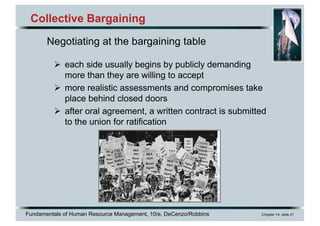
Ø each side usually begins by publicly demanding
more than they are willing to accept
Ø more realistic assessments and compromises take
place behind closed doors
Ø after oral agreement, a written contract is submitted
to the union for ratification
Negotiating at the bargaining table
Fundamentals of Human Resource Management, 10/e, DeCenzo/Robbins Chapter 14, slide 22
Collective Bargaining
1. information dissemination: helping staff and
workers understand the new contract provisions
2. implementation: making the changes to comply
with contract terms
3. interpreting the contract and grievance
resolution
4. monitoring activities during contract period
Contract administration is the implementation,
interpretation, and monitoring of the negotiated
contract between labor and management.
Fundamentals of Human Resource Management, 10/e, DeCenzo/Robbins Chapter 14, slide 23
Collective Bargaining
Ø economic strikes - labor and management
cannot reach agreement before the current
contract expires
Ø wildcat strikes - unauthorized and illegal strikes
that occur because of worker dissatisfaction
during an existing contract
Ø lockouts - when organizations deny unionized
workers access to their jobs during an impasse
Failure to Reach Agreement
Strikes versus Lockouts
Fundamentals of Human Resource Management, 10/e, DeCenzo/Robbins Chapter 14, slide 24
Collective Bargaining
Impasse-Resolution Techniques
used when labor and management cannot agree
Ø conciliation and mediation involve a third party to either
keep negotiations going or make nonbinding settlement
recommendations
Ø fact-finding involves a neutral third party who conducts a
hearing and recommends a nonbinding settlement
Ø interest arbitration Involves a panel of one neutral, one
management, and one union representative who hear
testimony and render a decision to settle a contract
negotiation dispute
Ø primarily in public-sector bargaining
Ø binding only if there is unanimous agreement
Fundamentals of Human Resource Management, 10/e, DeCenzo/Robbins Chapter 14, slide 25
Critical Issues for Unions Today
Where have the union members gone?
Ø Reasons for decline in membership include:
1. new concerns of a growing middle class
2. greater diversity of the workforce
3. growth of the service sector
4. diminished financial resources of unions
5. anti-union pressures resulting from increased
competitiveness
6. layoffs of large numbers of union workers
7. hiring of replacement workers for strikers
Fundamentals of Human Resource Management, 10/e, DeCenzo/Robbins Chapter 14, slide 26
Critical Issues for Unions Today
Ø unions are changing some of their organizing
tactics and may currently be gaining public support
Ø they also are placing more emphasis on the service
sector
Ø some unions recognize that they can gain more by
cooperating with management rather than fighting
Ø the Electromation case illustrates the potential legal
difficulties of cooperative efforts: The NLRB ruled that
employee committees were an unfair labor practice
Fundamentals of Human Resource Management, 10/e, DeCenzo/Robbins Chapter 14, slide 27
Critical Issues for Unions Today
Public-Sector Unionization
Ø membership of government workers in
unions has increased from 11% in 1970 to
nearly 38% in 2002
Ø public-sector labor relations differs from
private-sector labor relations
Ø sunshine laws in some states mandate that
labor-management negotiations be open to the
public
Fundamentals of Human Resource Management, 10/e, DeCenzo/Robbins Chapter 14, slide 28
International Labor Relations
See FedEE for general information on labor laws by country.
http://www.fedee.com/natlaw.html
Differing Perspectives Toward Labor Relations
Ø countries differ in their labor relations histories,
government involvement, and public acceptance of
labor unions
Ø the labor relations function for international
companies is more likely to be centralized with the
parent company when domestic sales are larger than
those overseas
The European Community
Ø brings together a dozen or more labor relations
systems
Ø countries wishing to do business in Europe must
keep up with changing labor legislation
Fundamentals of Human Resource Management, 10/e, DeCenzo/Robbins Chapter 14, slide 29
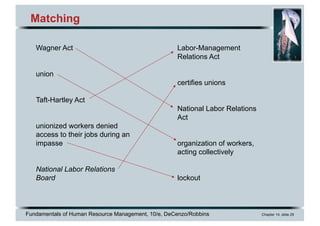
Matching
Wagner Act
union
Taft-Hartley Act
unionized workers denied
access to their jobs during an
impasse
National Labor Relations
Board
Labor-Management
Relations Act
certifies unions
National Labor Relations
Act
organization of workers,
acting collectively
lockout

Chapter 14 Labor Relations and Collective Bargaining

  • 1.
    Chapter 14 Labor Relationsand Collective Bargaining
  • 2.
    Fundamentals of HumanResource Management, 10/e, DeCenzo/Robbins Chapter 14, slide 2 Introduction Ø a union is an organization of workers, acting collectively, seeking to promote and protect its mutual interests through collective bargaining Ø only 12% of the private sector workforce is unionized Ø labor contracts typically stipulate: Ø wages Ø hours Ø terms and conditions of employment See http://www.aflcio.org/joinaunion/why/uniondifference/uniondiff16.cfm for a breakdown of union membership by state.
  • 3.
    Fundamentals of HumanResource Management, 10/e, DeCenzo/Robbins Chapter 14, slide 3 Introduction Union Membership Percentage of Workforce ▪ Total - 12.5% ▪ Public sector - 36.5% ▪ Private sector - 7.8% Demographics ▪ Age 16 - 24 - 4.6% ▪ 25 - 34 - 10.7% ▪ 35 - 44 - 13.7% ▪ 45 - 54 - 16.5% ▪ 55 - 64 - 16.5% ▪ 65 and over - 8.9% ▪ Women - 11.3% ▪ Men - 13.5% Wikipedia (USDL, retrieved 1/28/09) For a comprehensive history of labor unions see http://en.wikipedia.org/wiki/Labor_unions_in_the_United_States
  • 4.
    Fundamentals of HumanResource Management, 10/e, DeCenzo/Robbins Chapter 14, slide 4 Why Employees Join Unions Øhigher wages and benefits: the strength of large numbers and negotiating skills of professional bargainers give unions an advantage over individuals Øgreater job security: collective bargaining contracts limit management’s ability to arbitrarily hire, promote, or fire Øinfluence over work rules: unions represent workers and define channels for complaints and concerns Watch Solidarity Forever sung by Pete Seeger http://www.youtube.com/watch?v=kYiKdJoSsb8 for a feel of what unions meant to people at the turn of the 20th century, when labor laws were almost nonexistent.
  • 5.
    Fundamentals of HumanResource Management, 10/e, DeCenzo/Robbins Chapter 14, slide 5 Why Employees Join Unions Ø union shops require that all employees hired into positions covered under the collective-bargaining agreement must join the union Ø agency shops require nonunion employees to pay an amount equal to union fees and dues Ø open shops allow union membership to be totally voluntary Ø maintenance of membership clauses require union members to remain for the duration of the contract Ø dues checkoff provisions require employers to withhold union dues from members’ paychecks Compulsory Membership
  • 6.
    Fundamentals of HumanResource Management, 10/e, DeCenzo/Robbins Chapter 14, slide 6 Labor Legislation www.nlrb.gov The Wagner Act Ø “bill of rights” for unions, guaranteeing right to organize and bargain collectively Ø National Labor Relations Board (NLRB): Ø also known as the National Labor Relations Act Ø determines bargaining units Ø conducts elections Ø prevents or corrects unfair labor practices
  • 7.
    Fundamentals of HumanResource Management, 10/e, DeCenzo/Robbins Chapter 14, slide 7 Labor Legislation Unfair labor practices include: Øinterfering with an employee’s right to bargain collectively ØInterfering with or discriminating against anyone because of union activity Ødiscriminating against employee who gave testimony under the act Ørefusing to bargain collectively with employee representatives The Wagner Act
  • 8.
    Fundamentals of HumanResource Management, 10/e, DeCenzo/Robbins Chapter 14, slide 8 Labor Legislation Ø also known as the Labor-Management Relations Act Ø amended Wagner to address employer concerns Ø specified unfair union labor practices 1. coercion of employees to join the union 2. refusing to bargain collectively 3. engaging in illegal strikes and boycotts 4. obtaining compensation for services not performed Ø prohibited closed shops, secondary boycotts, and gave the president power to issue a cooling-off period Ø created Federal Mediation and Conciliation Service (FMCS) to help labor and management settle disputes Taft-Hartley Act
  • 9.
    Fundamentals of HumanResource Management, 10/e, DeCenzo/Robbins Chapter 14, slide 9 Labor Legislation Ø gave workers in the transportation industry the right to bargain collectively and allowed congressional and presidential intercession in the event of an impasse Established the National Mediation Board http://www.nmb.gov The Railway Labor Act
  • 10.
    Fundamentals of HumanResource Management, 10/e, DeCenzo/Robbins Chapter 14, slide 10 Labor Legislation Ø also known as the Labor and Management Reporting and Disclosure Act Ø made union officials accountable for funds, elections, and other business and representational matters Ø required annual filing of information by unions and by individuals employed by unions Ø required that all members be allowed to vote by secret ballot Landrum-Griffin Act
  • 11.
    Fundamentals of HumanResource Management, 10/e, DeCenzo/Robbins Chapter 14, slide 11 Labor Legislation Racketeering Influenced and Corrupt Organizations Act (RICO) of 1970 Ø prohibits payment and loans in the form of bribery, kickbacks, or extortion Ø has been used to oust labor officials with organized crime ties Executive Orders 10988 and 11491 Ø permitted federal employees to join unions and established the Federal Labor Relations Council (FLRC) The Department of Labor’s inspector general investigates union and organized crime activity http://www.oig.dol.gov/laborracprogram.htm
  • 12.
    Fundamentals of HumanResource Management, 10/e, DeCenzo/Robbins Chapter 14, slide 12 Labor Legislation Ø replaced executive orders as basic law governing labor relations for federal employees. Ø established the Federal Labor Relations Authority www.flra.gov Ø broad-scope grievance procedure Civil Service Reform Act of 1978
  • 13.
    Fundamentals of HumanResource Management, 10/e, DeCenzo/Robbins Chapter 14, slide 13 Certification of bargaining unit Unionizing Employees Union Organizing Process Petition NLRB for election: Are authorization cards in order? Vote taken: Did union receive a majority vote? Authorization card campaign: Did union get 30% or more? Unorganized No Nounionvoteforoneyear Yes No No Yes Yes
  • 14.
    Fundamentals of HumanResource Management, 10/e, DeCenzo/Robbins Chapter 14, slide 14 Unionizing Employees Employees want to form a union. Now what? Ø thirty percent of employees must sign authorization cards indicating their interest in having an election Ø with a representation certification (RC), a secret-ballot election is held Ø if the union is accepted by a majority of eligible voting workers, the union becomes the workers’ legal representative
  • 15.
    Fundamentals of HumanResource Management, 10/e, DeCenzo/Robbins Chapter 14, slide 15 Unionizing Employees Ø once the National Labor Relations Board certifies a union, each worker must abide by the negotiated contract Ø most organizations’ managements will try to influence workers against voting for union representation Ø representation decertification (RD) elections can be held to vote unions out Ø RMs are decertification elections initiated by management Ø most agreements bar the use of decertification elections during the term of a contract
  • 16.
    Fundamentals of HumanResource Management, 10/e, DeCenzo/Robbins Chapter 14, slide 16 Collective Bargaining Ø the negotiation, administration, and interpretation of a written agreement between two parties, at least one of which represents a group that is acting collectively, that covers a specific period of time What is collective bargaining?
  • 17.
    Fundamentals of HumanResource Management, 10/e, DeCenzo/Robbins Chapter 14, slide 17 Collective Bargaining Ø contracts must be acceptable to management, union representatives, and union membership Ø four issues appear in all labor contracts; the first three are mandated by the Wagner Act Objective and Scope of Collective Bargaining wages grievance procedures hours terms and conditions of employment
  • 18.
    Fundamentals of HumanResource Management, 10/e, DeCenzo/Robbins Chapter 14, slide 18 Collective Bargaining Collective Bargaining Participants 1. large corporations have HRM departments with industrial relations experts; corporate executives, and company lawyers also participate 2. in small companies, the president typically represents the company 3. union bargaining teams include an officer of the local union, local shop stewards, and reps from the international/ national union 4. government watches to ensure rules are followed 5. financial institutions set limits on the cost of the contract
  • 19.
    Fundamentals of HumanResource Management, 10/e, DeCenzo/Robbins Chapter 14, slide 19 Collective Bargaining Ø Preparing to negotiate Ø fact-gathering: includes internal information (e.g., employee performance records, overtime) and external (i.e., data on what similar organizations are doing and the economy) Ø goal-setting: management decides what it can expect from the negotiation Ø strategy development: this includes assessing the other side’s power and tactics The Collective Bargaining Process
  • 20.
    Fundamentals of HumanResource Management, 10/e, DeCenzo/Robbins Chapter 14, slide 20 Collective Bargaining The Collective Bargaining Process Preparefornextnegotiation Preparation for negotiations Contract negotiation Agreement Union ratification Contract administration yes yes no no
  • 21.
    Fundamentals of HumanResource Management, 10/e, DeCenzo/Robbins Chapter 14, slide 21 Collective Bargaining Ø each side usually begins by publicly demanding more than they are willing to accept Ø more realistic assessments and compromises take place behind closed doors Ø after oral agreement, a written contract is submitted to the union for ratification Negotiating at the bargaining table
  • 22.
    Fundamentals of HumanResource Management, 10/e, DeCenzo/Robbins Chapter 14, slide 22 Collective Bargaining 1. information dissemination: helping staff and workers understand the new contract provisions 2. implementation: making the changes to comply with contract terms 3. interpreting the contract and grievance resolution 4. monitoring activities during contract period Contract administration is the implementation, interpretation, and monitoring of the negotiated contract between labor and management.
  • 23.
    Fundamentals of HumanResource Management, 10/e, DeCenzo/Robbins Chapter 14, slide 23 Collective Bargaining Ø economic strikes - labor and management cannot reach agreement before the current contract expires Ø wildcat strikes - unauthorized and illegal strikes that occur because of worker dissatisfaction during an existing contract Ø lockouts - when organizations deny unionized workers access to their jobs during an impasse Failure to Reach Agreement Strikes versus Lockouts
  • 24.
    Fundamentals of HumanResource Management, 10/e, DeCenzo/Robbins Chapter 14, slide 24 Collective Bargaining Impasse-Resolution Techniques used when labor and management cannot agree Ø conciliation and mediation involve a third party to either keep negotiations going or make nonbinding settlement recommendations Ø fact-finding involves a neutral third party who conducts a hearing and recommends a nonbinding settlement Ø interest arbitration Involves a panel of one neutral, one management, and one union representative who hear testimony and render a decision to settle a contract negotiation dispute Ø primarily in public-sector bargaining Ø binding only if there is unanimous agreement
  • 25.
    Fundamentals of HumanResource Management, 10/e, DeCenzo/Robbins Chapter 14, slide 25 Critical Issues for Unions Today Where have the union members gone? Ø Reasons for decline in membership include: 1. new concerns of a growing middle class 2. greater diversity of the workforce 3. growth of the service sector 4. diminished financial resources of unions 5. anti-union pressures resulting from increased competitiveness 6. layoffs of large numbers of union workers 7. hiring of replacement workers for strikers
  • 26.
    Fundamentals of HumanResource Management, 10/e, DeCenzo/Robbins Chapter 14, slide 26 Critical Issues for Unions Today Ø unions are changing some of their organizing tactics and may currently be gaining public support Ø they also are placing more emphasis on the service sector Ø some unions recognize that they can gain more by cooperating with management rather than fighting Ø the Electromation case illustrates the potential legal difficulties of cooperative efforts: The NLRB ruled that employee committees were an unfair labor practice
  • 27.
    Fundamentals of HumanResource Management, 10/e, DeCenzo/Robbins Chapter 14, slide 27 Critical Issues for Unions Today Public-Sector Unionization Ø membership of government workers in unions has increased from 11% in 1970 to nearly 38% in 2002 Ø public-sector labor relations differs from private-sector labor relations Ø sunshine laws in some states mandate that labor-management negotiations be open to the public
  • 28.
    Fundamentals of HumanResource Management, 10/e, DeCenzo/Robbins Chapter 14, slide 28 International Labor Relations See FedEE for general information on labor laws by country. http://www.fedee.com/natlaw.html Differing Perspectives Toward Labor Relations Ø countries differ in their labor relations histories, government involvement, and public acceptance of labor unions Ø the labor relations function for international companies is more likely to be centralized with the parent company when domestic sales are larger than those overseas The European Community Ø brings together a dozen or more labor relations systems Ø countries wishing to do business in Europe must keep up with changing labor legislation
  • 29.
    Fundamentals of HumanResource Management, 10/e, DeCenzo/Robbins Chapter 14, slide 29 Matching Wagner Act union Taft-Hartley Act unionized workers denied access to their jobs during an impasse National Labor Relations Board Labor-Management Relations Act certifies unions National Labor Relations Act organization of workers, acting collectively lockout