Chapter 9
Career Development
Fundamentals of Human Resource Management, 10/e, DeCenzo/Robbins Chapter 9, slide 2
Introduction
Ø traditionally, career development programs
helped employees advance within the
organization
Ø today, each individual must take responsibility
for his or her career
Some helpful career development sites:
http://managementhelp.org/career/career.htm
http://associationdatabase.com/aws/NCDA/pt/sp/home_page
Fundamentals of Human Resource Management, 10/e, DeCenzo/Robbins Chapter 9, slide 3
Introduction
Ø organizations now focus on matching the career
needs of employees with the requirements of the
organization
Ø while many organizations still invest in their
employees, they don’t offer career security and
they can’t meet the needs of everyone in a diverse
workforce
Fundamentals of Human Resource Management, 10/e, DeCenzo/Robbins Chapter 9, slide 4
What is a Career?
A career
Øis a pattern of work-related experiences that span
the course of a person’s life
Øreflects any work, paid or unpaid
Øis a broad definition helpful in today’s work
environment where employees and organizations
have diverse needs
Fundamentals of Human Resource Management, 10/e, DeCenzo/Robbins Chapter 9, slide 5
What is a Career?
Øorganizational career planning develops career
ladders, tracks careers, and provides opportunities
for development
Øindividual career development helps employees
identify their goals and the steps to achieve them
Fundamentals of Human Resource Management, 10/e, DeCenzo/Robbins Chapter 9, slide 6
What is a Career?
Øcareer development looks at the long-term career
effectiveness and success of employees
Øemployee training and development focuses on
performance in the immediate or intermediate time
frames
Fundamentals of Human Resource Management, 10/e, DeCenzo/Robbins Chapter 9, slide 7
What is a Career?
Career development adds value to
the company. It
1. ensures needed talent will be available
2. improves the organization's ability to attract and retain
talented employees
3. ensures that minorities and women get opportunities for
growth and development. New legislation:
http://en.wikipedia.org/wiki/Lilly_Ledbetter_Fair_Pay_Act_of_2009
4. reduces employee frustration
5. enhances cultural diversity
6. promotes organizational goodwill
Fundamentals of Human Resource Management, 10/e, DeCenzo/Robbins Chapter 9, slide 8
What is a Career?
Ø individuals’ external career success is measured
by criteria such as:
progression up the hierarchy
type of occupation
long-term commitment
income
Ø internal career success is measured by the
meaningfulness of one’s work and achievement of
personal life goals
the external/internal distinction important to the manager who
wants to motivate employees
Fundamentals of Human Resource Management, 10/e, DeCenzo/Robbins Chapter 9, slide 9
What is a Career?
Ø effective coaches give guidance through
direction, advice, criticism, and suggestion in an
attempt to aid the employee’s growth
Ø mentors are typically senior-level employees
who:
Ø support younger employees by vouching for them
Ø answer for them in the “highest circles”
Ø introduce them to others
Ø advise and guide them through the corporate system
Fundamentals of Human Resource Management, 10/e, DeCenzo/Robbins Chapter 9, slide 10
What is a Career?
Ø disadvantages of coaching/mentoring include:
Ø a tendency to perpetuate current styles and practices
Ø reliance on the coach’s ability to be a good teacher
Ø considerations for organizations:
Ø coaching between employees who do not have a reporting
relationship
Ø ways to effectively implement cross-gender mentoring
For tips on obtaining a successful mentor/mentee relationships see
http://www.washington.edu/admin/hr/pod/staff/careerdev/mentoring/relationshipkeys.html
Fundamentals of Human Resource Management, 10/e, DeCenzo/Robbins Chapter 9, slide 11
Will performance
increase or decline?
Traditional Career Stages
High
5 1510 352520 4030 5045 6055 7065 75
Age
Low
Getting first
job and
being
accepted
The elder
statesperson
Preparing for
retirement
Exploration Estblshment Mid career Late Career Decline
Transition
from school
to work
Job
Performance
Fundamentals of Human Resource Management, 10/e, DeCenzo/Robbins Chapter 9, slide 12
Traditional Career Stages
this stage is least relevant to HRM because it occurs
prior to employment
exploration
Øincludes school and early work experiences, such as
internships.
Øinvolves:
Øtrying out different fields
Ødiscovering likes and dislikes
Øforming attitudes toward work and social relationship patterns
Fundamentals of Human Resource Management, 10/e, DeCenzo/Robbins Chapter 9, slide 13
establishment
Traditional Career Stages
Øincludes:
Øsearching for work
Øgetting first job
Øgetting evidence of “success” or “failure”
Øtakes time and energy to find a “niche” and to
“make your mark”
Fundamentals of Human Resource Management, 10/e, DeCenzo/Robbins Chapter 9, slide 14
mid-career
Traditional Career Stages
Ø challenged to remain productive at work
Ø employee may:
Øcontinue to grow
Øplateau (stay competent but not ambitious)
Ødeteriorate
Fundamentals of Human Resource Management, 10/e, DeCenzo/Robbins Chapter 9, slide 15
late career
Traditional Career Stages
Ø successful “elder states persons” can enjoy being
respected for their judgment. Good resource for
teaching others
Ø those who have declined may experience job insecurity
Ø plateauing is expected; life off the job increases in
importance
Fundamentals of Human Resource Management, 10/e, DeCenzo/Robbins Chapter 9, slide 16
Traditional Career Stages
Ø may be most difficult for those who were most
successful at earlier stages
Ø today’s longer life spans and legal protections for
older workers open the possibility for continued
work contributions, either paid or volunteer
decline
Fundamentals of Human Resource Management, 10/e, DeCenzo/Robbins Chapter 9, slide 17
Career Choices and Preferences
Good career choice outcomes provide a positive
self-concept and the opportunity to do work that
we value.
Models to help you match your skills to careers:
Also try the classic work “What Color is Your Parachute?” for career
advice and a wealth of information: http://www.jobhuntersbible.com/
Holland
Vocational
Preferences
Schein
Anchors
Myers Briggs
Typologies
Fundamentals of Human Resource Management, 10/e, DeCenzo/Robbins Chapter 9, slide 18
Career Choices and Preferences
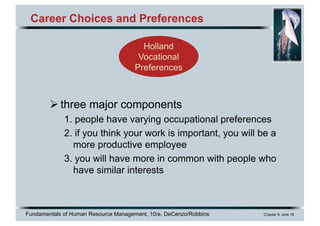
Ø three major components
1. people have varying occupational preferences
2. if you think your work is important, you will be a
more productive employee
3. you will have more in common with people who
have similar interests
Holland
Vocational
Preferences
Fundamentals of Human Resource Management, 10/e, DeCenzo/Robbins Chapter 9, slide 19
Career Choices and Preferences
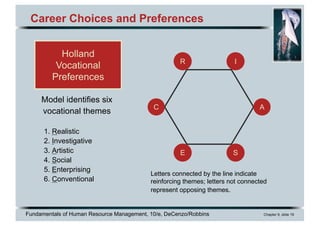
Model identifies six
vocational themes
1. Realistic
2. Investigative
3. Artistic
4. Social
5. Enterprising
6. Conventional
Holland
Vocational
Preferences
Letters connected by the line indicate
reinforcing themes; letters not connected
represent opposing themes.
R
C
E S
A
I
Fundamentals of Human Resource Management, 10/e, DeCenzo/Robbins Chapter 9, slide 20
Career Choices and Preferences
Øpreferences can be matched to work environments
Øexample: social-enterprising-conventional
preference structure matches career ladder in
large bureaucracy
Holland
Vocational
Preferences
Fundamentals of Human Resource Management, 10/e, DeCenzo/Robbins Chapter 9, slide 21
Career Choices and Preferences
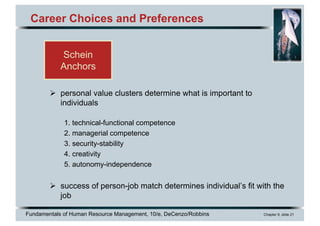
Ø personal value clusters determine what is important to
individuals
1. technical-functional competence
2. managerial competence
3. security-stability
4. creativity
5. autonomy-independence
Ø success of person-job match determines individual’s fit with the
job
Schein
Anchors
Fundamentals of Human Resource Management, 10/e, DeCenzo/Robbins Chapter 9, slide 22
Career Choices and Preferences
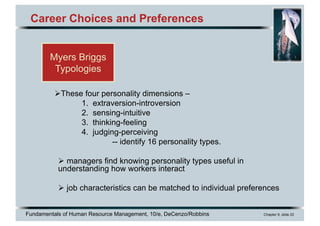
ØThese four personality dimensions –
1. extraversion-introversion
2. sensing-intuitive
3. thinking-feeling
4. judging-perceiving
-- identify 16 personality types.
Ø managers find knowing personality types useful in
understanding how workers interact
Ø job characteristics can be matched to individual preferences
Myers Briggs
Typologies
Fundamentals of Human Resource Management, 10/e, DeCenzo/Robbins Chapter 9, slide 23
Enhancing Your Career
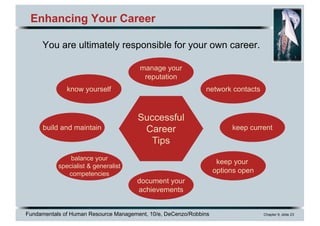
You are ultimately responsible for your own career.
manage your
reputation
know yourself
build and maintain
network contacts
keep current
keep your
options open
document your
achievements
balance your
specialist & generalist
competencies
Successful
Career
Tips

Chapter 9 Career Development

  • 1.
  • 2.
    Fundamentals of HumanResource Management, 10/e, DeCenzo/Robbins Chapter 9, slide 2 Introduction Ø traditionally, career development programs helped employees advance within the organization Ø today, each individual must take responsibility for his or her career Some helpful career development sites: http://managementhelp.org/career/career.htm http://associationdatabase.com/aws/NCDA/pt/sp/home_page
  • 3.
    Fundamentals of HumanResource Management, 10/e, DeCenzo/Robbins Chapter 9, slide 3 Introduction Ø organizations now focus on matching the career needs of employees with the requirements of the organization Ø while many organizations still invest in their employees, they don’t offer career security and they can’t meet the needs of everyone in a diverse workforce
  • 4.
    Fundamentals of HumanResource Management, 10/e, DeCenzo/Robbins Chapter 9, slide 4 What is a Career? A career Øis a pattern of work-related experiences that span the course of a person’s life Øreflects any work, paid or unpaid Øis a broad definition helpful in today’s work environment where employees and organizations have diverse needs
  • 5.
    Fundamentals of HumanResource Management, 10/e, DeCenzo/Robbins Chapter 9, slide 5 What is a Career? Øorganizational career planning develops career ladders, tracks careers, and provides opportunities for development Øindividual career development helps employees identify their goals and the steps to achieve them
  • 6.
    Fundamentals of HumanResource Management, 10/e, DeCenzo/Robbins Chapter 9, slide 6 What is a Career? Øcareer development looks at the long-term career effectiveness and success of employees Øemployee training and development focuses on performance in the immediate or intermediate time frames
  • 7.
    Fundamentals of HumanResource Management, 10/e, DeCenzo/Robbins Chapter 9, slide 7 What is a Career? Career development adds value to the company. It 1. ensures needed talent will be available 2. improves the organization's ability to attract and retain talented employees 3. ensures that minorities and women get opportunities for growth and development. New legislation: http://en.wikipedia.org/wiki/Lilly_Ledbetter_Fair_Pay_Act_of_2009 4. reduces employee frustration 5. enhances cultural diversity 6. promotes organizational goodwill
  • 8.
    Fundamentals of HumanResource Management, 10/e, DeCenzo/Robbins Chapter 9, slide 8 What is a Career? Ø individuals’ external career success is measured by criteria such as: progression up the hierarchy type of occupation long-term commitment income Ø internal career success is measured by the meaningfulness of one’s work and achievement of personal life goals the external/internal distinction important to the manager who wants to motivate employees
  • 9.
    Fundamentals of HumanResource Management, 10/e, DeCenzo/Robbins Chapter 9, slide 9 What is a Career? Ø effective coaches give guidance through direction, advice, criticism, and suggestion in an attempt to aid the employee’s growth Ø mentors are typically senior-level employees who: Ø support younger employees by vouching for them Ø answer for them in the “highest circles” Ø introduce them to others Ø advise and guide them through the corporate system
  • 10.
    Fundamentals of HumanResource Management, 10/e, DeCenzo/Robbins Chapter 9, slide 10 What is a Career? Ø disadvantages of coaching/mentoring include: Ø a tendency to perpetuate current styles and practices Ø reliance on the coach’s ability to be a good teacher Ø considerations for organizations: Ø coaching between employees who do not have a reporting relationship Ø ways to effectively implement cross-gender mentoring For tips on obtaining a successful mentor/mentee relationships see http://www.washington.edu/admin/hr/pod/staff/careerdev/mentoring/relationshipkeys.html
  • 11.
    Fundamentals of HumanResource Management, 10/e, DeCenzo/Robbins Chapter 9, slide 11 Will performance increase or decline? Traditional Career Stages High 5 1510 352520 4030 5045 6055 7065 75 Age Low Getting first job and being accepted The elder statesperson Preparing for retirement Exploration Estblshment Mid career Late Career Decline Transition from school to work Job Performance
  • 12.
    Fundamentals of HumanResource Management, 10/e, DeCenzo/Robbins Chapter 9, slide 12 Traditional Career Stages this stage is least relevant to HRM because it occurs prior to employment exploration Øincludes school and early work experiences, such as internships. Øinvolves: Øtrying out different fields Ødiscovering likes and dislikes Øforming attitudes toward work and social relationship patterns
  • 13.
    Fundamentals of HumanResource Management, 10/e, DeCenzo/Robbins Chapter 9, slide 13 establishment Traditional Career Stages Øincludes: Øsearching for work Øgetting first job Øgetting evidence of “success” or “failure” Øtakes time and energy to find a “niche” and to “make your mark”
  • 14.
    Fundamentals of HumanResource Management, 10/e, DeCenzo/Robbins Chapter 9, slide 14 mid-career Traditional Career Stages Ø challenged to remain productive at work Ø employee may: Øcontinue to grow Øplateau (stay competent but not ambitious) Ødeteriorate
  • 15.
    Fundamentals of HumanResource Management, 10/e, DeCenzo/Robbins Chapter 9, slide 15 late career Traditional Career Stages Ø successful “elder states persons” can enjoy being respected for their judgment. Good resource for teaching others Ø those who have declined may experience job insecurity Ø plateauing is expected; life off the job increases in importance
  • 16.
    Fundamentals of HumanResource Management, 10/e, DeCenzo/Robbins Chapter 9, slide 16 Traditional Career Stages Ø may be most difficult for those who were most successful at earlier stages Ø today’s longer life spans and legal protections for older workers open the possibility for continued work contributions, either paid or volunteer decline
  • 17.
    Fundamentals of HumanResource Management, 10/e, DeCenzo/Robbins Chapter 9, slide 17 Career Choices and Preferences Good career choice outcomes provide a positive self-concept and the opportunity to do work that we value. Models to help you match your skills to careers: Also try the classic work “What Color is Your Parachute?” for career advice and a wealth of information: http://www.jobhuntersbible.com/ Holland Vocational Preferences Schein Anchors Myers Briggs Typologies
  • 18.
    Fundamentals of HumanResource Management, 10/e, DeCenzo/Robbins Chapter 9, slide 18 Career Choices and Preferences Ø three major components 1. people have varying occupational preferences 2. if you think your work is important, you will be a more productive employee 3. you will have more in common with people who have similar interests Holland Vocational Preferences
  • 19.
    Fundamentals of HumanResource Management, 10/e, DeCenzo/Robbins Chapter 9, slide 19 Career Choices and Preferences Model identifies six vocational themes 1. Realistic 2. Investigative 3. Artistic 4. Social 5. Enterprising 6. Conventional Holland Vocational Preferences Letters connected by the line indicate reinforcing themes; letters not connected represent opposing themes. R C E S A I
  • 20.
    Fundamentals of HumanResource Management, 10/e, DeCenzo/Robbins Chapter 9, slide 20 Career Choices and Preferences Øpreferences can be matched to work environments Øexample: social-enterprising-conventional preference structure matches career ladder in large bureaucracy Holland Vocational Preferences
  • 21.
    Fundamentals of HumanResource Management, 10/e, DeCenzo/Robbins Chapter 9, slide 21 Career Choices and Preferences Ø personal value clusters determine what is important to individuals 1. technical-functional competence 2. managerial competence 3. security-stability 4. creativity 5. autonomy-independence Ø success of person-job match determines individual’s fit with the job Schein Anchors
  • 22.
    Fundamentals of HumanResource Management, 10/e, DeCenzo/Robbins Chapter 9, slide 22 Career Choices and Preferences ØThese four personality dimensions – 1. extraversion-introversion 2. sensing-intuitive 3. thinking-feeling 4. judging-perceiving -- identify 16 personality types. Ø managers find knowing personality types useful in understanding how workers interact Ø job characteristics can be matched to individual preferences Myers Briggs Typologies
  • 23.
    Fundamentals of HumanResource Management, 10/e, DeCenzo/Robbins Chapter 9, slide 23 Enhancing Your Career You are ultimately responsible for your own career. manage your reputation know yourself build and maintain network contacts keep current keep your options open document your achievements balance your specialist & generalist competencies Successful Career Tips