Business Requirements
Reference number:
Document Control
Change Record
Date
Author
Version
Change Reference
Reviewers
Name
Position
Table of Contents
2Document Control
1
Business Requirements
4
1.1
Project Overview
4
1.2
Background including current process
4
1.3
Scope
4
1.3.1
Scope of Project
4
1.3.2
Constraints and Assumptions
5
1.3.3
Risks
5
1.3.4
Scope Control
5
1.3.5
Relationship to Other Systems/Projects
5
1.3.6
Definition of Terms (if applicable)
5
1 Business Requirements
1.1 Project Overview
Provide a short, yet complete, overview of the project.
1.2 Background including current process
Describe the background to the project, (same section may be
reused in the Quality Plan) include:
This project is
The project goal is to
The IT role for this project is
1.3 Scope
1.3.1 Scope of Project
The scope of this project includes a number of areas. For each
area, there should be a corresponding strategy for incorporating
these areas into the overall project.
Applications
In order to meet the target production date, only these
applications will be implemented:
Sites
These sites are considered part of the implementation:
Process Re-engineering
Re-engineering will
Customization
Customizations will be limited to
Interfaces
the interfaces included are:
Architecture
Application and Technical Architecture will
Conversion
Only the following data and volume will be considered for
conversion:
Testing
Testing will include only
Funding
Project funding is limited to
Training
Training will be
Education
Education will include
1.3.2 Constraints and Assumptions
The following constraints have been identified:
The following assumptions have been made in defining the
scope, objectives and approach:
1.3.3 Risks
The following risks have been identified as possibly affecting
the project during its progression:
1.3.4 Scope Control
The control of changes to the scope identified in this document
will be managed through the Change Control, with business
owner representative approval for any changes that affect cost
or timeline for the project.
1.3.5 Relationship to Other Systems/Projects
It is the responsibility of the business unit to inform IT of other
business initiatives that may impact the project. The following
are known business initiatives:
1.3.6 Definition of Terms (if applicable)
List any definitions that will be used throughout the duration of
the project.
4
Labor Relations
Development, Structure, Process Eleventh Edition
John A. Fossum
Center for Human Resources and
Labor Studies
Carlson School of Management
University of Minnesota
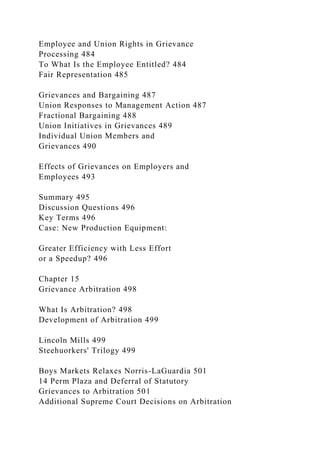
Table of Contents
About the Author iii
Preface v
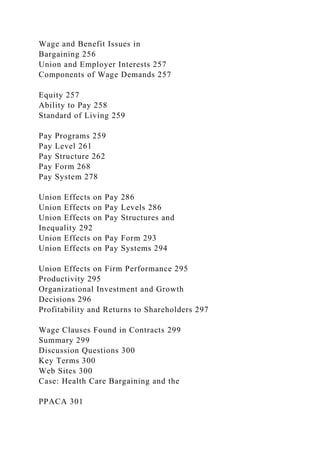
Chapter 1
Introduction 1
Contemporary Labor Relations 4
What Unions Do 5
Collective Behavior 7
Group Cohesiveness 7
Class Consciousness 7
External Threat 8
Why Workers Unionize 9
Catalyst for Organization 9
Individuals and Union Organizing 10
Beliefs about Unions 13
Willingness to Vote for Union
Representation 14
The Local Community 16
Union Member Beliefs 16
Unions, Their Members, and Decision
Making 1.6
Labor Unions in the "New Normal" 17
Why Has the Labor Movement Been in
Decline? 18
Transformation in Industrial Relations Systems 20
What Should Unions Do? 22
Summary and Preview 23
Plan of the Book 24
Key Terms 26
Selected Web Sites 26
Chapter 2
The Evolution of American Labor 27
Union Philosophies and Types in the United
States 28
Early Unions and the Conspiracy Doctrine 29
Philadelphia Cordwainers 29
Commonwealth v. Hunt 29
Pre-Civil War Unions 30
The Birth of National Unions 31
. The National Labor Union 31
The Knights of Labor 32
The American Federation of Labor 33
Labor Unrest 34
The Industrial Workers of the World and the
Western Federation of Miners 36
The Boycott Cases 39
Early Legislation 40
Trade Union Success and Apathy 40
World War I 40
The American Plan 41
The End of an Era 42
Industrial Unions 42
The Industrial Union Leadership 42
Organizing the Industrial Workforce 43
Legislation 44
Norris-LaGuardia Act (1932) 45
National Industrial Recovery Act (1933) 45
Wagner Act (National Labor Relations Act,
1935) 45
Employer Intransigence 46
Constitutionality of the Wagner Act 47
Labor Power 48
World War II 50
Reconversion 51
Changing the Balance 51
Taft-Hartley Act 52
The Nezv Production Paradigm 53
Retrenchment and Merger 53
Merger 53
Corruption 54
Landrum-Griffin Act 55
Public Sector Union Growth 55
Federal Executive Orders 55
Civil Service Reform Act 56
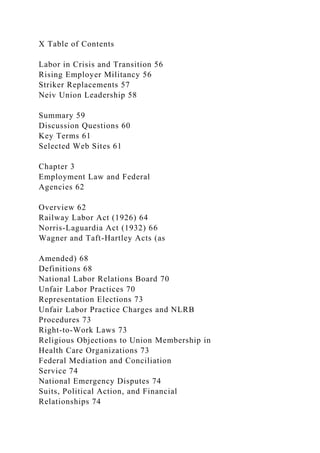
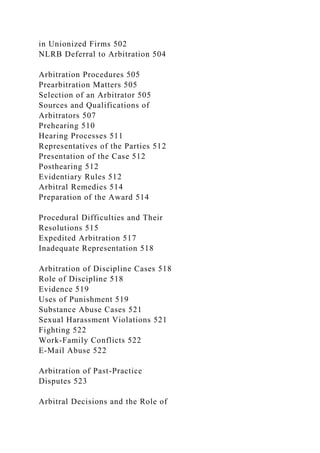
X Table of Contents
Labor in Crisis and Transition 56
Rising Employer Militancy 56
Striker Replacements 57
Neiv Union Leadership 58
Summary 59
Discussion Questions 60
Key Terms 61
Selected Web Sites 61
Chapter 3
Employment Law and Federal
Agencies 62
Overview 62
Railway Labor Act (1926) 64
Norris-Laguardia Act (1932) 66
Wagner and Taft-Hartley Acts (as
Amended) 68
Definitions 68
National Labor Relations Board 70
Unfair Labor Practices 70
Representation Elections 73
Unfair Labor Practice Charges and NLRB
Procedures 73
Right-to-Work Laws 73
Religious Objections to Union Membership in
Health Care Organizations 73
Federal Mediation and Conciliation
Service 74
National Emergency Disputes 74
Suits, Political Action, and Financial
Relationships 74
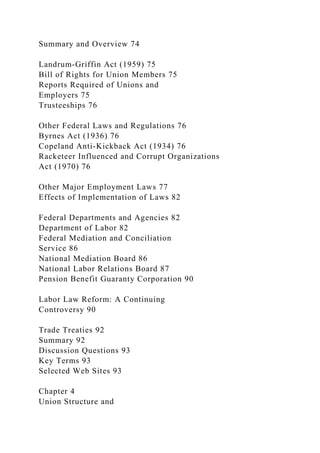
Summary and Overview 74
Landrum-Griffin Act (1959) 75
Bill of Rights for Union Members 75
Reports Required of Unions and
Employers 75
Trusteeships 76
Other Federal Laws and Regulations 76
Byrnes Act (1936) 76
Copeland Anti-Kickback Act (1934) 76
Racketeer Influenced and Corrupt Organizations
Act (1970) 76
Other Major Employment Laws 77
Effects of Implementation of Laws 82
Federal Departments and Agencies 82
Department of Labor 82
Federal Mediation and Conciliation
Service 86
National Mediation Board 86
National Labor Relations Board 87
Pension Benefit Guaranty Corporation 90
Labor Law Reform: A Continuing
Controversy 90
Trade Treaties 92
Summary 92
Discussion Questions 93
Key Terms 93
Selected Web Sites 93
Chapter 4
Union Structure and
Government 94
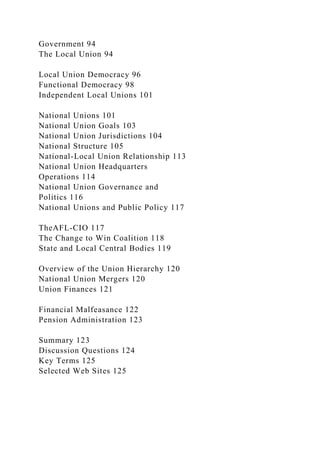
The Local Union 94
Local Union Democracy 96
Functional Democracy 98
Independent Local Unions 101
National Unions 101
National Union Goals 103
National Union Jurisdictions 104
National Structure 105
National-Local Union Relationship 113
National Union Headquarters
Operations 114
National Union Governance and
Politics 116
National Unions and Public Policy 117
TheAFL-CIO 117
The Change to Win Coalition 118
State and Local Central Bodies 119
Overview of the Union Hierarchy 120
National Union Mergers 120
Union Finances 121
Financial Malfeasance 122
Pension Administration 123
Summary 123
Discussion Questions 124
Key Terms 125
Selected Web Sites 125
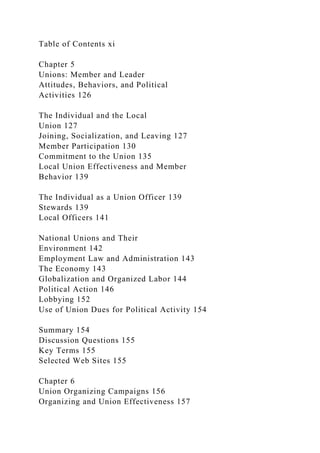
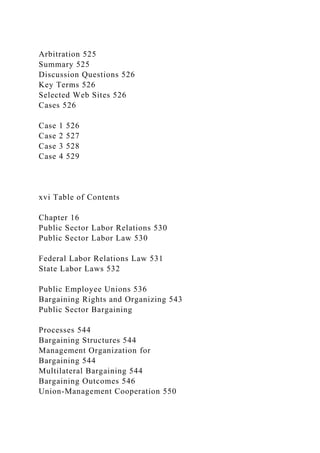
Table of Contents xi
Chapter 5
Unions: Member and Leader
Attitudes, Behaviors, and Political
Activities 126
The Individual and the Local
Union 127
Joining, Socialization, and Leaving 127
Member Participation 130
Commitment to the Union 135
Local Union Effectiveness and Member
Behavior 139
The Individual as a Union Officer 139
Stewards 139
Local Officers 141
National Unions and Their
Environment 142
Employment Law and Administration 143
The Economy 143
Globalization and Organized Labor 144
Political Action 146
Lobbying 152
Use of Union Dues for Political Activity 154
Summary 154
Discussion Questions 155
Key Terms 155
Selected Web Sites 155
Chapter 6
Union Organizing Campaigns 156
Organizing and Union Effectiveness 157
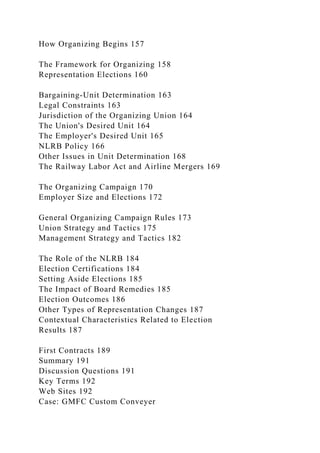
How Organizing Begins 157
The Framework for Organizing 158
Representation Elections 160
Bargaining-Unit Determination 163
Legal Constraints 163
Jurisdiction of the Organizing Union 164
The Union's Desired Unit 164
The Employer's Desired Unit 165
NLRB Policy 166
Other Issues in Unit Determination 168
The Railway Labor Act and Airline Mergers 169
The Organizing Campaign 170
Employer Size and Elections 172
General Organizing Campaign Rules 173
Union Strategy and Tactics 175
Management Strategy and Tactics 182
The Role of the NLRB 184
Election Certifications 184
Setting Aside Elections 185
The Impact of Board Remedies 185
Election Outcomes 186
Other Types of Representation Changes 187
Contextual Characteristics Related to Election
Results 187
First Contracts 189
Summary 191
Discussion Questions 191
Key Terms 192
Web Sites 192
Case: GMFC Custom Conveyer
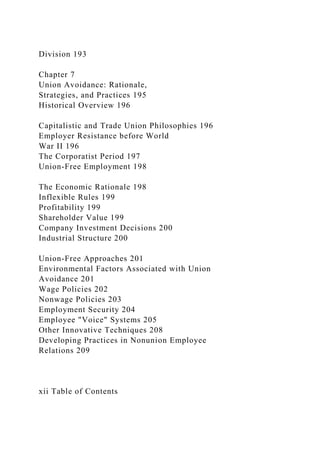
Division 193
Chapter 7
Union Avoidance: Rationale,
Strategies, and Practices 195
Historical Overview 196
Capitalistic and Trade Union Philosophies 196
Employer Resistance before World
War II 196
The Corporatist Period 197
Union-Free Employment 198
The Economic Rationale 198
Inflexible Rules 199
Profitability 199
Shareholder Value 199
Company Investment Decisions 200
Industrial Structure 200
Union-Free Approaches 201
Environmental Factors Associated with Union
Avoidance 201
Wage Policies 202
Nonwage Policies 203
Employment Security 204
Employee "Voice" Systems 205
Other Innovative Techniques 208
Developing Practices in Nonunion Employee
Relations 209
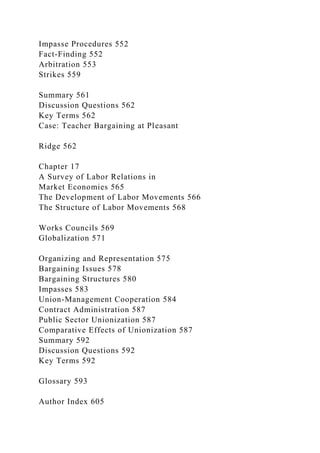
xii Table of Contents
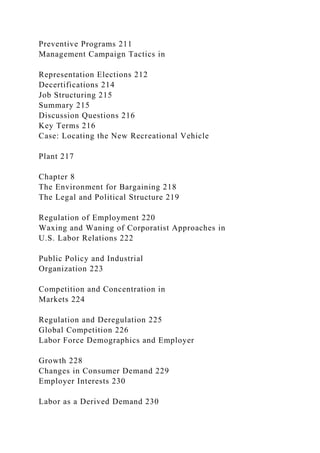
Preventive Programs 211
Management Campaign Tactics in
Representation Elections 212
Decertifications 214
Job Structuring 215
Summary 215
Discussion Questions 216
Key Terms 216
Case: Locating the New Recreational Vehicle
Plant 217
Chapter 8
The Environment for Bargaining 218
The Legal and Political Structure 219
Regulation of Employment 220
Waxing and Waning of Corporatist Approaches in
U.S. Labor Relations 222
Public Policy and Industrial
Organization 223
Competition and Concentration in
Markets 224
Regulation and Deregulation 225
Global Competition 226
Labor Force Demographics and Employer
Growth 228
Changes in Consumer Demand 229
Employer Interests 230
Labor as a Derived Demand 230
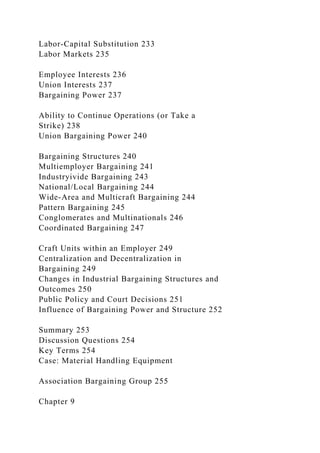
Labor-Capital Substitution 233
Labor Markets 235
Employee Interests 236
Union Interests 237
Bargaining Power 237
Ability to Continue Operations (or Take a
Strike) 238
Union Bargaining Power 240
Bargaining Structures 240
Multiemployer Bargaining 241
Industryivide Bargaining 243
National/Local Bargaining 244
Wide-Area and Multicraft Bargaining 244
Pattern Bargaining 245
Conglomerates and Multinationals 246
Coordinated Bargaining 247
Craft Units within an Employer 249
Centralization and Decentralization in
Bargaining 249
Changes in Industrial Bargaining Structures and
Outcomes 250
Public Policy and Court Decisions 251
Influence of Bargaining Power and Structure 252
Summary 253
Discussion Questions 254
Key Terms 254
Case: Material Handling Equipment
Association Bargaining Group 255
Chapter 9
Wage and Benefit Issues in
Bargaining 256
Union and Employer Interests 257
Components of Wage Demands 257
Equity 257
Ability to Pay 258
Standard of Living 259
Pay Programs 259
Pay Level 261
Pay Structure 262
Pay Form 268
Pay System 278
Union Effects on Pay 286
Union Effects on Pay Levels 286
Union Effects on Pay Structures and
Inequality 292
Union Effects on Pay Form 293
Union Effects on Pay Systems 294
Union Effects on Firm Performance 295
Productivity 295
Organizational Investment and Growth
Decisions 296
Profitability and Returns to Shareholders 297
Wage Clauses Found in Contracts 299
Summary 299
Discussion Questions 300
Key Terms 300
Web Sites 300
Case: Health Care Bargaining and the
PPACA 301
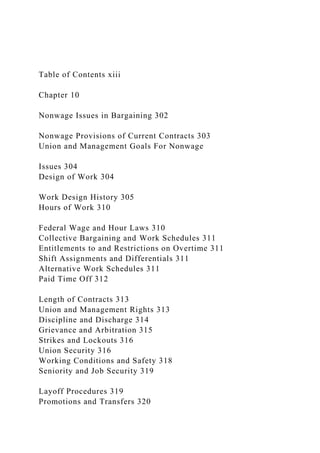
Table of Contents xiii
Chapter 10
Nonwage Issues in Bargaining 302
Nonwage Provisions of Current Contracts 303
Union and Management Goals For Nonwage
Issues 304
Design of Work 304
Work Design History 305
Hours of Work 310
Federal Wage and Hour Laws 310
Collective Bargaining and Work Schedules 311
Entitlements to and Restrictions on Overtime 311
Shift Assignments and Differentials 311
Alternative Work Schedules 311
Paid Time Off 312
Length of Contracts 313
Union and Management Rights 313
Discipline and Discharge 314
Grievance and Arbitration 315
Strikes and Lockouts 316
Union Security 316
Working Conditions and Safety 318
Seniority and Job Security 319
Layoff Procedures 319
Promotions and Transfers 320
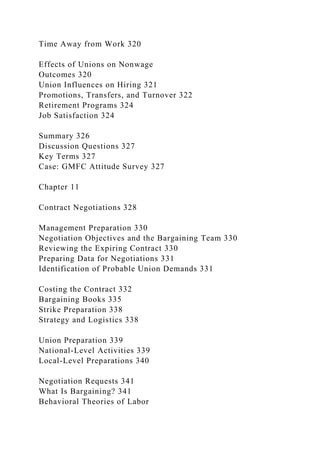
Time Away from Work 320
Effects of Unions on Nonwage
Outcomes 320
Union Influences on Hiring 321
Promotions, Transfers, and Turnover 322
Retirement Programs 324
Job Satisfaction 324
Summary 326
Discussion Questions 327
Key Terms 327
Case: GMFC Attitude Survey 327
Chapter 11
Contract Negotiations 328
Management Preparation 330
Negotiation Objectives and the Bargaining Team 330
Reviewing the Expiring Contract 330
Preparing Data for Negotiations 331
Identification of Probable Union Demands 331
Costing the Contract 332
Bargaining Books 335
Strike Preparation 338
Strategy and Logistics 338
Union Preparation 339
National-Level Activities 339
Local-Level Preparations 340
Negotiation Requests 341
What Is Bargaining? 341
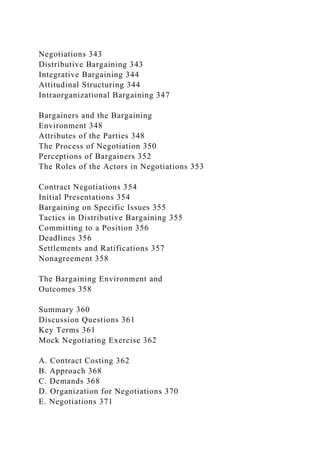
Behavioral Theories of Labor
Negotiations 343
Distributive Bargaining 343
Integrative Bargaining 344
Attitudinal Structuring 344
Intraorganizational Bargaining 347
Bargainers and the Bargaining
Environment 348
Attributes of the Parties 348
The Process of Negotiation 350
Perceptions of Bargainers 352
The Roles of the Actors in Negotiations 353
Contract Negotiations 354
Initial Presentations 354
Bargaining on Specific Issues 355
Tactics in Distributive Bargaining 355
Committing to a Position 356
Deadlines 356
Settlements and Ratifications 357
Nonagreement 358
The Bargaining Environment and
Outcomes 358
Summary 360
Discussion Questions 361
Key Terms 361
Mock Negotiating Exercise 362
A. Contract Costing 362
B. Approach 368
C. Demands 368
D. Organization for Negotiations 370
E. Negotiations 371
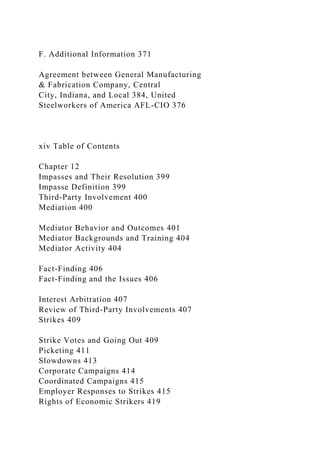
F. Additional Information 371
Agreement between General Manufacturing
& Fabrication Company, Central
City, Indiana, and Local 384, United
Steelworkers of America AFL-CIO 376
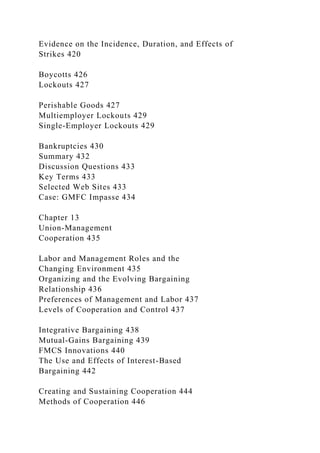
xiv Table of Contents
Chapter 12
Impasses and Their Resolution 399
Impasse Definition 399
Third-Party Involvement 400
Mediation 400
Mediator Behavior and Outcomes 401
Mediator Backgrounds and Training 404
Mediator Activity 404
Fact-Finding 406
Fact-Finding and the Issues 406
Interest Arbitration 407
Review of Third-Party Involvements 407
Strikes 409
Strike Votes and Going Out 409
Picketing 411
Slowdowns 413
Corporate Campaigns 414
Coordinated Campaigns 415
Employer Responses to Strikes 415
Rights of Economic Strikers 419
Evidence on the Incidence, Duration, and Effects of
Strikes 420
Boycotts 426
Lockouts 427
Perishable Goods 427
Multiemployer Lockouts 429
Single-Employer Lockouts 429
Bankruptcies 430
Summary 432
Discussion Questions 433
Key Terms 433
Selected Web Sites 433
Case: GMFC Impasse 434
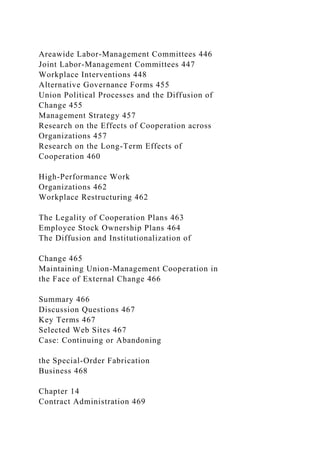
Chapter 13
Union-Management
Cooperation 435
Labor and Management Roles and the
Changing Environment 435
Organizing and the Evolving Bargaining
Relationship 436
Preferences of Management and Labor 437
Levels of Cooperation and Control 437
Integrative Bargaining 438
Mutual-Gains Bargaining 439
FMCS Innovations 440
The Use and Effects of Interest-Based
Bargaining 442
Creating and Sustaining Cooperation 444
Methods of Cooperation 446
Areawide Labor-Management Committees 446
Joint Labor-Management Committees 447
Workplace Interventions 448
Alternative Governance Forms 455
Union Political Processes and the Diffusion of
Change 455
Management Strategy 457
Research on the Effects of Cooperation across
Organizations 457
Research on the Long-Term Effects of
Cooperation 460
High-Performance Work
Organizations 462
Workplace Restructuring 462
The Legality of Cooperation Plans 463
Employee Stock Ownership Plans 464
The Diffusion and Institutionalization of
Change 465
Maintaining Union-Management Cooperation in
the Face of External Change 466
Summary 466
Discussion Questions 467
Key Terms 467
Selected Web Sites 467
Case: Continuing or Abandoning
the Special-Order Fabrication
Business 468
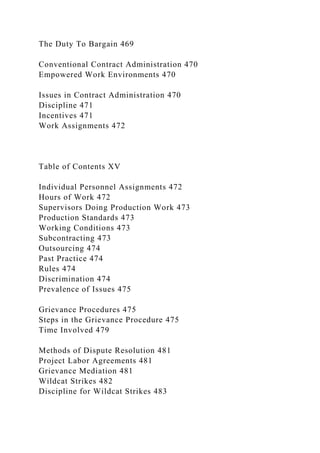
Chapter 14
Contract Administration 469
The Duty To Bargain 469
Conventional Contract Administration 470
Empowered Work Environments 470
Issues in Contract Administration 470
Discipline 471
Incentives 471
Work Assignments 472
Table of Contents XV
Individual Personnel Assignments 472
Hours of Work 472
Supervisors Doing Production Work 473
Production Standards 473
Working Conditions 473
Subcontracting 473
Outsourcing 474
Past Practice 474
Rules 474
Discrimination 474
Prevalence of Issues 475
Grievance Procedures 475
Steps in the Grievance Procedure 475
Time Involved 479
Methods of Dispute Resolution 481
Project Labor Agreements 481
Grievance Mediation 481
Wildcat Strikes 482
Discipline for Wildcat Strikes 483
Employee and Union Rights in Grievance
Processing 484
To What Is the Employee Entitled? 484
Fair Representation 485
Grievances and Bargaining 487
Union Responses to Management Action 487
Fractional Bargaining 488
Union Initiatives in Grievances 489
Individual Union Members and
Grievances 490
Effects of Grievances on Employers and
Employees 493
Summary 495
Discussion Questions 496
Key Terms 496
Case: New Production Equipment:
Greater Efficiency with Less Effort
or a Speedup? 496
Chapter 15
Grievance Arbitration 498
What Is Arbitration? 498
Development of Arbitration 499
Lincoln Mills 499
Steehuorkers' Trilogy 499
Boys Markets Relaxes Norris-LaGuardia 501
14 Perm Plaza and Deferral of Statutory
Grievances to Arbitration 501
Additional Supreme Court Decisions on Arbitration
in Unionized Firms 502
NLRB Deferral to Arbitration 504
Arbitration Procedures 505
Prearbitration Matters 505
Selection of an Arbitrator 505
Sources and Qualifications of
Arbitrators 507
Prehearing 510
Hearing Processes 511
Representatives of the Parties 512
Presentation of the Case 512
Posthearing 512
Evidentiary Rules 512
Arbitral Remedies 514
Preparation of the Award 514
Procedural Difficulties and Their
Resolutions 515
Expedited Arbitration 517
Inadequate Representation 518
Arbitration of Discipline Cases 518
Role of Discipline 518
Evidence 519
Uses of Punishment 519
Substance Abuse Cases 521
Sexual Harassment Violations 521
Fighting 522
Work-Family Conflicts 522
E-Mail Abuse 522
Arbitration of Past-Practice
Disputes 523
Arbitral Decisions and the Role of
Arbitration 525
Summary 525
Discussion Questions 526
Key Terms 526
Selected Web Sites 526
Cases 526
Case 1 526
Case 2 527
Case 3 528
Case 4 529
xvi Table of Contents
Chapter 16
Public Sector Labor Relations 530
Public Sector Labor Law 530
Federal Labor Relations Law 531
State Labor Laws 532
Public Employee Unions 536
Bargaining Rights and Organizing 543
Public Sector Bargaining
Processes 544
Bargaining Structures 544
Management Organization for
Bargaining 544
Multilateral Bargaining 544
Bargaining Outcomes 546
Union-Management Cooperation 550
Impasse Procedures 552
Fact-Finding 552
Arbitration 553
Strikes 559
Summary 561
Discussion Questions 562
Key Terms 562
Case: Teacher Bargaining at Pleasant
Ridge 562
Chapter 17
A Survey of Labor Relations in
Market Economies 565
The Development of Labor Movements 566
The Structure of Labor Movements 568
Works Councils 569
Globalization 571
Organizing and Representation 575
Bargaining Issues 578
Bargaining Structures 580
Impasses 583
Union-Management Cooperation 584
Contract Administration 587
Public Sector Unionization 587
Comparative Effects of Unionization 587
Summary 592
Discussion Questions 592
Key Terms 592
Glossary 593
Author Index 605
Subject Index 611
Running Head: Project Deliverable 1: Project Plan Inception
Project Deliverable 1: Project Plan Inception
8
Project Deliverable 1: Project Plan Inception
Regina Hardaway
Dr. Robert culver
CIS 590
October 19, 2014
Section 1: Project Introduction
Background Information of the Company
Just like Flickr, Wikimedia, Snapchat, Pinterest, etc. Fitz_U too
was formed on the basis of interaction. The innovative internet-
based company has transformed since its inception in 2006.
Barely two years after the dawn of website usage in the world,
Fitz_U was started as a blogging site as well as a social
network. Despite competition from Google, Facebook, Twitter,
and MySpace, Fitz_U was rated the fastest growing website
within its first three months of operation. In those three months,
it had attained 4 million users compared to 2.5 million, 2.8
million, 3 million, and 3.5 million users of Twitter, MySpace,
Google, and Facebook respectively. This was contributed by
opening websites to everyone above the age of 14. The
introduction of smart phones in 2007 enabled many people to
access the network across the United States and around the
world, doubling the number of website users. By this time
Fitz_U had grown to 189 million users annually with over 10
million web pages translating to over 100 million daily queries,
750 million images, and 890 million messages. Due to its high
market potential, Fitz_U was approached by its competitors for
a merger but declined in 2009. By 2011, the company had
grown to host millions of websites that were now used by over
400 million users, and currently stands at 500 million users with
over 900 million web pages. As a result, Fitz_U has attained a
$35 million gross revenue.
Type of Business Activities that Fitz_U is involved in
Like all the other Social Media sites, Fitz_U’s business
includes:
· Website development – since it was started as a blogging site
as well as a social network operator, Fitz_U is actively involved
in the creation of new websites that attracts more and more
people to it. Through these websites, the company is able to
create an interactive platform for its users.
· Advertising – Fitz_U is involved in business agreements with
other types of businesses that give it content to air in their
websites for its users to see. Through this, the company is
actively helping out other businesses to showcase their
products.
· Provision of internet service – in order to run website
applications, every internet-based company must be in a
position to provide the kind of service that will facilitate web
application. As a result of this, Fitz_U is involved in the
provision of internet services to its users to enable it run its
operations for the benefit of its users.
Speculation on outsourcing and offshoring opportunities
The term off shoring is used to refer to a process where multi-
national companies employ the service of low wage workers in
low wage countries. As a result of this, the company sends jobs
to these countries as a way of saving on their expenses and tries
to make or recover profit.
Outsourcing is used to refer to a process where the government
employs the services of low wage workers in low wage
countries. By so doing, the government gives out contracts to
countries that will manage to work on the same job at a lower
cost than using its national employees who charge higher. Just
like every other company in the market, Fitz_U has not been an
exception. In order to stand a chance of maintaining its bottom
line, the company has been forced to offshore some of its jobs
to low wage countries. This has led to the reduction of number
of employees from 75 to the current 25 employees.
Fitz_U’s Current Information System
Operating System
The operating system is the central unit of every internet-based
company. Through this unit, the company stands in a position to
serve all of its users without failing a single command. Because
of this, every internet-based company must ensure that it invests
heavily on the required up-to-date technological components
that will facilitate its operations. This includes networking
hardware’s as well as software’s that will facilitate network
connections.
The purpose of an operating system is to coordinate access
application by the computer. It contains;
· Search – despite the fact that not all internet-based companies
have established their own web search due to the complexity
involved in their creation, many have left this capability to the
two existing leaders in the market Microsoft and Google. Fitz_U
and the rest of the eight most successful internet-based
companies share in the platform that allows for search engine
sharing.
· Media Access – as an internet-based company, Fitz_U is
mandated to give its users access to the various types of media.
These medias include e-books, web pages, presentations,
downloadable applications that only work if the operating
system has an infrastructure of common technology than just the
search engine. These include; access control, analytics and
instrumentation, and caching.
· Communication – Fitz_U has been in the position that has
enabled it to witness the growth of internet communication from
simple emailing and chatting to video and audio
communication.
· Social Graph and identity – it is well known that every
internet-based company that provides communication as a social
network system must have its own content of social data. This
gives the company a social graph that enables it to evaluate its
stand in the competitive market.
· Payment – the reason that Fitz_U stands at a position of
making $35 million dollars on a yearly basis has been made
possible by the millions of credit cards used to pay for the
songs, e-books, applications, and videos they purchase on the
company’s websites.
· Advertising – the availability of e-commerce in social media
has been facilitated by the use of advertising that Fitz_U plays
to its users. Through this, users are able to purchase what they
need via the internet.
· Time – the constant need to look for dates and time have
triggered the reason why many internet-based companies have
created applications that enables users to know where and when
certain events will take place.
· Government Data – the government has played a major
supplier of information to websites. Internet applications that
show information on GPS position, weather, satellite images,
etc. have all been made possible by the supply that the
government makes to internet-based companies like Fitz_U.
Database
Fitz_U has a strong database that allows it to provide
exceptional communication for its users. Through this database,
the company is able to keep track of data it receives from its
users. Upon receiving, it accesses then classifies every data
according to efficiency.
Data Warehousing
Manhanti states, “Data warehousing is a significant component
in corporate computing, since it provides managers with the
most accurate and relevant information to improve strategic
decisions”. This is a form of back-up database that is designed
to inquire and analyze data received compared to processing
transactions. In this database, historical data received is stored;
in addition, storage of information that contains other sources
can be stored here as well. In Fitz_U, data warehousing is used
as an analysis separator that distinguishes work-load and allows
the company to stand a chance to merge its data with those of
other sources. Its usefulness is found in data extraction,
transformation, transportation, loading solutions, and analyzing
client tools (Awoyelu, I., Omodunbi, T., & Udo, J., 2014).
Cloud Technology and Virtualization
Cloud computing is a service, while virtualization is part of a
physical infrastructure.
Cloud technology is a term used by internet-based companies to
refer to a big group of parent servers that allow for storage of
centralized data as well as access of online services rendered to
computers (Rajaraman, 2014, p. 242). Most people have been
using cloud computing services without even knowing it.
Whenever you send an email using Gmail, Yahoo mail, or
Hotmail, you are using the email software running on the
computer infrastructure provided by Google, Yahoo, or
Microsoft. These are ‘free’ cloud software services. Cloud
technology shifts the location of this infrastructure to the
network to reduce the costs associated with the management of
hardware and software resources. It is mainly classified into
two namely private (hybrid) and public.
Virtualization is a term that is used to refer to technological
advancement that allows for one serve to operate various
computing environments individually. Virtualization is a key
enabler of the cloud infrastructure. It is the single most
effective way to reduce IT expenses while boosting efficiency
and agility (Daly, 2012). It allows Fitz_U to run multiple
operating systems and applications on a single computer,
consolidate hardware to get vastly higher productivity from
fewer servers, save 50 percent or more on overall IT costs, and
speed up and simplify IT management, maintenance, and the
deployment of new applications.
Network Infrastructure and Security
Engaging in good practices with respect to network
infrastructure is an important component of ensuring that
potential threats to the overall Fitz_U infrastructure and
security are managed effectively. The company has
implemented Security Policies that follows the National
Institute of Standards and Technology (NIST) security and
privacy in Public Cloud Computing guide and the Internet
Engineering Task Force (IETF) security architecture.
References
Mahanti, R. (2014). Application of quality tools to data
warehousing projects. Software Quality Professional, 16(4), 26-
35. Retrieved from
http://proxying.lib.ncsu.edu/index.php?url=/docview/156270889
0?accountid=12725
Awoyelu, I., Omodunbi, T., & Udo, J. (2014). Bridging the gap
in modern computing infrastructures: Issues and challenges of
data warehousing and cloud computing. Computer and
Information Science, 7(1), 33-40. Retrieved from
http://proxying.lib.ncsu.edu/index.php?url=/docview/149990835
4?accountid=12725
Rajaraman, V. (2014). Cloud Computing. Resonance, 19(3),
242-258. doi:10.1007/s12045-014-0030-1
Daly, J. (2012) What is virtualization? demystifying and
categorizing one of IT’s most confusing terms. EdTech.
Retrieved from
http://www.edtechmagazine.com/higher/article/2012/10/what-
virtualization

Business RequirementsReference number Document Control.docx

  • 1.
    Business Requirements Reference number: DocumentControl Change Record Date Author Version Change Reference Reviewers Name Position
  • 2.
    Table of Contents 2DocumentControl 1 Business Requirements 4 1.1 Project Overview 4 1.2 Background including current process 4 1.3 Scope 4 1.3.1 Scope of Project 4 1.3.2 Constraints and Assumptions 5 1.3.3 Risks 5 1.3.4 Scope Control 5 1.3.5 Relationship to Other Systems/Projects
  • 3.
    5 1.3.6 Definition of Terms(if applicable) 5 1 Business Requirements 1.1 Project Overview Provide a short, yet complete, overview of the project. 1.2 Background including current process Describe the background to the project, (same section may be reused in the Quality Plan) include: This project is The project goal is to The IT role for this project is 1.3 Scope 1.3.1 Scope of Project The scope of this project includes a number of areas. For each area, there should be a corresponding strategy for incorporating these areas into the overall project. Applications In order to meet the target production date, only these applications will be implemented: Sites These sites are considered part of the implementation: Process Re-engineering Re-engineering will
  • 4.
    Customization Customizations will belimited to Interfaces the interfaces included are: Architecture Application and Technical Architecture will Conversion Only the following data and volume will be considered for conversion: Testing Testing will include only Funding Project funding is limited to Training Training will be Education Education will include 1.3.2 Constraints and Assumptions The following constraints have been identified: The following assumptions have been made in defining the scope, objectives and approach: 1.3.3 Risks The following risks have been identified as possibly affecting
  • 5.
    the project duringits progression: 1.3.4 Scope Control The control of changes to the scope identified in this document will be managed through the Change Control, with business owner representative approval for any changes that affect cost or timeline for the project. 1.3.5 Relationship to Other Systems/Projects It is the responsibility of the business unit to inform IT of other business initiatives that may impact the project. The following are known business initiatives: 1.3.6 Definition of Terms (if applicable) List any definitions that will be used throughout the duration of the project. 4 Labor Relations Development, Structure, Process Eleventh Edition John A. Fossum Center for Human Resources and Labor Studies Carlson School of Management
  • 6.
    University of Minnesota Tableof Contents About the Author iii Preface v Chapter 1 Introduction 1 Contemporary Labor Relations 4 What Unions Do 5 Collective Behavior 7 Group Cohesiveness 7 Class Consciousness 7 External Threat 8 Why Workers Unionize 9 Catalyst for Organization 9 Individuals and Union Organizing 10 Beliefs about Unions 13 Willingness to Vote for Union Representation 14 The Local Community 16 Union Member Beliefs 16 Unions, Their Members, and Decision Making 1.6 Labor Unions in the "New Normal" 17
  • 7.
    Why Has theLabor Movement Been in Decline? 18 Transformation in Industrial Relations Systems 20 What Should Unions Do? 22 Summary and Preview 23 Plan of the Book 24 Key Terms 26 Selected Web Sites 26 Chapter 2 The Evolution of American Labor 27 Union Philosophies and Types in the United States 28 Early Unions and the Conspiracy Doctrine 29 Philadelphia Cordwainers 29 Commonwealth v. Hunt 29 Pre-Civil War Unions 30 The Birth of National Unions 31 . The National Labor Union 31 The Knights of Labor 32 The American Federation of Labor 33 Labor Unrest 34 The Industrial Workers of the World and the Western Federation of Miners 36 The Boycott Cases 39 Early Legislation 40 Trade Union Success and Apathy 40
  • 8.
    World War I40 The American Plan 41 The End of an Era 42 Industrial Unions 42 The Industrial Union Leadership 42 Organizing the Industrial Workforce 43 Legislation 44 Norris-LaGuardia Act (1932) 45 National Industrial Recovery Act (1933) 45 Wagner Act (National Labor Relations Act, 1935) 45 Employer Intransigence 46 Constitutionality of the Wagner Act 47 Labor Power 48 World War II 50 Reconversion 51 Changing the Balance 51 Taft-Hartley Act 52 The Nezv Production Paradigm 53 Retrenchment and Merger 53 Merger 53 Corruption 54 Landrum-Griffin Act 55 Public Sector Union Growth 55 Federal Executive Orders 55 Civil Service Reform Act 56
  • 9.
    X Table ofContents Labor in Crisis and Transition 56 Rising Employer Militancy 56 Striker Replacements 57 Neiv Union Leadership 58 Summary 59 Discussion Questions 60 Key Terms 61 Selected Web Sites 61 Chapter 3 Employment Law and Federal Agencies 62 Overview 62 Railway Labor Act (1926) 64 Norris-Laguardia Act (1932) 66 Wagner and Taft-Hartley Acts (as Amended) 68 Definitions 68 National Labor Relations Board 70 Unfair Labor Practices 70 Representation Elections 73 Unfair Labor Practice Charges and NLRB Procedures 73 Right-to-Work Laws 73 Religious Objections to Union Membership in Health Care Organizations 73 Federal Mediation and Conciliation Service 74 National Emergency Disputes 74 Suits, Political Action, and Financial Relationships 74
  • 10.
    Summary and Overview74 Landrum-Griffin Act (1959) 75 Bill of Rights for Union Members 75 Reports Required of Unions and Employers 75 Trusteeships 76 Other Federal Laws and Regulations 76 Byrnes Act (1936) 76 Copeland Anti-Kickback Act (1934) 76 Racketeer Influenced and Corrupt Organizations Act (1970) 76 Other Major Employment Laws 77 Effects of Implementation of Laws 82 Federal Departments and Agencies 82 Department of Labor 82 Federal Mediation and Conciliation Service 86 National Mediation Board 86 National Labor Relations Board 87 Pension Benefit Guaranty Corporation 90 Labor Law Reform: A Continuing Controversy 90 Trade Treaties 92 Summary 92 Discussion Questions 93 Key Terms 93 Selected Web Sites 93 Chapter 4 Union Structure and
  • 11.
    Government 94 The LocalUnion 94 Local Union Democracy 96 Functional Democracy 98 Independent Local Unions 101 National Unions 101 National Union Goals 103 National Union Jurisdictions 104 National Structure 105 National-Local Union Relationship 113 National Union Headquarters Operations 114 National Union Governance and Politics 116 National Unions and Public Policy 117 TheAFL-CIO 117 The Change to Win Coalition 118 State and Local Central Bodies 119 Overview of the Union Hierarchy 120 National Union Mergers 120 Union Finances 121 Financial Malfeasance 122 Pension Administration 123 Summary 123 Discussion Questions 124 Key Terms 125 Selected Web Sites 125
  • 12.
    Table of Contentsxi Chapter 5 Unions: Member and Leader Attitudes, Behaviors, and Political Activities 126 The Individual and the Local Union 127 Joining, Socialization, and Leaving 127 Member Participation 130 Commitment to the Union 135 Local Union Effectiveness and Member Behavior 139 The Individual as a Union Officer 139 Stewards 139 Local Officers 141 National Unions and Their Environment 142 Employment Law and Administration 143 The Economy 143 Globalization and Organized Labor 144 Political Action 146 Lobbying 152 Use of Union Dues for Political Activity 154 Summary 154 Discussion Questions 155 Key Terms 155 Selected Web Sites 155 Chapter 6 Union Organizing Campaigns 156 Organizing and Union Effectiveness 157
  • 13.
    How Organizing Begins157 The Framework for Organizing 158 Representation Elections 160 Bargaining-Unit Determination 163 Legal Constraints 163 Jurisdiction of the Organizing Union 164 The Union's Desired Unit 164 The Employer's Desired Unit 165 NLRB Policy 166 Other Issues in Unit Determination 168 The Railway Labor Act and Airline Mergers 169 The Organizing Campaign 170 Employer Size and Elections 172 General Organizing Campaign Rules 173 Union Strategy and Tactics 175 Management Strategy and Tactics 182 The Role of the NLRB 184 Election Certifications 184 Setting Aside Elections 185 The Impact of Board Remedies 185 Election Outcomes 186 Other Types of Representation Changes 187 Contextual Characteristics Related to Election Results 187 First Contracts 189 Summary 191 Discussion Questions 191 Key Terms 192 Web Sites 192 Case: GMFC Custom Conveyer
  • 14.
    Division 193 Chapter 7 UnionAvoidance: Rationale, Strategies, and Practices 195 Historical Overview 196 Capitalistic and Trade Union Philosophies 196 Employer Resistance before World War II 196 The Corporatist Period 197 Union-Free Employment 198 The Economic Rationale 198 Inflexible Rules 199 Profitability 199 Shareholder Value 199 Company Investment Decisions 200 Industrial Structure 200 Union-Free Approaches 201 Environmental Factors Associated with Union Avoidance 201 Wage Policies 202 Nonwage Policies 203 Employment Security 204 Employee "Voice" Systems 205 Other Innovative Techniques 208 Developing Practices in Nonunion Employee Relations 209 xii Table of Contents
  • 15.
    Preventive Programs 211 ManagementCampaign Tactics in Representation Elections 212 Decertifications 214 Job Structuring 215 Summary 215 Discussion Questions 216 Key Terms 216 Case: Locating the New Recreational Vehicle Plant 217 Chapter 8 The Environment for Bargaining 218 The Legal and Political Structure 219 Regulation of Employment 220 Waxing and Waning of Corporatist Approaches in U.S. Labor Relations 222 Public Policy and Industrial Organization 223 Competition and Concentration in Markets 224 Regulation and Deregulation 225 Global Competition 226 Labor Force Demographics and Employer Growth 228 Changes in Consumer Demand 229 Employer Interests 230 Labor as a Derived Demand 230
  • 16.
    Labor-Capital Substitution 233 LaborMarkets 235 Employee Interests 236 Union Interests 237 Bargaining Power 237 Ability to Continue Operations (or Take a Strike) 238 Union Bargaining Power 240 Bargaining Structures 240 Multiemployer Bargaining 241 Industryivide Bargaining 243 National/Local Bargaining 244 Wide-Area and Multicraft Bargaining 244 Pattern Bargaining 245 Conglomerates and Multinationals 246 Coordinated Bargaining 247 Craft Units within an Employer 249 Centralization and Decentralization in Bargaining 249 Changes in Industrial Bargaining Structures and Outcomes 250 Public Policy and Court Decisions 251 Influence of Bargaining Power and Structure 252 Summary 253 Discussion Questions 254 Key Terms 254 Case: Material Handling Equipment Association Bargaining Group 255 Chapter 9
  • 17.
    Wage and BenefitIssues in Bargaining 256 Union and Employer Interests 257 Components of Wage Demands 257 Equity 257 Ability to Pay 258 Standard of Living 259 Pay Programs 259 Pay Level 261 Pay Structure 262 Pay Form 268 Pay System 278 Union Effects on Pay 286 Union Effects on Pay Levels 286 Union Effects on Pay Structures and Inequality 292 Union Effects on Pay Form 293 Union Effects on Pay Systems 294 Union Effects on Firm Performance 295 Productivity 295 Organizational Investment and Growth Decisions 296 Profitability and Returns to Shareholders 297 Wage Clauses Found in Contracts 299 Summary 299 Discussion Questions 300 Key Terms 300 Web Sites 300 Case: Health Care Bargaining and the PPACA 301
  • 18.
    Table of Contentsxiii Chapter 10 Nonwage Issues in Bargaining 302 Nonwage Provisions of Current Contracts 303 Union and Management Goals For Nonwage Issues 304 Design of Work 304 Work Design History 305 Hours of Work 310 Federal Wage and Hour Laws 310 Collective Bargaining and Work Schedules 311 Entitlements to and Restrictions on Overtime 311 Shift Assignments and Differentials 311 Alternative Work Schedules 311 Paid Time Off 312 Length of Contracts 313 Union and Management Rights 313 Discipline and Discharge 314 Grievance and Arbitration 315 Strikes and Lockouts 316 Union Security 316 Working Conditions and Safety 318 Seniority and Job Security 319 Layoff Procedures 319 Promotions and Transfers 320
  • 19.
    Time Away fromWork 320 Effects of Unions on Nonwage Outcomes 320 Union Influences on Hiring 321 Promotions, Transfers, and Turnover 322 Retirement Programs 324 Job Satisfaction 324 Summary 326 Discussion Questions 327 Key Terms 327 Case: GMFC Attitude Survey 327 Chapter 11 Contract Negotiations 328 Management Preparation 330 Negotiation Objectives and the Bargaining Team 330 Reviewing the Expiring Contract 330 Preparing Data for Negotiations 331 Identification of Probable Union Demands 331 Costing the Contract 332 Bargaining Books 335 Strike Preparation 338 Strategy and Logistics 338 Union Preparation 339 National-Level Activities 339 Local-Level Preparations 340 Negotiation Requests 341 What Is Bargaining? 341 Behavioral Theories of Labor
  • 20.
    Negotiations 343 Distributive Bargaining343 Integrative Bargaining 344 Attitudinal Structuring 344 Intraorganizational Bargaining 347 Bargainers and the Bargaining Environment 348 Attributes of the Parties 348 The Process of Negotiation 350 Perceptions of Bargainers 352 The Roles of the Actors in Negotiations 353 Contract Negotiations 354 Initial Presentations 354 Bargaining on Specific Issues 355 Tactics in Distributive Bargaining 355 Committing to a Position 356 Deadlines 356 Settlements and Ratifications 357 Nonagreement 358 The Bargaining Environment and Outcomes 358 Summary 360 Discussion Questions 361 Key Terms 361 Mock Negotiating Exercise 362 A. Contract Costing 362 B. Approach 368 C. Demands 368 D. Organization for Negotiations 370 E. Negotiations 371
  • 21.
    F. Additional Information371 Agreement between General Manufacturing & Fabrication Company, Central City, Indiana, and Local 384, United Steelworkers of America AFL-CIO 376 xiv Table of Contents Chapter 12 Impasses and Their Resolution 399 Impasse Definition 399 Third-Party Involvement 400 Mediation 400 Mediator Behavior and Outcomes 401 Mediator Backgrounds and Training 404 Mediator Activity 404 Fact-Finding 406 Fact-Finding and the Issues 406 Interest Arbitration 407 Review of Third-Party Involvements 407 Strikes 409 Strike Votes and Going Out 409 Picketing 411 Slowdowns 413 Corporate Campaigns 414 Coordinated Campaigns 415 Employer Responses to Strikes 415 Rights of Economic Strikers 419
  • 22.
    Evidence on theIncidence, Duration, and Effects of Strikes 420 Boycotts 426 Lockouts 427 Perishable Goods 427 Multiemployer Lockouts 429 Single-Employer Lockouts 429 Bankruptcies 430 Summary 432 Discussion Questions 433 Key Terms 433 Selected Web Sites 433 Case: GMFC Impasse 434 Chapter 13 Union-Management Cooperation 435 Labor and Management Roles and the Changing Environment 435 Organizing and the Evolving Bargaining Relationship 436 Preferences of Management and Labor 437 Levels of Cooperation and Control 437 Integrative Bargaining 438 Mutual-Gains Bargaining 439 FMCS Innovations 440 The Use and Effects of Interest-Based Bargaining 442 Creating and Sustaining Cooperation 444 Methods of Cooperation 446
  • 23.
    Areawide Labor-Management Committees446 Joint Labor-Management Committees 447 Workplace Interventions 448 Alternative Governance Forms 455 Union Political Processes and the Diffusion of Change 455 Management Strategy 457 Research on the Effects of Cooperation across Organizations 457 Research on the Long-Term Effects of Cooperation 460 High-Performance Work Organizations 462 Workplace Restructuring 462 The Legality of Cooperation Plans 463 Employee Stock Ownership Plans 464 The Diffusion and Institutionalization of Change 465 Maintaining Union-Management Cooperation in the Face of External Change 466 Summary 466 Discussion Questions 467 Key Terms 467 Selected Web Sites 467 Case: Continuing or Abandoning the Special-Order Fabrication Business 468 Chapter 14 Contract Administration 469
  • 24.
    The Duty ToBargain 469 Conventional Contract Administration 470 Empowered Work Environments 470 Issues in Contract Administration 470 Discipline 471 Incentives 471 Work Assignments 472 Table of Contents XV Individual Personnel Assignments 472 Hours of Work 472 Supervisors Doing Production Work 473 Production Standards 473 Working Conditions 473 Subcontracting 473 Outsourcing 474 Past Practice 474 Rules 474 Discrimination 474 Prevalence of Issues 475 Grievance Procedures 475 Steps in the Grievance Procedure 475 Time Involved 479 Methods of Dispute Resolution 481 Project Labor Agreements 481 Grievance Mediation 481 Wildcat Strikes 482 Discipline for Wildcat Strikes 483
  • 25.
    Employee and UnionRights in Grievance Processing 484 To What Is the Employee Entitled? 484 Fair Representation 485 Grievances and Bargaining 487 Union Responses to Management Action 487 Fractional Bargaining 488 Union Initiatives in Grievances 489 Individual Union Members and Grievances 490 Effects of Grievances on Employers and Employees 493 Summary 495 Discussion Questions 496 Key Terms 496 Case: New Production Equipment: Greater Efficiency with Less Effort or a Speedup? 496 Chapter 15 Grievance Arbitration 498 What Is Arbitration? 498 Development of Arbitration 499 Lincoln Mills 499 Steehuorkers' Trilogy 499 Boys Markets Relaxes Norris-LaGuardia 501 14 Perm Plaza and Deferral of Statutory Grievances to Arbitration 501 Additional Supreme Court Decisions on Arbitration
  • 26.
    in Unionized Firms502 NLRB Deferral to Arbitration 504 Arbitration Procedures 505 Prearbitration Matters 505 Selection of an Arbitrator 505 Sources and Qualifications of Arbitrators 507 Prehearing 510 Hearing Processes 511 Representatives of the Parties 512 Presentation of the Case 512 Posthearing 512 Evidentiary Rules 512 Arbitral Remedies 514 Preparation of the Award 514 Procedural Difficulties and Their Resolutions 515 Expedited Arbitration 517 Inadequate Representation 518 Arbitration of Discipline Cases 518 Role of Discipline 518 Evidence 519 Uses of Punishment 519 Substance Abuse Cases 521 Sexual Harassment Violations 521 Fighting 522 Work-Family Conflicts 522 E-Mail Abuse 522 Arbitration of Past-Practice Disputes 523 Arbitral Decisions and the Role of
  • 27.
    Arbitration 525 Summary 525 DiscussionQuestions 526 Key Terms 526 Selected Web Sites 526 Cases 526 Case 1 526 Case 2 527 Case 3 528 Case 4 529 xvi Table of Contents Chapter 16 Public Sector Labor Relations 530 Public Sector Labor Law 530 Federal Labor Relations Law 531 State Labor Laws 532 Public Employee Unions 536 Bargaining Rights and Organizing 543 Public Sector Bargaining Processes 544 Bargaining Structures 544 Management Organization for Bargaining 544 Multilateral Bargaining 544 Bargaining Outcomes 546 Union-Management Cooperation 550
  • 28.
    Impasse Procedures 552 Fact-Finding552 Arbitration 553 Strikes 559 Summary 561 Discussion Questions 562 Key Terms 562 Case: Teacher Bargaining at Pleasant Ridge 562 Chapter 17 A Survey of Labor Relations in Market Economies 565 The Development of Labor Movements 566 The Structure of Labor Movements 568 Works Councils 569 Globalization 571 Organizing and Representation 575 Bargaining Issues 578 Bargaining Structures 580 Impasses 583 Union-Management Cooperation 584 Contract Administration 587 Public Sector Unionization 587 Comparative Effects of Unionization 587 Summary 592 Discussion Questions 592 Key Terms 592 Glossary 593 Author Index 605
  • 29.
    Subject Index 611 RunningHead: Project Deliverable 1: Project Plan Inception Project Deliverable 1: Project Plan Inception 8 Project Deliverable 1: Project Plan Inception Regina Hardaway Dr. Robert culver CIS 590 October 19, 2014 Section 1: Project Introduction Background Information of the Company Just like Flickr, Wikimedia, Snapchat, Pinterest, etc. Fitz_U too was formed on the basis of interaction. The innovative internet- based company has transformed since its inception in 2006. Barely two years after the dawn of website usage in the world, Fitz_U was started as a blogging site as well as a social network. Despite competition from Google, Facebook, Twitter, and MySpace, Fitz_U was rated the fastest growing website within its first three months of operation. In those three months, it had attained 4 million users compared to 2.5 million, 2.8 million, 3 million, and 3.5 million users of Twitter, MySpace, Google, and Facebook respectively. This was contributed by opening websites to everyone above the age of 14. The
  • 30.
    introduction of smartphones in 2007 enabled many people to access the network across the United States and around the world, doubling the number of website users. By this time Fitz_U had grown to 189 million users annually with over 10 million web pages translating to over 100 million daily queries, 750 million images, and 890 million messages. Due to its high market potential, Fitz_U was approached by its competitors for a merger but declined in 2009. By 2011, the company had grown to host millions of websites that were now used by over 400 million users, and currently stands at 500 million users with over 900 million web pages. As a result, Fitz_U has attained a $35 million gross revenue. Type of Business Activities that Fitz_U is involved in Like all the other Social Media sites, Fitz_U’s business includes: · Website development – since it was started as a blogging site as well as a social network operator, Fitz_U is actively involved in the creation of new websites that attracts more and more people to it. Through these websites, the company is able to create an interactive platform for its users. · Advertising – Fitz_U is involved in business agreements with other types of businesses that give it content to air in their websites for its users to see. Through this, the company is actively helping out other businesses to showcase their products. · Provision of internet service – in order to run website applications, every internet-based company must be in a position to provide the kind of service that will facilitate web application. As a result of this, Fitz_U is involved in the provision of internet services to its users to enable it run its operations for the benefit of its users. Speculation on outsourcing and offshoring opportunities The term off shoring is used to refer to a process where multi- national companies employ the service of low wage workers in
  • 31.
    low wage countries.As a result of this, the company sends jobs to these countries as a way of saving on their expenses and tries to make or recover profit. Outsourcing is used to refer to a process where the government employs the services of low wage workers in low wage countries. By so doing, the government gives out contracts to countries that will manage to work on the same job at a lower cost than using its national employees who charge higher. Just like every other company in the market, Fitz_U has not been an exception. In order to stand a chance of maintaining its bottom line, the company has been forced to offshore some of its jobs to low wage countries. This has led to the reduction of number of employees from 75 to the current 25 employees. Fitz_U’s Current Information System Operating System The operating system is the central unit of every internet-based company. Through this unit, the company stands in a position to serve all of its users without failing a single command. Because of this, every internet-based company must ensure that it invests heavily on the required up-to-date technological components that will facilitate its operations. This includes networking hardware’s as well as software’s that will facilitate network connections. The purpose of an operating system is to coordinate access application by the computer. It contains; · Search – despite the fact that not all internet-based companies have established their own web search due to the complexity involved in their creation, many have left this capability to the two existing leaders in the market Microsoft and Google. Fitz_U and the rest of the eight most successful internet-based companies share in the platform that allows for search engine sharing. · Media Access – as an internet-based company, Fitz_U is
  • 32.
    mandated to giveits users access to the various types of media. These medias include e-books, web pages, presentations, downloadable applications that only work if the operating system has an infrastructure of common technology than just the search engine. These include; access control, analytics and instrumentation, and caching. · Communication – Fitz_U has been in the position that has enabled it to witness the growth of internet communication from simple emailing and chatting to video and audio communication. · Social Graph and identity – it is well known that every internet-based company that provides communication as a social network system must have its own content of social data. This gives the company a social graph that enables it to evaluate its stand in the competitive market. · Payment – the reason that Fitz_U stands at a position of making $35 million dollars on a yearly basis has been made possible by the millions of credit cards used to pay for the songs, e-books, applications, and videos they purchase on the company’s websites. · Advertising – the availability of e-commerce in social media has been facilitated by the use of advertising that Fitz_U plays to its users. Through this, users are able to purchase what they need via the internet. · Time – the constant need to look for dates and time have triggered the reason why many internet-based companies have created applications that enables users to know where and when certain events will take place. · Government Data – the government has played a major supplier of information to websites. Internet applications that show information on GPS position, weather, satellite images, etc. have all been made possible by the supply that the government makes to internet-based companies like Fitz_U. Database Fitz_U has a strong database that allows it to provide exceptional communication for its users. Through this database,
  • 33.
    the company isable to keep track of data it receives from its users. Upon receiving, it accesses then classifies every data according to efficiency. Data Warehousing Manhanti states, “Data warehousing is a significant component in corporate computing, since it provides managers with the most accurate and relevant information to improve strategic decisions”. This is a form of back-up database that is designed to inquire and analyze data received compared to processing transactions. In this database, historical data received is stored; in addition, storage of information that contains other sources can be stored here as well. In Fitz_U, data warehousing is used as an analysis separator that distinguishes work-load and allows the company to stand a chance to merge its data with those of other sources. Its usefulness is found in data extraction, transformation, transportation, loading solutions, and analyzing client tools (Awoyelu, I., Omodunbi, T., & Udo, J., 2014). Cloud Technology and Virtualization Cloud computing is a service, while virtualization is part of a physical infrastructure. Cloud technology is a term used by internet-based companies to refer to a big group of parent servers that allow for storage of centralized data as well as access of online services rendered to computers (Rajaraman, 2014, p. 242). Most people have been using cloud computing services without even knowing it. Whenever you send an email using Gmail, Yahoo mail, or Hotmail, you are using the email software running on the computer infrastructure provided by Google, Yahoo, or Microsoft. These are ‘free’ cloud software services. Cloud technology shifts the location of this infrastructure to the network to reduce the costs associated with the management of hardware and software resources. It is mainly classified into
  • 34.
    two namely private(hybrid) and public. Virtualization is a term that is used to refer to technological advancement that allows for one serve to operate various computing environments individually. Virtualization is a key enabler of the cloud infrastructure. It is the single most effective way to reduce IT expenses while boosting efficiency and agility (Daly, 2012). It allows Fitz_U to run multiple operating systems and applications on a single computer, consolidate hardware to get vastly higher productivity from fewer servers, save 50 percent or more on overall IT costs, and speed up and simplify IT management, maintenance, and the deployment of new applications. Network Infrastructure and Security Engaging in good practices with respect to network infrastructure is an important component of ensuring that potential threats to the overall Fitz_U infrastructure and security are managed effectively. The company has implemented Security Policies that follows the National Institute of Standards and Technology (NIST) security and privacy in Public Cloud Computing guide and the Internet Engineering Task Force (IETF) security architecture. References Mahanti, R. (2014). Application of quality tools to data warehousing projects. Software Quality Professional, 16(4), 26- 35. Retrieved from http://proxying.lib.ncsu.edu/index.php?url=/docview/156270889 0?accountid=12725 Awoyelu, I., Omodunbi, T., & Udo, J. (2014). Bridging the gap in modern computing infrastructures: Issues and challenges of data warehousing and cloud computing. Computer and Information Science, 7(1), 33-40. Retrieved from http://proxying.lib.ncsu.edu/index.php?url=/docview/149990835
  • 35.
    4?accountid=12725 Rajaraman, V. (2014).Cloud Computing. Resonance, 19(3), 242-258. doi:10.1007/s12045-014-0030-1 Daly, J. (2012) What is virtualization? demystifying and categorizing one of IT’s most confusing terms. EdTech. Retrieved from http://www.edtechmagazine.com/higher/article/2012/10/what- virtualization