Human Resource Management   TENTH EDITON Union-Management Relations © 2003 Southwestern College Publishing. All rights reserved. PowerPoint Presentation  by Charlie Cook Chapter 17 SECTION 5 Employee Relations and Global HR Robert L. Mathis     John H. Jackson
Learning Objectives After you have read this chapter, you should be able to: Describe what a union is and explain why employees join unions. Identify several reasons for the decline in union membership. Explain the acts that compose the “National Labor Code.” Identify and discuss the stages of the unionization process. Describe the typical collective bargaining process. Describe  grievance  and explain why a grievance procedure is important for employers.
Nature of Unions Union A formal association of workers that promotes the interests of its members through collective action. State of U.S. Unions Focused on economic issues —wages, benefits, job security, and working conditions. Organized by kind of job and employer. Seek multi-year collective agreements on economic issues as “contracts.” Maintain competitive relations with management.
Factors Leading to Employee Unionization Figure 17 –1
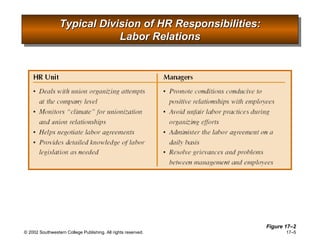
Typical Division of HR Responsibilities: Labor Relations Figure 17 –2
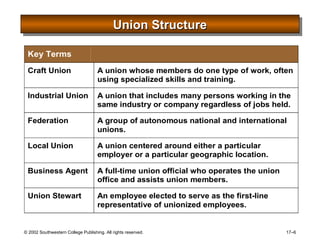
Union Structure
Union Membership as Percentage of the U.S. Workforce Figure 17 –3 Source: Bureau of Labor Statistics, U.S. Department of Labor.
Reasons for Union Decline in the U.S. Geographic Changes Deregulation Foreign Competition More Available Labor Union Decline Industrial Changes Workforce Changes
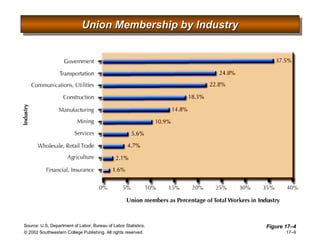
Union Membership by Industry Figure 17 –4 Source: U.S. Department of Labor, Bureau of Labor Statistics.
Union Targets for Membership Growth Union Organizing Professional Unions Contingent and Part-time Workers Low-Skilled Workers
The History of American Unions 1794 Shoemakers’ strike 1806 Shoemakers’ strike (“criminal conspiracy”) 1886 American Federation of Labor (AFL) 1938 Congress of Industrial Organizations CIO 1926 Railway Labor Act 1935 National Labor Relations Act (Wagner Act) 1932 Norris-LaGuardia Act 1947 Taft-Hartley Act 1957 AFL-CIO merger 1959 Landrum-Griffin Act 1978 Civil Service Reform Act
The National Labor Code Figure 17 –5
Unfair Labor Practices: Employer Interfering with the organizing and collective bargaining rights of employees. Dominating or interfering with any labor organization. Encouraging or discouraging membership in a particular union. Discharging persons for organizing activities or union membership. Refusing to bargain collectively.
Labor Relations: Key Terms
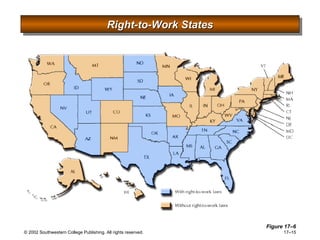
Right-to-Work States Figure 17 –6
Typical Unionization Process Figure 17 –7
Unionization: Key Terms
Bargaining Units “Community of Interest” Wages, hours, and working conditions Traditional industry groupings for bargaining purposes Physical location and amount of interaction and working relationships among employee groups Supervision by similar levels of management Supervisors and Bargaining Units Supervisors are excluded from bargaining units. Any individual with the authority to hire, transfer, discharge, discipline, and who uses independent judgment with employees.
Legal Do’s and Don’ts for Managers During the Unionization Process Figure 17 –8
Collective Bargaining Relationship Continuum Figure 17 –9
Collective Bargaining: Key Terms
Mandatory Bargaining Issues Issues identified specifically by labor laws or court decisions as subject to bargaining. Discharge of employees Grievances Work schedules Union security and dues checkoff Retirement and pension coverage Vacations Christmas bonuses Rest- and lunch-break rules Safety Rules Profit-sharing plans Required physical exam
Classification of Bargaining Issues Permissive Issues Collective bargaining issues that are not mandatory but relate to certain jobs. Benefits for retired employees Product prices (e.g., employee discounts) for employees Performance bonds Illegal Issues Collective bargaining issues that would require either party to take an illegal action (e.g., discriminate in hiring).
The Bargaining Process Preparation and Initial Demands Continuing Negotiations Settlement and Contract Agreement Strikes and Lockouts Bargaining Impasse Conciliation Mediation Arbitration
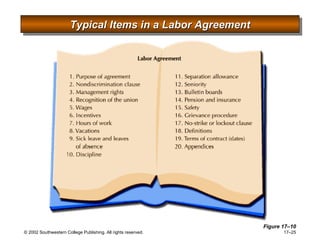
Typical Items in a Labor Agreement Figure 17 –10
Types of Strikes Economic Strikes Strikes over economic issues (e.g., wages) Unfair labor practice strikes Strikes over illegal employer actions (e.g., refusal to bargain) Wildcat strikes Strikes not approved by the union Jurisdictional strikes Strikes in dispute over the ownership of work Sympathy strikes Expressions of support for other unions
Union-Management Cooperation Issues Employee Ownership (ESOPs) Cooperation and Joint Efforts Employee Involvement (Teams) Union-Management Cooperation
Grievance Management Complaint Indication of employee dissatisfaction Grievance A complaint formally stated in writing Grievance Procedures Formal channels of communications used to resolve grievances. Union representation ( Weingarten ) rights
Typical HR Responsibilities: Grievance Management Figure 17 –11
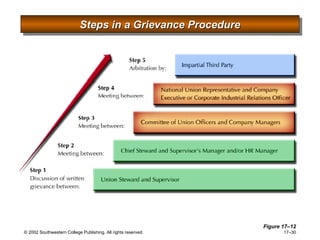
Steps in a Grievance Procedure Figure 17 –12

Hrm10e Chap17

  • 1.
    Human Resource Management TENTH EDITON Union-Management Relations © 2003 Southwestern College Publishing. All rights reserved. PowerPoint Presentation by Charlie Cook Chapter 17 SECTION 5 Employee Relations and Global HR Robert L. Mathis  John H. Jackson
  • 2.
    Learning Objectives Afteryou have read this chapter, you should be able to: Describe what a union is and explain why employees join unions. Identify several reasons for the decline in union membership. Explain the acts that compose the “National Labor Code.” Identify and discuss the stages of the unionization process. Describe the typical collective bargaining process. Describe grievance and explain why a grievance procedure is important for employers.
  • 3.
    Nature of UnionsUnion A formal association of workers that promotes the interests of its members through collective action. State of U.S. Unions Focused on economic issues —wages, benefits, job security, and working conditions. Organized by kind of job and employer. Seek multi-year collective agreements on economic issues as “contracts.” Maintain competitive relations with management.
  • 4.
    Factors Leading toEmployee Unionization Figure 17 –1
  • 5.
    Typical Division ofHR Responsibilities: Labor Relations Figure 17 –2
  • 6.
  • 7.
    Union Membership asPercentage of the U.S. Workforce Figure 17 –3 Source: Bureau of Labor Statistics, U.S. Department of Labor.
  • 8.
    Reasons for UnionDecline in the U.S. Geographic Changes Deregulation Foreign Competition More Available Labor Union Decline Industrial Changes Workforce Changes
  • 9.
    Union Membership byIndustry Figure 17 –4 Source: U.S. Department of Labor, Bureau of Labor Statistics.
  • 10.
    Union Targets forMembership Growth Union Organizing Professional Unions Contingent and Part-time Workers Low-Skilled Workers
  • 11.
    The History ofAmerican Unions 1794 Shoemakers’ strike 1806 Shoemakers’ strike (“criminal conspiracy”) 1886 American Federation of Labor (AFL) 1938 Congress of Industrial Organizations CIO 1926 Railway Labor Act 1935 National Labor Relations Act (Wagner Act) 1932 Norris-LaGuardia Act 1947 Taft-Hartley Act 1957 AFL-CIO merger 1959 Landrum-Griffin Act 1978 Civil Service Reform Act
  • 12.
    The National LaborCode Figure 17 –5
  • 13.
    Unfair Labor Practices:Employer Interfering with the organizing and collective bargaining rights of employees. Dominating or interfering with any labor organization. Encouraging or discouraging membership in a particular union. Discharging persons for organizing activities or union membership. Refusing to bargain collectively.
  • 14.
  • 15.
  • 16.
  • 17.
  • 18.
    Bargaining Units “Communityof Interest” Wages, hours, and working conditions Traditional industry groupings for bargaining purposes Physical location and amount of interaction and working relationships among employee groups Supervision by similar levels of management Supervisors and Bargaining Units Supervisors are excluded from bargaining units. Any individual with the authority to hire, transfer, discharge, discipline, and who uses independent judgment with employees.
  • 19.
    Legal Do’s andDon’ts for Managers During the Unionization Process Figure 17 –8
  • 20.
    Collective Bargaining RelationshipContinuum Figure 17 –9
  • 21.
  • 22.
    Mandatory Bargaining IssuesIssues identified specifically by labor laws or court decisions as subject to bargaining. Discharge of employees Grievances Work schedules Union security and dues checkoff Retirement and pension coverage Vacations Christmas bonuses Rest- and lunch-break rules Safety Rules Profit-sharing plans Required physical exam
  • 23.
    Classification of BargainingIssues Permissive Issues Collective bargaining issues that are not mandatory but relate to certain jobs. Benefits for retired employees Product prices (e.g., employee discounts) for employees Performance bonds Illegal Issues Collective bargaining issues that would require either party to take an illegal action (e.g., discriminate in hiring).
  • 24.
    The Bargaining ProcessPreparation and Initial Demands Continuing Negotiations Settlement and Contract Agreement Strikes and Lockouts Bargaining Impasse Conciliation Mediation Arbitration
  • 25.
    Typical Items ina Labor Agreement Figure 17 –10
  • 26.
    Types of StrikesEconomic Strikes Strikes over economic issues (e.g., wages) Unfair labor practice strikes Strikes over illegal employer actions (e.g., refusal to bargain) Wildcat strikes Strikes not approved by the union Jurisdictional strikes Strikes in dispute over the ownership of work Sympathy strikes Expressions of support for other unions
  • 27.
    Union-Management Cooperation IssuesEmployee Ownership (ESOPs) Cooperation and Joint Efforts Employee Involvement (Teams) Union-Management Cooperation
  • 28.
    Grievance Management ComplaintIndication of employee dissatisfaction Grievance A complaint formally stated in writing Grievance Procedures Formal channels of communications used to resolve grievances. Union representation ( Weingarten ) rights
  • 29.
    Typical HR Responsibilities:Grievance Management Figure 17 –11
  • 30.
    Steps in aGrievance Procedure Figure 17 –12