The Foundations of Human Resource Management Staffing the Organization Developing the Workforce Compensation and Benefits The Legal Context of HR Management New Challenges in the Changing Workplace Dealing With Organized Labor Collective Bargaining
Set of organizational activities directed at attracting, developing and maintaining an effective workforce
  The importance of HR stems from: Increased legal complexities Recognition of human resources as a valuable means for improving productivity Awareness of costs associated with poor human resource management
 
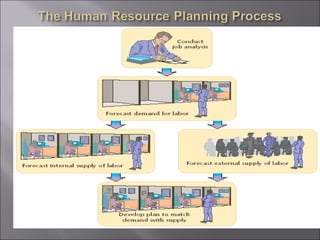
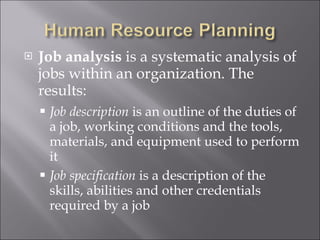
Job analysis  is a systematic analysis of jobs within an organization. The results: Job description  is an outline of the duties of a job, working conditions and the tools, materials, and equipment used to perform it Job specification  is a description of the skills, abilities and other credentials required by a job
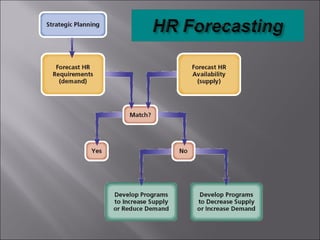
Forecasting the supply of labor is two tasks: Forecasting  internal  supply—the number and type of employees who will be in the firm at some future date Forecasting  external  supply—the number and type of people who will be available for hiring from the labor market at large
 
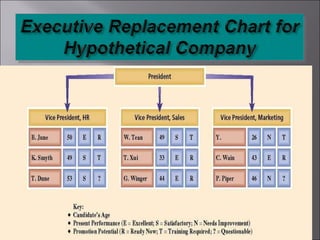
Replacement chart   is a list of each management position, who occupies it, how long that person will likely stay in the job and who is qualified as a replacement Employee information system  (or  Skills   inventory ) is a computerized system containing information on each employee's education, skills, work experience and career aspirations
 
Recruiting   is the process of attracting qualified persons to apply for the jobs that are open. Process of acquiring staff: Internal recruiting  means considering present employees as candidates for openings External recruiting  involves attracting people outside the organization to  apply for jobs
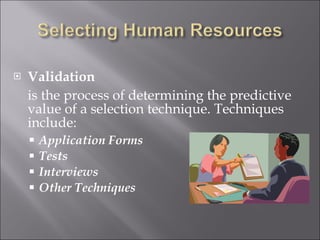
Validation is the process of determining the predictive value of a selection technique. Techniques include: Application Forms Tests Interviews Other Techniques
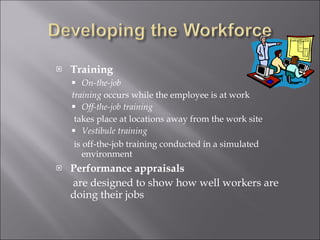
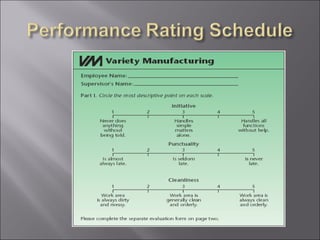
Training On-the-job training  occurs while the employee is at work Off-the-job training takes place at locations away from the work site Vestibule training is off-the-job training conducted in a simulated environment Performance appraisals   are designed to show how well workers are doing their jobs
 
Set of rewards that organizations provide to individuals in return for their willingness to perform various jobs and tasks within the organization
Wages   are paid for time worked Salary   is paid for discharging the responsibilities of a job
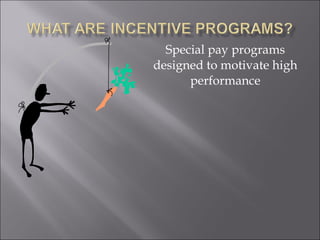
Special pay programs designed to motivate high performance
Bonuses   are special payments above their salaries Merit salary systems link raises to performance levels in non-sales jobs Pay for performance  ( Variable pay ) rewards a manager for especially productive output
Profit-sharing plans   distribute bonuses to employees when company profits rise above a certain level Gainsharing plans   distribute bonuses to employees when a company’s costs are reduced through greater work efficiency Pay-for-knowledge plans   encourage workers to learn new skills or become proficient at different jobs
Compensation other than wages and salaries offered by a firm to its workers
Workers’ compensation insurance   is legally required insurance for compensating workers injured on the job  Retirement plan   is set up to pay pensions to workers when they retire Cafeteria benefits plan   sets limits on benefits per employee, each of whom may choose from a variety of alternative benefits
Legally mandated nondiscrimination in employment on the basis of race, creed, sex or national origin
Set of individuals who by nature of one or more common characteristics are protected under the law from discrimination on the basis of that characteristic
Equal Employment Opportunity Commission  (or  EEOC ) is a federal agency enforcing several discrimination-related laws Affirmative action plan  is a practice of recruiting qualified employees belonging to racial, gender or ethnic groups who are underrepresented in an organization
Employment Safety and Health Occupational Safety and Health Act of 1970  (or  OSHA ) sets and enforces guidelines for protecting workers from unsafe conditions and potential health hazards in the workplace
AIDS in the Workplace Sexual harassment  is the practice or instance of making unwelcome sexual advances in the workplace quid pro quo harassment hostile work environment Employment-at-will  is the principle that organizations should be able to retain or dismiss employees at their discretion
Range of workers’ attitudes, values, beliefs and behaviors that differ by gender, race and ethnicity
 
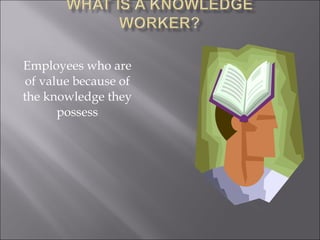
Employees who are of value because of the knowledge they possess
Employee hired on something other than a full-time basis to supplement an organization’s permanent workforce
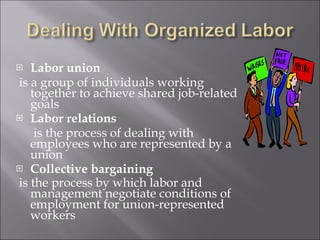
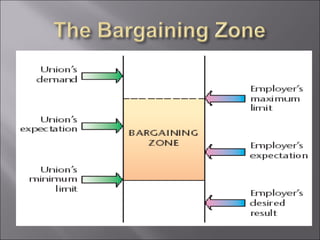
Labor union is a group of individuals working together to achieve shared job-related goals Labor relations   is the process of dealing with employees who are represented by a union Collective bargaining is the process by which labor and management negotiate conditions of employment for union-represented workers
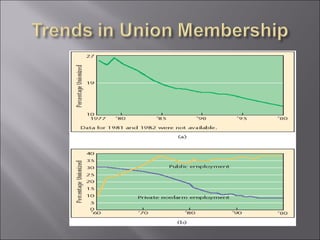
Trends in Union Membership Trends in Union-Management Relations Trends in Bargaining Perspectives The Future of Unions
 
 
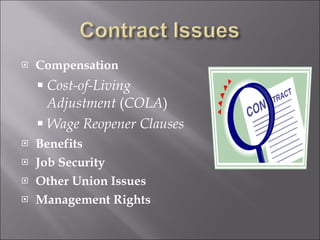
Compensation Cost-of-Living Adjustment  ( COLA ) Wage Reopener Clauses Benefits Job Security Other Union Issues Management Rights
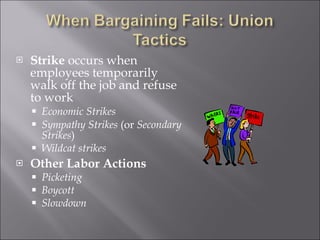
Strike  occurs when employees temporarily walk off the job and refuse to work Economic Strikes Sympathy Strikes  (or  Secondary Strikes ) Wildcat strikes Other Labor Actions Picketing Boycott Slowdown
Lockouts occur when employers deny employees access to the workplace Strikebreakers   are workers hired as permanent or temporary replacements for striking employees
Mediation is a method in which a third party (a mediator) suggests, but does not impose, a settlement Voluntary arbitration is a method in which both parties agree to submit to the judgment of a neutral party (an arbitrator)  Compulsory arbitration   is a method in which both parties are legally required to accept the judgment of a neutral  party

Managing human resources and labor relations

  • 1.
  • 2.
    The Foundations ofHuman Resource Management Staffing the Organization Developing the Workforce Compensation and Benefits The Legal Context of HR Management New Challenges in the Changing Workplace Dealing With Organized Labor Collective Bargaining
  • 3.
    Set of organizationalactivities directed at attracting, developing and maintaining an effective workforce
  • 4.
    Theimportance of HR stems from: Increased legal complexities Recognition of human resources as a valuable means for improving productivity Awareness of costs associated with poor human resource management
  • 5.
  • 6.
    Job analysis is a systematic analysis of jobs within an organization. The results: Job description is an outline of the duties of a job, working conditions and the tools, materials, and equipment used to perform it Job specification is a description of the skills, abilities and other credentials required by a job
  • 7.
    Forecasting the supplyof labor is two tasks: Forecasting internal supply—the number and type of employees who will be in the firm at some future date Forecasting external supply—the number and type of people who will be available for hiring from the labor market at large
  • 8.
  • 9.
    Replacement chart is a list of each management position, who occupies it, how long that person will likely stay in the job and who is qualified as a replacement Employee information system (or Skills inventory ) is a computerized system containing information on each employee's education, skills, work experience and career aspirations
  • 10.
  • 11.
    Recruiting is the process of attracting qualified persons to apply for the jobs that are open. Process of acquiring staff: Internal recruiting means considering present employees as candidates for openings External recruiting involves attracting people outside the organization to apply for jobs
  • 12.
    Validation is theprocess of determining the predictive value of a selection technique. Techniques include: Application Forms Tests Interviews Other Techniques
  • 13.
    Training On-the-job training occurs while the employee is at work Off-the-job training takes place at locations away from the work site Vestibule training is off-the-job training conducted in a simulated environment Performance appraisals are designed to show how well workers are doing their jobs
  • 14.
  • 15.
    Set of rewardsthat organizations provide to individuals in return for their willingness to perform various jobs and tasks within the organization
  • 16.
    Wages are paid for time worked Salary is paid for discharging the responsibilities of a job
  • 17.
    Special pay programsdesigned to motivate high performance
  • 18.
    Bonuses are special payments above their salaries Merit salary systems link raises to performance levels in non-sales jobs Pay for performance ( Variable pay ) rewards a manager for especially productive output
  • 19.
    Profit-sharing plans distribute bonuses to employees when company profits rise above a certain level Gainsharing plans distribute bonuses to employees when a company’s costs are reduced through greater work efficiency Pay-for-knowledge plans encourage workers to learn new skills or become proficient at different jobs
  • 20.
    Compensation other thanwages and salaries offered by a firm to its workers
  • 21.
    Workers’ compensation insurance is legally required insurance for compensating workers injured on the job Retirement plan is set up to pay pensions to workers when they retire Cafeteria benefits plan sets limits on benefits per employee, each of whom may choose from a variety of alternative benefits
  • 22.
    Legally mandated nondiscriminationin employment on the basis of race, creed, sex or national origin
  • 23.
    Set of individualswho by nature of one or more common characteristics are protected under the law from discrimination on the basis of that characteristic
  • 24.
    Equal Employment OpportunityCommission (or EEOC ) is a federal agency enforcing several discrimination-related laws Affirmative action plan is a practice of recruiting qualified employees belonging to racial, gender or ethnic groups who are underrepresented in an organization
  • 25.
    Employment Safety andHealth Occupational Safety and Health Act of 1970 (or OSHA ) sets and enforces guidelines for protecting workers from unsafe conditions and potential health hazards in the workplace
  • 26.
    AIDS in theWorkplace Sexual harassment is the practice or instance of making unwelcome sexual advances in the workplace quid pro quo harassment hostile work environment Employment-at-will is the principle that organizations should be able to retain or dismiss employees at their discretion
  • 27.
    Range of workers’attitudes, values, beliefs and behaviors that differ by gender, race and ethnicity
  • 28.
  • 29.
    Employees who areof value because of the knowledge they possess
  • 30.
    Employee hired onsomething other than a full-time basis to supplement an organization’s permanent workforce
  • 31.
    Labor union isa group of individuals working together to achieve shared job-related goals Labor relations is the process of dealing with employees who are represented by a union Collective bargaining is the process by which labor and management negotiate conditions of employment for union-represented workers
  • 32.
    Trends in UnionMembership Trends in Union-Management Relations Trends in Bargaining Perspectives The Future of Unions
  • 33.
  • 34.
  • 35.
    Compensation Cost-of-Living Adjustment ( COLA ) Wage Reopener Clauses Benefits Job Security Other Union Issues Management Rights
  • 36.
    Strike occurswhen employees temporarily walk off the job and refuse to work Economic Strikes Sympathy Strikes (or Secondary Strikes ) Wildcat strikes Other Labor Actions Picketing Boycott Slowdown
  • 37.
    Lockouts occur whenemployers deny employees access to the workplace Strikebreakers are workers hired as permanent or temporary replacements for striking employees
  • 38.
    Mediation is amethod in which a third party (a mediator) suggests, but does not impose, a settlement Voluntary arbitration is a method in which both parties agree to submit to the judgment of a neutral party (an arbitrator) Compulsory arbitration is a method in which both parties are legally required to accept the judgment of a neutral party