COMPENSATION
&
BENEFITS
Presenters
John Lui
Roel Balita
Matt Bravo
INTRODUCTION
▸One of the main priorities of any business is to have a
loyal and motivated set of employees.
▸Having an attractive compensation rate is important in
motivating your employees and reducing absenteeism.
▸Having a good set of benefits and services that fit your
employees reduces turnover rate and develops loyalty
towards the company.
▸The combination of good compensation and benefits
gives a feeling of security to employees. This causes
them to be more productive employees for the company.
CONCEPT PAY
▸Payment is the satisfactory amount of value to be
compensated to a person who has provided the same
value of goods or services.
▸In human resource management, this equates to the
salaries and wages that employees receive for their work
done.
▸In the Philippines, the form of salary/wage can only
come in legal tender which means that salary/wage in
the Philippines cannot be paid in any other manner than
Philippine Pesos.
COMPENSATION
What is COMPENSATION?
▹Compensation refers to employee compensation.
▹Refers to all forms of monetary pay given to an
employee in exchange for the work that was provided.
▹Compensation is the salary or wage given to a person
arising from employment.
▹It is directly related to the employee’s responsibility
and role in the company.
Base Salary
▸The minimum amount of
salary guaranteed to be
received by an employee.
▸Does not include possible
overtime pay, incentives,
and other monetary
incentives.
▸Usually given out weekly,
bi-weekly, or monthly
PARTS OF
COMPENSATION
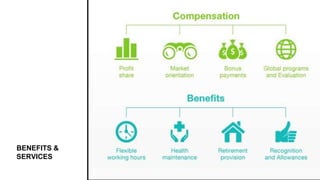
Bonuses
▸Includes all incentives
received by an employee
due to performance.
▸Added to the Base Salary
before tax reduction.
Ex.
▹Overtime
▹Sales commission
▹Hot Skill Bonus
BENEFITS &
SERVICES
What is Employee Benefits?
▹Any rewards received by an employee in addition to
direct monetary remuneration as a result of being an
employee of a company.
▹It is not related to the responsibility or performance of
the employee but as a result of being a member of the
company.
▹The benefits given to the employees usually are
related to the nature of work, work environment, and
health, safety & recreation of the employees.
▹In the Philippines, it is in the labor code that it is illegal
to stop offering benefits that were already experienced
by employees. Non-diminution of benefits
BENEFITS &
SERVICES
BENEFITS &
SERVICES
What are Company Services?
▹Company services ,also known as employee facilities,
are services provided by the company to its employees
to improve their accommodation and workplace quality .
▹These usually are services provided to employees at
very low costs or sometimes even for free.
▹These usually are provided to give convenience to
employees rather than an actual benefit.
BENEFITS &
SERVICES
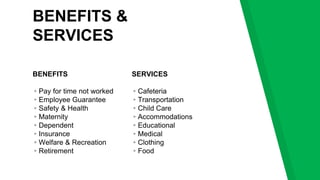
BENEFITS
▸Pay for time not worked
▸Employee Guarantee
▸Safety & Health
▸Maternity
▸Dependent
▸Insurance
▸Welfare & Recreation
▸Retirement
SERVICES
▸Cafeteria
▸Transportation
▸Child Care
▸Accommodations
▸Educational
▸Medical
▸Clothing
▸Food
BENEFITS &
SERVICES
COMPENSATION MANAGEMENT
What is Compensation Management?
▹Is a system in an organization designed to ensure that
no money is wasted on the labor costs and the labor cost
expenditure is used to secure the highest level of
productivity from the employees.
COMPENSATION MANAGEMENT
Goals and Objectives of Compensation
Management:
▹To be able to pay employees well enough which keeps
them highly motivated and loyal to the organization.
▹To draw in highly talented applicants based on the fact
that the organization has a great compensation package.
▹To be able to establish a work culture of high skill and
productivity because of the motivation of incentives.
COMPENSATION MANAGEMENT
Three Theories:
1. Behavior Reinforcement Theory:
▹The theory is that when a particular action is rewarded,
others will follow suit to receive the same reward.
▹The idea is that the positive consequences of an action
will motivate employees to do the same or better to feel
the satisfaction of the positive feedback that someone
else has received.
COMPENSATION MANAGEMENT
Three Theories:
2. Equity Theory:
▹The theory is that everyone who does the same exact
amount, time and effort at work should receive the same
compensation to prevent decrease in motivation.
▹The idea is that when two employees who does exactly
the same amount, time and effort at work receives
different level of pay, the one who receives a lower pay
will greatly decrease his/her productivity.
COMPENSATION MANAGEMENT
Three Theories:
3. Agency Theory:
▹The theory is to use compensation to organize the
agenda of different people within the organization.
▹Through good compensation, the management can
increase different aspects of the organization to achieve
different goals.
COMPENSTION
PROGRAM
▸SALARY RANGE is the range of pay in which an
employer is willing to pay an employee based on the
responsibility, function, and difficulty of the task assigned
to the employee.
▸ The salary range of a position is usually established
by the market in the same region of a country who are
doing similar tasks.
▸The salary range is heavily affected by demographics
and market factors.
▸The Salary range of an organization is established
through COMPENSATION ADMINISTRATION
PROGRAM
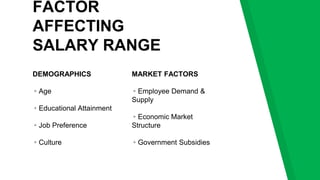
FACTOR
AFFECTING
SALARY RANGE
DEMOGRAPHICS
▸Age
▸Educational Attainment
▸Job Preference
▸Culture
MARKET FACTORS
▸Employee Demand &
Supply
▸Economic Market
Structure
▸Government Subsidies
IMPORTANCE OF
COMPENSATION
PROGRAM
▸Allows organizations to have a package which
produces a motivated and contributing workforce.
▸Develops a salary range which fits the nature of the
organization.
▸Develops a recognizable “brand” which can attract
better quality applicants.
▸Reflects the quality of the human resources of the
organization.
▸Allows organizations to gain competitive advantage
through better compensation and benefits cost
management.
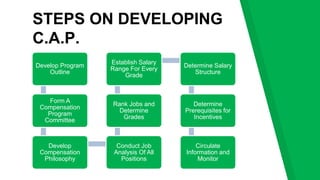
STEPS ON DEVELOPING
C.A.P.
Develop Program
Outline
Form A
Compensation
Program
Committee
Develop
Compensation
Philosophy
Conduct Job
Analysis Of All
Positions
Rank Jobs and
Determine
Grades
Establish Salary
Range For Every
Grade
Determine Salary
Structure
Determine
Prerequisites for
Incentives
Circulate
Information and
Monitor
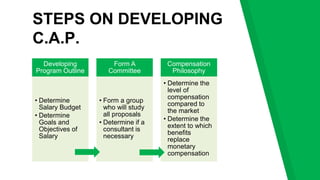
STEPS ON DEVELOPING
C.A.P.
Developing
Program Outline
• Determine
Salary Budget
• Determine
Goals and
Objectives of
Salary
Form A
Committee
• Form a group
who will study
all proposals
• Determine if a
consultant is
necessary
Compensation
Philosophy
• Determine the
level of
compensation
compared to
the market
• Determine the
extent to which
benefits
replace
monetary
compensation
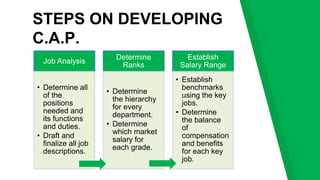
STEPS ON DEVELOPING
C.A.P.
Job Analysis
• Determine all
of the
positions
needed and
its functions
and duties.
• Draft and
finalize all job
descriptions.
Determine
Ranks
• Determine
the hierarchy
for every
department.
• Determine
which market
salary for
each grade.
Establish
Salary Range
• Establish
benchmarks
using the key
jobs.
• Determine
the balance
of
compensation
and benefits
for each key
job.
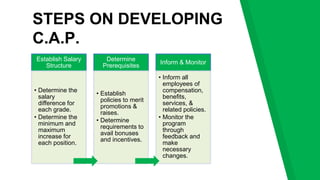
STEPS ON DEVELOPING
C.A.P.
Establish Salary
Structure
• Determine the
salary
difference for
each grade.
• Determine the
minimum and
maximum
increase for
each position.
Determine
Prerequisites
• Establish
policies to merit
promotions &
raises.
• Determine
requirements to
avail bonuses
and incentives.
Inform & Monitor
• Inform all
employees of
compensation,
benefits,
services, &
related policies.
• Monitor the
program
through
feedback and
make
necessary
changes.
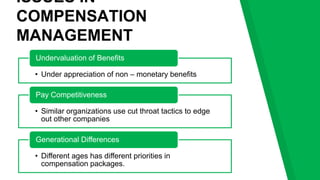
ISSUES IN
COMPENSATION
MANAGEMENT
• Under appreciation of non – monetary benefits
Undervaluation of Benefits
• Similar organizations use cut throat tactics to edge
out other companies
Pay Competitiveness
• Different ages has different priorities in
compensation packages.
Generational Differences
ISSUES IN
COMPENSATION
MANAGEMENT
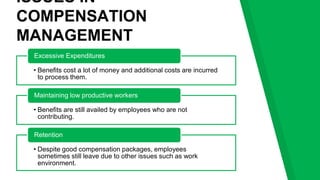
• Benefits cost a lot of money and additional costs are incurred
to process them.
Excessive Expenditures
• Benefits are still availed by employees who are not
contributing.
Maintaining low productive workers
• Despite good compensation packages, employees
sometimes still leave due to other issues such as work
environment.
Retention

Compensation and benefits

  • 1.
  • 2.
  • 3.
    INTRODUCTION ▸One of themain priorities of any business is to have a loyal and motivated set of employees. ▸Having an attractive compensation rate is important in motivating your employees and reducing absenteeism. ▸Having a good set of benefits and services that fit your employees reduces turnover rate and develops loyalty towards the company. ▸The combination of good compensation and benefits gives a feeling of security to employees. This causes them to be more productive employees for the company.
  • 4.
    CONCEPT PAY ▸Payment isthe satisfactory amount of value to be compensated to a person who has provided the same value of goods or services. ▸In human resource management, this equates to the salaries and wages that employees receive for their work done. ▸In the Philippines, the form of salary/wage can only come in legal tender which means that salary/wage in the Philippines cannot be paid in any other manner than Philippine Pesos.
  • 5.
    COMPENSATION What is COMPENSATION? ▹Compensationrefers to employee compensation. ▹Refers to all forms of monetary pay given to an employee in exchange for the work that was provided. ▹Compensation is the salary or wage given to a person arising from employment. ▹It is directly related to the employee’s responsibility and role in the company.
  • 6.
    Base Salary ▸The minimumamount of salary guaranteed to be received by an employee. ▸Does not include possible overtime pay, incentives, and other monetary incentives. ▸Usually given out weekly, bi-weekly, or monthly PARTS OF COMPENSATION Bonuses ▸Includes all incentives received by an employee due to performance. ▸Added to the Base Salary before tax reduction. Ex. ▹Overtime ▹Sales commission ▹Hot Skill Bonus
  • 7.
    BENEFITS & SERVICES What isEmployee Benefits? ▹Any rewards received by an employee in addition to direct monetary remuneration as a result of being an employee of a company. ▹It is not related to the responsibility or performance of the employee but as a result of being a member of the company. ▹The benefits given to the employees usually are related to the nature of work, work environment, and health, safety & recreation of the employees. ▹In the Philippines, it is in the labor code that it is illegal to stop offering benefits that were already experienced by employees. Non-diminution of benefits
  • 8.
  • 9.
    BENEFITS & SERVICES What areCompany Services? ▹Company services ,also known as employee facilities, are services provided by the company to its employees to improve their accommodation and workplace quality . ▹These usually are services provided to employees at very low costs or sometimes even for free. ▹These usually are provided to give convenience to employees rather than an actual benefit.
  • 10.
    BENEFITS & SERVICES BENEFITS ▸Pay fortime not worked ▸Employee Guarantee ▸Safety & Health ▸Maternity ▸Dependent ▸Insurance ▸Welfare & Recreation ▸Retirement SERVICES ▸Cafeteria ▸Transportation ▸Child Care ▸Accommodations ▸Educational ▸Medical ▸Clothing ▸Food
  • 11.
  • 12.
    COMPENSATION MANAGEMENT What isCompensation Management? ▹Is a system in an organization designed to ensure that no money is wasted on the labor costs and the labor cost expenditure is used to secure the highest level of productivity from the employees.
  • 13.
    COMPENSATION MANAGEMENT Goals andObjectives of Compensation Management: ▹To be able to pay employees well enough which keeps them highly motivated and loyal to the organization. ▹To draw in highly talented applicants based on the fact that the organization has a great compensation package. ▹To be able to establish a work culture of high skill and productivity because of the motivation of incentives.
  • 14.
    COMPENSATION MANAGEMENT Three Theories: 1.Behavior Reinforcement Theory: ▹The theory is that when a particular action is rewarded, others will follow suit to receive the same reward. ▹The idea is that the positive consequences of an action will motivate employees to do the same or better to feel the satisfaction of the positive feedback that someone else has received.
  • 15.
    COMPENSATION MANAGEMENT Three Theories: 2.Equity Theory: ▹The theory is that everyone who does the same exact amount, time and effort at work should receive the same compensation to prevent decrease in motivation. ▹The idea is that when two employees who does exactly the same amount, time and effort at work receives different level of pay, the one who receives a lower pay will greatly decrease his/her productivity.
  • 16.
    COMPENSATION MANAGEMENT Three Theories: 3.Agency Theory: ▹The theory is to use compensation to organize the agenda of different people within the organization. ▹Through good compensation, the management can increase different aspects of the organization to achieve different goals.
  • 17.
    COMPENSTION PROGRAM ▸SALARY RANGE isthe range of pay in which an employer is willing to pay an employee based on the responsibility, function, and difficulty of the task assigned to the employee. ▸ The salary range of a position is usually established by the market in the same region of a country who are doing similar tasks. ▸The salary range is heavily affected by demographics and market factors. ▸The Salary range of an organization is established through COMPENSATION ADMINISTRATION PROGRAM
  • 18.
    FACTOR AFFECTING SALARY RANGE DEMOGRAPHICS ▸Age ▸Educational Attainment ▸JobPreference ▸Culture MARKET FACTORS ▸Employee Demand & Supply ▸Economic Market Structure ▸Government Subsidies
  • 19.
    IMPORTANCE OF COMPENSATION PROGRAM ▸Allows organizationsto have a package which produces a motivated and contributing workforce. ▸Develops a salary range which fits the nature of the organization. ▸Develops a recognizable “brand” which can attract better quality applicants. ▸Reflects the quality of the human resources of the organization. ▸Allows organizations to gain competitive advantage through better compensation and benefits cost management.
  • 20.
    STEPS ON DEVELOPING C.A.P. DevelopProgram Outline Form A Compensation Program Committee Develop Compensation Philosophy Conduct Job Analysis Of All Positions Rank Jobs and Determine Grades Establish Salary Range For Every Grade Determine Salary Structure Determine Prerequisites for Incentives Circulate Information and Monitor
  • 21.
    STEPS ON DEVELOPING C.A.P. Developing ProgramOutline • Determine Salary Budget • Determine Goals and Objectives of Salary Form A Committee • Form a group who will study all proposals • Determine if a consultant is necessary Compensation Philosophy • Determine the level of compensation compared to the market • Determine the extent to which benefits replace monetary compensation
  • 22.
    STEPS ON DEVELOPING C.A.P. JobAnalysis • Determine all of the positions needed and its functions and duties. • Draft and finalize all job descriptions. Determine Ranks • Determine the hierarchy for every department. • Determine which market salary for each grade. Establish Salary Range • Establish benchmarks using the key jobs. • Determine the balance of compensation and benefits for each key job.
  • 23.
    STEPS ON DEVELOPING C.A.P. EstablishSalary Structure • Determine the salary difference for each grade. • Determine the minimum and maximum increase for each position. Determine Prerequisites • Establish policies to merit promotions & raises. • Determine requirements to avail bonuses and incentives. Inform & Monitor • Inform all employees of compensation, benefits, services, & related policies. • Monitor the program through feedback and make necessary changes.
  • 24.
    ISSUES IN COMPENSATION MANAGEMENT • Underappreciation of non – monetary benefits Undervaluation of Benefits • Similar organizations use cut throat tactics to edge out other companies Pay Competitiveness • Different ages has different priorities in compensation packages. Generational Differences
  • 25.
    ISSUES IN COMPENSATION MANAGEMENT • Benefitscost a lot of money and additional costs are incurred to process them. Excessive Expenditures • Benefits are still availed by employees who are not contributing. Maintaining low productive workers • Despite good compensation packages, employees sometimes still leave due to other issues such as work environment. Retention