A Presentation Report on
Labor - Management Relations
Nilda Sudario, MGM
Professorial Lecturer
Ronald D. Ravelo
Professorial Lecturer
LABOR RELATION DEFINED
• Relationships between the employee and the
employer
• Relationship of management and labor union

Governing Rule and Principles
• Labor Standards Law
• Social Legislation
• Labor relations law now embodied in the
Labor Code
Labor Relations as a Personnel
Management Function
1. Administration and application of the
personnel of the personnel policies and
programs adopted by management
2. Administration of the collective
bargaining contracts with the union
3. Solution of day-to-day problems that
arises in connection with labor and social
legislation and government rules realtive
to employee-employuer relations
Labor Relations as a Personnel
Management Function
•

The efficient use of the material resources of any
organization depends on how well it is utilized by its
Personnel or Manpower (Martinez et. al, 1993:215)

•

A code of the ways of organization and treating
individual at work so that they will each get the greatest
possible realization of their intrinsic abilities , thus
attaining maximum efficiency for themselves and their
group, and thereby giving to the enterprise of which
they are a part its determining competitive advantage
and its optimum result. (Spates, 1994:9)
Sources of Labor Problems
Dissatisfaction
•
•
•
•

Irritation
Complaints
Grievances
Misunderstanding between employeremployee
Presidential Decree No. 21

CREATING A NATIONAL LABOR RELATIONS
COMMISSION AND FOR OTHER PURPOSES

Rationale
• Promote industrial peace
• maximize productivity
• secure social justice for all the people

Original and Exclusive Jurisdiction
• All matters involving employee-employer relations
including all disputes and grievances which may
otherwise lead to strikes and lockouts under Republic Act
No. 875
• All strikes overtaken by Proclamation No. 1081
• All pending cases in the Bureau of Labor Relations.
The HUMAN NEEDS Classified
Basic Physiological/Primary Needs
1. Hunger
2. Rest and Sleep
3. Protection from the elements
4. Propagation of race
Social and Psychological/Secondary Needs
1. Companionship
2. Approval of Other
3. Assertion of oneself
4. Self-approval
5. Protection from unjust labor practices
Annoyances in the Labor
Relations
Workers Displeasures
1. Profit based labor practice
2. Production Cost vs Labor Expenses
3. Contemporary Business Management
practices
4. Biased decisions and judgements
5. Deficiencies in the HR administration and
labor Law Compliance
6. Legislative safeguards against employees
and unions
Annoyances in the Labor
Relations
Employers Displeasures
1.
2.
3.
4.
5.
6.

Loyalty of employees
Managements reduced disciplinary powers
Indifference towards Management
Labor Unions politics
Legal/Regulative Harassment
Abuse of entered Collective Bargaining
Agreements
Labor Union
• guardian of the just interest of an organizations
employees/workers
• organized to mediate or facilitate grievances of
employees to various factors that affect or in effect
cause disillusion/chaos to the workforce
• ensure security of labour rights of the workforce
• as stipulated in the constitution the right to organize
groups is favored in essence in every
company/organization
Why Join Unions/Labor Group
•
•
•
•
•
•
•
•

Selfishness or foolishness of company or both
Outside agitators, rabble-rousers, and radicals1
Unfair and arbitrary treatment
Inequality of pay or low wage
Effectiveness of mass action in dealing with
employers and promotion of their rights as mandated
by the Labor Code
Social and psychological satisfaction
Management failure to equal treatment
Provision of labor contracts for compulsory
membership
Why join Unions/Labor Group
• Enlistment by members of co-employees
• Solution to common labor problems
Types of Union
• Industrial Union – composed of workers in an
organization/company in a particular firm or plant
regardless of occupation.
• Craft Union – restricted to persons working in the
same trade or related occupation in the firm
Federation, Local, and
Independent Union
• Federation of Unions are organization of affiliated
local union duly registered with DOLE
• Local Union is formed by employees dependent on its’
own by-laws and has no restriction other than those
imposed by the federation
• Independent Union are non-federation affiliated
organizations
Union Security
• Provision in a Collective Bargaining
Agreement wherein a employer approves
the terms of employment in protecting
the Union from loss of membership or
income derived from membership dues.
Forms of Union Security
Closed Shop – understanding between firm and labor
union in which members covered by the CBA must be in
good standing during the life of the agreement
Union Shop – bargaining unit should in a prescribed
period join the union in good standing and remain a
member in order to retain their jobs
Agency Shop – are employees who are not member of the
recognized bargaining unit are assessed a reasonable fee
equivalent to the dues and other fees paid by by members
of the recognized union in order to avail the benefits
under the bargaining agreement
The International Labor
Organization
Established in 1919 and has 185 member countries
First specialized agency by the UN
a transnational organization who’s purpose is the
international collaboration of securing permanent peace
and eliminate injustices through the improvement of labor
practices.
Dedicated to the promotion of constructive dialogues in
the field of industrial relations
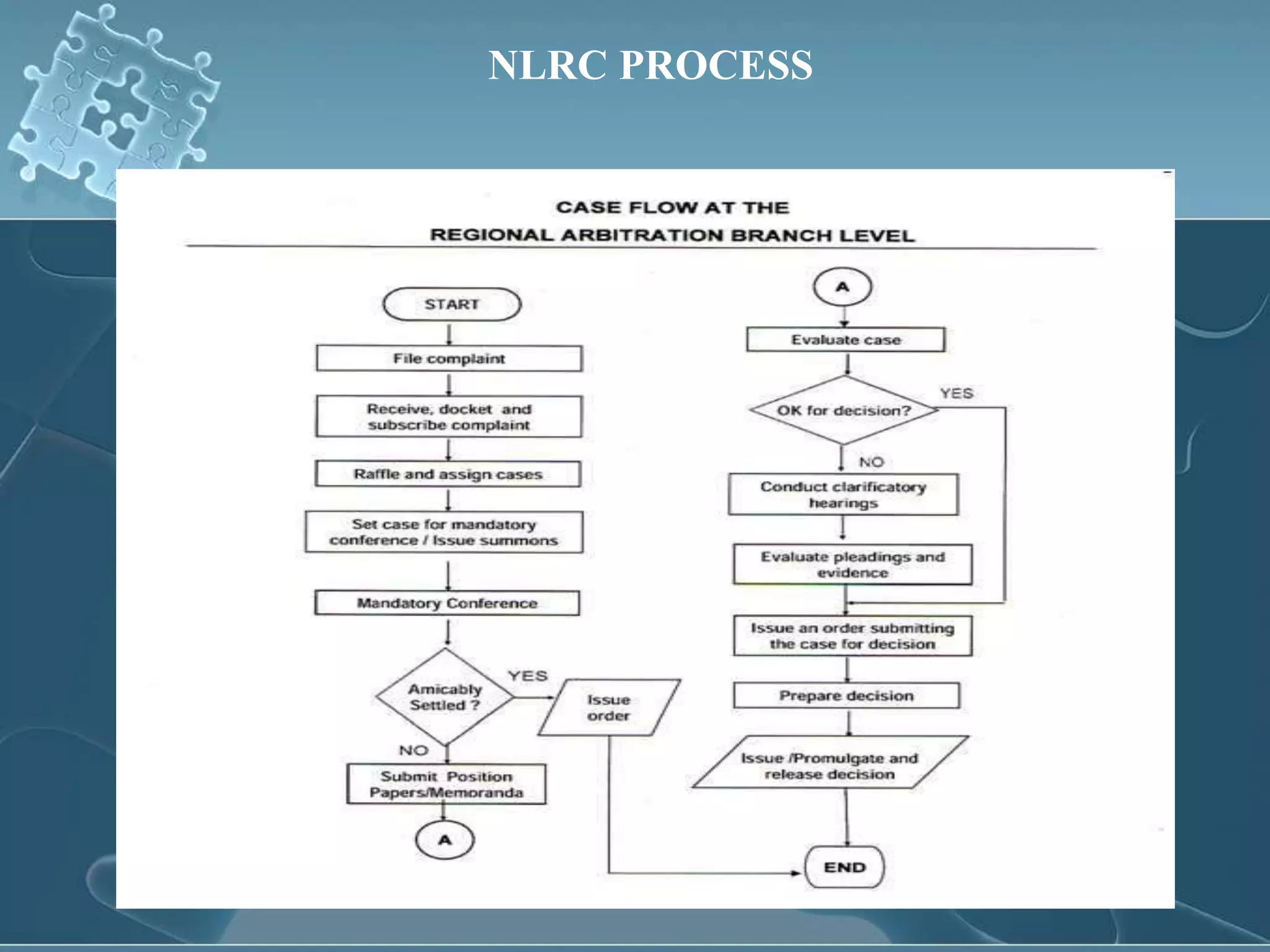
NLRC PROCESS

Labor Management Relations in the Philippine

  • 1.
    A Presentation Reporton Labor - Management Relations Nilda Sudario, MGM Professorial Lecturer Ronald D. Ravelo Professorial Lecturer
  • 2.
    LABOR RELATION DEFINED •Relationships between the employee and the employer • Relationship of management and labor union Governing Rule and Principles • Labor Standards Law • Social Legislation • Labor relations law now embodied in the Labor Code
  • 3.
    Labor Relations asa Personnel Management Function 1. Administration and application of the personnel of the personnel policies and programs adopted by management 2. Administration of the collective bargaining contracts with the union 3. Solution of day-to-day problems that arises in connection with labor and social legislation and government rules realtive to employee-employuer relations
  • 4.
    Labor Relations asa Personnel Management Function • The efficient use of the material resources of any organization depends on how well it is utilized by its Personnel or Manpower (Martinez et. al, 1993:215) • A code of the ways of organization and treating individual at work so that they will each get the greatest possible realization of their intrinsic abilities , thus attaining maximum efficiency for themselves and their group, and thereby giving to the enterprise of which they are a part its determining competitive advantage and its optimum result. (Spates, 1994:9)
  • 5.
    Sources of LaborProblems Dissatisfaction • • • • Irritation Complaints Grievances Misunderstanding between employeremployee
  • 6.
    Presidential Decree No.21 CREATING A NATIONAL LABOR RELATIONS COMMISSION AND FOR OTHER PURPOSES Rationale • Promote industrial peace • maximize productivity • secure social justice for all the people Original and Exclusive Jurisdiction • All matters involving employee-employer relations including all disputes and grievances which may otherwise lead to strikes and lockouts under Republic Act No. 875 • All strikes overtaken by Proclamation No. 1081 • All pending cases in the Bureau of Labor Relations.
  • 7.
    The HUMAN NEEDSClassified Basic Physiological/Primary Needs 1. Hunger 2. Rest and Sleep 3. Protection from the elements 4. Propagation of race Social and Psychological/Secondary Needs 1. Companionship 2. Approval of Other 3. Assertion of oneself 4. Self-approval 5. Protection from unjust labor practices
  • 8.
    Annoyances in theLabor Relations Workers Displeasures 1. Profit based labor practice 2. Production Cost vs Labor Expenses 3. Contemporary Business Management practices 4. Biased decisions and judgements 5. Deficiencies in the HR administration and labor Law Compliance 6. Legislative safeguards against employees and unions
  • 9.
    Annoyances in theLabor Relations Employers Displeasures 1. 2. 3. 4. 5. 6. Loyalty of employees Managements reduced disciplinary powers Indifference towards Management Labor Unions politics Legal/Regulative Harassment Abuse of entered Collective Bargaining Agreements
  • 10.
    Labor Union • guardianof the just interest of an organizations employees/workers • organized to mediate or facilitate grievances of employees to various factors that affect or in effect cause disillusion/chaos to the workforce • ensure security of labour rights of the workforce • as stipulated in the constitution the right to organize groups is favored in essence in every company/organization
  • 11.
    Why Join Unions/LaborGroup • • • • • • • • Selfishness or foolishness of company or both Outside agitators, rabble-rousers, and radicals1 Unfair and arbitrary treatment Inequality of pay or low wage Effectiveness of mass action in dealing with employers and promotion of their rights as mandated by the Labor Code Social and psychological satisfaction Management failure to equal treatment Provision of labor contracts for compulsory membership
  • 12.
    Why join Unions/LaborGroup • Enlistment by members of co-employees • Solution to common labor problems
  • 13.
    Types of Union •Industrial Union – composed of workers in an organization/company in a particular firm or plant regardless of occupation. • Craft Union – restricted to persons working in the same trade or related occupation in the firm
  • 14.
    Federation, Local, and IndependentUnion • Federation of Unions are organization of affiliated local union duly registered with DOLE • Local Union is formed by employees dependent on its’ own by-laws and has no restriction other than those imposed by the federation • Independent Union are non-federation affiliated organizations
  • 15.
    Union Security • Provisionin a Collective Bargaining Agreement wherein a employer approves the terms of employment in protecting the Union from loss of membership or income derived from membership dues.
  • 16.
    Forms of UnionSecurity Closed Shop – understanding between firm and labor union in which members covered by the CBA must be in good standing during the life of the agreement Union Shop – bargaining unit should in a prescribed period join the union in good standing and remain a member in order to retain their jobs Agency Shop – are employees who are not member of the recognized bargaining unit are assessed a reasonable fee equivalent to the dues and other fees paid by by members of the recognized union in order to avail the benefits under the bargaining agreement
  • 17.
    The International Labor Organization Establishedin 1919 and has 185 member countries First specialized agency by the UN a transnational organization who’s purpose is the international collaboration of securing permanent peace and eliminate injustices through the improvement of labor practices. Dedicated to the promotion of constructive dialogues in the field of industrial relations
  • 18.