Fundamentals of Human Resource Management, 10/e, DeCenzo/Robbins Chapter 6, slide 1
Chapter 6
Employee
Recruitment
Fundamentals of Human Resource Management, 10/e, DeCenzo/Robbins Chapter 6, slide 2
Introduction
Recruiting brings together
those with jobs to fill those seeking jobsand
Once an organization identifies its human resource
needs through employment planning, it can begin
recruiting candidates for actual or anticipated vacancies.
Fundamentals of Human Resource Management, 10/e, DeCenzo/Robbins Chapter 6, slide 3
Recruiting Goals
Video: Kevin Gazarra
Find the Right People and Keep Them Engaged
Ø recruiting provides information that will attract
a significant pool of qualified candidates and
discourage unqualified ones from applying
Ø recruiters promote the organization to
prospective applicants
Fundamentals of Human Resource Management, 10/e, DeCenzo/Robbins Chapter 6, slide 4
Recruiting Goals
Factors that affect recruiting efforts:
Øorganizational size
Øemployment conditions in the area
Øeffectiveness of past recruiting efforts
Øworking conditions, salary, and benefits offered
Øorganizational growth or decline
Fundamentals of Human Resource Management, 10/e, DeCenzo/Robbins Chapter 6, slide 5
Recruiting Goals
Constraints on recruiting efforts:
Øorganization’s image
Øjob attractiveness
Øinternal organizational policies
Øgovernment policy and laws
Ørecruiting costs
Fundamentals of Human Resource Management, 10/e, DeCenzo/Robbins Chapter 6, slide 6
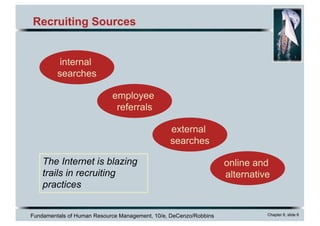
Recruiting Sources
The Internet is blazing
trails in recruiting
practices
internal
searches
employee
referrals
external
searches
online and
alternative
Fundamentals of Human Resource Management, 10/e, DeCenzo/Robbins Chapter 6, slide 7
Recruiting Sources
internal search
Organizations that promote from within identify
current employees for job openings
Øby having individuals bid for jobs
Øby using their HR management system
Øby utilizing employee referrals
Fundamentals of Human Resource Management, 10/e, DeCenzo/Robbins Chapter 6, slide 8
Recruiting Sources
Advantages
Ø good public relations
Ø morale building
Ø encouragement of employees and members of protected groups
Ø knowledge of existing employee performance
Ø cost-savings
Ø candidates’ knowledge of the organization
Ø opportunity to develop mid- and top-level managers
Disadvantages
Ø possible inferiority of internal candidates
Ø infighting and morale problems
Ø potential inbreeding
Promoting from Within
Fundamentals of Human Resource Management, 10/e, DeCenzo/Robbins Chapter 6, slide 9
Recruiting Sources
employee
referrals
Current employees can be asked to recommend recruits.
Advantages:
Ø the employee’s motivation to make a good recommendation
Ø the availability of accurate job information for the recruit
Ø employee referrals tend to be more acceptable applicants, more
likely to accept an offer, and have a higher survival rate
Disadvantages:
Ø the possibility of friendship being confused with job performance
Ø the potential for nepotism
Ø the potential for adverse impact
Fundamentals of Human Resource Management, 10/e, DeCenzo/Robbins Chapter 6, slide 10
Recruiting Sources
external
searches
Advertisements: Must decide type and location of ad,
depending on job; decide whether to focus on job (job
description) or on applicant (job specification).
Three factors influence the response rate:
Ø identification of the organization
Ø labor market conditions
Ø the degree to which specific requirements are listed.
Blind box ads do not identify the organization.
Fundamentals of Human Resource Management, 10/e, DeCenzo/Robbins Chapter 6, slide 11
Recruiting Sources
Employment Agencies:
Ø public or state employment services focus on helping
unemployed individuals with lower skill levels to find jobs
www.careeronestop.org
Ø private employment agencies provide more comprehensive
services and are perceived to offer positions and applicants of a
higher caliber
Ø management consulting firms (“headhunters”) research
candidates for mid- and upper-level executive placement
Ø executive search firms screen potential mid/top-level candidates
while keeping prospective employers anonymous
Fundamentals of Human Resource Management, 10/e, DeCenzo/Robbins Chapter 6, slide 12
Recruiting Sources
Schools, colleges, and universities:
Ø may provide entry-level or experienced
workers through their placement services
Ømay also help companies establish
cooperative education assignments and
internships
Fundamentals of Human Resource Management, 10/e, DeCenzo/Robbins Chapter 6, slide 13
Recruiting Sources
See:
http://www.inxpo.com/products/virtual-career-fairs/index.htm
http://work.secondlife.com/worksolutions/meetings/
From the WSJ:
http://online.wsj.com/article/SB118229876637841321.html
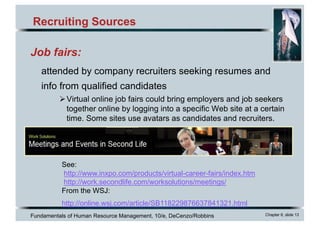
Job fairs:
attended by company recruiters seeking resumes and
info from qualified candidates
ØVirtual online job fairs could bring employers and job seekers
together online by logging into a specific Web site at a certain
time. Some sites use avatars as candidates and recruiters.
Fundamentals of Human Resource Management, 10/e, DeCenzo/Robbins Chapter 6, slide 14
Recruiting Sources
Professional organizations:
Øpublish rosters of vacancies
Ørun placement services at meetings
Øcontrol the supply of prospective applicants
Ølabor unions are also in this category
Unsolicited applicants (walk-ins):
Ømay provide a stockpile of prospective applicants if
there are no current openings
Fundamentals of Human Resource Management, 10/e, DeCenzo/Robbins Chapter 6, slide 15
Recruiting Sources
online
sources
Ø most companies use the Internet to recruit employees
Ø job seekers use online resumes and create Web pages
about their qualifications
Fundamentals of Human Resource Management, 10/e, DeCenzo/Robbins Chapter 6, slide 16
Recruiting Sources
recruiting
alternatives
Temporary help services:
Ø temporary employees help organizations meet short-term
fluctuations in HRM needs
Ø older workers can also provide high-quality help
Employee leasing:
Ø trained workers are employed by a leasing company, which
provides them to employers when needed for a flat fee
Ø typically remain with an organization for longer periods of time
Independent contractors:
Ø do specific work either on or off the company’s premises
Ø costs of regular employees (i.e. taxes and benefits costs) are not
incurred
Fundamentals of Human Resource Management, 10/e, DeCenzo/Robbins Chapter 6, slide 17
A Global Perspective
For some positions, the whole world is a relevant
labor market. So, HR can recruit
Ø home-country nationals when searching for someone
with extensive company experience to launch a product
in a country where it has never sold before
Ø host-country nationals when a foreign subsidiary is being
established and HQ wants to retain control yet hire
someone with local market knowledge
Ø candidates of any nationality, creating a truly
international perspective
Fundamentals of Human Resource Management, 10/e, DeCenzo/Robbins Chapter 6, slide 18
Your Own Job Search
Preparing Your Resume
Ø use quality paper and easy-to-read type
Ø proofread carefully
Ø include volunteer experience
Ø use typical job description phraseology
Ø use a cover letter to highlight your greatest strengths
Job searching takes training, commitment,
endurance, and support. Start searching well before
you plan to start work.
Use networking to gain access to an organization.
Fundamentals of Human Resource Management, 10/e, DeCenzo/Robbins Chapter 6, slide 19
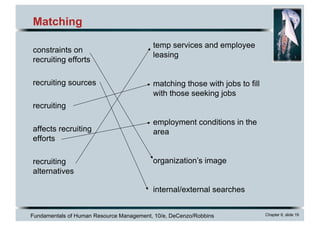
Matching
constraints on
recruiting efforts
recruiting sources
recruiting
affects recruiting
efforts
recruiting
alternatives
temp services and employee
leasing
matching those with jobs to fill
with those seeking jobs
employment conditions in the
area
organization’s image
internal/external searches

Chapter 6 Employee Recruitment

  • 1.
    Fundamentals of HumanResource Management, 10/e, DeCenzo/Robbins Chapter 6, slide 1 Chapter 6 Employee Recruitment
  • 2.
    Fundamentals of HumanResource Management, 10/e, DeCenzo/Robbins Chapter 6, slide 2 Introduction Recruiting brings together those with jobs to fill those seeking jobsand Once an organization identifies its human resource needs through employment planning, it can begin recruiting candidates for actual or anticipated vacancies.
  • 3.
    Fundamentals of HumanResource Management, 10/e, DeCenzo/Robbins Chapter 6, slide 3 Recruiting Goals Video: Kevin Gazarra Find the Right People and Keep Them Engaged Ø recruiting provides information that will attract a significant pool of qualified candidates and discourage unqualified ones from applying Ø recruiters promote the organization to prospective applicants
  • 4.
    Fundamentals of HumanResource Management, 10/e, DeCenzo/Robbins Chapter 6, slide 4 Recruiting Goals Factors that affect recruiting efforts: Øorganizational size Øemployment conditions in the area Øeffectiveness of past recruiting efforts Øworking conditions, salary, and benefits offered Øorganizational growth or decline
  • 5.
    Fundamentals of HumanResource Management, 10/e, DeCenzo/Robbins Chapter 6, slide 5 Recruiting Goals Constraints on recruiting efforts: Øorganization’s image Øjob attractiveness Øinternal organizational policies Øgovernment policy and laws Ørecruiting costs
  • 6.
    Fundamentals of HumanResource Management, 10/e, DeCenzo/Robbins Chapter 6, slide 6 Recruiting Sources The Internet is blazing trails in recruiting practices internal searches employee referrals external searches online and alternative
  • 7.
    Fundamentals of HumanResource Management, 10/e, DeCenzo/Robbins Chapter 6, slide 7 Recruiting Sources internal search Organizations that promote from within identify current employees for job openings Øby having individuals bid for jobs Øby using their HR management system Øby utilizing employee referrals
  • 8.
    Fundamentals of HumanResource Management, 10/e, DeCenzo/Robbins Chapter 6, slide 8 Recruiting Sources Advantages Ø good public relations Ø morale building Ø encouragement of employees and members of protected groups Ø knowledge of existing employee performance Ø cost-savings Ø candidates’ knowledge of the organization Ø opportunity to develop mid- and top-level managers Disadvantages Ø possible inferiority of internal candidates Ø infighting and morale problems Ø potential inbreeding Promoting from Within
  • 9.
    Fundamentals of HumanResource Management, 10/e, DeCenzo/Robbins Chapter 6, slide 9 Recruiting Sources employee referrals Current employees can be asked to recommend recruits. Advantages: Ø the employee’s motivation to make a good recommendation Ø the availability of accurate job information for the recruit Ø employee referrals tend to be more acceptable applicants, more likely to accept an offer, and have a higher survival rate Disadvantages: Ø the possibility of friendship being confused with job performance Ø the potential for nepotism Ø the potential for adverse impact
  • 10.
    Fundamentals of HumanResource Management, 10/e, DeCenzo/Robbins Chapter 6, slide 10 Recruiting Sources external searches Advertisements: Must decide type and location of ad, depending on job; decide whether to focus on job (job description) or on applicant (job specification). Three factors influence the response rate: Ø identification of the organization Ø labor market conditions Ø the degree to which specific requirements are listed. Blind box ads do not identify the organization.
  • 11.
    Fundamentals of HumanResource Management, 10/e, DeCenzo/Robbins Chapter 6, slide 11 Recruiting Sources Employment Agencies: Ø public or state employment services focus on helping unemployed individuals with lower skill levels to find jobs www.careeronestop.org Ø private employment agencies provide more comprehensive services and are perceived to offer positions and applicants of a higher caliber Ø management consulting firms (“headhunters”) research candidates for mid- and upper-level executive placement Ø executive search firms screen potential mid/top-level candidates while keeping prospective employers anonymous
  • 12.
    Fundamentals of HumanResource Management, 10/e, DeCenzo/Robbins Chapter 6, slide 12 Recruiting Sources Schools, colleges, and universities: Ø may provide entry-level or experienced workers through their placement services Ømay also help companies establish cooperative education assignments and internships
  • 13.
    Fundamentals of HumanResource Management, 10/e, DeCenzo/Robbins Chapter 6, slide 13 Recruiting Sources See: http://www.inxpo.com/products/virtual-career-fairs/index.htm http://work.secondlife.com/worksolutions/meetings/ From the WSJ: http://online.wsj.com/article/SB118229876637841321.html Job fairs: attended by company recruiters seeking resumes and info from qualified candidates ØVirtual online job fairs could bring employers and job seekers together online by logging into a specific Web site at a certain time. Some sites use avatars as candidates and recruiters.
  • 14.
    Fundamentals of HumanResource Management, 10/e, DeCenzo/Robbins Chapter 6, slide 14 Recruiting Sources Professional organizations: Øpublish rosters of vacancies Ørun placement services at meetings Øcontrol the supply of prospective applicants Ølabor unions are also in this category Unsolicited applicants (walk-ins): Ømay provide a stockpile of prospective applicants if there are no current openings
  • 15.
    Fundamentals of HumanResource Management, 10/e, DeCenzo/Robbins Chapter 6, slide 15 Recruiting Sources online sources Ø most companies use the Internet to recruit employees Ø job seekers use online resumes and create Web pages about their qualifications
  • 16.
    Fundamentals of HumanResource Management, 10/e, DeCenzo/Robbins Chapter 6, slide 16 Recruiting Sources recruiting alternatives Temporary help services: Ø temporary employees help organizations meet short-term fluctuations in HRM needs Ø older workers can also provide high-quality help Employee leasing: Ø trained workers are employed by a leasing company, which provides them to employers when needed for a flat fee Ø typically remain with an organization for longer periods of time Independent contractors: Ø do specific work either on or off the company’s premises Ø costs of regular employees (i.e. taxes and benefits costs) are not incurred
  • 17.
    Fundamentals of HumanResource Management, 10/e, DeCenzo/Robbins Chapter 6, slide 17 A Global Perspective For some positions, the whole world is a relevant labor market. So, HR can recruit Ø home-country nationals when searching for someone with extensive company experience to launch a product in a country where it has never sold before Ø host-country nationals when a foreign subsidiary is being established and HQ wants to retain control yet hire someone with local market knowledge Ø candidates of any nationality, creating a truly international perspective
  • 18.
    Fundamentals of HumanResource Management, 10/e, DeCenzo/Robbins Chapter 6, slide 18 Your Own Job Search Preparing Your Resume Ø use quality paper and easy-to-read type Ø proofread carefully Ø include volunteer experience Ø use typical job description phraseology Ø use a cover letter to highlight your greatest strengths Job searching takes training, commitment, endurance, and support. Start searching well before you plan to start work. Use networking to gain access to an organization.
  • 19.
    Fundamentals of HumanResource Management, 10/e, DeCenzo/Robbins Chapter 6, slide 19 Matching constraints on recruiting efforts recruiting sources recruiting affects recruiting efforts recruiting alternatives temp services and employee leasing matching those with jobs to fill with those seeking jobs employment conditions in the area organization’s image internal/external searches