Chapter Fifteen
Labor Relations and
Collective Bargaining
Copyright © Houghton Mifflin Company. All rights reserved. 15–2
Chapter Outline
• Historical, Legal, and Global Context of
Unions
• How Unions Are Formed: The Organizing
Process
• Collective Bargaining
• When Collective Bargaining Breaks Down:
Impasse
• When the Meaning of the Contract is in
Dispute: The Grievance Procedure
• The Role of Labor Relations in Human
Resource Management
Copyright © Houghton Mifflin Company. All rights reserved. 15–3
Labor Relations in Historical Context
• Historical Context
– American Federation of Labor (AFL) - craft
unions
– Congress of Industrial Organizations (CIO)
- industrial unions
– Professional Associations
Copyright © Houghton Mifflin Company. All rights reserved. 15–4
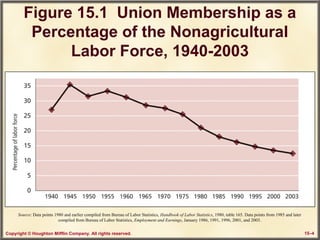
Figure 15.1 Union Membership as a
Percentage of the Nonagricultural
Labor Force, 1940-2003
Source: Data points 1980 and earlier compiled from Bureau of Labor Statistics, Handbook of Labor Statistics, 1980, table 165. Data points from 1985 and later
compiled from Bureau of Labor Statistics, Employment and Earnings, January 1986, 1991, 1996, 2001, and 2003.
Copyright © Houghton Mifflin Company. All rights reserved. 15–5
Legal Context - Private Sector
• National Labor Relations Act (Wagner
Act) of 1935
– Employees have the right to organize and
bargain collectively.
• Labor-Management Relations Act (Taft-
Hartley Act) of 1947
– Employers have rights too
• Both laws are enforced by the National
Labor Relations Board
Copyright © Houghton Mifflin Company. All rights reserved. 15–6
Unfair Labor Practices by Management
• Interfere with employee rights to
unionize
• Dominate labor organization
• Discriminate against employees for
legal union activities or sentiments
• Refuse to bargain in good faith
Copyright © Houghton Mifflin Company. All rights reserved. 15–7
Unfair Labor Practices by Unions
• Coerce employees to join
• Cause employer to discriminate in favor of
union members
• Refuse to bargain in good faith
• Secondary boycotts
• Excessive dues or fees
• Featherbedding
• Jurisdictional strikes, recognition picketing
Copyright © Houghton Mifflin Company. All rights reserved. 15–8
Legal Context - Public Sector
• Executive Orders, Civil Service Reform
Act of 1978, State laws
• Federal Labor Relations Authority
(FLRA)
• Federal employees may not strike and
may not bargain over wages
Copyright © Houghton Mifflin Company. All rights reserved. 15–9
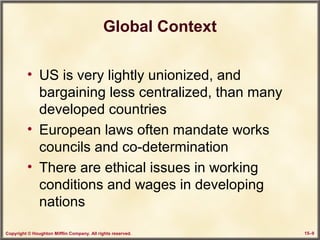
Global Context
• US is very lightly unionized, and
bargaining less centralized, than many
developed countries
• European laws often mandate works
councils and co-determination
• There are ethical issues in working
conditions and wages in developing
nations
Copyright © Houghton Mifflin Company. All rights reserved. 15–10
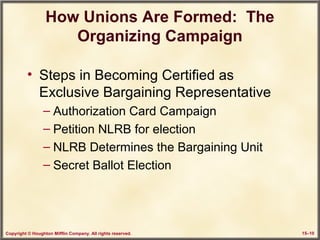
How Unions Are Formed: The
Organizing Campaign
• Steps in Becoming Certified as
Exclusive Bargaining Representative
– Authorization Card Campaign
– Petition NLRB for election
– NLRB Determines the Bargaining Unit
– Secret Ballot Election
Copyright © Houghton Mifflin Company. All rights reserved. 15–11
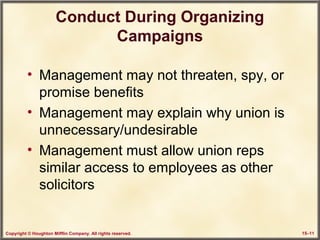
Conduct During Organizing
Campaigns
• Management may not threaten, spy, or
promise benefits
• Management may explain why union is
unnecessary/undesirable
• Management must allow union reps
similar access to employees as other
solicitors
Copyright © Houghton Mifflin Company. All rights reserved. 15–12
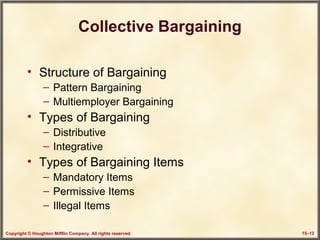
Collective Bargaining
• Structure of Bargaining
– Pattern Bargaining
– Multiemployer Bargaining
• Types of Bargaining
– Distributive
– Integrative
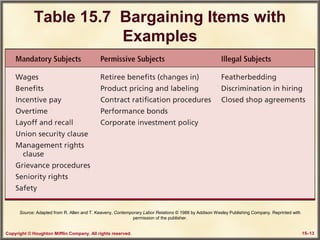
• Types of Bargaining Items
– Mandatory Items
– Permissive Items
– Illegal Items
Copyright © Houghton Mifflin Company. All rights reserved. 15–13
Table 15.7 Bargaining Items with
Examples
Source: Adapted from R. Allen and T. Keaveny, Contemporary Labor Relations © 1988 by Addison Wesley Publishing Company. Reprinted with
permission of the publisher.
Copyright © Houghton Mifflin Company. All rights reserved. 15–14
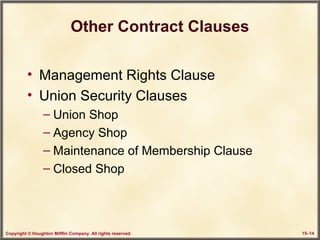
Other Contract Clauses
• Management Rights Clause
• Union Security Clauses
– Union Shop
– Agency Shop
– Maintenance of Membership Clause
– Closed Shop
Copyright © Houghton Mifflin Company. All rights reserved. 15–15
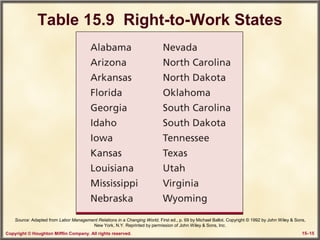
Table 15.9 Right-to-Work States
Source: Adapted from Labor Management Relations in a Changing World, First ed., p. 69 by Michael Ballot. Copyright © 1992 by John Wiley & Sons,
New York, N.Y. Reprinted by permission of John Wiley & Sons, Inc.
Copyright © Houghton Mifflin Company. All rights reserved. 15–16
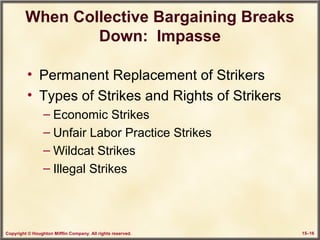
When Collective Bargaining Breaks
Down: Impasse
• Permanent Replacement of Strikers
• Types of Strikes and Rights of Strikers
– Economic Strikes
– Unfair Labor Practice Strikes
– Wildcat Strikes
– Illegal Strikes
Copyright © Houghton Mifflin Company. All rights reserved. 15–17
When Collective Bargaining Breaks
Down: Impasse (cont’d)
• Alternative dispute resolution procedures
• Mediation
– Interest Arbitration
• Conventional Interest Arbitration
• Final-Offer Arbitration
– By Package
– By Issue
• Fact Finding
• National Emergency Dispute Procedures
– Cooling-Off Period
Copyright © Houghton Mifflin Company. All rights reserved. 15–18
When the Meaning of the Contract is in
Dispute: The Grievance Procedure
• Steps in the Grievance Procedure
– Aggrieved employee complains
– Supervisor responds
– If employee unsatisfied, writes up
grievance to appeal to higher levels of
management
– If still unsatisfied, may go to arbitration
Copyright © Houghton Mifflin Company. All rights reserved. 15–19
Review
• Historical, Legal, and Global Context of
Unions
• How Unions Are Formed: The Organizing
Process
• Collective Bargaining
• When Collective Bargaining Breaks Down:
Impasse
• When the Meaning of the Contract is in
Dispute: The Grievance Procedure
• The Role of Labor Relations in Human
Resource Management

Hra 310 chapter 15

  • 1.
    Chapter Fifteen Labor Relationsand Collective Bargaining
  • 2.
    Copyright © HoughtonMifflin Company. All rights reserved. 15–2 Chapter Outline • Historical, Legal, and Global Context of Unions • How Unions Are Formed: The Organizing Process • Collective Bargaining • When Collective Bargaining Breaks Down: Impasse • When the Meaning of the Contract is in Dispute: The Grievance Procedure • The Role of Labor Relations in Human Resource Management
  • 3.
    Copyright © HoughtonMifflin Company. All rights reserved. 15–3 Labor Relations in Historical Context • Historical Context – American Federation of Labor (AFL) - craft unions – Congress of Industrial Organizations (CIO) - industrial unions – Professional Associations
  • 4.
    Copyright © HoughtonMifflin Company. All rights reserved. 15–4 Figure 15.1 Union Membership as a Percentage of the Nonagricultural Labor Force, 1940-2003 Source: Data points 1980 and earlier compiled from Bureau of Labor Statistics, Handbook of Labor Statistics, 1980, table 165. Data points from 1985 and later compiled from Bureau of Labor Statistics, Employment and Earnings, January 1986, 1991, 1996, 2001, and 2003.
  • 5.
    Copyright © HoughtonMifflin Company. All rights reserved. 15–5 Legal Context - Private Sector • National Labor Relations Act (Wagner Act) of 1935 – Employees have the right to organize and bargain collectively. • Labor-Management Relations Act (Taft- Hartley Act) of 1947 – Employers have rights too • Both laws are enforced by the National Labor Relations Board
  • 6.
    Copyright © HoughtonMifflin Company. All rights reserved. 15–6 Unfair Labor Practices by Management • Interfere with employee rights to unionize • Dominate labor organization • Discriminate against employees for legal union activities or sentiments • Refuse to bargain in good faith
  • 7.
    Copyright © HoughtonMifflin Company. All rights reserved. 15–7 Unfair Labor Practices by Unions • Coerce employees to join • Cause employer to discriminate in favor of union members • Refuse to bargain in good faith • Secondary boycotts • Excessive dues or fees • Featherbedding • Jurisdictional strikes, recognition picketing
  • 8.
    Copyright © HoughtonMifflin Company. All rights reserved. 15–8 Legal Context - Public Sector • Executive Orders, Civil Service Reform Act of 1978, State laws • Federal Labor Relations Authority (FLRA) • Federal employees may not strike and may not bargain over wages
  • 9.
    Copyright © HoughtonMifflin Company. All rights reserved. 15–9 Global Context • US is very lightly unionized, and bargaining less centralized, than many developed countries • European laws often mandate works councils and co-determination • There are ethical issues in working conditions and wages in developing nations
  • 10.
    Copyright © HoughtonMifflin Company. All rights reserved. 15–10 How Unions Are Formed: The Organizing Campaign • Steps in Becoming Certified as Exclusive Bargaining Representative – Authorization Card Campaign – Petition NLRB for election – NLRB Determines the Bargaining Unit – Secret Ballot Election
  • 11.
    Copyright © HoughtonMifflin Company. All rights reserved. 15–11 Conduct During Organizing Campaigns • Management may not threaten, spy, or promise benefits • Management may explain why union is unnecessary/undesirable • Management must allow union reps similar access to employees as other solicitors
  • 12.
    Copyright © HoughtonMifflin Company. All rights reserved. 15–12 Collective Bargaining • Structure of Bargaining – Pattern Bargaining – Multiemployer Bargaining • Types of Bargaining – Distributive – Integrative • Types of Bargaining Items – Mandatory Items – Permissive Items – Illegal Items
  • 13.
    Copyright © HoughtonMifflin Company. All rights reserved. 15–13 Table 15.7 Bargaining Items with Examples Source: Adapted from R. Allen and T. Keaveny, Contemporary Labor Relations © 1988 by Addison Wesley Publishing Company. Reprinted with permission of the publisher.
  • 14.
    Copyright © HoughtonMifflin Company. All rights reserved. 15–14 Other Contract Clauses • Management Rights Clause • Union Security Clauses – Union Shop – Agency Shop – Maintenance of Membership Clause – Closed Shop
  • 15.
    Copyright © HoughtonMifflin Company. All rights reserved. 15–15 Table 15.9 Right-to-Work States Source: Adapted from Labor Management Relations in a Changing World, First ed., p. 69 by Michael Ballot. Copyright © 1992 by John Wiley & Sons, New York, N.Y. Reprinted by permission of John Wiley & Sons, Inc.
  • 16.
    Copyright © HoughtonMifflin Company. All rights reserved. 15–16 When Collective Bargaining Breaks Down: Impasse • Permanent Replacement of Strikers • Types of Strikes and Rights of Strikers – Economic Strikes – Unfair Labor Practice Strikes – Wildcat Strikes – Illegal Strikes
  • 17.
    Copyright © HoughtonMifflin Company. All rights reserved. 15–17 When Collective Bargaining Breaks Down: Impasse (cont’d) • Alternative dispute resolution procedures • Mediation – Interest Arbitration • Conventional Interest Arbitration • Final-Offer Arbitration – By Package – By Issue • Fact Finding • National Emergency Dispute Procedures – Cooling-Off Period
  • 18.
    Copyright © HoughtonMifflin Company. All rights reserved. 15–18 When the Meaning of the Contract is in Dispute: The Grievance Procedure • Steps in the Grievance Procedure – Aggrieved employee complains – Supervisor responds – If employee unsatisfied, writes up grievance to appeal to higher levels of management – If still unsatisfied, may go to arbitration
  • 19.
    Copyright © HoughtonMifflin Company. All rights reserved. 15–19 Review • Historical, Legal, and Global Context of Unions • How Unions Are Formed: The Organizing Process • Collective Bargaining • When Collective Bargaining Breaks Down: Impasse • When the Meaning of the Contract is in Dispute: The Grievance Procedure • The Role of Labor Relations in Human Resource Management