Chapter 13
Health and Safety
Fundamentals of Human Resource Management, 10/e, DeCenzo/Robbins Chapter 13, slide 2
Introduction
Ø management has both legal and moral
responsibilities to provide a safe and healthy
workplace
Ø work-related accidents, injuries, and illnesses are
costly
Ø cost of lost productivity to U.S. companies surpasses
$100 billion annually. Enter:
Fundamentals of Human Resource Management, 10/e, DeCenzo/Robbins Chapter 13, slide 3
The Occupational Safety and Health Act
OSHA
Ø 1970 federal legislation
Ø established health and safety standards
Ø authorized inspections and fines for violations
Ø empowered OSH Administration to ensure
standards are met
Ø requires employers to keep records of illnesses
and injuries, and calculate accident ratios
Ø applies to almost every U.S. business engaged
in interstate commerce
Fundamentals of Human Resource Management, 10/e, DeCenzo/Robbins Chapter 13, slide 4
The Occupational Safety and Health Act
1. imminent danger: where an accident is
about to occur
2. accidents that have led to serious injuries or
death: Employer must report within 8 hours
3. employee complaints: employees have right
to call OSHA
OSHA’s Five Inspection Priorities
Fundamentals of Human Resource Management, 10/e, DeCenzo/Robbins Chapter 13, slide 5
The Occupational Safety and Health Act
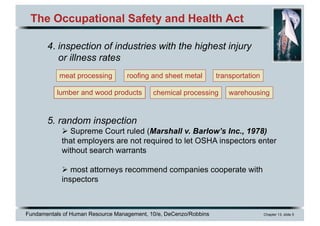
4. inspection of industries with the highest injury
or illness rates
5. random inspection
Ø Supreme Court ruled (Marshall v. Barlow’s Inc., 1978)
that employers are not required to let OSHA inspectors enter
without search warrants
Ø most attorneys recommend companies cooperate with
inspectors
meat processing
lumber and wood products
roofing and sheet metal
chemical processing
transportation
warehousing
Fundamentals of Human Resource Management, 10/e, DeCenzo/Robbins Chapter 13, slide 6
The Occupational Safety and Health Act
Ø industries with high incidences of injury (incident
rates) must keep records for OSHA
Ø basis for record-keeping is Form 300
Ø must report any work-related illness; report
injuries that require medical treatment besides
first aid, involve loss of consciousness, restriction
of work or motion, or transfer to another job
Ø incidence rate: number of illnesses, injuries or
lost workdays per 100 full-time workers
OSHA’s Record-Keeping Requirements
Fundamentals of Human Resource Management, 10/e, DeCenzo/Robbins Chapter 13, slide 7
The Occupational Safety and Health Act
Ø Omnibus Budget Reconciliation Act of 1990
allows fines up to $70,000 if violation is
severe, willful and repetitive
Ø fines can be for safety violations or failure to
keep adequate records
Ø courts have backed criminal charges against
executives when they have willfully violated
health and safety laws
OSHA Punitive Actions
Fundamentals of Human Resource Management, 10/e, DeCenzo/Robbins Chapter 13, slide 8
The National Institute for Occupational Safety and Health (NIOSH)
is a government agency that researches and makes
recommendations to prevent work-related illness and injury.
OSHA: A Resource for Employers
1. fostering management and employee involvement
2. offering worksite analysis
3. teaching hazard prevention and control
4. training employees, supervisors, managers
OSHA also helps small businesses and
entrepreneurs by
Fundamentals of Human Resource Management, 10/e, DeCenzo/Robbins Chapter 13, slide 9
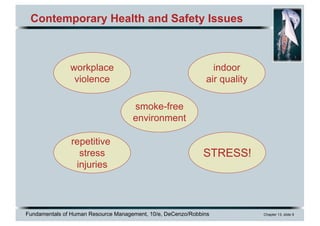
Contemporary Health and Safety Issues
workplace
violence
indoor
air quality
smoke-free
environment
repetitive
stress
injuries
STRESS!
Fundamentals of Human Resource Management, 10/e, DeCenzo/Robbins Chapter 13, slide 10
Contemporary Health and Safety Issues
Ø at-risk workers are those who exchange money and/or interact
primarily with the public, make deliveries, work alone or in small
groups, and work late-night or early morning hours
Ø recommended HRM actions:
1. develop a plan, including review of policies and employee treatment;
respect to workers is paramount
2. train supervisors to identify and deal with troubled employees
3. implement stronger security mechanisms
4. prepare employees to deal with violent situations
workplace
violence
Fundamentals of Human Resource Management, 10/e, DeCenzo/Robbins Chapter 13, slide 11
Contemporary Health and Safety Issues
Ø a building is “sick” if it contains harmful airborne chemicals,
asbestos, or indoor pollution
Ø suggestions for keeping the environment healthy:
1. make sure workers get enough fresh air
2. avoid suspect building materials and furnishings
3. test new buildings for toxins before occupancy
4. provide a smoke-free environment
5. keep air ducts clean and dry
6. pay attention to workers’ complaints
indoor
air
quality
Fundamentals of Human Resource Management, 10/e, DeCenzo/Robbins Chapter 13, slide 12
Contemporary Health and Safety Issues
Costs of smokers:
Ø increased health premiums
Ø absenteeism
Ø lost productivity due to smoke breaks
Ø maintenance costs
Ø harm to coworkers by second-hand smoke
smoking bans should take a phased-in approach
smoke-free
environment
Fundamentals of Human Resource Management, 10/e, DeCenzo/Robbins Chapter 13, slide 13
Contemporary Health and Safety Issues
Ø smoke-free policies at work include banning
smoking or restricting it to properly ventilated
designated areas
Ø employees should be involved in phase-in of
programs
Ø some employers offer incentives and help for
employees to stop smoking
smoke-free
environment
Fundamentals of Human Resource Management, 10/e, DeCenzo/Robbins Chapter 13, slide 14
Contemporary Health and Safety Issues
Ø injuries resulting from continuous, repetitive
movements, such as typing
Ø also referred to as musculoskeletal disorders (MSDs)
Ø the most frequent injury is carpal tunnel syndrome,
which occurs in the wrist
Ø ergonomics, or fitting the work environment to the
individual, can prevent repetitive motion injuries
See http://www.office-ergo.com/a.htm for specific tips.
repetitive
stress
injuries
Fundamentals of Human Resource Management, 10/e, DeCenzo/Robbins Chapter 13, slide 15
Contemporary Health and Safety Issues
Ø we feel negative stress in the face of constraints,
demands, and pressure
Ø stress costs U.S. corporations almost $300 billion
annually
STRESS!
The American Institute of Stress, www.stress.org, offers a wealth of
information, including this questionnaire that assesses stress levels:
http://www.stress.org/topic-workplace.htm
Fundamentals of Human Resource Management, 10/e, DeCenzo/Robbins Chapter 13, slide 16
Contemporary Health and Safety Issues
Common Causes of Stress
organizational personal
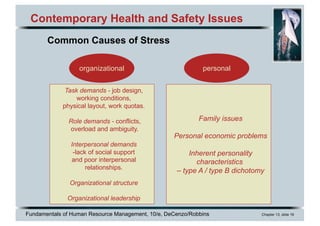
Task demands - job design,
working conditions,
physical layout, work quotas.
Role demands - conflicts,
overload and ambiguity.
Interpersonal demands
-lack of social support
and poor interpersonal
relationships.
Organizational structure
Organizational leadership
Family issues
Personal economic problems
Inherent personality
characteristics
– type A / type B dichotomy
organizational personal
Fundamentals of Human Resource Management, 10/e, DeCenzo/Robbins Chapter 13, slide 17
Contemporary Health and Safety Issues
Ø physiological (increased blood pressure, headaches,
increased pulse rate) are the most difficult to observe
Ø psychological (increased tension and anxiety, boredom,
procrastination) can lead to productivity decreases
Ø behavioral (increased smoking or substance
consumption, sleep disorders) also affect the
organization
What HR Can Do
1. match individuals to their jobs
2. clarify expectations
3. redesign jobs
4. offer involvement and participation
Symptoms of Stress
Fundamentals of Human Resource Management, 10/e, DeCenzo/Robbins Chapter 13, slide 18
Contemporary Health and Safety Issues
Ø Dilemmas for HRM include:
1. balancing the need to energize people with
the need to minimize dysfunctional stress
2. deciding how much an employer can
intrude on employees’ personal lives
Reducing Stress
Fundamentals of Human Resource Management, 10/e, DeCenzo/Robbins Chapter 13, slide 19
Four techniques HR can use to reduce burnout:
1. identification
2. prevention
3. mediation
4. remediation
Contemporary Health and Safety Issues
Burnout is a function of three concerns:
Ø chronic emotional stress with emotional and/or physical
exhaustion
Ø lowered job productivity
Ø dehumanizing of jobs
Take this quiz if you think you are approaching burnout at work:
http://stress.about.com/library/burnout/bl_job_burnout_quiz.htm
Burnout
Fundamentals of Human Resource Management, 10/e, DeCenzo/Robbins Chapter 13, slide 20
Employee Assistance Programs
Ø extension of 1940’s programs to help employees with
alcohol-related problems
Ø cost-effective counseling to help employees overcome
problems such as:
1. substance abuse
2. bereavement
3. child-parent problems
4. marriage problems
A Brief History of EAPs
Fundamentals of Human Resource Management, 10/e, DeCenzo/Robbins Chapter 13, slide 21
The Employee Assistance Program
Øprovides employees visits with counselors at
company expense; usually visits are off-site
Øhelp control rising health insurance costs
Øemployees and supervisors must be familiar
with and trust the program and perceive EAPs
as worthwhile
Øconfidentiality is guaranteed
Øfor every dollar spent on EAP programs,
studies estimate a return of $5.00 to $16.00 in
savings
EAPs Today
Fundamentals of Human Resource Management, 10/e, DeCenzo/Robbins Chapter 13, slide 22
The Employee Assistance Program
Ø programs to keep employees healthy; include smoking
cessation, physical fitness, weight control, etc.
Ø designed to cut employer health costs and lower
absenteeism
Ø employees must view programs as having value
Ø must have top management support
Ø should also provide services for employees’ families
Ø need opportunities for employee input
Wellness Programs
Fundamentals of Human Resource Management, 10/e, DeCenzo/Robbins Chapter 13, slide 23
International Safety and Health
1. an up-to-date health certificate providing records of
employee vaccinations
2. a general first aid kit should include over-the-counter and
prescription medications and other supplies that might not
be available to U.S. workers abroad
3. emergency plans help expatriates anticipate medical
needs and locate resources
4. U.S. Department of State “hotline” provides travel alerts
about such issues as terrorist activity or disease
outbreaks
5. security concerns prompt recommendations regarding
travel modes, attire, and “blending in”
International Health Issues/Needs

Chapter 13 Health and Safety

  • 1.
  • 2.
    Fundamentals of HumanResource Management, 10/e, DeCenzo/Robbins Chapter 13, slide 2 Introduction Ø management has both legal and moral responsibilities to provide a safe and healthy workplace Ø work-related accidents, injuries, and illnesses are costly Ø cost of lost productivity to U.S. companies surpasses $100 billion annually. Enter:
  • 3.
    Fundamentals of HumanResource Management, 10/e, DeCenzo/Robbins Chapter 13, slide 3 The Occupational Safety and Health Act OSHA Ø 1970 federal legislation Ø established health and safety standards Ø authorized inspections and fines for violations Ø empowered OSH Administration to ensure standards are met Ø requires employers to keep records of illnesses and injuries, and calculate accident ratios Ø applies to almost every U.S. business engaged in interstate commerce
  • 4.
    Fundamentals of HumanResource Management, 10/e, DeCenzo/Robbins Chapter 13, slide 4 The Occupational Safety and Health Act 1. imminent danger: where an accident is about to occur 2. accidents that have led to serious injuries or death: Employer must report within 8 hours 3. employee complaints: employees have right to call OSHA OSHA’s Five Inspection Priorities
  • 5.
    Fundamentals of HumanResource Management, 10/e, DeCenzo/Robbins Chapter 13, slide 5 The Occupational Safety and Health Act 4. inspection of industries with the highest injury or illness rates 5. random inspection Ø Supreme Court ruled (Marshall v. Barlow’s Inc., 1978) that employers are not required to let OSHA inspectors enter without search warrants Ø most attorneys recommend companies cooperate with inspectors meat processing lumber and wood products roofing and sheet metal chemical processing transportation warehousing
  • 6.
    Fundamentals of HumanResource Management, 10/e, DeCenzo/Robbins Chapter 13, slide 6 The Occupational Safety and Health Act Ø industries with high incidences of injury (incident rates) must keep records for OSHA Ø basis for record-keeping is Form 300 Ø must report any work-related illness; report injuries that require medical treatment besides first aid, involve loss of consciousness, restriction of work or motion, or transfer to another job Ø incidence rate: number of illnesses, injuries or lost workdays per 100 full-time workers OSHA’s Record-Keeping Requirements
  • 7.
    Fundamentals of HumanResource Management, 10/e, DeCenzo/Robbins Chapter 13, slide 7 The Occupational Safety and Health Act Ø Omnibus Budget Reconciliation Act of 1990 allows fines up to $70,000 if violation is severe, willful and repetitive Ø fines can be for safety violations or failure to keep adequate records Ø courts have backed criminal charges against executives when they have willfully violated health and safety laws OSHA Punitive Actions
  • 8.
    Fundamentals of HumanResource Management, 10/e, DeCenzo/Robbins Chapter 13, slide 8 The National Institute for Occupational Safety and Health (NIOSH) is a government agency that researches and makes recommendations to prevent work-related illness and injury. OSHA: A Resource for Employers 1. fostering management and employee involvement 2. offering worksite analysis 3. teaching hazard prevention and control 4. training employees, supervisors, managers OSHA also helps small businesses and entrepreneurs by
  • 9.
    Fundamentals of HumanResource Management, 10/e, DeCenzo/Robbins Chapter 13, slide 9 Contemporary Health and Safety Issues workplace violence indoor air quality smoke-free environment repetitive stress injuries STRESS!
  • 10.
    Fundamentals of HumanResource Management, 10/e, DeCenzo/Robbins Chapter 13, slide 10 Contemporary Health and Safety Issues Ø at-risk workers are those who exchange money and/or interact primarily with the public, make deliveries, work alone or in small groups, and work late-night or early morning hours Ø recommended HRM actions: 1. develop a plan, including review of policies and employee treatment; respect to workers is paramount 2. train supervisors to identify and deal with troubled employees 3. implement stronger security mechanisms 4. prepare employees to deal with violent situations workplace violence
  • 11.
    Fundamentals of HumanResource Management, 10/e, DeCenzo/Robbins Chapter 13, slide 11 Contemporary Health and Safety Issues Ø a building is “sick” if it contains harmful airborne chemicals, asbestos, or indoor pollution Ø suggestions for keeping the environment healthy: 1. make sure workers get enough fresh air 2. avoid suspect building materials and furnishings 3. test new buildings for toxins before occupancy 4. provide a smoke-free environment 5. keep air ducts clean and dry 6. pay attention to workers’ complaints indoor air quality
  • 12.
    Fundamentals of HumanResource Management, 10/e, DeCenzo/Robbins Chapter 13, slide 12 Contemporary Health and Safety Issues Costs of smokers: Ø increased health premiums Ø absenteeism Ø lost productivity due to smoke breaks Ø maintenance costs Ø harm to coworkers by second-hand smoke smoking bans should take a phased-in approach smoke-free environment
  • 13.
    Fundamentals of HumanResource Management, 10/e, DeCenzo/Robbins Chapter 13, slide 13 Contemporary Health and Safety Issues Ø smoke-free policies at work include banning smoking or restricting it to properly ventilated designated areas Ø employees should be involved in phase-in of programs Ø some employers offer incentives and help for employees to stop smoking smoke-free environment
  • 14.
    Fundamentals of HumanResource Management, 10/e, DeCenzo/Robbins Chapter 13, slide 14 Contemporary Health and Safety Issues Ø injuries resulting from continuous, repetitive movements, such as typing Ø also referred to as musculoskeletal disorders (MSDs) Ø the most frequent injury is carpal tunnel syndrome, which occurs in the wrist Ø ergonomics, or fitting the work environment to the individual, can prevent repetitive motion injuries See http://www.office-ergo.com/a.htm for specific tips. repetitive stress injuries
  • 15.
    Fundamentals of HumanResource Management, 10/e, DeCenzo/Robbins Chapter 13, slide 15 Contemporary Health and Safety Issues Ø we feel negative stress in the face of constraints, demands, and pressure Ø stress costs U.S. corporations almost $300 billion annually STRESS! The American Institute of Stress, www.stress.org, offers a wealth of information, including this questionnaire that assesses stress levels: http://www.stress.org/topic-workplace.htm
  • 16.
    Fundamentals of HumanResource Management, 10/e, DeCenzo/Robbins Chapter 13, slide 16 Contemporary Health and Safety Issues Common Causes of Stress organizational personal Task demands - job design, working conditions, physical layout, work quotas. Role demands - conflicts, overload and ambiguity. Interpersonal demands -lack of social support and poor interpersonal relationships. Organizational structure Organizational leadership Family issues Personal economic problems Inherent personality characteristics – type A / type B dichotomy organizational personal
  • 17.
    Fundamentals of HumanResource Management, 10/e, DeCenzo/Robbins Chapter 13, slide 17 Contemporary Health and Safety Issues Ø physiological (increased blood pressure, headaches, increased pulse rate) are the most difficult to observe Ø psychological (increased tension and anxiety, boredom, procrastination) can lead to productivity decreases Ø behavioral (increased smoking or substance consumption, sleep disorders) also affect the organization What HR Can Do 1. match individuals to their jobs 2. clarify expectations 3. redesign jobs 4. offer involvement and participation Symptoms of Stress
  • 18.
    Fundamentals of HumanResource Management, 10/e, DeCenzo/Robbins Chapter 13, slide 18 Contemporary Health and Safety Issues Ø Dilemmas for HRM include: 1. balancing the need to energize people with the need to minimize dysfunctional stress 2. deciding how much an employer can intrude on employees’ personal lives Reducing Stress
  • 19.
    Fundamentals of HumanResource Management, 10/e, DeCenzo/Robbins Chapter 13, slide 19 Four techniques HR can use to reduce burnout: 1. identification 2. prevention 3. mediation 4. remediation Contemporary Health and Safety Issues Burnout is a function of three concerns: Ø chronic emotional stress with emotional and/or physical exhaustion Ø lowered job productivity Ø dehumanizing of jobs Take this quiz if you think you are approaching burnout at work: http://stress.about.com/library/burnout/bl_job_burnout_quiz.htm Burnout
  • 20.
    Fundamentals of HumanResource Management, 10/e, DeCenzo/Robbins Chapter 13, slide 20 Employee Assistance Programs Ø extension of 1940’s programs to help employees with alcohol-related problems Ø cost-effective counseling to help employees overcome problems such as: 1. substance abuse 2. bereavement 3. child-parent problems 4. marriage problems A Brief History of EAPs
  • 21.
    Fundamentals of HumanResource Management, 10/e, DeCenzo/Robbins Chapter 13, slide 21 The Employee Assistance Program Øprovides employees visits with counselors at company expense; usually visits are off-site Øhelp control rising health insurance costs Øemployees and supervisors must be familiar with and trust the program and perceive EAPs as worthwhile Øconfidentiality is guaranteed Øfor every dollar spent on EAP programs, studies estimate a return of $5.00 to $16.00 in savings EAPs Today
  • 22.
    Fundamentals of HumanResource Management, 10/e, DeCenzo/Robbins Chapter 13, slide 22 The Employee Assistance Program Ø programs to keep employees healthy; include smoking cessation, physical fitness, weight control, etc. Ø designed to cut employer health costs and lower absenteeism Ø employees must view programs as having value Ø must have top management support Ø should also provide services for employees’ families Ø need opportunities for employee input Wellness Programs
  • 23.
    Fundamentals of HumanResource Management, 10/e, DeCenzo/Robbins Chapter 13, slide 23 International Safety and Health 1. an up-to-date health certificate providing records of employee vaccinations 2. a general first aid kit should include over-the-counter and prescription medications and other supplies that might not be available to U.S. workers abroad 3. emergency plans help expatriates anticipate medical needs and locate resources 4. U.S. Department of State “hotline” provides travel alerts about such issues as terrorist activity or disease outbreaks 5. security concerns prompt recommendations regarding travel modes, attire, and “blending in” International Health Issues/Needs