Design Principles
Chapter 13: Color
Color Theory
 Every decision from clothes selection to
home/work environment is a color choice.
 The study of color is complex.
 Everyone can profit from the knowing some
basic color principles.
The Essentials
 Light is made of all colors (Sir Isaac Newton put
white light through a prism = colors)
 Color is a property of light.
 Objects have no color of their own, they just reflect a
particular wavelength from the color spectrum.
(For example a blue object absorbs all of the
wavelengths, EXCEPT the blue ones, thus the blue
ones are reflected back to our eyes.
 Black absorbs all the wave lengths of the color
spectrum.
 White reflects all the wave lengths of the color
spectrum.
Color Mixing
Additive System – Color is created from projected light.
(Example: theater lighting, photography, interior design,
etc.) (The primary colors mix to create white in an
additive system.)
Subtractive System – Color is created from pigments,
(Painting, drawing, etc…) The primary colors mix to
create neutral gray or black.
Color Wheel – most common organization for color
Primary Colors – Subtractive Color:
– Red
– Blue
– Yellow
Color Characteristics
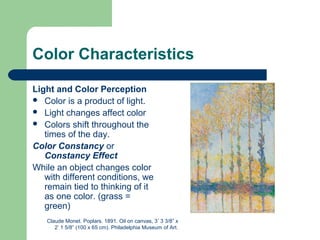
Light and Color Perception
 Color is a product of light.
 Light changes affect color
 Colors shift throughout the
times of the day.
Color Constancy or
Constancy Effect
While an object changes color
with different conditions, we
remain tied to thinking of it
as one color. (grass =
green)
Claude Monet. Poplars. 1891. Oil on canvas, 3’ 3 3/8” x
2’ 1 5/8” (100 x 65 cm). Philadelphia Museum of Art.
Color and its Surroundings
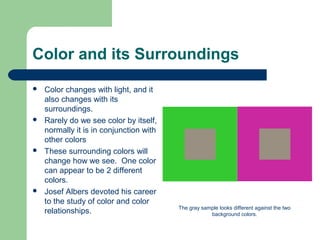
 Color changes with light, and it
also changes with its
surroundings.
 Rarely do we see color by itself,
normally it is in conjunction with
other colors
 These surrounding colors will
change how we see. One color
can appear to be 2 different
colors.
 Josef Albers devoted his career
to the study of color and color
relationships. The gray sample looks different against the two
background colors.
The 3 Properties of Color
Hue
Value
Intensity/Complementary
Colors
Properties of Color: Hue
First property of Color
Hue – Refers to the name of the color
 Example: Pink, scarlet, maroon and
crimson are all a hue of Red.
 There are few hues but there are many
colors.
 The same hue or color can have many
different names. This is especially true
in the world of commercial products.
(Think color names of cars, shirts, etc.)
Color Wheel
The most common organization
for the relationship of the
basic colors is the color
wheel. (Wheel system
dates from the 18th
century.)
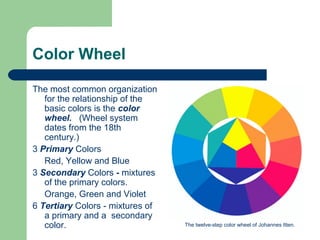
3 Primary Colors
Red, Yellow and Blue
3 Secondary Colors - mixtures
of the primary colors.
Orange, Green and Violet
6 Tertiary Colors - mixtures of
a primary and a secondary
color. The twelve-step color wheel of Johannes Itten.
Properties of Color: Value
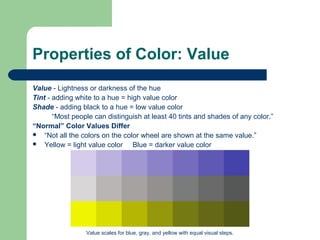
Value - Lightness or darkness of the hue
Tint - adding white to a hue = high value color
Shade - adding black to a hue = low value color
“Most people can distinguish at least 40 tints and shades of any color.”
“Normal” Color Values Differ
 “Not all the colors on the color wheel are shown at the same value.”
 Yellow = light value color Blue = darker value color
Value scales for blue, gray, and yellow with equal visual steps.
Properties of Color: Value
Changing Color Value
 When working with paint you can thin
a color by adding medium.
 The more transparent a color is, the
lighter it’s value placed over white.
 You can also alter the value by mixing
hues together.
 Value, just like color, is changed by its
surroundings.
Color Properties
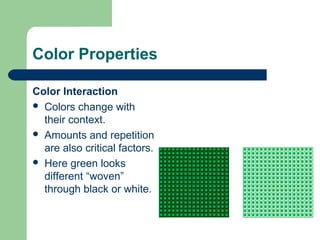
Color Interaction
 Colors change with
their context.
 Amounts and repetition
are also critical factors.
 Here green looks
different “woven”
through black or white.
Properties of Color:
Intensity/Complementary Colors
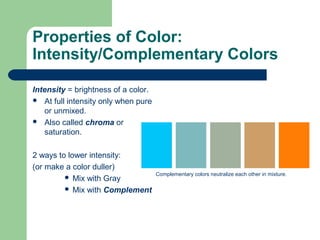
Intensity = brightness of a color.
 At full intensity only when pure
or unmixed.
 Also called chroma or
saturation.
2 ways to lower intensity:
(or make a color duller)
 Mix with Gray
 Mix with Complement
Complementary colors neutralize each other in mixture.
Intensity/Complementary Colors
To Make Brighter use:
 Simultaneous contrast – when 2
compliments are placed next to each other,
they increase in visual brilliance, usually with
a vibrating edge.
A visual phenomenon:
 Afterimage effect – when you stare at an
intense color for a minute or so and then look
away, you will see the complementary color
Mixing Light:
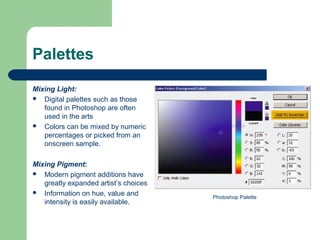
 Digital palettes such as those
found in Photoshop are often
used in the arts
 Colors can be mixed by numeric
percentages or picked from an
onscreen sample.
Mixing Pigment:
 Modern pigment additions have
greatly expanded artist’s choices
 Information on hue, value and
intensity is easily available.
Palettes
Photoshop Palette
Visual Color Mixing
Techniques that suggest light
Visual Color Mixing Techniques:
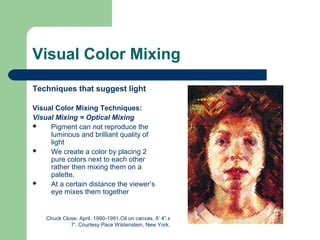
Visual Mixing = Optical Mixing
 Pigment can not reproduce the
luminous and brilliant quality of
light
 We create a color by placing 2
pure colors next to each other
rather then mixing them on a
palette.
 At a certain distance the viewer’s
eye mixes them together
Chuck Close. April. 1990-1991.Oil on canvas, 8’ 4” x
7’. Courtesy Pace Wildenstein, New York.
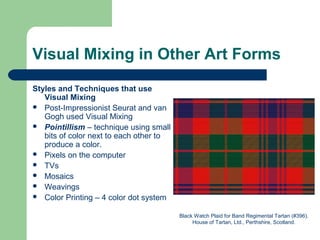
Visual Mixing in Other Art Forms
Styles and Techniques that use
Visual Mixing
 Post-Impressionist Seurat and van
Gogh used Visual Mixing
 Pointillism – technique using small
bits of color next to each other to
produce a color.
 Pixels on the computer
 TVs
 Mosaics
 Weavings
 Color Printing – 4 color dot system
Black Watch Plaid for Band Regimental Tartan (#396).
House of Tartan, Ltd., Perthshire, Scotland.
Cool/Warm Colors
Color as physical sensation:
Cool Colors –Blue, Green, Violet
 Cool colors recedes
 Represents – Sky, Water,
Grass, Plants
Warm Colors – Red, Orange,
Yellow
 Warm colors come forward
 Represent – Fire, sun and heat
Cool/Warm Colors
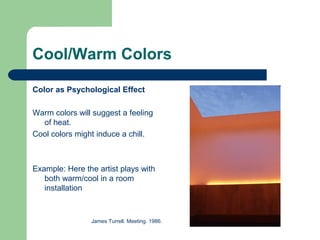
Color as Psychological Effect
Warm colors will suggest a feeling
of heat.
Cool colors might induce a chill.
Example: Here the artist plays with
both warm/cool in a room
installation
James Turrell. Meeting. 1986.
Cool/Warm Colors
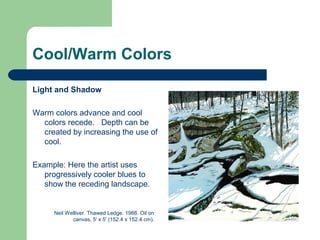
Light and Shadow
Warm colors advance and cool
colors recede. Depth can be
created by increasing the use of
cool.
Example: Here the artist uses
progressively cooler blues to
show the receding landscape.
Neil Welliver. Thawed Ledge. 1988. Oil on
canvas, 5' x 5' (152.4 x 152.4 cm).
Color as Emphasis
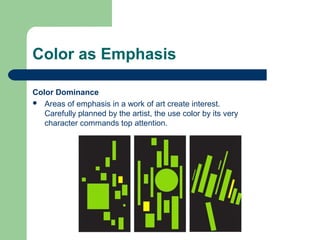
Color Dominance
 Areas of emphasis in a work of art create interest.
Carefully planned by the artist, the use color by its very
character commands top attention.
Color as Emphasis
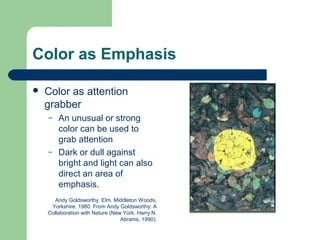
 Color as attention
grabber
– An unusual or strong
color can be used to
grab attention
– Dark or dull against
bright and light can also
direct an area of
emphasis.
Andy Goldsworthy. Elm. Middleton Woods,
Yorkshire. 1980. From Andy Goldsworthy: A
Collaboration with Nature (New York: Harry N.
Abrams, 1990).
Color and Balance
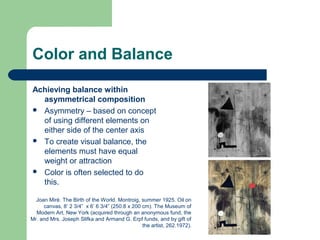
Achieving balance within
asymmetrical composition
 Asymmetry – based on concept
of using different elements on
either side of the center axis
 To create visual balance, the
elements must have equal
weight or attraction
 Color is often selected to do
this.
Joan Miré. The Birth of the World. Montroig, summer 1925. Oil on
canvas, 8’ 2 3/4” x 6’ 6 3/4” (250.8 x 200 cm). The Museum of
Modern Art, New York (acquired through an anonymous fund, the
Mr. and Mrs. Joseph Slifka and Armand G. Erpf funds, and by gift of
the artist, 262.1972).
Color and Balance
Dynamics of Balance and
Imbalance
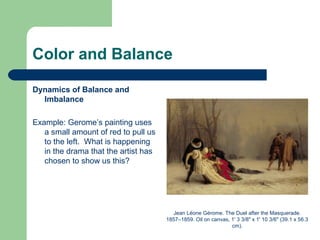
Example: Gerome’s painting uses
a small amount of red to pull us
to the left. What is happening
in the drama that the artist has
chosen to show us this?
Jean Léone Gérome. The Duel after the Masquerade.
1857–1859. Oil on canvas, 1' 3 3/8" x 1' 10 3/6" (39.1 x 56.3
cm).
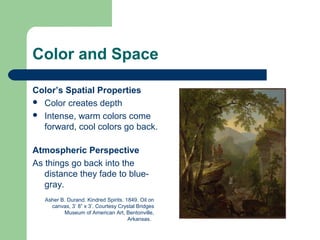
Color and Space
Color’s Spatial Properties
 Color creates depth
 Intense, warm colors come
forward, cool colors go back.
Atmospheric Perspective
As things go back into the
distance they fade to blue-
gray.
Asher B. Durand. Kindred Spirits. 1849. Oil on
canvas, 3’ 8” x 3’. Courtesy Crystal Bridges
Museum of American Art, Bentonville,
Arkansas.
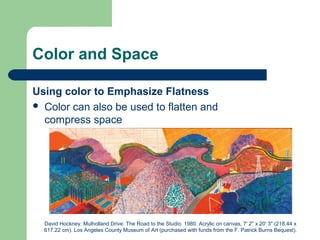
Color and Space
Using color to Emphasize Flatness
 Color can also be used to flatten and
compress space
David Hockney. Mulholland Drive: The Road to the Studio. 1980. Acrylic on canvas, 7' 2" x 20' 3" (218.44 x
617.22 cm). Los Angeles County Museum of Art (purchased with funds from the F. Patrick Burns Bequest).
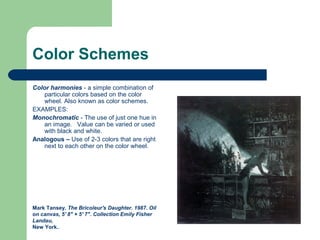
Color Schemes
Color harmonies - a simple combination of
particular colors based on the color
wheel. Also known as color schemes.
EXAMPLES:
Monochromatic - The use of just one hue in
an image. Value can be varied or used
with black and white.
Analogous – Use of 2-3 colors that are right
next to each other on the color wheel.
Mark Tansey. The Bricoleur's Daughter. 1987. Oil
on canvas, 5' 8" × 5' 7". Collection Emily Fisher
Landau,
New York..
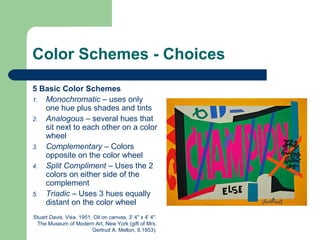
Color Schemes - Choices
5 Basic Color Schemes
1. Monochromatic – uses only
one hue plus shades and tints
2. Analogous – several hues that
sit next to each other on a color
wheel
3. Complementary – Colors
opposite on the color wheel
4. Split Compliment – Uses the 2
colors on either side of the
complement
5. Triadic – Uses 3 hues equally
distant on the color wheel
Stuart Davis. Visa. 1951. Oil on canvas, 3' 4" x 4' 4".
The Museum of Modern Art, New York (gift of Mrs.
Gertrud A. Mellon, 9.1953).
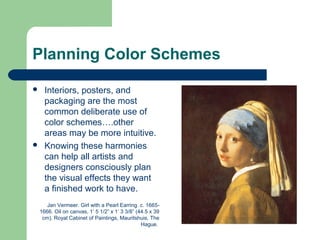
Planning Color Schemes
 Interiors, posters, and
packaging are the most
common deliberate use of
color schemes….other
areas may be more intuitive.
 Knowing these harmonies
can help all artists and
designers consciously plan
the visual effects they want
a finished work to have.
Jan Vermeer. Girl with a Pearl Earring. c. 1665-
1666. Oil on canvas, 1’ 5 1/2” x 1’ 3 3/8” (44.5 x 39
cm). Royal Cabinet of Paintings, Mauritshuis, The
Hague.
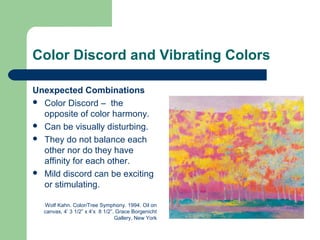
Color Discord and Vibrating Colors
Unexpected Combinations
 Color Discord – the
opposite of color harmony.
 Can be visually disturbing.
 They do not balance each
other nor do they have
affinity for each other.
 Mild discord can be exciting
or stimulating.
Wolf Kahn. Color/Tree Symphony. 1994. Oil on
canvas, 4’ 3 1/2” x 4’x 8 1/2”. Grace Borgenicht
Gallery, New York
Color Discord and Vibrating Colors
Using Discord to add Interest
 Mild discord results in exciting, eye-catching
combinations
 The fashion world exploits this concept so discordant is
commonplace and acceptable
 Discordant color = visual surprise
 Rules about what “goes together” seem outdated and
silly.
 We approach color more freely today, seeking
unexpected and unusual color combinations
Color Discord and Vibrating Colors
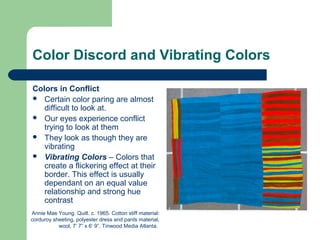
Colors in Conflict
 Certain color paring are almost
difficult to look at.
 Our eyes experience conflict
trying to look at them
 They look as though they are
vibrating
 Vibrating Colors – Colors that
create a flickering effect at their
border. This effect is usually
dependant on an equal value
relationship and strong hue
contrast
Annie Mae Young. Quilt. c. 1965. Cotton stiff material:
corduroy sheeting, polyester dress and pants material,
wool, 7’ 7” x 6’ 9”. Tinwood Media Atlanta.
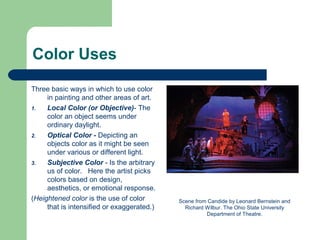
Color Uses
Three basic ways in which to use color
in painting and other areas of art.
1. Local Color (or Objective)- The
color an object seems under
ordinary daylight.
2. Optical Color - Depicting an
objects color as it might be seen
under various or different light.
3. Subjective Color - Is the arbitrary
us of color. Here the artist picks
colors based on design,
aesthetics, or emotional response.
(Heightened color is the use of color
that is intensified or exaggerated.)
Scene from Candide by Leonard Bernstein and
Richard Wilbur. The Ohio State University
Department of Theatre.
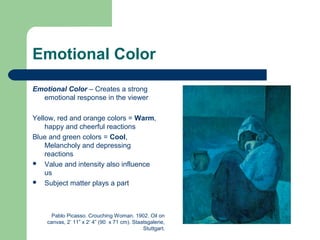
Emotional Color
Emotional Color – Creates a strong
emotional response in the viewer
Yellow, red and orange colors = Warm,
happy and cheerful reactions
Blue and green colors = Cool,
Melancholy and depressing
reactions
 Value and intensity also influence
us
 Subject matter plays a part
Pablo Picasso. Crouching Woman. 1902. Oil on
canvas, 2’ 11” x 2’ 4” (90 x 71 cm). Staatsgalerie,
Stuttgart.
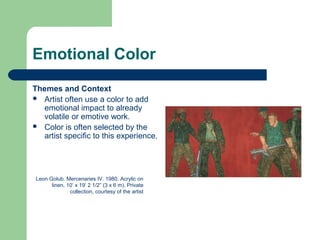
Emotional Color
Themes and Context
 Artist often use a color to add
emotional impact to already
volatile or emotive work.
 Color is often selected by the
artist specific to this experience.
Leon Golub. Mercenaries IV. 1980. Acrylic on
linen, 10’ x 19’ 2 1/2” (3 x 6 m). Private
collection, courtesy of the artist
Color Symbolism
 Conceptual Qualities of Color
He is true-blue.
Caught him red-handed.
She told a white lie.
Color Can represent a concept or idea like sin,
greed, cowardice, etc. This is a mental or
conceptual idea.
Color Symbolism
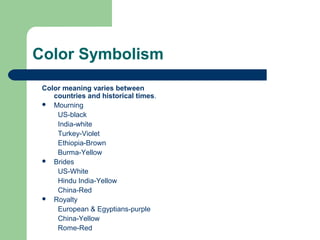
Color meaning varies between
countries and historical times.
 Mourning
US-black
India-white
Turkey-Violet
Ethiopia-Brown
Burma-Yellow
 Brides
US-White
Hindu India-Yellow
China-Red
 Royalty
European & Egyptians-purple
China-Yellow
Rome-Red
Color Symbolism
Symbolic Color Today
 Symbolic color is associated with
political, religious and commercial
messages
 Examples to think about: Green
may mean environmental
responsibility or black denote
sophistication or a premium brand.
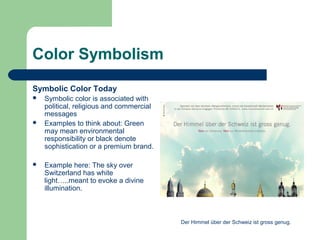
 Example here: The sky over
Switzerland has white
light…..meant to evoke a divine
illumination.
Der Himmel über der Schweiz ist gross genug.

Chapter 13 color

  • 1.
  • 2.
    Color Theory  Everydecision from clothes selection to home/work environment is a color choice.  The study of color is complex.  Everyone can profit from the knowing some basic color principles.
  • 3.
    The Essentials  Lightis made of all colors (Sir Isaac Newton put white light through a prism = colors)  Color is a property of light.  Objects have no color of their own, they just reflect a particular wavelength from the color spectrum. (For example a blue object absorbs all of the wavelengths, EXCEPT the blue ones, thus the blue ones are reflected back to our eyes.  Black absorbs all the wave lengths of the color spectrum.  White reflects all the wave lengths of the color spectrum.
  • 4.
    Color Mixing Additive System– Color is created from projected light. (Example: theater lighting, photography, interior design, etc.) (The primary colors mix to create white in an additive system.) Subtractive System – Color is created from pigments, (Painting, drawing, etc…) The primary colors mix to create neutral gray or black. Color Wheel – most common organization for color Primary Colors – Subtractive Color: – Red – Blue – Yellow
  • 5.
    Color Characteristics Light andColor Perception  Color is a product of light.  Light changes affect color  Colors shift throughout the times of the day. Color Constancy or Constancy Effect While an object changes color with different conditions, we remain tied to thinking of it as one color. (grass = green) Claude Monet. Poplars. 1891. Oil on canvas, 3’ 3 3/8” x 2’ 1 5/8” (100 x 65 cm). Philadelphia Museum of Art.
  • 6.
    Color and itsSurroundings  Color changes with light, and it also changes with its surroundings.  Rarely do we see color by itself, normally it is in conjunction with other colors  These surrounding colors will change how we see. One color can appear to be 2 different colors.  Josef Albers devoted his career to the study of color and color relationships. The gray sample looks different against the two background colors.
  • 7.
    The 3 Propertiesof Color Hue Value Intensity/Complementary Colors
  • 8.
    Properties of Color:Hue First property of Color Hue – Refers to the name of the color  Example: Pink, scarlet, maroon and crimson are all a hue of Red.  There are few hues but there are many colors.  The same hue or color can have many different names. This is especially true in the world of commercial products. (Think color names of cars, shirts, etc.)
  • 9.
    Color Wheel The mostcommon organization for the relationship of the basic colors is the color wheel. (Wheel system dates from the 18th century.) 3 Primary Colors Red, Yellow and Blue 3 Secondary Colors - mixtures of the primary colors. Orange, Green and Violet 6 Tertiary Colors - mixtures of a primary and a secondary color. The twelve-step color wheel of Johannes Itten.
  • 10.
    Properties of Color:Value Value - Lightness or darkness of the hue Tint - adding white to a hue = high value color Shade - adding black to a hue = low value color “Most people can distinguish at least 40 tints and shades of any color.” “Normal” Color Values Differ  “Not all the colors on the color wheel are shown at the same value.”  Yellow = light value color Blue = darker value color Value scales for blue, gray, and yellow with equal visual steps.
  • 11.
    Properties of Color:Value Changing Color Value  When working with paint you can thin a color by adding medium.  The more transparent a color is, the lighter it’s value placed over white.  You can also alter the value by mixing hues together.  Value, just like color, is changed by its surroundings.
  • 12.
    Color Properties Color Interaction Colors change with their context.  Amounts and repetition are also critical factors.  Here green looks different “woven” through black or white.
  • 13.
    Properties of Color: Intensity/ComplementaryColors Intensity = brightness of a color.  At full intensity only when pure or unmixed.  Also called chroma or saturation. 2 ways to lower intensity: (or make a color duller)  Mix with Gray  Mix with Complement Complementary colors neutralize each other in mixture.
  • 14.
    Intensity/Complementary Colors To MakeBrighter use:  Simultaneous contrast – when 2 compliments are placed next to each other, they increase in visual brilliance, usually with a vibrating edge. A visual phenomenon:  Afterimage effect – when you stare at an intense color for a minute or so and then look away, you will see the complementary color
  • 15.
    Mixing Light:  Digitalpalettes such as those found in Photoshop are often used in the arts  Colors can be mixed by numeric percentages or picked from an onscreen sample. Mixing Pigment:  Modern pigment additions have greatly expanded artist’s choices  Information on hue, value and intensity is easily available. Palettes Photoshop Palette
  • 16.
    Visual Color Mixing Techniquesthat suggest light Visual Color Mixing Techniques: Visual Mixing = Optical Mixing  Pigment can not reproduce the luminous and brilliant quality of light  We create a color by placing 2 pure colors next to each other rather then mixing them on a palette.  At a certain distance the viewer’s eye mixes them together Chuck Close. April. 1990-1991.Oil on canvas, 8’ 4” x 7’. Courtesy Pace Wildenstein, New York.
  • 17.
    Visual Mixing inOther Art Forms Styles and Techniques that use Visual Mixing  Post-Impressionist Seurat and van Gogh used Visual Mixing  Pointillism – technique using small bits of color next to each other to produce a color.  Pixels on the computer  TVs  Mosaics  Weavings  Color Printing – 4 color dot system Black Watch Plaid for Band Regimental Tartan (#396). House of Tartan, Ltd., Perthshire, Scotland.
  • 18.
    Cool/Warm Colors Color asphysical sensation: Cool Colors –Blue, Green, Violet  Cool colors recedes  Represents – Sky, Water, Grass, Plants Warm Colors – Red, Orange, Yellow  Warm colors come forward  Represent – Fire, sun and heat
  • 19.
    Cool/Warm Colors Color asPsychological Effect Warm colors will suggest a feeling of heat. Cool colors might induce a chill. Example: Here the artist plays with both warm/cool in a room installation James Turrell. Meeting. 1986.
  • 20.
    Cool/Warm Colors Light andShadow Warm colors advance and cool colors recede. Depth can be created by increasing the use of cool. Example: Here the artist uses progressively cooler blues to show the receding landscape. Neil Welliver. Thawed Ledge. 1988. Oil on canvas, 5' x 5' (152.4 x 152.4 cm).
  • 21.
    Color as Emphasis ColorDominance  Areas of emphasis in a work of art create interest. Carefully planned by the artist, the use color by its very character commands top attention.
  • 22.
    Color as Emphasis Color as attention grabber – An unusual or strong color can be used to grab attention – Dark or dull against bright and light can also direct an area of emphasis. Andy Goldsworthy. Elm. Middleton Woods, Yorkshire. 1980. From Andy Goldsworthy: A Collaboration with Nature (New York: Harry N. Abrams, 1990).
  • 23.
    Color and Balance Achievingbalance within asymmetrical composition  Asymmetry – based on concept of using different elements on either side of the center axis  To create visual balance, the elements must have equal weight or attraction  Color is often selected to do this. Joan Miré. The Birth of the World. Montroig, summer 1925. Oil on canvas, 8’ 2 3/4” x 6’ 6 3/4” (250.8 x 200 cm). The Museum of Modern Art, New York (acquired through an anonymous fund, the Mr. and Mrs. Joseph Slifka and Armand G. Erpf funds, and by gift of the artist, 262.1972).
  • 24.
    Color and Balance Dynamicsof Balance and Imbalance Example: Gerome’s painting uses a small amount of red to pull us to the left. What is happening in the drama that the artist has chosen to show us this? Jean Léone Gérome. The Duel after the Masquerade. 1857–1859. Oil on canvas, 1' 3 3/8" x 1' 10 3/6" (39.1 x 56.3 cm).
  • 25.
    Color and Space Color’sSpatial Properties  Color creates depth  Intense, warm colors come forward, cool colors go back. Atmospheric Perspective As things go back into the distance they fade to blue- gray. Asher B. Durand. Kindred Spirits. 1849. Oil on canvas, 3’ 8” x 3’. Courtesy Crystal Bridges Museum of American Art, Bentonville, Arkansas.
  • 26.
    Color and Space Usingcolor to Emphasize Flatness  Color can also be used to flatten and compress space David Hockney. Mulholland Drive: The Road to the Studio. 1980. Acrylic on canvas, 7' 2" x 20' 3" (218.44 x 617.22 cm). Los Angeles County Museum of Art (purchased with funds from the F. Patrick Burns Bequest).
  • 27.
    Color Schemes Color harmonies- a simple combination of particular colors based on the color wheel. Also known as color schemes. EXAMPLES: Monochromatic - The use of just one hue in an image. Value can be varied or used with black and white. Analogous – Use of 2-3 colors that are right next to each other on the color wheel. Mark Tansey. The Bricoleur's Daughter. 1987. Oil on canvas, 5' 8" × 5' 7". Collection Emily Fisher Landau, New York..
  • 28.
    Color Schemes -Choices 5 Basic Color Schemes 1. Monochromatic – uses only one hue plus shades and tints 2. Analogous – several hues that sit next to each other on a color wheel 3. Complementary – Colors opposite on the color wheel 4. Split Compliment – Uses the 2 colors on either side of the complement 5. Triadic – Uses 3 hues equally distant on the color wheel Stuart Davis. Visa. 1951. Oil on canvas, 3' 4" x 4' 4". The Museum of Modern Art, New York (gift of Mrs. Gertrud A. Mellon, 9.1953).
  • 29.
    Planning Color Schemes Interiors, posters, and packaging are the most common deliberate use of color schemes….other areas may be more intuitive.  Knowing these harmonies can help all artists and designers consciously plan the visual effects they want a finished work to have. Jan Vermeer. Girl with a Pearl Earring. c. 1665- 1666. Oil on canvas, 1’ 5 1/2” x 1’ 3 3/8” (44.5 x 39 cm). Royal Cabinet of Paintings, Mauritshuis, The Hague.
  • 30.
    Color Discord andVibrating Colors Unexpected Combinations  Color Discord – the opposite of color harmony.  Can be visually disturbing.  They do not balance each other nor do they have affinity for each other.  Mild discord can be exciting or stimulating. Wolf Kahn. Color/Tree Symphony. 1994. Oil on canvas, 4’ 3 1/2” x 4’x 8 1/2”. Grace Borgenicht Gallery, New York
  • 31.
    Color Discord andVibrating Colors Using Discord to add Interest  Mild discord results in exciting, eye-catching combinations  The fashion world exploits this concept so discordant is commonplace and acceptable  Discordant color = visual surprise  Rules about what “goes together” seem outdated and silly.  We approach color more freely today, seeking unexpected and unusual color combinations
  • 32.
    Color Discord andVibrating Colors Colors in Conflict  Certain color paring are almost difficult to look at.  Our eyes experience conflict trying to look at them  They look as though they are vibrating  Vibrating Colors – Colors that create a flickering effect at their border. This effect is usually dependant on an equal value relationship and strong hue contrast Annie Mae Young. Quilt. c. 1965. Cotton stiff material: corduroy sheeting, polyester dress and pants material, wool, 7’ 7” x 6’ 9”. Tinwood Media Atlanta.
  • 33.
    Color Uses Three basicways in which to use color in painting and other areas of art. 1. Local Color (or Objective)- The color an object seems under ordinary daylight. 2. Optical Color - Depicting an objects color as it might be seen under various or different light. 3. Subjective Color - Is the arbitrary us of color. Here the artist picks colors based on design, aesthetics, or emotional response. (Heightened color is the use of color that is intensified or exaggerated.) Scene from Candide by Leonard Bernstein and Richard Wilbur. The Ohio State University Department of Theatre.
  • 34.
    Emotional Color Emotional Color– Creates a strong emotional response in the viewer Yellow, red and orange colors = Warm, happy and cheerful reactions Blue and green colors = Cool, Melancholy and depressing reactions  Value and intensity also influence us  Subject matter plays a part Pablo Picasso. Crouching Woman. 1902. Oil on canvas, 2’ 11” x 2’ 4” (90 x 71 cm). Staatsgalerie, Stuttgart.
  • 35.
    Emotional Color Themes andContext  Artist often use a color to add emotional impact to already volatile or emotive work.  Color is often selected by the artist specific to this experience. Leon Golub. Mercenaries IV. 1980. Acrylic on linen, 10’ x 19’ 2 1/2” (3 x 6 m). Private collection, courtesy of the artist
  • 36.
    Color Symbolism  ConceptualQualities of Color He is true-blue. Caught him red-handed. She told a white lie. Color Can represent a concept or idea like sin, greed, cowardice, etc. This is a mental or conceptual idea.
  • 37.
    Color Symbolism Color meaningvaries between countries and historical times.  Mourning US-black India-white Turkey-Violet Ethiopia-Brown Burma-Yellow  Brides US-White Hindu India-Yellow China-Red  Royalty European & Egyptians-purple China-Yellow Rome-Red
  • 38.
    Color Symbolism Symbolic ColorToday  Symbolic color is associated with political, religious and commercial messages  Examples to think about: Green may mean environmental responsibility or black denote sophistication or a premium brand.  Example here: The sky over Switzerland has white light…..meant to evoke a divine illumination. Der Himmel über der Schweiz ist gross genug.