Design Principles
Chapter 5: Balance
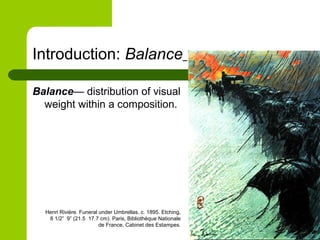
Introduction: Balance
Balance— distribution of visual
weight within a composition.
Henri Rivière. Funeral under Umbrellas. c. 1895. Etching,
8 1/2” 9” (21.5 17.7 cm). Paris, Bibliothèque Nationale
de France, Cabinet des Estampes.
Pictorial Balance
Axis - A line of reference around
which a form or composition is
balanced.
 Often this a vertical line down
the center of a piece that we
use to determine balance.
Equilibrium - Visual balance
between opposing
compositional elements.
(When the 2 sides of an image
feel balanced.)
 When equilibrium is lacking in
a piece often a certain
uneasiness or dissatisfaction
results.
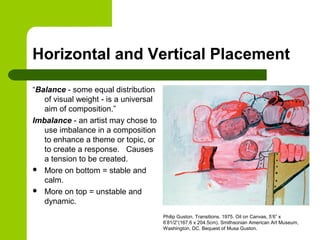
Horizontal and Vertical Placement
“Balance - some equal distribution
of visual weight - is a universal
aim of composition.”
Imbalance - an artist may chose to
use imbalance in a composition
to enhance a theme or topic, or
to create a response. Causes
a tension to be created.
 More on bottom = stable and
calm.
 More on top = unstable and
dynamic.
Philip Guston. Transitions. 1975. Oil on Canvas, 5’6” x
6’81/2”(167.6 x 204.5cm). Smithsonian American Art Museum,
Washington, DC. Bequest of Musa Guston.
The 4 Types of Balance:
I. Symmetrical Balance
II. Asymmetrical Balance
III. Radial Balance
IV. Crystallographic
Balance
(or Allover Pattern)
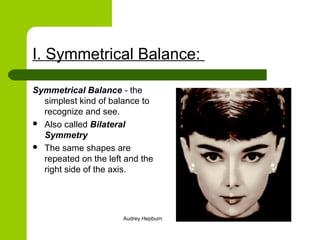
I. Symmetrical Balance:
Symmetrical Balance - the
simplest kind of balance to
recognize and see.
 Also called Bilateral
Symmetry
 The same shapes are
repeated on the left and the
right side of the axis.
Audrey Hepburn
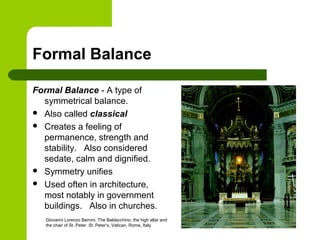
Formal Balance
Formal Balance - A type of
symmetrical balance.
 Also called classical
 Creates a feeling of
permanence, strength and
stability. Also considered
sedate, calm and dignified.
 Symmetry unifies
 Used often in architecture,
most notably in government
buildings. Also in churches.
Giovanni Lorenzo Bernini. The Baldacchino, the high altar and
the chair of St. Peter. St. Peter’s, Vatican, Rome, Italy.
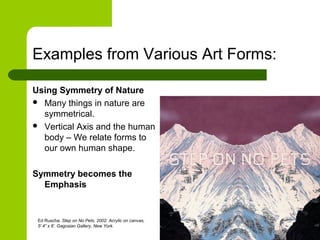
Examples from Various Art Forms:
Using Symmetry of Nature
 Many things in nature are
symmetrical.
 Vertical Axis and the human
body – We relate forms to
our own human shape.
Symmetry becomes the
Emphasis
Ed Ruscha. Step on No Pets. 2002. Acrylic on canvas,
5' 4” x 6’. Gagosian Gallery, New York.
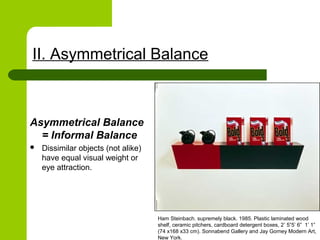
II. Asymmetrical Balance
Asymmetrical Balance
= Informal Balance
 Dissimilar objects (not alike)
have equal visual weight or
eye attraction.
Ham Steinbach. supremely black. 1985. Plastic laminated wood
shelf, ceramic pitchers, cardboard detergent boxes, 2’ 5”5’ 6” 1’ 1”
(74 x168 x33 cm). Sonnabend Gallery and Jay Gorney Modern Art,
New York.
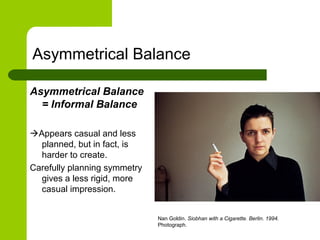
Asymmetrical Balance
= Informal Balance
Appears casual and less
planned, but in fact, is
harder to create.
Carefully planning symmetry
gives a less rigid, more
casual impression.
Nan Goldin. Siobhan with a Cigarette. Berlin. 1994.
Photograph.
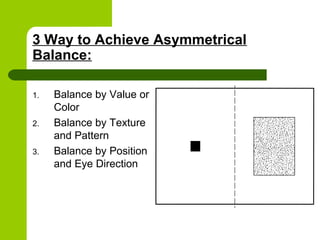
3 Way to Achieve Asymmetrical
Balance:
1. Balance by Value or
Color
2. Balance by Texture
and Pattern
3. Balance by Position
and Eye Direction
1. Balance by Value and/or Color
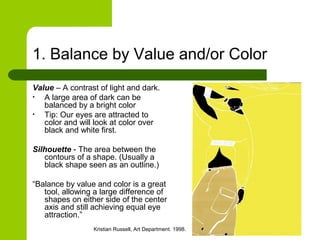
Value – A contrast of light and dark.
• A large area of dark can be
balanced by a bright color
• Tip: Our eyes are attracted to
color and will look at color over
black and white first.
Silhouette - The area between the
contours of a shape. (Usually a
black shape seen as an outline.)
“Balance by value and color is a great
tool, allowing a large difference of
shapes on either side of the center
axis and still achieving equal eye
attraction.”
Kristian Russell, Art Department. 1998.
2. Balance by Texture and Pattern
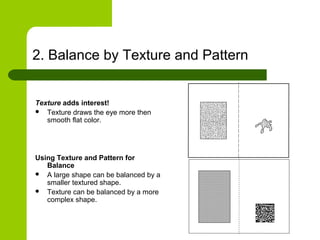
Texture adds interest!
 Texture draws the eye more then
smooth flat color.
Using Texture and Pattern for
Balance
 A large shape can be balanced by a
smaller textured shape.
 Texture can be balanced by a more
complex shape.
Example: Texture
and Pattern for
Balance
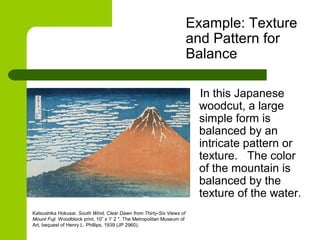
In this Japanese
woodcut, a large
simple form is
balanced by an
intricate pattern or
texture. The color
of the mountain is
balanced by the
texture of the water.
Katsushika Hokusai. South Wind, Clear Dawn from Thirty-Six Views of
Mount Fuji. Woodblock print, 10” x 1' 2 ". The Metropolitan Museum of
Art, bequest of Henry L. Phillips, 1939 (JP 2960).
3. Balance by Position and Eye Direction
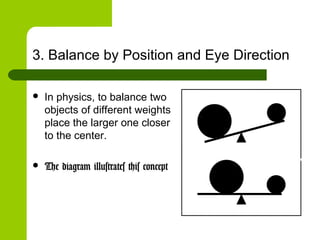
 In physics, to balance two
objects of different weights
place the larger one closer
to the center.
 The diagram illustrates this concept
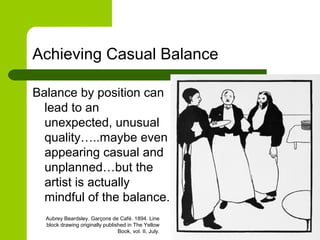
Achieving Casual Balance
Balance by position can
lead to an
unexpected, unusual
quality…..maybe even
appearing casual and
unplanned…but the
artist is actually
mindful of the balance.
Aubrey Beardsley. Garçons de Café. 1894. Line
block drawing originally published in The Yellow
Book, vol. II, July.
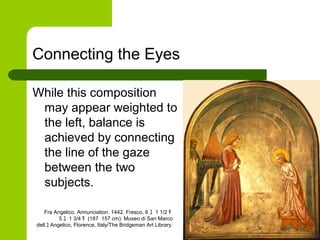
Connecting the Eyes
While this composition
may appear weighted to
the left, balance is
achieved by connecting
the line of the gaze
between the two
subjects.
Fra Angelico. Annunciation. 1442. Fresco, 6 ユ 1 1/2 モ
5 ユ 1 3/4 モ (187 157 cm). Museo di San Marco
dell ユ Angelico, Florence, Italy/The Bridgeman Art Library.
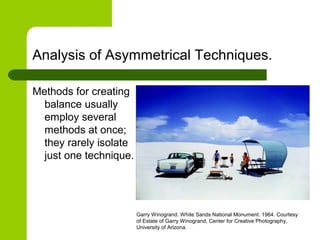
Analysis of Asymmetrical Techniques.
Methods for creating
balance usually
employ several
methods at once;
they rarely isolate
just one technique.
Garry Winogrand. White Sands National Monument. 1964. Courtesy
of Estate of Garry Winogrand, Center for Creative Photography,
University of Arizona.
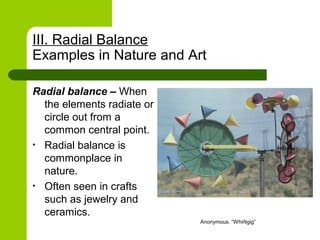
III. Radial Balance
Examples in Nature and Art
Radial balance – When
the elements radiate or
circle out from a
common central point.
• Radial balance is
commonplace in
nature.
• Often seen in crafts
such as jewelry and
ceramics.
Anonymous. “Whirligig”
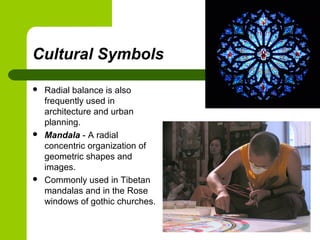
Cultural Symbols
 Radial balance is also
frequently used in
architecture and urban
planning.
 Mandala - A radial
concentric organization of
geometric shapes and
images.
 Commonly used in Tibetan
mandalas and in the Rose
windows of gothic churches.
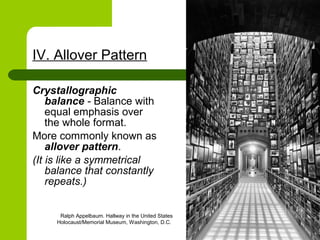
Crystallographic
balance - Balance with
equal emphasis over
the whole format.
More commonly known as
allover pattern.
(It is like a symmetrical
balance that constantly
repeats.)
IV. Allover Pattern
Ralph Appelbaum. Hallway in the United States
Holocaust/Memorial Museum, Washington, D.C.

Chapter 5 balance

  • 1.
  • 2.
    Introduction: Balance Balance— distributionof visual weight within a composition. Henri Rivière. Funeral under Umbrellas. c. 1895. Etching, 8 1/2” 9” (21.5 17.7 cm). Paris, Bibliothèque Nationale de France, Cabinet des Estampes.
  • 3.
    Pictorial Balance Axis -A line of reference around which a form or composition is balanced.  Often this a vertical line down the center of a piece that we use to determine balance. Equilibrium - Visual balance between opposing compositional elements. (When the 2 sides of an image feel balanced.)  When equilibrium is lacking in a piece often a certain uneasiness or dissatisfaction results.
  • 4.
    Horizontal and VerticalPlacement “Balance - some equal distribution of visual weight - is a universal aim of composition.” Imbalance - an artist may chose to use imbalance in a composition to enhance a theme or topic, or to create a response. Causes a tension to be created.  More on bottom = stable and calm.  More on top = unstable and dynamic. Philip Guston. Transitions. 1975. Oil on Canvas, 5’6” x 6’81/2”(167.6 x 204.5cm). Smithsonian American Art Museum, Washington, DC. Bequest of Musa Guston.
  • 5.
    The 4 Typesof Balance: I. Symmetrical Balance II. Asymmetrical Balance III. Radial Balance IV. Crystallographic Balance (or Allover Pattern)
  • 6.
    I. Symmetrical Balance: SymmetricalBalance - the simplest kind of balance to recognize and see.  Also called Bilateral Symmetry  The same shapes are repeated on the left and the right side of the axis. Audrey Hepburn
  • 7.
    Formal Balance Formal Balance- A type of symmetrical balance.  Also called classical  Creates a feeling of permanence, strength and stability. Also considered sedate, calm and dignified.  Symmetry unifies  Used often in architecture, most notably in government buildings. Also in churches. Giovanni Lorenzo Bernini. The Baldacchino, the high altar and the chair of St. Peter. St. Peter’s, Vatican, Rome, Italy.
  • 8.
    Examples from VariousArt Forms: Using Symmetry of Nature  Many things in nature are symmetrical.  Vertical Axis and the human body – We relate forms to our own human shape. Symmetry becomes the Emphasis Ed Ruscha. Step on No Pets. 2002. Acrylic on canvas, 5' 4” x 6’. Gagosian Gallery, New York.
  • 9.
    II. Asymmetrical Balance AsymmetricalBalance = Informal Balance  Dissimilar objects (not alike) have equal visual weight or eye attraction. Ham Steinbach. supremely black. 1985. Plastic laminated wood shelf, ceramic pitchers, cardboard detergent boxes, 2’ 5”5’ 6” 1’ 1” (74 x168 x33 cm). Sonnabend Gallery and Jay Gorney Modern Art, New York.
  • 10.
    Asymmetrical Balance Asymmetrical Balance =Informal Balance Appears casual and less planned, but in fact, is harder to create. Carefully planning symmetry gives a less rigid, more casual impression. Nan Goldin. Siobhan with a Cigarette. Berlin. 1994. Photograph.
  • 11.
    3 Way toAchieve Asymmetrical Balance: 1. Balance by Value or Color 2. Balance by Texture and Pattern 3. Balance by Position and Eye Direction
  • 12.
    1. Balance byValue and/or Color Value – A contrast of light and dark. • A large area of dark can be balanced by a bright color • Tip: Our eyes are attracted to color and will look at color over black and white first. Silhouette - The area between the contours of a shape. (Usually a black shape seen as an outline.) “Balance by value and color is a great tool, allowing a large difference of shapes on either side of the center axis and still achieving equal eye attraction.” Kristian Russell, Art Department. 1998.
  • 13.
    2. Balance byTexture and Pattern Texture adds interest!  Texture draws the eye more then smooth flat color. Using Texture and Pattern for Balance  A large shape can be balanced by a smaller textured shape.  Texture can be balanced by a more complex shape.
  • 14.
    Example: Texture and Patternfor Balance In this Japanese woodcut, a large simple form is balanced by an intricate pattern or texture. The color of the mountain is balanced by the texture of the water. Katsushika Hokusai. South Wind, Clear Dawn from Thirty-Six Views of Mount Fuji. Woodblock print, 10” x 1' 2 ". The Metropolitan Museum of Art, bequest of Henry L. Phillips, 1939 (JP 2960).
  • 15.
    3. Balance byPosition and Eye Direction  In physics, to balance two objects of different weights place the larger one closer to the center.  The diagram illustrates this concept
  • 16.
    Achieving Casual Balance Balanceby position can lead to an unexpected, unusual quality…..maybe even appearing casual and unplanned…but the artist is actually mindful of the balance. Aubrey Beardsley. Garçons de Café. 1894. Line block drawing originally published in The Yellow Book, vol. II, July.
  • 17.
    Connecting the Eyes Whilethis composition may appear weighted to the left, balance is achieved by connecting the line of the gaze between the two subjects. Fra Angelico. Annunciation. 1442. Fresco, 6 ユ 1 1/2 モ 5 ユ 1 3/4 モ (187 157 cm). Museo di San Marco dell ユ Angelico, Florence, Italy/The Bridgeman Art Library.
  • 18.
    Analysis of AsymmetricalTechniques. Methods for creating balance usually employ several methods at once; they rarely isolate just one technique. Garry Winogrand. White Sands National Monument. 1964. Courtesy of Estate of Garry Winogrand, Center for Creative Photography, University of Arizona.
  • 19.
    III. Radial Balance Examplesin Nature and Art Radial balance – When the elements radiate or circle out from a common central point. • Radial balance is commonplace in nature. • Often seen in crafts such as jewelry and ceramics. Anonymous. “Whirligig”
  • 20.
    Cultural Symbols  Radialbalance is also frequently used in architecture and urban planning.  Mandala - A radial concentric organization of geometric shapes and images.  Commonly used in Tibetan mandalas and in the Rose windows of gothic churches.
  • 21.
    Crystallographic balance - Balancewith equal emphasis over the whole format. More commonly known as allover pattern. (It is like a symmetrical balance that constantly repeats.) IV. Allover Pattern Ralph Appelbaum. Hallway in the United States Holocaust/Memorial Museum, Washington, D.C.