Design PrinciplesDesign Principles
Chapter 9: Pattern and TextureChapter 9: Pattern and Texture
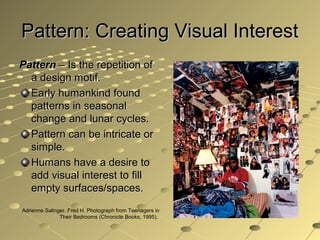
Pattern: Creating Visual InterestPattern: Creating Visual Interest
PatternPattern – Is the repetition of– Is the repetition of
a design motif.a design motif.
Early humankind foundEarly humankind found
patterns in seasonalpatterns in seasonal
change and lunar cycles.change and lunar cycles.
Pattern can be intricate orPattern can be intricate or
simple.simple.
Humans have a desire toHumans have a desire to
add visual interest to filladd visual interest to fill
empty surfaces/spaces.empty surfaces/spaces.
Adrienne Salinger. Fred H. Photograph from Teenagers in
Their Bedrooms (Chronicle Books, 1995).
Pattern: Order and VarietyPattern: Order and Variety
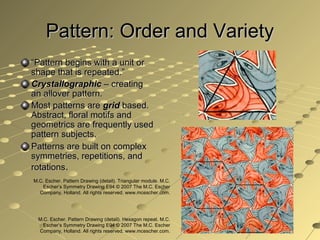
β€œβ€œPattern begins with a unit orPattern begins with a unit or
shape that is repeated.”shape that is repeated.”
CrystallographicCrystallographic – creating– creating
an allover pattern.an allover pattern.
Most patterns areMost patterns are gridgrid based.based.
Abstract, floral motifs andAbstract, floral motifs and
geometrics are frequently usedgeometrics are frequently used
pattern subjects.pattern subjects.
Patterns are built on complexPatterns are built on complex
symmetries, repetitions, andsymmetries, repetitions, and
rotationsrotations..
M.C. Escher. Pattern Drawing (detail). Triangular module. M.C.
Escher’s Symmetry Drawing E94 Β© 2007 The M.C. Escher
Company, Holland. All rights reserved. www.mcescher.com.
M.C. Escher. Pattern Drawing (detail). Hexagon repeat. M.C.
Escher’s Symmetry Drawing E94 Β© 2007 The M.C. Escher
Company, Holland. All rights reserved. www.mcescher.com.
Texture and Pattern: SimilaritiesTexture and Pattern: Similarities
and Differencesand Differences
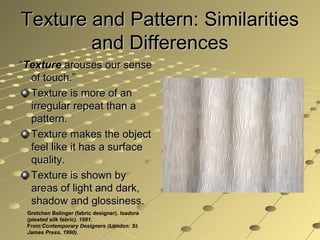
β€œβ€œTextureTexture arouses our sensearouses our sense
of touch.”of touch.”
Texture is more of anTexture is more of an
irregular repeat than airregular repeat than a
pattern.pattern.
Texture makes the objectTexture makes the object
feel like it has a surfacefeel like it has a surface
quality.quality.
Texture is shown byTexture is shown by
areas of light and dark,areas of light and dark,
shadow and glossiness.shadow and glossiness.
Gretchen Belinger (fabric designer). Isadora
(pleated silk fabric). 1981.
From Contemporary Designers (London: St.
James Press, 1990).
Creating Visual InterestCreating Visual Interest
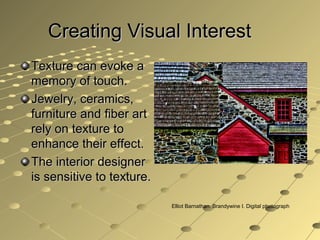
Texture can evoke aTexture can evoke a
memory of touch.memory of touch.
Jewelry, ceramics,Jewelry, ceramics,
furniture and fiber artfurniture and fiber art
rely on texture torely on texture to
enhance their effect.enhance their effect.
The interior designerThe interior designer
is sensitive to texture.is sensitive to texture.
Elliot Barnathan. Brandywine I. Digital photograph
Tactile TextureTactile Texture
Two Categories of artistic texture:Two Categories of artistic texture:
1.1. TactileTactile - can actually be felt.- can actually be felt.
2.2. ImpliedImplied - can be observed, not touched.- can be observed, not touched.
ImpastoImpasto – Creating a painting using– Creating a painting using
thick pigment which creates a rough, 3Dthick pigment which creates a rough, 3D
surface that has texture.surface that has texture.
β€œβ€œRelief” painting brings tactile textures toRelief” painting brings tactile textures to
a painting.a painting.
Actual TextureActual Texture
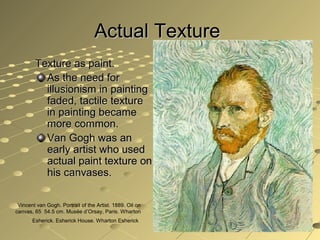
Texture as paint.Texture as paint.
As the need forAs the need for
illusionism in paintingillusionism in painting
faded, tactile texturefaded, tactile texture
in painting becamein painting became
more common.more common.
Van Gogh was anVan Gogh was an
early artist who usedearly artist who used
actual paint texture onactual paint texture on
his canvases.his canvases.
Vincent van Gogh. Portrait of the Artist. 1889. Oil on
canvas, 65 54.5 cm. MusΓ©e d’Orsay, Paris. Wharton
Esherick. Esherick House. Wharton Esherick
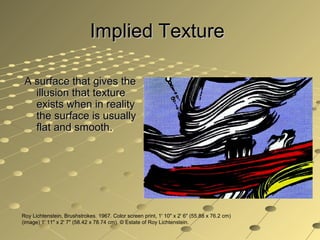
Implied TextureImplied Texture
A surface that gives theA surface that gives the
illusion that textureillusion that texture
exists when in realityexists when in reality
the surface is usuallythe surface is usually
flat and smooth.flat and smooth.
Roy Lichtenstein, Brushstrokes. 1967. Color screen print, 1' 10" x 2' 6" (55.88 x 76.2 cm)
(image) 1' 11" x 2' 7" (58.42 x 78.74 cm). Β© Estate of Roy Lichtenstein.
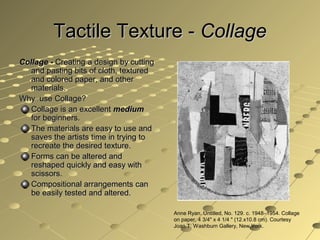
Tactile Texture -Tactile Texture - CollageCollage
Collage -Collage - Creating a design by cuttingCreating a design by cutting
and pasting bits of cloth, texturedand pasting bits of cloth, textured
and colored paper, and otherand colored paper, and other
materials.materials.
Why use Collage?Why use Collage?
Collage is an excellentCollage is an excellent mediummedium
for beginners.for beginners.
The materials are easy to use andThe materials are easy to use and
saves the artists time in trying tosaves the artists time in trying to
recreate the desired texture.recreate the desired texture.
Forms can be altered andForms can be altered and
reshaped quickly and easy withreshaped quickly and easy with
scissors.scissors.
Compositional arrangements canCompositional arrangements can
be easily tested and altered.be easily tested and altered.
Anne Ryan. Untitled, No. 129. c. 1948–1954. Collage
on paper, 4 3/4" x 4 1/4 " (12.x10.8 cm). Courtesy
Joan T. Washburn Gallery, New York.
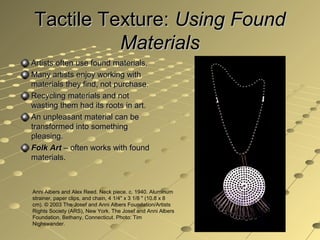
Tactile Texture:Tactile Texture: Using FoundUsing Found
MaterialsMaterials
Artists often use found materials.Artists often use found materials.
Many artists enjoy working withMany artists enjoy working with
materials they find, not purchase.materials they find, not purchase.
Recycling materials and notRecycling materials and not
wasting them had its roots in art.wasting them had its roots in art.
An unpleasant material can beAn unpleasant material can be
transformed into somethingtransformed into something
pleasing.pleasing.
Folk ArtFolk Art – often works with found– often works with found
materials.materials.
Anni Albers and Alex Reed. Neck piece. c. 1940. Aluminum
strainer, paper clips, and chain, 4 1/4" x 3 1/8 " (10.8 x 8
cm). Β© 2003 The Josef and Anni Albers Foundation/Artists
Rights Society (ARS), New York. The Josef and Anni Albers
Foundation, Bethany, Connecticut. Photo: Tim
Nighswander.
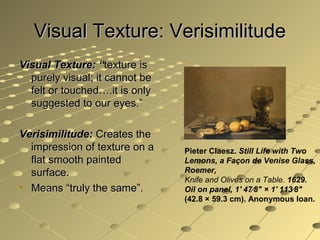
Visual Texture: VerisimilitudeVisual Texture: Verisimilitude
Visual Texture: β€œVisual Texture: β€œtexture istexture is
purely visual; it cannot bepurely visual; it cannot be
felt or touched….it is onlyfelt or touched….it is only
suggested to our eyes.”suggested to our eyes.”
Verisimilitude:Verisimilitude: Creates theCreates the
impression of texture on aimpression of texture on a
flat smooth paintedflat smooth painted
surface.surface.
β€’ Means β€œtruly the same”.Means β€œtruly the same”.
Pieter Claesz. Still Life with Two
Lemons, a FaΓ§on de Venise Glass,
Roemer,
Knife and Olives on a Table. 1629.
Oil on panel, 1' 47⁄8" Γ— 1' 113⁄8"
(42.8 Γ— 59.3 cm). Anonymous loan.
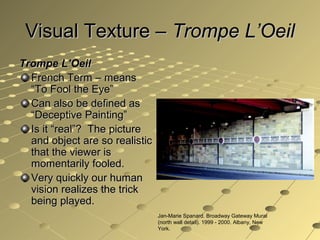
Visual Texture –Visual Texture – Trompe L’OeilTrompe L’Oeil
Trompe L’OeilTrompe L’Oeil
French Term – meansFrench Term – means
β€œTo Fool the Eyeβ€β€œTo Fool the Eye”
Can also be defined asCan also be defined as
β€œDeceptive Paintingβ€β€œDeceptive Painting”
Is it β€œreal”? The pictureIs it β€œreal”? The picture
and object are so realisticand object are so realistic
that the viewer isthat the viewer is
momentarily fooled.momentarily fooled.
Very quickly our humanVery quickly our human
vision realizes the trickvision realizes the trick
being played.being played.
Jan-Marie Spanard. Broadway Gateway Mural
(north wall detail). 1999 - 2000. Albany, New
York.
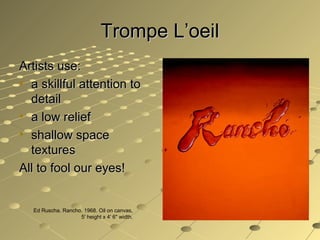
Trompe L’oeilTrompe L’oeil
Artists use:Artists use:
β€’ a skillful attention toa skillful attention to
detaildetail
β€’ a low reliefa low relief
β€’ shallow spaceshallow space
texturestextures
All to fool our eyes!All to fool our eyes!
Ed Ruscha. Rancho. 1968. Oil on canvas,
5' height x 4' 6" width.

Chapter 9 pattern and texture

  • 1.
    Design PrinciplesDesign Principles Chapter9: Pattern and TextureChapter 9: Pattern and Texture
  • 2.
    Pattern: Creating VisualInterestPattern: Creating Visual Interest PatternPattern – Is the repetition of– Is the repetition of a design motif.a design motif. Early humankind foundEarly humankind found patterns in seasonalpatterns in seasonal change and lunar cycles.change and lunar cycles. Pattern can be intricate orPattern can be intricate or simple.simple. Humans have a desire toHumans have a desire to add visual interest to filladd visual interest to fill empty surfaces/spaces.empty surfaces/spaces. Adrienne Salinger. Fred H. Photograph from Teenagers in Their Bedrooms (Chronicle Books, 1995).
  • 3.
    Pattern: Order andVarietyPattern: Order and Variety β€œβ€œPattern begins with a unit orPattern begins with a unit or shape that is repeated.”shape that is repeated.” CrystallographicCrystallographic – creating– creating an allover pattern.an allover pattern. Most patterns areMost patterns are gridgrid based.based. Abstract, floral motifs andAbstract, floral motifs and geometrics are frequently usedgeometrics are frequently used pattern subjects.pattern subjects. Patterns are built on complexPatterns are built on complex symmetries, repetitions, andsymmetries, repetitions, and rotationsrotations.. M.C. Escher. Pattern Drawing (detail). Triangular module. M.C. Escher’s Symmetry Drawing E94 Β© 2007 The M.C. Escher Company, Holland. All rights reserved. www.mcescher.com. M.C. Escher. Pattern Drawing (detail). Hexagon repeat. M.C. Escher’s Symmetry Drawing E94 Β© 2007 The M.C. Escher Company, Holland. All rights reserved. www.mcescher.com.
  • 4.
    Texture and Pattern:SimilaritiesTexture and Pattern: Similarities and Differencesand Differences β€œβ€œTextureTexture arouses our sensearouses our sense of touch.”of touch.” Texture is more of anTexture is more of an irregular repeat than airregular repeat than a pattern.pattern. Texture makes the objectTexture makes the object feel like it has a surfacefeel like it has a surface quality.quality. Texture is shown byTexture is shown by areas of light and dark,areas of light and dark, shadow and glossiness.shadow and glossiness. Gretchen Belinger (fabric designer). Isadora (pleated silk fabric). 1981. From Contemporary Designers (London: St. James Press, 1990).
  • 5.
    Creating Visual InterestCreatingVisual Interest Texture can evoke aTexture can evoke a memory of touch.memory of touch. Jewelry, ceramics,Jewelry, ceramics, furniture and fiber artfurniture and fiber art rely on texture torely on texture to enhance their effect.enhance their effect. The interior designerThe interior designer is sensitive to texture.is sensitive to texture. Elliot Barnathan. Brandywine I. Digital photograph
  • 6.
    Tactile TextureTactile Texture TwoCategories of artistic texture:Two Categories of artistic texture: 1.1. TactileTactile - can actually be felt.- can actually be felt. 2.2. ImpliedImplied - can be observed, not touched.- can be observed, not touched. ImpastoImpasto – Creating a painting using– Creating a painting using thick pigment which creates a rough, 3Dthick pigment which creates a rough, 3D surface that has texture.surface that has texture. β€œβ€œRelief” painting brings tactile textures toRelief” painting brings tactile textures to a painting.a painting.
  • 7.
    Actual TextureActual Texture Textureas paint.Texture as paint. As the need forAs the need for illusionism in paintingillusionism in painting faded, tactile texturefaded, tactile texture in painting becamein painting became more common.more common. Van Gogh was anVan Gogh was an early artist who usedearly artist who used actual paint texture onactual paint texture on his canvases.his canvases. Vincent van Gogh. Portrait of the Artist. 1889. Oil on canvas, 65 54.5 cm. MusΓ©e d’Orsay, Paris. Wharton Esherick. Esherick House. Wharton Esherick
  • 8.
    Implied TextureImplied Texture Asurface that gives theA surface that gives the illusion that textureillusion that texture exists when in realityexists when in reality the surface is usuallythe surface is usually flat and smooth.flat and smooth. Roy Lichtenstein, Brushstrokes. 1967. Color screen print, 1' 10" x 2' 6" (55.88 x 76.2 cm) (image) 1' 11" x 2' 7" (58.42 x 78.74 cm). Β© Estate of Roy Lichtenstein.
  • 9.
    Tactile Texture -TactileTexture - CollageCollage Collage -Collage - Creating a design by cuttingCreating a design by cutting and pasting bits of cloth, texturedand pasting bits of cloth, textured and colored paper, and otherand colored paper, and other materials.materials. Why use Collage?Why use Collage? Collage is an excellentCollage is an excellent mediummedium for beginners.for beginners. The materials are easy to use andThe materials are easy to use and saves the artists time in trying tosaves the artists time in trying to recreate the desired texture.recreate the desired texture. Forms can be altered andForms can be altered and reshaped quickly and easy withreshaped quickly and easy with scissors.scissors. Compositional arrangements canCompositional arrangements can be easily tested and altered.be easily tested and altered. Anne Ryan. Untitled, No. 129. c. 1948–1954. Collage on paper, 4 3/4" x 4 1/4 " (12.x10.8 cm). Courtesy Joan T. Washburn Gallery, New York.
  • 10.
    Tactile Texture:Tactile Texture:Using FoundUsing Found MaterialsMaterials Artists often use found materials.Artists often use found materials. Many artists enjoy working withMany artists enjoy working with materials they find, not purchase.materials they find, not purchase. Recycling materials and notRecycling materials and not wasting them had its roots in art.wasting them had its roots in art. An unpleasant material can beAn unpleasant material can be transformed into somethingtransformed into something pleasing.pleasing. Folk ArtFolk Art – often works with found– often works with found materials.materials. Anni Albers and Alex Reed. Neck piece. c. 1940. Aluminum strainer, paper clips, and chain, 4 1/4" x 3 1/8 " (10.8 x 8 cm). Β© 2003 The Josef and Anni Albers Foundation/Artists Rights Society (ARS), New York. The Josef and Anni Albers Foundation, Bethany, Connecticut. Photo: Tim Nighswander.
  • 11.
    Visual Texture: VerisimilitudeVisualTexture: Verisimilitude Visual Texture: β€œVisual Texture: β€œtexture istexture is purely visual; it cannot bepurely visual; it cannot be felt or touched….it is onlyfelt or touched….it is only suggested to our eyes.”suggested to our eyes.” Verisimilitude:Verisimilitude: Creates theCreates the impression of texture on aimpression of texture on a flat smooth paintedflat smooth painted surface.surface. β€’ Means β€œtruly the same”.Means β€œtruly the same”. Pieter Claesz. Still Life with Two Lemons, a FaΓ§on de Venise Glass, Roemer, Knife and Olives on a Table. 1629. Oil on panel, 1' 47⁄8" Γ— 1' 113⁄8" (42.8 Γ— 59.3 cm). Anonymous loan.
  • 12.
    Visual Texture –VisualTexture – Trompe L’OeilTrompe L’Oeil Trompe L’OeilTrompe L’Oeil French Term – meansFrench Term – means β€œTo Fool the Eyeβ€β€œTo Fool the Eye” Can also be defined asCan also be defined as β€œDeceptive Paintingβ€β€œDeceptive Painting” Is it β€œreal”? The pictureIs it β€œreal”? The picture and object are so realisticand object are so realistic that the viewer isthat the viewer is momentarily fooled.momentarily fooled. Very quickly our humanVery quickly our human vision realizes the trickvision realizes the trick being played.being played. Jan-Marie Spanard. Broadway Gateway Mural (north wall detail). 1999 - 2000. Albany, New York.
  • 13.
    Trompe L’oeilTrompe L’oeil Artistsuse:Artists use: β€’ a skillful attention toa skillful attention to detaildetail β€’ a low reliefa low relief β€’ shallow spaceshallow space texturestextures All to fool our eyes!All to fool our eyes! Ed Ruscha. Rancho. 1968. Oil on canvas, 5' height x 4' 6" width.