color theory:
color schemes &
“traditional” color
wheel
ART 251
“Newton’s error was trusting math over
the sensations of his eye.”
-Goethe
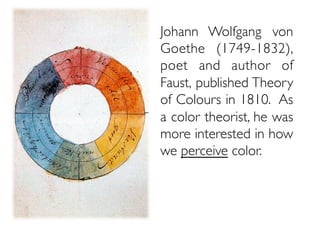
Johann Wolfgang von
Goethe (1749-1832),
poet and author of
Faust, published Theory
of Colours in 1810. As
a color theorist, he was
more interested in how
we perceive color.
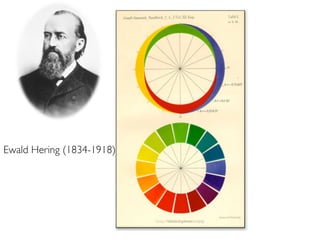
Ewald Hering (1834-1918)
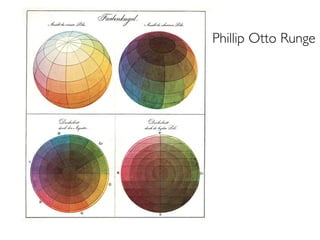
Phillip Otto Runge
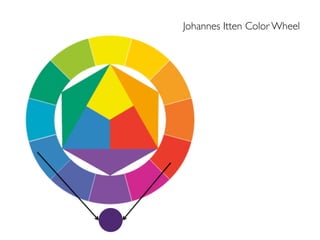
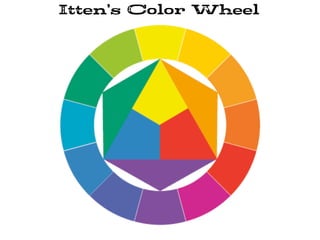
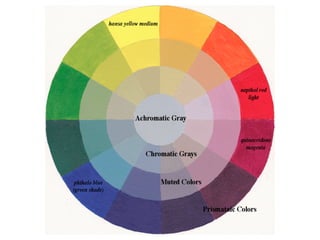
Johannes Itten Color Wheel
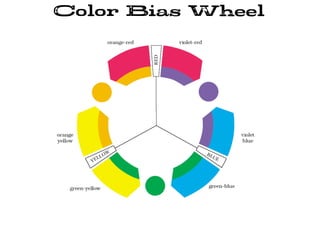
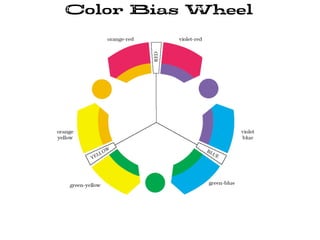
Color Bias Wheel
How to use the
Color Bias Wheel
to mix colors...
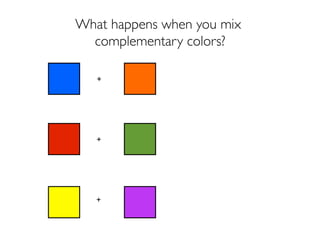
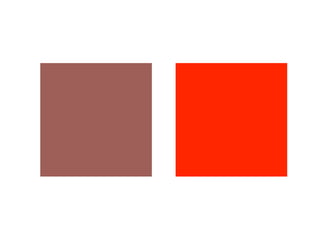
What happens when you mix
complementary colors?
+
+
+
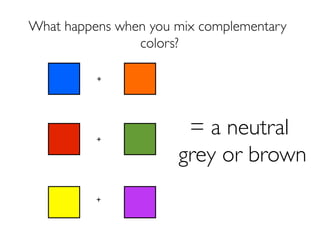
What happens when you mix complementary
colors?
+
+
+
= a neutral
grey or brown
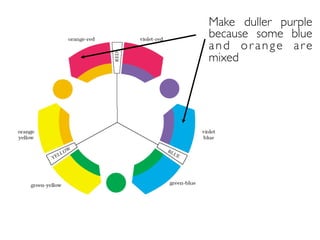
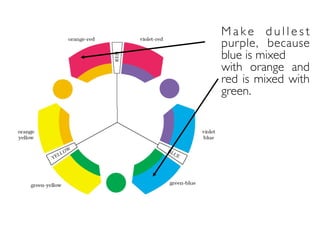
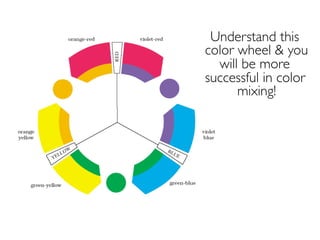
Color Bias Wheel
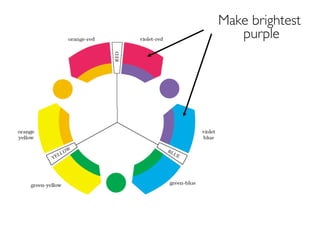
Make brightest
purple
Make duller purple
because some blue
and orange are
mixed
M a k e d u l l e s t
purple, because
blue is mixed
with orange and
red is mixed with
green.
Understand this
color wheel & you
will be more
successful in color
mixing!
Itten’s Color Wheel
The 3 Properties of
Color
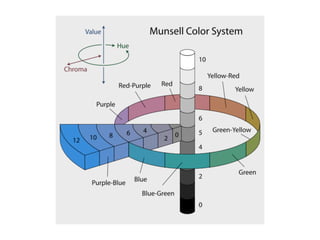
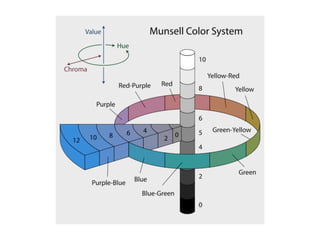
Hue
Value
Intensity
Properties of Color
• HUE
• VALUE
• INTENSITY (or saturation)
(HateVideogames Immensely)
Properties of Color
HUE - the name of the color, the part
of the color spectrum that the color
belongs to: Red, orange, yellow, green,
blue, or violet.
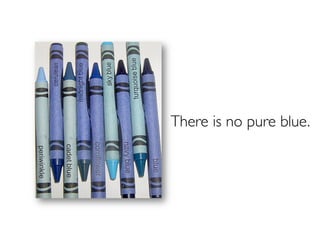
There is no pure blue.
. ... ..... . .
.... . .. ...
. .. .... . . .
.. .... . . .. .
.... . ... . . .
. .... . ..
.. . . . ...
.... .... ..
.. .. ... ..
.. . ..
.. . . . ... ...
. .... .. .. ..
... .. .. . ..
.. . . . ... ...
. .... .. .. ..
... .. .. . ..
.. . . . ... ...
. .... .. .. ..
... .. .. . ..
.. . . . ...
.... .... ..
.. .. ... ..
.. . .
.. . . . ...
.... .... ..
.. .. ... ..
.. . .
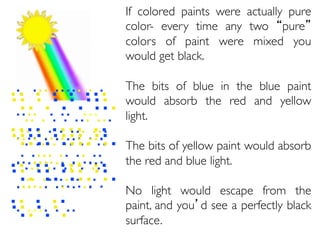
If colored paints were actually pure
color- every time any two “pure”
colors of paint were mixed you
would get black.
The bits of blue in the blue paint
would absorb the red and yellow
light.
The bits of yellow paint would absorb
the red and blue light.
No light would escape from the
paint, and you’d see a perfectly black
surface.
Properties of Color
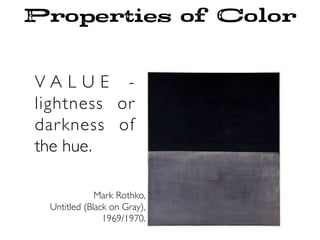
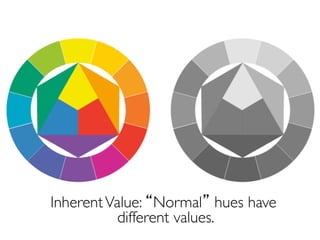
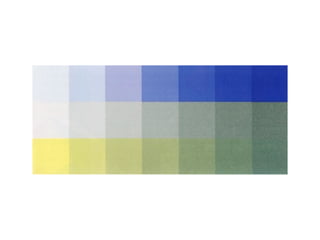
V A L U E -
lightness or
darkness of
the hue.
Mark Rothko,
Untitled (Black on Gray),
1969/1970.
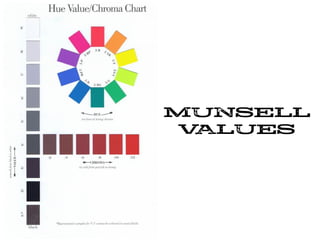
MUNSELL
VALUES
InherentValue: “Normal” hues have
different values.
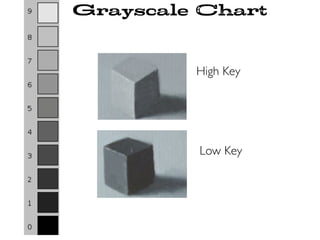
Grayscale Chart
Low Key
High Key
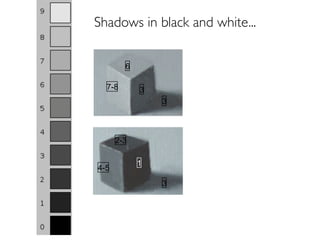
Shadows in black and white...
7-8
6
3
4-5
2-3
1
3
3
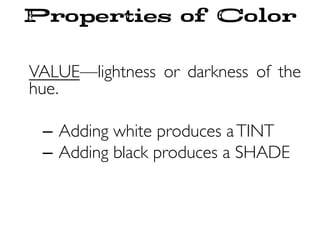
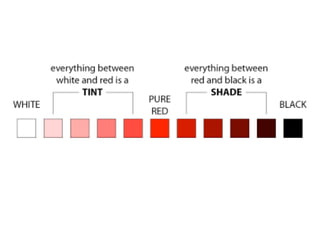
Properties of Color
VALUE—lightness or darkness of the
hue.
–  Adding white produces aTINT
–  Adding black produces a SHADE
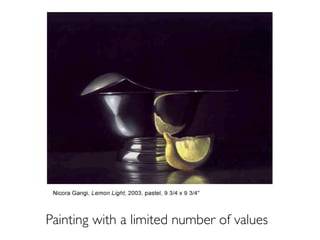
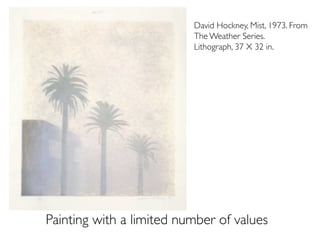
Painting with a limited number of values
David Hockney, Mist, 1973. From
The Weather Series.
Lithograph, 37 X 32 in.
Painting with a limited number of values
Properties of Color
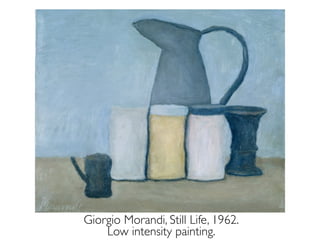
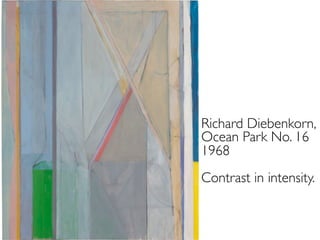
INTENSITY—The brightness of a
color. Not to be confused with
lightness, which is value.
–  Also called chroma or saturation.
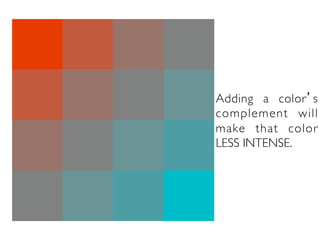
Adding a color’s
complement will
make that color
LESS INTENSE.
Giorgio Morandi, Still Life, 1962.
Low intensity painting.
Richard Diebenkorn,
Ocean Park No. 16
1968
Contrast in intensity.
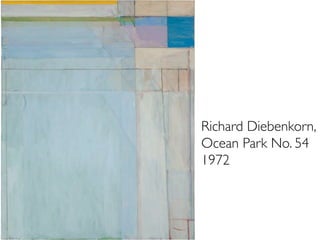
Richard Diebenkorn,
Ocean Park No. 54
1972
Color Schemes or
Systems
A h a r m o n y o r
c o m b i n a t i o n o f
particular colors based
on the color wheel.
Color Schemes
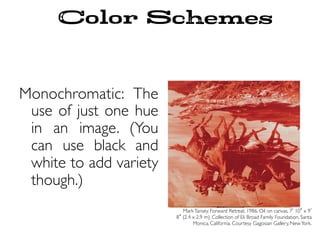
Monochromatic: The
use of just one hue
in an image. (You
can use black and
white to add variety
though.)
MarkTansey. Forward Retreat. 1986. Oil on canvas, 7 10 x 9
8 (2.4 x 2.9 m). Collection of Eli Broad Family Foundation, Santa
Monica, California. Courtesy Gagosian Gallery, NewYork.
Color Schemes
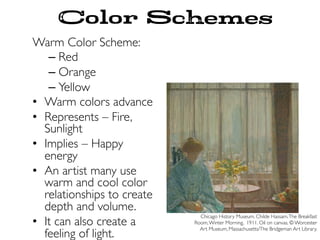
Warm Color Scheme:
– Red
– Orange
– Yellow
•  Warm colors advance
•  Represents – Fire,
Sunlight
•  Implies – Happy
energy
•  An artist many use
warm and cool color
relationships to create
depth and volume.
•  It can also create a
feeling of light.
Chicago History Museum. Childe Hassam.The Breakfast
Room,Winter Morning. 1911. Oil on canvas. © Worcester
Art Museum, Massachusetts/The Bridgeman Art Library.
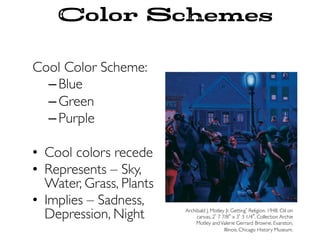
Cool Color Scheme:
– Blue
– Green
– Purple
•  Cool colors recede
•  Represents – Sky,
Water, Grass, Plants
•  Implies – Sadness,
Depression, Night Archibald J. Motley Jr. Getting Religion. 1948. Oil on
canvas, 2 7 7/8 x 3 3 1/4 . Collection Archie
Motley andValerie Gerrard Browne, Evanston,
Illinois. Chicago History Museum.
Color Schemes
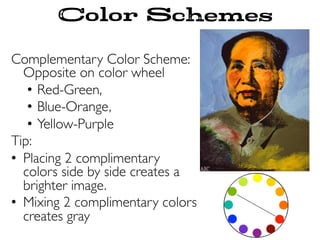
Complementary Color Scheme:
Opposite on color wheel
•  Red-Green,
•  Blue-Orange,
•  Yellow-Purple
Tip:
•  Placing 2 complimentary
colors side by side creates a
brighter image.
•  Mixing 2 complimentary colors
creates gray
Color Schemes
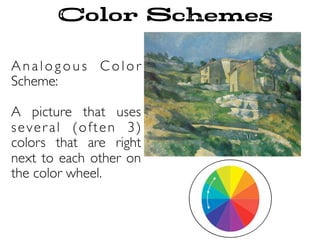
Analogous Color
Scheme:
A picture that uses
several (often 3)
colors that are right
next to each other on
the color wheel.
Color Schemes
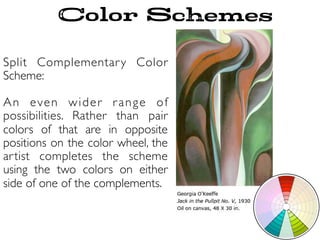
Split Complementary Color
Scheme:
An even wider range of
possibilities. Rather than pair
colors of that are in opposite
positions on the color wheel, the
artist completes the scheme
using the two colors on either
side of one of the complements.
Color Schemes
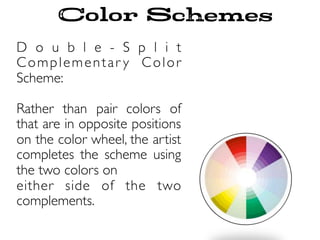
D o u b l e - S p l i t
Complementar y Color
Scheme:
Rather than pair colors of
that are in opposite positions
on the color wheel, the artist
completes the scheme using
the two colors on
either side of the two
complements.
Color Schemes
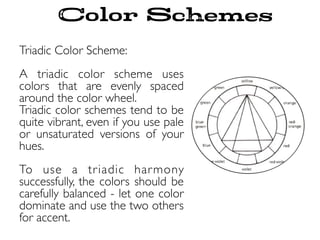
Triadic Color Scheme:
A triadic color scheme uses
colors that are evenly spaced
around the color wheel.
Triadic color schemes tend to be
quite vibrant, even if you use pale
or unsaturated versions of your
hues.
To use a triadic harmony
successfully, the colors should be
carefully balanced - let one color
dominate and use the two others
for accent.
Color Schemes
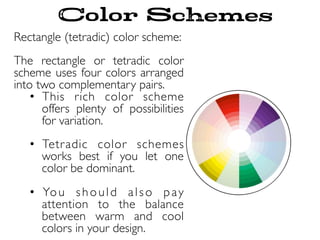
Rectangle (tetradic) color scheme:
The rectangle or tetradic color
scheme uses four colors arranged
into two complementary pairs.
•  This rich color scheme
offers plenty of possibilities
for variation.
•  Tetradic color schemes
works best if you let one
color be dominant.
•  You should also pay
attention to the balance
between warm and cool
colors in your design.
Color Schemes
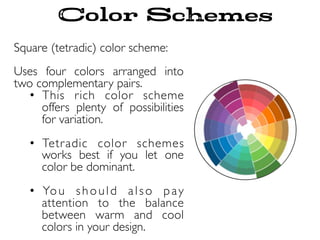
Square (tetradic) color scheme:
Uses four colors arranged into
two complementary pairs.
•  This rich color scheme
offers plenty of possibilities
for variation.
•  Tetradic color schemes
works best if you let one
color be dominant.
•  You should also pay
attention to the balance
between warm and cool
colors in your design.
Color Schemes
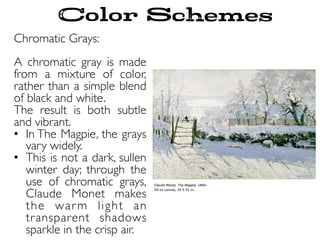
Chromatic Grays:
A chromatic gray is made
from a mixture of color,
rather than a simple blend
of black and white.
The result is both subtle
and vibrant.
•  In The Magpie, the grays
vary widely.
•  This is not a dark, sullen
winter day; through the
use of chromatic grays,
Claude Monet makes
the warm light an
transparent shadows
sparkle in the crisp air.
Color Schemes
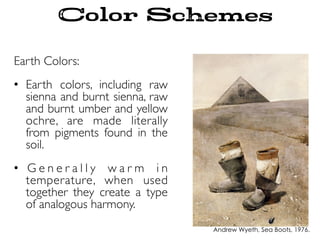
Earth Colors:
•  Earth colors, including raw
sienna and burnt sienna, raw
and burnt umber and yellow
ochre, are made literally
from pigments found in the
soil.
•  G e n e r a l l y w a r m i n
temperature, when used
together they create a type
of analogous harmony.
Color Schemes
Andrew Wyeth, Sea Boots, 1976.
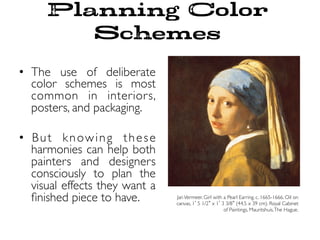
Planning Color
Schemes
•  The use of deliberate
color schemes is most
common in interiors,
posters, and packaging.
•  But knowing these
harmonies can help both
painters and designers
consciously to plan the
visual effects they want a
finished piece to have. JanVermeer. Girl with a Pearl Earring. c. 1665-1666. Oil on
canvas, 1 5 1/2 x 1 3 3/8 (44.5 x 39 cm). Royal Cabinet
of Paintings, Mauritshuis,The Hague.
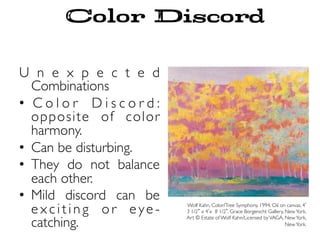
U n e x p e c t e d
Combinations
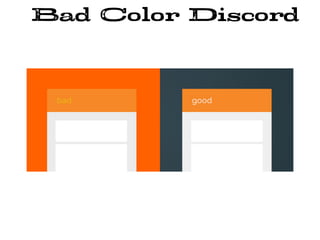
•  C o l o r D i s c o r d :
opposite of color
harmony.
•  Can be disturbing.
•  They do not balance
each other.
•  Mild discord can be
e x c i t i n g o r e ye -
catching.
Wolf Kahn. Color/Tree Symphony. 1994. Oil on canvas, 4
3 1/2 x 4 x 8 1/2 . Grace Borgenicht Gallery, NewYork.
Art © Estate of Wolf Kahn/Licensed byVAGA, NewYork,
NewYork.
Color Discord
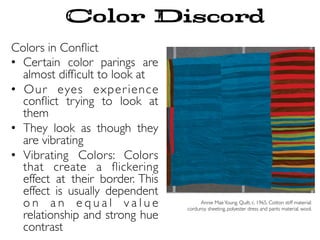
Colors in Conflict
•  Certain color parings are
almost difficult to look at
•  Our eyes experience
conflict trying to look at
them
•  They look as though they
are vibrating
•  Vibrating Colors: Colors
that create a flickering
effect at their border. This
effect is usually dependent
o n a n e q u a l v a l u e
relationship and strong hue
contrast
Annie MaeYoung. Quilt. c. 1965. Cotton stiff material:
corduroy sheeting, polyester dress and pants material, wool.
Color Discord
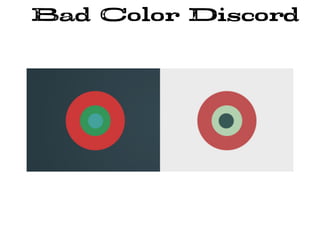
Bad Color Discord
Bad Color Discord
Bad Color Discord
(among other things)
Color Use
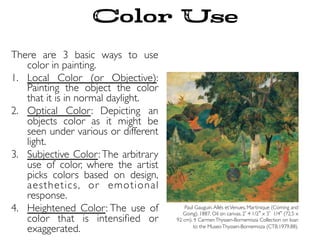
There are 3 basic ways to use
color in painting.
1.  Local Color (or Objective):
Painting the object the color
that it is in normal daylight.
2.  Optical Color: Depicting an
objects color as it might be
seen under various or different
light.
3.  Subjective Color: The arbitrary
use of color, where the artist
picks colors based on design,
aesthetics, or emotional
response.
4.  Heightened Color: The use of
color that is intensified or
exaggerated.
Paul Gauguin.Allés etVenues, Martinique (Coming and
Going). 1887. Oil on canvas, 2 4 1/2 x 3 1/4 (72.5 x
92 cm). ゥ CarmenThyssen-Bornemisza Collection on loan
to the MuseoThyssen-Bornemisza (CTB.1979.88).

Color Schemes & Wheel

  • 1.
    color theory: color schemes& “traditional” color wheel ART 251
  • 4.
    “Newton’s error wastrusting math over the sensations of his eye.” -Goethe
  • 5.
    Johann Wolfgang von Goethe(1749-1832), poet and author of Faust, published Theory of Colours in 1810. As a color theorist, he was more interested in how we perceive color.
  • 7.
  • 8.
  • 10.
  • 11.
  • 12.
    How to usethe Color Bias Wheel to mix colors...
  • 13.
    What happens whenyou mix complementary colors? + + +
  • 14.
    What happens whenyou mix complementary colors? + + + = a neutral grey or brown
  • 15.
  • 16.
  • 17.
    Make duller purple becausesome blue and orange are mixed
  • 18.
    M a ke d u l l e s t purple, because blue is mixed with orange and red is mixed with green.
  • 19.
    Understand this color wheel& you will be more successful in color mixing!
  • 20.
  • 21.
    The 3 Propertiesof Color Hue Value Intensity
  • 22.
    Properties of Color • HUE • VALUE • INTENSITY(or saturation) (HateVideogames Immensely)
  • 23.
    Properties of Color HUE- the name of the color, the part of the color spectrum that the color belongs to: Red, orange, yellow, green, blue, or violet.
  • 24.
    There is nopure blue.
  • 25.
    . ... ...... . .... . .. ... . .. .... . . . .. .... . . .. . .... . ... . . . . .... . .. .. . . . ... .... .... .. .. .. ... .. .. . .. .. . . . ... ... . .... .. .. .. ... .. .. . .. .. . . . ... ... . .... .. .. .. ... .. .. . .. .. . . . ... ... . .... .. .. .. ... .. .. . .. .. . . . ... .... .... .. .. .. ... .. .. . . .. . . . ... .... .... .. .. .. ... .. .. . . If colored paints were actually pure color- every time any two “pure” colors of paint were mixed you would get black. The bits of blue in the blue paint would absorb the red and yellow light. The bits of yellow paint would absorb the red and blue light. No light would escape from the paint, and you’d see a perfectly black surface.
  • 26.
    Properties of Color VA L U E - lightness or darkness of the hue. Mark Rothko, Untitled (Black on Gray), 1969/1970.
  • 27.
  • 29.
    InherentValue: “Normal” hueshave different values.
  • 31.
  • 32.
    Shadows in blackand white... 7-8 6 3 4-5 2-3 1 3 3
  • 34.
    Properties of Color VALUE—lightnessor darkness of the hue. –  Adding white produces aTINT –  Adding black produces a SHADE
  • 36.
    Painting with alimited number of values
  • 37.
    David Hockney, Mist,1973. From The Weather Series. Lithograph, 37 X 32 in. Painting with a limited number of values
  • 38.
    Properties of Color INTENSITY—Thebrightness of a color. Not to be confused with lightness, which is value. –  Also called chroma or saturation.
  • 40.
    Adding a color’s complementwill make that color LESS INTENSE.
  • 42.
    Giorgio Morandi, StillLife, 1962. Low intensity painting.
  • 43.
    Richard Diebenkorn, Ocean ParkNo. 16 1968 Contrast in intensity.
  • 44.
  • 45.
    Color Schemes or Systems Ah a r m o n y o r c o m b i n a t i o n o f particular colors based on the color wheel.
  • 46.
    Color Schemes Monochromatic: The useof just one hue in an image. (You can use black and white to add variety though.) MarkTansey. Forward Retreat. 1986. Oil on canvas, 7 10 x 9 8 (2.4 x 2.9 m). Collection of Eli Broad Family Foundation, Santa Monica, California. Courtesy Gagosian Gallery, NewYork.
  • 47.
    Color Schemes Warm ColorScheme: – Red – Orange – Yellow •  Warm colors advance •  Represents – Fire, Sunlight •  Implies – Happy energy •  An artist many use warm and cool color relationships to create depth and volume. •  It can also create a feeling of light. Chicago History Museum. Childe Hassam.The Breakfast Room,Winter Morning. 1911. Oil on canvas. © Worcester Art Museum, Massachusetts/The Bridgeman Art Library.
  • 48.
    Cool Color Scheme: – Blue – Green – Purple • Cool colors recede •  Represents – Sky, Water, Grass, Plants •  Implies – Sadness, Depression, Night Archibald J. Motley Jr. Getting Religion. 1948. Oil on canvas, 2 7 7/8 x 3 3 1/4 . Collection Archie Motley andValerie Gerrard Browne, Evanston, Illinois. Chicago History Museum. Color Schemes
  • 49.
    Complementary Color Scheme: Oppositeon color wheel •  Red-Green, •  Blue-Orange, •  Yellow-Purple Tip: •  Placing 2 complimentary colors side by side creates a brighter image. •  Mixing 2 complimentary colors creates gray Color Schemes
  • 50.
    Analogous Color Scheme: A picturethat uses several (often 3) colors that are right next to each other on the color wheel. Color Schemes
  • 51.
    Split Complementary Color Scheme: Aneven wider range of possibilities. Rather than pair colors of that are in opposite positions on the color wheel, the artist completes the scheme using the two colors on either side of one of the complements. Color Schemes
  • 52.
    D o ub l e - S p l i t Complementar y Color Scheme: Rather than pair colors of that are in opposite positions on the color wheel, the artist completes the scheme using the two colors on either side of the two complements. Color Schemes
  • 53.
    Triadic Color Scheme: Atriadic color scheme uses colors that are evenly spaced around the color wheel. Triadic color schemes tend to be quite vibrant, even if you use pale or unsaturated versions of your hues. To use a triadic harmony successfully, the colors should be carefully balanced - let one color dominate and use the two others for accent. Color Schemes
  • 54.
    Rectangle (tetradic) colorscheme: The rectangle or tetradic color scheme uses four colors arranged into two complementary pairs. •  This rich color scheme offers plenty of possibilities for variation. •  Tetradic color schemes works best if you let one color be dominant. •  You should also pay attention to the balance between warm and cool colors in your design. Color Schemes
  • 55.
    Square (tetradic) colorscheme: Uses four colors arranged into two complementary pairs. •  This rich color scheme offers plenty of possibilities for variation. •  Tetradic color schemes works best if you let one color be dominant. •  You should also pay attention to the balance between warm and cool colors in your design. Color Schemes
  • 56.
    Chromatic Grays: A chromaticgray is made from a mixture of color, rather than a simple blend of black and white. The result is both subtle and vibrant. •  In The Magpie, the grays vary widely. •  This is not a dark, sullen winter day; through the use of chromatic grays, Claude Monet makes the warm light an transparent shadows sparkle in the crisp air. Color Schemes
  • 57.
    Earth Colors: •  Earthcolors, including raw sienna and burnt sienna, raw and burnt umber and yellow ochre, are made literally from pigments found in the soil. •  G e n e r a l l y w a r m i n temperature, when used together they create a type of analogous harmony. Color Schemes Andrew Wyeth, Sea Boots, 1976.
  • 58.
    Planning Color Schemes •  Theuse of deliberate color schemes is most common in interiors, posters, and packaging. •  But knowing these harmonies can help both painters and designers consciously to plan the visual effects they want a finished piece to have. JanVermeer. Girl with a Pearl Earring. c. 1665-1666. Oil on canvas, 1 5 1/2 x 1 3 3/8 (44.5 x 39 cm). Royal Cabinet of Paintings, Mauritshuis,The Hague.
  • 59.
    U n ex p e c t e d Combinations •  C o l o r D i s c o r d : opposite of color harmony. •  Can be disturbing. •  They do not balance each other. •  Mild discord can be e x c i t i n g o r e ye - catching. Wolf Kahn. Color/Tree Symphony. 1994. Oil on canvas, 4 3 1/2 x 4 x 8 1/2 . Grace Borgenicht Gallery, NewYork. Art © Estate of Wolf Kahn/Licensed byVAGA, NewYork, NewYork. Color Discord
  • 60.
    Colors in Conflict • Certain color parings are almost difficult to look at •  Our eyes experience conflict trying to look at them •  They look as though they are vibrating •  Vibrating Colors: Colors that create a flickering effect at their border. This effect is usually dependent o n a n e q u a l v a l u e relationship and strong hue contrast Annie MaeYoung. Quilt. c. 1965. Cotton stiff material: corduroy sheeting, polyester dress and pants material, wool. Color Discord
  • 61.
  • 62.
  • 63.
  • 64.
    Color Use There are3 basic ways to use color in painting. 1.  Local Color (or Objective): Painting the object the color that it is in normal daylight. 2.  Optical Color: Depicting an objects color as it might be seen under various or different light. 3.  Subjective Color: The arbitrary use of color, where the artist picks colors based on design, aesthetics, or emotional response. 4.  Heightened Color: The use of color that is intensified or exaggerated. Paul Gauguin.Allés etVenues, Martinique (Coming and Going). 1887. Oil on canvas, 2 4 1/2 x 3 1/4 (72.5 x 92 cm). ゥ CarmenThyssen-Bornemisza Collection on loan to the MuseoThyssen-Bornemisza (CTB.1979.88).