Spinal Cord (1)
Introduction and Ascending Tracts
By: Ahmed A. E. Eljack
Is it really important?
2
Objectives:
3
By the end of this session you should be able to:
● Describe the spinal cord, its location and its
function.
● Describe the surface features of the spinal cord
and its meningeal coverings.
● Discuss the internal structure of the spinal
cord.
Objectives:
4
● List the major ascending tracts in the spinal
cord and their functions.
● Describe the pathways of each major
ascending tract.
● Discuss other minor ascending tracts and their
functions.
External Anatomy of the Spinal
Cord
5
Surface Features
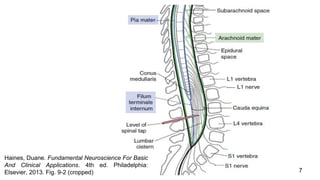
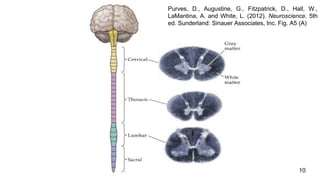
● The spinal cord extends from the foramen
magnum (medullary spinal junction) to the first
or second lumbar vertebra.
● It occupies the upper two thirds of the vertebral
column.
● The rest of the cord is occupied by cauda
equina.
6
7
Haines, Duane. Fundamental Neuroscience For Basic
And Clinical Applications. 4th ed. Philadelphia:
Elsevier, 2013. Fig. 9-2 (cropped)
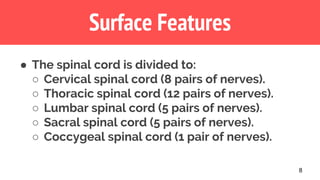
● The spinal cord is divided to:
○ Cervical spinal cord (8 pairs of nerves).
○ Thoracic spinal cord (12 pairs of nerves).
○ Lumbar spinal cord (5 pairs of nerves).
○ Sacral spinal cord (5 pairs of nerves).
○ Coccygeal spinal cord (1 pair of nerves).
Surface Features
8
9
Surface Features
● The spinal cord is enlarged at the cervical and
lumbosacral parts to give the origin to the
brachial and lumbosacral plexuses,
respectively.
● It ends into the conus medullaris.
10
Purves, D., Augustine, G., Fitzpatrick, D., Hall, W.,
LaMantina, A. and White, L. (2012). Neuroscience. 5th
ed. Sunderland: Sinauer Associates, Inc. Fig. A5 (A)
11
Surface Features
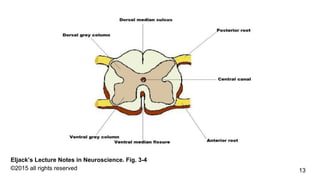
● The anterior median fissure is a deep
longitudinal fissure in the anterior surface.
● The posterior median sulcus is a shallow sulcus
in the posterior surface. It contains the posterior
median septum (pia mater).
12
Surface Features
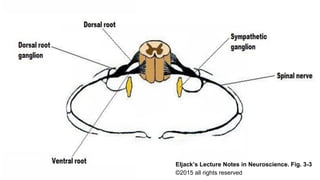
● The posterolateral sulcus is the entry site for
the posterior root (sensory) fibers.
● The anterolateral sulcus is the exit site for the
anterior root (motor) fibers.
13
Eljack’s Lecture Notes in Neuroscience. Fig. 3-4
©2015 all rights reserved
14
Eljack’s Lecture Notes in Neuroscience. Fig. 3-3
©2015 all rights reserved
15
Meningeal Covering
● The spinal cord is covered by:
○ Dura mater
○ Arachnoid mater
○ Pia mater
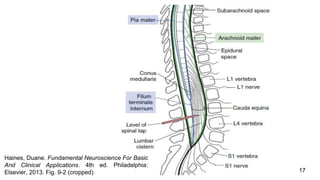
● Filum terminale is a prolongation of the pia mater
from the apex of the conus medullaris to the
posterior surface of the coccyx.
16
Meningeal Covering
● The subarachnoid space at the level of the
cauda equina enlarges to form the lumbar
cistern (site for lumbar puncture and spinal
anesthesia).
● The pia mater attaches to the vertebral column
laterally by the denticulate ligament.
17
Haines, Duane. Fundamental Neuroscience For Basic
And Clinical Applications. 4th ed. Philadelphia:
Elsevier, 2013. Fig. 9-2 (cropped)
18
Internal Anatomy of the Spinal
Cord
19
The inner core of the spinal cord is
formed by grey matter and it is
surrounded by white matter
Grey Matter
20
● Composed of neuronal cell bodies, dendrites,
initial parts of axons, and glial cells.
● Divided into dorsal (posterior) and ventral
(anterior) horns (H shape in cross sections).
● The grey commissure connects the anterior and
posterior horns. It contains the central canal.
21
Grey Matter
● The dorsal horn receives sensory information
while the ventral horn projects motor
commands.
● The small lateral grey horn lie in the thoracic
and upper lumbar segments. It functions as
sympathetic synapse area.
22
Grey Matter
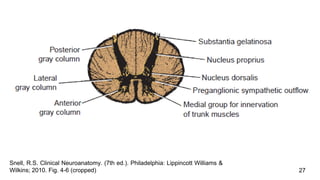
● The posterior grey horn has four nerve groups:
○ Substantia gelatinosa group (lamina II)
○ Nucleus proprius group (laminae III & IV)
○ Nucleus dorsalis group (Clarke’s column-
lamina VII)
○ Visceral afferent nucleus
23
Grey Matter
● The substantia gelatinosa is located in the
apex of the posterior grey horn throughout the
spinal cord.
● It receives afferents conveying pain, touch,
and temperature.
24
Grey Matter
● The nucleus proprius is located anterior to the
substantia gelatinosa throughout the spinal
cord.
● It receives afferents conveying proprioception,
two-point discrimination, and vibration from
the posterior column.
25
Grey Matter
● Clarke’s column is situated at the base of the
posterior grey horn from the lower cervical to
the middle lumbar segment.
● It receives proprioceptive input (mainly muscle
and tendon spindles).
26
Grey Matter
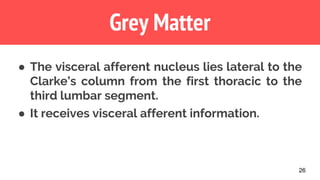
● The visceral afferent nucleus lies lateral to the
Clarke’s column from the first thoracic to the
third lumbar segment.
● It receives visceral afferent information.
27
Snell, R.S. Clinical Neuroanatomy. (7th ed.). Philadelphia: Lippincott Williams &
Wilkins; 2010. Fig. 4-6 (cropped)
28
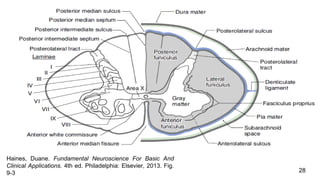
Haines, Duane. Fundamental Neuroscience For Basic And
Clinical Applications. 4th ed. Philadelphia: Elsevier, 2013. Fig.
9-3
White Matter
29
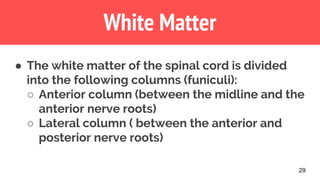
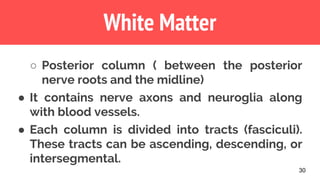
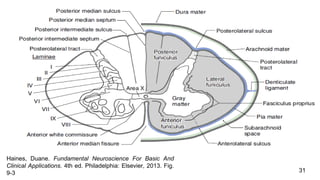
● The white matter of the spinal cord is divided
into the following columns (funiculi):
○ Anterior column (between the midline and the
anterior nerve roots)
○ Lateral column ( between the anterior and
posterior nerve roots)
30
White Matter
○ Posterior column ( between the posterior
nerve roots and the midline)
● It contains nerve axons and neuroglia along
with blood vessels.
● Each column is divided into tracts (fasciculi).
These tracts can be ascending, descending, or
intersegmental.
31
Haines, Duane. Fundamental Neuroscience For Basic And
Clinical Applications. 4th ed. Philadelphia: Elsevier, 2013. Fig.
9-3
32
White Matter
● The nomenclature of the tracts start with the
origin and ends with the destination.
● Ascending tracts named spino_____ tract. For
example: spinothalamic tracts.
● Descending tracts are usually named
_____spinal tract. For example: corticospinal
tract.
33
Ascending Tracts of the Spinal
Cord
Basic Concepts
34
● Information conveyed by ascending tracts may
be divided into:
○ Exteroceptive information (pain, temperature,
and touch)
○ Proprioceptive information (e.g., muscle
stretch)
35
Basic Concepts
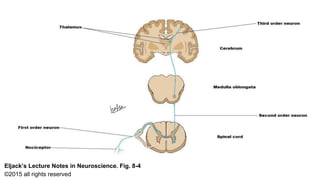
● Each tract usually consists of three neurons:
○ First-order neuron
○ Second-order neuron
○ Third-order neuron
● Afferent axons of the first-order neurons have
their cell bodies in the dorsal root ganglia.
36
Basic Concepts
● Second-order neurons decussate at different
levels.
● Third-order neurons are usually found in the
thalamus.
● These neurons branch to give input to motor
neurons and the reticular formation.
37
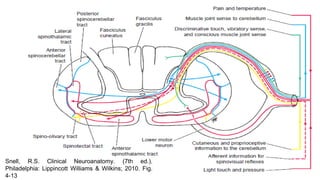
Spinothalamic Tracts
● Also called anterolateral system.
● Consists of two tracts:
○ Anterior spinothalamic tract (crude touch)
○ Lateral spinothalamic tract (pain and
temperature)
38
Spinothalamic Tracts
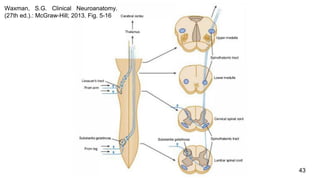
● They enter the spinal cord and travel for a
segment or two in the posterolateral tract of
Lissauer then synapse in lamina I, II and IV.
● After synapse, fibers from the second-order
neurons cross to the opposite side in the white
and grey commissures and travel rostrally.
39
Spinothalamic Tracts
● The anterolateral system shows somatotopic
organization.
● Sensation from lower parts of the body travel
laterally while sensation from upper parts
travel medially.
40
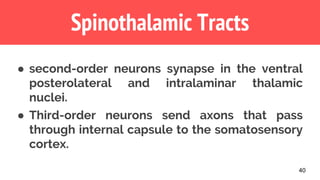
Spinothalamic Tracts
● second-order neurons synapse in the ventral
posterolateral and intralaminar thalamic
nuclei.
● Third-order neurons send axons that pass
through internal capsule to the somatosensory
cortex.
41
Snell, R.S. Clinical Neuroanatomy. (7th ed.).
Philadelphia: Lippincott Williams & Wilkins; 2010. Fig.
4-13
42
Eljack’s Lecture Notes in Neuroscience. Fig. 8-4
©2015 all rights reserved
43
Waxman, S.G. Clinical Neuroanatomy.
(27th ed.).: McGraw-Hill; 2013. Fig. 5-16
44
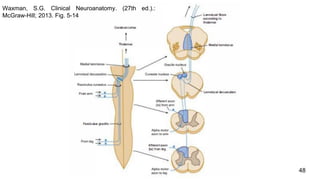
Dorsal Column Tracts
● Carry fine and discriminative touch, vibration,
and proprioception.
● Divided into:
○ Fasciculus gracilis (lower part of the body)
○ Fasciculus cuneatus (upper part of the body)
45
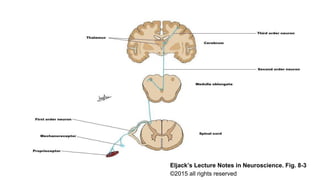
Dorsal Column Tracts
● Fasciculus gracilis and cuneatus pass directly
to the ipsilateral posterior white column and
ascend without synapse till the they reach the
brainstem.
● They synapse on the nuclei gracilis and
cuneatus in the medulla oblongata,
respectively
46
Dorsal Column Tracts
● Second-order neurons decussate and ascend
forming the medial lemniscus to synapse in the
ventral posterolateral nucleus of the thalamus.
● third-order neurons pass through the internal
capsule to reach the somatosensory cortex.
47
Eljack’s Lecture Notes in Neuroscience. Fig. 8-3
©2015 all rights reserved
48
Waxman, S.G. Clinical Neuroanatomy. (27th ed.).:
McGraw-Hill; 2013. Fig. 5-14
49
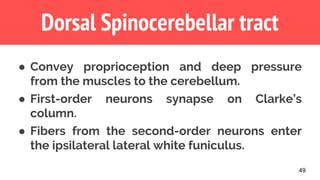
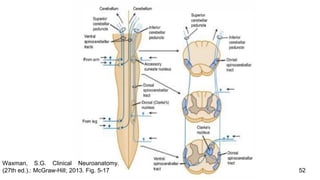
Dorsal Spinocerebellar tract
● Convey proprioception and deep pressure
from the muscles to the cerebellum.
● First-order neurons synapse on Clarke’s
column.
● Fibers from the second-order neurons enter
the ipsilateral lateral white funiculus.
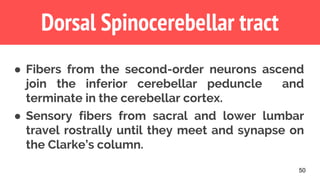
50
Dorsal Spinocerebellar tract
● Fibers from the second-order neurons ascend
join the inferior cerebellar peduncle and
terminate in the cerebellar cortex.
● Sensory fibers from sacral and lower lumbar
travel rostrally until they meet and synapse on
the Clarke’s column.
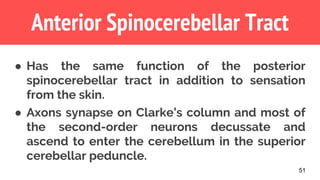
51
Anterior Spinocerebellar Tract
● Has the same function of the posterior
spinocerebellar tract in addition to sensation
from the skin.
● Axons synapse on Clarke’s column and most of
the second-order neurons decussate and
ascend to enter the cerebellum in the superior
cerebellar peduncle.
52
Waxman, S.G. Clinical Neuroanatomy.
(27th ed.).: McGraw-Hill; 2013. Fig. 5-17
53
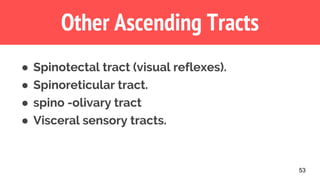
Other Ascending Tracts
● Spinotectal tract (visual reflexes).
● Spinoreticular tract.
● spino -olivary tract
● Visceral sensory tracts.
54
In summary...
55
Further Readings
● Sinnatamby, C.S. Last's Anatomy Regional and
Applied. (12th ed.). : Churchill Livingstone;
2011.
● Snell, R.S. Clinical Neuroanatomy. (7th ed.).
Philadelphia: Lippincott Williams & Wilkins;
2010.
56
Further Readings
● Eljack, A. A. E. Eljack’s Lecture Notes in
Neuroscience. Khartoum; 2015.
● Siegel, A, Sapru, H.N. Essential Neuroscience.
(3rd ed.). Philadelphia: Lippincott Williams &
Wilkins; 2015.
57
Further Readings
● Medical Neuroscience MOOC by Duke
University | Coursera.
● Purves, D., Augustine, G., Fitzpatrick, D., Hall, W.,
LaMantina, A. and White, L. (2012).
Neuroscience. 5th ed. Sunderland: Sinauer
Associates, Inc.
58
Further Readings
● Haines, Duane. Fundamental Neuroscience For
Basic And Clinical Applications. 4th ed.
Philadelphia: Elsevier, 2013.
● Waxman, S.G. Clinical Neuroanatomy. (26th ed.).
: McGraw-Hill; 2010.

Neuroanatomy | 8. Spinal Cord (1)

  • 1.
    Spinal Cord (1) Introductionand Ascending Tracts By: Ahmed A. E. Eljack
  • 2.
    Is it reallyimportant? 2
  • 3.
    Objectives: 3 By the endof this session you should be able to: ● Describe the spinal cord, its location and its function. ● Describe the surface features of the spinal cord and its meningeal coverings. ● Discuss the internal structure of the spinal cord.
  • 4.
    Objectives: 4 ● List themajor ascending tracts in the spinal cord and their functions. ● Describe the pathways of each major ascending tract. ● Discuss other minor ascending tracts and their functions.
  • 5.
    External Anatomy ofthe Spinal Cord 5
  • 6.
    Surface Features ● Thespinal cord extends from the foramen magnum (medullary spinal junction) to the first or second lumbar vertebra. ● It occupies the upper two thirds of the vertebral column. ● The rest of the cord is occupied by cauda equina. 6
  • 7.
    7 Haines, Duane. FundamentalNeuroscience For Basic And Clinical Applications. 4th ed. Philadelphia: Elsevier, 2013. Fig. 9-2 (cropped)
  • 8.
    ● The spinalcord is divided to: ○ Cervical spinal cord (8 pairs of nerves). ○ Thoracic spinal cord (12 pairs of nerves). ○ Lumbar spinal cord (5 pairs of nerves). ○ Sacral spinal cord (5 pairs of nerves). ○ Coccygeal spinal cord (1 pair of nerves). Surface Features 8
  • 9.
    9 Surface Features ● Thespinal cord is enlarged at the cervical and lumbosacral parts to give the origin to the brachial and lumbosacral plexuses, respectively. ● It ends into the conus medullaris.
  • 10.
    10 Purves, D., Augustine,G., Fitzpatrick, D., Hall, W., LaMantina, A. and White, L. (2012). Neuroscience. 5th ed. Sunderland: Sinauer Associates, Inc. Fig. A5 (A)
  • 11.
    11 Surface Features ● Theanterior median fissure is a deep longitudinal fissure in the anterior surface. ● The posterior median sulcus is a shallow sulcus in the posterior surface. It contains the posterior median septum (pia mater).
  • 12.
    12 Surface Features ● Theposterolateral sulcus is the entry site for the posterior root (sensory) fibers. ● The anterolateral sulcus is the exit site for the anterior root (motor) fibers.
  • 13.
    13 Eljack’s Lecture Notesin Neuroscience. Fig. 3-4 ©2015 all rights reserved
  • 14.
    14 Eljack’s Lecture Notesin Neuroscience. Fig. 3-3 ©2015 all rights reserved
  • 15.
    15 Meningeal Covering ● Thespinal cord is covered by: ○ Dura mater ○ Arachnoid mater ○ Pia mater ● Filum terminale is a prolongation of the pia mater from the apex of the conus medullaris to the posterior surface of the coccyx.
  • 16.
    16 Meningeal Covering ● Thesubarachnoid space at the level of the cauda equina enlarges to form the lumbar cistern (site for lumbar puncture and spinal anesthesia). ● The pia mater attaches to the vertebral column laterally by the denticulate ligament.
  • 17.
    17 Haines, Duane. FundamentalNeuroscience For Basic And Clinical Applications. 4th ed. Philadelphia: Elsevier, 2013. Fig. 9-2 (cropped)
  • 18.
    18 Internal Anatomy ofthe Spinal Cord
  • 19.
    19 The inner coreof the spinal cord is formed by grey matter and it is surrounded by white matter
  • 20.
    Grey Matter 20 ● Composedof neuronal cell bodies, dendrites, initial parts of axons, and glial cells. ● Divided into dorsal (posterior) and ventral (anterior) horns (H shape in cross sections). ● The grey commissure connects the anterior and posterior horns. It contains the central canal.
  • 21.
    21 Grey Matter ● Thedorsal horn receives sensory information while the ventral horn projects motor commands. ● The small lateral grey horn lie in the thoracic and upper lumbar segments. It functions as sympathetic synapse area.
  • 22.
    22 Grey Matter ● Theposterior grey horn has four nerve groups: ○ Substantia gelatinosa group (lamina II) ○ Nucleus proprius group (laminae III & IV) ○ Nucleus dorsalis group (Clarke’s column- lamina VII) ○ Visceral afferent nucleus
  • 23.
    23 Grey Matter ● Thesubstantia gelatinosa is located in the apex of the posterior grey horn throughout the spinal cord. ● It receives afferents conveying pain, touch, and temperature.
  • 24.
    24 Grey Matter ● Thenucleus proprius is located anterior to the substantia gelatinosa throughout the spinal cord. ● It receives afferents conveying proprioception, two-point discrimination, and vibration from the posterior column.
  • 25.
    25 Grey Matter ● Clarke’scolumn is situated at the base of the posterior grey horn from the lower cervical to the middle lumbar segment. ● It receives proprioceptive input (mainly muscle and tendon spindles).
  • 26.
    26 Grey Matter ● Thevisceral afferent nucleus lies lateral to the Clarke’s column from the first thoracic to the third lumbar segment. ● It receives visceral afferent information.
  • 27.
    27 Snell, R.S. ClinicalNeuroanatomy. (7th ed.). Philadelphia: Lippincott Williams & Wilkins; 2010. Fig. 4-6 (cropped)
  • 28.
    28 Haines, Duane. FundamentalNeuroscience For Basic And Clinical Applications. 4th ed. Philadelphia: Elsevier, 2013. Fig. 9-3
  • 29.
    White Matter 29 ● Thewhite matter of the spinal cord is divided into the following columns (funiculi): ○ Anterior column (between the midline and the anterior nerve roots) ○ Lateral column ( between the anterior and posterior nerve roots)
  • 30.
    30 White Matter ○ Posteriorcolumn ( between the posterior nerve roots and the midline) ● It contains nerve axons and neuroglia along with blood vessels. ● Each column is divided into tracts (fasciculi). These tracts can be ascending, descending, or intersegmental.
  • 31.
    31 Haines, Duane. FundamentalNeuroscience For Basic And Clinical Applications. 4th ed. Philadelphia: Elsevier, 2013. Fig. 9-3
  • 32.
    32 White Matter ● Thenomenclature of the tracts start with the origin and ends with the destination. ● Ascending tracts named spino_____ tract. For example: spinothalamic tracts. ● Descending tracts are usually named _____spinal tract. For example: corticospinal tract.
  • 33.
    33 Ascending Tracts ofthe Spinal Cord
  • 34.
    Basic Concepts 34 ● Informationconveyed by ascending tracts may be divided into: ○ Exteroceptive information (pain, temperature, and touch) ○ Proprioceptive information (e.g., muscle stretch)
  • 35.
    35 Basic Concepts ● Eachtract usually consists of three neurons: ○ First-order neuron ○ Second-order neuron ○ Third-order neuron ● Afferent axons of the first-order neurons have their cell bodies in the dorsal root ganglia.
  • 36.
    36 Basic Concepts ● Second-orderneurons decussate at different levels. ● Third-order neurons are usually found in the thalamus. ● These neurons branch to give input to motor neurons and the reticular formation.
  • 37.
    37 Spinothalamic Tracts ● Alsocalled anterolateral system. ● Consists of two tracts: ○ Anterior spinothalamic tract (crude touch) ○ Lateral spinothalamic tract (pain and temperature)
  • 38.
    38 Spinothalamic Tracts ● Theyenter the spinal cord and travel for a segment or two in the posterolateral tract of Lissauer then synapse in lamina I, II and IV. ● After synapse, fibers from the second-order neurons cross to the opposite side in the white and grey commissures and travel rostrally.
  • 39.
    39 Spinothalamic Tracts ● Theanterolateral system shows somatotopic organization. ● Sensation from lower parts of the body travel laterally while sensation from upper parts travel medially.
  • 40.
    40 Spinothalamic Tracts ● second-orderneurons synapse in the ventral posterolateral and intralaminar thalamic nuclei. ● Third-order neurons send axons that pass through internal capsule to the somatosensory cortex.
  • 41.
    41 Snell, R.S. ClinicalNeuroanatomy. (7th ed.). Philadelphia: Lippincott Williams & Wilkins; 2010. Fig. 4-13
  • 42.
    42 Eljack’s Lecture Notesin Neuroscience. Fig. 8-4 ©2015 all rights reserved
  • 43.
    43 Waxman, S.G. ClinicalNeuroanatomy. (27th ed.).: McGraw-Hill; 2013. Fig. 5-16
  • 44.
    44 Dorsal Column Tracts ●Carry fine and discriminative touch, vibration, and proprioception. ● Divided into: ○ Fasciculus gracilis (lower part of the body) ○ Fasciculus cuneatus (upper part of the body)
  • 45.
    45 Dorsal Column Tracts ●Fasciculus gracilis and cuneatus pass directly to the ipsilateral posterior white column and ascend without synapse till the they reach the brainstem. ● They synapse on the nuclei gracilis and cuneatus in the medulla oblongata, respectively
  • 46.
    46 Dorsal Column Tracts ●Second-order neurons decussate and ascend forming the medial lemniscus to synapse in the ventral posterolateral nucleus of the thalamus. ● third-order neurons pass through the internal capsule to reach the somatosensory cortex.
  • 47.
    47 Eljack’s Lecture Notesin Neuroscience. Fig. 8-3 ©2015 all rights reserved
  • 48.
    48 Waxman, S.G. ClinicalNeuroanatomy. (27th ed.).: McGraw-Hill; 2013. Fig. 5-14
  • 49.
    49 Dorsal Spinocerebellar tract ●Convey proprioception and deep pressure from the muscles to the cerebellum. ● First-order neurons synapse on Clarke’s column. ● Fibers from the second-order neurons enter the ipsilateral lateral white funiculus.
  • 50.
    50 Dorsal Spinocerebellar tract ●Fibers from the second-order neurons ascend join the inferior cerebellar peduncle and terminate in the cerebellar cortex. ● Sensory fibers from sacral and lower lumbar travel rostrally until they meet and synapse on the Clarke’s column.
  • 51.
    51 Anterior Spinocerebellar Tract ●Has the same function of the posterior spinocerebellar tract in addition to sensation from the skin. ● Axons synapse on Clarke’s column and most of the second-order neurons decussate and ascend to enter the cerebellum in the superior cerebellar peduncle.
  • 52.
    52 Waxman, S.G. ClinicalNeuroanatomy. (27th ed.).: McGraw-Hill; 2013. Fig. 5-17
  • 53.
    53 Other Ascending Tracts ●Spinotectal tract (visual reflexes). ● Spinoreticular tract. ● spino -olivary tract ● Visceral sensory tracts.
  • 54.
  • 55.
    55 Further Readings ● Sinnatamby,C.S. Last's Anatomy Regional and Applied. (12th ed.). : Churchill Livingstone; 2011. ● Snell, R.S. Clinical Neuroanatomy. (7th ed.). Philadelphia: Lippincott Williams & Wilkins; 2010.
  • 56.
    56 Further Readings ● Eljack,A. A. E. Eljack’s Lecture Notes in Neuroscience. Khartoum; 2015. ● Siegel, A, Sapru, H.N. Essential Neuroscience. (3rd ed.). Philadelphia: Lippincott Williams & Wilkins; 2015.
  • 57.
    57 Further Readings ● MedicalNeuroscience MOOC by Duke University | Coursera. ● Purves, D., Augustine, G., Fitzpatrick, D., Hall, W., LaMantina, A. and White, L. (2012). Neuroscience. 5th ed. Sunderland: Sinauer Associates, Inc.
  • 58.
    58 Further Readings ● Haines,Duane. Fundamental Neuroscience For Basic And Clinical Applications. 4th ed. Philadelphia: Elsevier, 2013. ● Waxman, S.G. Clinical Neuroanatomy. (26th ed.). : McGraw-Hill; 2010.