Chapter 12: a glance at the nervous systemBy Shawna Miller
Functions and organsThe functions of the nervous system are to coordinate and control body functions.Receives sensory outputMakes decisionsOrders body responsesThe organs of the nervous system are:BrainNervesSpinal cord
Nervous tissueConsists of two cell typesNeurons- individual nerve cellsDendrite- branched projections, receive impulsesNerve cell body- contains nucleus/other organellesAxon-projection from the nerve cell body, conducts electrical impulses to destinationThe point which the axon of one neuron meets the dendrite of another neuron is called a synapse.The gap between two neurons is called a synaptic cleft.The electrical impulses need help from chemical messengers caller neurotransmitters.Different neuroglial cells are in nervous tissueSome produce myelin-a fatty substance which acts like insulation for axonsThey do not conduct electrical impulses
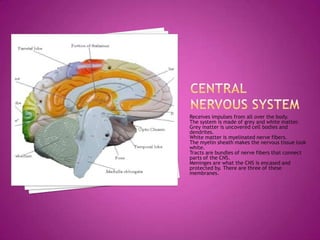
Central nervous systemReceives impulses from all over the body.The system is made of grey and white matter.Grey matter is uncovered cell bodies and dendrites.White matter is myelinated nerve fibers.The myelin sheath makes the nervous tissue look white.Tracts are bundles of nerve fibers that connect parts of the CNS.Meninges are what the CNS is encased and protected by. There are three of these membranes.
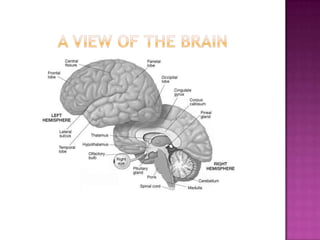
The BrainOne of the largest organs in the body.Center for thought, judgement, memory, and emotion.Four sections:Cerebrum- largest section in the upper part of the brain. It processes problem solving, language, thoughts, and memory. It has an outer layer called the cerebral cortex which is made up of folds of grey matter.Diencephalon- below the cerebrum contains the thalmus and hypothalmusThalmus- center for relaying impulses for eyes, ears, and skin to the cerebrum. What our pain perception is controlled by.Hypothalmus- below thalmus, controls body temperature, sleep appetite,  and emotions.Cerebellum- second largest section, beneath the posterior part of the cerebrum. Helps to maintain body movements and maintain balance.Brain stem : has three partsMid brain- acts as pathway between brain and spinal cordPons- connects the cerebellum to rest of brainMedulla oblongata- most inferior portion of the brain; it connects the brain to the spinal cordA vital are that controls respiration, heart rate, and blood pressureSite where nerve tracts crossThe brain has four interconnected cavities called ventricles. There is one in each hemisphere of the brainThey contain CSF(cerebral spinal fluid) that protects the brain from shock/sudden movement to brain and spinal cord
A view of the brain
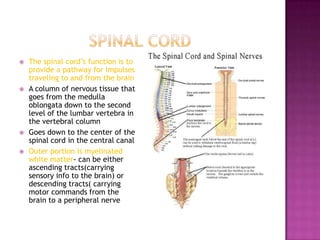
Spinal cordThe spinal cord’s function is to provide a pathway for impulses traveling to and from the brainA column of nervous tissue that goes from the medulla oblongata down to the second level of the lumbar vertebra in the vertebral columnGoes down to the center of the spinal cord in the central canalOuter portion is myelinated white matter- can be either ascending tracts(carrying sensory info to the brain) or descending tracts( carrying motor commands from the brain to a peripheral nerve
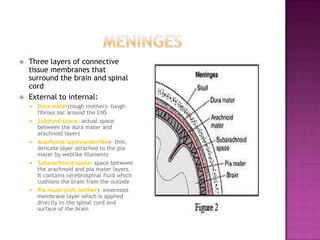
meningesThree layers of connective tissue membranes that surround the brain and spinal cordExternal to internal:Dura mater(tough mother)- tough fibrous sac around the CNSSubdural space- actual space between the dura mater and arachnoid layersArachnoid layer(spiderlike)- thin, delicate layer attached to the pia mater by weblike filamentsSubarachnoid space- space between the arachnoid and pia mater layers. It contains cerebrospinal fluid which cushions the brain from the outsidePia mater(soft mother)- innermost membrane layer which is applied directly to the spinal cord and surface of the brain
Peripheral nervous systemIncludes 12 pairs of cranial nerves and 31 pairs of spinal nervesWhere the nerve originates determines if it is cranial or spinalThe point where either type is attached to the CNS is called the nerve rootAfferent neurons(sensory neurons)- carry sensory info from a sensory receptor to the CNSEfferent neurons(motor neurons)- carry activity instructions from the CNS to muscles/glands out in the bodyNerves of the peripheral nervous system are subdivided into two areas: the autonomic nervous system(ANS) and somatic nerves which each serve a different part of the bodyThe nerve cell bodies of the neurons are grouped together in a knot-like mass, called a ganglion
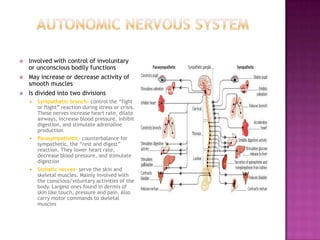
Autonomic nervous systemInvolved with control of involuntary or unconscious bodily functionsMay increase or decrease activity of smooth musclesIs divided into two divisionsSympathetic branch- control the “fight or flight” reaction during stress or crisis. These nerves increase heart rate, dilate airways, increase blood pressure, inhibit digestion, and stimulate adrenaline productionParasympathetic- counterbalance for sympathetic, the “rest and digest” reaction. They lower heart rate, decrease blood pressure, and stimulate digestionSomatic nerves- serve the skin and skeletal muscles. Mainly involved with the conscious/voluntary activities of the body. Largest ones found in dermis of skin like touch, pressure and pain. Also carry motor commands to skeletal muscles
Common termsCerebrospinal, meningitis, analgesia, aphasia, dysphasia, quadriplegia, neuropathy, encephalitis, electroencephalogram
DefinitionsCerebrospinal- pertaining to the cerebrum and spineMeningitis- meninges inflammationAnalgesia- absence of pain or sensationAphasia- lack of speechDysphagia- difficult speechQuadriplegia- paralysis of fourNeuropathy- nerve diseaseElectroencephalogram(EEG)- record of brain’s activity
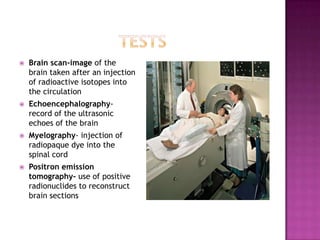
testsBrain scan-image of the brain taken after an injection of radioactive isotopes into the circulationEchoencephalography- record of the ultrasonic echoes of the brainMyelography- injection of radiopaque dye into the spinal cordPositron emission tomography- use of positive radionuclides to reconstruct brain sections
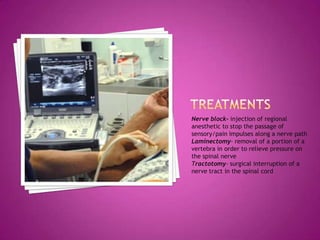
treatmentsNerve block- injection of regional anesthetic to stop the passage of sensory/pain impulses along a nerve pathLaminectomy- removal of a portion of a vertebra in order to relieve pressure on the spinal nerveTractotomy- surgical interruption of a nerve tract in the spinal cord
MedicationsAnalgesics- non narcotics to treat pain(aspirin, tylenol, aleve, ibuprofen)Anesthetics- drug that produces a loss of sensation or loss of consciousness( propofol, novocain, lidocaine, nembutal)Hypnotic- drug that promotes sleep(restoril, seconal, temazepam)Sedative- drug that has a relaxing or calming effect(amytal, butisol, amobarbital)

Chapter 12 the nervous system

  • 1.
    Chapter 12: aglance at the nervous systemBy Shawna Miller
  • 2.
    Functions and organsThefunctions of the nervous system are to coordinate and control body functions.Receives sensory outputMakes decisionsOrders body responsesThe organs of the nervous system are:BrainNervesSpinal cord
  • 3.
    Nervous tissueConsists oftwo cell typesNeurons- individual nerve cellsDendrite- branched projections, receive impulsesNerve cell body- contains nucleus/other organellesAxon-projection from the nerve cell body, conducts electrical impulses to destinationThe point which the axon of one neuron meets the dendrite of another neuron is called a synapse.The gap between two neurons is called a synaptic cleft.The electrical impulses need help from chemical messengers caller neurotransmitters.Different neuroglial cells are in nervous tissueSome produce myelin-a fatty substance which acts like insulation for axonsThey do not conduct electrical impulses
  • 4.
    Central nervous systemReceivesimpulses from all over the body.The system is made of grey and white matter.Grey matter is uncovered cell bodies and dendrites.White matter is myelinated nerve fibers.The myelin sheath makes the nervous tissue look white.Tracts are bundles of nerve fibers that connect parts of the CNS.Meninges are what the CNS is encased and protected by. There are three of these membranes.
  • 5.
    The BrainOne ofthe largest organs in the body.Center for thought, judgement, memory, and emotion.Four sections:Cerebrum- largest section in the upper part of the brain. It processes problem solving, language, thoughts, and memory. It has an outer layer called the cerebral cortex which is made up of folds of grey matter.Diencephalon- below the cerebrum contains the thalmus and hypothalmusThalmus- center for relaying impulses for eyes, ears, and skin to the cerebrum. What our pain perception is controlled by.Hypothalmus- below thalmus, controls body temperature, sleep appetite, and emotions.Cerebellum- second largest section, beneath the posterior part of the cerebrum. Helps to maintain body movements and maintain balance.Brain stem : has three partsMid brain- acts as pathway between brain and spinal cordPons- connects the cerebellum to rest of brainMedulla oblongata- most inferior portion of the brain; it connects the brain to the spinal cordA vital are that controls respiration, heart rate, and blood pressureSite where nerve tracts crossThe brain has four interconnected cavities called ventricles. There is one in each hemisphere of the brainThey contain CSF(cerebral spinal fluid) that protects the brain from shock/sudden movement to brain and spinal cord
  • 6.
    A view ofthe brain
  • 7.
    Spinal cordThe spinalcord’s function is to provide a pathway for impulses traveling to and from the brainA column of nervous tissue that goes from the medulla oblongata down to the second level of the lumbar vertebra in the vertebral columnGoes down to the center of the spinal cord in the central canalOuter portion is myelinated white matter- can be either ascending tracts(carrying sensory info to the brain) or descending tracts( carrying motor commands from the brain to a peripheral nerve
  • 8.
    meningesThree layers ofconnective tissue membranes that surround the brain and spinal cordExternal to internal:Dura mater(tough mother)- tough fibrous sac around the CNSSubdural space- actual space between the dura mater and arachnoid layersArachnoid layer(spiderlike)- thin, delicate layer attached to the pia mater by weblike filamentsSubarachnoid space- space between the arachnoid and pia mater layers. It contains cerebrospinal fluid which cushions the brain from the outsidePia mater(soft mother)- innermost membrane layer which is applied directly to the spinal cord and surface of the brain
  • 9.
    Peripheral nervous systemIncludes12 pairs of cranial nerves and 31 pairs of spinal nervesWhere the nerve originates determines if it is cranial or spinalThe point where either type is attached to the CNS is called the nerve rootAfferent neurons(sensory neurons)- carry sensory info from a sensory receptor to the CNSEfferent neurons(motor neurons)- carry activity instructions from the CNS to muscles/glands out in the bodyNerves of the peripheral nervous system are subdivided into two areas: the autonomic nervous system(ANS) and somatic nerves which each serve a different part of the bodyThe nerve cell bodies of the neurons are grouped together in a knot-like mass, called a ganglion
  • 10.
    Autonomic nervous systemInvolvedwith control of involuntary or unconscious bodily functionsMay increase or decrease activity of smooth musclesIs divided into two divisionsSympathetic branch- control the “fight or flight” reaction during stress or crisis. These nerves increase heart rate, dilate airways, increase blood pressure, inhibit digestion, and stimulate adrenaline productionParasympathetic- counterbalance for sympathetic, the “rest and digest” reaction. They lower heart rate, decrease blood pressure, and stimulate digestionSomatic nerves- serve the skin and skeletal muscles. Mainly involved with the conscious/voluntary activities of the body. Largest ones found in dermis of skin like touch, pressure and pain. Also carry motor commands to skeletal muscles
  • 11.
    Common termsCerebrospinal, meningitis,analgesia, aphasia, dysphasia, quadriplegia, neuropathy, encephalitis, electroencephalogram
  • 12.
    DefinitionsCerebrospinal- pertaining tothe cerebrum and spineMeningitis- meninges inflammationAnalgesia- absence of pain or sensationAphasia- lack of speechDysphagia- difficult speechQuadriplegia- paralysis of fourNeuropathy- nerve diseaseElectroencephalogram(EEG)- record of brain’s activity
  • 13.
    testsBrain scan-image ofthe brain taken after an injection of radioactive isotopes into the circulationEchoencephalography- record of the ultrasonic echoes of the brainMyelography- injection of radiopaque dye into the spinal cordPositron emission tomography- use of positive radionuclides to reconstruct brain sections
  • 14.
    treatmentsNerve block- injectionof regional anesthetic to stop the passage of sensory/pain impulses along a nerve pathLaminectomy- removal of a portion of a vertebra in order to relieve pressure on the spinal nerveTractotomy- surgical interruption of a nerve tract in the spinal cord
  • 15.
    MedicationsAnalgesics- non narcoticsto treat pain(aspirin, tylenol, aleve, ibuprofen)Anesthetics- drug that produces a loss of sensation or loss of consciousness( propofol, novocain, lidocaine, nembutal)Hypnotic- drug that promotes sleep(restoril, seconal, temazepam)Sedative- drug that has a relaxing or calming effect(amytal, butisol, amobarbital)