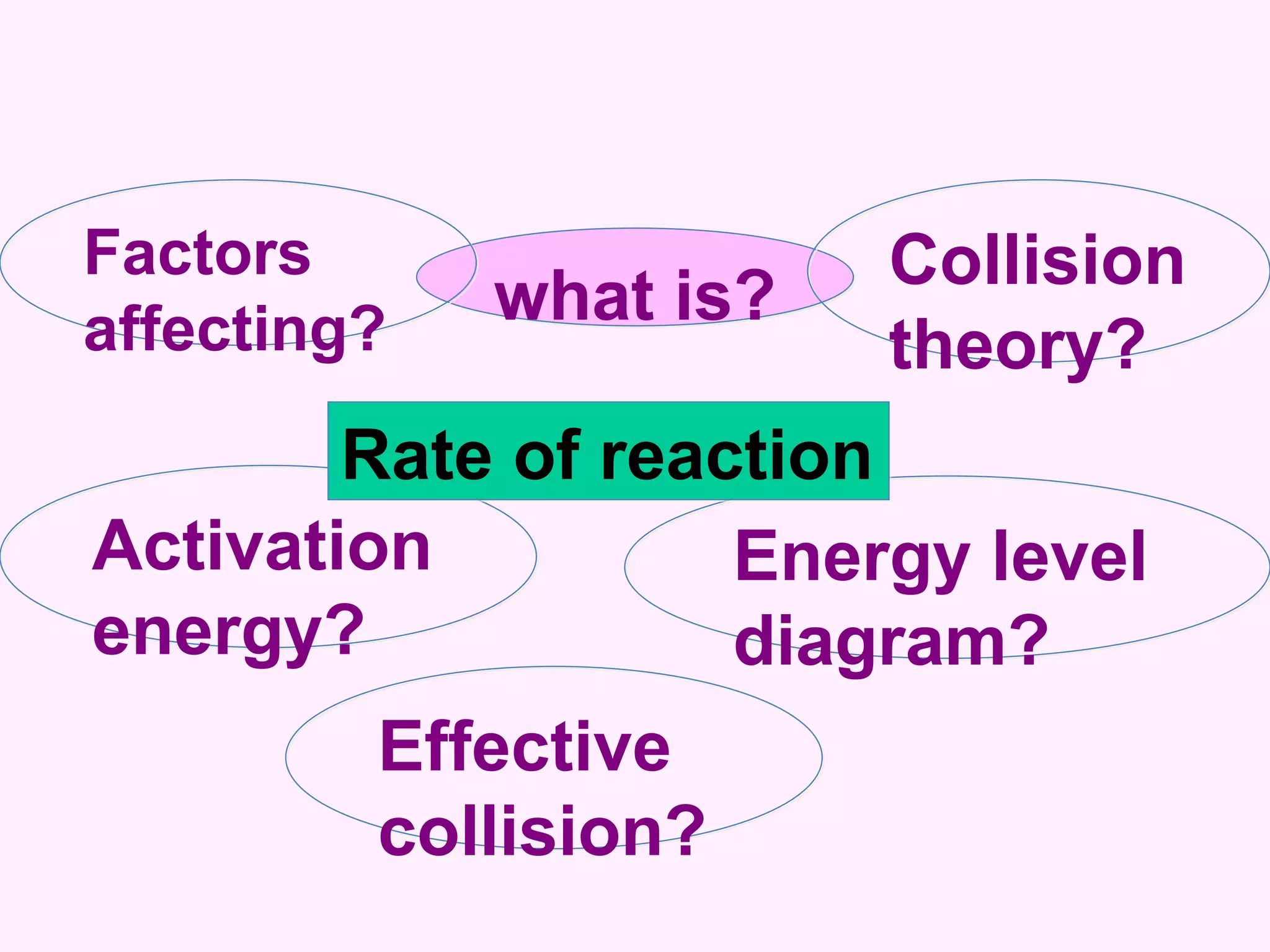

what is? Effective collision? Collision theory? Factors affecting? Activation energy? Energy level diagram? Rate of reaction
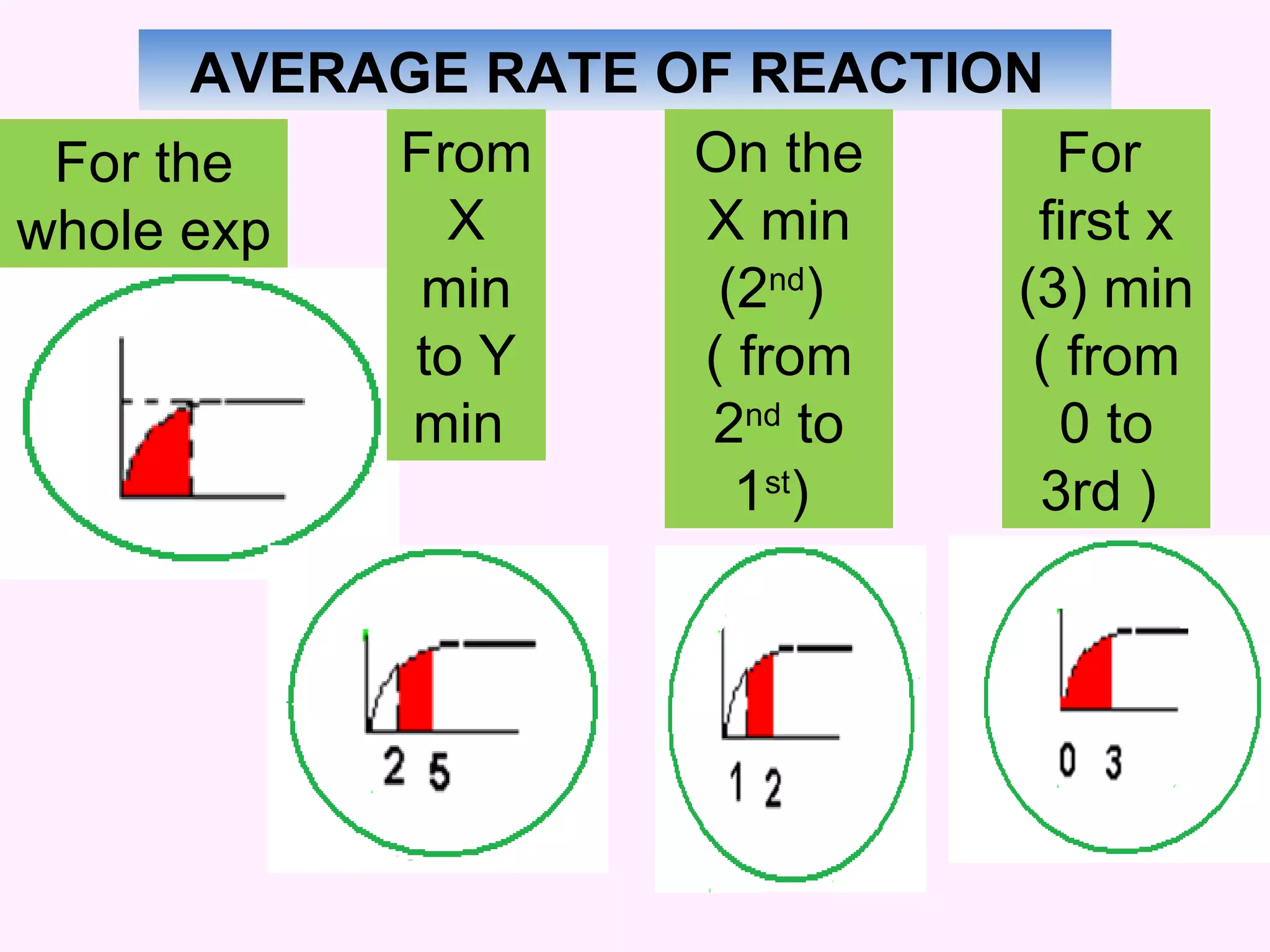
AVERAGE RATE OF REACTION  For the whole exp From X min to Y min  On the X min (2 nd )  ( from 2 nd  to 1 st )  For  first x (3) min ( from 0 to 3rd )
b) Example from the graph, determine: i) The average rate of reaction for the whole experiment = Total volume of gas  Total time taken
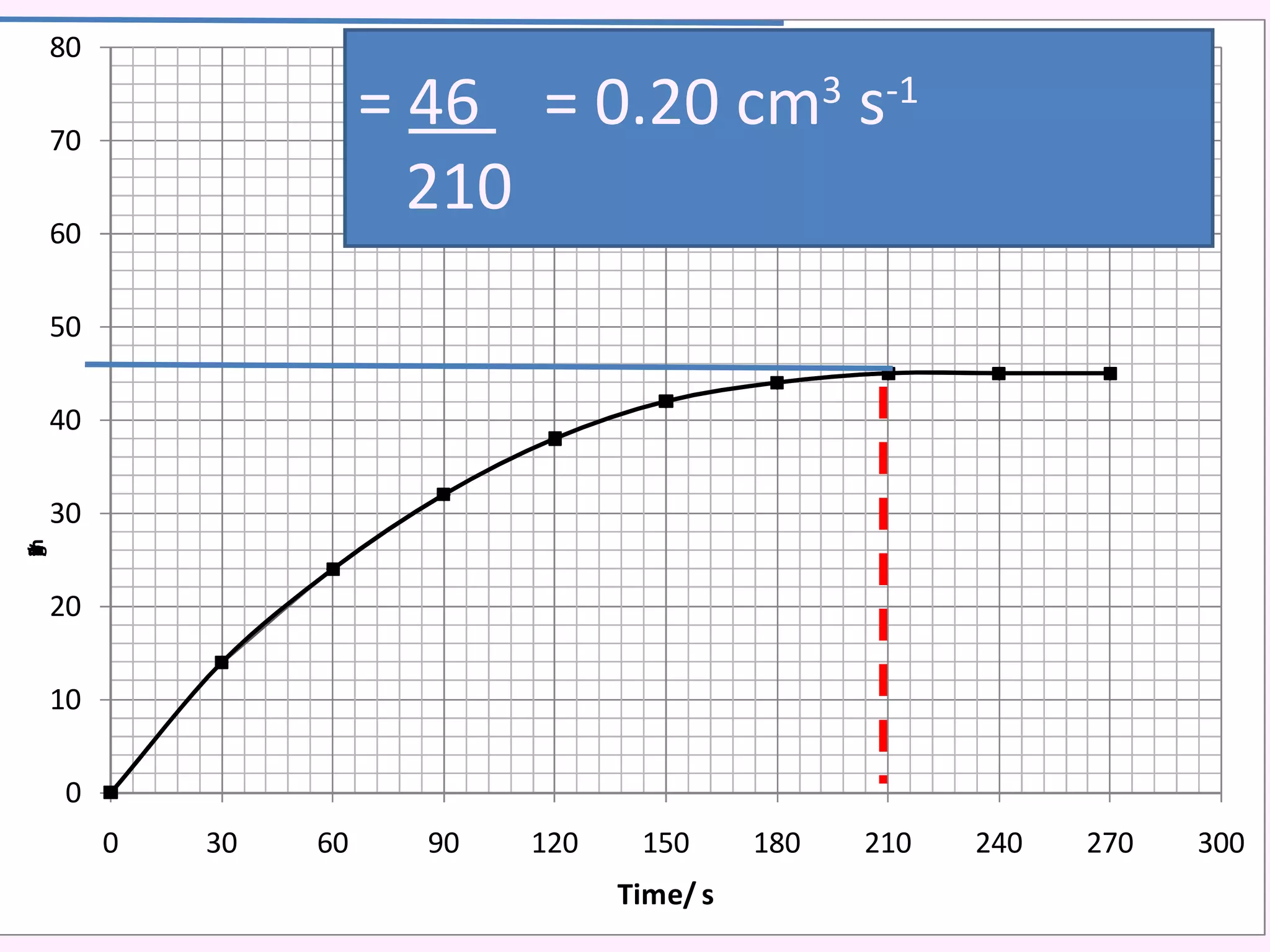
=  46  = 0.20 cm 3  s -1 210
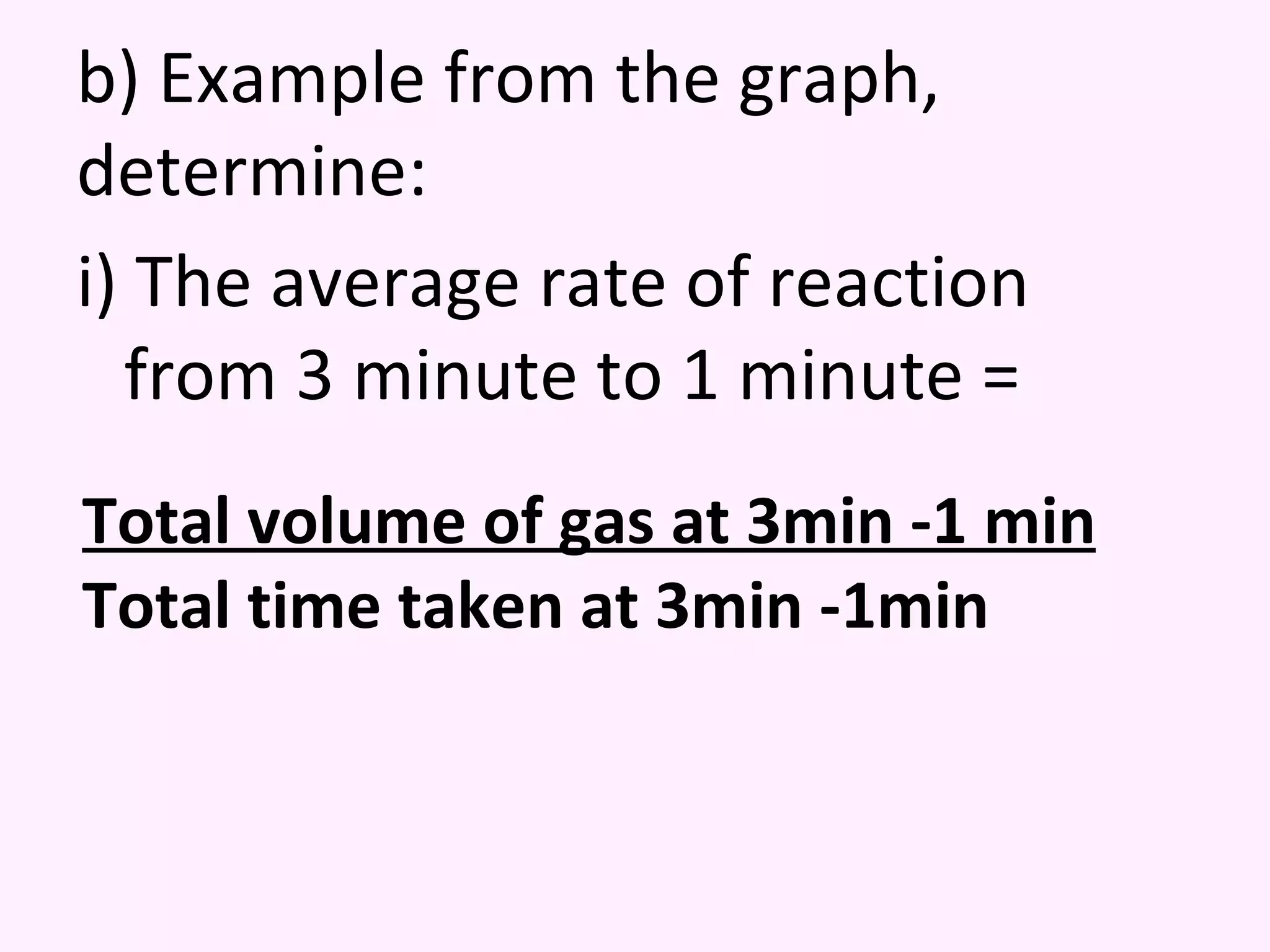
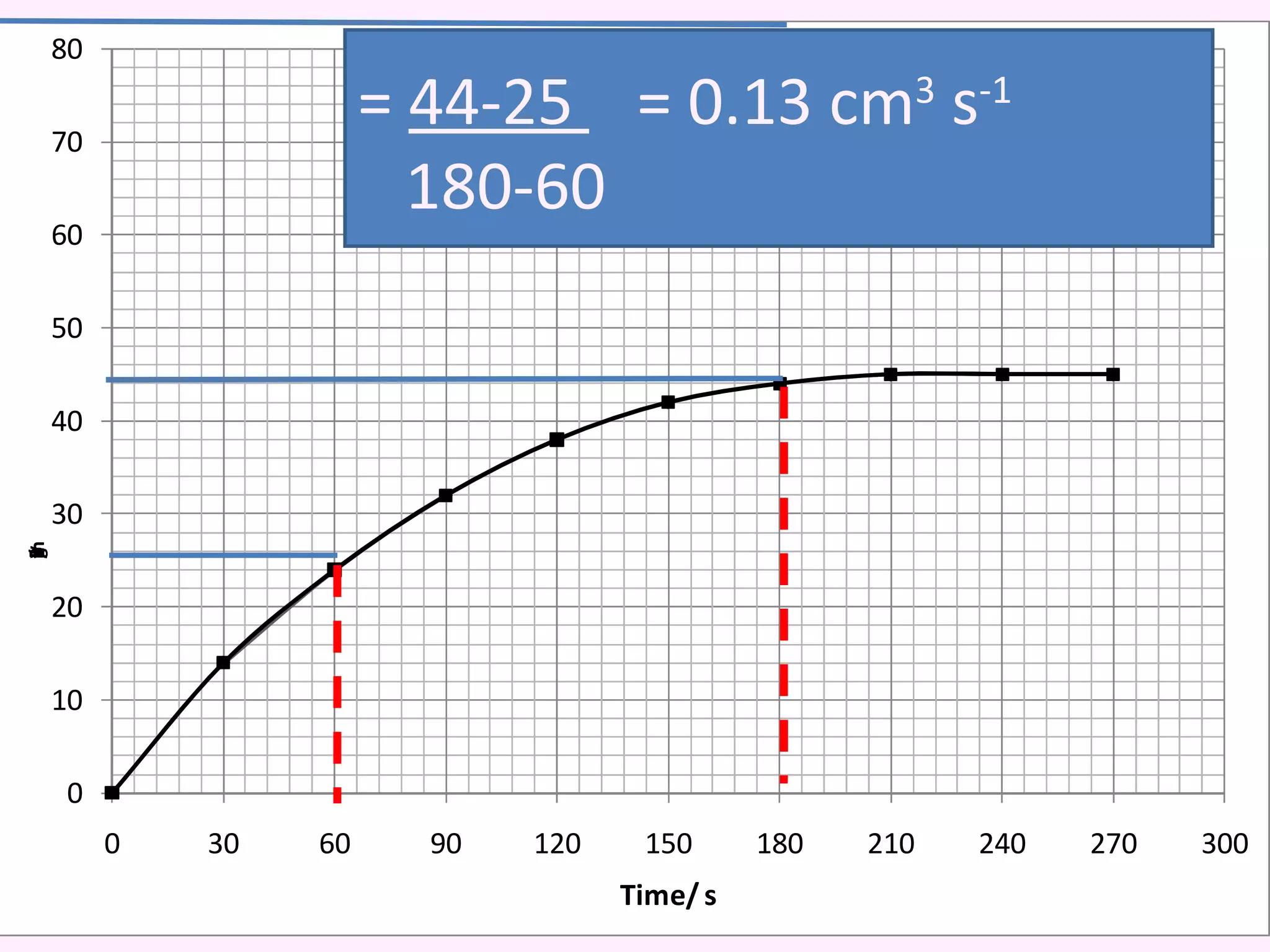
b) Example from the graph, determine: i) The average rate of reaction from 3 minute to 1 minute = Total volume of gas at 3min -1 min Total time taken at 3min -1min
=  44-25  = 0.13 cm 3  s -1 180-60
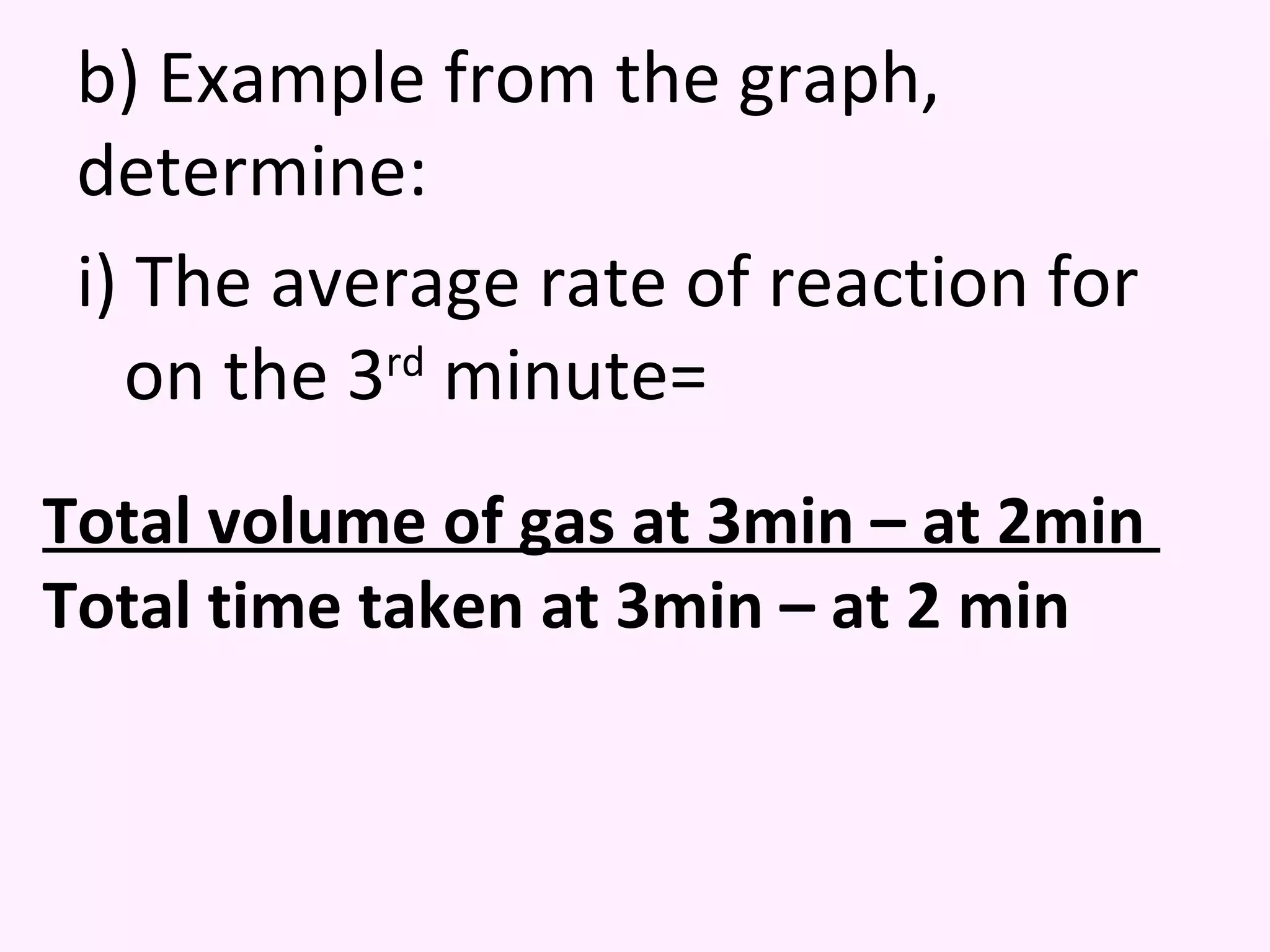
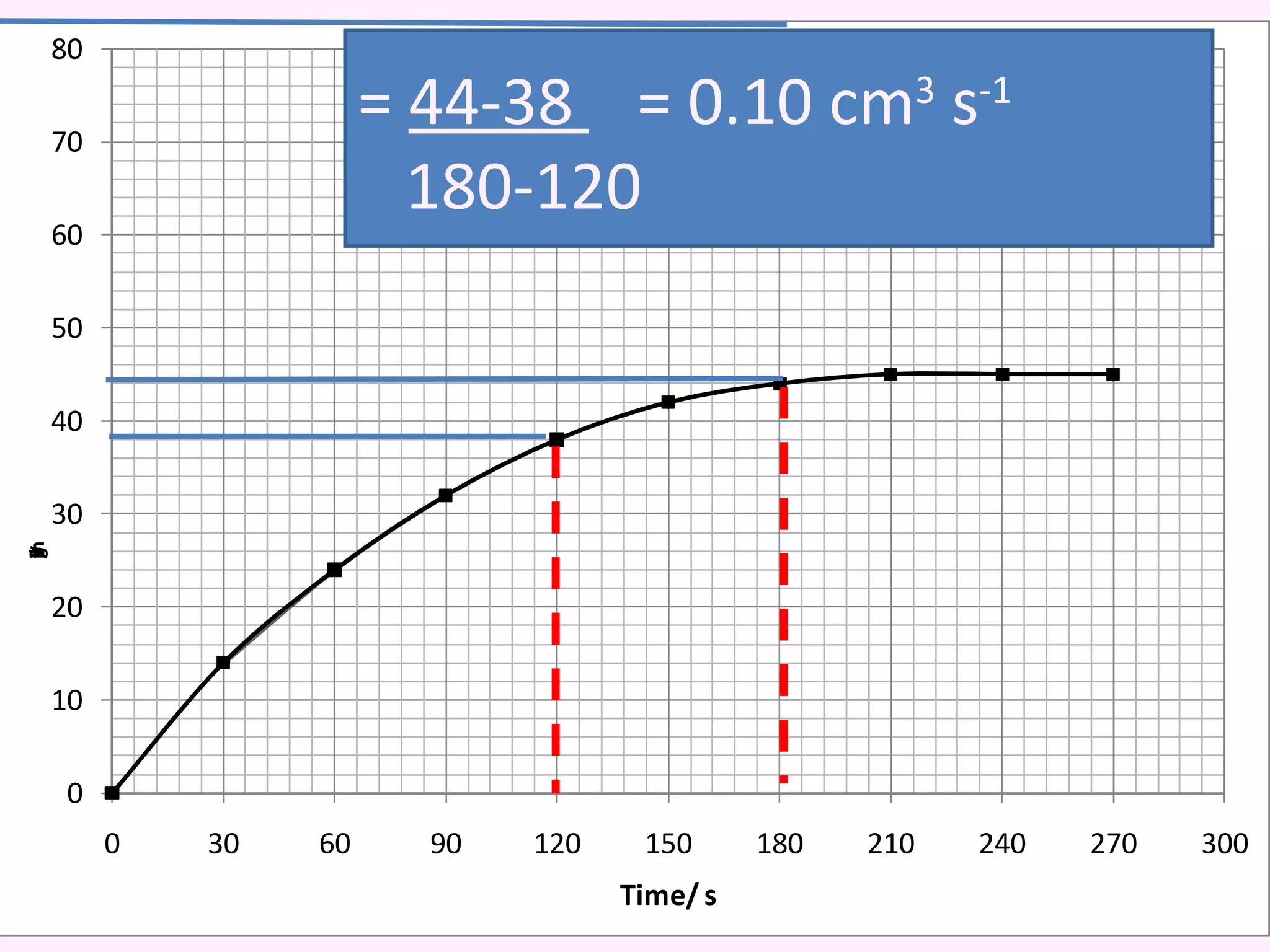
b) Example from the graph, determine: i) The average rate of reaction for on the 3 rd  minute= Total volume of gas at 3min – at 2min  Total time taken at 3min – at 2 min
=  44-38  = 0.10 cm 3  s -1 180-120
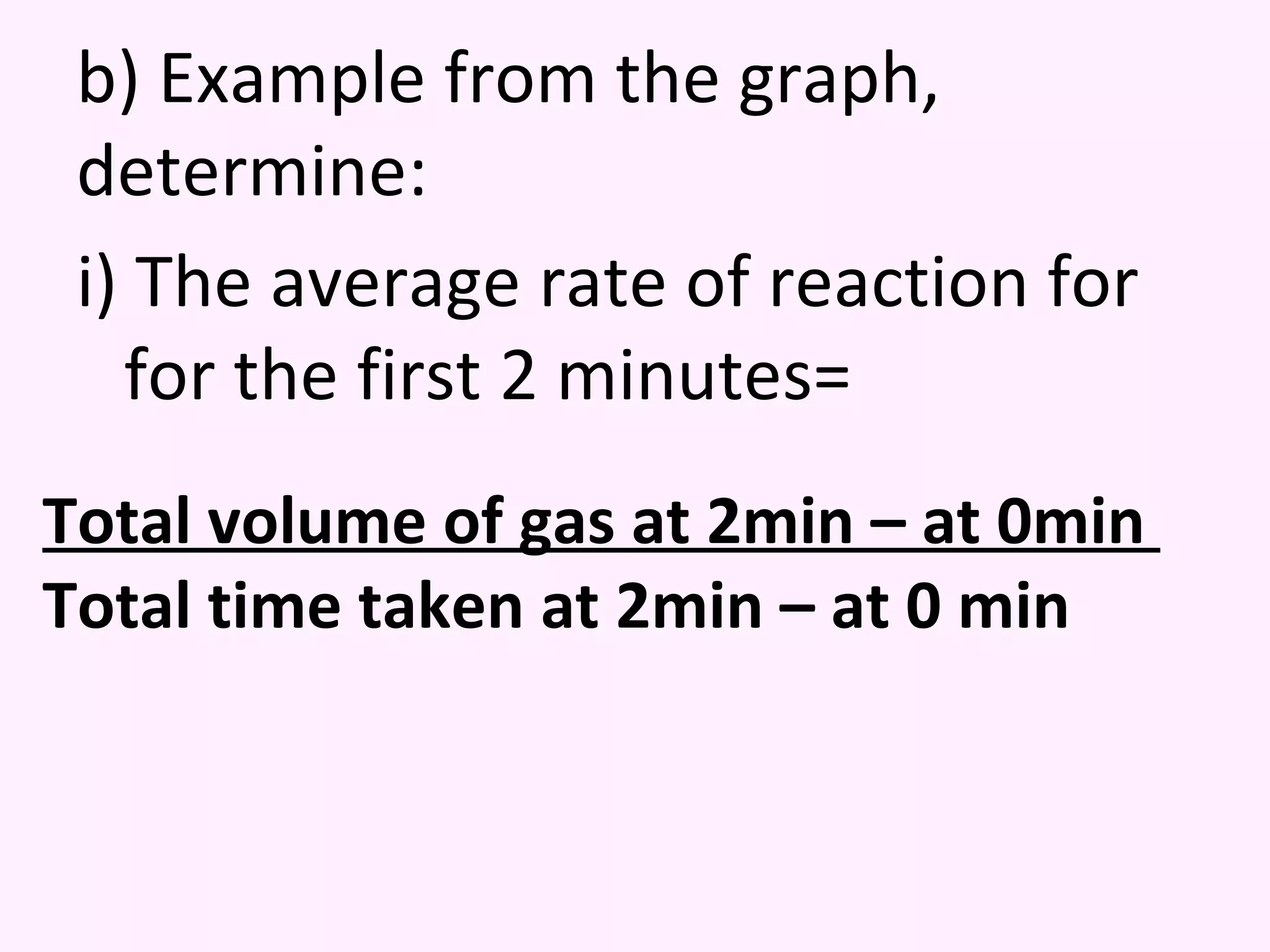
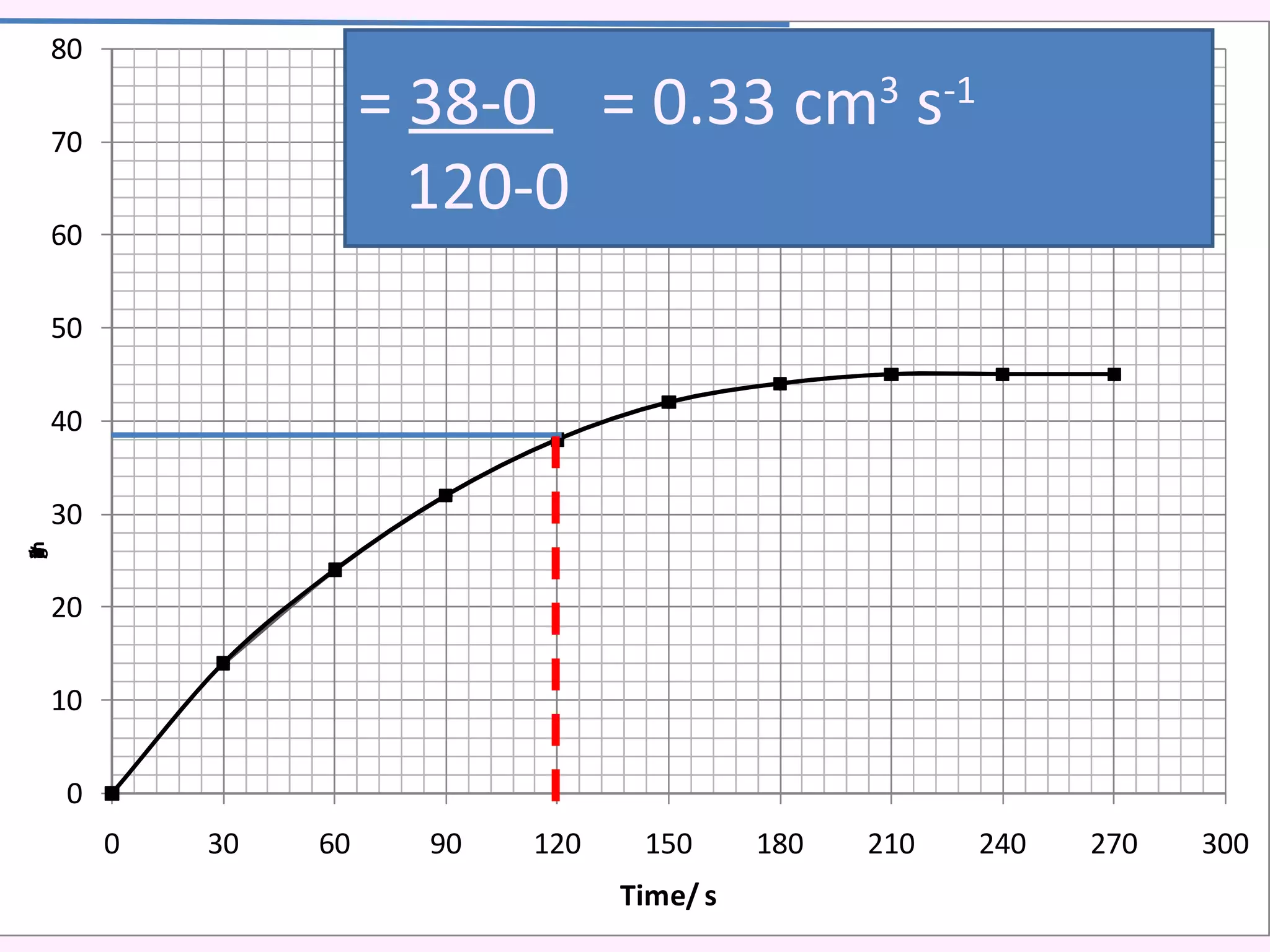
b) Example from the graph, determine: i) The average rate of reaction for for the first 2 minutes= Total volume of gas at 2min – at 0min  Total time taken at 2min – at 0 min
=  38-0  = 0.33 cm 3  s -1 120-0
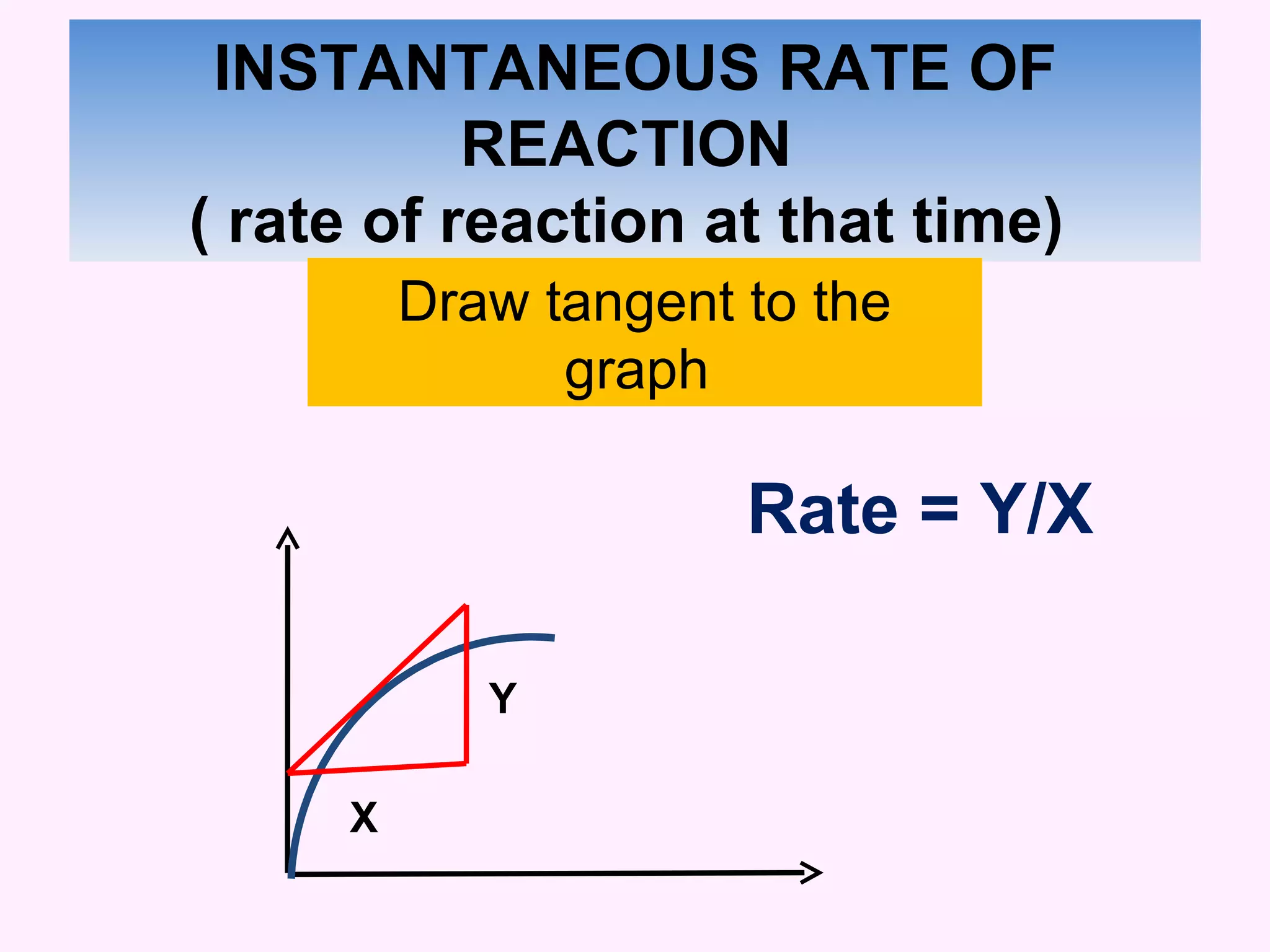
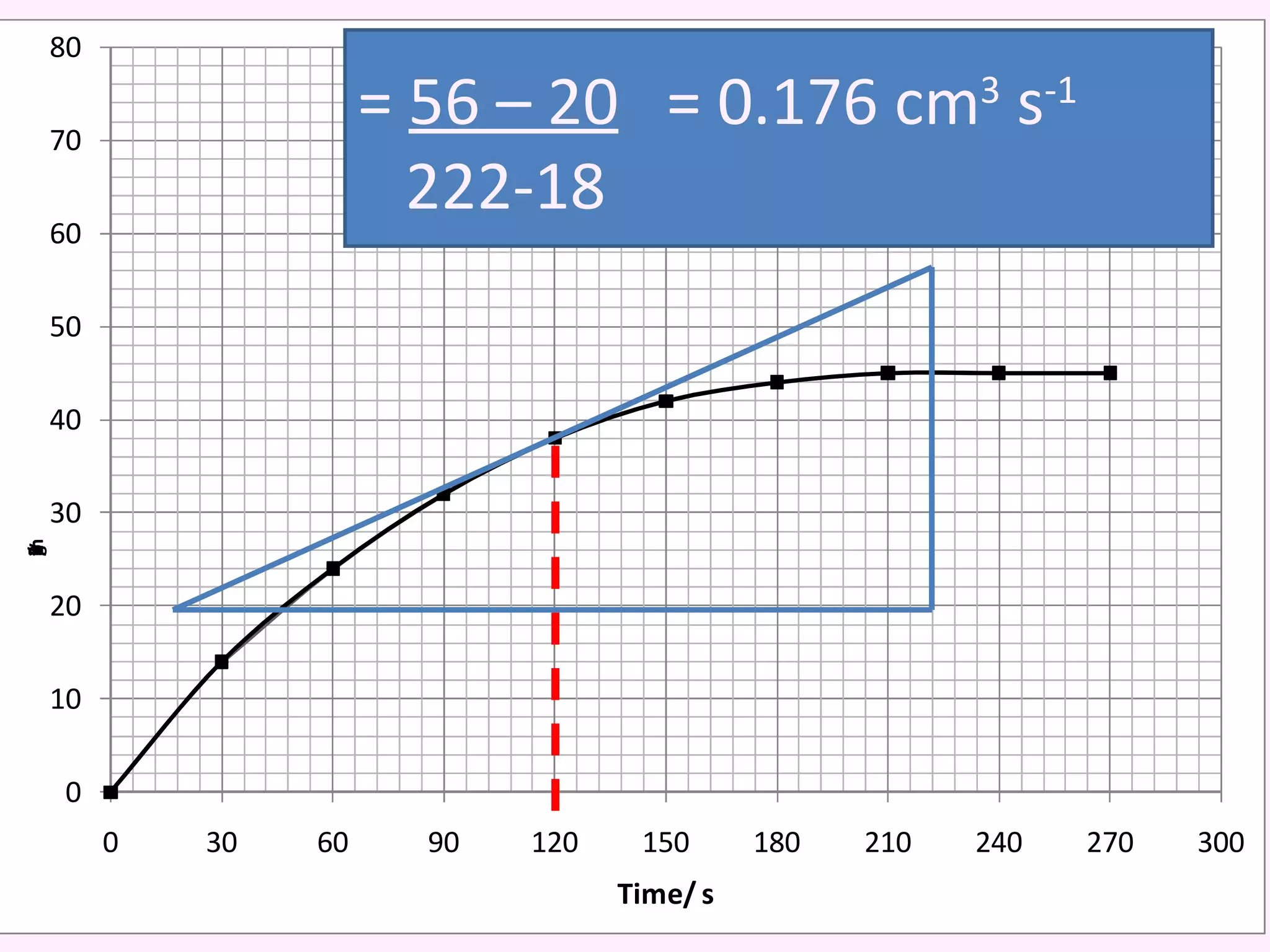
INSTANTANEOUS RATE OF REACTION  ( rate of reaction at that time)  Draw tangent to the graph  Y X Rate = Y/X
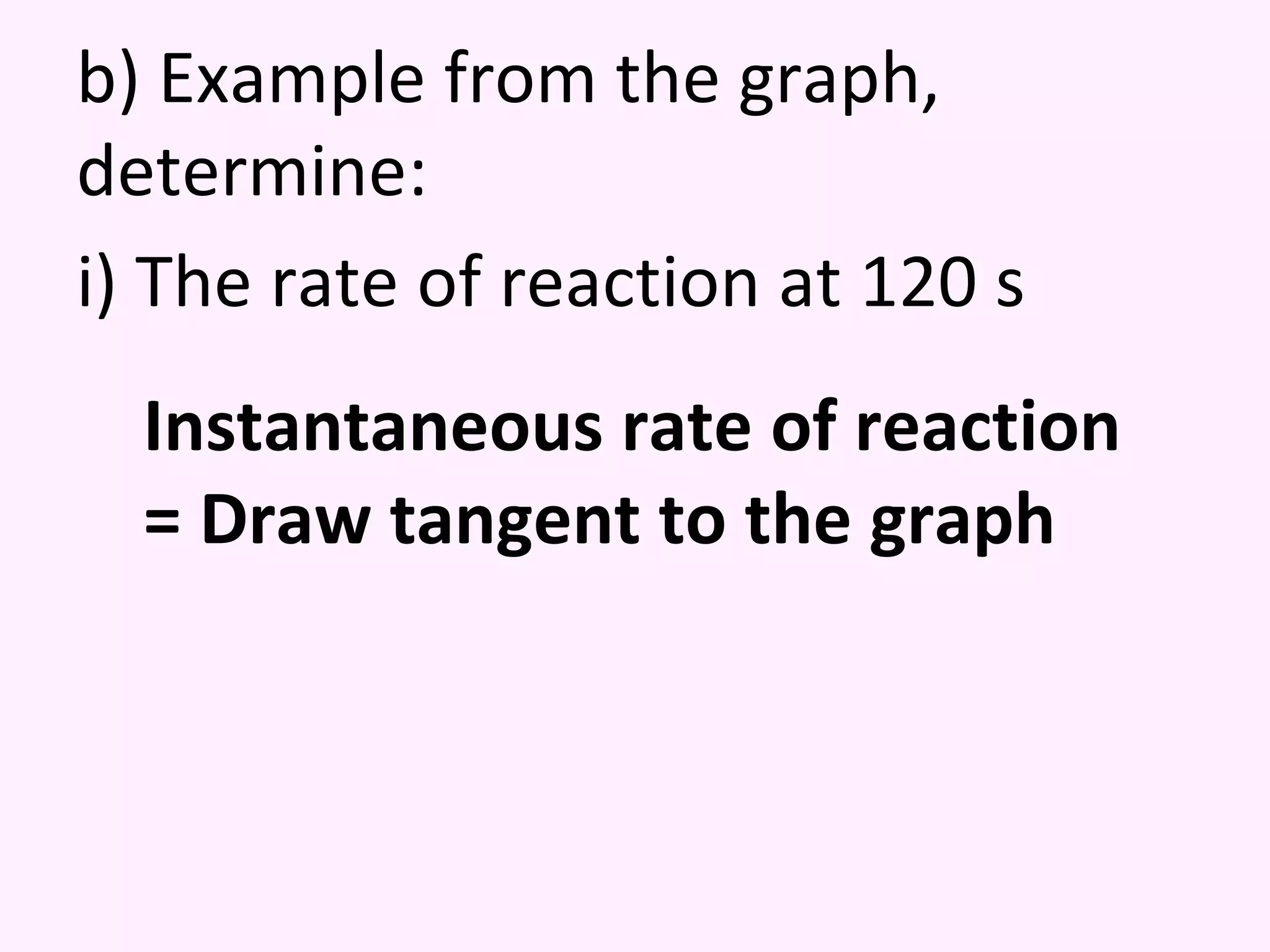
b) Example from the graph, determine: i) The rate of reaction at 120 s Instantaneous rate of reaction = Draw tangent to the graph
=  56 – 20   = 0.176 cm 3  s -1 222-18


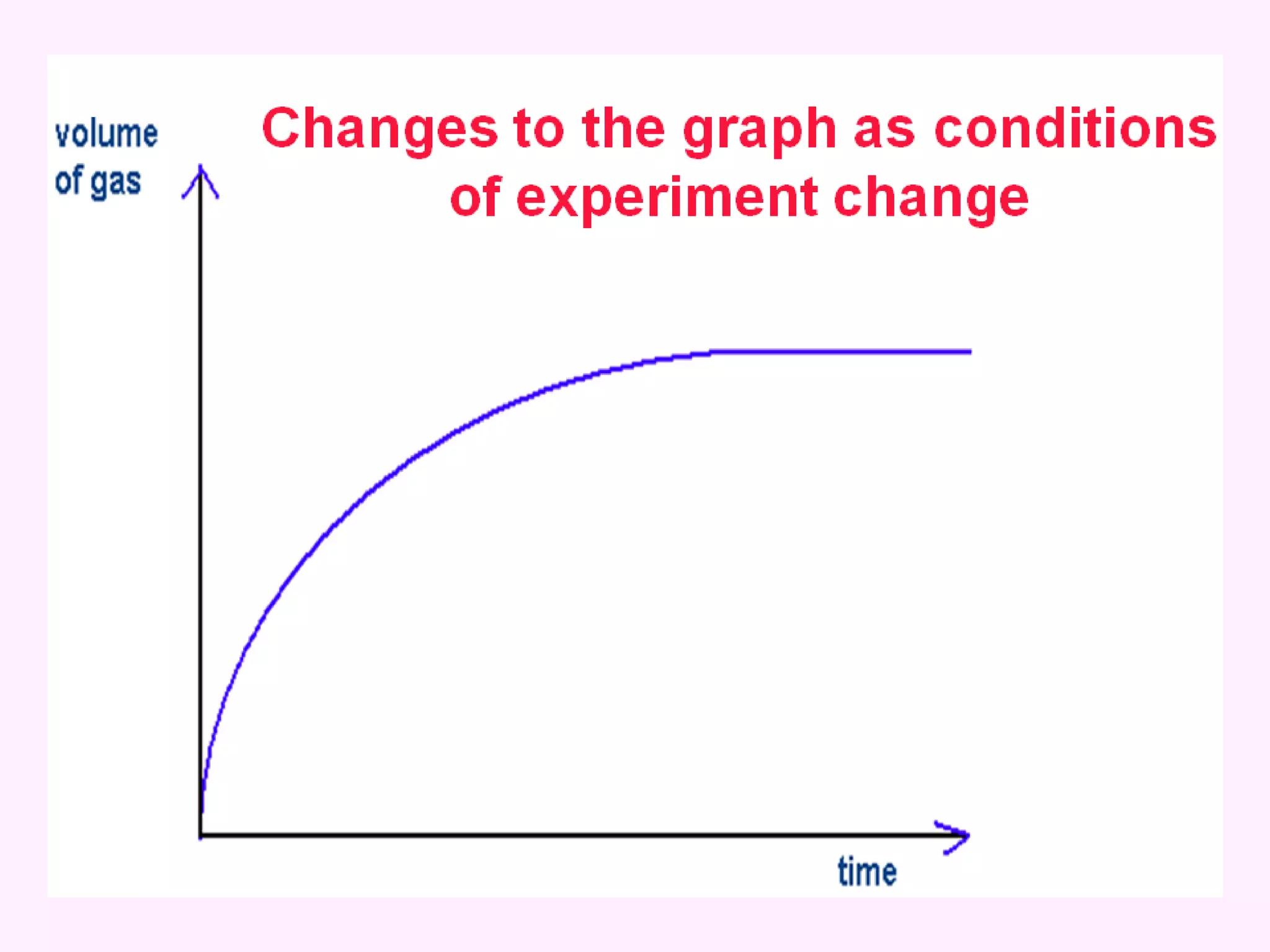
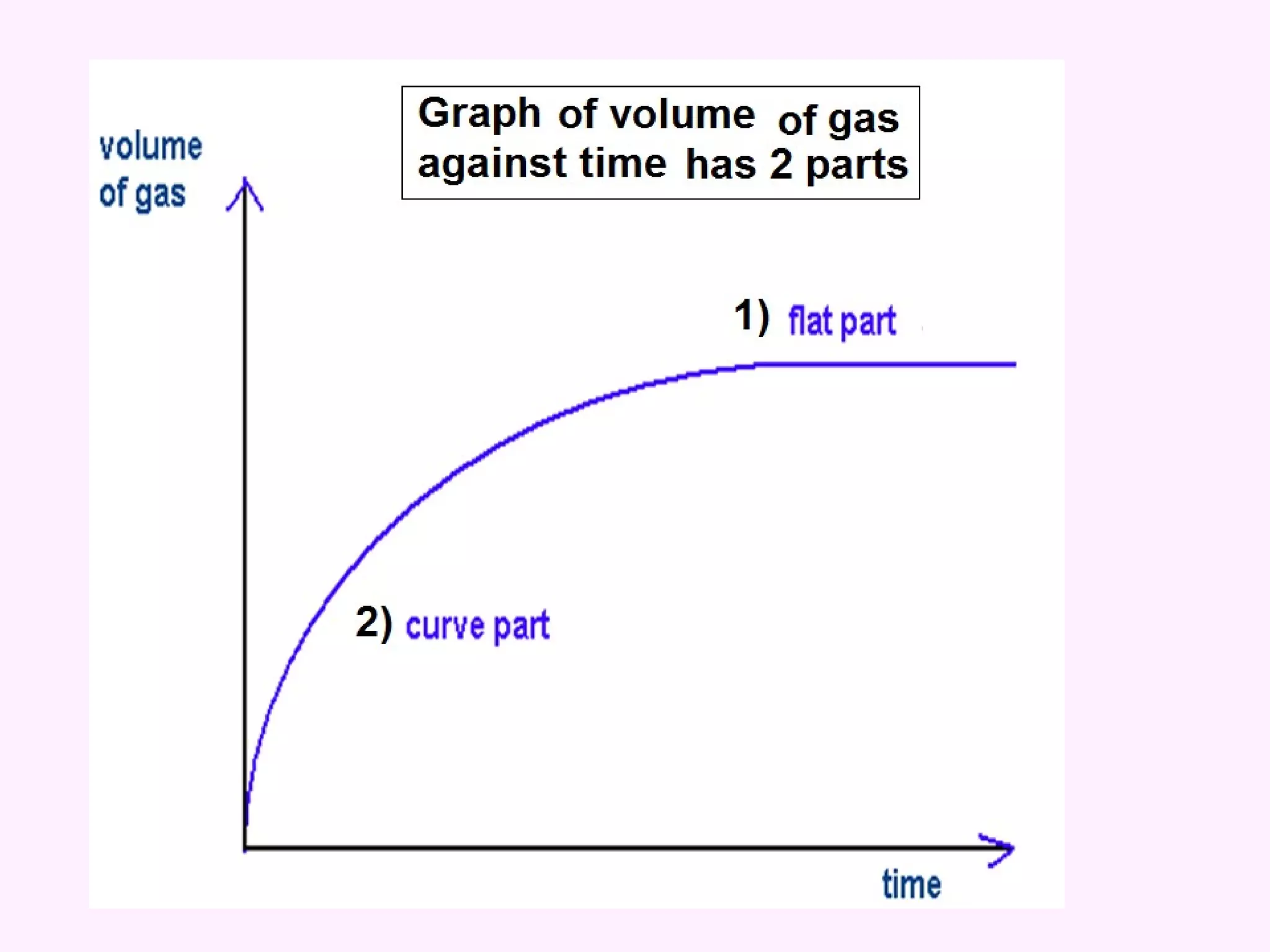
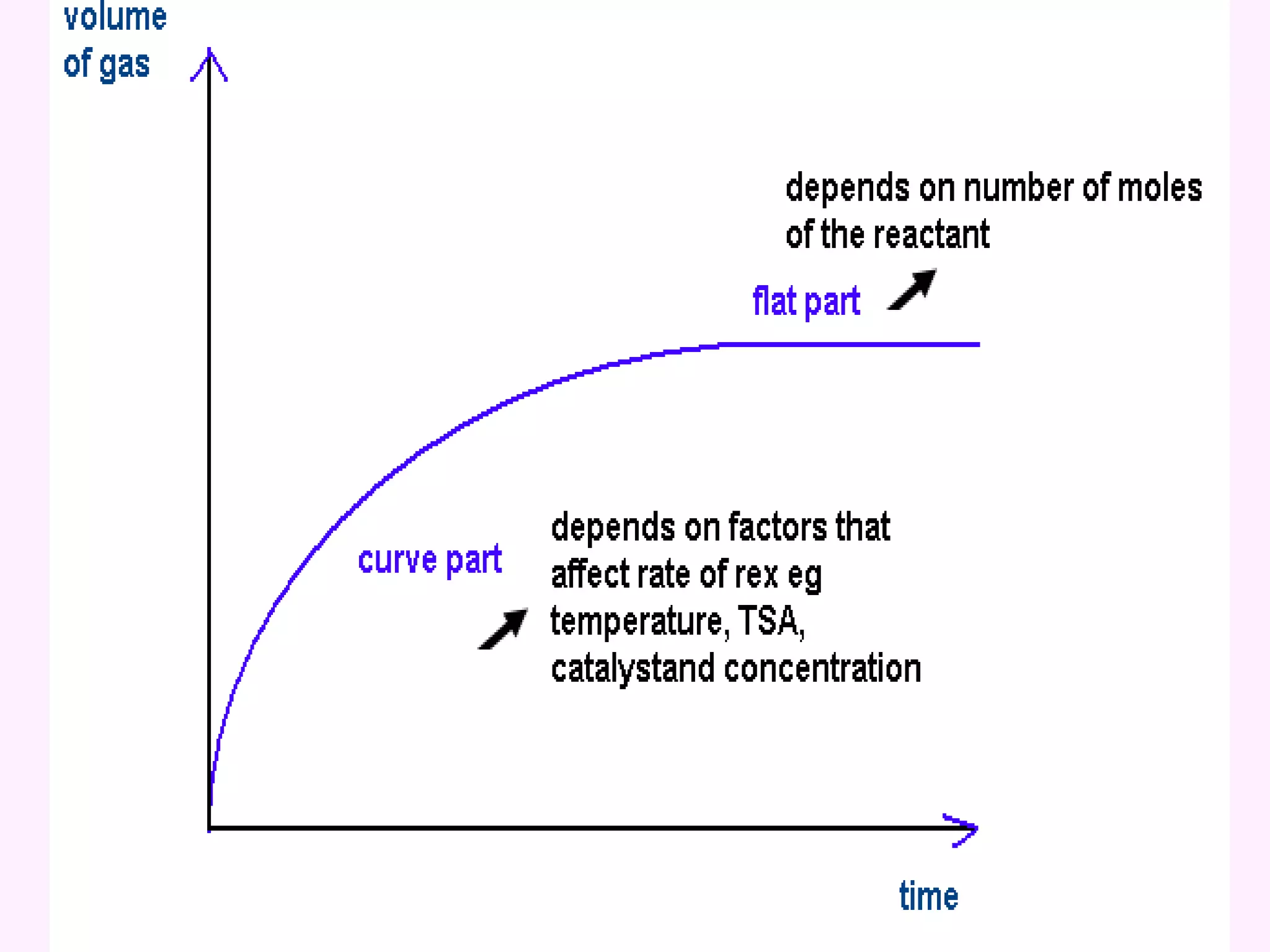
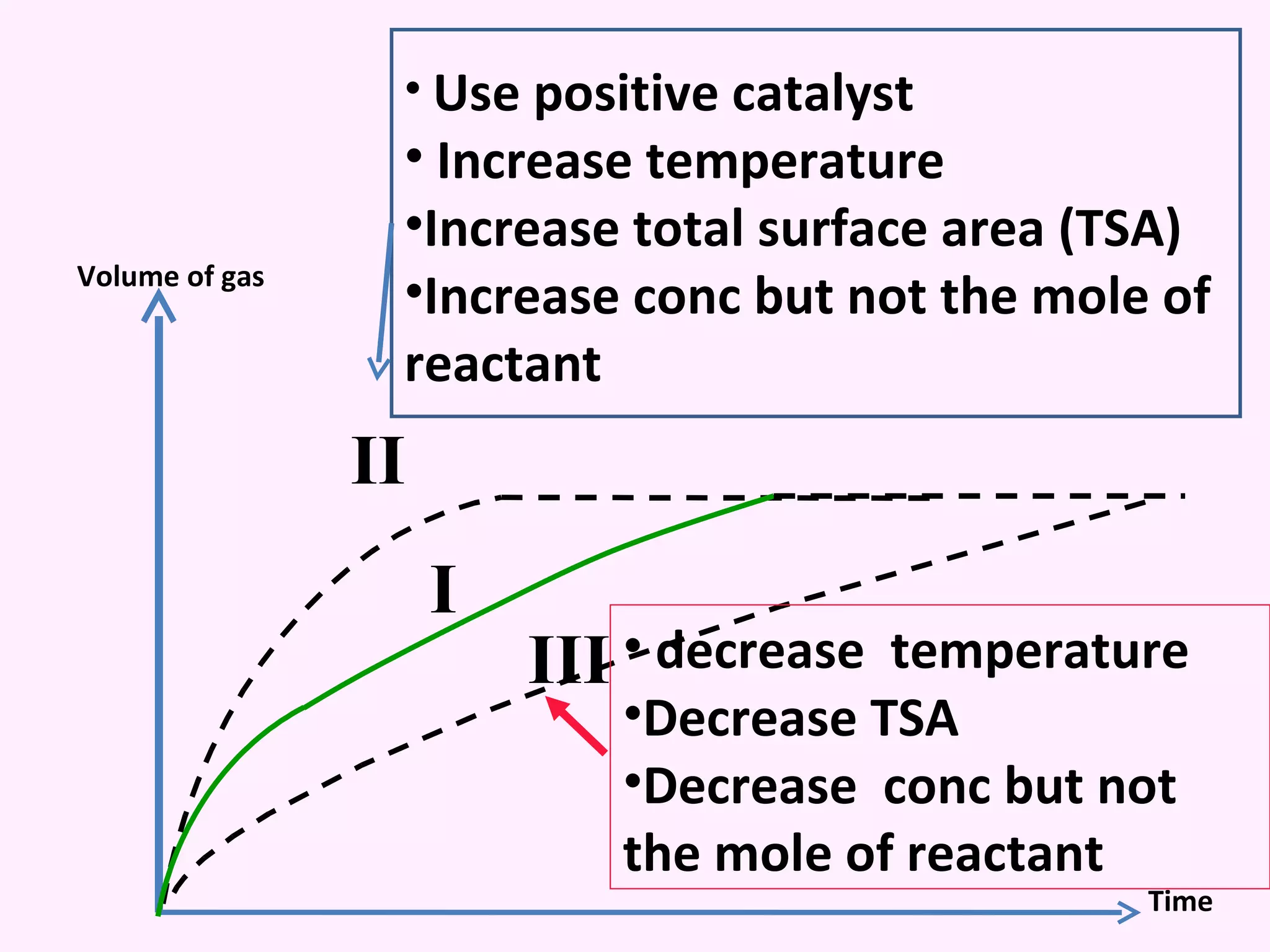
II I III Volume of gas Time decrease  temperature  Decrease TSA Decrease  conc but not the mole of reactant Use positive catalyst Increase temperature  Increase total surface area (TSA) Increase conc but not the mole of reactant
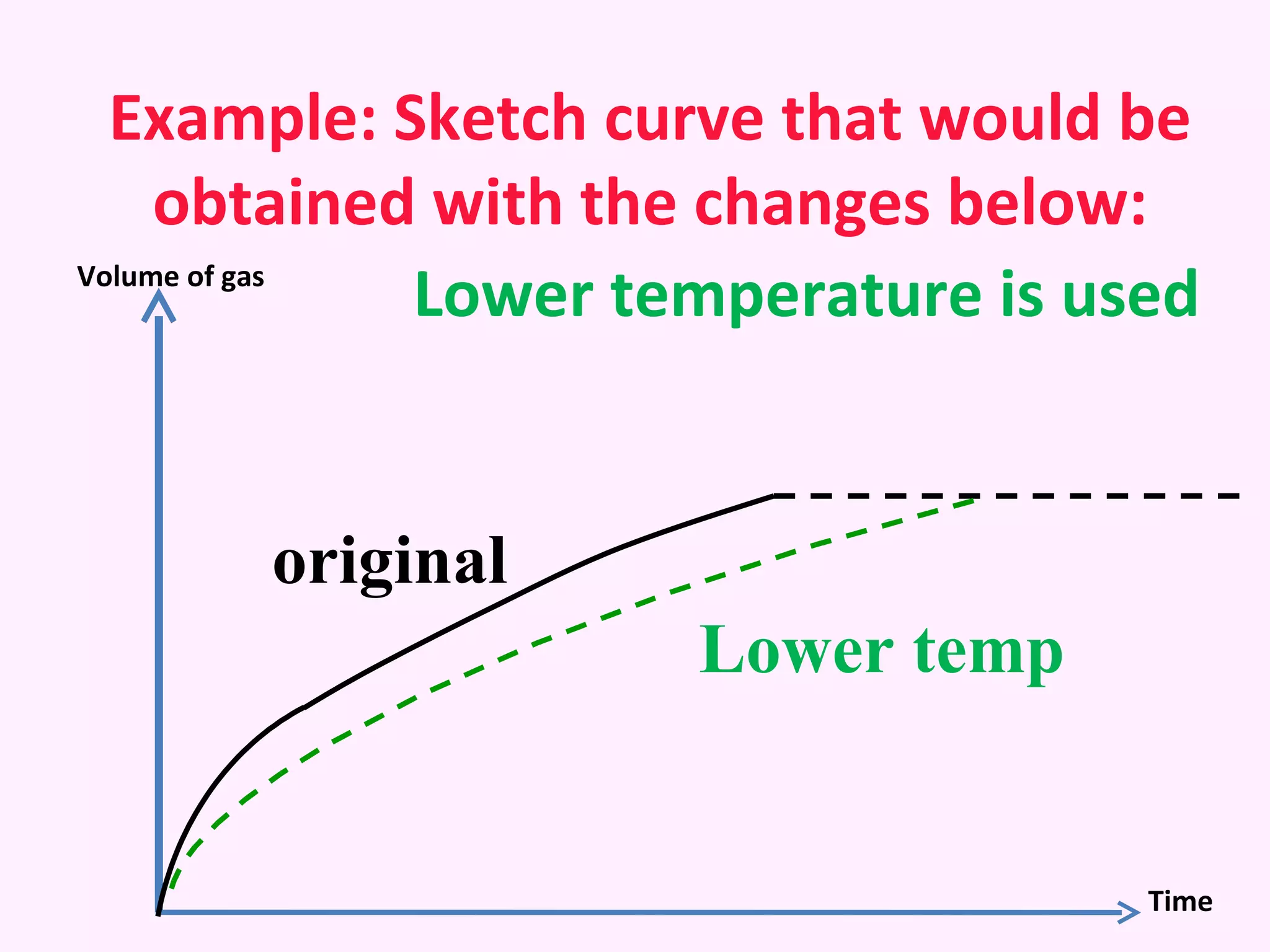
Example: Sketch curve that would be obtained with the changes below: original Lower temp Volume of gas Time Lower temperature is used
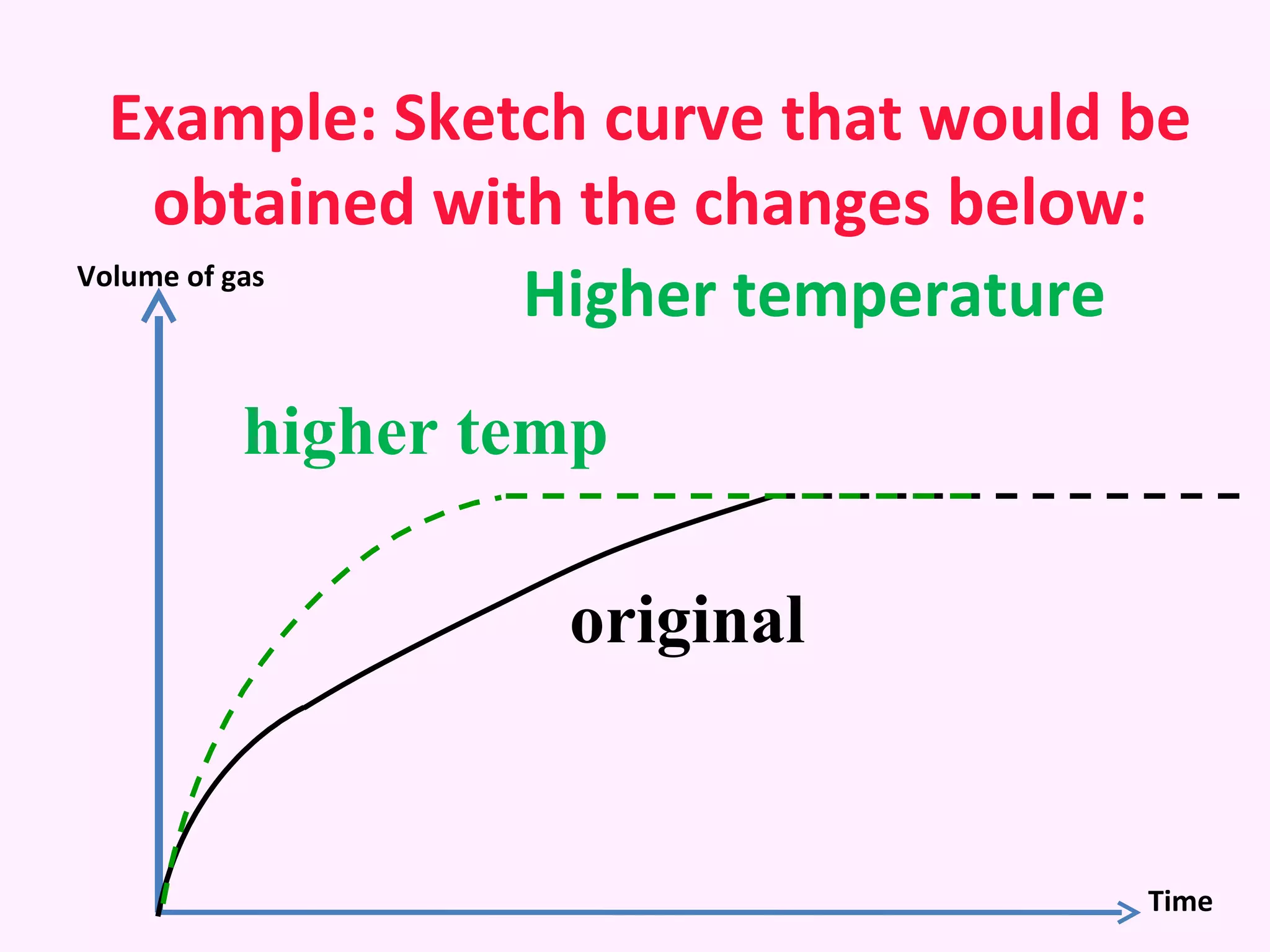
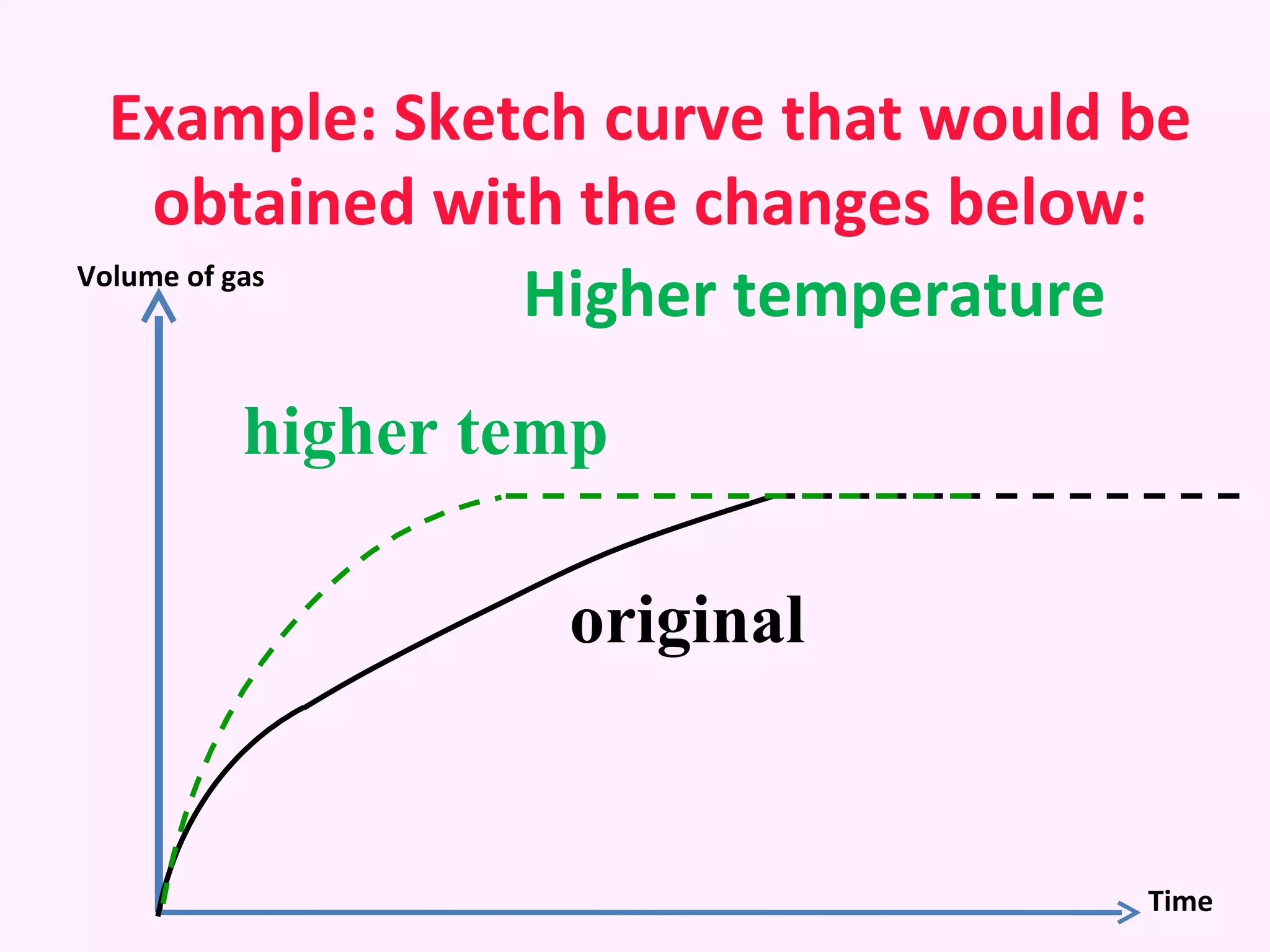
Example: Sketch curve that would be obtained with the changes below: original higher temp Volume of gas Time Higher temperature
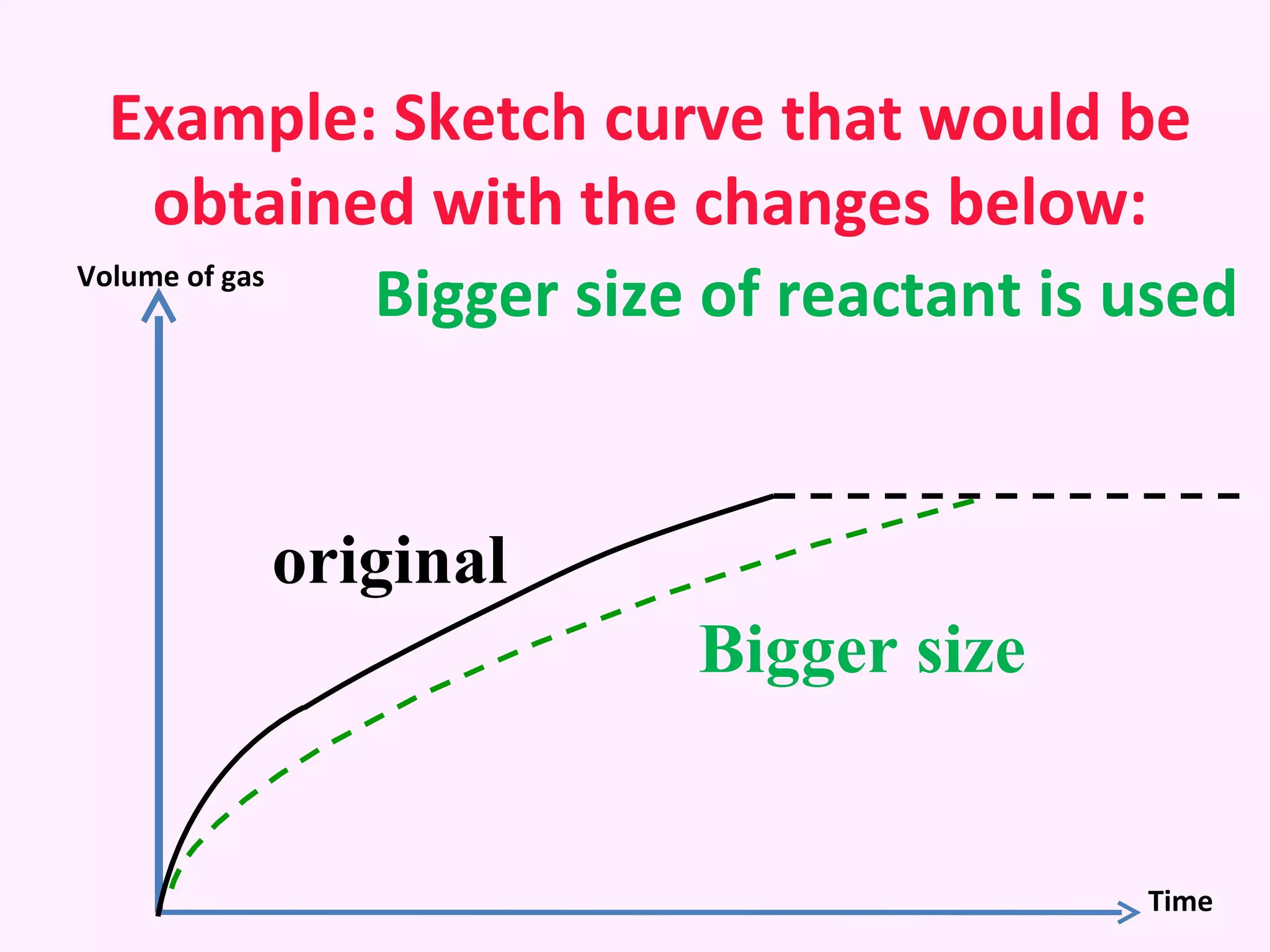
Example: Sketch curve that would be obtained with the changes below: original Bigger size Volume of gas Time Bigger size of reactant is used
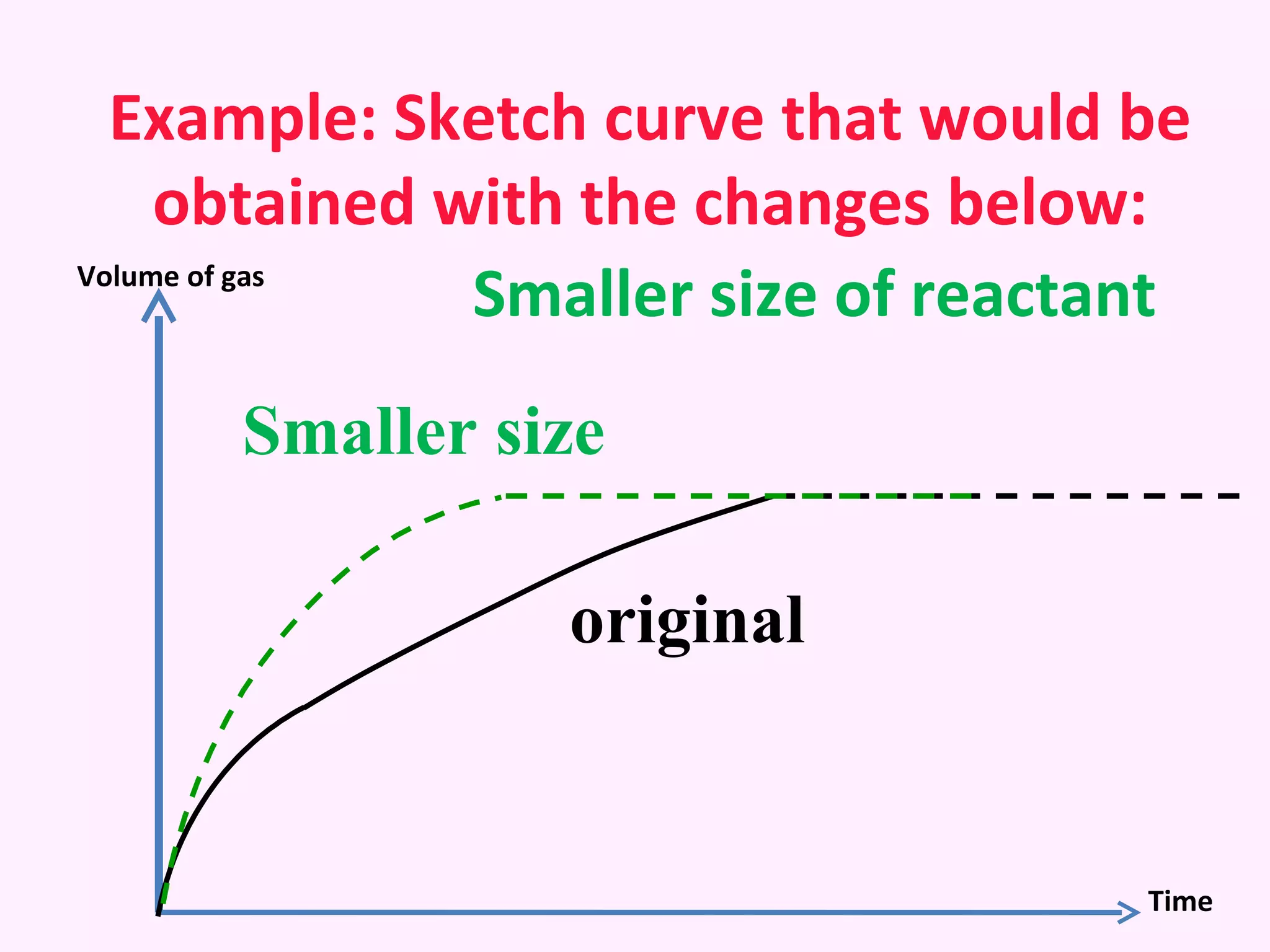
Example: Sketch curve that would be obtained with the changes below: original Smaller size Volume of gas Time Smaller size of reactant
Example: Sketch curve that would be obtained with the changes below: original higher temp Volume of gas Time Higher temperature
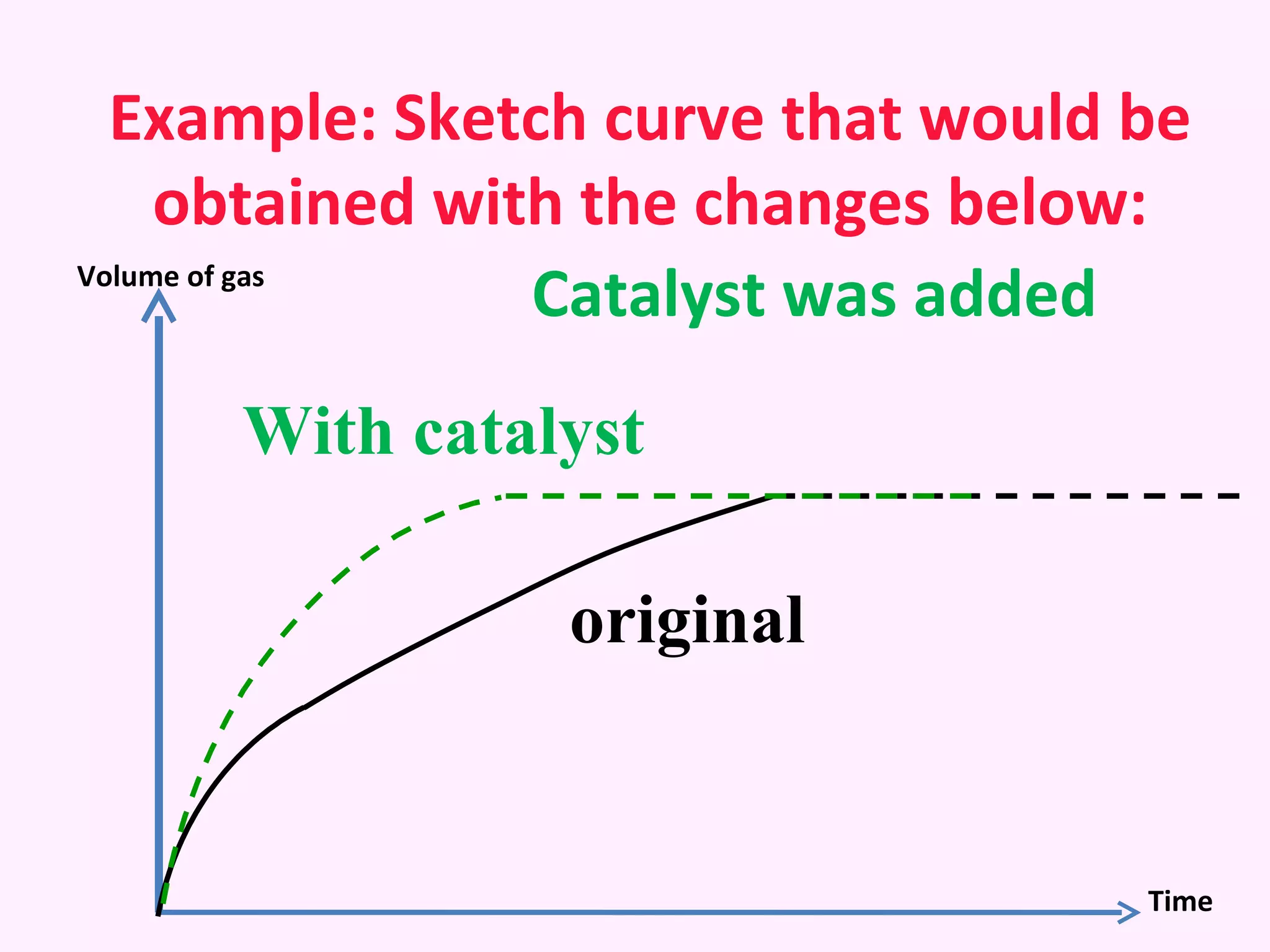
Example: Sketch curve that would be obtained with the changes below: original With catalyst Volume of gas Time Catalyst was added
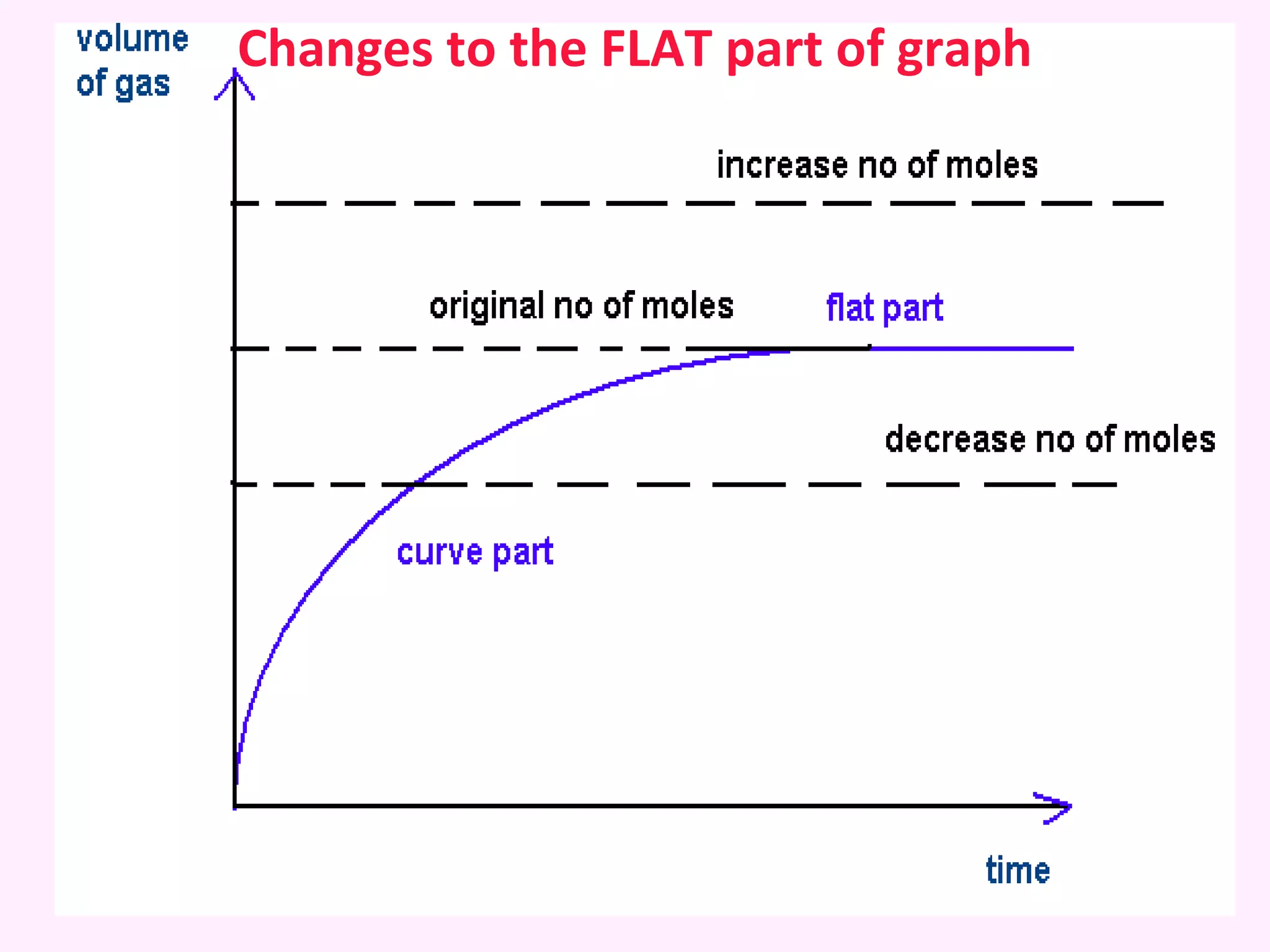
Changes to the FLAT part of graph
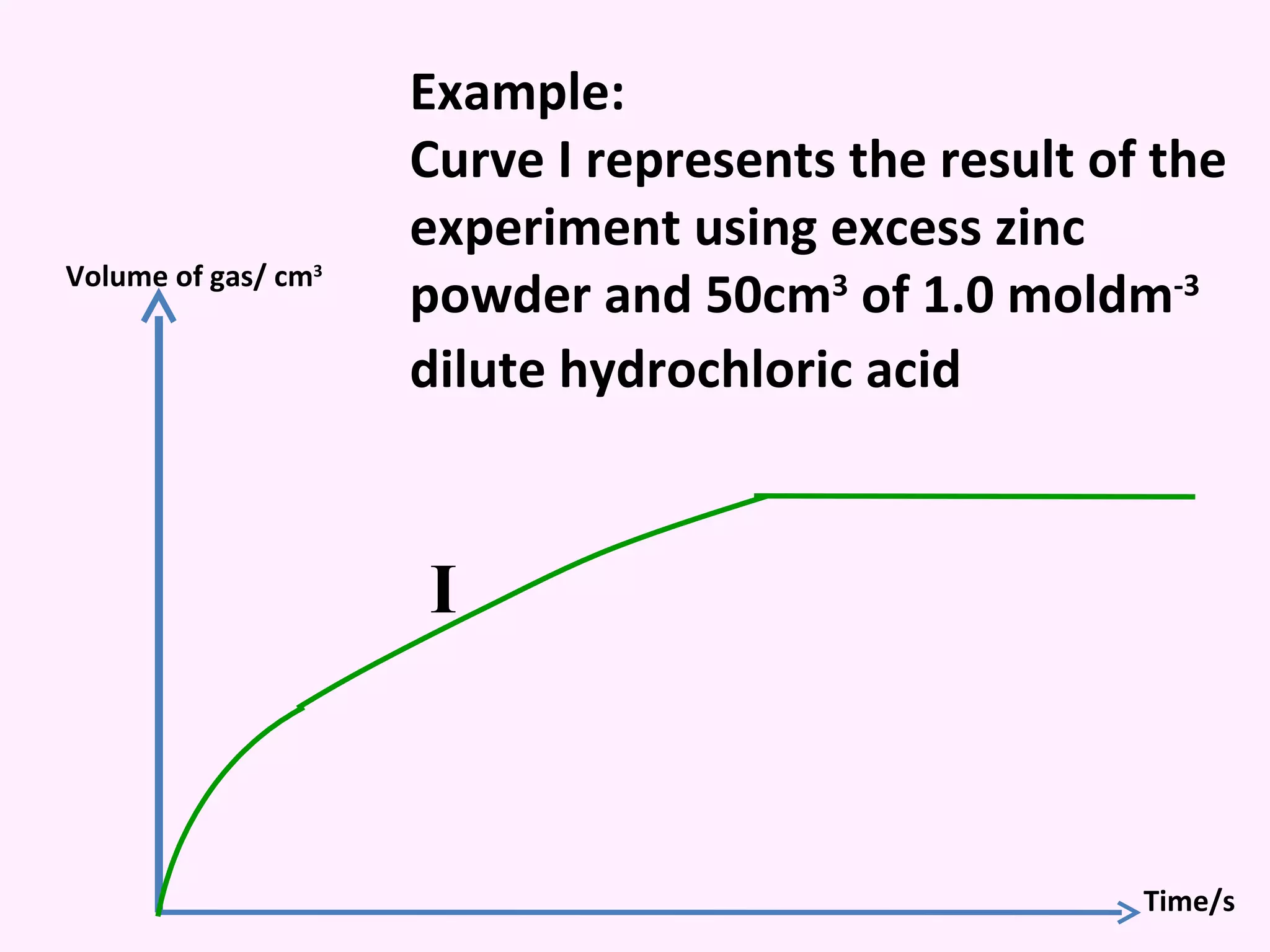
Example: Curve I represents the result of the experiment using excess zinc powder and 50cm 3  of 1.0 moldm -3  dilute hydrochloric acid   I Volume of gas/ cm 3 Time/s
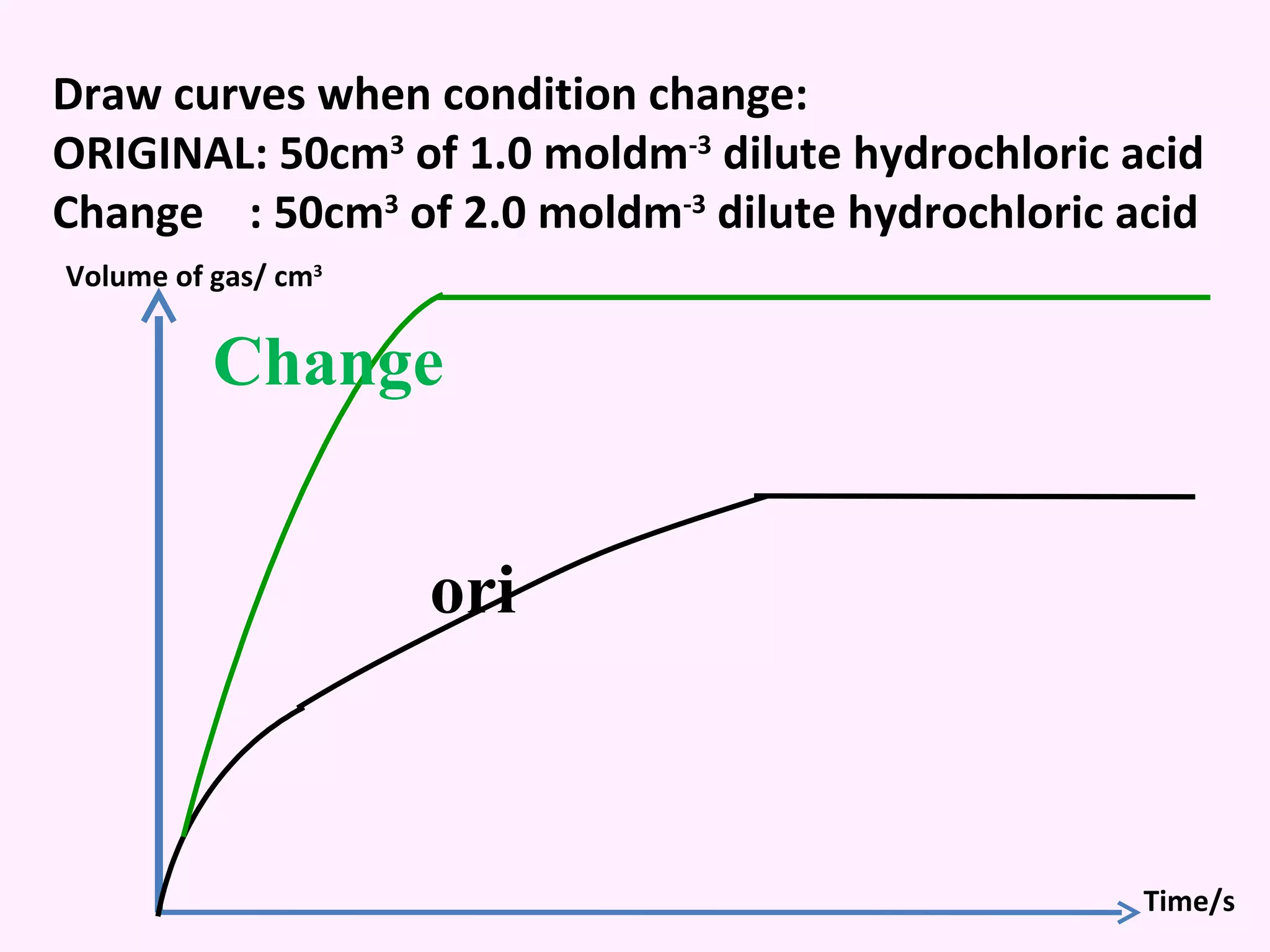
Draw curves when condition change: ORIGINAL: 50cm 3  of 1.0 moldm -3  dilute hydrochloric acid Change  : 50cm 3  of 2.0 moldm -3  dilute hydrochloric acid ori Volume of gas/ cm 3 Time/s Change
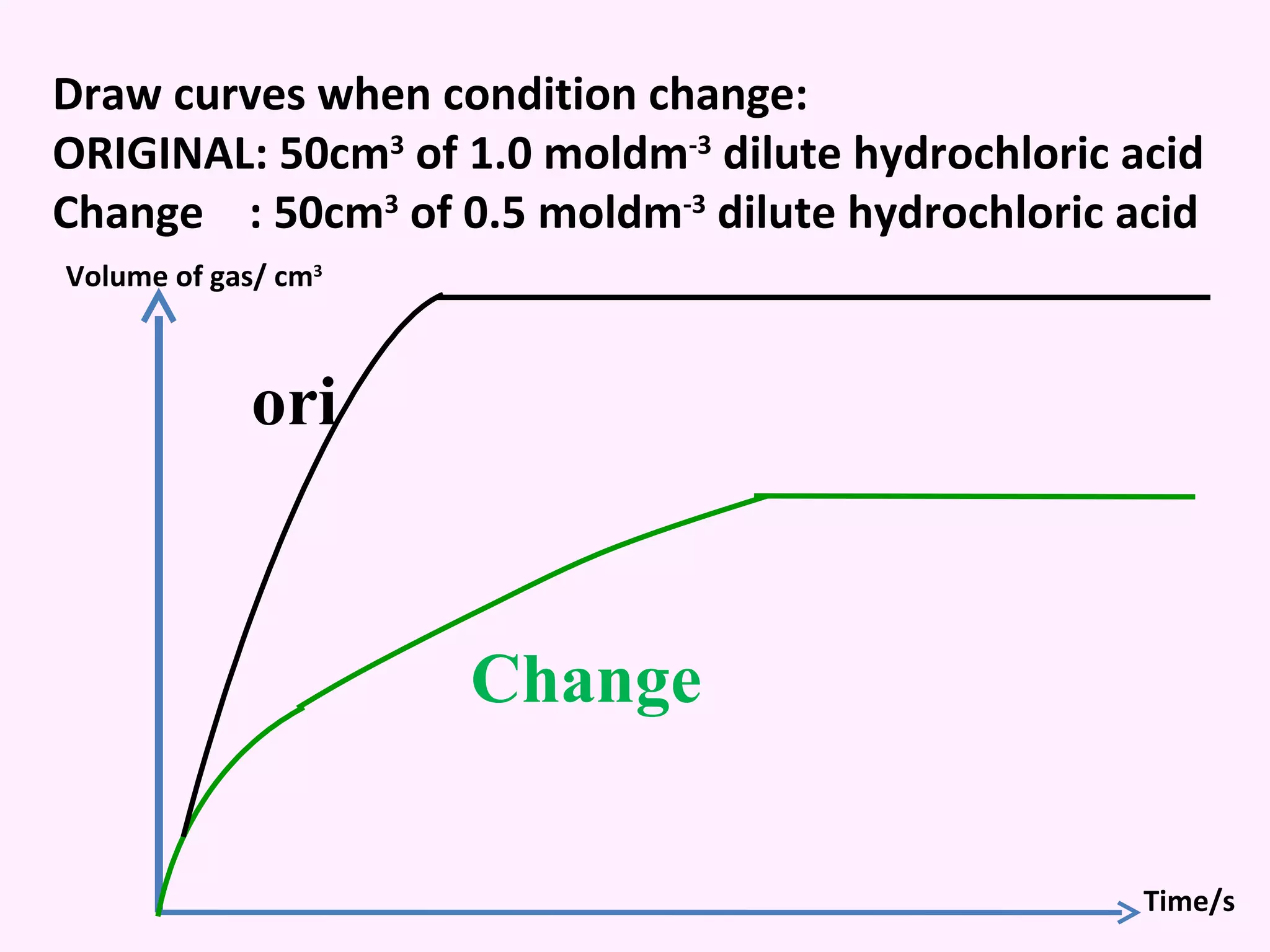
Draw curves when condition change: ORIGINAL: 50cm 3  of 1.0 moldm -3  dilute hydrochloric acid Change  : 50cm 3  of 0.5 moldm -3  dilute hydrochloric acid ori Volume of gas/ cm 3 Time/s Change
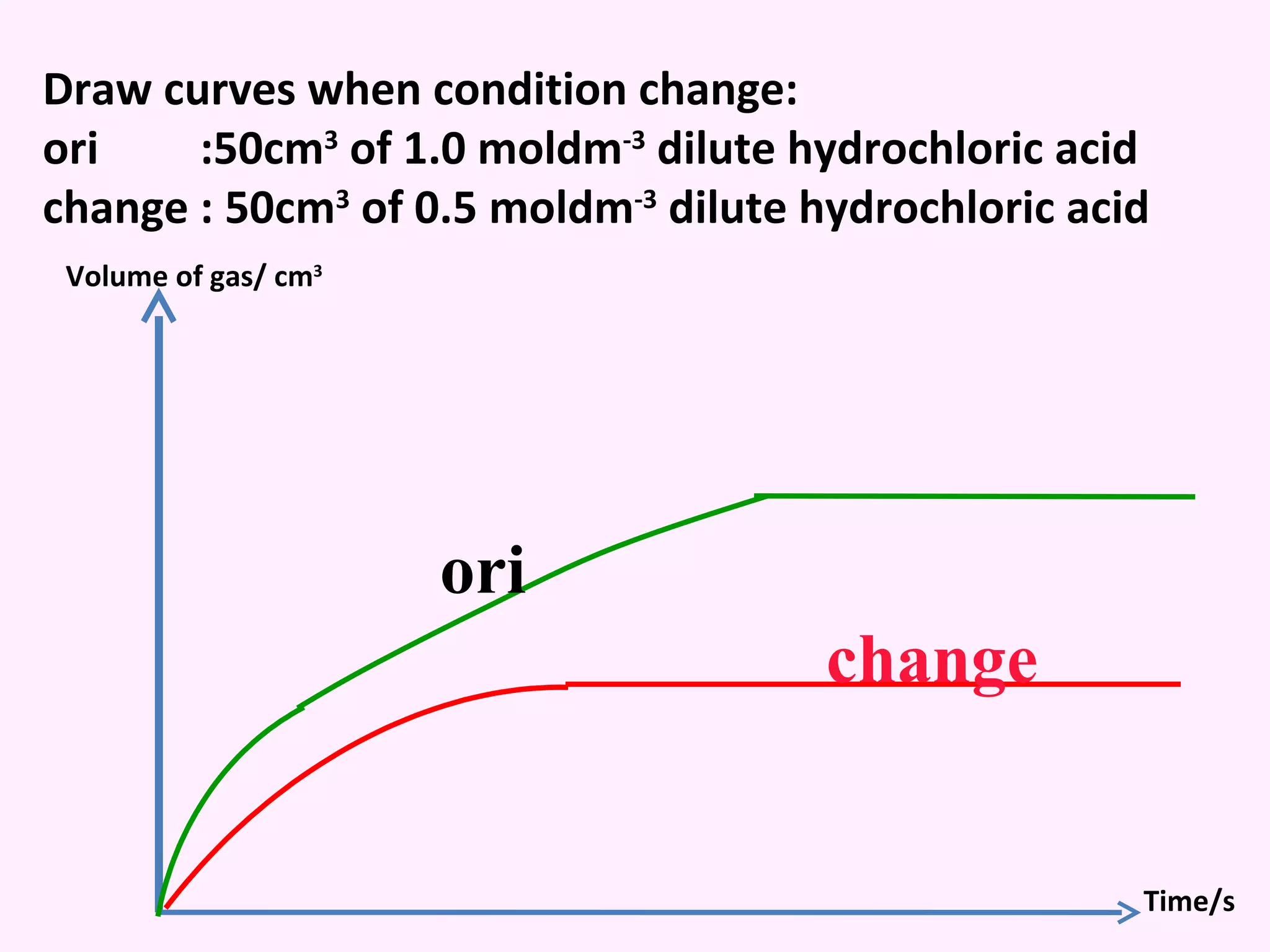
Draw curves when condition change: ori  :50cm 3  of 1.0 moldm -3  dilute hydrochloric acid  change : 50cm 3  of 0.5 moldm -3  dilute hydrochloric acid  ori Volume of gas/ cm 3 Time/s change
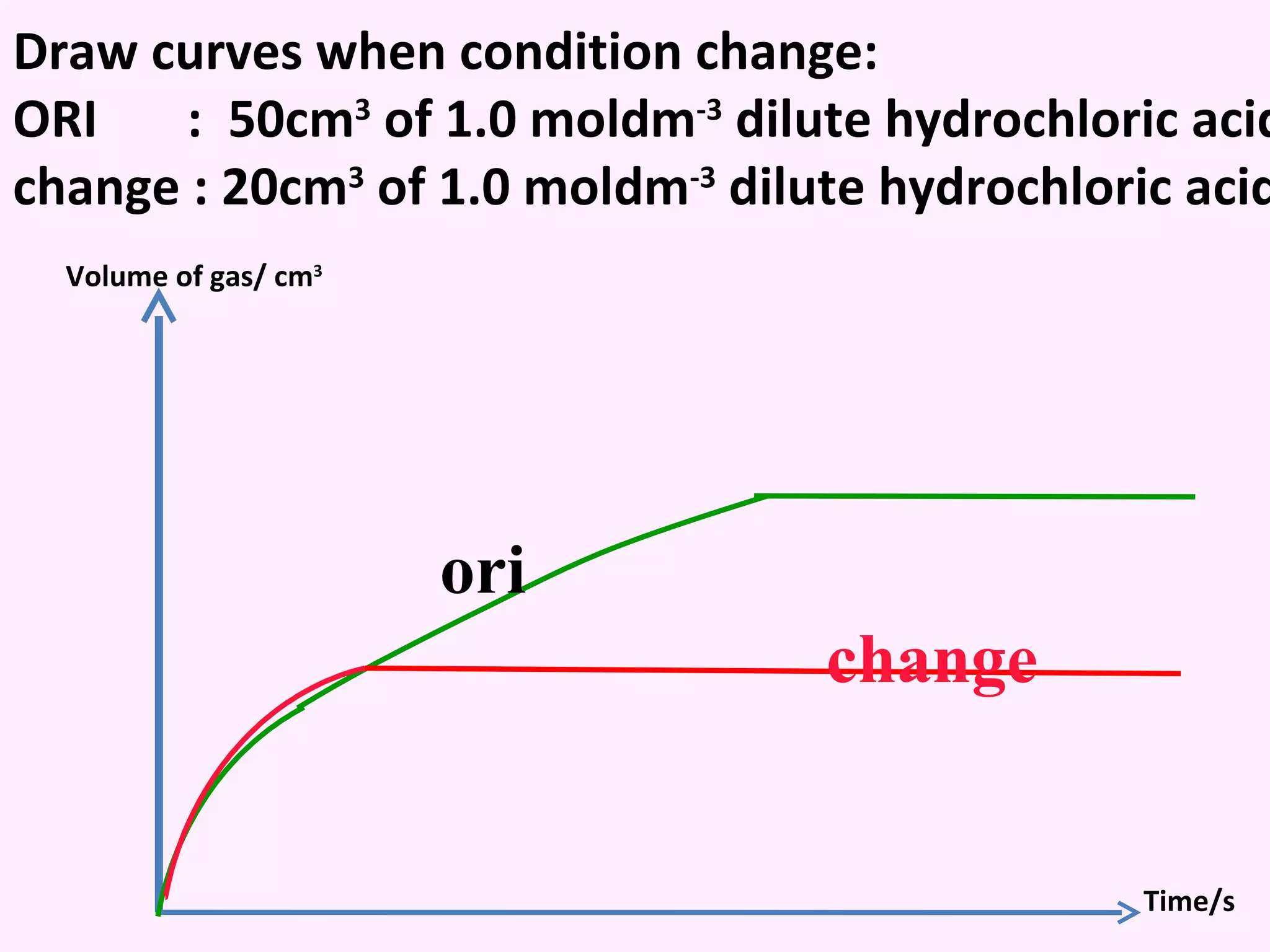
Draw curves when condition change: ORI  :  50cm 3  of 1.0 moldm -3  dilute hydrochloric acid  change : 20cm 3  of 1.0 moldm -3  dilute hydrochloric acid ori Volume of gas/ cm 3 Time/s change
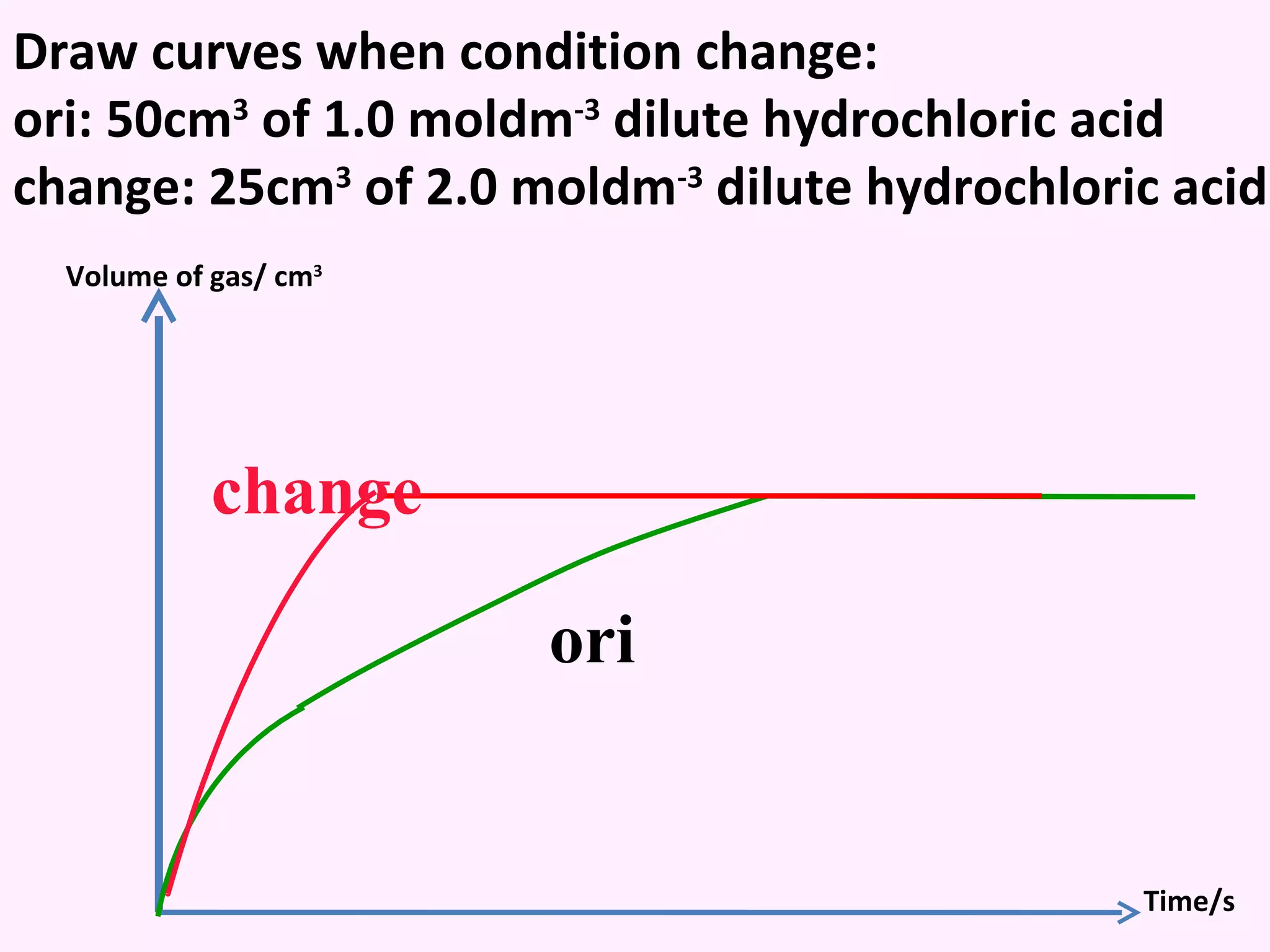
Draw curves when condition change: ori: 50cm 3  of 1.0 moldm -3  dilute hydrochloric acid  change: 25cm 3  of 2.0 moldm -3  dilute hydrochloric acid ori Volume of gas/ cm 3 Time/s change
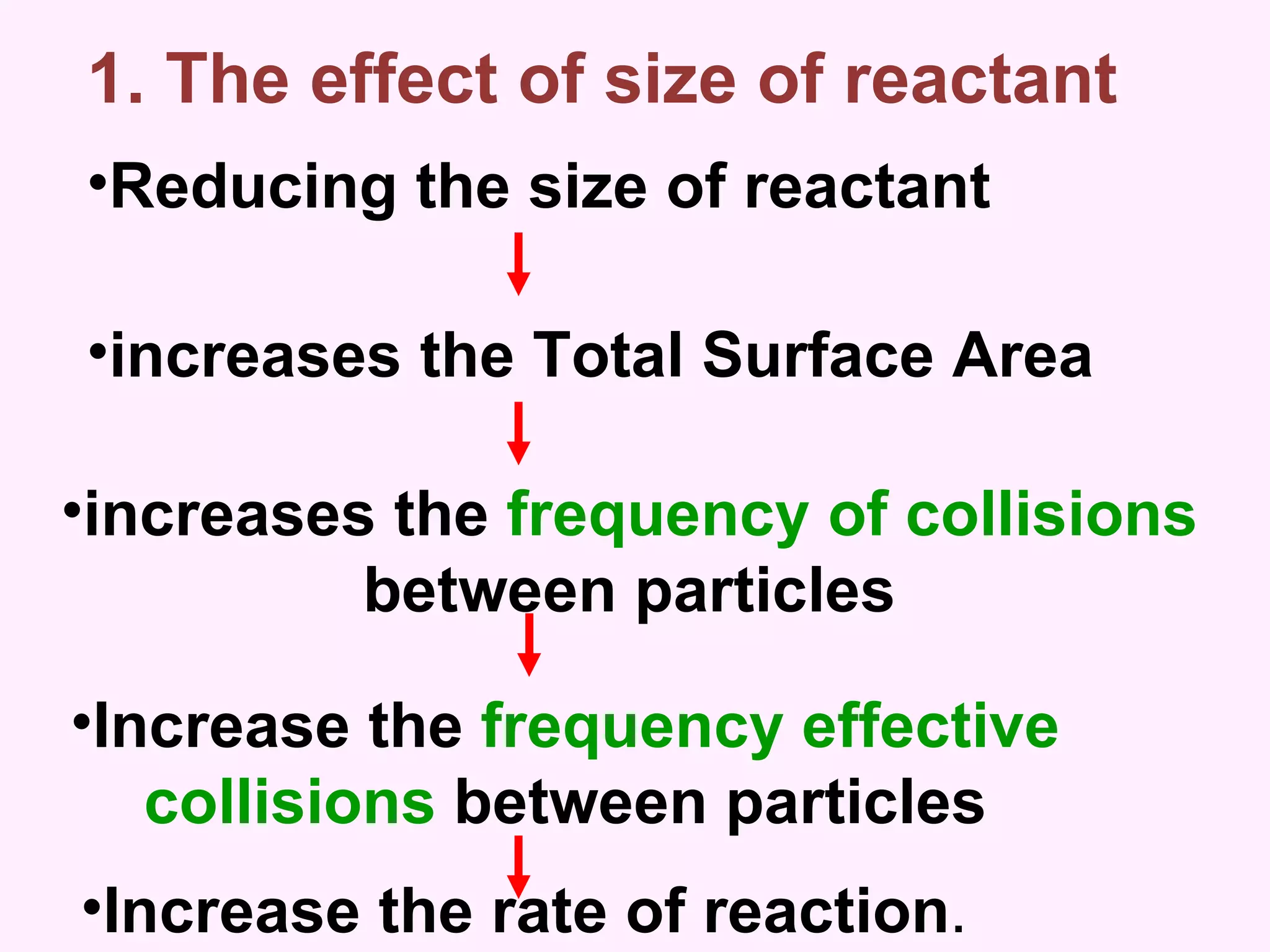
1. The effect of size of reactant Reducing the size of reactant  increases the Total Surface Area increases the  frequency of collisions  between particles  Increase the rate of reaction .  Increase the  frequency effective  collisions  between particles
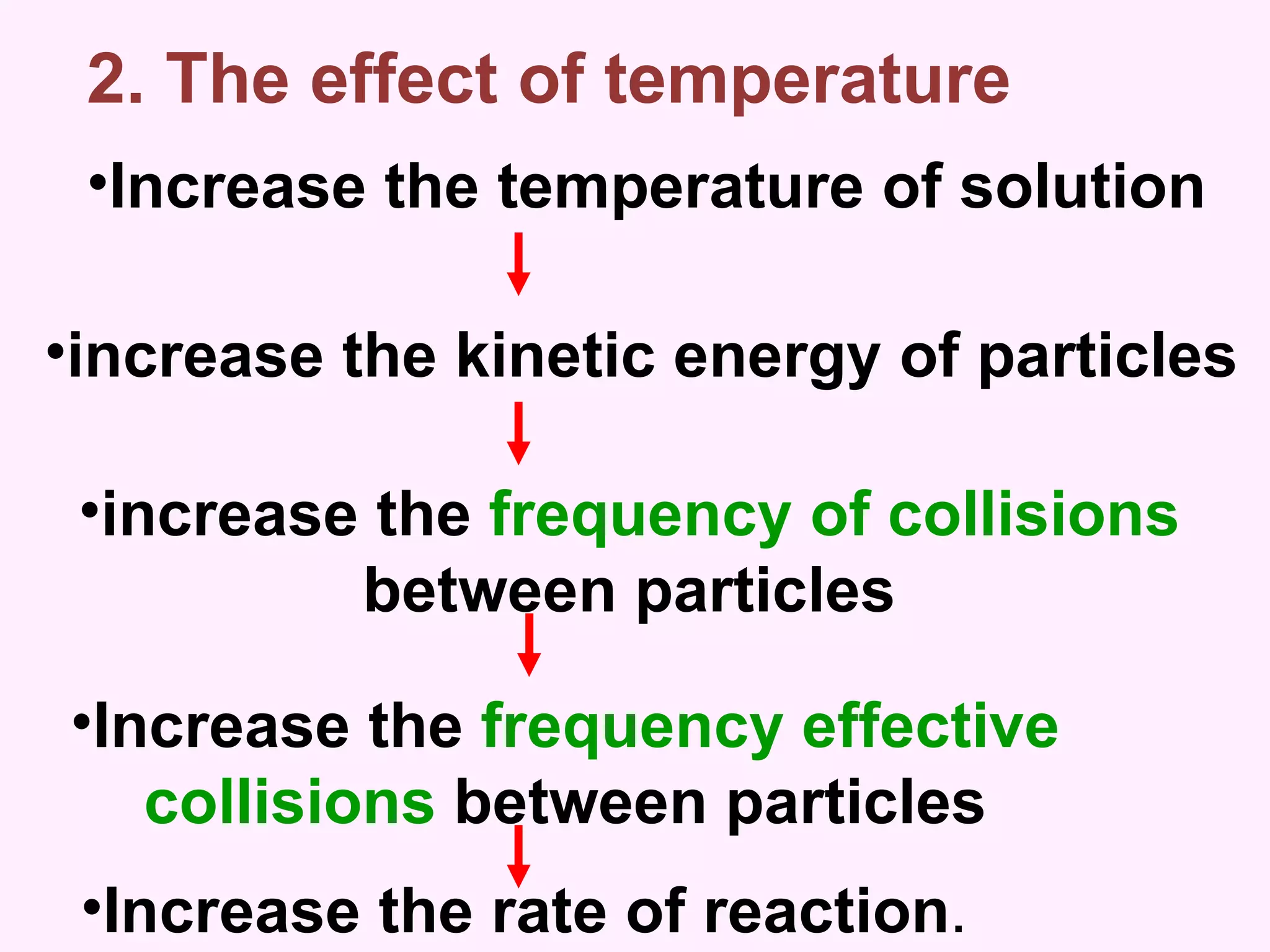
2. The effect of temperature Increase the temperature of solution increase the kinetic energy of particles increase the  frequency of collisions  between particles  Increase the rate of reaction .  Increase the  frequency effective  collisions   between particles
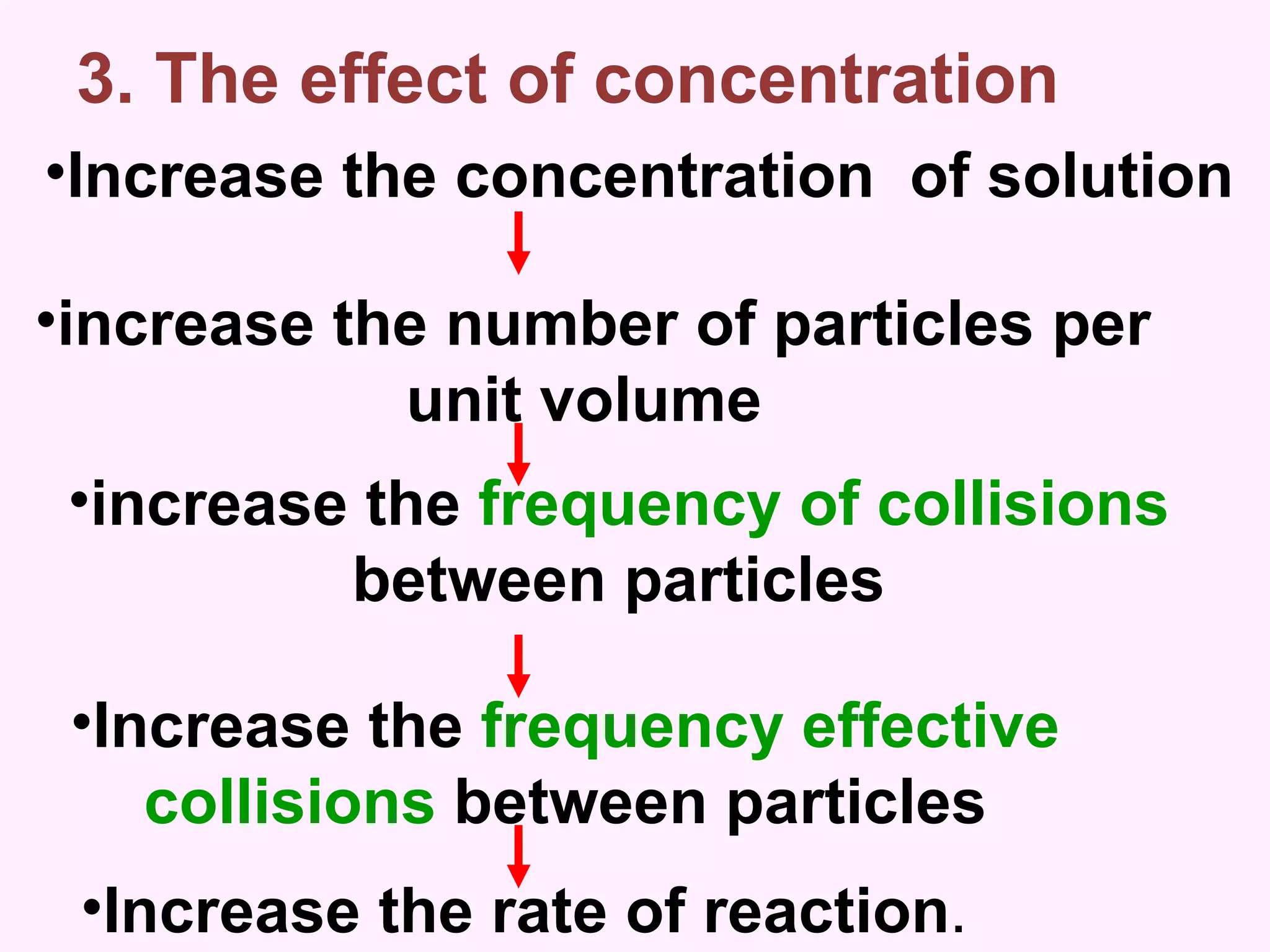
3. The effect of concentration Increase the concentration  of solution increase the number of particles per unit volume  increase the  frequency of collisions  between particles  Increase the rate of reaction .  Increase the  frequency effective  collisions  between particles
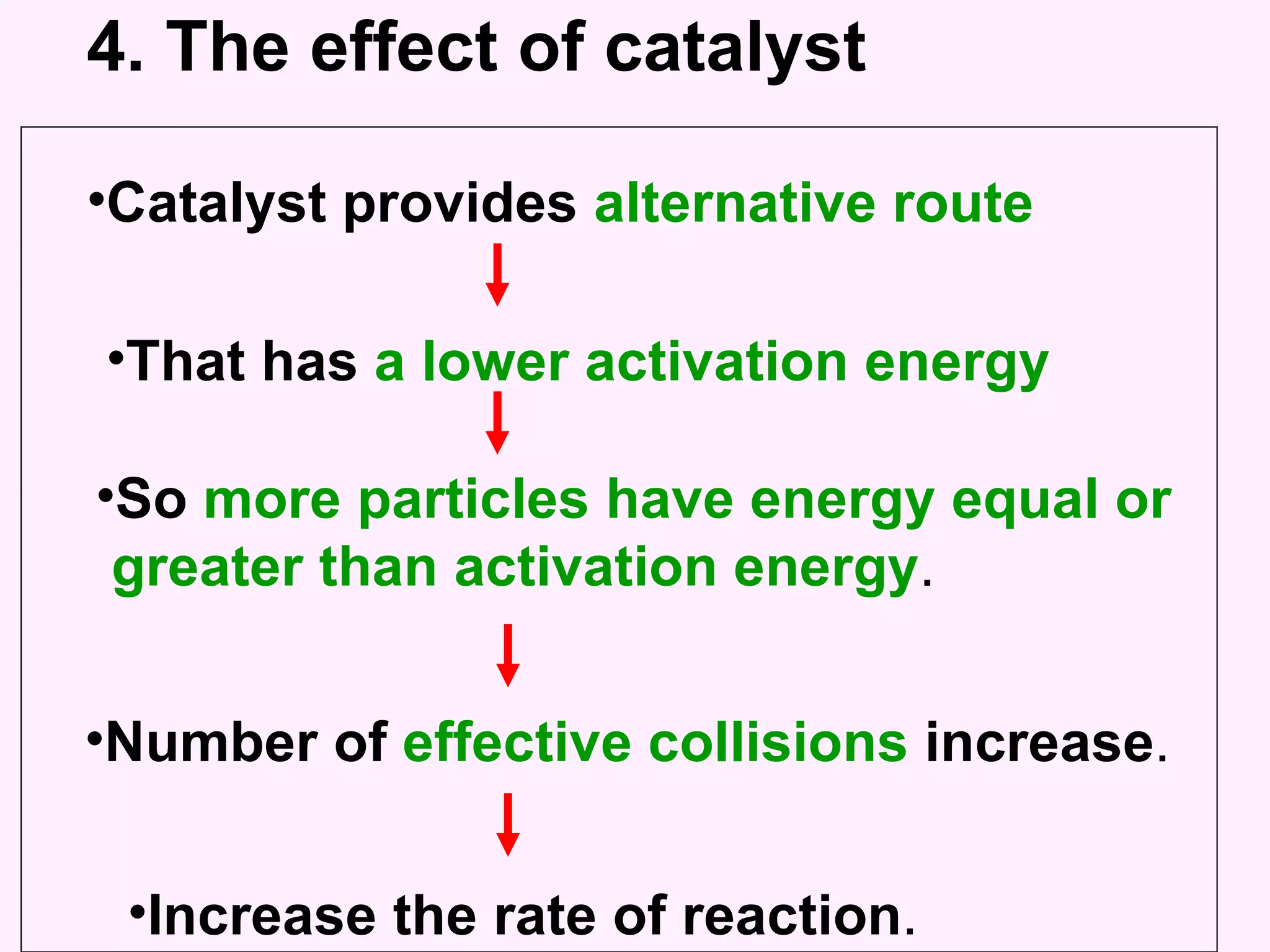
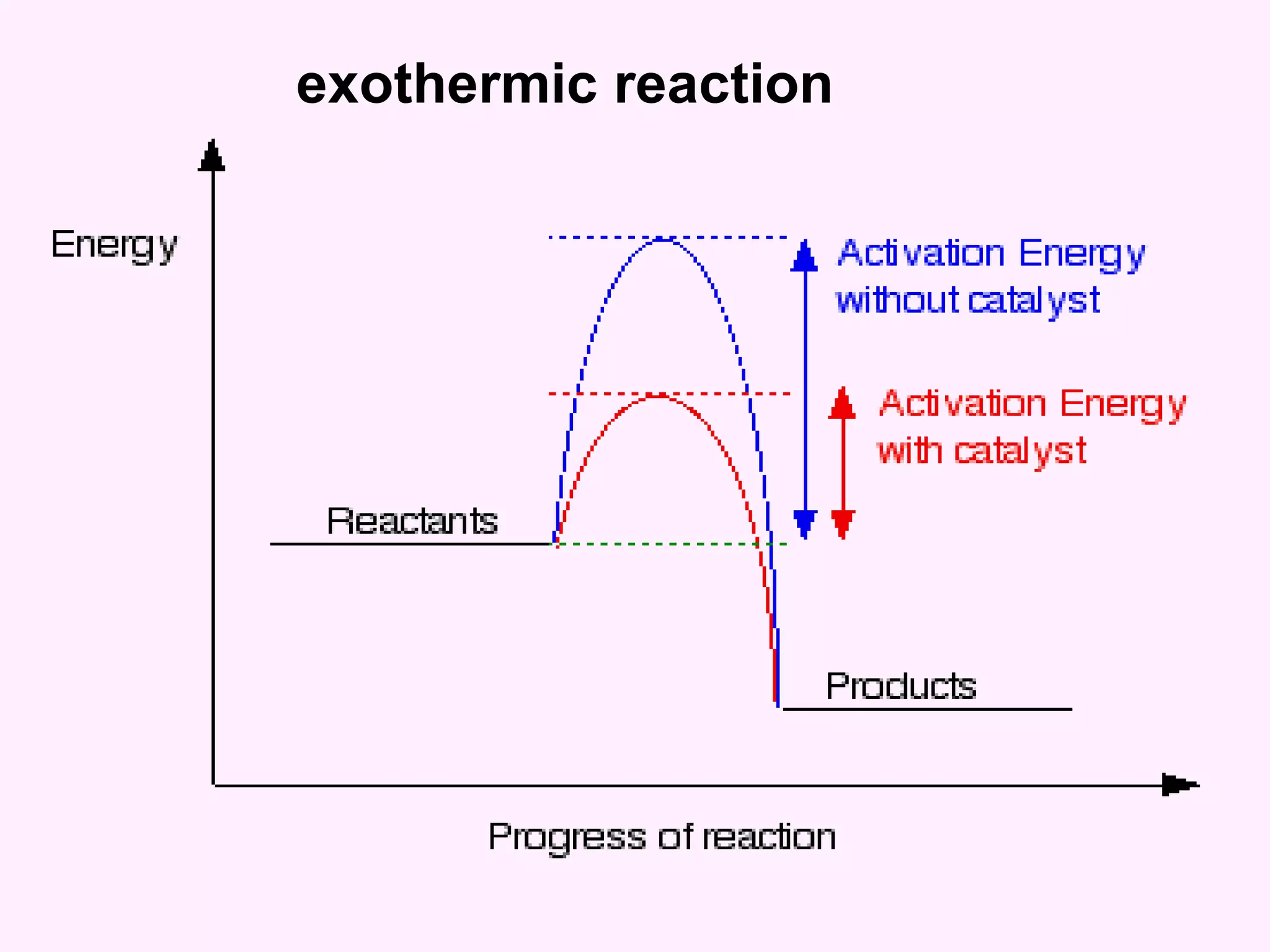
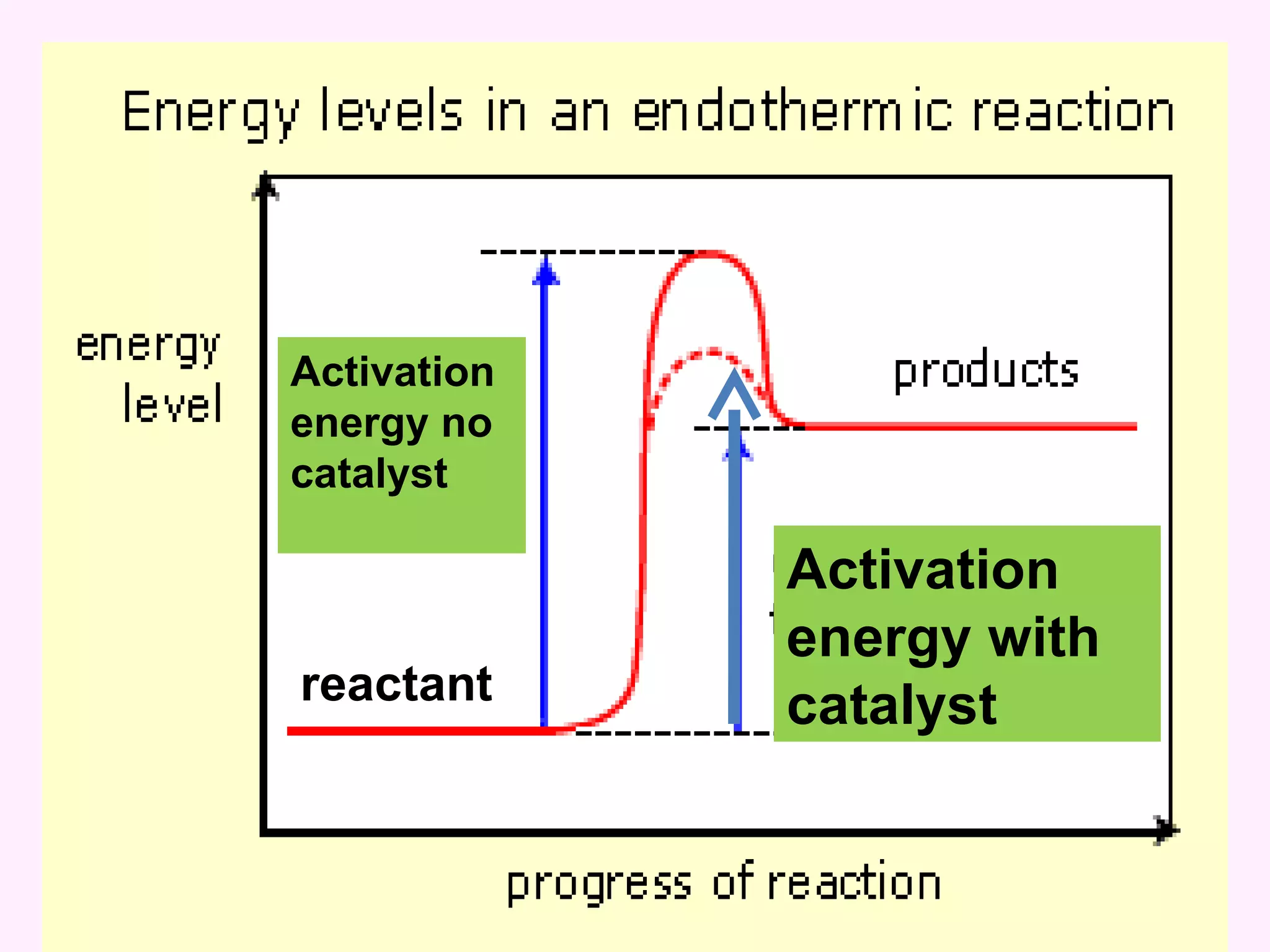
4. The effect of catalyst Catalyst provides  alternative route  That has  a lower activation energy Increase the rate of reaction .  So  more particles have energy equal or greater than activation energy .  Number of  effective collisions  increase .
exothermic reaction
Activation energy with catalyst Activation energy no catalyst reactant
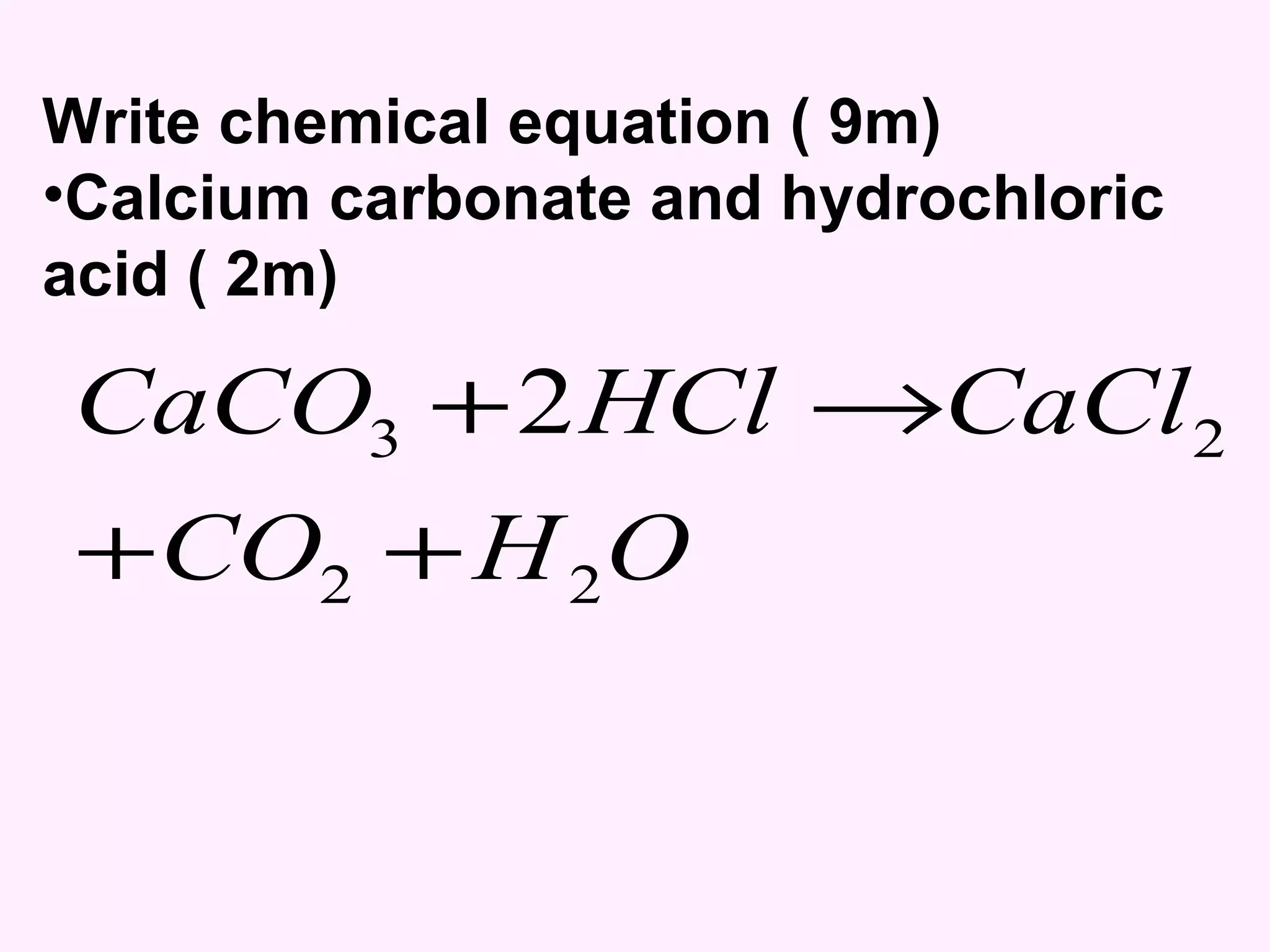
Write chemical equation ( 9m) Calcium carbonate and hydrochloric acid ( 2m)
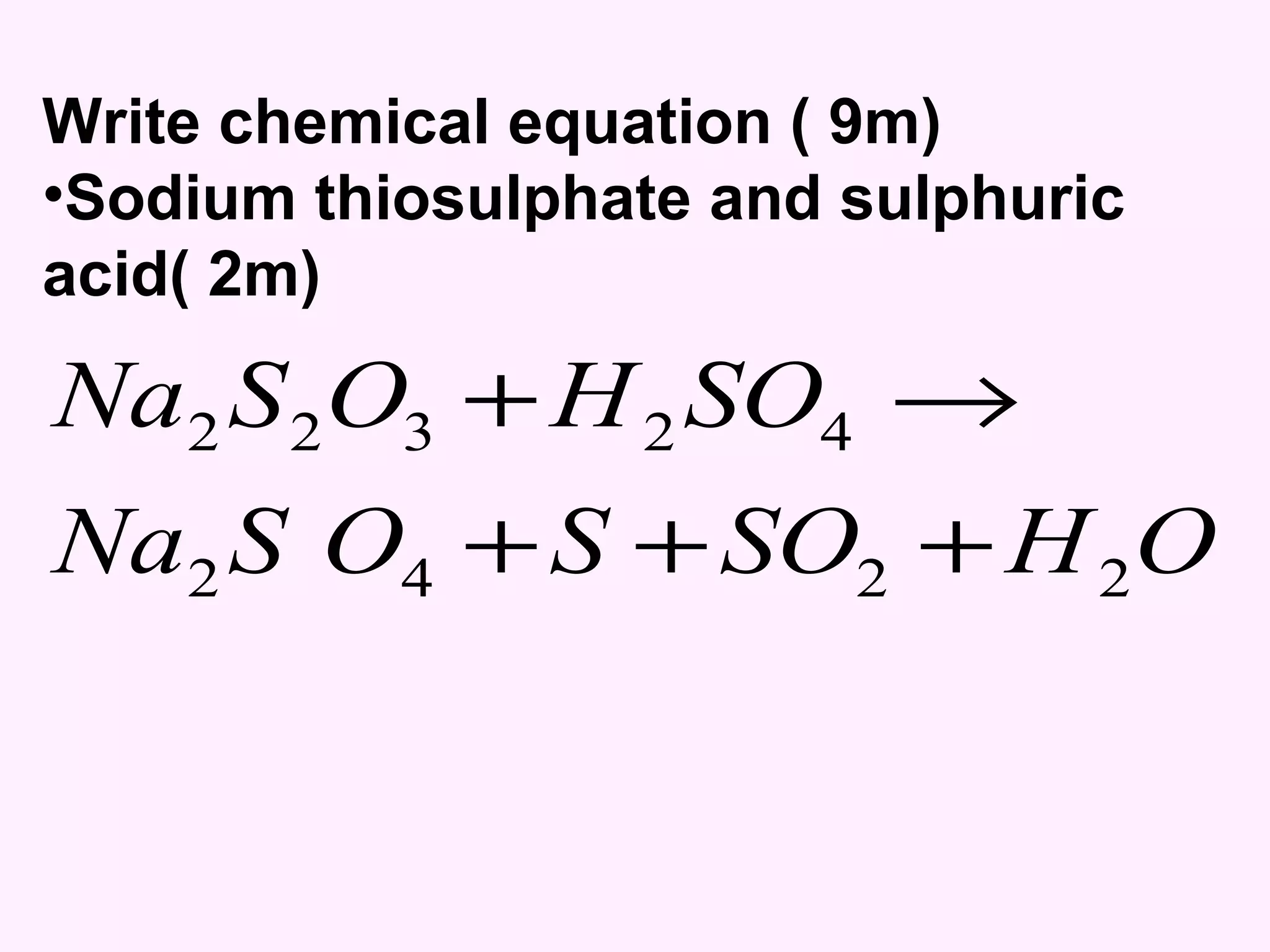
Write chemical equation ( 9m) Sodium thiosulphate and sulphuric acid( 2m)
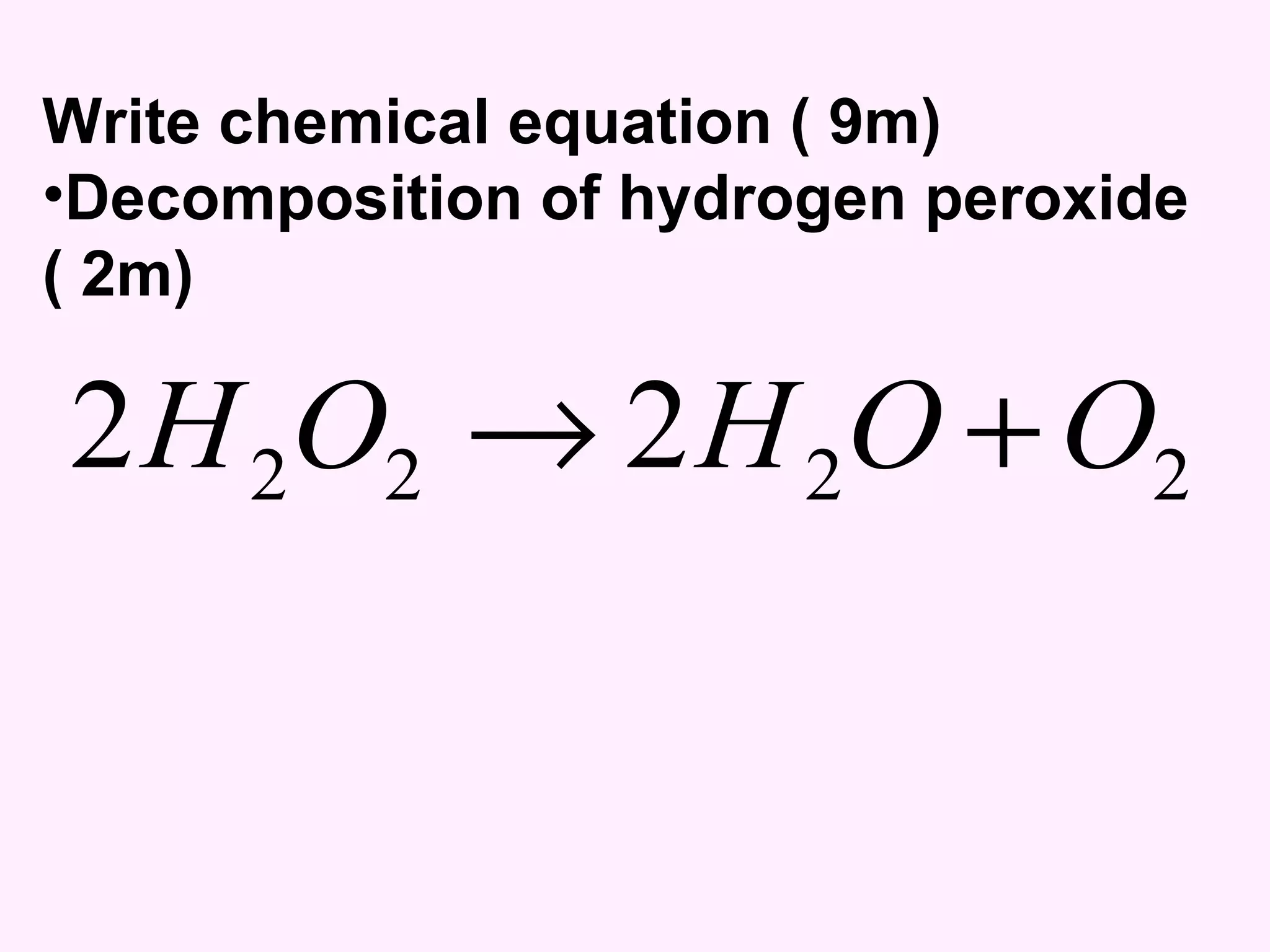
Write chemical equation ( 9m) Decomposition of hydrogen peroxide  ( 2m)
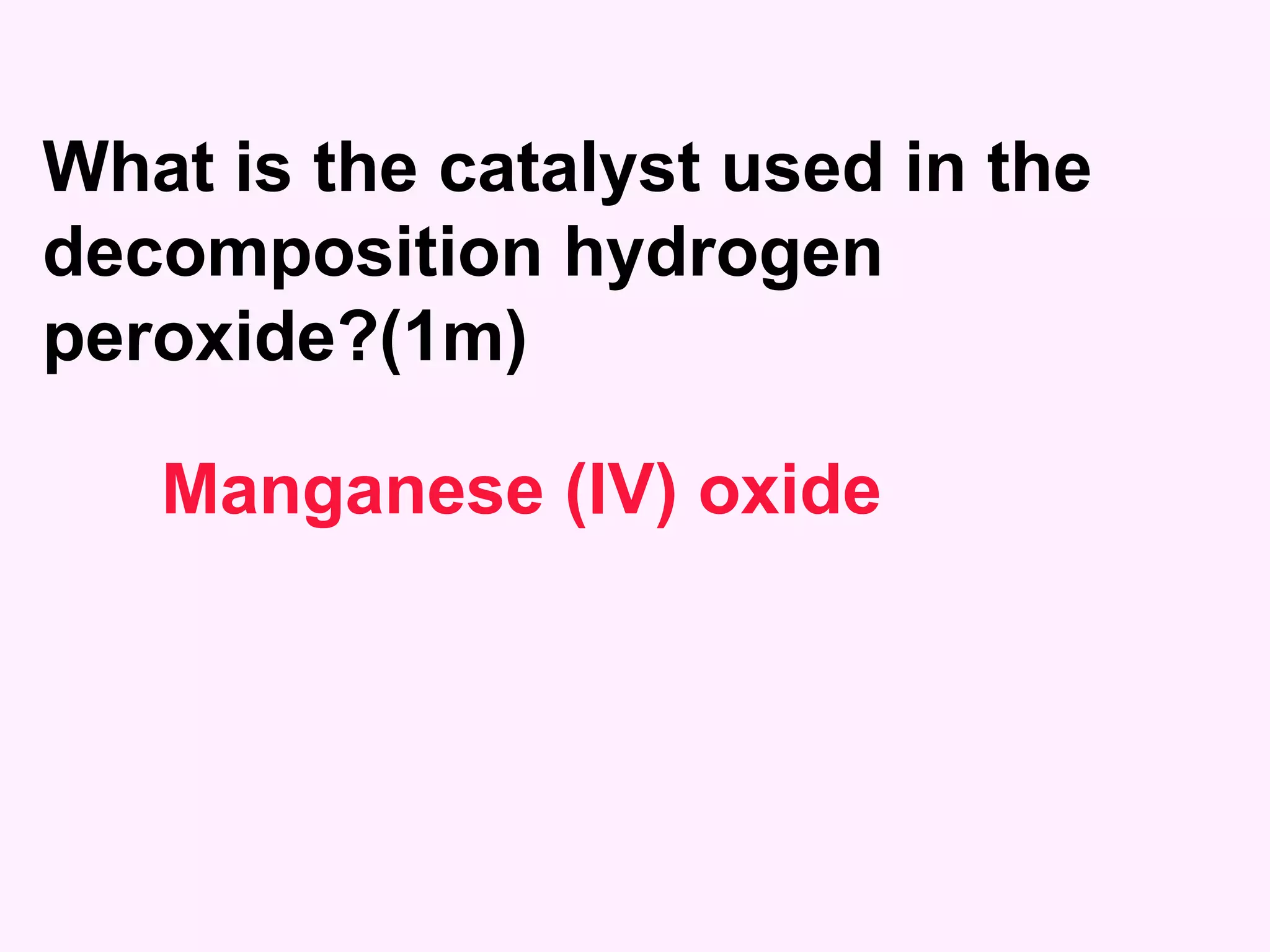
What is the catalyst used in the decomposition hydrogen peroxide?(1m) Manganese (IV) oxide
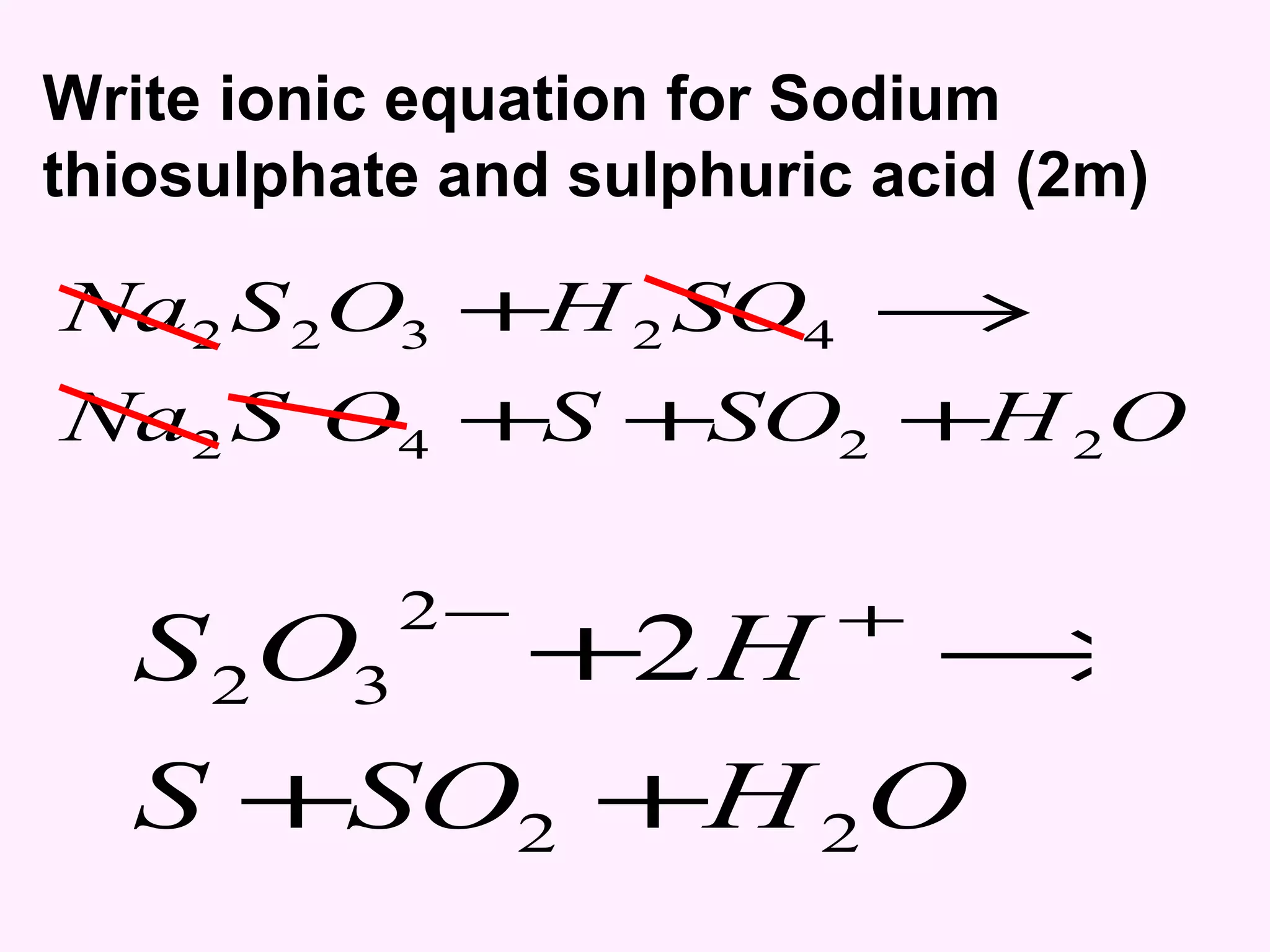
Write ionic equation for Sodium thiosulphate and sulphuric acid (2m)
End

Discussion on rate of reaction =for quiz 1 and 2

  • 1.
    what is? Effectivecollision? Collision theory? Factors affecting? Activation energy? Energy level diagram? Rate of reaction
  • 2.
    AVERAGE RATE OFREACTION For the whole exp From X min to Y min On the X min (2 nd ) ( from 2 nd to 1 st ) For first x (3) min ( from 0 to 3rd )
  • 3.
    b) Example fromthe graph, determine: i) The average rate of reaction for the whole experiment = Total volume of gas Total time taken
  • 4.
    = 46 = 0.20 cm 3 s -1 210
  • 5.
    b) Example fromthe graph, determine: i) The average rate of reaction from 3 minute to 1 minute = Total volume of gas at 3min -1 min Total time taken at 3min -1min
  • 6.
    = 44-25 = 0.13 cm 3 s -1 180-60
  • 7.
    b) Example fromthe graph, determine: i) The average rate of reaction for on the 3 rd minute= Total volume of gas at 3min – at 2min Total time taken at 3min – at 2 min
  • 8.
    = 44-38 = 0.10 cm 3 s -1 180-120
  • 9.
    b) Example fromthe graph, determine: i) The average rate of reaction for for the first 2 minutes= Total volume of gas at 2min – at 0min Total time taken at 2min – at 0 min
  • 10.
    = 38-0 = 0.33 cm 3 s -1 120-0
  • 11.
    INSTANTANEOUS RATE OFREACTION ( rate of reaction at that time) Draw tangent to the graph Y X Rate = Y/X
  • 12.
    b) Example fromthe graph, determine: i) The rate of reaction at 120 s Instantaneous rate of reaction = Draw tangent to the graph
  • 13.
    = 56– 20 = 0.176 cm 3 s -1 222-18
  • 14.
  • 15.
  • 16.
  • 17.
    II I IIIVolume of gas Time decrease temperature Decrease TSA Decrease conc but not the mole of reactant Use positive catalyst Increase temperature Increase total surface area (TSA) Increase conc but not the mole of reactant
  • 18.
    Example: Sketch curvethat would be obtained with the changes below: original Lower temp Volume of gas Time Lower temperature is used
  • 19.
    Example: Sketch curvethat would be obtained with the changes below: original higher temp Volume of gas Time Higher temperature
  • 20.
    Example: Sketch curvethat would be obtained with the changes below: original Bigger size Volume of gas Time Bigger size of reactant is used
  • 21.
    Example: Sketch curvethat would be obtained with the changes below: original Smaller size Volume of gas Time Smaller size of reactant
  • 22.
    Example: Sketch curvethat would be obtained with the changes below: original higher temp Volume of gas Time Higher temperature
  • 23.
    Example: Sketch curvethat would be obtained with the changes below: original With catalyst Volume of gas Time Catalyst was added
  • 24.
    Changes to theFLAT part of graph
  • 25.
    Example: Curve Irepresents the result of the experiment using excess zinc powder and 50cm 3 of 1.0 moldm -3 dilute hydrochloric acid I Volume of gas/ cm 3 Time/s
  • 26.
    Draw curves whencondition change: ORIGINAL: 50cm 3 of 1.0 moldm -3 dilute hydrochloric acid Change : 50cm 3 of 2.0 moldm -3 dilute hydrochloric acid ori Volume of gas/ cm 3 Time/s Change
  • 27.
    Draw curves whencondition change: ORIGINAL: 50cm 3 of 1.0 moldm -3 dilute hydrochloric acid Change : 50cm 3 of 0.5 moldm -3 dilute hydrochloric acid ori Volume of gas/ cm 3 Time/s Change
  • 28.
    Draw curves whencondition change: ori :50cm 3 of 1.0 moldm -3 dilute hydrochloric acid change : 50cm 3 of 0.5 moldm -3 dilute hydrochloric acid ori Volume of gas/ cm 3 Time/s change
  • 29.
    Draw curves whencondition change: ORI : 50cm 3 of 1.0 moldm -3 dilute hydrochloric acid change : 20cm 3 of 1.0 moldm -3 dilute hydrochloric acid ori Volume of gas/ cm 3 Time/s change
  • 30.
    Draw curves whencondition change: ori: 50cm 3 of 1.0 moldm -3 dilute hydrochloric acid change: 25cm 3 of 2.0 moldm -3 dilute hydrochloric acid ori Volume of gas/ cm 3 Time/s change
  • 31.
    1. The effectof size of reactant Reducing the size of reactant increases the Total Surface Area increases the frequency of collisions between particles Increase the rate of reaction . Increase the frequency effective collisions between particles
  • 32.
    2. The effectof temperature Increase the temperature of solution increase the kinetic energy of particles increase the frequency of collisions between particles Increase the rate of reaction . Increase the frequency effective collisions between particles
  • 33.
    3. The effectof concentration Increase the concentration of solution increase the number of particles per unit volume increase the frequency of collisions between particles Increase the rate of reaction . Increase the frequency effective collisions between particles
  • 34.
    4. The effectof catalyst Catalyst provides alternative route That has a lower activation energy Increase the rate of reaction . So more particles have energy equal or greater than activation energy . Number of effective collisions increase .
  • 35.
  • 36.
    Activation energy withcatalyst Activation energy no catalyst reactant
  • 37.
    Write chemical equation( 9m) Calcium carbonate and hydrochloric acid ( 2m)
  • 38.
    Write chemical equation( 9m) Sodium thiosulphate and sulphuric acid( 2m)
  • 39.
    Write chemical equation( 9m) Decomposition of hydrogen peroxide ( 2m)
  • 40.
    What is thecatalyst used in the decomposition hydrogen peroxide?(1m) Manganese (IV) oxide
  • 41.
    Write ionic equationfor Sodium thiosulphate and sulphuric acid (2m)
  • 42.