Global
Marketing
Warren J. Keegan Mark C. Green
Global
Marketing
Warren J. Keegan Mark C. Green
Global Marketing
and the Digital
Revolution
Chapter 15
Copyright 2013, Pearson Education Inc., Publishing as Prentice-Hall
15-2
Introduction
• This chapter looks at:
– Innovations that led to the digital revolution
– Value networks and the sustaining and disruptive
nature technologies
– E-commerce and Web site categories
– New products and services of the past decade
It’s a Small World After All!
Copyright 2013, Pearson Education Inc., Publishing as Prentice-Hall
15-3
The Digital Revolution:
A Brief History
• 1937 to 1942: World’s first electronic
digital computer was developed at Iowa
State University
• 1947: The transistor was invented
• 1950s: Invention of the silicon chip
• 1970s: The decade for companies like Atari,
Commodore, and Apple
Copyright 2013, Pearson Education Inc., Publishing as Prentice-Hall
15-4
The Digital Revolution:
A Brief History
• 1981: IBM introduced its first Personal
Computer (PC)
• 1982: The 286 microprocessor was
unveiled
• 1984: Apple introduced the Macintosh
• 1993: The creation of the Pentium
processor
Copyright 2013, Pearson Education Inc., Publishing as Prentice-Hall
15-5
The Digital Revolution:
Additional Milestones
• 1969: The Internet can trace its origins (Defense Advanced Research
Projects Agency)
• 1972: E-mail was sent for the first time
• 1973: The creation of a cross-network protocol; the true birth of a
network of networks or the Internet
• 1993: Tim Berners-Lee invented URL, HTML, and http;
The Father of the World Wide Web
• First commercial browser, Netscape, was created
• Web users: 1993 - 600,000; 2012 - 2billion
• Search engine market share: Google 64%; Yahoo! 20%; Bing, new in
2009
Copyright 2013, Pearson Education Inc., Publishing as Prentice-Hall
Industry Convergence
“The 2000s were the broadband decade, the
disintermediation decade, the file-sharing decade, the
digital recording (and image) decade, the iPod
decade, the long-tail decade, the blog decade, the
user-generated decade, the on-demand decade, the all-
access decade. Inaugurating the new millennium, the
Internet swallowed culture whole and delivered it
back—cheaper, faster, and smaller—to everyone who
can get online.”
Jon Pareles, New York Times columnist
Copyright 2013, Pearson Education Inc., Publishing as Prentice-Hall
15-7
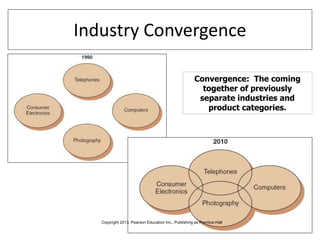
Industry Convergence
Convergence: The coming
together of previously
separate industries and
product categories.
Copyright 2013, Pearson Education Inc., Publishing as Prentice-Hall
15-8
Value Networks and
Disruptive Technologies
• Innovator’s Dilemma
• Value network
• Sustaining Technologies
• Disruptive Technologies
Copyright 2013, Pearson Education Inc., Publishing as Prentice-Hall
15-9
Innovator’s Dilemma
• Innovator’s Dilemma
– Staying committed to a current,
profitable technology
– Failing to provide adequate levels of
investment to new and possibly risky
technologies
– Company is responding to the needs
of established customers
Copyright 2013, Pearson Education Inc., Publishing as Prentice-Hall
15-10
Value Network
• Found in every industry
• Cost structure that dictates the margins
needed to achieve profitability
• Boundaries are defined by the unique rank
ordering of the importance of various product
attributes
• Each network has its own metrics of value
Copyright 2013, Pearson Education Inc., Publishing as Prentice-Hall
15-11
Sustaining Technologies
• Incremental or radical innovations that
improve product performance
• Most new technologies developed by
established companies are sustaining in
nature
• The vast majority of innovations are sustaining
in nature
Copyright 2013, Pearson Education Inc., Publishing as Prentice-Hall
15-12
Disruptive Technologies
• Redefine performance
• New entrants to an industry
• Enable something to be done that was
previously deemed impossible
• Enable new markets to emerge
Copyright 2013, Pearson Education Inc., Publishing as Prentice-Hall
Five Principles
of Disruptive Innovations
1. Companies are dependent on customers and
many innovations are customer-driven. By
listening to those long-established customers,
opportunities may be missed.
2. Small markets don’t solve the growth needs of
large companies.
3. Markets that don’t exist can’t be analyzed.
4. An organization’s capabilities define its
disabilities.
5. Technology supply may not equal market
demand.
Copyright 2013, Pearson Education Inc., Publishing as Prentice-Hall
15-14
Global E-Commerce
• Every 48 hours, Yahoo records more than 24 terabytes of
data about its users’ online habits— equal to all the
information contained in all the books in the Library of
Congress
• Between 2003 and 2010, the number of Internet users in
China increased from 68 million to 450 million; in
Shanghai, Beijing and Guangzhou, one-third of all
residents use the Internet
• 37% of European adults—136 million people—shopped
online in 2008. Online retail and travel sales will have a
CAGR of 8%
Copyright 2013, Pearson Education Inc., Publishing as Prentice-Hall
15-15
Global E-Commerce
• Divided into three broad
categories
–Business to Business
(B2B) largest share of
the Internet economy
–Business to Consumer
(B2C) iTunes
–Consumer to
Consumer (Peer to
peer) eBay
Copyright 2013, Pearson Education Inc., Publishing as Prentice-Hall
Internet as a Communications Tool
“Content for broadband costs significantly less
than TV…and distributes to a much larger
audience.”
Ad Agency Executive
Unilever digitized TV
commercials stored as
product videos, and created
Web series for Yahoo! Food
built around Hellman’s
Mayonnaise.
Copyright 2013, Pearson Education Inc., Publishing as Prentice-Hall
Internet Retail Sales
• U.S online retails sales $192 billion in 2011
• Companies like A&F, Saks, Timberland, Coach
trying to attract foreign buyers
– Weak U.S. dollar
– Saks’ Canadian buyers spend 20 – 30% more
– Some retailers to open distribution centers abroad
to hold down shipping costs
Copyright 2013, Pearson Education Inc., Publishing as Prentice-Hall
Luxury Retailers and the Internet
• Many do not sell online but use the Internet
to inform and promote
• Concern that the brand essence cannot be
communicated online but changing
• Smartphone and iPad apps and Facebook
communities aim to “create a dialog and get
consumers connecting with our brand”.
Copyright 2013, Pearson Education Inc., Publishing as Prentice-Hall
15-19
Web Site Design
• Internet potential requires using interactive media
• Key issues
1. Choosing domain names—Cybersquatting
2. Arranging payment—credit card usage rate, fraud, postal
money order or bank check
3. Localizing sites—reflect local culture, language,
aesthetics
4. Addressing privacy issues—EU laws more stringent
5. Setting up distribution—local sales tax issues
Copyright 2013, Pearson Education Inc., Publishing as Prentice-Hall
15-20
Broadband
• Has sufficient capacity to carry multiple voice,
data, or video channels simultaneously
• Bandwidth determines the range of frequencies
that can pass over a transmission channel
Copyright 2013, Pearson Education Inc., Publishing as Prentice-Hall
New Products and Services
• Cloud Software will not
be installed on a
computer hard drive
but through a web
browser
• Smartphones represent
¼ of 1 billion cellular
handsets sold each year.
• SMS texting to move to
other channels like TV,
the Internet, e-mail.
• Apple and Android
systems
• Apps—Angry Birds best
selling in 2010
15-21
Copyright 2013, Pearson Education Inc., Publishing as Prentice-Hall
15-22
Mobile Advertising and Mobile Commerce
• Term for conducting commercial transactions
using cell phones
• Wi-Fi
• Cellular data plans via 3G, 4G networks
• Tablets like iPad, Galaxy
Copyright 2013, Pearson Education Inc., Publishing as Prentice-Hall
15-23
Mobile Commerce
• Bluetooth–uses less power than Wi-Fi, works
well with cell phones and covers shorter
distances than Wi-Fi
• Handles data, not voice
Copyright 2013, Pearson Education Inc., Publishing as Prentice-Hall
15-24
Mobile Music
• Ringtone sales peaked in 2006 at $6 billion
• iTunes downloads in 2006 reached 1 billion;
cumulative total of 12 billion downloads
• By 2011, worldwide mobile music purchases should
reach $14 billion with Asia accounting for 40% of the
market
• Cloud-based music systems offer a locker for storing
music that is accessed by a variety of mobile devices
Copyright 2013, Pearson Education Inc., Publishing as Prentice-Hall
15-25
Internet Phone Service
• The next big thing for the telecommunications
industry
• Has the potential to render the current
telecommunications infrastructure obsolete
• Currently only accounts for a small percentage
of total global calling
• Skype acquired by Microsoft for 48.6 billion in
2011
Copyright 2013, Pearson Education Inc., Publishing as Prentice-Hall
15-26
Digital Books and
Electronic Reading Devices
• Amazon’s Kindle, Sony’s Reader Digital Book,
Apple’s iPad
• Textbooks are a huge market opportunity for
publishers
• Piracy is a concern for many authors
Copyright 2013, Pearson Education Inc., Publishing as Prentice-Hall
15-27
Looking Ahead to Chapter 16
• Strategic Elements of Competitive Advantage
Copyright 2013, Pearson Education Inc., Publishing as Prentice-Hall

Ch15

  • 1.
    Global Marketing Warren J. KeeganMark C. Green Global Marketing Warren J. Keegan Mark C. Green Global Marketing and the Digital Revolution Chapter 15 Copyright 2013, Pearson Education Inc., Publishing as Prentice-Hall
  • 2.
    15-2 Introduction • This chapterlooks at: – Innovations that led to the digital revolution – Value networks and the sustaining and disruptive nature technologies – E-commerce and Web site categories – New products and services of the past decade It’s a Small World After All! Copyright 2013, Pearson Education Inc., Publishing as Prentice-Hall
  • 3.
    15-3 The Digital Revolution: ABrief History • 1937 to 1942: World’s first electronic digital computer was developed at Iowa State University • 1947: The transistor was invented • 1950s: Invention of the silicon chip • 1970s: The decade for companies like Atari, Commodore, and Apple Copyright 2013, Pearson Education Inc., Publishing as Prentice-Hall
  • 4.
    15-4 The Digital Revolution: ABrief History • 1981: IBM introduced its first Personal Computer (PC) • 1982: The 286 microprocessor was unveiled • 1984: Apple introduced the Macintosh • 1993: The creation of the Pentium processor Copyright 2013, Pearson Education Inc., Publishing as Prentice-Hall
  • 5.
    15-5 The Digital Revolution: AdditionalMilestones • 1969: The Internet can trace its origins (Defense Advanced Research Projects Agency) • 1972: E-mail was sent for the first time • 1973: The creation of a cross-network protocol; the true birth of a network of networks or the Internet • 1993: Tim Berners-Lee invented URL, HTML, and http; The Father of the World Wide Web • First commercial browser, Netscape, was created • Web users: 1993 - 600,000; 2012 - 2billion • Search engine market share: Google 64%; Yahoo! 20%; Bing, new in 2009 Copyright 2013, Pearson Education Inc., Publishing as Prentice-Hall
  • 6.
    Industry Convergence “The 2000swere the broadband decade, the disintermediation decade, the file-sharing decade, the digital recording (and image) decade, the iPod decade, the long-tail decade, the blog decade, the user-generated decade, the on-demand decade, the all- access decade. Inaugurating the new millennium, the Internet swallowed culture whole and delivered it back—cheaper, faster, and smaller—to everyone who can get online.” Jon Pareles, New York Times columnist Copyright 2013, Pearson Education Inc., Publishing as Prentice-Hall
  • 7.
    15-7 Industry Convergence Convergence: Thecoming together of previously separate industries and product categories. Copyright 2013, Pearson Education Inc., Publishing as Prentice-Hall
  • 8.
    15-8 Value Networks and DisruptiveTechnologies • Innovator’s Dilemma • Value network • Sustaining Technologies • Disruptive Technologies Copyright 2013, Pearson Education Inc., Publishing as Prentice-Hall
  • 9.
    15-9 Innovator’s Dilemma • Innovator’sDilemma – Staying committed to a current, profitable technology – Failing to provide adequate levels of investment to new and possibly risky technologies – Company is responding to the needs of established customers Copyright 2013, Pearson Education Inc., Publishing as Prentice-Hall
  • 10.
    15-10 Value Network • Foundin every industry • Cost structure that dictates the margins needed to achieve profitability • Boundaries are defined by the unique rank ordering of the importance of various product attributes • Each network has its own metrics of value Copyright 2013, Pearson Education Inc., Publishing as Prentice-Hall
  • 11.
    15-11 Sustaining Technologies • Incrementalor radical innovations that improve product performance • Most new technologies developed by established companies are sustaining in nature • The vast majority of innovations are sustaining in nature Copyright 2013, Pearson Education Inc., Publishing as Prentice-Hall
  • 12.
    15-12 Disruptive Technologies • Redefineperformance • New entrants to an industry • Enable something to be done that was previously deemed impossible • Enable new markets to emerge Copyright 2013, Pearson Education Inc., Publishing as Prentice-Hall
  • 13.
    Five Principles of DisruptiveInnovations 1. Companies are dependent on customers and many innovations are customer-driven. By listening to those long-established customers, opportunities may be missed. 2. Small markets don’t solve the growth needs of large companies. 3. Markets that don’t exist can’t be analyzed. 4. An organization’s capabilities define its disabilities. 5. Technology supply may not equal market demand. Copyright 2013, Pearson Education Inc., Publishing as Prentice-Hall
  • 14.
    15-14 Global E-Commerce • Every48 hours, Yahoo records more than 24 terabytes of data about its users’ online habits— equal to all the information contained in all the books in the Library of Congress • Between 2003 and 2010, the number of Internet users in China increased from 68 million to 450 million; in Shanghai, Beijing and Guangzhou, one-third of all residents use the Internet • 37% of European adults—136 million people—shopped online in 2008. Online retail and travel sales will have a CAGR of 8% Copyright 2013, Pearson Education Inc., Publishing as Prentice-Hall
  • 15.
    15-15 Global E-Commerce • Dividedinto three broad categories –Business to Business (B2B) largest share of the Internet economy –Business to Consumer (B2C) iTunes –Consumer to Consumer (Peer to peer) eBay Copyright 2013, Pearson Education Inc., Publishing as Prentice-Hall
  • 16.
    Internet as aCommunications Tool “Content for broadband costs significantly less than TV…and distributes to a much larger audience.” Ad Agency Executive Unilever digitized TV commercials stored as product videos, and created Web series for Yahoo! Food built around Hellman’s Mayonnaise. Copyright 2013, Pearson Education Inc., Publishing as Prentice-Hall
  • 17.
    Internet Retail Sales •U.S online retails sales $192 billion in 2011 • Companies like A&F, Saks, Timberland, Coach trying to attract foreign buyers – Weak U.S. dollar – Saks’ Canadian buyers spend 20 – 30% more – Some retailers to open distribution centers abroad to hold down shipping costs Copyright 2013, Pearson Education Inc., Publishing as Prentice-Hall
  • 18.
    Luxury Retailers andthe Internet • Many do not sell online but use the Internet to inform and promote • Concern that the brand essence cannot be communicated online but changing • Smartphone and iPad apps and Facebook communities aim to “create a dialog and get consumers connecting with our brand”. Copyright 2013, Pearson Education Inc., Publishing as Prentice-Hall
  • 19.
    15-19 Web Site Design •Internet potential requires using interactive media • Key issues 1. Choosing domain names—Cybersquatting 2. Arranging payment—credit card usage rate, fraud, postal money order or bank check 3. Localizing sites—reflect local culture, language, aesthetics 4. Addressing privacy issues—EU laws more stringent 5. Setting up distribution—local sales tax issues Copyright 2013, Pearson Education Inc., Publishing as Prentice-Hall
  • 20.
    15-20 Broadband • Has sufficientcapacity to carry multiple voice, data, or video channels simultaneously • Bandwidth determines the range of frequencies that can pass over a transmission channel Copyright 2013, Pearson Education Inc., Publishing as Prentice-Hall
  • 21.
    New Products andServices • Cloud Software will not be installed on a computer hard drive but through a web browser • Smartphones represent ¼ of 1 billion cellular handsets sold each year. • SMS texting to move to other channels like TV, the Internet, e-mail. • Apple and Android systems • Apps—Angry Birds best selling in 2010 15-21 Copyright 2013, Pearson Education Inc., Publishing as Prentice-Hall
  • 22.
    15-22 Mobile Advertising andMobile Commerce • Term for conducting commercial transactions using cell phones • Wi-Fi • Cellular data plans via 3G, 4G networks • Tablets like iPad, Galaxy Copyright 2013, Pearson Education Inc., Publishing as Prentice-Hall
  • 23.
    15-23 Mobile Commerce • Bluetooth–usesless power than Wi-Fi, works well with cell phones and covers shorter distances than Wi-Fi • Handles data, not voice Copyright 2013, Pearson Education Inc., Publishing as Prentice-Hall
  • 24.
    15-24 Mobile Music • Ringtonesales peaked in 2006 at $6 billion • iTunes downloads in 2006 reached 1 billion; cumulative total of 12 billion downloads • By 2011, worldwide mobile music purchases should reach $14 billion with Asia accounting for 40% of the market • Cloud-based music systems offer a locker for storing music that is accessed by a variety of mobile devices Copyright 2013, Pearson Education Inc., Publishing as Prentice-Hall
  • 25.
    15-25 Internet Phone Service •The next big thing for the telecommunications industry • Has the potential to render the current telecommunications infrastructure obsolete • Currently only accounts for a small percentage of total global calling • Skype acquired by Microsoft for 48.6 billion in 2011 Copyright 2013, Pearson Education Inc., Publishing as Prentice-Hall
  • 26.
    15-26 Digital Books and ElectronicReading Devices • Amazon’s Kindle, Sony’s Reader Digital Book, Apple’s iPad • Textbooks are a huge market opportunity for publishers • Piracy is a concern for many authors Copyright 2013, Pearson Education Inc., Publishing as Prentice-Hall
  • 27.
    15-27 Looking Ahead toChapter 16 • Strategic Elements of Competitive Advantage Copyright 2013, Pearson Education Inc., Publishing as Prentice-Hall