Internet History
How did the Internet come to be? It started as a research project  to experiment with connecting computers together with packet switched networks. It was developed with funding and leadership of the Defense Department’s Advanced Research Projects Agency (ARPA).
Who invented the Internet? Al Gore?  No   Leonard Kleinrock who did early work in packet switching? Vint Cerf and Robert Kahn who defined the "Internet Protocol" (IP) and participated in the development of TCP?  Tim Berners-Lee who developed HTTP to support a global hyper-text system he called the World Wide Web?
1958-1961: Connect Computers?  1958 – After USSR launches Sputnik, first artificial earth satellite, US forms the Advanced Research Projects Agency ( ARPA ), the following year, within the Department of Defense (DoD) to establish US lead in science and technology applicable to the military 1961 – First published work on packet switching (“Information Flow in Large Communication Nets”, Leonard Kleinrock, MIT graduate student) 1964 – other independent work in packet switching at RAND Institute and National Physics Laboratory in England
1966 –1968: Connect Computers? Funded 1966 – Lawrence Roberts (colleague of Kleinrock from MIT) publishes overall plan for an ARPAnet, a proposed packet switch network 1968 – ARPA awards contracts for four nodes in  ARPANET to UCLA (Network Measurement), Stanford Research Institute (Network Information Center), UCSB (Interactive Mathematics) and U Utah (Graphics);  BBN gets contract to build the IMP switches
1969: First Connections 4/7/1969 – First RFC (“Host Software” by Steve Crocker) basis for the Network Control Protocol (NCP) 9/2/1969 – Leonard Kleinrock’s computer at UCLA becomes first node on the ARPANET 10/29/1969 – First packets sent; Charlie Kline attempts use of remote login from UCLA to SRI; system crashes as “G” is entered
1967-1971: So what do we do with it? 1967-1972 – Vint Cerf, graduate student in Kleinrock’s lab, works on application level protocols for the ARPANET (file transfer and Telnet protocols)  1971 - Ray Tomlinson of BBN writes email application; derived from two existing: an intra-machine email program (SENDMSG) and an experimental file transfer program (CPYNET)
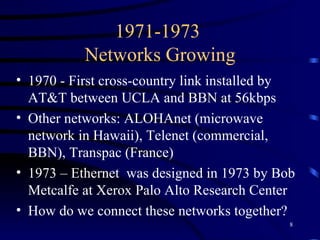
1971-1973  Networks Growing 1970 - First cross-country link installed by AT&T between UCLA and BBN at 56kbps Other networks: ALOHAnet (microwave network in Hawaii), Telenet (commercial, BBN), Transpac (France)  1973 – Ethernet  was designed in 1973 by Bob Metcalfe at Xerox Palo Alto Research Center How do we connect these networks together?
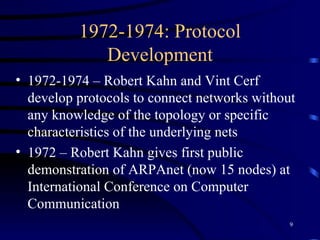
1972-1974: Protocol Development 1972-1974 – Robert Kahn and Vint Cerf develop protocols to connect networks without any knowledge of the topology or specific characteristics of the underlying nets 1972 – Robert Kahn gives first public demonstration of ARPAnet (now 15 nodes) at International Conference on Computer Communication
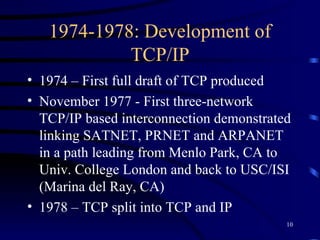
1974-1978: Development of TCP/IP 1974 – First full draft of TCP produced November 1977 - First three-network TCP/IP based interconnection demonstrated linking SATNET, PRNET and ARPANET in a path leading from Menlo Park, CA to Univ. College London and back to USC/ISI (Marina del Ray, CA) 1978 – TCP split into TCP and IP
1981 –1984:  Base Protocols In Place 1981 – Term “Internet” coined to mean collection of interconnected networks 1982 – ISO releases OSI seven layer model; actual protocols die but model is influential 1/1/1983 – Original ARPANET NCP was banned from the ARPANET and TCP/IP was required 1984 – Cisco Systems founded
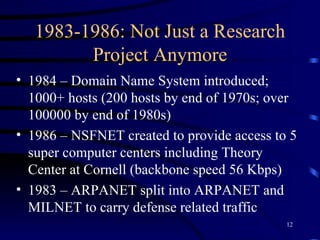
1983-1986: Not Just a Research Project Anymore 1984 – Domain Name System introduced; 1000+ hosts (200 hosts by end of 1970s; over 100000 by end of 1980s)  1986 – NSFNET created to provide access to 5 super computer centers including Theory Center at Cornell (backbone speed 56 Kbps) 1983 – ARPANET split into ARPANET and MILNET to carry defense related traffic
1988-1989: Growing Pains? 1988 - Nodes on Internet began to double every year November 1988 – Internet worm affecting about 10% of the 60000 computers on the Internet (Robert Morris, Cornell) 1988 - Internet Assigned Numbers Authority (IANA) established in December with Jon Postel as its Director. Postel was also the RFC Editor and US Domain registrar for many years
1990-1993: WWW Explosion 1990 – ARPANET ceases to exist 1990 – Tim Berners-Lee develops hypertext system with initial versions of  HTML and HTTP and first GUI web browser called “WorldWideWeb” 1993 – Mosaic, a GUI web browser, written by Marc Andreessen and Eric Bina at NCSA takes world by storm (was easy to install) WWW proliferates at a 341,634% annual growth rate of service traffic
1990-1993: Ready for Prime Time 1990 – First ISP world.std.com 1991 – NSFNET lifted restrictions on use of NSFNET for commercial purposes 1992 – Internet Society founded 1993 – InterNIC created by NSF to provide Internet services; Private companies transition into roles (AT&T – directory and database services; Network Solutions – registration services; CERFnet – information services)
1995: As we know it 1995- NSFNET reverts back to a research network. Main US backbone traffic now routed through commercial internet service providers  1995 – Sun launches Java 1995 - Traditional online dial-up systems (Compuserve, America Online, Prodigy) begin to provide Internet access  1995 - Registration of domain names no longer free
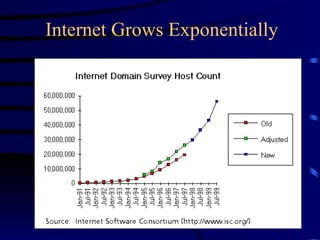
Internet Grows Exponentially

Internet History

  • 1.
  • 2.
    How did theInternet come to be? It started as a research project to experiment with connecting computers together with packet switched networks. It was developed with funding and leadership of the Defense Department’s Advanced Research Projects Agency (ARPA).
  • 3.
    Who invented theInternet? Al Gore? No  Leonard Kleinrock who did early work in packet switching? Vint Cerf and Robert Kahn who defined the "Internet Protocol" (IP) and participated in the development of TCP? Tim Berners-Lee who developed HTTP to support a global hyper-text system he called the World Wide Web?
  • 4.
    1958-1961: Connect Computers? 1958 – After USSR launches Sputnik, first artificial earth satellite, US forms the Advanced Research Projects Agency ( ARPA ), the following year, within the Department of Defense (DoD) to establish US lead in science and technology applicable to the military 1961 – First published work on packet switching (“Information Flow in Large Communication Nets”, Leonard Kleinrock, MIT graduate student) 1964 – other independent work in packet switching at RAND Institute and National Physics Laboratory in England
  • 5.
    1966 –1968: ConnectComputers? Funded 1966 – Lawrence Roberts (colleague of Kleinrock from MIT) publishes overall plan for an ARPAnet, a proposed packet switch network 1968 – ARPA awards contracts for four nodes in ARPANET to UCLA (Network Measurement), Stanford Research Institute (Network Information Center), UCSB (Interactive Mathematics) and U Utah (Graphics); BBN gets contract to build the IMP switches
  • 6.
    1969: First Connections4/7/1969 – First RFC (“Host Software” by Steve Crocker) basis for the Network Control Protocol (NCP) 9/2/1969 – Leonard Kleinrock’s computer at UCLA becomes first node on the ARPANET 10/29/1969 – First packets sent; Charlie Kline attempts use of remote login from UCLA to SRI; system crashes as “G” is entered
  • 7.
    1967-1971: So whatdo we do with it? 1967-1972 – Vint Cerf, graduate student in Kleinrock’s lab, works on application level protocols for the ARPANET (file transfer and Telnet protocols) 1971 - Ray Tomlinson of BBN writes email application; derived from two existing: an intra-machine email program (SENDMSG) and an experimental file transfer program (CPYNET)
  • 8.
    1971-1973 NetworksGrowing 1970 - First cross-country link installed by AT&T between UCLA and BBN at 56kbps Other networks: ALOHAnet (microwave network in Hawaii), Telenet (commercial, BBN), Transpac (France) 1973 – Ethernet was designed in 1973 by Bob Metcalfe at Xerox Palo Alto Research Center How do we connect these networks together?
  • 9.
    1972-1974: Protocol Development1972-1974 – Robert Kahn and Vint Cerf develop protocols to connect networks without any knowledge of the topology or specific characteristics of the underlying nets 1972 – Robert Kahn gives first public demonstration of ARPAnet (now 15 nodes) at International Conference on Computer Communication
  • 10.
    1974-1978: Development ofTCP/IP 1974 – First full draft of TCP produced November 1977 - First three-network TCP/IP based interconnection demonstrated linking SATNET, PRNET and ARPANET in a path leading from Menlo Park, CA to Univ. College London and back to USC/ISI (Marina del Ray, CA) 1978 – TCP split into TCP and IP
  • 11.
    1981 –1984: Base Protocols In Place 1981 – Term “Internet” coined to mean collection of interconnected networks 1982 – ISO releases OSI seven layer model; actual protocols die but model is influential 1/1/1983 – Original ARPANET NCP was banned from the ARPANET and TCP/IP was required 1984 – Cisco Systems founded
  • 12.
    1983-1986: Not Justa Research Project Anymore 1984 – Domain Name System introduced; 1000+ hosts (200 hosts by end of 1970s; over 100000 by end of 1980s) 1986 – NSFNET created to provide access to 5 super computer centers including Theory Center at Cornell (backbone speed 56 Kbps) 1983 – ARPANET split into ARPANET and MILNET to carry defense related traffic
  • 13.
    1988-1989: Growing Pains?1988 - Nodes on Internet began to double every year November 1988 – Internet worm affecting about 10% of the 60000 computers on the Internet (Robert Morris, Cornell) 1988 - Internet Assigned Numbers Authority (IANA) established in December with Jon Postel as its Director. Postel was also the RFC Editor and US Domain registrar for many years
  • 14.
    1990-1993: WWW Explosion1990 – ARPANET ceases to exist 1990 – Tim Berners-Lee develops hypertext system with initial versions of HTML and HTTP and first GUI web browser called “WorldWideWeb” 1993 – Mosaic, a GUI web browser, written by Marc Andreessen and Eric Bina at NCSA takes world by storm (was easy to install) WWW proliferates at a 341,634% annual growth rate of service traffic
  • 15.
    1990-1993: Ready forPrime Time 1990 – First ISP world.std.com 1991 – NSFNET lifted restrictions on use of NSFNET for commercial purposes 1992 – Internet Society founded 1993 – InterNIC created by NSF to provide Internet services; Private companies transition into roles (AT&T – directory and database services; Network Solutions – registration services; CERFnet – information services)
  • 16.
    1995: As weknow it 1995- NSFNET reverts back to a research network. Main US backbone traffic now routed through commercial internet service providers 1995 – Sun launches Java 1995 - Traditional online dial-up systems (Compuserve, America Online, Prodigy) begin to provide Internet access 1995 - Registration of domain names no longer free
  • 17.