e-commerce
                                           business. technology. society.

                                           eighth edition


                                           Kenneth C. Laudon
                                           Carol Guercio Traver


Copyright © 2012 Pearson Education, Inc.


Chapter 9
Online Media


                                                                            1
Information Wants to Be Expensive
                                     Class Discussion


     Why did the Wall Street Journal succeed with a
     subscription model?
     Would you pay to read a daily newspaper online?
     Why or why not? Would you pay for access to
     online archives of newspapers and/or magazines?
     Do you think newspapers can make the transition
     from “print on paper” to “news on-screen”?
     What do you think about the New York Times’ new
     subscription-based model?
Copyright © 2012 Pearson Education                      Slide 9-3


                           Learning Objectives
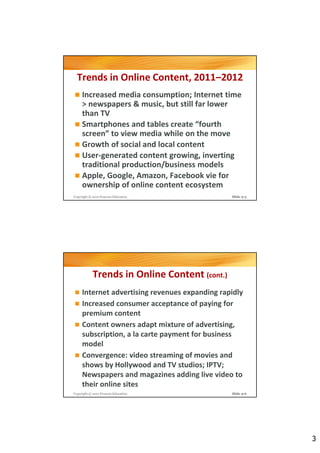
     Identify the major trends in the consumption of
     media and online content
     Discuss the concept of media convergence and the
     challenges it faces
     Describe the five basic content revenue models
     Discuss the key challenges facing content producers
     and owners
     Understand the key factors affecting the online
     publishing industry
     Understand the key factors affecting the online
     entertainment industry

Copyright © 2012 Pearson Education                      Slide 9-4


                                                                    2
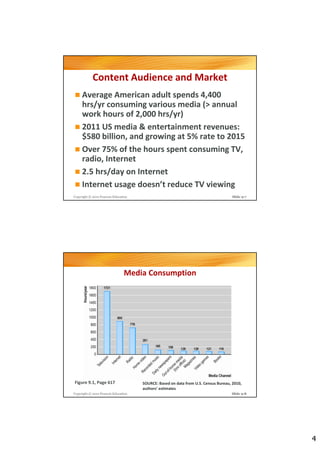
Trends in Online Content, 2011–2012
     Increased media consumption; Internet time
     > newspapers & music, but still far lower
     than TV
     Smartphones and tables create “fourth
     screen” to view media while on the move
     Growth of social and local content
     User-generated content growing, inverting
     traditional production/business models
     Apple, Google, Amazon, Facebook vie for
     ownership of online content ecosystem
Copyright © 2012 Pearson Education              Slide 9-5


            Trends in Online Content (cont.)
     Internet advertising revenues expanding rapidly
     Increased consumer acceptance of paying for
     premium content
     Content owners adapt mixture of advertising,
     subscription, a la carte payment for business
     model
     Convergence: video streaming of movies and
     shows by Hollywood and TV studios; IPTV;
     Newspapers and magazines adding live video to
     their online sites
Copyright © 2012 Pearson Education              Slide 9-6


                                                            3
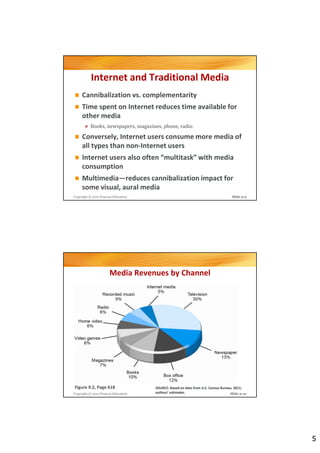
Content Audience and Market
     Average American adult spends 4,400
     hrs/yr consuming various media (> annual
     work hours of 2,000 hrs/yr)
     2011 US media & entertainment revenues:
     $580 billion, and growing at 5% rate to 2015
     Over 75% of the hours spent consuming TV,
     radio, Internet
     2.5 hrs/day on Internet
     Internet usage doesn’t reduce TV viewing
Copyright © 2012 Pearson Education                                                  Slide 9-7


                               Media Consumption


Figure 9.1, Page 617                 SOURCE: Based on data from U.S. Census Bureau, 2010,
                                     authors’ estimates
Copyright © 2012 Pearson Education                                                 Slide 9-8


                                                                                                4
Internet and Traditional Media
     Cannibalization vs. complementarity
     Time spent on Internet reduces time available for
     other media
          Books, newspapers, magazines, phone, radio

     Conversely, Internet users consume more media of
     all types than non-Internet users
     Internet users also often “multitask” with media
     consumption
     Multimedia—reduces cannibalization impact for
     some visual, aural media
Copyright © 2012 Pearson Education                                                Slide 9-9


                      Media Revenues by Channel


Figure 9.2, Page 618                 SOURCE: Based on data from U.S. Census Bureau, 2011;
Copyright © 2012 Pearson Education   authors’ estimates.                         Slide 9-10


                                                                                              5
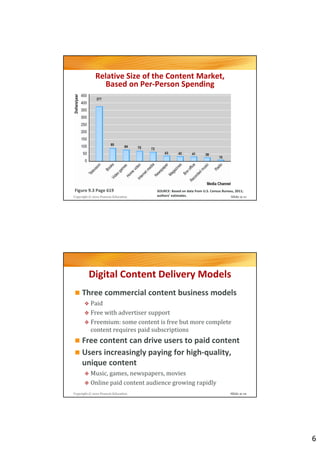
Relative Size of the Content Market,
                Based on Per-Person Spending


Figure 9.3 Page 619                  SOURCE: Based on data from U.S. Census Bureau, 2011;
Copyright © 2012 Pearson Education   authors’ estimates.                         Slide 9-11


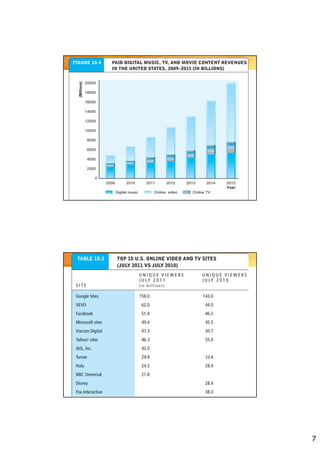
         Digital Content Delivery Models
     Three commercial content business models
          Paid
          Free with advertiser support
          Freemium: some content is free but more complete
          content requires paid subscriptions
     Free content can drive users to paid content
     Users increasingly paying for high-quality,
     unique content
          Music, games, newspapers, movies
          Online paid content audience growing rapidly
Copyright © 2012 Pearson Education                                               Slide 9-12


                                                                                              6
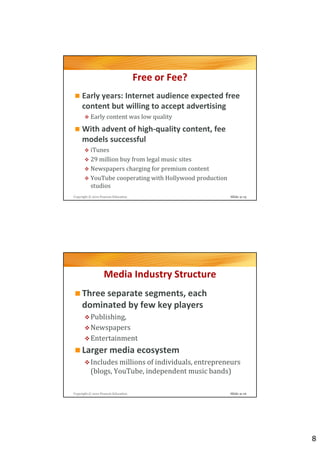
Fig. 9.4


Copyright © 2012 Pearson Education   Slide 9-13


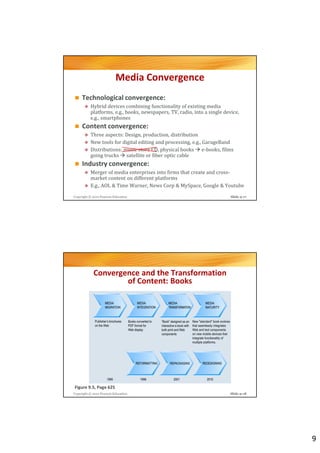
     Table 9.2


Copyright © 2012 Pearson Education   Slide 9-14


                                                  7
Free or Fee?
     Early years: Internet audience expected free
     content but willing to accept advertising
          Early content was low quality
     With advent of high-quality content, fee
     models successful
          iTunes
          29 million buy from legal music sites
          Newspapers charging for premium content
          YouTube cooperating with Hollywood production
          studios
Copyright © 2012 Pearson Education                        Slide 9-15


                   Media Industry Structure
     Three separate segments, each
     dominated by few key players
          Publishing,
          Newspapers
          Entertainment
     Larger media ecosystem
          Includes millions of individuals, entrepreneurs
          (blogs, YouTube, independent music bands)

Copyright © 2012 Pearson Education                        Slide 9-16


                                                                       8
Media Convergence
     Technological convergence:
          Hybrid devices combining functionality of existing media
          platforms, e.g., books, newspapers, TV, radio, into a single device,
          e.g., smartphones
     Content convergence:
          Three aspects: Design, production, distribution
          New tools for digital editing and processing, e.g., GarageBand
          Distributions: music store CD, physical books e-books, films
          going trucks satellite or fiber optic cable
     Industry convergence:
          Merger of media enterprises into firms that create and cross-
          market content on different platforms
          E.g., AOL & Time Warner, News Corp & MySpace, Google & Youtube
Copyright © 2012 Pearson Education                                        Slide 9-17


            Convergence and the Transformation
                    of Content: Books


Figure 9.5, Page 625
Copyright © 2012 Pearson Education                                       Slide 9-18


                                                                                       9
Online Content Revenue Models and
          Business Processes
     Marketing
          Free content drives offline revenues
     Advertising
          Fee content paid for by advertising
     Pay-per-view/pay-for-download
          Charge for premium content
     Subscription
          Monthly charges for services
     Mixed
Copyright © 2012 Pearson Education               Slide 9-19


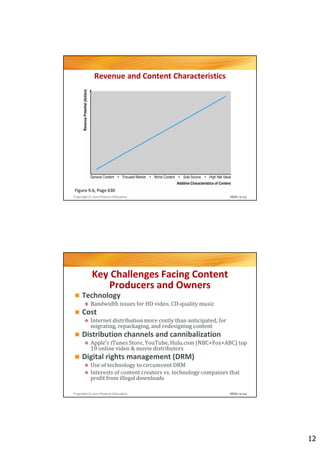
     Table 9.3


Copyright © 2012 Pearson Education               Slide 9-20


                                                              10
Table 9.4


Copyright © 2012 Pearson Education                                Slide 9-21


   Making a Profit with Online Content
     25% users will pay for some content
     Four factors required to charge for
     online content
      1.     Focused market
      2.     Specialized content
      3.     Sole source monopoly
      4.     High perceived net value
                Portion of perceived customer value that can be
                attributed to fact that content is available on the
                Internet
Copyright © 2012 Pearson Education                                Slide 9-22


                                                                               11
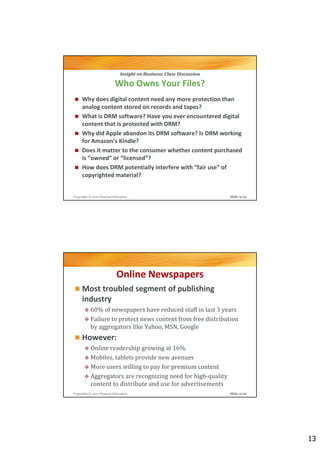
Revenue and Content Characteristics


Figure 9.6, Page 630
Copyright © 2012 Pearson Education                                  Slide 9-23


           Key Challenges Facing Content
              Producers and Owners
     Technology
          Bandwidth issues for HD video, CD-quality music
     Cost
          Internet distribution more costly than anticipated, for
          migrating, repackaging, and redesigning content
     Distribution channels and cannibalization
          Apple’s iTunes Store, YouTube, Hulu.com (NBC+Fox+ABC) top
          10 online video & movie distributors
     Digital rights management (DRM)
          Use of technology to circumvent DRM
          Interests of content creators vs. technology companies that
          profit from illegal downloads

Copyright © 2012 Pearson Education                                  Slide 9-24


                                                                                 12
Insight on Business: Class Discussion

                          Who Owns Your Files?
     Why does digital content need any more protection than
     analog content stored on records and tapes?
     What is DRM software? Have you ever encountered digital
     content that is protected with DRM?
     Why did Apple abandon its DRM software? Is DRM working
     for Amazon’s Kindle?
     Does it matter to the consumer whether content purchased
     is “owned” or “licensed”?
     How does DRM potentially interfere with “fair use” of
     copyrighted material?


Copyright © 2012 Pearson Education                                   Slide 9-25


                           Online Newspapers
     Most troubled segment of publishing
     industry
          60% of newspapers have reduced staff in last 3 years
          Failure to protect news content from free distribution
          by aggregators like Yahoo, MSN, Google
     However:
          Online readership growing at 16%
          Mobiles, tablets provide new avenues
          More users willing to pay for premium content
          Aggregators are recognizing need for high-quality
          content to distribute and use for advertisements
Copyright © 2012 Pearson Education                                   Slide 9-26


                                                                                  13
Monthly Unique Visitors at Online Newspapers


Figure 9.7, Page 637                 SOURCES: Based on data from comScore, 2011a;
Copyright © 2012 Pearson Education   Compete.com, 2011.                  Slide 9-27


              Newspaper Business Models
     Initially fee-based, then free, and now
     beginning a return to fee-based
     Newspaper headlines are primary content on
     Google News, Yahoo News
     New York Times now charging for premium
     access
     Newspaper efforts to ally with Internet titans
     New reader devices with reader apps

Copyright © 2012 Pearson Education                                       Slide 9-28


                                                                                      14
Convergence in Newspaper Industry
     Technology:
          Slow move to Internet; beginning to incorporate video, RSS, user
          feedback
     Content:
          Four content changes
                Premium archived content
                Fine-grained searching
                Videos reporting
                RSS feeds
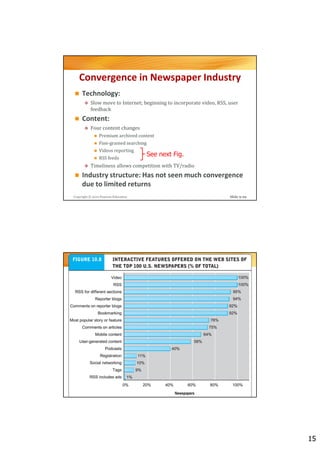
                                         See next Fig.
          Timeliness allows competition with TV/radio
     Industry structure: Has not seen much convergence
     due to limited returns
Copyright © 2012 Pearson Education                                    Slide 9-29


     Fig. 9.8


Copyright © 2012 Pearson Education                                    Slide 9-30


                                                                                   15
Challenges: Disruptive Technologies
     Newspapers: a classic case of disruptive
     technology?
     Industry still in flux
          Newspapers have significant assets:
                Content
                Readership
                Local advertising
                Audience (wealthier, older, better educated)
          Online audience will continue to grow in
          numbers and sophistication
Copyright © 2012 Pearson Education                             Slide 9-31


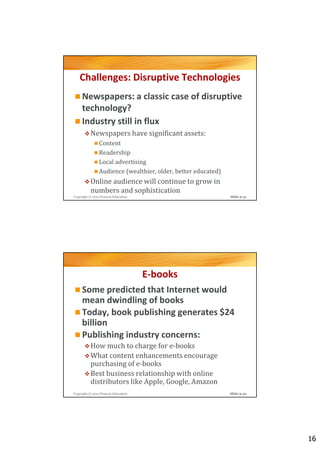
                                     E-books
     Some predicted that Internet would
     mean dwindling of books
     Today, book publishing generates $24
     billion
     Publishing industry concerns:
          How much to charge for e-books
          What content enhancements encourage
          purchasing of e-books
          Best business relationship with online
          distributors like Apple, Google, Amazon
Copyright © 2012 Pearson Education                             Slide 9-32


                                                                            16
E-books
     Evolution
          Project Gutenberg (1970s) putting Declaration of
          Independence and 2,00 classic books online
          Voyager’s putting Jurassic Park and Alice in Wonderland
          books on CDs (1990s)
          Adobe’s PDF format
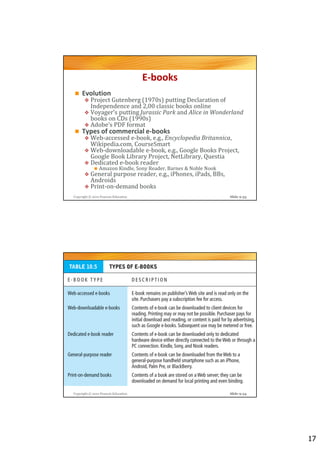
     Types of commercial e-books
          Web-accessed e-book, e.g., Encyclopedia Britannica,
          Wikipedia.com, CourseSmart
          Web-downloadable e-book, e.g., Google Books Project,
          Google Book Library Project, NetLibrary, Questia
          Dedicated e-book reader
                Amazon Kindle, Sony Reader, Barnes & Noble Nook
          General purpose reader, e.g., iPhones, iPads, BBs,
          Androids
          Print-on-demand books
Copyright © 2012 Pearson Education                                Slide 9-33


     Table 9.5


Copyright © 2012 Pearson Education                                Slide 9-34


                                                                               17
Book Audience Size and Growth
     Americans read about 10 books per year per
     person
     Americans spend $95/year on trade books,
     more than video games ($72), and in-theater
     movies ($41)
     Book readership is flat, anchored in the 40+
     population
     Professional and educational titles
     publication growing 2 times as fast as US
     economy
Copyright © 2012 Pearson Education                                                        Slide 9-35


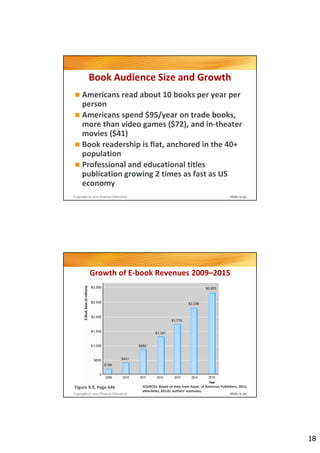
          Growth of E-book Revenues 2009–2015


Figure 9.9, Page 646                 SOURCES: Based on data from Assoc. of American Publishers, 2011;
                                     eMarketer, 2011b; authors’ estimates.
Copyright © 2012 Pearson Education                                                        Slide 9-36


                                                                                                        18
E-book Industry Revenue Models
     Wholesale model
          As with traditional publishing, retailer pays wholesale
          price and marks price up
          With lowered prices of e-books, profits to publisher are
          also lower
      Agency model
          Publishers set retail price and designate an agent who
          receives 30% commission
          Leads to higher, fixed prices for e-books
          Google, Amazon, Apple benefit primarily by selling
          e-book readers
Copyright © 2012 Pearson Education                           Slide 9-37


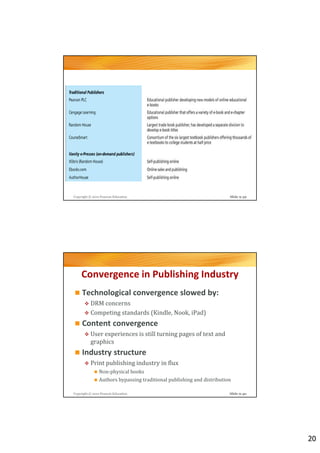
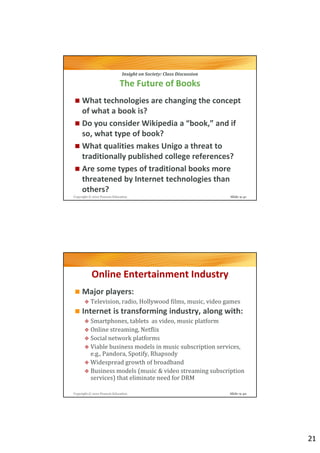
     Table 9.6


Copyright © 2012 Pearson Education                           Slide 9-38


                                                                          19
Copyright © 2012 Pearson Education                                      Slide 9-39


     Convergence in Publishing Industry
     Technological convergence slowed by:
          DRM concerns
          Competing standards (Kindle, Nook, iPad)
     Content convergence
          User experiences is still turning pages of text and
          graphics
     Industry structure
          Print publishing industry in flux
                Non-physical books
                Authors bypassing traditional publishing and distribution

Copyright © 2012 Pearson Education                                      Slide 9-40


                                                                                     20
Insight on Society: Class Discussion

                             The Future of Books
     What technologies are changing the concept
     of what a book is?
     Do you consider Wikipedia a “book,” and if
     so, what type of book?
     What qualities makes Unigo a threat to
     traditionally published college references?
     Are some types of traditional books more
     threatened by Internet technologies than
     others?
Copyright © 2012 Pearson Education                                   Slide 9-41


           Online Entertainment Industry
     Major players:
          Television, radio, Hollywood films, music, video games
     Internet is transforming industry, along with:
          Smartphones, tablets as video, music platform
          Online streaming, Netflix
          Social network platforms
          Viable business models in music subscription services,
          e.g., Pandora, Spotify, Rhapsody
          Widespread growth of broadband
          Business models (music & video streaming subscription
          services) that eliminate need for DRM

Copyright © 2012 Pearson Education                                   Slide 9-42


                                                                                  21
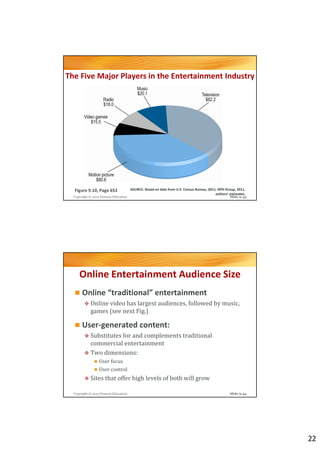
The Five Major Players in the Entertainment Industry


  Figure 9.10, Page 652                SOURCE: Based on data from U.S. Census Bureau, 2011; NPD Group, 2011,
                                                                                          authors’ estimates.
  Copyright © 2012 Pearson Education                                                               Slide 9-43


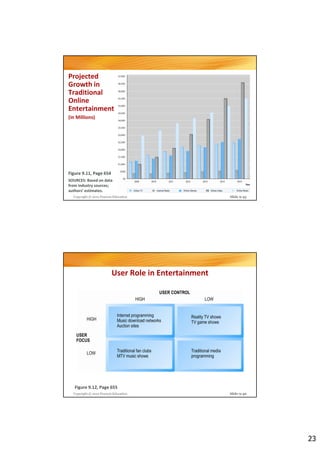
     Online Entertainment Audience Size
       Online “traditional” entertainment
            Online video has largest audiences, followed by music,
            games (see next Fig.)

       User-generated content:
            Substitutes for and complements traditional
            commercial entertainment
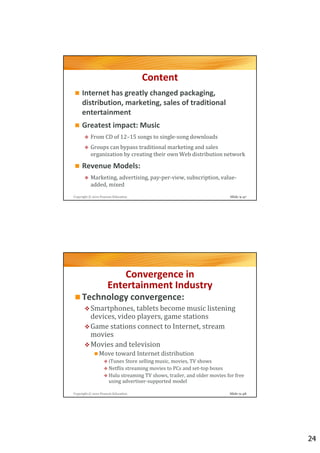
            Two dimensions:
                  User focus
                  User control
            Sites that offer high levels of both will grow

  Copyright © 2012 Pearson Education                                                               Slide 9-44


                                                                                                                22
Projected
Growth in
Traditional
Online
Entertainment
(in Millions)


Figure 9.11, Page 654
SOURCES: Based on data
from industry sources;
authors’ estimates.
  Copyright © 2012 Pearson Education                   Slide 9-45


                          User Role in Entertainment


   Figure 9.12, Page 655
  Copyright © 2012 Pearson Education                   Slide 9-46


                                                                    23
Content
     Internet has greatly changed packaging,
     distribution, marketing, sales of traditional
     entertainment
     Greatest impact: Music
          From CD of 12–15 songs to single-song downloads
          Groups can bypass traditional marketing and sales
          organization by creating their own Web distribution network

     Revenue Models:
          Marketing, advertising, pay-per-view, subscription, value-
          added, mixed
Copyright © 2012 Pearson Education                                        Slide 9-47


                         Convergence in
                     Entertainment Industry
     Technology convergence:
          Smartphones, tablets become music listening
          devices, video players, game stations
          Game stations connect to Internet, stream
          movies
          Movies and television
                Move toward Internet distribution
                      iTunes Store selling music, movies, TV shows
                      Netflix streaming movies to PCs and set-top boxes
                      Hulu streaming TV shows, trailer, and older movies for free
                      using advertiser-supported model

Copyright © 2012 Pearson Education                                        Slide 9-48


                                                                                       24
Convergence in
       Entertainment Industry (cont.)
     Content convergence
          Significant progress toward digital tools
          for content creation and production
                Digital cameras, workstations generating
                animations and digital effects in movie scenes
                Music recording and production highly
                digitized; some distribution direct to Internet,
                bypassing CD production stage
Copyright © 2012 Pearson Education                        Slide 9-49


                    Convergence in
              Entertainment Industry (cont.)
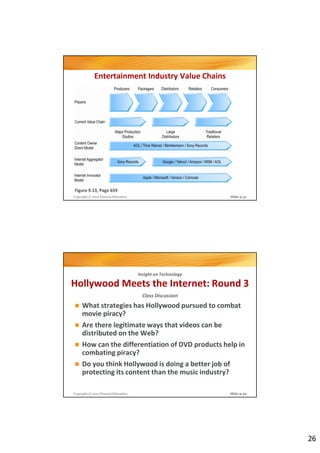
     Industry structure
          Fractured: Many players and forces shape
          industry
          Reorganization of value chain needed for
          aggressive move to Web
          Possible alternative models
                Content owner direct model
                Internet aggregator model
                Internet innovator model

Copyright © 2012 Pearson Education                        Slide 9-50


                                                                       25
Entertainment Industry Value Chains


Figure 9.13, Page 659
Copyright © 2012 Pearson Education                           Slide 9-51


                                     Insight on Technology

Hollywood Meets the Internet: Round 3
                                       Class Discussion
     What strategies has Hollywood pursued to combat
     movie piracy?
     Are there legitimate ways that videos can be
     distributed on the Web?
     How can the differentiation of DVD products help in
     combating piracy?
     Do you think Hollywood is doing a better job of
     protecting its content than the music industry?

Copyright © 2012 Pearson Education                           Slide 9-52


                                                                          26
Copyright © 2012 Pearson Education   Slide 9-53


                                                  27