Applied Mechanics

     Chapter 1
    Introduction
What is Mechanics?


Mechanics is a branch of
science which deals with
  bodies at rest or motion
  under the action of
  forces.
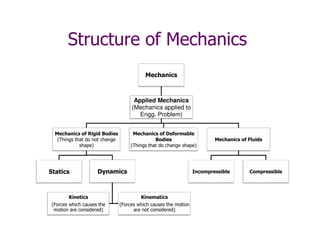
Structure of Mechanics
                                           Mechanics


                                      Applied Mechanics
                                     (Mechanics applied to
                                        Engg. Problem)


  Mechanics of Rigid Bodies          Mechanics of Deformable
   (Things that do not change                  Bodies                     Mechanics of Fluids
             shape)                 (Things that do change shape)


Statics             Dynamics                                      Incompressible       Compressible


       Kinetics                          Kinematics
(Forces which causes the        (Forces which causes the motion
 motion are considered)               are not considered)
Fundamental Concepts
Particle- it is an idealized body which may have negligible
mass and whose size and shape can be neglected
Matter- substances that posses weight, occupies space,
volume, apprehended by sense.
Body: the matter bounded by a closed surface is called
body.
    It is accumulation of large number of particles
Rigid Body- if the relative distance between the particle of
the body is same before and after the application of forces.
Deformable body: if the relative distance between the
particle of the body is different(change) before and after the
application of forces.
Rigid Body


    Deformable Body
Space - associated with the notion of the position of a point P
given in terms of three coordinates measured from a reference
point or origin.
                                   OR
The unlimited expanse of physical dimensions in which all
material objects are located
Time- It is a measure of duration between successive events.
Force - Represents the action of one body on another.
A force is characterized by its point of application, magnitude,
and direction.

In Newtonian Mechanics, space, time, and mass are absolute concepts,
independent of each other. Force, however, is not independent of the other
three. The force acting on a body is related to the mass of the body and
the variation of its velocity with time.
Systems of Unit
FPS: Foot, Pound, Second
CGS: Centimeter, Gram, and Second
MKS: Metre, Kilogram and second
SI: System International
Fundamental Units
 Physical                                  Unit
                    Symbol      Unit
 Quantity                                 symbol
    length             l        metre       m

     mass              m       kilogram     kg
     time              t       second       s
electric current       I       ampere       A
thermodynamic
                       T        kelvin      K
  temperature
  amount of
                       n        mole       mol
  substance
Prefix of SI system
Sr.           Prefix    Symbol     Expontial
No.                                Notation
1     Exa                 E             1018
2     Peta                P             1015
3     Tera                T             1012
4     Giga                G             109
5     Mega                M             106
6     Kilo                K             103
7     Hecto               h             102
8     Deka                da            101
9     Deci                d             10-1
10    Centi               c             10-2
12    Milli               m             10-3
13    Micro                             10-6
14    Nano                n             10-9
15    pico                p          10-12
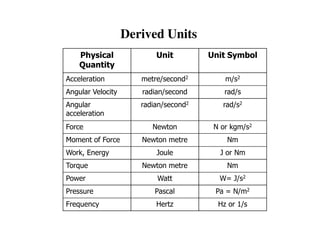
Derived Units
    Physical              Unit         Unit Symbol
    Quantity
Acceleration          metre/second2        m/s2
Angular Velocity      radian/second        rad/s
Angular               radian/second2      rad/s2
acceleration
Force                    Newton         N or kgm/s2
Moment of Force       Newton metre         Nm
Work, Energy              Joule          J or Nm
Torque                Newton metre         Nm
Power                     Watt           W= J/s2
Pressure                  Pascal        Pa = N/m2
Frequency                 Hertz          Hz or 1/s
Scalar and Vector quantities
Fundamental Principles
Newton’s First Law: If the resultant force on a particle is zero, the
particle will remain at rest or continue to move in a straight line.
• Newton’s Second Law:          A particle will have an
 acceleration proportional to a nonzero resultant applied
 force.
• When a force acts on an object, the object accelerates in
 the direction of the force.
• If the mass of an object is held constant, increasing force
 will increase acceleration.
• If the force on an object remains constant, increasing mass
 will decrease acceleration.
Newton’s Third Law: The forces of action and reaction
between two particles have the same magnitude and line of
action with opposite sense.
Newton’s Law of Gravitation: Two particles are attracted with
equal and opposite forces.
•every point mass in the universe
attracts every other point mass with a
force that is directly proportional to
the product of their masses and
inversely proportional to the square of
the distance between them.


                           GM
  W = mg               g =                G = 6.67 x 10⁻¹¹ Nm2/kg2
                            R2
Law of Parallelogram of Forces
        If the two forces acting at a point be represented in
        magnitude and direction by the two adjacent sides of
        a parallelogram, then their resultant is represented in
        magnitude and direction by the diagonal of the
        parallelogram passing through that point.


                                The magnitude of Resultant force R


• Parallelogram Law
Law of Triangle of forces
“If the forces acting at a point be represented
in magnitude and direction by the three sides
of a triangle taken in order, they will be in
equilibrium.”
Lami’s Theorem:
 if three forces acting at a fixed point
are in equilibrium, each force will be
proportional to the sine of the angle
between the other two forces.”
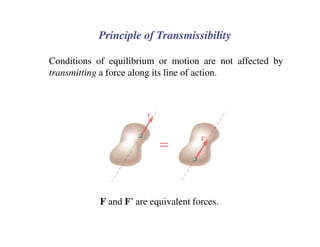
Principle of Transmissibility

Conditions of equilibrium or motion are not affected by
transmitting a force along its line of action.


           F and F’ are equivalent forces.
Task


Draw one simple mechanism to lift
the body or water or weight.
Make the group of five students.
Thank You

Chapter 1 [compatibility mode]

  • 1.
    Applied Mechanics Chapter 1 Introduction
  • 2.
    What is Mechanics? Mechanicsis a branch of science which deals with bodies at rest or motion under the action of forces.
  • 3.
    Structure of Mechanics Mechanics Applied Mechanics (Mechanics applied to Engg. Problem) Mechanics of Rigid Bodies Mechanics of Deformable (Things that do not change Bodies Mechanics of Fluids shape) (Things that do change shape) Statics Dynamics Incompressible Compressible Kinetics Kinematics (Forces which causes the (Forces which causes the motion motion are considered) are not considered)
  • 4.
    Fundamental Concepts Particle- itis an idealized body which may have negligible mass and whose size and shape can be neglected Matter- substances that posses weight, occupies space, volume, apprehended by sense. Body: the matter bounded by a closed surface is called body. It is accumulation of large number of particles Rigid Body- if the relative distance between the particle of the body is same before and after the application of forces. Deformable body: if the relative distance between the particle of the body is different(change) before and after the application of forces.
  • 5.
    Rigid Body Deformable Body
  • 6.
    Space - associatedwith the notion of the position of a point P given in terms of three coordinates measured from a reference point or origin. OR The unlimited expanse of physical dimensions in which all material objects are located Time- It is a measure of duration between successive events. Force - Represents the action of one body on another. A force is characterized by its point of application, magnitude, and direction. In Newtonian Mechanics, space, time, and mass are absolute concepts, independent of each other. Force, however, is not independent of the other three. The force acting on a body is related to the mass of the body and the variation of its velocity with time.
  • 7.
    Systems of Unit FPS:Foot, Pound, Second CGS: Centimeter, Gram, and Second MKS: Metre, Kilogram and second SI: System International
  • 8.
    Fundamental Units Physical Unit Symbol Unit Quantity symbol length l metre m mass m kilogram kg time t second s electric current I ampere A thermodynamic T kelvin K temperature amount of n mole mol substance
  • 9.
    Prefix of SIsystem Sr. Prefix Symbol Expontial No. Notation 1 Exa E 1018 2 Peta P 1015 3 Tera T 1012 4 Giga G 109 5 Mega M 106 6 Kilo K 103 7 Hecto h 102 8 Deka da 101 9 Deci d 10-1 10 Centi c 10-2 12 Milli m 10-3 13 Micro 10-6 14 Nano n 10-9 15 pico p 10-12
  • 10.
    Derived Units Physical Unit Unit Symbol Quantity Acceleration metre/second2 m/s2 Angular Velocity radian/second rad/s Angular radian/second2 rad/s2 acceleration Force Newton N or kgm/s2 Moment of Force Newton metre Nm Work, Energy Joule J or Nm Torque Newton metre Nm Power Watt W= J/s2 Pressure Pascal Pa = N/m2 Frequency Hertz Hz or 1/s
  • 11.
  • 12.
    Fundamental Principles Newton’s FirstLaw: If the resultant force on a particle is zero, the particle will remain at rest or continue to move in a straight line.
  • 13.
    • Newton’s SecondLaw: A particle will have an acceleration proportional to a nonzero resultant applied force. • When a force acts on an object, the object accelerates in the direction of the force. • If the mass of an object is held constant, increasing force will increase acceleration. • If the force on an object remains constant, increasing mass will decrease acceleration.
  • 16.
    Newton’s Third Law:The forces of action and reaction between two particles have the same magnitude and line of action with opposite sense.
  • 18.
    Newton’s Law ofGravitation: Two particles are attracted with equal and opposite forces. •every point mass in the universe attracts every other point mass with a force that is directly proportional to the product of their masses and inversely proportional to the square of the distance between them. GM W = mg g = G = 6.67 x 10⁻¹¹ Nm2/kg2 R2
  • 19.
    Law of Parallelogramof Forces If the two forces acting at a point be represented in magnitude and direction by the two adjacent sides of a parallelogram, then their resultant is represented in magnitude and direction by the diagonal of the parallelogram passing through that point. The magnitude of Resultant force R • Parallelogram Law
  • 20.
    Law of Triangleof forces “If the forces acting at a point be represented in magnitude and direction by the three sides of a triangle taken in order, they will be in equilibrium.”
  • 21.
    Lami’s Theorem: ifthree forces acting at a fixed point are in equilibrium, each force will be proportional to the sine of the angle between the other two forces.”
  • 22.
    Principle of Transmissibility Conditionsof equilibrium or motion are not affected by transmitting a force along its line of action. F and F’ are equivalent forces.
  • 23.
    Task Draw one simplemechanism to lift the body or water or weight. Make the group of five students.
  • 24.