Engineering Mechanics:
 Statics in SI Units, 12e

    1           General Principles


        Copyright © 2010 Pearson Education South Asia Pte Ltd
Chapter Objectives

  • Basic quantities and idealizations of mechanics
  • Newton’s Laws of Motion and Gravitation
  • Principles for applying the SI system of units
  • Standard procedures for performing numerical
    calculations
  • General guide for solving problems


           Copyright © 2010 Pearson Education South Asia Pte Ltd
Chapter Outline

  1.   Mechanics
  2.   Fundamental Concepts
  3.   Units of Measurement
  4.   The International System of Units
  5.   Numerical Calculations
  6.   General Procedure for Analysis


             Copyright © 2010 Pearson Education South Asia Pte Ltd
1.1 Mechanics

  • Mechanics can be divided into 3 branches:
    - Rigid-body Mechanics
    - Deformable-body Mechanics
    - Fluid Mechanics

  • Rigid-body Mechanics deals with
    - Statics
    - Dynamics


           Copyright © 2010 Pearson Education South Asia Pte Ltd
1.1 Mechanics

  • Statics – Equilibrium of bodies
   At rest
   Move with constant velocity

  • Dynamics – Accelerated motion of bodies


           Copyright © 2010 Pearson Education South Asia Pte Ltd
1.2 Fundamentals Concepts

  Basic Quantities
  2. Length
     - locate the position of a point in space
  3. Mass
     - measure of a quantity of matter
  4. Time
     - succession of events
  5. Force
     - a “push” or “pull” exerted by one body on another


           Copyright © 2010 Pearson Education South Asia Pte Ltd
1.2 Fundamentals Concepts

  Idealizations
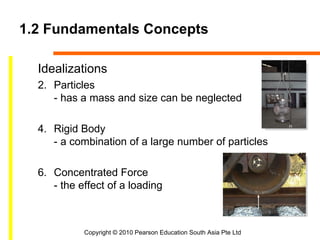
  2. Particles
     - has a mass and size can be neglected

  4. Rigid Body
     - a combination of a large number of particles

  6. Concentrated Force
     - the effect of a loading


            Copyright © 2010 Pearson Education South Asia Pte Ltd
1.2 Fundamentals Concepts

  Newton’s Three Laws of Motion
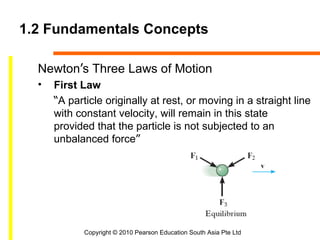
  •   First Law
      “A particle originally at rest, or moving in a straight line
      with constant velocity, will remain in this state
      provided that the particle is not subjected to an
      unbalanced force”


             Copyright © 2010 Pearson Education South Asia Pte Ltd
1.2 Fundamentals Concepts

  Newton’s Three Laws of Motion
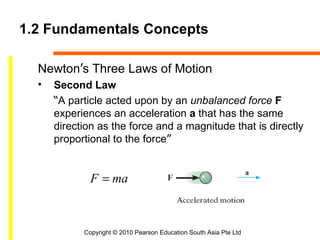
  •   Second Law
      “A particle acted upon by an unbalanced force F
      experiences an acceleration a that has the same
      direction as the force and a magnitude that is directly
      proportional to the force”


              F = ma


            Copyright © 2010 Pearson Education South Asia Pte Ltd
1.2 Fundamentals Concepts

  Newton’s Three Laws of Motion
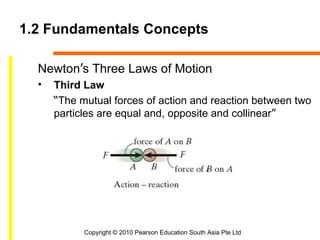
  •   Third Law
      “The mutual forces of action and reaction between two
      particles are equal and, opposite and collinear”


            Copyright © 2010 Pearson Education South Asia Pte Ltd
1.2 Fundamentals Concepts

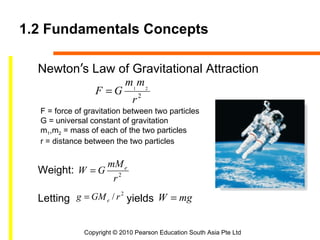
  Newton’s Law of Gravitational Attraction
                           m1 m 2
                 F =G
                              r2
  F = force of gravitation between two particles
  G = universal constant of gravitation
  m1,m2 = mass of each of the two particles
  r = distance between the two particles

               mM e
  Weight: W = G 2
                r
  Letting g = GM e / r 2 yields W = mg


              Copyright © 2010 Pearson Education South Asia Pte Ltd
1.3 Units of Measurement

  SI Units
  •   Stands for Système International d’Unités
  •   F = ma is maintained only if
      – 3 of the units, called base units, are defined
      – 4th unit is derived from the equation
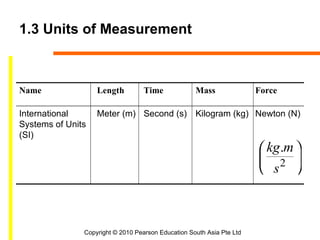
  •   SI system specifies length in meters (m), time in
      seconds (s) and mass in kilograms (kg)
  •   Force unit, Newton (N), is derived from F = ma


             Copyright © 2010 Pearson Education South Asia Pte Ltd
1.3 Units of Measurement


Name               Length          Time             Mass               Force

International      Meter (m) Second (s) Kilogram (kg) Newton (N)
Systems of Units
(SI)
                                                                        kg.m 
                                                                        2 
                                                                        s 


               Copyright © 2010 Pearson Education South Asia Pte Ltd
1.3 Units of Measurement

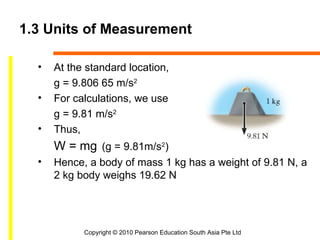
  •   At the standard location,
      g = 9.806 65 m/s2
  •   For calculations, we use
      g = 9.81 m/s2
  •   Thus,
      W = mg (g = 9.81m/s2)
  •   Hence, a body of mass 1 kg has a weight of 9.81 N, a
      2 kg body weighs 19.62 N


            Copyright © 2010 Pearson Education South Asia Pte Ltd
1.4 The International System of Units

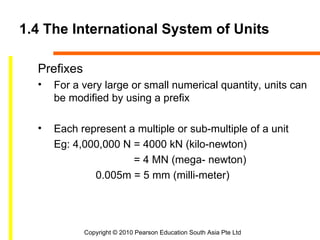
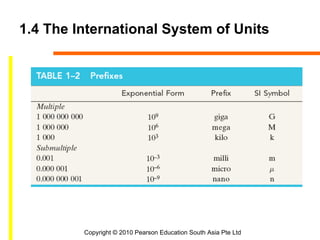
  Prefixes
  •   For a very large or small numerical quantity, units can
      be modified by using a prefix

  •   Each represent a multiple or sub-multiple of a unit
      Eg: 4,000,000 N = 4000 kN (kilo-newton)
                      = 4 MN (mega- newton)
              0.005m = 5 mm (milli-meter)


             Copyright © 2010 Pearson Education South Asia Pte Ltd
1.4 The International System of Units


         Copyright © 2010 Pearson Education South Asia Pte Ltd
1.5 Numerical Calculations

  Dimensional Homogeneity
  •   Each term must be expressed in the same units
  •   Regardless of how the equation is evaluated, it
      maintains its dimensional homogeneity
  •   All terms can be replaced by a consistent set of units


            Copyright © 2010 Pearson Education South Asia Pte Ltd
1.5 Numerical Calculations

  Significant Figures
  •   Accuracy of a number is specified by the number of
      significant figures it contains
  •   A significant figure is any digit including zero
      e.g. 5604 and 34.52 have four significant numbers
  •   When numbers begin or end with zero, we make use
      of prefixes to clarify the number of significant figures
      e.g. 400 as one significant figure would be 0.4(103)


            Copyright © 2010 Pearson Education South Asia Pte Ltd
1.5 Numerical Calculations

  Rounding Off Numbers
  •   Accuracy obtained would never be better than the
      accuracy of the problem data
  •   Calculators or computers involve more figures in the
      answer than the number of significant figures in the
      data
  •   Calculated results should always be “rounded off” to
      an appropriate number of significant figures


            Copyright © 2010 Pearson Education South Asia Pte Ltd
1.5 Numerical Calculations

  Calculations
  •   Retain a greater number of digits for accuracy
  •   Work out computations so that numbers that are
      approximately equal
  •   Round off final answers to three significant figures


            Copyright © 2010 Pearson Education South Asia Pte Ltd
1.6 General Procedure for Analysis

  •    To solve problems, it is important to present work in a
       logical and orderly way as suggested:
  2.   Correlate actual physical situation with theory
  3.   Draw any diagrams and tabulate the problem data
  4.   Apply principles in mathematics forms
  5.   Solve equations which are
       dimensionally homogenous
  6.   Report the answer with
       significance figures
  7.   Technical judgment
       and common sense
             Copyright © 2010 Pearson Education South Asia Pte Ltd
Example

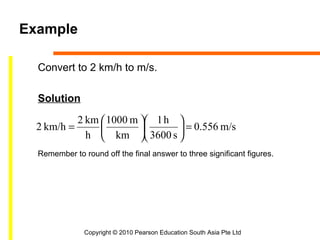
  Convert to 2 km/h to m/s.

  Solution

           2 km  1000 m  1 h 
  2 km/h =                    = 0.556 m/s
             h  km  3600 s 
  Remember to round off the final answer to three significant figures.


               Copyright © 2010 Pearson Education South Asia Pte Ltd
QUIZ

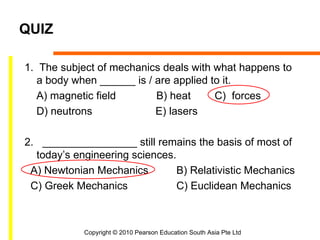
1. The subject of mechanics deals with what happens to
   a body when ______ is / are applied to it.
   A) magnetic field       B) heat      C) forces
   D) neutrons             E) lasers

2. ________________ still remains the basis of most of
  today’s engineering sciences.
 A) Newtonian Mechanics         B) Relativistic Mechanics
 C) Greek Mechanics             C) Euclidean Mechanics


            Copyright © 2010 Pearson Education South Asia Pte Ltd
QUIZ

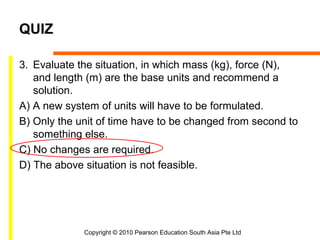
3. Evaluate the situation, in which mass (kg), force (N),
   and length (m) are the base units and recommend a
   solution.
A) A new system of units will have to be formulated.
B) Only the unit of time have to be changed from second to
   something else.
C) No changes are required.
D) The above situation is not feasible.


             Copyright © 2010 Pearson Education South Asia Pte Ltd
QUIZ

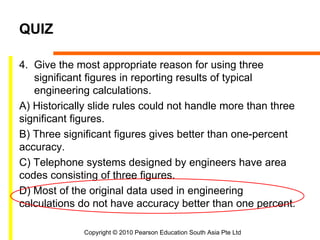
4. Give the most appropriate reason for using three
   significant figures in reporting results of typical
   engineering calculations.
A) Historically slide rules could not handle more than three
significant figures.
B) Three significant figures gives better than one-percent
accuracy.
C) Telephone systems designed by engineers have area
codes consisting of three figures.
D) Most of the original data used in engineering
calculations do not have accuracy better than one percent.

              Copyright © 2010 Pearson Education South Asia Pte Ltd
QUIZ

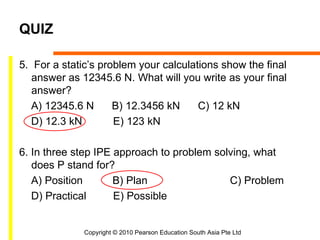
5. For a static’s problem your calculations show the final
   answer as 12345.6 N. What will you write as your final
   answer?
   A) 12345.6 N      B) 12.3456 kN     C) 12 kN
   D) 12.3 kN        E) 123 kN

6. In three step IPE approach to problem solving, what
   does P stand for?
   A) Position       B) Plan                C) Problem
   D) Practical      E) Possible


              Copyright © 2010 Pearson Education South Asia Pte Ltd

Bab1

  • 1.
    Engineering Mechanics: Staticsin SI Units, 12e 1 General Principles Copyright © 2010 Pearson Education South Asia Pte Ltd
  • 2.
    Chapter Objectives • Basic quantities and idealizations of mechanics • Newton’s Laws of Motion and Gravitation • Principles for applying the SI system of units • Standard procedures for performing numerical calculations • General guide for solving problems Copyright © 2010 Pearson Education South Asia Pte Ltd
  • 3.
    Chapter Outline 1. Mechanics 2. Fundamental Concepts 3. Units of Measurement 4. The International System of Units 5. Numerical Calculations 6. General Procedure for Analysis Copyright © 2010 Pearson Education South Asia Pte Ltd
  • 4.
    1.1 Mechanics • Mechanics can be divided into 3 branches: - Rigid-body Mechanics - Deformable-body Mechanics - Fluid Mechanics • Rigid-body Mechanics deals with - Statics - Dynamics Copyright © 2010 Pearson Education South Asia Pte Ltd
  • 5.
    1.1 Mechanics • Statics – Equilibrium of bodies  At rest  Move with constant velocity • Dynamics – Accelerated motion of bodies Copyright © 2010 Pearson Education South Asia Pte Ltd
  • 6.
    1.2 Fundamentals Concepts Basic Quantities 2. Length - locate the position of a point in space 3. Mass - measure of a quantity of matter 4. Time - succession of events 5. Force - a “push” or “pull” exerted by one body on another Copyright © 2010 Pearson Education South Asia Pte Ltd
  • 7.
    1.2 Fundamentals Concepts Idealizations 2. Particles - has a mass and size can be neglected 4. Rigid Body - a combination of a large number of particles 6. Concentrated Force - the effect of a loading Copyright © 2010 Pearson Education South Asia Pte Ltd
  • 8.
    1.2 Fundamentals Concepts Newton’s Three Laws of Motion • First Law “A particle originally at rest, or moving in a straight line with constant velocity, will remain in this state provided that the particle is not subjected to an unbalanced force” Copyright © 2010 Pearson Education South Asia Pte Ltd
  • 9.
    1.2 Fundamentals Concepts Newton’s Three Laws of Motion • Second Law “A particle acted upon by an unbalanced force F experiences an acceleration a that has the same direction as the force and a magnitude that is directly proportional to the force” F = ma Copyright © 2010 Pearson Education South Asia Pte Ltd
  • 10.
    1.2 Fundamentals Concepts Newton’s Three Laws of Motion • Third Law “The mutual forces of action and reaction between two particles are equal and, opposite and collinear” Copyright © 2010 Pearson Education South Asia Pte Ltd
  • 11.
    1.2 Fundamentals Concepts Newton’s Law of Gravitational Attraction m1 m 2 F =G r2 F = force of gravitation between two particles G = universal constant of gravitation m1,m2 = mass of each of the two particles r = distance between the two particles mM e Weight: W = G 2 r Letting g = GM e / r 2 yields W = mg Copyright © 2010 Pearson Education South Asia Pte Ltd
  • 12.
    1.3 Units ofMeasurement SI Units • Stands for Système International d’Unités • F = ma is maintained only if – 3 of the units, called base units, are defined – 4th unit is derived from the equation • SI system specifies length in meters (m), time in seconds (s) and mass in kilograms (kg) • Force unit, Newton (N), is derived from F = ma Copyright © 2010 Pearson Education South Asia Pte Ltd
  • 13.
    1.3 Units ofMeasurement Name Length Time Mass Force International Meter (m) Second (s) Kilogram (kg) Newton (N) Systems of Units (SI)  kg.m   2   s  Copyright © 2010 Pearson Education South Asia Pte Ltd
  • 14.
    1.3 Units ofMeasurement • At the standard location, g = 9.806 65 m/s2 • For calculations, we use g = 9.81 m/s2 • Thus, W = mg (g = 9.81m/s2) • Hence, a body of mass 1 kg has a weight of 9.81 N, a 2 kg body weighs 19.62 N Copyright © 2010 Pearson Education South Asia Pte Ltd
  • 15.
    1.4 The InternationalSystem of Units Prefixes • For a very large or small numerical quantity, units can be modified by using a prefix • Each represent a multiple or sub-multiple of a unit Eg: 4,000,000 N = 4000 kN (kilo-newton) = 4 MN (mega- newton) 0.005m = 5 mm (milli-meter) Copyright © 2010 Pearson Education South Asia Pte Ltd
  • 16.
    1.4 The InternationalSystem of Units Copyright © 2010 Pearson Education South Asia Pte Ltd
  • 17.
    1.5 Numerical Calculations Dimensional Homogeneity • Each term must be expressed in the same units • Regardless of how the equation is evaluated, it maintains its dimensional homogeneity • All terms can be replaced by a consistent set of units Copyright © 2010 Pearson Education South Asia Pte Ltd
  • 18.
    1.5 Numerical Calculations Significant Figures • Accuracy of a number is specified by the number of significant figures it contains • A significant figure is any digit including zero e.g. 5604 and 34.52 have four significant numbers • When numbers begin or end with zero, we make use of prefixes to clarify the number of significant figures e.g. 400 as one significant figure would be 0.4(103) Copyright © 2010 Pearson Education South Asia Pte Ltd
  • 19.
    1.5 Numerical Calculations Rounding Off Numbers • Accuracy obtained would never be better than the accuracy of the problem data • Calculators or computers involve more figures in the answer than the number of significant figures in the data • Calculated results should always be “rounded off” to an appropriate number of significant figures Copyright © 2010 Pearson Education South Asia Pte Ltd
  • 20.
    1.5 Numerical Calculations Calculations • Retain a greater number of digits for accuracy • Work out computations so that numbers that are approximately equal • Round off final answers to three significant figures Copyright © 2010 Pearson Education South Asia Pte Ltd
  • 21.
    1.6 General Procedurefor Analysis • To solve problems, it is important to present work in a logical and orderly way as suggested: 2. Correlate actual physical situation with theory 3. Draw any diagrams and tabulate the problem data 4. Apply principles in mathematics forms 5. Solve equations which are dimensionally homogenous 6. Report the answer with significance figures 7. Technical judgment and common sense Copyright © 2010 Pearson Education South Asia Pte Ltd
  • 22.
    Example Convertto 2 km/h to m/s. Solution 2 km  1000 m  1 h  2 km/h =    = 0.556 m/s h  km  3600 s  Remember to round off the final answer to three significant figures. Copyright © 2010 Pearson Education South Asia Pte Ltd
  • 23.
    QUIZ 1. The subjectof mechanics deals with what happens to a body when ______ is / are applied to it. A) magnetic field B) heat C) forces D) neutrons E) lasers 2. ________________ still remains the basis of most of today’s engineering sciences. A) Newtonian Mechanics B) Relativistic Mechanics C) Greek Mechanics C) Euclidean Mechanics Copyright © 2010 Pearson Education South Asia Pte Ltd
  • 24.
    QUIZ 3. Evaluate thesituation, in which mass (kg), force (N), and length (m) are the base units and recommend a solution. A) A new system of units will have to be formulated. B) Only the unit of time have to be changed from second to something else. C) No changes are required. D) The above situation is not feasible. Copyright © 2010 Pearson Education South Asia Pte Ltd
  • 25.
    QUIZ 4. Give themost appropriate reason for using three significant figures in reporting results of typical engineering calculations. A) Historically slide rules could not handle more than three significant figures. B) Three significant figures gives better than one-percent accuracy. C) Telephone systems designed by engineers have area codes consisting of three figures. D) Most of the original data used in engineering calculations do not have accuracy better than one percent. Copyright © 2010 Pearson Education South Asia Pte Ltd
  • 26.
    QUIZ 5. For astatic’s problem your calculations show the final answer as 12345.6 N. What will you write as your final answer? A) 12345.6 N B) 12.3456 kN C) 12 kN D) 12.3 kN E) 123 kN 6. In three step IPE approach to problem solving, what does P stand for? A) Position B) Plan C) Problem D) Practical E) Possible Copyright © 2010 Pearson Education South Asia Pte Ltd