11/29/18 Chapter 1 General Principles 1
Chapter 1 -
General Principles
11/29/18 Chapter 1 General Principles2
11/29/18 Chapter 1 General Principles3
Objectives
1. To provide an introduction to the
basic quantities and idealizations of
mechanics.
2. To give a statement of Newton’s laws
of Motion and Gravitation.
3. To review the principles for applying
the SI system of units.
4. To examine the standard procedures
for performing numerical calculations.
5. To present a general guide for
problem solving.
11/29/18 Chapter 1 General Principles4
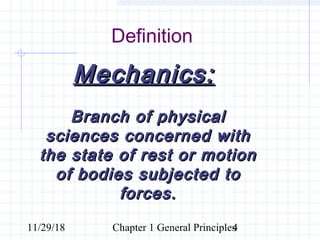
Definition
Mechanics:Mechanics:
Branch of physicalBranch of physical
sciences concerned withsciences concerned with
the state of rest or motionthe state of rest or motion
of bodies subjected toof bodies subjected to
forces.forces.
11/29/18 Chapter 1 General Principles5
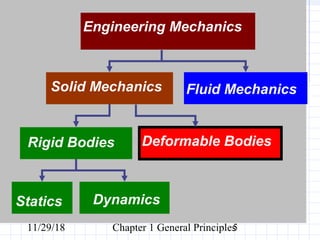
Statics Dynamics
Rigid Bodies Deformable Bodies
Solid Mechanics Fluid Mechanics
Engineering Mechanics
11/29/18 Chapter 1 General Principles6
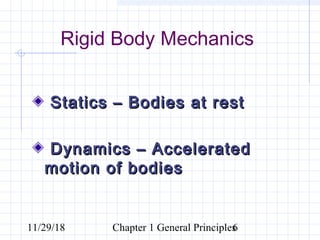
Rigid Body Mechanics
Statics – Bodies at restStatics – Bodies at rest
Dynamics – AcceleratedDynamics – Accelerated
motion of bodiesmotion of bodies
11/29/18 Chapter 1 General Principles7
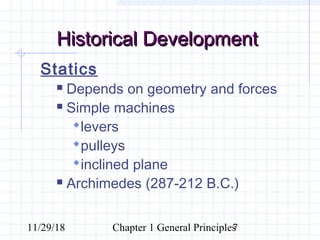
Historical DevelopmentHistorical Development
Statics
 Depends on geometry and forces
 Simple machines
levers
pulleys
inclined plane
 Archimedes (287-212 B.C.)
11/29/18 Chapter 1 General Principles8
Historical DevelopmentHistorical Development
Dynamics
 Accurate Measurement of time
 Galileo (1564-1642)
 Newton(1642-1727)
11/29/18 Chapter 1 General Principles9
Basic Quantities
Length
 meter
 foot
Time
 second
Mass
 kilogram
 slug
Force
 newton
 pound
11/29/18 Chapter 1 General Principles10
Length
Needed to locate the position of a
point in space and describe the size
of a physical system.
11/29/18 Chapter 1 General Principles11
Time
Conceived as a succession of
events. Concepts of STATICS are
time independent.
11/29/18 Chapter 1 General Principles12
Mass
A property of matter by which we can
compare the action of one body to
another. This property manifests itself
as a gravitational attraction between
two bodies and provide a qualitative
measure of the resistance of matter to
a change in velocity.
11/29/18 Chapter 1 General Principles13
Force
Generally considered as a push of a
pull exerted by one body on another.
Interaction occurs when there is direct
contact between the bodies.
Gravitational, electrical and magnetic
forces do not require direct contact.
Force is characterized by magnitude,
direction and point of application.
11/29/18 Chapter 1 General Principles14
Idealizations
1.1. ParticleParticle - an object having mass but
the size is neglected.
2.2. Rigid BodyRigid Body - a combination of a large
number of particles which remain in a
fixed position relative to each other,
both before and after the application of
a force.
11/29/18 Chapter 1 General Principles15
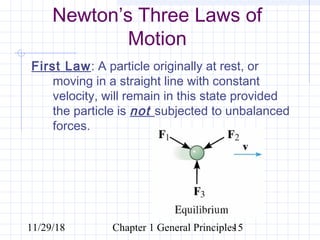
Newton’s Three Laws of
Motion
First Law: A particle originally at rest, or
moving in a straight line with constant
velocity, will remain in this state provided
the particle is not subjected to unbalanced
forces.
11/29/18 Chapter 1 General Principles16
Newton’s Three Laws of
Motion
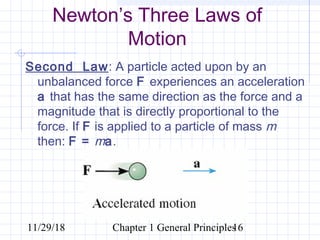
Second Law: A particle acted upon by an
unbalanced force F experiences an acceleration
a that has the same direction as the force and a
magnitude that is directly proportional to the
force. If F is applied to a particle of mass m
then: F = ma.
11/29/18 Chapter 1 General Principles17
Newton’s Three Laws of
Motion
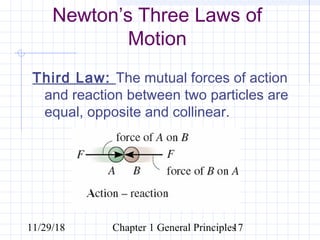
Third Law: The mutual forces of action
and reaction between two particles are
equal, opposite and collinear.
11/29/18 Chapter 1 General Principles18
Newton’s Laws of
Gravitational Attraction
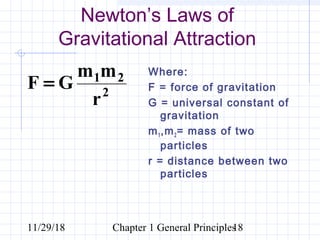
2
21
r
mm
GF =
Where:
F = force of gravitation
G = universal constant of
gravitation
m1,m2= mass of two
particles
r = distance between two
particles
11/29/18 Chapter 1 General Principles19
Weight
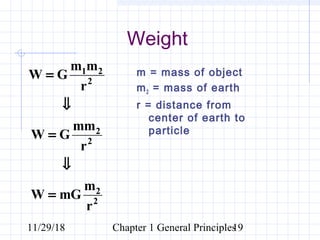
1 2
2
2
2
2
2
m m
W G
r
mm
W G
r
m
W mG
r
=
⇓
=
⇓
=
m = mass of object
m2 = mass of earth
r = distance from
center of earth to
particle
11/29/18 Chapter 1 General Principles20
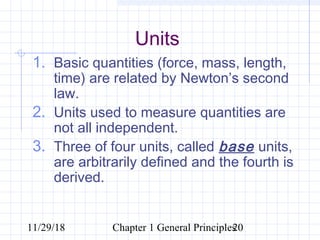
Units
1. Basic quantities (force, mass, length,
time) are related by Newton’s second
law.
2. Units used to measure quantities are
not all independent.
3. Three of four units, called base units,
are arbitrarily defined and the fourth is
derived.
11/29/18 Chapter 1 General Principles21
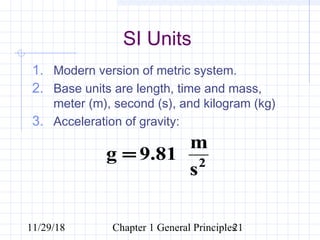
1. Modern version of metric system.
2. Base units are length, time and mass,
meter (m), second (s), and kilogram (kg)
3. Acceleration of gravity:
SI Units
2
m
g 9.81
s
=
11/29/18 Chapter 1 General Principles22
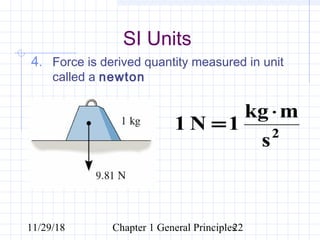
4. Force is derived quantity measured in unit
called a newton
SI Units
2
s
mkg
1N1
⋅
=
11/29/18 Chapter 1 General Principles23
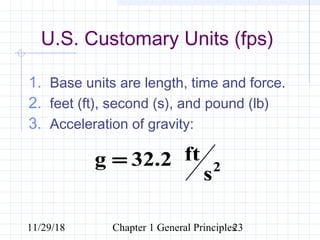
U.S. Customary Units (fps)
1. Base units are length, time and force.
2. feet (ft), second (s), and pound (lb)
3. Acceleration of gravity:
2
ftg 32.2
s
=
11/29/18 Chapter 1 General Principles24
U.S. Customary Units (fps)
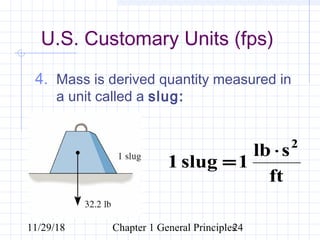
4. Mass is derived quantity measured in
a unit called a slug:
ft
slb
1slug1
2
⋅
=
11/29/18 Chapter 1 General Principles25
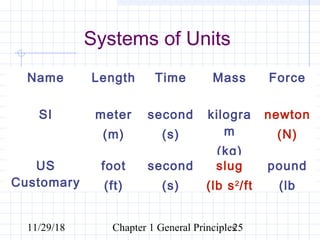
Systems of Units
Name Length Time Mass Force
SI meter
(m)
second
(s)
kilogra
m
(kg)
newton
(N)
US
Customary
foot
(ft)
second
(s)
slug
(lb s2
/ft
pound
(lb
11/29/18 Chapter 1 General Principles26
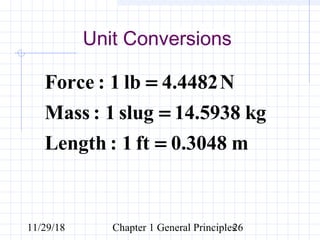
Force : 1 lb 4.4482N
Mass : 1 slug 14.5938 kg
Length : 1 ft 0.3048 m
=
=
=
Unit ConversionsUnit Conversions
11/29/18 Chapter 1 General Principles27
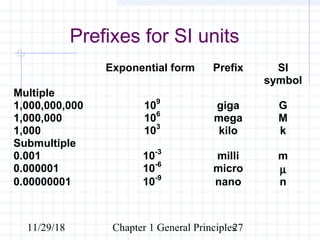
Prefixes for SI units
Exponential form Prefix SI
symbol
Multiple
1,000,000,000 109
giga G
1,000,000 106
mega M
1,000 103
kilo k
Submultiple
0.001 10-3
milli m
0.000001 10-6
micro µ
0.00000001 10-9
nano n
11/29/18 Chapter 1 General Principles28
Concepts to Study
1. Dimensional Homogeneity
2. Significant Figures
3. Rounding Off Numbers
4. Calculations
11/29/18 Chapter 1 General Principles29
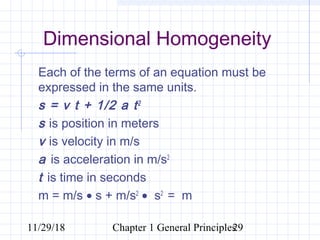
Dimensional Homogeneity
Each of the terms of an equation must be
expressed in the same units.
s = v t + 1/2 a t2
s is position in meters
v is velocity in m/s
a is acceleration in m/s2
t is time in seconds
m = m/s • s + m/s2
• s2
= m
11/29/18 Chapter 1 General Principles30
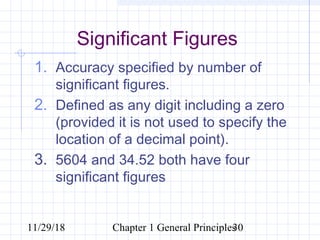
Significant Figures
1. Accuracy specified by number of
significant figures.
2. Defined as any digit including a zero
(provided it is not used to specify the
location of a decimal point).
3. 5604 and 34.52 both have four
significant figures
11/29/18 Chapter 1 General Principles31
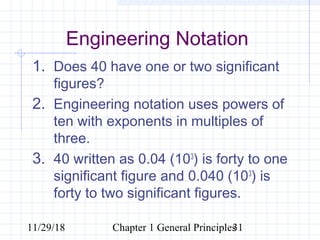
Engineering Notation
1. Does 40 have one or two significant
figures?
2. Engineering notation uses powers of
ten with exponents in multiples of
three.
3. 40 written as 0.04 (103
) is forty to one
significant figure and 0.040 (103
) is
forty to two significant figures.
11/29/18 Chapter 1 General Principles32
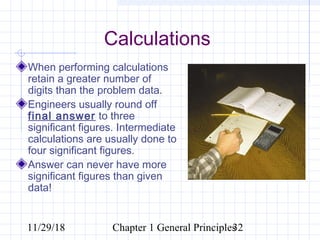
Calculations
When performing calculations
retain a greater number of
digits than the problem data.
Engineers usually round off
final answer to three
significant figures. Intermediate
calculations are usually done to
four significant figures.
Answer can never have more
significant figures than given
data!
11/29/18 Chapter 1 General Principles33
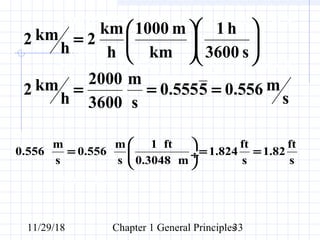
Convert 2 km/h to m/s. How many ft/s
is this?
SOLUTION:
Since 1 km = 1000 m and 1 h = 3600 s, the conversion
factors are arranged so that a cancellation of units can
be applied.
s
m556.05555.0
s
m
3600
2000
h
km2
s3600
h1
km
m1000
h
km
2
h
km2
===












=
Recall that 1 ft = 0.3038 m
m m 1 ft ft ft
0.556 0.556 1.824 1.82
s s 0.3048 m s s
 
= = = ÷
 
11/29/18 Chapter 1 General Principles34
Procedure for Analysis
1. Read the problem carefully and
correlate the actual physical situation
with the theory studied.
2. Draw necessary diagrams and tables.
3. Apply relevant principles, generally in
mathematical form.
11/29/18 Chapter 1 General Principles35
Procedure for Analysis
4. Solve the equations algebraically (without
numbers) as far as possible, then obtain a
numerical answer.
5. Be sure to use a consistent set of units.
6. Report the answer with no more significant
figures than the accuracy of the given data.
7. Decide if answer seems reasonable.
8. Think about what the problem taught you!
11/29/18 Chapter 1 General Principles36
Important Points
1. Statics is the study of bodies at rest or
moving with constant velocity.
2. A particle has mass but a size that can
be neglected.
3. A rigid body does not deform under
load.
4. Concentrated forces are assumed to
act at a point on a body.
11/29/18 Chapter 1 General Principles37
Important Points
1. Newton’s three laws of motion must be
memorized!
2. Mass is a property of matter that does
not change from one location to
another.
3. Weight is the gravitational attraction of
the earth on a body or quantity of
mass. Its magnitude depends on the
location of the mass.
11/29/18 Chapter 1 General Principles38
Important Points
1. In the SI system the unit of force is the
newton. It is a derived quantity. Mass, length
and time are the base quantities.
2. In the SI system prefixes are used to denote
large or small numerical quantities of a unit.
3. Perform numerical calculation to several
significant figures and report answers to three
significant figures.
4. Be sure that all equations are dimensionally
homogeneous.
11/29/18 Chapter 1 General Principles39
Objectives - Review
1. To provide an introduction to the basic
quantities and idealizations of mechanics.
2. To give a statement of Newton’s laws of
Motion and Gravitation.
3. To review the principles for applying the SI
system of units.
4. To examine the standard procedures for
performing numerical calculations.
5. To present a general guide for problem
solving.

Introduction to mechanics

  • 1.
    11/29/18 Chapter 1General Principles 1 Chapter 1 - General Principles
  • 2.
    11/29/18 Chapter 1General Principles2
  • 3.
    11/29/18 Chapter 1General Principles3 Objectives 1. To provide an introduction to the basic quantities and idealizations of mechanics. 2. To give a statement of Newton’s laws of Motion and Gravitation. 3. To review the principles for applying the SI system of units. 4. To examine the standard procedures for performing numerical calculations. 5. To present a general guide for problem solving.
  • 4.
    11/29/18 Chapter 1General Principles4 Definition Mechanics:Mechanics: Branch of physicalBranch of physical sciences concerned withsciences concerned with the state of rest or motionthe state of rest or motion of bodies subjected toof bodies subjected to forces.forces.
  • 5.
    11/29/18 Chapter 1General Principles5 Statics Dynamics Rigid Bodies Deformable Bodies Solid Mechanics Fluid Mechanics Engineering Mechanics
  • 6.
    11/29/18 Chapter 1General Principles6 Rigid Body Mechanics Statics – Bodies at restStatics – Bodies at rest Dynamics – AcceleratedDynamics – Accelerated motion of bodiesmotion of bodies
  • 7.
    11/29/18 Chapter 1General Principles7 Historical DevelopmentHistorical Development Statics  Depends on geometry and forces  Simple machines levers pulleys inclined plane  Archimedes (287-212 B.C.)
  • 8.
    11/29/18 Chapter 1General Principles8 Historical DevelopmentHistorical Development Dynamics  Accurate Measurement of time  Galileo (1564-1642)  Newton(1642-1727)
  • 9.
    11/29/18 Chapter 1General Principles9 Basic Quantities Length  meter  foot Time  second Mass  kilogram  slug Force  newton  pound
  • 10.
    11/29/18 Chapter 1General Principles10 Length Needed to locate the position of a point in space and describe the size of a physical system.
  • 11.
    11/29/18 Chapter 1General Principles11 Time Conceived as a succession of events. Concepts of STATICS are time independent.
  • 12.
    11/29/18 Chapter 1General Principles12 Mass A property of matter by which we can compare the action of one body to another. This property manifests itself as a gravitational attraction between two bodies and provide a qualitative measure of the resistance of matter to a change in velocity.
  • 13.
    11/29/18 Chapter 1General Principles13 Force Generally considered as a push of a pull exerted by one body on another. Interaction occurs when there is direct contact between the bodies. Gravitational, electrical and magnetic forces do not require direct contact. Force is characterized by magnitude, direction and point of application.
  • 14.
    11/29/18 Chapter 1General Principles14 Idealizations 1.1. ParticleParticle - an object having mass but the size is neglected. 2.2. Rigid BodyRigid Body - a combination of a large number of particles which remain in a fixed position relative to each other, both before and after the application of a force.
  • 15.
    11/29/18 Chapter 1General Principles15 Newton’s Three Laws of Motion First Law: A particle originally at rest, or moving in a straight line with constant velocity, will remain in this state provided the particle is not subjected to unbalanced forces.
  • 16.
    11/29/18 Chapter 1General Principles16 Newton’s Three Laws of Motion Second Law: A particle acted upon by an unbalanced force F experiences an acceleration a that has the same direction as the force and a magnitude that is directly proportional to the force. If F is applied to a particle of mass m then: F = ma.
  • 17.
    11/29/18 Chapter 1General Principles17 Newton’s Three Laws of Motion Third Law: The mutual forces of action and reaction between two particles are equal, opposite and collinear.
  • 18.
    11/29/18 Chapter 1General Principles18 Newton’s Laws of Gravitational Attraction 2 21 r mm GF = Where: F = force of gravitation G = universal constant of gravitation m1,m2= mass of two particles r = distance between two particles
  • 19.
    11/29/18 Chapter 1General Principles19 Weight 1 2 2 2 2 2 2 m m W G r mm W G r m W mG r = ⇓ = ⇓ = m = mass of object m2 = mass of earth r = distance from center of earth to particle
  • 20.
    11/29/18 Chapter 1General Principles20 Units 1. Basic quantities (force, mass, length, time) are related by Newton’s second law. 2. Units used to measure quantities are not all independent. 3. Three of four units, called base units, are arbitrarily defined and the fourth is derived.
  • 21.
    11/29/18 Chapter 1General Principles21 1. Modern version of metric system. 2. Base units are length, time and mass, meter (m), second (s), and kilogram (kg) 3. Acceleration of gravity: SI Units 2 m g 9.81 s =
  • 22.
    11/29/18 Chapter 1General Principles22 4. Force is derived quantity measured in unit called a newton SI Units 2 s mkg 1N1 ⋅ =
  • 23.
    11/29/18 Chapter 1General Principles23 U.S. Customary Units (fps) 1. Base units are length, time and force. 2. feet (ft), second (s), and pound (lb) 3. Acceleration of gravity: 2 ftg 32.2 s =
  • 24.
    11/29/18 Chapter 1General Principles24 U.S. Customary Units (fps) 4. Mass is derived quantity measured in a unit called a slug: ft slb 1slug1 2 ⋅ =
  • 25.
    11/29/18 Chapter 1General Principles25 Systems of Units Name Length Time Mass Force SI meter (m) second (s) kilogra m (kg) newton (N) US Customary foot (ft) second (s) slug (lb s2 /ft pound (lb
  • 26.
    11/29/18 Chapter 1General Principles26 Force : 1 lb 4.4482N Mass : 1 slug 14.5938 kg Length : 1 ft 0.3048 m = = = Unit ConversionsUnit Conversions
  • 27.
    11/29/18 Chapter 1General Principles27 Prefixes for SI units Exponential form Prefix SI symbol Multiple 1,000,000,000 109 giga G 1,000,000 106 mega M 1,000 103 kilo k Submultiple 0.001 10-3 milli m 0.000001 10-6 micro µ 0.00000001 10-9 nano n
  • 28.
    11/29/18 Chapter 1General Principles28 Concepts to Study 1. Dimensional Homogeneity 2. Significant Figures 3. Rounding Off Numbers 4. Calculations
  • 29.
    11/29/18 Chapter 1General Principles29 Dimensional Homogeneity Each of the terms of an equation must be expressed in the same units. s = v t + 1/2 a t2 s is position in meters v is velocity in m/s a is acceleration in m/s2 t is time in seconds m = m/s • s + m/s2 • s2 = m
  • 30.
    11/29/18 Chapter 1General Principles30 Significant Figures 1. Accuracy specified by number of significant figures. 2. Defined as any digit including a zero (provided it is not used to specify the location of a decimal point). 3. 5604 and 34.52 both have four significant figures
  • 31.
    11/29/18 Chapter 1General Principles31 Engineering Notation 1. Does 40 have one or two significant figures? 2. Engineering notation uses powers of ten with exponents in multiples of three. 3. 40 written as 0.04 (103 ) is forty to one significant figure and 0.040 (103 ) is forty to two significant figures.
  • 32.
    11/29/18 Chapter 1General Principles32 Calculations When performing calculations retain a greater number of digits than the problem data. Engineers usually round off final answer to three significant figures. Intermediate calculations are usually done to four significant figures. Answer can never have more significant figures than given data!
  • 33.
    11/29/18 Chapter 1General Principles33 Convert 2 km/h to m/s. How many ft/s is this? SOLUTION: Since 1 km = 1000 m and 1 h = 3600 s, the conversion factors are arranged so that a cancellation of units can be applied. s m556.05555.0 s m 3600 2000 h km2 s3600 h1 km m1000 h km 2 h km2 ===             = Recall that 1 ft = 0.3038 m m m 1 ft ft ft 0.556 0.556 1.824 1.82 s s 0.3048 m s s   = = = ÷  
  • 34.
    11/29/18 Chapter 1General Principles34 Procedure for Analysis 1. Read the problem carefully and correlate the actual physical situation with the theory studied. 2. Draw necessary diagrams and tables. 3. Apply relevant principles, generally in mathematical form.
  • 35.
    11/29/18 Chapter 1General Principles35 Procedure for Analysis 4. Solve the equations algebraically (without numbers) as far as possible, then obtain a numerical answer. 5. Be sure to use a consistent set of units. 6. Report the answer with no more significant figures than the accuracy of the given data. 7. Decide if answer seems reasonable. 8. Think about what the problem taught you!
  • 36.
    11/29/18 Chapter 1General Principles36 Important Points 1. Statics is the study of bodies at rest or moving with constant velocity. 2. A particle has mass but a size that can be neglected. 3. A rigid body does not deform under load. 4. Concentrated forces are assumed to act at a point on a body.
  • 37.
    11/29/18 Chapter 1General Principles37 Important Points 1. Newton’s three laws of motion must be memorized! 2. Mass is a property of matter that does not change from one location to another. 3. Weight is the gravitational attraction of the earth on a body or quantity of mass. Its magnitude depends on the location of the mass.
  • 38.
    11/29/18 Chapter 1General Principles38 Important Points 1. In the SI system the unit of force is the newton. It is a derived quantity. Mass, length and time are the base quantities. 2. In the SI system prefixes are used to denote large or small numerical quantities of a unit. 3. Perform numerical calculation to several significant figures and report answers to three significant figures. 4. Be sure that all equations are dimensionally homogeneous.
  • 39.
    11/29/18 Chapter 1General Principles39 Objectives - Review 1. To provide an introduction to the basic quantities and idealizations of mechanics. 2. To give a statement of Newton’s laws of Motion and Gravitation. 3. To review the principles for applying the SI system of units. 4. To examine the standard procedures for performing numerical calculations. 5. To present a general guide for problem solving.