Engineering Mechanics
Statics
Supported with MATLAB Codes
Dr. Ahmed Momtaz Hosny
PhD in Aircraft Dynamics and Control, BUAA
Lecturer at KMA
Lecture Notes & Solved Examples with MATLAB Applications
List of Contents
Chapter 1 Introduction to Mechanics
Chapter 2
Chapter 3
Chapter 4
Chapter 5
Chapter 6
Statics of Particles
Statics of Rigid Bodies, Equivalent Systems of Forces
Equilibrium of Rigid Bodies
Distributed Forces, Centroids and Center of Gravity
Analysis of Structures, Simple Truss (Pin Joints & Two-Forces Members)
Chapter 7 Shear and Bending Moment of Beams
Chapter 8 Friction, Pulleys, Tension Belts and Journal Bearings
Chapter 1
Introduction to Mechanics
1.1 WHAT IS MECHANICS?
Mechanics can be defined as that science which describes and predicts the
conditions of rest or motion of bodies under the action of forces. It is divided into
three parts: mechanics of rigid bodies, mechanics of deformable bodies, and
mechanics of fluids. The mechanics of rigid bodies is subdivided into statics and
dynamics, the former dealing with bodies at rest, the latter with bodies in motion.
In this part of the study of mechanics, bodies are assumed to be perfectly rigid.
Actual structures and machines, however, are never absolutely rigid and deform
under the loads to which they are subjected. But these deformations are usually
small and do not appreciably affect the conditions of equilibrium or motion of the
structure under consideration. They are important, though, as far as the resistance
of the structure to failure is concerned and are studied in mechanics of materials,
which is a part of the mechanics of deformable bodies. The third division of
mechanics, the mechanics of fluids, is subdivided into the study of incompressible
fluids and of compressible fluids. An important subdivision of the study of
incompressible fluids is hydraulics, which deals with problems involving water.
Mechanics is a physical science, since it deals with the study of physical
phenomena. However, some associate mechanics with mathematics, while many
consider it as an engineering subject. Both these views are justified in part.
Mechanics is the foundation of most engineering sciences and is an indispensable
prerequisite to their study. However, it does not have the empiricism found in some
engineering sciences, i.e., it does not rely on experience or observation alone; by
its rigor and the emphasis it places on deductive reasoning it resembles
mathematics. But, again, it is not an abstract or even a pure science; mechanics is
an applied science. The purpose of mechanics is to explain and predict physical
phenomena and thus to lay the foundations for engineering applications.
1
1.2 SYSTEMS OF UNITS
With the four fundamental concepts introduced in the preceding section are
associated the so-called kinetic units, i.e., the units of length, time, mass, and force.
International System of Units (SI Units). In this system, which will be in
universal use after the United States has completed its conversion to SI units, the
base units are the units of length, mass, and time, and they are called, respectively,
the meter (m), the kilogram (kg), and the second (s). All three are arbitrarily
defined. The unit of force is a derived unit. It is called the newton (N) and is
defined as the force which gives an acceleration of 1 m/s 2 to a mass of 1 kg.
1 N = (1 kg)(1 m/s2
)
Multiples and submultiples of the fundamental SI units may be obtained through
the use of the prefixes defined in Table 1.1 . The multiples and submultiples of the
units of length, mass, and force most frequently used in engineering are,
respectively, the kilometer (km) and the millimeter (mm); the megagram (Mg) and
the gram (g); and the kilonewton (kN). According to Table 1.1 ,
2
Other derived SI units used to measure the moment of a force, the work of a force,
etc., are shown in Table 1.2 . While these units will be introduced in later chapters
as they are needed.
U.S. Customary Units. Most practicing American engineers still commonly use a
system in which the base units are the units of length, force, and time. These units
are, respectively, the foot (ft), the pound (lb), and the second (s).
The U.S. customary units most frequently used in mechanics are listed in Table
1.3 with their SI equivalents.
3
4
Chapter 2
Statics of Particles
2.1 INTRODUCTION
In this chapter you will study the effect of forces acting on particles. First you will
learn how to replace two or more forces acting on a given particle by a single force
having the same effect as the original forces. This single equivalent force is the
resultant of the original forces acting on the particle. Later the relations which
exist among the various forces acting on a particle in a state of equilibrium will be
derived and used to determine some of the forces acting on the particle. The use of
the word “particle” does not imply that our study will be limited to that of small
corpuscles. What it means is that the size and shape of the bodies under
consideration will not significantly affect the solution of the problems treated in
this chapter and that all the forces acting on a given body will be assumed to be
applied at the same point. Since such an assumption is verified in many practical
applications, you will be able to solve a number of engineering problems in this
chapter. The first part of the chapter is devoted to the study of forces contained in a
single plane, and the second part to the analysis of forces in three-dimensional
space.
2.2 FORCE ON A PARTICLE. RESULTANT OF TWO FORCES
A force represents the action of one body on another and is generally characterized
by its point of application, its magnitude, and its direction. Forces acting on a
given particle, however, have the same point of application. Each force considered
in this chapter will thus be completely defined by its magnitude and direction. The
magnitude of a force is characterized by a certain number of units. As indicated in
Chap. 1, the SI units used by engineers to measure the magnitude of a force are the
newton (N) and its multiple the kilonewton (kN), equal to 1000 N, while the U.S.
customary units used for the same purpose are the pound (lb) and its multiple the
kilopound (kip), equal to 1000 lb. The direction of a force is defined by the line of
action and the sense of the force. The line of action is the infinite straight line
along which the force acts; it is characterized by the angle it forms with some fixed
5
axis (Fig. 2.1). The force itself is represented by a segment of that line; through the
use of an appropriate scale, the length of this segment may be chosen to represent
the magnitude of the force.
Fig. 2.1
Finally, the sense of the force should be indicated by an arrowhead. It is important
in defining a force to indicate its sense. Two forces having the same magnitude and
the same line of action but different sense, such as the forces shown in Fig. 2.1a
and b, will have directly opposite effects on a particle. Experimental evidence
shows that two forces P and Q acting on a particle A (Fig. 2.2a) can be replaced by
a single force R which has the same effect on the particle (Fig. 2.2c). This force is
called the resultant of the forces P and Q and can be obtained, as shown in Fig.
2.2b, by constructing a parallelogram, using P and Q as two adjacent sides of the
parallelogram. The diagonal that passes through A represents the resultant. This
method for finding the resultant is known as the parallelogram law for the addition
of two forces. This law is based on experimental evidence; it cannot be proved or
derived mathematically.
Fig. 2.2
6
2.3 VECTORS
It appears from the above that forces do not obey the rules of addition defined in
ordinary arithmetic or algebra. For example, two forces acting at a right angle to
each other, one of 4 lb and the other of 3 lb, add up to a force of 5 lb, not to a force
of 7 lb. Forces are not the only quantities which follow the parallelogram law of
addition. As you will see later, displacements, velocities, accelerations, and
momenta are other examples of physical quantities possessing magnitude and
direction that are added according to the parallelogram law. All these quantities
can be represented mathematically by vectors, while those physical quantities
which have magnitude but not direction, such as volume, mass, or energy, are
represented by plain numbers or scalars. Vectors are defined as mathematical
expressions possessing magnitude and direction, which add according to the
parallelogram law. Vectors are represented by arrows in the illustrations and will
be distinguished from scalar quantities in this text through the use of boldface type
(P). In longhand writing, a vector may be denoted by drawing a short arrow above
the letter used to represent it (𝑷𝑷��⃗) or by underlining the letter (P)
Two vectors which have the same magnitude and the same direction are said to be
equal, whether or not they also have the same point of application (Fig. 2.4); equal
vectors may be denoted by the
. The last method
may be preferred since underlining can also be used on a typewriter or computer.
The magnitude of a vector defines the length of the arrow used to represent the
vector. In this text, italic type will be used to denote the magnitude of a vector.
Thus, the magnitude of the vector P will be denoted by P. A vector used to
represent a force acting on a given particle has a well-defined point of application,
namely, the particle itself. Such a vector is said to be a fixed, or bound, vector and
cannot be moved without modifying the conditions of the problem. Other physical
quantities, however, such as couples (see Chap. 3), are represented by vectors
which may be freely moved in space; these vectors are called free vectors. Still
other physical quantities, such as forces acting on a rigid body (see Chap. 3), are
represented by vectors which can be moved, or slid, along their lines of action;
they are known as sliding vectors.
same letter.
7
The negative vector of a given vector P is defined as a vector having the same
magnitude as P and a direction opposite to that of P (Fig. 2.5); the negative of the
vector P is denoted by -P. The vectors P and -P are commonly referred to as equal
and opposite vectors. Clearly, we have
P + (-P) = 0
2.4 ADDITION OF VECTORS
We saw in the preceding section that, by definition, vectors add according to the
parallelogram law. Thus, the sum of two vectors P and Q is obtained by attaching
the two vectors to the same point A and constructing a parallelogram, using P and
Q as two sides of the parallelogram (Fig. 2.6). The diagonal that passes through A
represents the sum of the vectors P and Q, consequently we can write
R = P + Q = Q + P
8
PROPRIETARY MATERIAL. © 2013 The McGraw-Hill Companies, Inc. All rights reserved. No part of this Manual may be displayed,
reproduced or distributed in any form or by any means, without the prior written permission of the publisher, or used beyond the limited
distribution to teachers and educators permitted by McGraw-Hill for their individual course preparation. If you are a student using this Manual,
you are using it without permission.
3
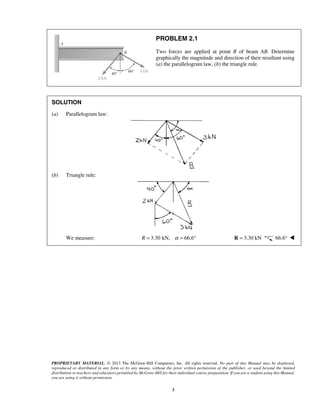
PROBLEM 2.1
Two forces are applied at point B of beam AB. Determine
graphically the magnitude and direction of their resultant using
(a) the parallelogram law, (b) the triangle rule.
SOLUTION
(a) Parallelogram law:
(b) Triangle rule:
We measure: 3.30 kN, 66.6R α= = ° 3.30 kN=R 66.6° 
9
2.1
Solve the above problem replacing 2 kN force with 5 kN and 3 kN force with 10 kN.
PROPRIETARY MATERIAL. © 2013 The McGraw-Hill Companies, Inc. All rights reserved. No part of this Manual may be displayed,
reproduced or distributed in any form or by any means, without the prior written permission of the publisher, or used beyond the limited
distribution to teachers and educators permitted by McGraw-Hill for their individual course preparation. If you are a student using this Manual,
you are using it without permission.
4
PROBLEM 2.2
The cable stays AB and AD help support pole AC. Knowing
that the tension is 120 lb in AB and 40 lb in AD, determine
graphically the magnitude and direction of the resultant of the
forces exerted by the stays at A using (a) the parallelogram
law, (b) the triangle rule.
SOLUTION
We measure: 51.3
59.0
α
β
= °
= °
(a) Parallelogram law:
(b) Triangle rule:
We measure: 139.1 lb,R = 67.0γ = ° 139.1lbR = 67.0° 

10
2.2
PROPRIETARY MATERIAL. © 2013 The McGraw-Hill Companies, Inc. All rights reserved. No part of this Manual may be displayed,
reproduced or distributed in any form or by any means, without the prior written permission of the publisher, or used beyond the limited
distribution to teachers and educators permitted by McGraw-Hill for their individual course preparation. If you are a student using this Manual,
you are using it without permission.
5
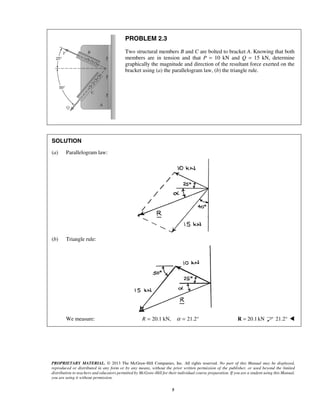
PROBLEM 2.3
Two structural members B and C are bolted to bracket A. Knowing that both
members are in tension and that P = 10 kN and Q = 15 kN, determine
graphically the magnitude and direction of the resultant force exerted on the
bracket using (a) the parallelogram law, (b) the triangle rule.
SOLUTION
(a) Parallelogram law:
(b) Triangle rule:
We measure: 20.1 kN,R = 21.2α = ° 20.1kN=R 21.2° 
11
2.3
PROPRIETARY MATERIAL. © 2013 The McGraw-Hill Companies, Inc. All rights reserved. No part of this Manual may be displayed,
reproduced or distributed in any form or by any means, without the prior written permission of the publisher, or used beyond the limited
distribution to teachers and educators permitted by McGraw-Hill for their individual course preparation. If you are a student using this Manual,
you are using it without permission.
6
PROBLEM 2.4
Two structural members B and C are bolted to bracket A. Knowing that
both members are in tension and that P = 6 kips and Q = 4 kips, determine
graphically the magnitude and direction of the resultant force exerted on
the bracket using (a) the parallelogram law, (b) the triangle rule.
SOLUTION
(a) Parallelogram law:
(b) Triangle rule:
We measure: 8.03 kips, 3.8R α= = ° 8.03 kips=R 3.8° 
12
2.4
PROPRIETARY MATERIAL. © 2013 The McGraw-Hill Companies, Inc. All rights reserved. No part of this Manual may be displayed,
reproduced or distributed in any form or by any means, without the prior written permission of the publisher, or used beyond the limited
distribution to teachers and educators permitted by McGraw-Hill for their individual course preparation. If you are a student using this Manual,
you are using it without permission.
7
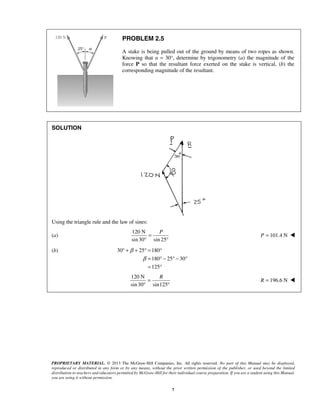
PROBLEM 2.5
A stake is being pulled out of the ground by means of two ropes as shown.
Knowing that α = 30°, determine by trigonometry (a) the magnitude of the
force P so that the resultant force exerted on the stake is vertical, (b) the
corresponding magnitude of the resultant.
SOLUTION
Using the triangle rule and the law of sines:
(a)
120 N
sin30 sin 25
P
=
° °
101.4 NP = 
(b) 30 25 180
180 25 30
125
β
β
° + + ° = °
= ° − ° − °
= °
120 N
sin30 sin125
=
° °
R
196.6 N=R 
13
2.5
PROPRIETARY MATERIAL. © 2013 The McGraw-Hill Companies, Inc. All rights reserved. No part of this Manual may be displayed,
reproduced or distributed in any form or by any means, without the prior written permission of the publisher, or used beyond the limited
distribution to teachers and educators permitted by McGraw-Hill for their individual course preparation. If you are a student using this Manual,
you are using it without permission.
8
PROBLEM 2.6
A trolley that moves along a horizontal beam is acted upon by two
forces as shown. (a) Knowing that α = 25°, determine by trigonometry
the magnitude of the force P so that the resultant force exerted on the
trolley is vertical. (b) What is the corresponding magnitude of the
resultant?
SOLUTION
Using the triangle rule and the law of sines:
(a)
1600 N
sin 25° sin 75
P
=
°
3660 NP = 
(b) 25 75 180
180 25 75
80
β
β
° + + ° = °
= ° − ° − °
= °
1600 N
sin 25° sin80
R
=
°
3730 NR = 
14
Solve the above problem knowing that P = 1600 N and alfa angle = 110 Degrees.
2.6
PROPRIETARY MATERIAL. © 2013 The McGraw-Hill Companies, Inc. All rights reserved. No part of this Manual may be displayed,
reproduced or distributed in any form or by any means, without the prior written permission of the publisher, or used beyond the limited
distribution to teachers and educators permitted by McGraw-Hill for their individual course preparation. If you are a student using this Manual,
you are using it without permission.
13
PROBLEM 2.11
A steel tank is to be positioned in an excavation. Knowing that
α = 20°, determine by trigonometry (a) the required magnitude
of the force P if the resultant R of the two forces applied at A is
to be vertical, (b) the corresponding magnitude of R.
SOLUTION
Using the triangle rule and the law of sines:
(a) 50 60 180
180 50 60
70
β
β
+ ° + ° = °
= ° − ° − °
= °
425 lb
sin 70 sin 60
P
=
° °
392 lbP = 
(b)
425 lb
sin 70 sin50
R
=
° °
346 lbR = 
2.7
15
PROPRIETARY MATERIAL. © 2013 The McGraw-Hill Companies, Inc. All rights reserved. No part of this Manual may be displayed,
reproduced or distributed in any form or by any means, without the prior written permission of the publisher, or used beyond the limited
distribution to teachers and educators permitted by McGraw-Hill for their individual course preparation. If you are a student using this Manual,
you are using it without permission.
14
PROBLEM 2.12
A steel tank is to be positioned in an excavation. Knowing that
the magnitude of P is 500 lb, determine by trigonometry (a) the
required angle α if the resultant R of the two forces applied at A
is to be vertical, (b) the corresponding magnitude of R.
SOLUTION
Using the triangle rule and the law of sines:
(a) ( 30 ) 60 180
180 ( 30 ) 60
90
sin (90 ) sin60
425 lb 500 lb
α β
β α
β α
α
+ ° + ° + = °
= ° − + ° − °
= ° −
° − °
=
90 47.402α° − = ° 42.6α = ° 
(b)
500 lb
sin (42.598 30 ) sin 60
R
=
° + ° °
551 lbR = 
16
2.8
%%%%%%%%%Problem 2.12 How to calculate angle Alfa for different values of P
%%%%%%%%%Considering Vertical Resultant R and Constant Force of 425 with
%%%%%%%%%angle 30 degree
%% Calculating the regular problem
%% Beta=180 - (Alfa+30)- 60 ie Beta= 90- Alfa ;
%% Substituting in Sines Law sin(Beta)/425 = sin(pi/3)/500;
B =(sin(pi/3)/500)*425;
Beta = asin(B)
Beta = Beta * 57.3 %%%% in Radians
Alfa=90 - Beta
%%%%%%%%% Calculating the resultant Force
R=(500/sin(pi/3))* sin((Alfa+30)/57.3)
%%%%%%%%%%%%%%%%%%%%%%%%%%%%%%%%%%%%%%%%%%%%%%%%%%%%%%%%%%%%%%%%%%%%%%%%%%%
%% Performing a loop calculation for P=[500 550 600 650 700 750 800 850 900]
P=[500 550 600 650 700 750 800 850 900]
for I=0:1:8
I=I+1
B =(sin(pi/3)/P(I))*425;
Beta = asin(B)
Beta = Beta * 57.3 %%%% in Degrees
Beta1(I)=Beta
Alfa(I)=90 - Beta
R(I)=(P(I)/sin(pi/3))* sin((Alfa(I)+30)/57.3)
end
%%%%%%%%%%%%%%%%%%%%%%%%%%%%%%%%%%%%%%%%%%%%%%%%%%%%%%%%%%%%%%%%%%%%%%%%%%%
%% Plotting Alfa and Beta for Different P
17
figure(1);
plot(P,Alfa);
xlabel('P in LB'),grid on;;ylabel('Alfa in Degrees'),grid on;;
figure(2);
plot(P,Beta1);
xlabel('P in LB'),grid on;;ylabel('Beta in Degrees'),grid on;;
figure(3);
plot(P,R);
xlabel('P in LB'),grid on;;ylabel('R Resultant'),grid on;;
figure(4);
plot(P,Alfa,'+',P,Beta1,'o');
xlabel('P in LB'),grid on;;ylabel('Alfa Beta in Degrees'),grid on;;
18
19
PROPRIETARY MATERIAL. © 2013 The McGraw-Hill Companies, Inc. All rights reserved. No part of this Manual may be displayed,
reproduced or distributed in any form or by any means, without the prior written permission of the publisher, or used beyond the limited
distribution to teachers and educators permitted by McGraw-Hill for their individual course preparation. If you are a student using this Manual,
you are using it without permission.
17
PROBLEM 2.15
Solve Problem 2.2 by trigonometry.
PROBLEM 2.2 The cable stays AB and AD help support pole
AC. Knowing that the tension is 120 lb in AB and 40 lb in AD,
determine graphically the magnitude and direction of the
resultant of the forces exerted by the stays at A using (a) the
parallelogram law, (b) the triangle rule.
SOLUTION
8
tan
10
38.66
6
tan
10
30.96
α
α
β
β
=
= °
=
= °
Using the triangle rule: 180
38.66 30.96 180
110.38
α β ψ
ψ
ψ
+ + = °
° + ° + = °
= °
Using the law of cosines: 2 22
(120 lb) (40 lb) 2(120 lb)(40 lb)cos110.38
139.08 lb
R
R
= + − °
=
Using the law of sines:
sin sin110.38
40 lb 139.08 lb
γ °
=
15.64
(90 )
(90 38.66 ) 15.64
66.98
γ
φ α γ
φ
φ
= °
= ° − +
= ° − ° + °
= ° 139.1 lb=R 67.0° 
2.9
20
%%%%%%%%%Problem 2.15 How to calculate Resultant R and its angle from the
%%%%%%%%%horizontal plane
%% Calculating the regular problem
%% tan(Alfa)=8/10 & tan(Beta)=6/10 then we can get Alfa & Beta;
Alfa=atan(8/10)*57.3
Beta=atan(6/10)*57.3
Epsai = 180 - Alfa - Beta
%%%%% Calculating the resultant from the Law of Cosines
R = ((120^2) + (40^2) - 2*40*120*cos(Epsai/57.3))^0.5
%%%%% Calculating the angle Gama to obtain angle Fai as shown in the figure
%%%%% sin(Gama)/40=sin(Epsai)/R consequently we can obtain sin(Gama) in
%%%%% form of G
G=(sin(Epsai/57.3)/R)*40
Gama=asin(G)*57.3 %%%%%%% in Degrees
Fai=90-Alfa + Gama
%%%%%%%%%%%%%%%%%%%%%%%%%%%%%%%%%%%%%%%%%%%%%%%%%%%%%%%%%%%%%%%%%%%%%%%%%%%
%% Performing a loop calculation for P=[500 550 600 650 700 750 800 850 900]
T1=[100 120 140 160 180 200 220 240 260];
T2=[30 40 50 60 70 80 90 100 110];
for I=0:1:8
I=I+1;
%%%%% Calculating the resultant from the Law of Cosines
R(I) = ((T1(I)^2) + (T2(I)^2) - 2*T1(I)*T2(I)*cos(Epsai/57.3))^0.5;
%%%%% Calculating the angle Gama to obtain angle Fai as shown in the figure
%%%%% sin(Gama)/40=sin(Epsai)/R consequently we can obtain sin(Gama) in
%%%%% form of G
G=(sin(Epsai/57.3)/R(I))*40;
Gama=asin(G)*57.3; %%%%%%% in Degrees
Fai(I)=90-Alfa + Gama;
21
end
%%%%%%%%%%%%%%%%%%%%%%%%%%%%%%%%%%%%%%%%%%%%%%%%%%%%%%%%%%%%%%%%%%%%%%%%%%%
%% Plotting Resultant R and the Corresponding Angle Fai for different T1 & T2
figure(1);
plot3(T1,T2,R);
xlabel('T1 in LB'), grid on;ylabel('T2 in LB'), grid on;zlabel('R in LB'),
grid on;
figure(2);
plot(R,Fai);
xlabel('R in LB'), grid on;ylabel('Fai in Degrees'), grid on;
22
PROPRIETARY MATERIAL. © 2013 The McGraw-Hill Companies, Inc. All rights reserved. No part of this Manual may be displayed,
reproduced or distributed in any form or by any means, without the prior written permission of the publisher, or used beyond the limited
distribution to teachers and educators permitted by McGraw-Hill for their individual course preparation. If you are a student using this Manual,
you are using it without permission.
18
PROBLEM 2.16
Solve Problem 2.4 by trigonometry.
PROBLEM 2.4 Two structural members B and C are bolted to bracket A.
Knowing that both members are in tension and that P = 6 kips and Q = 4 kips,
determine graphically the magnitude and direction of the resultant force
exerted on the bracket using (a) the parallelogram law, (b) the triangle rule.
SOLUTION
Using the force triangle and the laws of cosines and sines:
We have: 180 (50 25 )
105
γ = ° − ° + °
= °
Then 2 2 2
2
(4 kips) (6 kips) 2(4 kips)(6 kips)cos105
64.423 kips
8.0264 kips
R
R
= + − °
=
=
And
4 kips 8.0264 kips
sin(25 ) sin105
sin(25 ) 0.48137
25 28.775
3.775
α
α
α
α
=
° + °
° + =
° + = °
= °
8.03 kips=R 3.8° 
2.10
23
PROPRIETARY MATERIAL. © 2013 The McGraw-Hill Companies, Inc. All rights reserved. No part of this Manual may be displayed,
reproduced or distributed in any form or by any means, without the prior written permission of the publisher, or used beyond the limited
distribution to teachers and educators permitted by McGraw-Hill for their individual course preparation. If you are a student using this Manual,
you are using it without permission.
31
PROBLEM 2.29
The guy wire BD exerts on the telephone pole AC a force P directed along
BD. Knowing that P must have a 720-N component perpendicular to the
pole AC, determine (a) the magnitude of the force P, (b) its component
along line AC.
SOLUTION
(a)
37
12
37
(720 N)
12
2220 N
=
=
=
xP P
2.22 kNP = 
(b)
35
12
35
(720 N)
12
2100 N
y xP P=
=
=
2.10 kN=yP 
24
2.11
%%%%%%%%%Problem 2.29 How to calculate Resultant P by knowing one component
%%%%%%%%%Px = 720 N as shown in figure
Px = 720;
%% Calculating the regular problem
%% Taking into consideration that Px = P*sin(theta)where theta = the angle
%% between Py and P -----> sin(theta)= 2.4/(2.4^2 + 7^2)^0.5
s= 2.4/(2.4^2 + 7^2)^0.5;
P = Px/s
%% Taking into consideration that Py = P*cos(theta)where theta = the angle
%% between Py and P -----> cos(theta) = 7/(2.4^2 + 7^2)^0.5
Py = P*(7/(2.4^2 + 7^2)^0.5)
%%%%%%%%%%%%%%%%%%%%%%%%%%%%%%%%%%%%%%%%%%%%%%%%%%%%%%%%%%%%%%%%%%%%%%%%%%%
%% Performing a loop calculation with Length L (from point D to point C
%% varies from L=[1 2.4 4 6 8 10 12 14 16 18]) therefore calculating the
%% corresponding P & Py
L=[1 2.4 4 6 8 10 12 14 16 20 30 40];
for I=0:1:11
I=I+1;
%% Taking into consideration that Px = P*sin(theta)where theta = the angle
%% between Py and P -----> sin(theta)= L(I)/(L(I)^2 + 7^2)^0.5
s= L(I)/(L(I)^2 + 7^2)^0.5;
P(I) = Px/s;
%% Taking into consideration that Py = P*cos(theta)where theta = the angle
%% between Py and P -----> cos(theta) = 7/(L(I)^2 + 7^2)^0.5
Py(I) = P(I)*(7/(L(I)^2 + 7^2)^0.5);
end
%%%%%%%%%%%%%%%%%%%%%%%%%%%%%%%%%%%%%%%%%%%%%%%%%%%%%%%%%%%%%%%%%%%%%%%%%%%
%% Plotting Resultant P & Px & Py with respect to length L
25
Px = [720 720 720 720 720 720 720 720 720 720 720 720];
figure(1);
plot(L,P,'o',L,Px,'*',L,Py,'+');
xlabel('L in m '), grid on;ylabel('P & Px & Py in N'), grid on;
26
PROPRIETARY MATERIAL. © 2013 The McGraw-Hill Companies, Inc. All rights reserved. No part of this Manual may be displayed,
reproduced or distributed in any form or by any means, without the prior written permission of the publisher, or used beyond the limited
distribution to teachers and educators permitted by McGraw-Hill for their individual course preparation. If you are a student using this Manual,
you are using it without permission.
33
PROBLEM 2.31
Determine the resultant of the three forces of Problem 2.23.
PROBLEM 2.23 Determine the x and y components of each of
the forces shown.
SOLUTION
Components of the forces were determined in Problem 2.23:
Force x Comp. (N) y Comp. (N)
800 lb +640 +480
424 lb –224 –360
408 lb +192 –360
608xR = + 240yR = −
(608 lb) ( 240 lb)
tan
240
608
21.541
240 N
sin(21.541°)
653.65 N
x y
y
x
R R
R
R
R
α
α
= +
= + −
=
=
= °
=
=
R i j
i j
654 N=R 21.5° 
27
2.12
as shown in the table below.
Write a MATLAB Code to resolve the problem above.
%%%%%%%%%Problem 2.31 How to calculate Resultant R by knowing all the
%%%%%%%%%components of the applied forces as shown in figure
%%%Calculating the regular problem as it is stated in the book
%%Calculating the X & Y Components for each applied force as following:-
%%%First force T1 = 800 N & x = 800 mm & y = 600 mm
T1 = 800
T1x = 800*(800/(800^2 + 600^2)^0.5)
T1y = 800*(600/(800^2 + 600^2)^0.5)
%%%Second force T2 = 408 N & x = 480 mm & y = -900 mm
T2 = 408
T2x = 408*(480/(480^2 + 900^2)^0.5)
T2y = 408*(-900/(480^2 + 900^2)^0.5)
%%%Third force T3 = 424 N & x = -560 mm & y = -900 mm
T3 = 424
T3x = 424*(-560/(560^2 + 900^2)^0.5)
T3y = 424*(-900/(560^2 + 900^2)^0.5)
%%%%Calculating the Resultant R as a summation of X components and Y
%%%%components as following:-
Rx = T1x + T2x + T3x
Ry = T1y + T2y + T3y
R=(Rx^2 + Ry^2)^0.5
%%%%Calculating the angle of the resultant R as following:-
theta = atan(Ry/Rx)*57.3 %%%% in Degrees
%%In case of several acting forces or even enormous number of acting forces
%%A Successive Loop should be constructed as following:-
%%T = [T1 T2 T3 T4 T5 .........]
%%x = [x1 x2 x3 x4 x5 .........]
%%y = [y1 y2 y3 y4 y5 .........]
T = [800 408 424]
x = [800 480 -560]
y = [600 -900 -900]
Rx=0;
Ry=0;
for H=0:1:2
H=H+1
Tx(H)= T(H)*(x(H)/(x(H)^2 + y(H)^2)^0.5)
Ty(H)= T(H)*(y(H)/(x(H)^2 + y(H)^2)^0.5)
Rx = Rx + Tx(H)
Ry = Ry + Ty(H)
end
R=(Rx^2 + Ry^2)^0.5
28
%%%%Calculating the angle of the resultant R as following:-
theta = atan(Ry/Rx)*57.3 %%%% in Degrees
29
PROPRIETARY MATERIAL. © 2013 The McGraw-Hill Companies, Inc. All rights reserved. No part of this Manual may be displayed,
reproduced or distributed in any form or by any means, without the prior written permission of the publisher, or used beyond the limited
distribution to teachers and educators permitted by McGraw-Hill for their individual course preparation. If you are a student using this Manual,
you are using it without permission.
34
PROBLEM 2.32
Determine the resultant of the three forces of Problem 2.21.
PROBLEM 2.21 Determine the x and y components of each of the
forces shown.
SOLUTION
Components of the forces were determined in Problem 2.21:
Force x Comp. (N) y Comp. (N)
80 N +61.3 +51.4
120 N +41.0 +112.8
150 N –122.9 +86.0
20.6xR = − 250.2yR = +
( 20.6 N) (250.2 N)
tan
250.2 N
tan
20.6 N
tan 12.1456
85.293
250.2 N
sin85.293
x y
y
x
R R
R
R
R
α
α
α
α
= +
= − +
=
=
=
= °
=
°
R i j
i j
251 N=R 85.3° 
2.13
30
as shown in the table below.
PROPRIETARY MATERIAL. © 2013 The McGraw-Hill Companies, Inc. All rights reserved. No part of this Manual may be displayed,
reproduced or distributed in any form or by any means, without the prior written permission of the publisher, or used beyond the limited
distribution to teachers and educators permitted by McGraw-Hill for their individual course preparation. If you are a student using this Manual,
you are using it without permission.
36
PROBLEM 2.34
Determine the resultant of the three forces of Problem 2.24.
PROBLEM 2.24 Determine the x and y components of each of the
forces shown.
SOLUTION
Components of the forces were determined in Problem 2.24:
Force x Comp. (lb) y Comp. (lb)
102 lb −48.0 +90.0
106 lb +56.0 +90.0
200 lb −160.0 −120.0
152.0xR = − 60.0yR =
( 152 lb) (60.0 lb)
tan
60.0 lb
tan
152.0 lb
tan 0.39474
21.541
α
α
α
α
= +
= − +
=
=
=
= °
x y
y
x
R R
R
R
R i j
i j
60.0 lb
sin 21.541
R =
°
163.4 lb=R 21.5° 
31
2.14
as shown in the table below.
PROPRIETARY MATERIAL. © 2013 The McGraw-Hill Companies, Inc. All rights reserved. No part of this Manual may be displayed,
reproduced or distributed in any form or by any means, without the prior written permission of the publisher, or used beyond the limited
distribution to teachers and educators permitted by McGraw-Hill for their individual course preparation. If you are a student using this Manual,
you are using it without permission.
38
PROBLEM 2.36
Knowing that the tension in rope AC is 365 N, determine the
resultant of the three forces exerted at point C of post BC.
SOLUTION
Determine force components:
Cable force AC:
960
(365 N) 240 N
1460
1100
(365 N) 275 N
1460
= − = −
= − = −
x
y
F
F
500-N Force:
24
(500 N) 480 N
25
7
(500 N) 140 N
25
x
y
F
F
= =
= =
200-N Force:
4
(200 N) 160 N
5
3
(200 N) 120 N
5
x
y
F
F
= =
= − = −
and
2 2
2 2
240 N 480 N 160 N 400 N
275 N 140 N 120 N 255 N
(400 N) ( 255 N)
474.37 N
= Σ = − + + =
= Σ = − + − = −
= +
= + −
=
x x
y y
x y
R F
R F
R R R
Further:
255
tan
400
32.5
α
α
=
= °
474 N=R 32.5° 
2.15
32
%%%%%%%%%Problem 2.36 How to calculate Resultant P by knowing all the
%%%%%%%%%components of the applied forces as shown in figure
%%%Calculating the regular problem as it is stated in the book
%%Calculating the X & Y Components for each applied force as following:-
%%%First force T1 = 500 N & x = 24 m & y = 7 m
T1 = 500
T1x = 500*(24/(24^2 + 7^2)^0.5)
T1y = 500*(7/(24^2 + 7^2)^0.5)
%%%Second force T2 = 200 N & x = 4 m & y = -3 m
T2 = 200
T2x = 200*(4/(4^2 + 3^2)^0.5)
T2y = 200*(-3/(4^2 + 3^2)^0.5)
%%%Third force T3 = 365 N & x = -960 mm & y = -1100 mm
T3 = 365
T3x = 365*(-960/(960^2 + 1100^2)^0.5)
T3y = 365*(-1100/(960^2 + 1100^2)^0.5)
%%%%Calculating the Resultant R as a summation of X components and Y
%%%%components as following:-
Rx = T1x + T2x + T3x
Ry = T1y + T2y + T3y
R=(Rx^2 + Ry^2)^0.5
%%%%Calculating the angle of the resultant R as following:-
theta = atan(Ry/Rx)*57.3 %%%% in Degrees
%%In case of several acting forces or even enormous number of acting forces
%%A Successive Loop should be constructed as following:-
%%T = [T1 T2 T3 T4 T5 .........]
%%x = [x1 x2 x3 x4 x5 .........]
%%y = [y1 y2 y3 y4 y5 .........]
for I=1:1:50
%%P is the highest force of 500 N, a range of P will be proposed
%%from 0 : 500 N in the following loop to discuss the effect on the
%%resultant
P(I)=I*10;
T = [P(I) 200 365];
x = [24 4 -960];
y = [7 -3 -1100];
Rx=0;
Ry=0;
for H=0:1:2
H=H+1;
33
Tx(H)= T(H)*(x(H)/(x(H)^2 + y(H)^2)^0.5);
Ty(H)= T(H)*(y(H)/(x(H)^2 + y(H)^2)^0.5);
Rx = Rx + Tx(H);
Ry = Ry + Ty(H);
end
R(I)=(Rx^2 + Ry^2)^0.5;
%%%%Calculating the angle of the resultant R as following:-
theta(I) = atan(Ry/Rx)*57.3; %%%% in Degrees
end
figure(1);
plot(P,theta,'o');
xlabel('Required P (The Highest Force)'), grid on;ylabel('theta in Degrees'),
grid on;
figure(2);
plot(P,R,'+');
xlabel('Required P (The Highest Force)'), grid on;ylabel('Resultant in N'),
grid on;
34
35
PROPRIETARY MATERIAL. © 2013 The McGraw-Hill Companies, Inc. All rights reserved. No part of this Manual may be displayed,
reproduced or distributed in any form or by any means, without the prior written permission of the publisher, or used beyond the limited
distribution to teachers and educators permitted by McGraw-Hill for their individual course preparation. If you are a student using this Manual,
you are using it without permission.
39
PROBLEM 2.37
Knowing that α = 40°, determine the resultant of the three forces
shown.
SOLUTION
60-lb Force: (60 lb)cos20 56.382 lb
(60 lb)sin 20 20.521lb
x
y
F
F
= ° =
= ° =
80-lb Force: (80 lb)cos60 40.000 lb
(80 lb)sin 60 69.282 lb
x
y
F
F
= ° =
= ° =
120-lb Force: (120 lb)cos30 103.923 lb
(120 lb)sin30 60.000 lb
x
y
F
F
= ° =
= − ° = −
and
2 2
200.305 lb
29.803 lb
(200.305 lb) (29.803 lb)
202.510 lb
x x
y y
R F
R F
R
= Σ =
= Σ =
= +
=
Further:
29.803
tan
200.305
α =
1 29.803
tan
200.305
8.46
α −
=
= ° 203 lb=R 8.46° 
2.16
36
PROPRIETARY MATERIAL. © 2013 The McGraw-Hill Companies, Inc. All rights reserved. No part of this Manual may be displayed,
reproduced or distributed in any form or by any means, without the prior written permission of the publisher, or used beyond the limited
distribution to teachers and educators permitted by McGraw-Hill for their individual course preparation. If you are a student using this Manual,
you are using it without permission.
40
PROBLEM 2.38
Knowing that α = 75°, determine the resultant of the three forces
shown.
SOLUTION
60-lb Force: (60 lb)cos 20 56.382 lb
(60 lb)sin 20 20.521 lb
x
y
F
F
= ° =
= ° =
80-lb Force: (80 lb)cos 95 6.9725 lb
(80 lb)sin 95 79.696 lb
x
y
F
F
= ° = −
= ° =
120-lb Force: (120 lb)cos 5 119.543 lb
(120 lb)sin 5 10.459 lb
x
y
F
F
= ° =
= ° =
Then 168.953 lb
110.676 lb
x x
y y
R F
R F
= Σ =
= Σ =
and 2 2
(168.953 lb) (110.676 lb)
201.976 lb
R = +
=
110.676
tan
168.953
tan 0.65507
33.228
α
α
α
=
=
= ° 202 lb=R 33.2° 
2.17
37
PROPRIETARY MATERIAL. © 2013 The McGraw-Hill Companies, Inc. All rights reserved. No part of this Manual may be displayed,
reproduced or distributed in any form or by any means, without the prior written permission of the publisher, or used beyond the limited
distribution to teachers and educators permitted by McGraw-Hill for their individual course preparation. If you are a student using this Manual,
you are using it without permission.
42
PROBLEM 2.40
For the post of Prob. 2.36, determine (a) the required tension in
rope AC if the resultant of the three forces exerted at point C is
to be horizontal, (b) the corresponding magnitude of the
resultant.
SOLUTION
960 24 4
(500 N) (200 N)
1460 25 5
48
640 N
73
x x AC
x AC
R F T
R T
= Σ = − + +
= − + (1)
1100 7 3
(500 N) (200 N)
1460 25 5
55
20 N
73
y y AC
y AC
R F T
R T
= Σ = − + −
= − + (2)
(a) For R to be horizontal, we must have 0.yR =
Set 0yR = in Eq. (2):
55
20 N 0
73
ACT− + =
26.545 NACT = 26.5 NACT = 
(b) Substituting for ACT into Eq. (1) gives
48
(26.545 N) 640 N
73
622.55 N
623 N
= − +
=
= =
x
x
x
R
R
R R 623 NR = 
2.18
38
PROPRIETARY MATERIAL. © 2013 The McGraw-Hill Companies, Inc. All rights reserved. No part of this Manual may be displayed,
reproduced or distributed in any form or by any means, without the prior written permission of the publisher, or used beyond the limited
distribution to teachers and educators permitted by McGraw-Hill for their individual course preparation. If you are a student using this Manual,
you are using it without permission.
45
PROBLEM 2.43
Two cables are tied together at C and are loaded as shown.
Determine the tension (a) in cable AC, (b) in cable BC.
SOLUTION
Free-Body Diagram
1100
tan
960
48.888
400
tan
960
22.620
α
α
β
β
=
= °
=
= °
Force Triangle
Law of sines:
15.696 kN
sin 22.620 sin 48.888 sin108.492
AC BCT T
= =
° ° °
(a)
15.696 kN
(sin 22.620 )
sin108.492
ACT = °
°
6.37 kNACT = 
(b)
15.696 kN
(sin 48.888 )
sin108.492
BCT = °
°
12.47 kNBCT = 
2.19
39
PROPRIETARY MATERIAL. © 2013 The McGraw-Hill Companies, Inc. All rights reserved. No part of this Manual may be displayed,
reproduced or distributed in any form or by any means, without the prior written permission of the publisher, or used beyond the limited
distribution to teachers and educators permitted by McGraw-Hill for their individual course preparation. If you are a student using this Manual,
you are using it without permission.
46
PROBLEM 2.44
Two cables are tied together at C and are loaded as shown. Determine
the tension (a) in cable AC, (b) in cable BC.
SOLUTION
3
tan
2.25
53.130
1.4
tan
2.25
31.891
α
α
β
β
=
= °
=
= °
Free-Body Diagram
Law of sines: Force-Triangle
660 N
sin31.891 sin53.130 sin94.979
AC BCT T
= =
° ° °
(a)
660 N
(sin31.891 )
sin94.979
ACT = °
°
350 NACT = 
(b)
660 N
(sin53.130 )
sin94.979
BCT = °
°
530 NBCT = 
2.20
40
PROPRIETARY MATERIAL. © 2013 The McGraw-Hill Companies, Inc. All rights reserved. No part of this Manual may be displayed,
reproduced or distributed in any form or by any means, without the prior written permission of the publisher, or used beyond the limited
distribution to teachers and educators permitted by McGraw-Hill for their individual course preparation. If you are a student using this Manual,
you are using it without permission.
47
PROBLEM 2.45
Knowing that 20 ,α = ° determine the tension (a) in cable AC,
(b) in rope BC.
SOLUTION
Free-Body Diagram Force Triangle
Law of sines:
1200 lb
sin 110 sin 5 sin 65
AC BCT T
= =
° ° °
(a)
1200 lb
sin 110
sin 65
ACT = °
°
1244 lbACT = 
(b)
1200 lb
sin 5
sin 65
BCT = °
°
115.4 lbBCT = 
2.21
41
Solve the problem above with replacing alfa angle = 20 Degrees with alfa angle = 80
Degrees, mention your conclusion upon the changing in alfa angle from 20 to 80 Degrees.
PROPRIETARY MATERIAL. © 2013 The McGraw-Hill Companies, Inc. All rights reserved. No part of this Manual may be displayed,
reproduced or distributed in any form or by any means, without the prior written permission of the publisher, or used beyond the limited
distribution to teachers and educators permitted by McGraw-Hill for their individual course preparation. If you are a student using this Manual,
you are using it without permission.
48
PROBLEM 2.46
Knowing that 55α = ° and that boom AC exerts on pin C a force directed
along line AC, determine (a) the magnitude of that force, (b) the tension in
cable BC.
SOLUTION
Free-Body Diagram Force Triangle
Law of sines:
300 lb
sin 35 sin 50 sin 95
AC BCF T
= =
° ° °
(a)
300 lb
sin 35
sin 95
ACF = °
°
172.7 lbACF = 
(b)
300 lb
sin 50
sin 95
BCT = °
°
231 lbBCT = 
2.22
42
PROPRIETARY MATERIAL. © 2013 The McGraw-Hill Companies, Inc. All rights reserved. No part of this Manual may be displayed,
reproduced or distributed in any form or by any means, without the prior written permission of the publisher, or used beyond the limited
distribution to teachers and educators permitted by McGraw-Hill for their individual course preparation. If you are a student using this Manual,
you are using it without permission.
54
PROBLEM 2.52
Two cables are tied together at C and loaded as shown.
Determine the range of values of P for which both cables
remain taut.
SOLUTION
Free Body: C
12 4
0: 0
13 5
x ACTΣ = − + =F P
13
15
ACT P= (1)
5 3
0: 480 N 0
13 5
y AC BCT T PΣ = + + − =F
Substitute for ACT from (1):
5 13 3
480 N 0
13 15 5
BCP T P
  
+ + − =  
  
14
480 N
15
BCT P= − (2)
From (1), 0ACT Ͼ requires 0.P Ͼ
From (2), 0BCT Ͼ requires
14
480 N, 514.29 N
15
P PϽ Ͻ
Allowable range: 0 514 NPϽ Ͻ 
2.23
43
PROPRIETARY MATERIAL. © 2013 The McGraw-Hill Companies, Inc. All rights reserved. No part of this Manual may be displayed,
reproduced or distributed in any form or by any means, without the prior written permission of the publisher, or used beyond the limited
distribution to teachers and educators permitted by McGraw-Hill for their individual course preparation. If you are a student using this Manual,
you are using it without permission.
55
PROBLEM 2.53
A sailor is being rescued using a boatswain’s chair that is
suspended from a pulley that can roll freely on the support
cable ACB and is pulled at a constant speed by cable CD.
Knowing that 30α = ° and 10β = ° and that the combined
weight of the boatswain’s chair and the sailor is 900 N,
determine the tension (a) in the support cable ACB, (b) in the
traction cable CD.
SOLUTION
Free-Body Diagram
0: cos 10 cos 30 cos 30 0x ACB ACB CDF T T TΣ = ° − ° − ° =
0.137158CD ACBT T= (1)
0: sin 10 sin 30 sin 30 900 0y ACB ACB CDF T T TΣ = ° + ° + ° − =
0.67365 0.5 900ACB CDT T+ = (2)
(a) Substitute (1) into (2): 0.67365 0.5(0.137158 ) 900ACB ACBT T+ =
1212.56 NACBT = 1213 NACBT = 
(b) From (1): 0.137158(1212.56 N)CDT = 166.3 NCDT = 
44
2.24
PROPRIETARY MATERIAL. © 2013 The McGraw-Hill Companies, Inc. All rights reserved. No part of this Manual may be displayed,
reproduced or distributed in any form or by any means, without the prior written permission of the publisher, or used beyond the limited
distribution to teachers and educators permitted by McGraw-Hill for their individual course preparation. If you are a student using this Manual,
you are using it without permission.
56
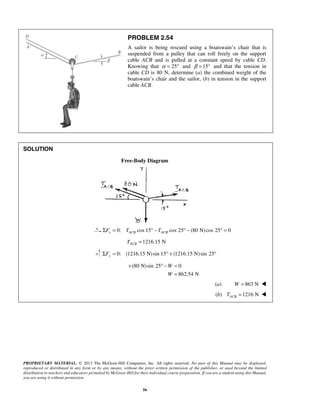
PROBLEM 2.54
A sailor is being rescued using a boatswain’s chair that is
suspended from a pulley that can roll freely on the support
cable ACB and is pulled at a constant speed by cable CD.
Knowing that 25α = ° and 15β = ° and that the tension in
cable CD is 80 N, determine (a) the combined weight of the
boatswain’s chair and the sailor, (b) in tension in the support
cable ACB.
SOLUTION
Free-Body Diagram
0: cos 15 cos 25 (80 N)cos 25 0x ACB ACBF T TΣ = ° − ° − ° =
1216.15 NACBT =
0: (1216.15 N)sin 15 (1216.15 N)sin 25yFΣ = ° + °
(80 N)sin 25 0
862.54 N
W
W
+ ° − =
=
(a) 863 NW = 
(b) 1216 NACBT = 
2.25
45
PROPRIETARY MATERIAL. © 2013 The McGraw-Hill Companies, Inc. All rights reserved. No part of this Manual may be displayed,
reproduced or distributed in any form or by any means, without the prior written permission of the publisher, or used beyond the limited
distribution to teachers and educators permitted by McGraw-Hill for their individual course preparation. If you are a student using this Manual,
you are using it without permission.
57
PROBLEM 2.55
Two forces P and Q are applied as shown to an aircraft
connection. Knowing that the connection is in equilibrium and
that 500P = lb and 650Q = lb, determine the magnitudes of
the forces exerted on the rods A and B.
SOLUTION
Free-Body Diagram
Resolving the forces into x- and y-directions:
0A B= + + + =R P Q F F
Substituting components: (500 lb) [(650 lb)cos50 ]
[(650 lb)sin50 ]
( cos50 ) ( sin50 ) 0B A AF F F
= − + °
− °
+ − ° + ° =
R j i
j
i i j
In the y-direction (one unknown force):
500 lb (650 lb)sin50 sin50 0AF− − ° + ° =
Thus,
500 lb (650 lb)sin50
sin50
AF
+ °
=
°
1302.70 lb= 1303 lbAF = 
In the x-direction: (650 lb)cos50 cos50 0B AF F° + − ° =
Thus, cos50 (650 lb)cos50
(1302.70 lb)cos50 (650 lb)cos50
B AF F= ° − °
= ° − °
419.55 lb= 420 lbBF = 
2.26
46
PROPRIETARY MATERIAL. © 2013 The McGraw-Hill Companies, Inc. All rights reserved. No part of this Manual may be displayed,
reproduced or distributed in any form or by any means, without the prior written permission of the publisher, or used beyond the limited
distribution to teachers and educators permitted by McGraw-Hill for their individual course preparation. If you are a student using this Manual,
you are using it without permission.
58
PROBLEM 2.56
Two forces P and Q are applied as shown to an aircraft
connection. Knowing that the connection is in equilibrium
and that the magnitudes of the forces exerted on rods A and B
are 750AF = lb and 400BF = lb, determine the magnitudes of
P and Q.
SOLUTION
Free-Body Diagram
Resolving the forces into x- and y-directions:
0A B= + + + =R P Q F F
Substituting components: cos 50 sin 50
[(750 lb)cos 50 ]
[(750 lb)sin 50 ] (400 lb)
P Q Q= − + ° − °
− °
+ ° +
R j i j
i
j i
In the x-direction (one unknown force):
cos 50 [(750 lb)cos 50 ] 400 lb 0Q ° − ° + =
(750 lb)cos 50 400 lb
cos 50
127.710 lb
Q
° −
=
°
=
In the y-direction: sin 50 (750 lb)sin 50 0P Q− − ° + ° =
sin 50 (750 lb)sin 50
(127.710 lb)sin 50 (750 lb)sin 50
476.70 lb
P Q= − ° + °
= − ° + °
= 477 lb; 127.7 lbP Q= = 
2.27
47
PROPRIETARY MATERIAL. © 2013 The McGraw-Hill Companies, Inc. All rights reserved. No part of this Manual may be displayed,
reproduced or distributed in any form or by any means, without the prior written permission of the publisher, or used beyond the limited
distribution to teachers and educators permitted by McGraw-Hill for their individual course preparation. If you are a student using this Manual,
you are using it without permission.
61
PROBLEM 2.59
For the situation described in Figure P2.45, determine (a) the
value of α for which the tension in rope BC is as small as
possible, (b) the corresponding value of the tension.
PROBLEM 2.45 Knowing that 20 ,α = ° determine the tension
(a) in cable AC, (b) in rope BC.
SOLUTION
Free-Body Diagram Force Triangle
To be smallest, BCT must be perpendicular to the direction of .ACT
(a) Thus, 5α = ° 5.00α = ° 
(b) (1200 lb)sin 5BCT = ° 104.6 lbBCT = 
2.28
2.21
2.21
48
Write a MATLAB Code to describe the correlation between the Tension in rope BC and the
angle between rope BC and the upward vertical axis.
%%%%%%%%%Problem 2.59 How to calculate value of alfa for which the tension
%%%%%%%%%in rope BC is as small as possible.
%%Measuring alfa from vertical line upward
%%Considering the Law of Sines consequently (Tac/sin(90+90-alfa)) =
%%(Tbc/sin(90+90-5)) = (1200/sin(180 -5-alfa).
for I=1:1:180
alfa(I)=I
Tbc(I) = (1200/sin((5+alfa(I))/57.3))*sin((180-5)/57.3);
Tac(I) = (1200/sin((5+alfa(I))/57.3))*sin((180-alfa(I))/57.3);
end
figure(1);
plot(alfa,Tbc,'o');
xlabel('alfa in Degrees '),grid on;ylabel('Tbc in LB'),grid on;
xlim([0 180])
ylim([0 2000])
figure(2);
plot(alfa,Tac,'+');
xlabel('alfa in Degrees '),grid on;ylabel('Tac in LB'),grid on;
xlim([0 180])
ylim([0 2000])
figure(3);
plot(alfa,Tac,'+',alfa,Tbc,'o');
xlabel('alfa in Degrees '),grid on;ylabel('Tac in LB & Tbc in LB'),grid on;
xlim([0 180])
ylim([0 2000])
49
50
PROPRIETARY MATERIAL. © 2013 The McGraw-Hill Companies, Inc. All rights reserved. No part of this Manual may be displayed,
reproduced or distributed in any form or by any means, without the prior written permission of the publisher, or used beyond the limited
distribution to teachers and educators permitted by McGraw-Hill for their individual course preparation. If you are a student using this Manual,
you are using it without permission.
62
PROBLEM 2.60
For the structure and loading of Problem 2.46, determine (a) the value of α for
which the tension in cable BC is as small as possible, (b) the corresponding
value of the tension.
SOLUTION
BCT must be perpendicular to ACF to be as small as possible.
Free-Body Diagram: C Force Triangle is a right triangle
To be a minimum, BCT must be perpendicular to .ACF
(a) We observe: 90 30α = ° − ° 60.0α = ° 
(b) (300 lb)sin 50BCT = °
or 229.81lbBCT = 230 lbBCT = 
2.29
51
PROPRIETARY MATERIAL. © 2013 The McGraw-Hill Companies, Inc. All rights reserved. No part of this Manual may be displayed,
reproduced or distributed in any form or by any means, without the prior written permission of the publisher, or used beyond the limited
distribution to teachers and educators permitted by McGraw-Hill for their individual course preparation. If you are a student using this Manual,
you are using it without permission.
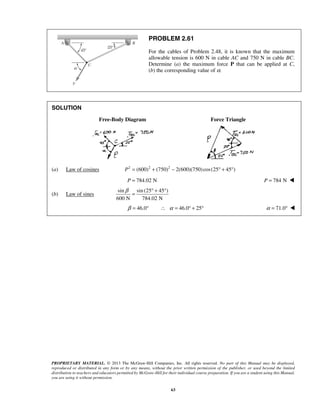
63
PROBLEM 2.61
For the cables of Problem 2.48, it is known that the maximum
allowable tension is 600 N in cable AC and 750 N in cable BC.
Determine (a) the maximum force P that can be applied at C,
(b) the corresponding value of α.
SOLUTION
Free-Body Diagram Force Triangle
(a) Law of cosines 2 2 2
(600) (750) 2(600)(750)cos(25 45 )P = + − ° + °
784.02 NP = 784 NP = 
(b) Law of sines
sin sin (25 45 )
600 N 784.02 N
β ° + °
=
46.0β = ° 46.0 25α∴ = ° + ° 71.0α = ° 
2.30
52
PROPRIETARY MATERIAL. © 2013 The McGraw-Hill Companies, Inc. All rights reserved. No part of this Manual may be displayed,
reproduced or distributed in any form or by any means, without the prior written permission of the publisher, or used beyond the limited
distribution to teachers and educators permitted by McGraw-Hill for their individual course preparation. If you are a student using this Manual,
you are using it without permission.
64
PROBLEM 2.62
A movable bin and its contents have a combined weight of 2.8 kN.
Determine the shortest chain sling ACB that can be used to lift the
loaded bin if the tension in the chain is not to exceed 5 kN.
SOLUTION
Free-Body Diagram
tan
0.6 m
α =
h
(1)
Isosceles Force Triangle
Law of sines:
1
2
1
2
(2.8 kN)
sin
5 kN
(2.8 kN)
sin
5 kN
16.2602
AC
AC
T
T
α
α
α
=
=
=
= °
From Eq. (1): tan16.2602 0.175000 m
0.6 m
h
h° = ∴ =
Half length of chain 2 2
(0.6 m) (0.175 m)
0.625 m
AC= = +
=
Total length: 2 0.625 m= × 1.250 m 
2.31
53
PROPRIETARY MATERIAL. © 2013 The McGraw-Hill Companies, Inc. All rights reserved. No part of this Manual may be displayed,
reproduced or distributed in any form or by any means, without the prior written permission of the publisher, or used beyond the limited
distribution to teachers and educators permitted by McGraw-Hill for their individual course preparation. If you are a student using this Manual,
you are using it without permission.
65
PROBLEM 2.63
Collar A is connected as shown to a 50-lb load and can slide on
a frictionless horizontal rod. Determine the magnitude of the
force P required to maintain the equilibrium of the collar when
(a) 4.5 in.,x = (b) 15 in.x =
SOLUTION
(a) Free Body: Collar A Force Triangle
50 lb
4.5 20.5
P
= 10.98 lbP = 
(b) Free Body: Collar A Force Triangle
50 lb
15 25
P
= 30.0 lbP = 

2.32
54
PROPRIETARY MATERIAL. © 2013 The McGraw-Hill Companies, Inc. All rights reserved. No part of this Manual may be displayed,
reproduced or distributed in any form or by any means, without the prior written permission of the publisher, or used beyond the limited
distribution to teachers and educators permitted by McGraw-Hill for their individual course preparation. If you are a student using this Manual,
you are using it without permission.
66
PROBLEM 2.64
Collar A is connected as shown to a 50-lb load and can slide on a
frictionless horizontal rod. Determine the distance x for which the
collar is in equilibrium when P = 48 lb.
SOLUTION
Free Body: Collar A Force Triangle
2 2 2
(50) (48) 196
14.00 lb
N
N
= − =
=
Similar Triangles
48 lb
20 in. 14 lb
x
=
68.6 in.x = 
55
2.33
Write a MATLAB Code to describe the correlation between Distance (X) and the relevant
Tension T in rope BA, explain your final conclusion upon the mentioned correlation.
%%%%%%%%%Problem 2.64 How to calculate value of alfa while the tension in
%%%%%%%%%rope AB is varing from T = 0 LB to 250 LB
%%%%%%%%%
%%Measuring alfa from horizontal line to the right at Point A
%%Considering the Law of Sines consequently (T/sin(90)) = (48/sin(90-alfa))
%%= (N/sin(alfa) consequently Beta = sin(90-alfa)=48/T
for I = 1:1:50
T(I)=I*5
Beta(I) = 48/T(I);
alfa(I) = -asin(Beta(I))*57.3 + 90;
X(I) = 20/tan(alfa(I)/57.3)
N(I) = (T(I))*sin(alfa(I)/57.3)
end
figure(1);
plot(T,X,'o');
xlabel('T in LB '),grid on;ylabel('X in in'),grid on;
xlim([0 250])
ylim([0 100])
figure(2);
plot(T,alfa,'*');
xlabel('T in LB '),grid on;ylabel('alfa in Degrees'),grid on;
xlim([0 250])
ylim([0 100])
figure(3);
plot(T,N,'+');
xlabel('T in LB '),grid on;ylabel('N in LB'),grid on;
xlim([0 250])
ylim([0 200])
56
57
PROPRIETARY MATERIAL. © 2013 The McGraw-Hill Companies, Inc. All rights reserved. No part of this Manual may be displayed,
reproduced or distributed in any form or by any means, without the prior written permission of the publisher, or used beyond the limited
distribution to teachers and educators permitted by McGraw-Hill for their individual course preparation. If you are a student using this Manual,
you are using it without permission.
67
PROBLEM 2.65
Three forces are applied to a bracket as shown. The directions of the two 150-N
forces may vary, but the angle between these forces is always 50°. Determine the
range of values of α for which the magnitude of the resultant of the forces acting at A
is less than 600 N.
SOLUTION
Combine the two 150-N forces into a resultant force Q:
2(150 N)cos25
271.89 N
Q = °
=
Equivalent loading at A:
Using the law of cosines:
2 2 2
(600 N) (500 N) (271.89 N) 2(500 N)(271.89 N)cos(55 )
cos(55 ) 0.132685
α
α
= + + ° +
° + =
Two values for :α 55 82.375
27.4
α
α
° + =
= °
or 55 82.375
55 360 82.375
222.6
α
α
α
° + = − °
° + = ° − °
= °
For 600 lb:R < 27.4 222.6α° < < 
Resolve the problem above by the summation of X, Y Components analytically.
2.34
58
PROPRIETARY MATERIAL. © 2013 The McGraw-Hill Companies, Inc. All rights reserved. No part of this Manual may be displayed,
reproduced or distributed in any form or by any means, without the prior written permission of the publisher, or used beyond the limited
distribution to teachers and educators permitted by McGraw-Hill for their individual course preparation. If you are a student using this Manual,
you are using it without permission.
68
PROBLEM 2.66
A 200-kg crate is to be supported by the rope-and-pulley arrangement shown.
Determine the magnitude and direction of the force P that must be exerted on the free
end of the rope to maintain equilibrium. (Hint: The tension in the rope is the same on
each side of a simple pulley. This can be proved by the methods of Ch. 4.)
SOLUTION
Free-Body Diagram: Pulley A
5
0: 2 cos 0
281
cos 0.59655
53.377
xF P P α
α
α
 
Σ = − + = 
 
=
= ± °
For 53.377 :α = + °
16
0: 2 sin53.377 1962 N 0
281
yF P P
 
Σ = + ° − = 
 
724 N=P 53.4° 
For 53.377 :α = − °
16
0: 2 sin( 53.377 ) 1962 N 0
281
yF P P
 
Σ = + − ° − = 
 
1773=P 53.4° 
59
2.35
PROPRIETARY MATERIAL. © 2013 The McGraw-Hill Companies, Inc. All rights reserved. No part of this Manual may be displayed,
reproduced or distributed in any form or by any means, without the prior written permission of the publisher, or used beyond the limited
distribution to teachers and educators permitted by McGraw-Hill for their individual course preparation. If you are a student using this Manual,
you are using it without permission.
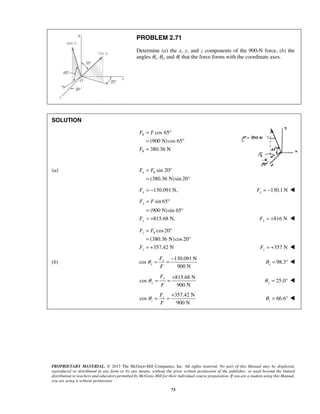
73
PROBLEM 2.71
Determine (a) the x, y, and z components of the 900-N force, (b) the
angles θx, θy, and θz that the force forms with the coordinate axes.
SOLUTION
cos 65
(900 N)cos 65
380.36 N
h
h
F F
F
= °
= °
=
(a) sin 20
(380.36 N)sin 20°
x hF F= °
=
130.091 N,= −xF 130.1 NxF = − 
sin65
(900 N)sin 65°
815.68 N,
y
y
F F
F
= °
=
= + 816 NyF = + 
cos20
(380.36 N)cos20
357.42 N
= °
= °
= +
z h
z
F F
F 357 NzF = + 
(b)
130.091 N
cos
900 N
x
x
F
F
θ
−
= = 98.3xθ = ° 
815.68 N
cos
900 N
y
y
F
F
θ
+
= = 25.0yθ = ° 
357.42 N
cos
900 N
z
z
F
F
θ
+
= = 66.6zθ = ° 
60
2.36
PROPRIETARY MATERIAL. © 2013 The McGraw-Hill Companies, Inc. All rights reserved. No part of this Manual may be displayed,
reproduced or distributed in any form or by any means, without the prior written permission of the publisher, or used beyond the limited
distribution to teachers and educators permitted by McGraw-Hill for their individual course preparation. If you are a student using this Manual,
you are using it without permission.
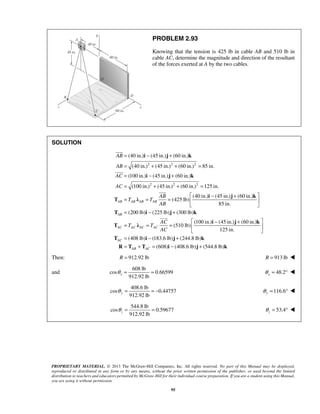
95
PROBLEM 2.93
Knowing that the tension is 425 lb in cable AB and 510 lb in
cable AC, determine the magnitude and direction of the resultant
of the forces exerted at A by the two cables.
SOLUTION
2 2 2
2 2 2
(40 in.) (45 in.) (60 in.)
(40 in.) (45 in.) (60 in.) 85 in.
(100 in.) (45 in.) (60 in.)
(100 in.) (45 in.) (60 in.) 125 in.
(40 in.) (45 in.) (60 in.)
(425 lb)
85 in.
AB AB AB AB
AB
AB
AC
AC
AB
T T
AB
= − +
= + + =
= − +
= + + =
− +
= = =
i j k
i j k
i j k
T λ



(200 lb) (225 lb) (300 lb)
(100 in.) (45 in.) (60 in.)
(510 lb)
125 in.
(408 lb) (183.6 lb) (244.8 lb)
(608) (408.6 lb) (544.8 lb)
AB
AC AC AC AC
AC
AB AC
AC
T T
AC
 
 
 
= − +
 − +
= = =  
 
= − +
= + = − +
T i j k
i j k
T λ
T i j k
R T T i j k

Then: 912.92 lbR = 913 lbR = 
and
608 lb
cos 0.66599
912.92 lb
xθ = = 48.2xθ = ° 
408.6 lb
cos 0.44757
912.92 lb
yθ = = − 116.6yθ = ° 
544.8 lb
cos 0.59677
912.92 lb
zθ = = 53.4zθ = ° 
2.37
61
Write a MATLAB Code to resolve the problem above.
%%%%%%%%%Problem 2.93 How to calculate the resultant at point A from
%%different acting forces using the unit vector & vector summation concept,
%%considering the tension in cable AB = 425 LB and in cable AC = 510 LB
%% Calculating each force in vector form by calculating the unit vector for
%% each
AB=[40 -45 60] %%% 40i -45j + 60k
AC=[100 -45 60] %%% 100i - 45j + 60k
lamdaAB=AB./(AB(1)^2 + AB(2)^2 + AB(3)^2)^0.5
Tab=lamdaAB.*425
lamdaAC=AC./(AC(1)^2 + AC(2)^2 + AC(3)^2)^0.5
Tac=lamdaAC.*510
R = Tab + Tac
Rm=(R(1)^2 + R(2)^2 + R(3)^2)^0.5
%%Calculating theta angles with respect to X, Y, Z
thetaX = acos(R(1)/Rm)*57.3
thetaY = acos(R(2)/Rm)*57.3
thetaZ = acos(R(3)/Rm)*57.3
62
PROPRIETARY MATERIAL. © 2013 The McGraw-Hill Companies, Inc. All rights reserved. No part of this Manual may be displayed,
reproduced or distributed in any form or by any means, without the prior written permission of the publisher, or used beyond the limited
distribution to teachers and educators permitted by McGraw-Hill for their individual course preparation. If you are a student using this Manual,
you are using it without permission.
112
PROBLEM 2.107
Three cables are connected at A, where the forces P and Q are
applied as shown. Knowing that 0,Q = find the value of P for
which the tension in cable AD is 305 N.
SOLUTION
0: 0A AB AC ADΣ = + + + =F T T T P where P=P i

(960 mm) (240 mm) (380 mm) 1060 mm
(960 mm) (240 mm) (320 mm) 1040 mm
(960 mm) (720 mm) (220 mm) 1220 mm
AB AB
AC AC
AD AD
= − − + =
= − − − =
= − + − =
i j k
i j k
i j k




48 12 19
53 53 53
12 3 4
13 13 13
305 N
[( 960 mm) (720 mm) (220 mm) ]
1220 mm
(240 N) (180 N) (55 N)
AB AB AB AB AB
AC AC AC AC AC
AD AD AD
AB
T T T
AB
AC
T T T
AC
T
 
= = = − − + 
 
 
= = = − − − 
 
= = − + −
= − + −
T λ i j k
T λ i j k
T λ i j k
i j k


Substituting into 0,AΣ =F factoring , , ,i j k and setting each coefficient equal to φ gives:
48 12
: 240 N
53 13
AB ACP T T= + +i (1)
:j
12 3
180 N
53 13
AB ACT T+ = (2)
:k
19 4
55 N
53 13
AB ACT T− = (3)
Solving the system of linear equations using conventional algorithms gives:
446.71 N
341.71 N
AB
AC
T
T
=
= 960 NP = 
2.38
63
PROPRIETARY MATERIAL. © 2013 The McGraw-Hill Companies, Inc. All rights reserved. No part of this Manual may be displayed,
reproduced or distributed in any form or by any means, without the prior written permission of the publisher, or used beyond the limited
distribution to teachers and educators permitted by McGraw-Hill for their individual course preparation. If you are a student using this Manual,
you are using it without permission.
113
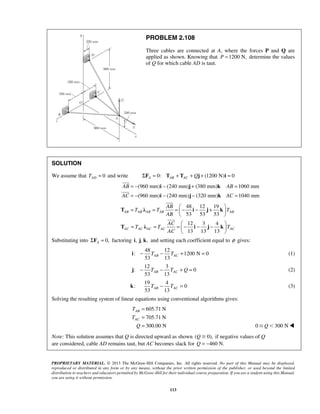
PROBLEM 2.108
Three cables are connected at A, where the forces P and Q are
applied as shown. Knowing that 1200 N,P = determine the values
of Q for which cable AD is taut.
SOLUTION
We assume that 0ADT = and write 0: (1200 N) 0A AB AC QΣ = + + + =F T T j i
(960 mm) (240 mm) (380 mm) 1060 mm
(960 mm) (240 mm) (320 mm) 1040 mm
AB AB
AC AC
= − − + =
= − − − =
i j k
i j k


48 12 19
53 53 53
12 3 4
13 13 13
AB AB AB AB AB
AC AC AC AC AC
AB
T T T
AB
AC
T T T
AC
 
= = = − − + 
 
 
= = = − − − 
 
T λ i j k
T λ i j k


Substituting into 0,AΣ =F factoring , , ,i j k and setting each coefficient equal to φ gives:
48 12
: 1200 N 0
53 13
AB ACT T− − + =i (1)
12 3
: 0
53 13
AB ACT T Q− − + =j (2)
19 4
: 0
53 13
AB ACT T− =k (3)
Solving the resulting system of linear equations using conventional algorithms gives:
605.71 N
705.71 N
300.00 N
AB
AC
T
T
Q
=
=
= 0 300 NQՅ Ͻ 
Note: This solution assumes that Q is directed upward as shown ( 0),Q Ն if negative values of Q
are considered, cable AD remains taut, but AC becomes slack for 460 N.Q = − 
2.39
64
PROPRIETARY MATERIAL. © 2013 The McGraw-Hill Companies, Inc. All rights reserved. No part of this Manual may be displayed,
reproduced or distributed in any form or by any means, without the prior written permission of the publisher, or used beyond the limited
distribution to teachers and educators permitted by McGraw-Hill for their individual course preparation. If you are a student using this Manual,
you are using it without permission.
114
PROBLEM 2.109
A rectangular plate is supported by three cables as shown.
Knowing that the tension in cable AC is 60 N, determine the
weight of the plate.
SOLUTION
We note that the weight of the plate is equal in magnitude to the force P exerted by the support on Point A.
Free Body A:
0: 0AB AC ADF PΣ = + + + =T T T j
We have:
( )
(320 mm) (480 mm) (360 mm) 680 mm
(450 mm) (480 mm) (360 mm) 750 mm
(250 mm) (480 mm) 360 mm 650 mm
AB AB
AC AC
AD AD
= − − + =
= − + =
= − − =
i j k
i j k
i j k



Thus:
( )
8 12 9
17 17 17
0.6 0.64 0.48
5 9.6 7.2
13 13 13
AB AB AB AB AB
AC AC AC AC AC
AD AD AD AD AD
AB
T T T
AB
AC
T T T
AC
AD
T T T
AD
 
= = = − − + 
 
= = = − +
 
= = = − − 
 
T λ i j k
T λ i j k
T λ i j k



Substituting into the Eq. 0FΣ = and factoring , , :i j k
8 5
0.6
17 13
12 9.6
0.64
17 13
9 7.2
0.48 0
17 13
AB AC AD
AB AC AD
AB AC AD
T T T
T T T P
T T T
 
− + + 
 
 
+ − − − + 
 
 
+ + − = 
 
i
j
k
Dimensions in mm
2.40
65
PROPRIETARY MATERIAL. © 2013 The McGraw-Hill Companies, Inc. All rights reserved. No part of this Manual may be displayed,
reproduced or distributed in any form or by any means, without the prior written permission of the publisher, or used beyond the limited
distribution to teachers and educators permitted by McGraw-Hill for their individual course preparation. If you are a student using this Manual,
you are using it without permission.
115
PROBLEM 2.109 (Continued)
Setting the coefficient of i, j, k equal to zero:
:i
8 5
0.6 0
17 13
AB AC ADT T T− + + = (1)
:j
12 9.6
0.64 0
7 13
AB AC ADT T T P− − − + = (2)
:k
9 7.2
0.48 0
17 13
AB AC ADT T T+ − = (3)
Making 60 NACT = in (1) and (3):
8 5
36 N 0
17 13
AB ADT T− + + = (1′)
9 7.2
28.8 N 0
17 13
AB ADT T+ − = (3′)
Multiply (1′) by 9, (3′) by 8, and add:
12.6
554.4 N 0 572.0 N
13
AD ADT T− = =
Substitute into (1′) and solve for :ABT
17 5
36 572 544.0 N
8 13
AB ABT T
 
= + × = 
 
Substitute for the tensions in Eq. (2) and solve for P:
12 9.6
(544 N) 0.64(60 N) (572 N)
17 13
844.8 N
P = + +
= Weight of plate 845 NP= = 
2.40
66
Write a MATLAB Code to resolve the problem above.
%%%%%%%%%Problem 2.109 How to calculate weight of a plate supported by
%%tensions at point A in cables AD & AB & AC knowing that tension in AC is
%%60 N
AB=[-320 -480 360] %%% -320i -450j + 360k
AC=[450 -480 360] %%% 450i - 450j + 360k
AD=[250 -480 -360] %%% 250i -450j + 360k
%%Tab=lamdaAB.*Tab
lamdaAB=AB./(AB(1)^2 + AB(2)^2 + AB(3)^2)^0.5
%%Tac=lamdaAC.*Tac
lamdaAC=AC./(AC(1)^2 + AC(2)^2 + AC(3)^2)^0.5
Tac=lamdaAC.*60
%%Tad=lamdaAD.*Tad
lamdaAD=AD./(AD(1)^2 + AD(2)^2 + AD(3)^2)^0.5
%%%%Consider the weight force = Wj as it is upward
%%%%As long the plate is in equilibrium state therefore the summation of
%%%%forces is equal to zero in all directions X, Y, Z
%%%Calculating the weight of the plate in matrix calculations
%%%[lamdaAB(1) lamdaAD(1) 0] [Tab] [-Tac(1)]
%%%[lamdaAB(2) lamdaAD(2) 1] * [Tad] = [-Tac(2)]
%%%[lamdaAB(3) lamdaAD(3) 0] [ W ] [-Tac(3)]
A = [lamdaAB(1) lamdaAD(1) 0;lamdaAB(2) lamdaAD(2) 1;lamdaAB(3)
lamdaAD(3) 0]
C = [-Tac(1) -Tac(2) -Tac(3)]'
X = inv(A)*C
Tab = X(1)
Tad = X(2)
W = X(3)
-480
-480
-480 -360
67
PROPRIETARY MATERIAL. © 2013 The McGraw-Hill Companies, Inc. All rights reserved. No part of this Manual may be displayed,
reproduced or distributed in any form or by any means, without the prior written permission of the publisher, or used beyond the limited
distribution to teachers and educators permitted by McGraw-Hill for their individual course preparation. If you are a student using this Manual,
you are using it without permission.
116
PROBLEM 2.110
A rectangular plate is supported by three cables as shown. Knowing
that the tension in cable AD is 520 N, determine the weight of the plate.
SOLUTION
See Problem 2.109 for the figure and the analysis leading to the linear algebraic Equations (1), (2), and
(3) below:
8 5
0.6 0
17 13
AB AC ADT T T− + + = (1)
12 9.6
0.64 0
17 13
AB AC ADT T T P− + − + = (2)
9 7.2
0.48 0
17 13
AB AC ADT T T+ − = (3)
Making 520 NADT = in Eqs. (1) and (3):
8
0.6 200 N 0
17
AB ACT T− + + = (1′)
9
0.48 288 N 0
17
AB ACT T+ − = (3′)
Multiply (1′) by 9, (3′) by 8, and add:
9.24 504 N 0 54.5455 NAC ACT T− = =
Substitute into (1′) and solve for :ABT
17
(0.6 54.5455 200) 494.545 N
8
AB ABT T= × + =
Substitute for the tensions in Eq. (2) and solve for P:
12 9.6
(494.545 N) 0.64(54.5455 N) (520 N)
17 13
768.00 N
P = + +
= Weight of plate 768 NP= = 
2.41
68
Write a MATLAB Code to resolve the problem above.
%%%%%%%%%Problem 2.110 How to calculate weight of a plate supported by
%%tensions at point A in cables AD & AB & AC knowing that tension in AD is
%%520 N
AB=[-320 -480 360] %%% -320i -450j + 360k
AC=[450 -480 360] %%% 450i - 450j + 360k
AD=[250 -480 -360] %%% 250i -450j + 360k
lamdaAB=AB./(AB(1)^2 + AB(2)^2 + AB(3)^2)^0.5
%%Tab=lamdaAB.*Tab
lamdaAC=AC./(AC(1)^2 + AC(2)^2 + AC(3)^2)^0.5
%%Tac=lamdaAC.*Tac
lamdaAD=AD./(AD(1)^2 + AD(2)^2 + AD(3)^2)^0.5
Tad=lamdaAD.*520
%%%%Consider the weight force = -Wj as it is downward
%%%%As long the plate is in equilibrium state therefore the summation of
%%%%forces is equal to zero in all directions X, Y, Z
%%%Calculating the weight of the plate in matrix calculations
%%%[lamdaAB(1) lamdaAC(1) 0] [Tab] [-Tad(1)]
%%%[lamdaAB(2) lamdaAC(2) -1] * [Tac] = [-Tad(2)]
%%%[lamdaAB(3) lamdaAC(3) 0] [ W ] [-Tad(3)]
A = [lamdaAB(1) lamdaAC(1) 0;lamdaAB(2) lamdaAC(2) 1;lamdaAB(3)
lamdaAC(3) 0]
C = [-Tad(1) -Tad(2) -Tad(3)]'
X = inv(A)*C
Tab = X(1)
Tac = X(2)
W = X(3)
69
-480
-480
-480 -360
Chapter 3
Statics of Rigid Bodies
Equivalent Systems of Forces
3.1 INTRODUCTION
In the preceding chapter it was assumed that each of the bodies considered could
be treated as a single particle. Such a view, however, is not always possible, and a
body, in general, should be treated as a combination of a large number of particles.
The size of the body will have to be taken into consideration, as well as the fact
that forces will act on different particles and thus will have different points of
application. Most of the bodies considered in elementary mechanics are assumed to
be rigid, a rigid body being defined as one which does not deform. Actual
structures and machines, however, are never absolutely rigid and deform under the
loads to which they are subjected. But these deformations are usually small and do
not appreciably affect the conditions of equilibrium or motion of the structure
under consideration. They are important, though, as far as the resistance of the
structure to failure is concerned and are considered in the study of mechanics of
materials. In this chapter you will study the effect of forces exerted on a rigid body,
and you will learn how to replace a given system of forces by a simpler equivalent
system. This analysis will rest on the fundamental assumption that the effect of a
given force on a rigid body remains unchanged if that force is moved along its line
of action (principle of transmissibility).
The basic system is called a force-couple system. In the case of concurrent,
coplanar, or parallel forces, the equivalent force-couple system can be further
reduced to a single force, called the resultant of the system, or to a single
couple, called the resultant couple of the system.
3.2 EXTERNAL AND INTERNAL FORCES
Forces acting on rigid bodies can be separated into two groups: (1) external forces
and (2) internal forces.
70
1. The external forces represent the action of other bodies on the rigid body under
consideration. They are entirely responsible for the external behavior of the rigid
body. They will either cause it to move or ensure that it remains at rest. We shall
be concerned only with external forces in this chapter and in Chaps. 4 and 5.
2 . The internal forces are the forces which hold together the particles forming the
rigid body. If the rigid body is structurally composed of several parts, the forces
holding the component parts together are also defined as internal forces. Internal
forces will be considered in Chaps. 6 and 7.
As an example of external forces, let us consider the forces acting on a disabled
truck that three people are pulling forward by means of a rope attached to the front
bumper (Fig. 3.1). The external forces acting on the truck are shown in a free-body
diagram (Fig. 3.2). Let us first consider the weight of the truck. Although it
embodies the effect of the earth’s pull on each of the particles forming the truck,
the weight can be represented by the single force W. The point of application of
this force, i.e., the point at which the force acts, is defined as the center of gravity
of the truck. It will be seen in Chap. 5 how centers of gravity can be determined.
The weight W tends to make the truck move vertically downward. In fact, it would
actually cause the truck to move downward, i.e., to fall, if it were not for the
presence of the ground. The ground opposes the downward motion of the truck by
means of the reactions R 1 and R 2. These forces are exerted by the ground on the
truck and must therefore be included among the external forces acting on the truck.
The people pulling on the rope exert the force F. The point of application of F is
on the front bumper. The force F tends to make the truck move forward in a
straight line and does actually make it move, since no external force opposes this
motion. (Rolling resistance has been neglected here for simplicity.) This forward
motion of the truck, during which each straight line keeps its original orientation
(the floor of the truck remains horizontal, and the walls remain vertical), is known
as a translation. Other forces might cause the truck to move differently. For
example, the force exerted by a jack placed under the front axle would cause the
truck to pivot about its rear axle. Such a motion is a rotation. It can be concluded,
therefore, that each of the external forces acting on a rigid body can, if unopposed,
impart to the rigid body a motion of translation or rotation, or both.
71
3.3 VECTOR PRODUCT OF TWO VECTORS
In order to gain a better understanding of the effect of a force on a rigid body, a
new concept, the concept of a moment of a force about a point, will be introduced
at this time. This concept will be more clearly understood, and applied more
effectively, if we first add to the mathematical tools at our disposal the vector
product of two vectors. The vector product of two vectors P and Q is defined as
the vector V which satisfies the following conditions.
1. The line of action of V is perpendicular to the plane containing P and Q (Fig.
3.3 a).
2. The magnitude of V is the product of the magnitudes of P and Q and of the sine
of the angle u formed by P and Q (the measure of which will always be 180° or
less); we thus have
V = PQ sin θ
3. The direction of V is obtained from the right-hand rule. Close your right hand
and hold it so that your fingers are curled in the same sense as the rotation through
u which brings the vector P in line with the vector Q ; your thumb will then
indicate the direction of the vector V (Fig. 3.3 b ). Note that if P and Q do not have
a common point of application, they should first be redrawn from the same point.
The three vectors P , Q, and V —taken in that order—are said to form a right-
handed rule.
As stated above, the vector V satisfying these three conditions (which define it
uniquely) is referred to as the vector product of P and Q ; it is represented by the
mathematical expression in vector form as:
V = P x Q
72
Fig. 3.3
We can now easily express the vector product V of two given vectors P and Q in
terms of the rectangular components of these vectors. Resolving P and Q into
components, we first write:
V = P x Q = (Pxi + Pyj + Pzk) x (Qxi + Qyj + Qz
V = (P
k)
yQz - PzQy)i + (PzQx - PxQz)j + (PxQy - PyQx
The rectangular components of the vector product V are thus found to be:
)k
Which is more easily memorized by the following determinate:
73
PROPRIETARY MATERIAL. © 2013 The McGraw-Hill Companies, Inc. All rights reserved. No part of this Manual may be displayed,
reproduced or distributed in any form or by any means, without the prior written permission of the publisher, or used beyond the limited
distribution to teachers and educators permitted by McGraw-Hill for their individual course preparation. If you are a student using this Manual,
you are using it without permission.
161
PROBLEM 3.1
A 20-lb force is applied to the control rod AB as shown. Knowing that the length of
the rod is 9 in. and that α = 25°, determine the moment of the force about Point B
by resolving the force into horizontal and vertical components.
SOLUTION
Free-Body Diagram of Rod AB:
(9 in.)cos65
3.8036 in.
(9 in.)sin65
8.1568 in.
x
y
= °
=
= °
=
(20 lb cos25 ) ( 20 lb sin 25 )
(18.1262 lb) (8.4524 lb)
x yF F= +
= ° + − °
= −
F i j
i j
i j
/ ( 3.8036 in.) (8.1568 in.)A B BA= = − +r i j

/
( 3.8036 8.1568 ) (18.1262 8.4524 )
32.150 147.852
115.702 lb-in.
B A B= ×
= − + × −
= −
= −
M r F
i j i j
k k
115.7 lb-in.B =M 
3.1
74
Write a MATLAB Code to resolve the problem above.
%%%%%%%%%Problem 3.1 How to calculate the moment of force about point B as
%%%%%%%%%shown in figure.
%%Calulating the acting force of 20 LB in vector form as following:-
%%F = (Fx)i + (Fy)j
%%F = 20*cos(25/57.3)i - 20*sin(25/57.3)j
F=[ 20*cos(25/57.3) -20*sin(25/57.3)]
%%% F = 20*cos(25/57.3)i - 20*sin(25/57.3)j
%%Calulating the moment arm BA in vector form as shown in figure.
%% BA = (x)i + (y)j
%% BA = -9*cos(65/57.3)i + 9*sin(65/57.3)j
BA=[-9*cos(65/57.3) 9*sin(65/57.3)]
%%% BA = -9*cos(65/57.3)i + 9*sin(65/57.3)j
%%Calculating the moment acting about point B by force of 20 LB as
%%Mb = BA x F by the cross product method as following:-
%% | i j k |
%%determinate of | BA(1) BA(2) 0 |
%% | F(1) F(2) 0 |
%%
Mb = BA(1)*F(2) - F(1)*BA(2) %%%%Mb= (Mb)k
%%Negative sign of the moment magnitude represents a clock wise acting
%%moment
75
PROPRIETARY MATERIAL. © 2013 The McGraw-Hill Companies, Inc. All rights reserved. No part of this Manual may be displayed,
reproduced or distributed in any form or by any means, without the prior written permission of the publisher, or used beyond the limited
distribution to teachers and educators permitted by McGraw-Hill for their individual course preparation. If you are a student using this Manual,
you are using it without permission.
166
PROBLEM 3.6
A 300-N force P is applied at Point A of the bell crank shown.
(a) Compute the moment of the force P about O by resolving
it into horizontal and vertical components. (b) Using the
result of part (a), determine the perpendicular distance from
O to the line of action of P.
SOLUTION
(0.2 m)cos40
0.153209 m
(0.2 m)sin 40
0.128558 m
x
y
= °
=
= °
=
/ (0.153209 m) (0.128558 m)A O∴ = +r i j
(a) (300 N)sin30
150 N
(300 N)cos30
259.81 N
x
y
F
F
= °
=
= °
=
(150 N) (259.81 N)= +F i j
/
(0.153209 0.128558 ) m (150 259.81 ) N
(39.805 19.2837 ) N m
(20.521 N m)
O A O= ×
= + × +
= − ⋅
= ⋅
M r F
i j i j
k k
k 20.5 N mO = ⋅M 
(b) OM Fd=
20.521 N m (300 N)( )
0.068403 m
d
d
⋅ =
= 68.4 mmd = 
3.2
76
Write a MATLAB Code to resolve the problem above.
%%%%%%%%%Problem 3.6 How to calculate the moment of force about point O as
%%%%%%%%%shown in figure.
%%Calulating the acting force of 300 N in vector form as following:-
%%F = (Fx)i + (Fy)j
%%F = 300*sin(30/57.3)i + 300*cos(30/57.3)j
F=[ 300*sin(30/57.3) 300*cos(30/57.3)]
%%% F = 300*sin(30/57.3)i + 300*cos(30/57.3)j
%%Calulating the moment arm OA in vector form as shown in figure.
%% OA = (x)i + (y)j
%% OA = 200*cos(40/57.3)i + 200*sin(40/57.3)j
OA=[200*cos(40/57.3) 200*sin(40/57.3)]
%%% OA = 200*cos(40/57.3)i + 200*sin(40/57.3)j
%%Calculating the moment acting about point O by force of 300 N as
%%Mo = OA x F by evaluating the cross product as following:-
%% | i j k |
%%Mo =determinate of | OA(1) OA(2) 0 |
%% | F(1) F(2) 0 |
%%
Mo = OA(1)*F(2) - F(1)*OA(2) %%%%Mo= (Mo)k in N.mm
Mo = Mo/1000 %%%%Mo in N.m
%%Negative sign of the moment magnitude represents a clock wise acting
%%Calculating the perpendicular distance from point O to the line of the
%%acting force of the 300 N as following:-
D = Mo/300 %%%% D in meter
77
PROPRIETARY MATERIAL. © 2013 The McGraw-Hill Companies, Inc. All rights reserved. No part of this Manual may be displayed,
reproduced or distributed in any form or by any means, without the prior written permission of the publisher, or used beyond the limited
distribution to teachers and educators permitted by McGraw-Hill for their individual course preparation. If you are a student using this Manual,
you are using it without permission.
171
PROBLEM 3.11
A winch puller AB is used to straighten a fence post. Knowing that the tension in cable BC is 1040 N and
length d is 1.90 m, determine the moment about D of the force exerted by the cable at C by resolving that
force into horizontal and vertical components applied (a) at Point C, (b) at Point E.
SOLUTION
(a) Slope of line:
0.875 m 5
1.90 m 0.2 m 12
EC = =
+
Then
12
( )
13
ABx ABT T=
12
(1040 N)
13
960 N
=
= (a)
and
5
(1040 N)
13
400 N
AByT =
=
Then (0.875 m) (0.2 m)
(960 N)(0.875 m) (400 N)(0.2 m)
D ABx AByM T T= −
= −
760 N m= ⋅ or 760 N mD = ⋅M 
(b) We have ( ) ( )D ABx ABxM T y T x= +
(960 N)(0) (400 N)(1.90 m)
760 N m
= +
= ⋅ (b)
or 760 N mD = ⋅M 
3.3
78
%%%%%%%%%Problem 3.11 How to calculate the moment of force about point D as
%%%%%%%%%shown in figure using unit vector method to resolve the tension in
%%%%%%%%%cable BC into the horizontal and vertical components
%%unit vector of CB = unit vector of CE ---> lamdaCB = lamdaCE therefore
%%lamdaCE can be easily calculated from the geometry
%%CE = ((-d)i + 0j) - ((o.2)i + (0.857)j)
d=1.9 %%%%d = 1.9 meter
CE = [(-d - 0.2) (0 - 0.875)]
lamdaCE =CE./(CE(1)^2 + CE(2)^2)^0.5
%%Calulating the acting tension of 1040 N in vector form as following:-
%%T = (Fx)i + (Fy)j
%%T = 1040*lamdaCE
T = 1040*lamdaCE
%%Calulating the moment arm DC in vector form as shown in figure.
%% DC = (x)i + (y)j
%% DC = (0.2)i + (0.875)j
DC = [(0.2) (0.875)]
%%Calculating the moment acting about point D by force of 1040 N as
%%MD = DC x T by evaluating the cross product as following:-
%% | i j k |
%%MD =determinate of | DC(1) DC(2) 0 |
%% | T(1) T(2) 0 |
%%
MD1 = DC(1)*T(2) - T(1)*DC(2) %%%%MD1 = (MD1)k in N.m
%%Negative sign of the moment magnitude represents a clock wise acting
%%Calulating the moment arm DE in vector form as shown in figure.
%% DE = (x)i + (y)j
%% DE = (-1.9)i (0)j
DE = [(-1.9) (0)]
%%Calculating the moment acting about point D by force of 1040 N as
%%MD = DE x T by evaluating the cross product as following:-
%% | i j k |
%%MD =determinate of | DE(1) DE(2) 0 |
%% | T(1) T(2) 0 |
%%
MD2 = DE(1)*T(2) - T(1)*DE(2) %%%%MD2= (MD2)k in N.m
%%Negative sign of the moment magnitude represents a clock wise acting
79
PROPRIETARY MATERIAL. © 2013 The McGraw-Hill Companies, Inc. All rights reserved. No part of this Manual may be displayed,
reproduced or distributed in any form or by any means, without the prior written permission of the publisher, or used beyond the limited
distribution to teachers and educators permitted by McGraw-Hill for their individual course preparation. If you are a student using this Manual,
you are using it without permission.
172
PROBLEM 3.12
It is known that a force with a moment of 960 N · m about D is required to straighten the fence post CD. If
d = 2.80 m, determine the tension that must be developed in the cable of winch puller AB to create the
required moment about Point D.
SOLUTION
Slope of line:
0.875 m 7
2.80 m 0.2 m 24
EC = =
+
Then
24
25
ABx ABT T=
and
7
25
ABy ABT T=
We have ( ) ( )D ABx AByM T y T x= +
24 7
960 N m (0) (2.80 m)
25 25
1224 N
AB AB
AB
T T
T
⋅ = +
= or 1224 NABT = 
3.4
80
PROPRIETARY MATERIAL. © 2013 The McGraw-Hill Companies, Inc. All rights reserved. No part of this Manual may be displayed,
reproduced or distributed in any form or by any means, without the prior written permission of the publisher, or used beyond the limited
distribution to teachers and educators permitted by McGraw-Hill for their individual course preparation. If you are a student using this Manual,
you are using it without permission.
173
PROBLEM 3.13
It is known that a force with a moment of 960 N · m about D is required to straighten the fence post CD. If the
capacity of winch puller AB is 2400 N, determine the minimum value of distance d to create the specified
moment about Point D.
SOLUTION
The minimum value of d can be found based on the equation relating the moment of the force ABT about D:
max( ) ( )D AB yM T d=
where 960 N mDM = ⋅
max max( ) sin (2400 N)sinAB y ABT T θ θ= =
Now
2 2
2 2
0.875 m
sin
( 0.20) (0.875) m
0.875
960 N m 2400 N ( )
( 0.20) (0.875)
d
d
d
θ =
+ +
 
 ⋅ =
 + + 
or 2 2
( 0.20) (0.875) 2.1875d d+ + =
or 2 2 2
( 0.20) (0.875) 4.7852d d+ + =
or 2
3.7852 0.40 0.8056 0d d− − =
Using the quadratic equation, the minimum values of d are 0.51719 m and 0.41151 m.−
Since only the positive value applies here, 0.51719 md =
or 517 mmd = 
3.5
81
PROPRIETARY MATERIAL. © 2013 The McGraw-Hill Companies, Inc. All rights reserved. No part of this Manual may be displayed,
reproduced or distributed in any form or by any means, without the prior written permission of the publisher, or used beyond the limited
distribution to teachers and educators permitted by McGraw-Hill for their individual course preparation. If you are a student using this Manual,
you are using it without permission.
175
PROBLEM 3.15
Form the vector products B × C and B′ × C, where B = B′, and use the results
obtained to prove the identity
1 1
sin cos sin ( ) sin ( ).
2 2
α β α β α β= + + −
SOLUTION
Note: (cos sin )
(cos sin )
(cos sin )
B
B
C
β β
β β
α α
= +
′ = −
= +
B i j
B i j
C i j
By definition, | | sin ( )BC α β× = −B C (1)
| | sin ( )BC α β′× = +B C (2)
Now (cos sin ) (cos sin )B Cβ β α α× = + × +B C i j i j
(cos sin sin cos )BC β α β α= − k (3)
and (cos sin ) (cos sin )B Cβ β α α′× = − × +B C i j i j
(cos sin sin cos )BC β α β α= + k (4)
Equating the magnitudes of ×B C from Equations (1) and (3) yields:
sin( ) (cos sin sin cos )BC BCα β β α β α− = − (5)
Similarly, equating the magnitudes of ′×B C from Equations (2) and (4) yields:
sin( ) (cos sin sin cos )BC BCα β β α β α+ = + (6)
Adding Equations (5) and (6) gives:
sin( ) sin( ) 2cos sinα β α β β α− + + =
or
1 1
sin cos sin( ) sin( )
2 2
α β α β α β= + + − 
3.6
82
PROPRIETARY MATERIAL. © 2013 The McGraw-Hill Companies, Inc. All rights reserved. No part of this Manual may be displayed,
reproduced or distributed in any form or by any means, without the prior written permission of the publisher, or used beyond the limited
distribution to teachers and educators permitted by McGraw-Hill for their individual course preparation. If you are a student using this Manual,
you are using it without permission.
176
PROBLEM 3.16
The vectors P and Q are two adjacent sides of a parallelogram. Determine the area of the parallelogram when
(a) P = −7i + 3j − 3k and Q = 2i + 2j + 5k, (b) P = 6i − 5j − 2k and Q = −2i + 5j − k.
SOLUTION
(a) We have | |A = ×P Q
where 7 3 3= − + −P i j k
2 2 5= + +Q i j k
Then 7 3 3
2 2 5
[(15 6) ( 6 35) ( 14 6) ]
(21) (29) ( 20)
× = − −
= + + − + + − −
= + −
i j k
P Q
i j k
i j k
2 2 2
(20) (29) ( 20)A = + + − or 41.0A = 
(b) We have | |A = ×P Q
where 6 5 2= − −P i j k
2 5 1= − + −Q i j k
Then 6 5 2
2 5 1
[(5 10) (4 6) (30 10) ]
(15) (10) (20)
× = − −
− −
= + + + + −
= + +
i j k
P Q
i j k
i j k
2 2 2
(15) (10) (20)A = + + or 26.9A = 
3.7
82
PROPRIETARY MATERIAL. © 2013 The McGraw-Hill Companies, Inc. All rights reserved. No part of this Manual may be displayed,
reproduced or distributed in any form or by any means, without the prior written permission of the publisher, or used beyond the limited
distribution to teachers and educators permitted by McGraw-Hill for their individual course preparation. If you are a student using this Manual,
you are using it without permission.
177
PROBLEM 3.17
A plane contains the vectors A and B. Determine the unit vector normal to the plane when A and B are equal
to, respectively, (a) i + 2j − 5k and 4i − 7j − 5k, (b) 3i − 3j + 2k and −2i + 6j − 4k.
SOLUTION
(a) We have
| |
×
=
×
A B
λ
A B
where 1 2 5= + −A i j k
4 7 5= − −B i j k
Then 1 2 5
4 7 5
( 10 35) (20 5) ( 7 8)
15(3 1 1 )
× = + −
− −
= − − + + + − −
= − −
i j k
A B
i j k
i j k
and 2 2 2
| | 15 ( 3) ( 1) ( 1) 15 11× = − + − + − =A B
15( 3 1 1 )
15 11
− − −
=
i j k
λ or
1
( 3 )
11
= − − −λ i j k 
(b) We have
| |
×
=
×
A B
λ
A B
where 3 3 2= − +A i j k
2 6 4= − + −B i j k
Then 3 3 2
2 6 4
(12 12) ( 4 12) (18 6)
(8 12 )
× = −
− −
= − + − + + −
= +
i j k
A B
i j k
j k
and 2 2
| | 4 (2) (3) 4 13× = + =A B
4(2 3 )
4 13
+
=
j k
λ or
1
(2 3 )
13
= +λ j k 
3.8
83
PROPRIETARY MATERIAL. © 2013 The McGraw-Hill Companies, Inc. All rights reserved. No part of this Manual may be displayed,
reproduced or distributed in any form or by any means, without the prior written permission of the publisher, or used beyond the limited
distribution to teachers and educators permitted by McGraw-Hill for their individual course preparation. If you are a student using this Manual,
you are using it without permission.
179
PROBLEM 3.19
Determine the moment about the origin O of the force F = 4i − 3j + 5k that acts at a Point A. Assume that the
position vector of A is (a) r = 2i + 3j − 4k, (b) r = −8i + 6j − 10k, (c) r = 8i − 6j + 5k.
SOLUTION
O = ×M r F
(a) 2 3 4
4 3 5
O = −
−
i j k
M
(15 12) ( 16 10) ( 6 12)= − + − − + − −i j k 3 26 18O = − −M i j k 
(b) 8 6 10
4 3 5
O = − −
−
i j k
M
(30 30) ( 40 40) (24 24)= − + − + + −i j k 0O =M 
(c) 8 6 5
4 3 5
O = −
−
i j k
M
( 30 15) (20 40) ( 24 24)= − + + − + − +i j k 15 20O = − −M i j 
Note: The answer to Part (b) could have been anticipated since the elements of the last two rows of the
determinant are proportional.
3.9
84
PROPRIETARY MATERIAL. © 2013 The McGraw-Hill Companies, Inc. All rights reserved. No part of this Manual may be displayed,
reproduced or distributed in any form or by any means, without the prior written permission of the publisher, or used beyond the limited
distribution to teachers and educators permitted by McGraw-Hill for their individual course preparation. If you are a student using this Manual,
you are using it without permission.
180
PROBLEM 3.20
Determine the moment about the origin O of the force F = 2i + 3j − 4k that acts at a Point A. Assume that the
position vector of A is (a) r = 3i − 6j + 5k, (b) r = i − 4j − 2k, (c) r = 4i + 6j − 8k.
SOLUTION
O = ×M r F
(a) 3 6 5
2 3 4
O = −
−
i j k
M
(24 15) (10 12) (9 12)= − + + + +i j k 9 22 21O = + +M i j k 
(b) 1 4 2
2 3 4
O = − −
−
i j k
M
(16 6) ( 4 4) (3 8)= + + − + + +i j k 22 11O = +M i k 
(c) 4 6 8
2 3 4
O = −
−
i j k
M
( 24 24) ( 16 16) (12 12)= − + + − + + −i j k 0O =M 
Note: The answer to Part (c) could have been anticipated since the elements of the last two rows of the
determinant are proportional.
3.10
85
PROPRIETARY MATERIAL. © 2013 The McGraw-Hill Companies, Inc. All rights reserved. No part of this Manual may be displayed,
reproduced or distributed in any form or by any means, without the prior written permission of the publisher, or used beyond the limited
distribution to teachers and educators permitted by McGraw-Hill for their individual course preparation. If you are a student using this Manual,
you are using it without permission.
213
PROBLEM 3.53
A single force P acts at C in a direction perpendicular to the
handle BC of the crank shown. Knowing that Mx = +20 N ·
m and My = −8.75 N · m, and Mz = −30 N · m, determine the
magnitude of P and the values of φ and θ.
SOLUTION
(0.25 m) (0.2 m)sin (0.2 m)cos
sin cos
0.25 0.2sin 0.2cos
0 sin cos
C
O C
P P
P P
θ θ
φ φ
θ θ
φ φ
= + +
= − +
= × =
−
r i j k
P j k
i j k
M r P
Expanding the determinant, we find
(0.2) (sin cos cos sin )xM P θ φ θ φ= +
(0.2) sin( )xM P θ φ= + (1)
(0.25) cosyM P φ= − (2)
(0.25) sinzM P φ= − (3)
Dividing Eq. (3) by Eq. (2) gives: tan z
y
M
M
φ = (4)
30 N m
tan
8.75 N m
φ
− ⋅
=
− ⋅
73.740φ = 73.7φ = ° 
Squaring Eqs. (2) and (3) and adding gives:
2 2 2 2 2 2
(0.25) or 4y z y zM M P P M M+ = = + (5)
2 2
4 (8.75) (30)
125.0 N
P = +
= 125.0 NP = 
Substituting data into Eq. (1):
( 20 N m) 0.2 m(125.0 N)sin( )
( ) 53.130 and ( ) 126.87
20.6 and 53.1
θ φ
θ φ θ φ
θ θ
+ ⋅ = +
+ = ° + = °
= − ° = °
53.1Q = ° 
3.11
86
PROPRIETARY MATERIAL. © 2013 The McGraw-Hill Companies, Inc. All rights reserved. No part of this Manual may be displayed,
reproduced or distributed in any form or by any means, without the prior written permission of the publisher, or used beyond the limited
distribution to teachers and educators permitted by McGraw-Hill for their individual course preparation. If you are a student using this Manual,
you are using it without permission.
217
PROBLEM 3.57
The 23-in. vertical rod CD is welded to the midpoint C of the
50-in. rod AB. Determine the moment about AB of the 235-lb
force P.
SOLUTION
(32 in.) (30 in.) (24 in.)AB = − −i j k

2 2 2
(32) ( 30) ( 24) 50 in.AB = + − + − =
0.64 0.60 0.48AB
AB
AB
= = − −i k

λ
We shall apply the force P at Point G:
/ (5 in.) (30 in.)G B = +r i k
(21 in.) (38 in.) (18 in.)DG = − +i j k

2 2 2
(21) ( 38) (18) 47 in.DG = + − + =
21 38 18
(235 lb)
47
DG
P
DG
− +
= =
i j k
P

(105 lb) (190 lb) (90 lb)= − +P i j k
The moment of P about AB is given by Eq. (3.46):
/
0.64 0.60 0.48
( ) 5 in. 0 30 in.
105 lb 190 lb 90 lb
AB AB G B P
− −
= ⋅ × =
−
M rλ
0.64[0 (30 in.)( 190 lb)]
0.60[(30 in.)(105 lb) (5 in.)(90 lb)]
0.48[(5 in.)( 190 lb) 0]
2484 lb in.
AB = − −
− −
− − −
= + ⋅
M
207 lb ftAB = + ⋅M 
3.12
87
Write a MATLAB Code to resolve the problem above.
%%%%%%%%%Problem 3.57 How to calculate the moment of force
%%%%%%%%%about a definite straight line AB
%%%%%%%%%shown in figure using unit vector method to resolve the
%%%%%%%%%force acting P into horizontal and vertical component and resolve
%%%%%%%%%the rod AB into horizontal and vertical compnents of unity
%%unit vector of AB where AB = 32i - 30j - 24j
AB = [32 -30 -24]
lamdaAB =AB./(AB(1)^2 + AB(2)^2 + AB(3)^2)^0.5
%%unit vector of DG where DG = 16i - 38j + 18j
DG = [21 -38 18]
lamdaDG =DG./(DG(1)^2 + DG(2)^2 + DG(3)^2)^0.5
%%Calulating the acting force P of 235 LB in vector form as following:-
%%P = (Fx)i + (Fy)j + (Fz)K
%%P = 235*lamdaDG
P = 235*lamdaDG
%%Calulating the moment arm CD in vector form as shown in figure.
%% CD = (x)i + (y)j + (z)k
%% CD= 0i + 23j + 0k
CD = 23 %%%% DC = 23j
%%Calculating the moment acting about point C by force of 235 LB as
%%MC = CD x P by evaluating the cross product as following:-
%% | i j k |
%%MC =determinate of | 0 CD 0 |
%% | P(1) P(2) P(3)|
%%
MC = [CD*P(3) -CD*P(1)] %%%%MC = (MCx)i + (MCy)k in LB.in
%%Negative sign of the moment magnitude represents a clock wise acting
%%Calculating the moment of force P about AB Rod
Mab=lamdaAB(1)*MC(1) + lamdaAB(3)*MC(2)%%%%%%Scalar value of acting
%%moment by force P about the rod AB in LB.in
88
PROPRIETARY MATERIAL. © 2013 The McGraw-Hill Companies, Inc. All rights reserved. No part of this Manual may be displayed,
reproduced or distributed in any form or by any means, without the prior written permission of the publisher, or used beyond the limited
distribution to teachers and educators permitted by McGraw-Hill for their individual course preparation. If you are a student using this Manual,
you are using it without permission.
218
PROBLEM 3.58
The 23-in. vertical rod CD is welded to the midpoint C of the
50-in. rod AB. Determine the moment about AB of the 174-lb
force Q.
SOLUTION
(32 in.) (30 in.) (24 in.)AB = − −i j k

2 2 2
(32) ( 30) ( 24) 50 in.AB = + − + − =
0.64 0.60 0.48AB
AB
AB
= = − −i j k

λ
We shall apply the force Q at Point H:
/ (32 in.) (17 in.)H B = − +r i j
(16 in.) (21 in.) (12 in.)DH = − − −i j k

2 2 2
(16) ( 21) ( 12) 29 in.DH = + − + − =
16 21 12
(174 lb)
29
DH
DH
− − −
= =
i j k
Q

(96 lb) (126 lb) (72 lb)Q = − − −i j k
The moment of Q about AB is given by Eq. (3.46):
/
0.64 0.60 0.48
( ) 32 in. 17 in. 0
96 lb 126 lb 72 lb
AB AB H B
− −
= ⋅ × = −
− − −
M r Qλ
0.64[(17 in.)( 72 lb) 0]
0.60[(0 ( 32 in.)( 72 lb)]
0.48[( 32 in.)( 126 lb) (17 in.)( 96 lb)]
2119.7 lb in.
AB = − −
− − − −
− − − − −
= − ⋅
M
176.6 lb ftAB = ⋅M 
89
3.13
Write a MATLAB Code to resolve the problem above.
%%%%%%%%%Problem 3.58 How to calculate the moment of force
%%%%%%%%%about a definite straight line AB
%%%%%%%%%shown in figure using unit vector method to resolve the
%%%%%%%%%force acting Q into horizontal and vertical component and resolve
%%%%%%%%%the rod AB into horizontal and vertical compnents of unity
%%unit vector of AB where AB = 32i - 30j - 24j
AB = [32 -30 -24]
lamdaAB =AB./(AB(1)^2 + AB(2)^2 + AB(3)^2)^0.5
%%unit vector of DH where DH = -16i - 21j - 12j
DH = [-16 -21 -12]
lamdaDH =DH./(DH(1)^2 + DH(2)^2 + DH(3)^2)^0.5
%%Calulating the acting force Q of 174 LB in vector form as following:-
%%Q = (Fx)i + (Fy)j + (Fz)K
%%Q = 174*lamdaDH
Q = 174*lamdaDH
%%Calulating the moment arm CD in vector form as shown in figure.
%% CD = (x)i + (y)j + (z)k
%% CD= 0i + 23j + 0k
CD = 23 %%%% DC = 23j
%%Calculating the moment acting about point C by force of 174 LB as
%%MC = CD x Q by evaluating the cross product as following:-
%% | i j k |
%%MC =determinate of | 0 CD 0 |
%% | Q(1) Q(2) Q(3)|
%%
MC = [CD*Q(3) -CD*Q(1)] %%%%MC = (MCx)i + (MCy)k in LB.in
%%Negative sign of the moment magnitude represents a clock wise acting
%%Calculating the moment of force Q about AB Rod
Mab=lamdaAB(1)*MC(1) + lamdaAB(3)*MC(2) %%%%%%Scalar value of acting
%%moment by force Q about the rod AB in LB.in
90
PROPRIETARY MATERIAL. © 2013 The McGraw-Hill Companies, Inc. All rights reserved. No part of this Manual may be displayed,
reproduced or distributed in any form or by any means, without the prior written permission of the publisher, or used beyond the limited
distribution to teachers and educators permitted by McGraw-Hill for their individual course preparation. If you are a student using this Manual,
you are using it without permission.
271
PROBLEM 3.107
The weights of two children sitting at ends A and B of a seesaw
are 84 lb and 64 lb, respectively. Where should a third child sit
so that the resultant of the weights of the three children will
pass through C if she weighs (a) 60 lb, (b) 52 lb.
SOLUTION
(a) For the resultant weight to act at C, 0 60 lbC CM WΣ = =
Then (84 lb)(6 ft) 60 lb( ) 64 lb(6 ft) 0d− − =
2.00 ft to the right ofd C= 
(b) For the resultant weight to act at C, 0 52 lbC CM WΣ = =
Then (84 lb)(6 ft) 52 lb( ) 64 lb(6 ft) 0d− − =
2.31 ft to the right ofd C= 
3.14
91
PROPRIETARY MATERIAL. © 2013 The McGraw-Hill Companies, Inc. All rights reserved. No part of this Manual may be displayed,
reproduced or distributed in any form or by any means, without the prior written permission of the publisher, or used beyond the limited
distribution to teachers and educators permitted by McGraw-Hill for their individual course preparation. If you are a student using this Manual,
you are using it without permission.
272
PROBLEM 3.108
A couple of magnitude M = 54 lb ⋅ in. and the three forces shown are
applied to an angle bracket. (a) Find the resultant of this system of
forces. (b) Locate the points where the line of action of the resultant
intersects line AB and line BC.
SOLUTION
(a) We have : ( 10 ) (30 cos 60 )
30 sin 60 ( 45 )
(30 lb) (15.9808 lb)
Σ = − + °
+ ° + −
= − +
F R j i
j i
i j
or 34.0 lb=R 28.0° 
(b) First reduce the given forces and couple to an equivalent force-couple system ( , )BR M at B.
We have : (54 lb in) (12 in.)(10 lb) (8 in.)(45 lb)
186 lb in.
B BM MΣ = ⋅ + −
= − ⋅
Then with R at D, : 186 lb in (15.9808 lb)BM aΣ − ⋅ =
or 11.64 in.a =
and with R at E, : 186 lb in (30 lb)BM CΣ − ⋅ =
or 6.2 in.C =
The line of action of R intersects line AB 11.64 in. to the left of B and intersects line BC 6.20 in.
below B. 
3.15
92
PROPRIETARY MATERIAL. © 2013 The McGraw-Hill Companies, Inc. All rights reserved. No part of this Manual may be displayed,
reproduced or distributed in any form or by any means, without the prior written permission of the publisher, or used beyond the limited
distribution to teachers and educators permitted by McGraw-Hill for their individual course preparation. If you are a student using this Manual,
you are using it without permission.
278
PROBLEM 3.114
Four ropes are attached to a crate and exert the forces shown.
If the forces are to be replaced with a single equivalent force
applied at a point on line AB, determine (a) the equivalent
force and the distance from A to the point of application of
the force when 30 ,α = ° (b) the value of α so that the single
equivalent force is applied at Point B.
SOLUTION
We have
(a) For equivalence, : 100 cos30 400 cos65 90 cos65x xF RΣ − ° + ° + ° =
or 120.480 lbxR =
: 100 sin 160 400 sin65 90 sin65y yF RαΣ + + ° + ° =
or (604.09 100sin ) lbyR α= + (1)
With 30 ,α = ° 654.09 lbyR =
Then 2 2 654.09
(120.480) (654.09) tan
120.480
665 lb or 79.6
R θ
θ
= + =
= = °
Also
: (46 in.)(160 lb) (66 in.)(400 lb)sin65
(26 in.)(400 lb)cos65 (66 in.)(90 lb)sin65
(36 in.)(90 lb)cos65 (654.09 lb)
AM
d
Σ + °
+ ° + °
+ ° =
or 42,435 lb in. and 64.9 in.AM dΣ = ⋅ = 665 lbR = 79.6° 
and R is applied 64.9 in. to the right of A. 
(b) We have 66 in.d =
Then : 42,435 lb in (66 in.)A yM RΣ ⋅ =
or 642.95 lbyR =
Using Eq. (1): 642.95 604.09 100sinα= + or 22.9α = ° 
Write a MATALB Code to resolve the Problem above.
3.16
93
%%%%%%%%%Problem 3.114 How to calculate the equivalent force of a proposed
%%%%%%%%%system of forces
%%Considering an equivalent force R has two components Rx & Ry for the
%%proposed system of forces ie. Summation of all forces in X direction is
%%equal to Rx and Summation of all forces in Y direction is equal to Ry
Rx=90*cos(65/57.3) + 400*cos(65/57.3) - 100*cos(30/57.3)
Ry=90*sin(65/57.3) + 400*sin(65/57.3) + 100*sin(30/57.3) + 160
%%Calculating equivalent force angle by using tan(theta)=Ry/Rx
theta = atan(Ry/Rx)*57.3 %%%%theta in Degrees
%%Calculating the application point of the R over the edge AB
%%Summation of the system moments = the equivalent moment by the equivalent
%%force R we can take the moments about any arbitrary point ex. point A
%%Assume D is the distance between the equivalent force and point A
D =(160*46 + 90*sin(65/57.3)*66 + 400*sin(65/57.3)*66 + 90*cos(65/57.3)*36 +
400*cos(65/57.3)*26)/Ry
%%Considering D = 66 in -----> the application angle of the equivalent
%%force and alfa angle could be calculated as following:-
Ry =(160*46 + 90*sin(65/57.3)*66 + 400*sin(65/57.3)*66 + 90*cos(65/57.3)*36 +
400*cos(65/57.3)*26)/66
sinalfa=(90*sin(65/57.3) + 400*sin(65/57.3) + 160 - Ry)/(-100)
alfa=asin(sinalfa)*57.3
Rx=90*cos(65/57.3) + 400*cos(65/57.3) - 100*cos(alfa/57.3)
R = (Rx^2 + Ry^2)^0.5
94
PROPRIETARY MATERIAL. © 2013 The McGraw-Hill Companies, Inc. All rights reserved. No part of this Manual may be displayed,
reproduced or distributed in any form or by any means, without the prior written permission of the publisher, or used beyond the limited
distribution to teachers and educators permitted by McGraw-Hill for their individual course preparation. If you are a student using this Manual,
you are using it without permission.
306
PROBLEM 3.137*
Two bolts at A and B are tightened by applying the forces
and couples shown. Replace the two wrenches with a
single equivalent wrench and determine (a) the resultant
R, (b) the pitch of the single equivalent wrench, (c) the
point where the axis of the wrench intersects the xz-plane.
SOLUTION
First, reduce the given force system to a force-couple at the origin.
We have : (84 N) (80 N) 116 NRΣ − − = =F j k R
and : ( ) R
O O C OΣ Σ × + Σ =M r F M M
0.6 0 0.1 0.4 0.3 0 ( 30 32 ) N m
0 84 0 0 0 80
R
O+ + − − ⋅ =
i j k i j k
j k M
(15.6 N m) (2 N m) (82.4 N m)R
O = − ⋅ + ⋅ − ⋅M i j k
(a) (84.0 N) (80.0 N)= − −R j k 
(b) We have 1
84 80
[ (15.6 N m) (2 N m) (82.4 N m) ]
116
55.379 N m
R
R O RM
R
= ⋅ =
− −
= − ⋅ − ⋅ + ⋅ − ⋅
= ⋅
R
λ M λ
j k
i j k
and 1 1 (40.102 N m) (38.192 N m)RM λ= = − ⋅ − ⋅M j k
Then pitch 1 55.379 N m
0.47741m
116 N
M
p
R
⋅
= = = or 0.477 mp = 
3.17
95
PROPRIETARY MATERIAL. © 2013 The McGraw-Hill Companies, Inc. All rights reserved. No part of this Manual may be displayed,
reproduced or distributed in any form or by any means, without the prior written permission of the publisher, or used beyond the limited
distribution to teachers and educators permitted by McGraw-Hill for their individual course preparation. If you are a student using this Manual,
you are using it without permission.
307
PROBLEM 3.137* (Continued)
(c) We have 1 2
2 1 [( 15.6 2 82.4 ) (40.102 38.192 )] N m
(15.6 N m) (42.102 N m) (44.208 N m)
R
O
R
O
= +
= − = − + − − − ⋅
= − ⋅ + ⋅ − ⋅
M M M
M M M i j k j k
i j k
We require 2 /
( 15.6 42.102 44.208 ) ( ) (84 80 )
(84 ) (80 ) (84 )
Q O
x z
z x x
= ×
− + − = + × −
= + −
M r R
i j k i k j k
i j k
From i: 15.6 84
0.185714 m
z
z
− =
= −
or 0.1857 mz = −
From k: 44.208 84
0.52629 m
x
x
− = −
=
or 0.526 mx =
The axis of the wrench intersects the xz-plane at
0.526 m 0 0.1857 mx y z= = = − 
3.17
96
Write a MATLAB Code to resolve the problem above.
%%%%%%%%%Problem 3.137 How to calculate the equivalent wrench
%%(Force - Couple)
%%of a proposed system of forces and moments
%%Calculating the equivalent force at the orgin
Rx = 0
Ry = -84
Rz = -80
R = (Rx^2 + Ry^2 + Rz^2)^0.5
%% ie. R = 0i + (Ry)j + (Rz)k
%%%Calculating the unit vector of R
lamdaR=[Rx Ry Rz]./(Rx^2 + Ry^2 + Rz^2)^0.5
%%Calculating the equivalent moment at the orgin in form of two components
%%in Y & Z directions
Mox = 84*0.1 - 80*0.3
Moy = -30 + 80*0.4
Moz = -32 - 84*0.6
MoMAG = (Mox^2 + Moy^2 + Moz^2)^0.5
Mo = [Mox Moy Moz]
%% ie. Mo = (Mox)i + (Moy)j + (Moz)k
%%%Calculating the component of Mo in the direction of R
M1MAG = lamdaR(1)*Mo(1) + lamdaR(2)*Mo(2) + lamdaR(3)*Mo(3)
%%%Scalar value of M1 on N.m
M1 = M1MAG*lamdaR %%%%Vector form in N.m
M2 = Mo - M1 %%%% in N.m
Pitch = M1/R %%%% in meters
%%%Calculating the shift of the wrench in xz plane through M2 = rxz X R
%%% | i j k |
%%% M2 = Determinate | rx ry rz| = (M2x)i + (M2y)j + (M2z)k
%%% | Rx Ry Rz|
rx = M2(3)/Ry %%% in meters
rz = -M2(1)/Ry %%% in meters
97
PROPRIETARY MATERIAL. © 2013 The McGraw-Hill Companies, Inc. All rights reserved. No part of this Manual may be displayed,
reproduced or distributed in any form or by any means, without the prior written permission of the publisher, or used beyond the limited
distribution to teachers and educators permitted by McGraw-Hill for their individual course preparation. If you are a student using this Manual,
you are using it without permission.
308
PROBLEM 3.138*
Two bolts at A and B are tightened by applying the forces and
couples shown. Replace the two wrenches with a single equivalent
wrench and determine (a) the resultant R, (b) the pitch of the
single equivalent wrench, (c) the point where the axis of the
wrench intersects the xz-plane.
SOLUTION
First, reduce the given force system to a force-couple at the origin at B.
(a) We have
8 15
: (26.4 lb) (17 lb)
17 17
 
Σ − − + = 
 
F k i j R
(8.00 lb) (15.00 lb) (26.4 lb)= − − −R i j k 
and 31.4 lbR =
We have /: R
B A B A A B BΣ × + + =M r F M M M
8 15
0 10 0 220 238 264 220 14(8 15 )
17 17
0 0 26.4
(152 lb in.) (210 lb in.) (220 lb in.)
R
B
R
B
 
= − − − + = − − + 
 
−
= ⋅ − ⋅ − ⋅
i j k
M k i j i k i j
M i j k
(b) We have 1
8.00 15.00 26.4
[(152 lb in.) (210 lb in.) (220 lb in.) ]
31.4
246.56 lb in.
R
R O RM
R
= ⋅ =
− − −
= ⋅ ⋅ − ⋅ − ⋅
= ⋅
R
λ M λ
i j k
i j k
3.18
98
PROPRIETARY MATERIAL. © 2013 The McGraw-Hill Companies, Inc. All rights reserved. No part of this Manual may be displayed,
reproduced or distributed in any form or by any means, without the prior written permission of the publisher, or used beyond the limited
distribution to teachers and educators permitted by McGraw-Hill for their individual course preparation. If you are a student using this Manual,
you are using it without permission.
309
PROBLEM 3.138* (Continued)
and 1 1 (62.818 lb in.) (117.783 lb in.) (207.30 lb in.)RM λ= = − ⋅ − ⋅ − ⋅M i j k
Then pitch 1 246.56 lb in.
7.8522 in.
31.4 lb
M
p
R
⋅
= = = or 7.85 in.p = 
(c) We have 1 2
2 1 (152 210 220 ) ( 62.818 117.783 207.30 )
(214.82 lb in.) (92.217 lb in.) (12.7000 lb in.)
R
B
R
B
= +
= − = − − − − − −
= ⋅ − ⋅ − ⋅
M M M
M M M i j k i j k
i j k
We require 2 /Q B= ×M r R
214.82 92.217 12.7000 0
8 15 26.4
(15 ) (8 ) (26.4 ) (15 )
x z
z z x x
− − =
− − −
= − + −
i j k
i j k
i j j k
From i: 214.82 15 14.3213 in.z z= =
From k: 12.7000 15 0.84667 in.x x− = − =
The axis of the wrench intersects the xz-plane at 0.847 in. 0 14.32 in.x y z= = = 
3.18
99
Write a MATLAB Code to resolve the problem above.
PROPRIETARY MATERIAL. © 2013 The McGraw-Hill Companies, Inc. All rights reserved. No part of this Manual may be displayed,
reproduced or distributed in any form or by any means, without the prior written permission of the publisher, or used beyond the limited
distribution to teachers and educators permitted by McGraw-Hill for their individual course preparation. If you are a student using this Manual,
you are using it without permission.
341
PROBLEM 3.158
A concrete foundation mat in the shape of a regular hexagon of side
12 ft supports four column loads as shown. Determine the magnitudes
of the additional loads that must be applied at B and F if the resultant
of all six loads is to pass through the center of the mat.
SOLUTION
From the statement of the problem, it can be concluded that the six applied loads are equivalent to the
resultant R at O. It then follows that
0 or 0 0O x zM MΣ = Σ = Σ =M
For the applied loads:
Then 0: (6 3 ft) (6 3 ft)(10 kips) (6 3 ft)(20 kips)
(6 3 ft) 0
x B
F
F
F
Σ = + −
− =
M
or 10B FF F− = (1)
0: (12 ft)(15 kips) (6 ft) (6 ft)(10 kips)
(12 ft)(30 kips) (6 ft)(20 kips) (6 ft) 0
z B
F
F
F
Σ = + −
− − + =
M
or 60B FF F+ = (2)
Then Eqs.(1) (2)+  35.0 kipsB =F 
and 25.0 kipsF =F 
3.19
100
Chapter 4
Equilibrium of Rigid Bodies
4.1 INTRODUCTION
We saw in the preceding chapter that the external forces acting on a rigid body can
be reduced to a force-couple system at some arbitrary point O. When the force and
the couple are both equal to zero, the external forces form a system equivalent to
zero, and the rigid body is said to be in equilibrium.
Resolving each force and each moment into its rectangular components, we can
express the necessary and sufficient conditions for the equilibrium of a rigid body
with the following six scalar equations:
4.2 REACTIONS AT SUPPORTS AND CONNECTIONS FOR A 2
DIMENSIONAL STRUCTURE
In the first part of this chapter, the equilibrium of a two-dimensional structure is
considered; i.e., it is assumed that the structure being analyzed and the forces
applied to it are contained in the same plane. Clearly, the reactions needed to
maintain the structure in the same position will also be contained in this plane. The
reactions exerted on a two-dimensional structure can be divided into three groups
corresponding to three types of supports, or connections as following:
101
Table 4.1
102
4.3 STATICALLY INDETERMINATE REACTIONS.
PARTIAL CONSTRAINTS
In the two examples considered in the preceding section (Figs. 4.2 and 4.3), the
types of supports used were such that the rigid body could not possibly move under
the given loads or under any other loading conditions. In such cases, the rigid body
is said to be completely constrained. We also recall that the reactions
corresponding to these supports involved three unknowns and could be determined
by solving the three equations of equilibrium. When such a situation exists, the
reactions are said to be statically determinate. Consider Fig. 4.4a, in which the
truss shown is held by pins at A and B. These supports provide more constraints
than are necessary to keep the truss from moving under the given loads or under
any other loading conditions. We also note from the free-body diagram of Fig.
4.4b that the corresponding reactions involve four unknowns. Since, only three
independent equilibrium equations are available, there are more unknowns than
equations; thus, all of the unknowns cannot be determined. While the equations
∑ 𝑀𝑀𝐴𝐴 = 0 and ∑ 𝑀𝑀𝐵𝐵 = 0 yield the vertical components By and Ay, respectively,
the equation ∑ 𝐹𝐹𝑥𝑥 = 0 gives only the sum Ax + Bx of the horizontal components of
the reactions at A and B. The components Ax and Bx are said to be statically
indeterminate. They could be determined by considering the deformations
produced in the truss by the given loading, but this method is beyond the scope of
statics and belongs to the study of mechanics of materials.
103
The supports used to hold the truss shown in Fig. 4.5a,b consist of rollers at A and
B. Clearly, the constraints provided by these supports are not sufficient to keep the
truss from moving. While any vertical motion is prevented, the truss is free to
move horizontally. The truss is said to be partially constrained.
The examples of Figs. 4.6 and 4.7 lead us to conclude that a rigid body is
improperly constrained whenever the supports, even though they may provide a
sufficient number of reactions, that are arranged in such a way that the reactions
must be either concurrent or parallel.
104
PROPRIETARY MATERIAL. © 2013 The McGraw-Hill Companies, Inc. All rights reserved. No part of this Manual may be displayed,
reproduced or distributed in any form or by any means, without the prior written permission of the publisher, or used beyond the limited
distribution to teachers and educators permitted by McGraw-Hill for their individual course preparation. If you are a student using this Manual,
you are using it without permission.
345
PROBLEM 4.1
Two crates, each of mass 350 kg, are placed as shown in the
bed of a 1400-kg pickup truck. Determine the reactions at each
of the two (a) rear wheels A, (b) front wheels B.
SOLUTION
Free-Body Diagram:
2
2
(350 kg)(9.81 m/s ) 3.4335 kN
(1400 kg)(9.81m/s ) 13.7340 kNt
W
W
= =
= =
(a) Rear wheels: 0: (1.7 m 2.05 m) (2.05 m) (1.2 m) 2 (3 m) 0B tM W W W AΣ = + + + − =
(3.4335 kN)(3.75 m) (3.4335 kN)(2.05 m)
(13.7340 kN)(1.2 m) 2 (3 m) 0A
+
+ − =
6.0659 kNA = + 6.07 kN=A 
(b) Front wheels: 0: 2 2 0y tF W W W A BΣ = − − − + + =
3.4335 kN 3.4335 kN 13.7340 kN 2(6.0659 kN) 2 0B− − − + + =
4.2346 kNB = + 4.23 kN=B 
Write a MATLAB Code to resolve the problem above.
4.1
105
%%Problem 4.1 How to calculate the ground reactions on a truck of 1400 kg
%%As long as the case is in equilibrium state it is available to use the
%%relevant equilibrium equations ---> Summation of Forces = 0 & Summation
%%of Moment at any point = 0
%%Calculating the moments about point A
%% Rb*3 - 1400*1.8 - 350*(3.75 - 2.8) + 350*(4.5 - 3.75) = 0
Rb = ((1400*1.8 + 350*(3.75 - 2.8) - 350*(4.5 - 3.75))/3) %%% in kg
Ra = (2*350 + 1400 -Rb) %%% in kg
Rb = (Rb/2)*9.8 %%%As we have 2 wheels in front in N
Ra = (Ra/2)*9.8 %%%As we have 2 wheels in rear in N
%%Calculating the maximum available distance between C & D
%%Rb should be estimated to equal 0 to calculate the maximum available
%%distance CD keeping weight in D location.
CD = (1400*1.8 + 350*(3.75 - 2.8))/350 - 2.8 + 3.75 %%%% in meters
for I=1:1:91
CD1(I) = I*0.1;
Rb1(I) = ((1400*1.8 + 350*(3.75 - 2.8) - 350*(2.8 + CD1(I) - 3.75))/3); %%%
in kg
Ra1(I) = (2*350 + 1400 -Rb1(I)); %%% in kg
Rb1(I) = (Rb1(I)/2)*9.8; %%%As we have 2 wheels in front in N
Ra1(I) = (Ra1(I)/2)*9.8; %%%As we have 2 wheels in rear in N
end
figure(1);
plot(CD1,Rb1,'o',CD1,Ra1,'*');
xlabel('CD Distance in meters '),grid on;ylabel('Reaction on one wheel in
front in N'),grid on;
xlim([0 10])
ylim([0 11000])
106
PROPRIETARY MATERIAL. © 2013 The McGraw-Hill Companies, Inc. All rights reserved. No part of this Manual may be displayed,
reproduced or distributed in any form or by any means, without the prior written permission of the publisher, or used beyond the limited
distribution to teachers and educators permitted by McGraw-Hill for their individual course preparation. If you are a student using this Manual,
you are using it without permission.
346
PROBLEM 4.2
Solve Problem 4.1, assuming that crate D is removed and that
the position of crate C is unchanged.
PROBLEM 4.1 Two crates, each of mass 350 kg, are placed
as shown in the bed of a 1400-kg pickup truck. Determine the
reactions at each of the two (a) rear wheels A, (b) front wheels B.
SOLUTION
Free-Body Diagram:
2
2
(350 kg)(9.81 m/s ) 3.4335 kN
(1400 kg)(9.81m/s ) 13.7340 kNt
W
W
= =
= =
(a) Rear wheels: 0: (1.7 m 2.05 m) (1.2 m) 2 (3 m) 0B tM W W AΣ = + + − =
(3.4335 kN)(3.75 m) (13.7340 kN)(1.2 m) 2 (3 m) 0A+ − =
4.8927 kNA = + 4.89 kN=A 
(b) Front wheels: 0: 2 2 0y tM W W A BΣ = − − + + =
3.4335 kN 13.7340 kN 2(4.8927 kN) 2 0B− − + + =
3.6911 kNB = + 3.69 kN=B 
107
4.2
PROPRIETARY MATERIAL. © 2013 The McGraw-Hill Companies, Inc. All rights reserved. No part of this Manual may be displayed,
reproduced or distributed in any form or by any means, without the prior written permission of the publisher, or used beyond the limited
distribution to teachers and educators permitted by McGraw-Hill for their individual course preparation. If you are a student using this Manual,
you are using it without permission.
347
PROBLEM 4.3
A T-shaped bracket supports the four loads shown. Determine the
reactions at A and B (a) if 10 in.,a = (b) if 7 in.a =
SOLUTION
Free-Body Diagram: 0: 0x xF BΣ = =
0: (40 lb)(6 in.) (30 lb) (10 lb)( 8 in.) (12 in.) 0BM a a AΣ = − − + + =
(40 160)
12
a
A
−
= (1)
0: (40 lb)(6 in.) (50 lb)(12 in.) (30 lb)( 12 in.)
(10 lb)( 20 in.) (12 in.) 0
A
y
M a
a B
Σ = − − − +
− + + =
(1400 40 )
12
y
a
B
+
=
Since
(1400 40 )
0,
12
x
a
B B
+
= = (2)
(a) For 10 in.,a =
Eq. (1):
(40 10 160)
20.0 lb
12
A
× −
= = + 20.0 lb=A 
Eq. (2):
(1400 40 10)
150.0 lb
12
B
+ ×
= = + 150.0 lb=B 
(b) For 7 in.,a =
Eq. (1):
(40 7 160)
10.00 lb
12
A
× −
= = + 10.00 lb=A 
Eq. (2):
(1400 40 7)
140.0 lb
12
B
+ ×
= = + 140.0 lb=B 
4.3
108
PROPRIETARY MATERIAL. © 2013 The McGraw-Hill Companies, Inc. All rights reserved. No part of this Manual may be displayed,
reproduced or distributed in any form or by any means, without the prior written permission of the publisher, or used beyond the limited
distribution to teachers and educators permitted by McGraw-Hill for their individual course preparation. If you are a student using this Manual,
you are using it without permission.
348
PROBLEM 4.4
For the bracket and loading of Problem 4.3, determine the smallest
distance a if the bracket is not to move.
PROBLEM 4.3 A T-shaped bracket supports the four loads shown.
Determine the reactions at A and B (a) if 10 in.,a = (b) if 7 in.a =
SOLUTION
Free-Body Diagram:
For no motion, reaction at A must be downward or zero; smallest distance a for no motion
corresponds to 0.=A
0: (40 lb)(6 in.) (30 lb) (10 lb)( 8 in.) (12 in.) 0BM a a AΣ = − − + + =
(40 160)
12
a
A
−
=
0: (40 160) 0A a= − = 4.00 in.a = 
Resolve the problem above after replacing the 10 lb force with 20 lb force.
4.4
109
PROPRIETARY MATERIAL. © 2013 The McGraw-Hill Companies, Inc. All rights reserved. No part of this Manual may be displayed,
reproduced or distributed in any form or by any means, without the prior written permission of the publisher, or used beyond the limited
distribution to teachers and educators permitted by McGraw-Hill for their individual course preparation. If you are a student using this Manual,
you are using it without permission.
349
PROBLEM 4.5
A hand truck is used to move two kegs, each of mass 40 kg.
Neglecting the mass of the hand truck, determine (a) the vertical
force P that should be applied to the handle to maintain
equilibrium when 35 ,α = ° (b) the corresponding reaction at each
of the two wheels.
SOLUTION
Free-Body Diagram:
2
1
2
(40 kg)(9.81 m/s ) 392.40 N
(300 mm)sin (80 mm)cos
(430 mm)cos (300 mm)sin
(930 mm)cos
W mg
a
a
b
α α
α α
α
= = =
= −
= −
=
From free-body diagram of hand truck,
Dimensions in mm
2 10: ( ) ( ) ( ) 0BM P b W a W aΣ = − + = (1)
0: 2 2 0yF P W BΣ = − + = (2)
For 35α = °
1
2
300sin35 80cos35 106.541 mm
430cos35 300sin35 180.162 mm
930cos35 761.81 mm
a
a
b
= ° − ° =
= ° − ° =
= ° =
(a) From Equation (1):
(761.81 mm) 392.40 N(180.162 mm) 392.40 N(106.54 mm) 0P − + =
37.921 NP = or 37.9 N=P 
(b) From Equation (2):
37.921 N 2(392.40 N) 2 0B− + = or 373 N=B 
4.5
110
PROPRIETARY MATERIAL. © 2013 The McGraw-Hill Companies, Inc. All rights reserved. No part of this Manual may be displayed,
reproduced or distributed in any form or by any means, without the prior written permission of the publisher, or used beyond the limited
distribution to teachers and educators permitted by McGraw-Hill for their individual course preparation. If you are a student using this Manual,
you are using it without permission.
350
PROBLEM 4.6
Solve Problem 4.5 when α = 40°.
PROBLEM 4.5 A hand truck is used to move two kegs, each of
mass 40 kg. Neglecting the mass of the hand truck, determine
(a) the vertical force P that should be applied to the handle to
maintain equilibrium when α = 35°, (b) the corresponding reaction
at each of the two wheels.
SOLUTION
Free-Body Diagram:
2
1
2
(40 kg)(9.81 m/s )
392.40 N
(300 mm)sin (80 mm)cos
(430 mm)cos (300 mm)sin
(930 mm)cos
W mg
W
a
a
b
α α
α α
α
= =
=
= −
= −
=
From F.B.D.:
2 10: ( ) ( ) ( ) 0BM P b W a W aΣ = − + =
2 1( )/P W a a b= − (1)
0: 2 0yF W W P BΣ = − − + + =
1
2
B W P= − (2)
For 40 :α = °
1
2
300sin 40 80cos40 131.553 mm
430cos40 300sin 40 136.563 mm
930cos40 712.42 mm
a
a
b
= ° − ° =
= ° − ° =
= ° =
(a) From Equation (1):
392.40 N (0.136563 m 0.131553 m)
0.71242 m
P
−
=
2.7595 NP = 2.76 N=P 
(b) From Equation (2):
1
392.40 N (2.7595 N)
2
B = − 391 N=B 
4.6
111
PROPRIETARY MATERIAL. © 2013 The McGraw-Hill Companies, Inc. All rights reserved. No part of this Manual may be displayed,
reproduced or distributed in any form or by any means, without the prior written permission of the publisher, or used beyond the limited
distribution to teachers and educators permitted by McGraw-Hill for their individual course preparation. If you are a student using this Manual,
you are using it without permission.
351
PROBLEM 4.7
A 3200-lb forklift truck is used to lift a 1700-lb crate. Determine
the reaction at each of the two (a) front wheels A, (b) rear wheels B.
SOLUTION
Free-Body Diagram:
(a) Front wheels: 0: (1700 lb)(52 in.) (3200 lb)(12 in.) 2 (36 in.) 0BM AΣ = + − =
1761.11lbA = + 1761lb=A 
(b) Rear wheels: 0: 1700 lb 3200 lb 2(1761.11lb) 2 0yF BΣ = − − + + =
688.89 lbB = + 689 lb=B 
4.7
112
PROPRIETARY MATERIAL. © 2013 The McGraw-Hill Companies, Inc. All rights reserved. No part of this Manual may be displayed,
reproduced or distributed in any form or by any means, without the prior written permission of the publisher, or used beyond the limited
distribution to teachers and educators permitted by McGraw-Hill for their individual course preparation. If you are a student using this Manual,
you are using it without permission.
352
PROBLEM 4.8
For the beam and loading shown, determine (a) the reaction at A,
(b) the tension in cable BC.
SOLUTION
Free-Body Diagram:
(a) Reaction at A: 0: 0x xF AΣ = =
0: (15 lb)(28 in.) (20 lb)(22 in.) (35 lb)(14 in.)
(20 lb)(6 in.) (6 in.) 0
B
y
M
A
Σ = + +
+ − =
245 lbyA = + 245 lb=A 
(b) Tension in BC: 0: (15 lb)(22 in.) (20 lb)(16 in.) (35 lb)(8 in.)
(15 lb)(6 in.) (6 in.) 0
A
BC
M
F
Σ = + +
− − =
140.0 lbBCF = + 140.0 lbBCF = 
Check: 0: 15 lb 20 lb 35 lb 20 lb 0
105 lb 245 lb 140.0 0
y BCF A FΣ = − − = − + − =
− + − =
0 0 (Checks)=
4.8
113
PROPRIETARY MATERIAL. © 2013 The McGraw-Hill Companies, Inc. All rights reserved. No part of this Manual may be displayed,
reproduced or distributed in any form or by any means, without the prior written permission of the publisher, or used beyond the limited
distribution to teachers and educators permitted by McGraw-Hill for their individual course preparation. If you are a student using this Manual,
you are using it without permission.
353
PROBLEM 4.9
For the beam and loading shown, determine the range of the
distance a for which the reaction at B does not exceed 100 lb
downward or 200 lb upward.
SOLUTION
Assume B is positive when directed .
Sketch showing distance from D to forces.
0: (300 lb)(8 in. ) (300 lb)( 2 in.) (50 lb)(4 in.) 16 0DM a a BΣ = − − − − + =
600 2800 16 0a B− + + =
(2800 16 )
600
B
a
+
= (1)
For 100 lbB = 100 lb,= − Eq. (1) yields:
[2800 16( 100)] 1200
2 in.
600 600
a
+ −
≥ = = 2.00 in.a ≥ 
For 200B = 200 lb,= + Eq. (1) yields:
[2800 16(200)] 6000
10 in.
600 600
a
+
≤ = = 10.00 in.a ≤ 
Required range: 2.00 in. 10.00 in.a≤ ≤ 
4.9
114
PROPRIETARY MATERIAL. © 2013 The McGraw-Hill Companies, Inc. All rights reserved. No part of this Manual may be displayed,
reproduced or distributed in any form or by any means, without the prior written permission of the publisher, or used beyond the limited
distribution to teachers and educators permitted by McGraw-Hill for their individual course preparation. If you are a student using this Manual,
you are using it without permission.
354
PROBLEM 4.10
The maximum allowable value of each of the reactions is
180 N. Neglecting the weight of the beam, determine the range
of the distance d for which the beam is safe.
SOLUTION
0: 0x xF BΣ = =
yB B=
0: (50 N) (100 N)(0.45 m ) (150 N)(0.9 m ) (0.9 m ) 0AM d d d B dΣ = − − − − + − =
50 45 100 135 150 0.9 0d d d B Bd− + − + + − =
180 N m (0.9 m)
300
B
d
A B
⋅ −
=
−
(1)
0: (50 N)(0.9 m) (0.9 m ) (100 N)(0.45 m) 0BM A dΣ = − − + =
45 0.9 45 0A Ad− + + =
(0.9 m) 90 N mA
d
A
− ⋅
= (2)
Since 180 N,B ≤ Eq. (1) yields
180 (0.9)180 18
0.15 m
300 180 120
d
−
≥ = =
−
150.0 mmd ≥ 
Since 180 N,A ≤ Eq. (2) yields
(0.9)180 90 72
0.40 m
180 180
d
−
≤ = = 400 mmd ≤ 
Range: 150.0 mm 400 mmd≤ ≤ 
4.10
115
PROPRIETARY MATERIAL. © 2013 The McGraw-Hill Companies, Inc. All rights reserved. No part of this Manual may be displayed,
reproduced or distributed in any form or by any means, without the prior written permission of the publisher, or used beyond the limited
distribution to teachers and educators permitted by McGraw-Hill for their individual course preparation. If you are a student using this Manual,
you are using it without permission.
355
PROBLEM 4.11
Three loads are applied as shown to a light beam supported by
cables attached at B and D. Neglecting the weight of the beam,
determine the range of values of Q for which neither cable
becomes slack when P = 0.
SOLUTION
0: (3.00 kN)(0.500 m) (2.25 m) (3.00 m) 0B DM T QΣ = + − =
0.500 kN (0.750) DQ T= + (1)
0: (3.00 kN)(2.75 m) (2.25 m) (0.750 m) 0D BM T QΣ = − − =
11.00 kN (3.00) BQ T= − (2)
For cable B not to be slack, 0,BT ≥ and from Eq. (2),
11.00 kNQ ≤
For cable D not to be slack, 0,DT ≥ and from Eq. (1),
0.500 kNQ ≥
For neither cable to be slack,
0.500 kN 11.00 kNQ≤ ≤ 
4.11
116
PROPRIETARY MATERIAL. © 2013 The McGraw-Hill Companies, Inc. All rights reserved. No part of this Manual may be displayed,
reproduced or distributed in any form or by any means, without the prior written permission of the publisher, or used beyond the limited
distribution to teachers and educators permitted by McGraw-Hill for their individual course preparation. If you are a student using this Manual,
you are using it without permission.
356
PROBLEM 4.12
Three loads are applied as shown to a light beam supported by
cables attached at B and D. Knowing that the maximum allowable
tension in each cable is 4 kN and neglecting the weight of the beam,
determine the range of values of Q for which the loading is safe
when P = 0.
SOLUTION
0: (3.00 kN)(0.500 m) (2.25 m) (3.00 m) 0B DM T QΣ = + − =
0.500 kN (0.750) DQ T= + (1)
0: (3.00 kN)(2.75 m) (2.25 m) (0.750 m) 0D BM T QΣ = − − =
11.00 kN (3.00) BQ T= − (2)
For 4.00 kN,BT ≤ Eq. (2) yields
11.00 kN 3.00(4.00 kN)Q ≥ − 1.000 kNQ ≥ −
For 4.00 kN,DT ≤ Eq. (1) yields
0.500 kN 0.750(4.00 kN)Q ≤ + 3.50 kNQ ≤
For loading to be safe, cables must also not be slack. Combining with the conditions obtained in Problem 4.11,
0.500 kN 3.50 kNQ≤ ≤ 
4.12
117
PROPRIETARY MATERIAL. © 2013 The McGraw-Hill Companies, Inc. All rights reserved. No part of this Manual may be displayed,
reproduced or distributed in any form or by any means, without the prior written permission of the publisher, or used beyond the limited
distribution to teachers and educators permitted by McGraw-Hill for their individual course preparation. If you are a student using this Manual,
you are using it without permission.
357
PROBLEM 4.13
For the beam of Problem 4.12, determine the range of values of Q
for which the loading is safe when P = 1 kN.
PROBLEM 4.12 Three loads are applied as shown to a light beam
supported by cables attached at B and D. Knowing that the maximum
allowable tension in each cable is 4 kN and neglecting the weight of
the beam, determine the range of values of Q for which the loading
is safe when P = 0.
SOLUTION
0: (3.00 kN)(0.500 m) (1.000 kN)(0.750 m) (2.25 m) (3.00 m) 0B DM T QΣ = − + − =
0.250 kN 0.75 DQ T= + (1)
0: (3.00 kN)(2.75 m) (1.000 kN)(1.50 m)
(2.25 m) (0.750 m) 0
D
B
M
T Q
Σ = +
− − =
13.00 kN 3.00 BQ T= − (2)
For the loading to be safe, cables must not be slack and tension must not exceed 4.00 kN.
Making 0 4.00 kNBT≤ ≤ in Eq. (2), we have
13.00 kN 3.00(4.00 kN) 13.00 kN 3.00(0)Q− ≤ ≤ −
1.000 kN 13.00 kNQ≤ ≤ (3)
Making 0 4.00 kNDT≤ ≤ in Eq. (1), we have
0.250 kN 0.750(0) 0.250 kN 0.750(4.00 kN)Q+ ≤ ≤ +
0.250 kN 3.25 kNQ≤ ≤ (4)
Combining Eqs. (3) and (4), 1.000 kN 3.25 kNQ≤ ≤ 
4.13
118
PROPRIETARY MATERIAL. © 2013 The McGraw-Hill Companies, Inc. All rights reserved. No part of this Manual may be displayed,
reproduced or distributed in any form or by any means, without the prior written permission of the publisher, or used beyond the limited
distribution to teachers and educators permitted by McGraw-Hill for their individual course preparation. If you are a student using this Manual,
you are using it without permission.
358
PROBLEM 4.14
For the beam of Sample Problem 4.2, determine the range of values
of P for which the beam will be safe, knowing that the maximum
allowable value of each of the reactions is 30 kips and that the
reaction at A must be directed upward.
SOLUTION
0: 0x xF BΣ = =
yB=B
0: (3 ft) (9 ft) (6 kips)(11ft) (6 kips)(13 ft) 0AM P BΣ = − + − − =
3 48 kipsP B= − (1)
0: (9 ft) (6 ft) (6 kips)(2 ft) (6 kips)(4 ft) 0BM A PΣ = − + − − =
1.5 6 kipsP A= + (2)
Since 30 kips,B ≤ Eq. (1) yields
(3)(30 kips) 48 kipsP ≤ − 42.0 kipsP ≤ 
Since 0 30 kips,A≤ ≤ Eq. (2) yields
0 6 kips (1.5)(30 kips)1.6 kipsP+ ≤ ≤
6.00 kips 51.0 kipsP≤ ≤ 
Range of values of P for which beam will be safe:
6.00 kips 42.0 kipsP≤ ≤ 
4.14
119
PROPRIETARY MATERIAL. © 2013 The McGraw-Hill Companies, Inc. All rights reserved. No part of this Manual may be displayed,
reproduced or distributed in any form or by any means, without the prior written permission of the publisher, or used beyond the limited
distribution to teachers and educators permitted by McGraw-Hill for their individual course preparation. If you are a student using this Manual,
you are using it without permission.
359
PROBLEM 4.15
The bracket BCD is hinged at C and attached to a control
cable at B. For the loading shown, determine (a) the tension
in the cable, (b) the reaction at C.
SOLUTION
At B:
0.18 m
0.24 m
y
x
T
T
=
3
4
y xT T= (1)
(a) 0: (0.18 m) (240 N)(0.4 m) (240 N)(0.8 m) 0C xM TΣ = − − =
1600 NxT = +
From Eq. (1):
3
(1600 N) 1200 N
4
yT = =
2 2 2 2
1600 1200 2000 Nx yT T T= + = + = 2.00 kNT = 
(b) 0: 0x x xF C TΣ = − =
1600 N 0 1600 Nx xC C− = = + 1600 Nx =C
0: 240 N 240 N 0y y yF C TΣ = − − − =
1200 N 480 N 0yC − − =
1680 NyC = + 1680 Ny =C
46.4
2320 NC
α = °
= 2.32 kN=C 46.4° 
4.15
120
PROPRIETARY MATERIAL. © 2013 The McGraw-Hill Companies, Inc. All rights reserved. No part of this Manual may be displayed,
reproduced or distributed in any form or by any means, without the prior written permission of the publisher, or used beyond the limited
distribution to teachers and educators permitted by McGraw-Hill for their individual course preparation. If you are a student using this Manual,
you are using it without permission.
360
PROBLEM 4.16
Solve Problem 4.15, assuming that 0.32 m.a =
PROBLEM 4.15 The bracket BCD is hinged at C and
attached to a control cable at B. For the loading shown,
determine (a) the tension in the cable, (b) the reaction at C.
SOLUTION
At B:
0.32 m
0.24 m
4
3
y
x
y x
T
T
T T
=
=
0: (0.32 m) (240 N)(0.4 m) (240 N)(0.8 m) 0C xM TΣ = − − =
900 NxT =
From Eq. (1):
4
(900 N) 1200 N
3
yT = =
2 2 2 2
900 1200 1500 Nx yT T T= + = + = 1.500 kNT = 
0: 0x x xF C TΣ = − =
900 N 0 900 Nx xC C− = = + 900 Nx =C
0: 240 N 240 N 0y y yF C TΣ = − − − =
1200 N 480 N 0yC − − =
1680 NyC = + 1680 Ny =C
61.8
1906 NC
α = °
= 1.906 kN=C 61.8° 
4.16
121
PROPRIETARY MATERIAL. © 2013 The McGraw-Hill Companies, Inc. All rights reserved. No part of this Manual may be displayed,
reproduced or distributed in any form or by any means, without the prior written permission of the publisher, or used beyond the limited
distribution to teachers and educators permitted by McGraw-Hill for their individual course preparation. If you are a student using this Manual,
you are using it without permission.
361
PROBLEM 4.17
The lever BCD is hinged at C and attached to a control rod at B. If
P = 100 lb, determine (a) the tension in rod AB, (b) the reaction at C.
SOLUTION
Free-Body Diagram:
(a) 0: (5 in.) (100 lb)(7.5 in.) 0CM TΣ = − =
150.0 lbT = 
(b)
3
0: 100 lb (150.0 lb) 0
5
x xF CΣ = + + =
190 lbxC = − 190 lbx =C
4
0: lb) 0
5
y yF CΣ = + (150.0 =
120 lbyC = − 120 lby =C
32.3α = ° 225 lbC = 225 lb=C 32.3° 
4.17
122
PROPRIETARY MATERIAL. © 2013 The McGraw-Hill Companies, Inc. All rights reserved. No part of this Manual may be displayed,
reproduced or distributed in any form or by any means, without the prior written permission of the publisher, or used beyond the limited
distribution to teachers and educators permitted by McGraw-Hill for their individual course preparation. If you are a student using this Manual,
you are using it without permission.
362
PROBLEM 4.18
The lever BCD is hinged at C and attached to a control rod at B.
Determine the maximum force P that can be safely applied at D if the
maximum allowable value of the reaction at C is 250 lb.
SOLUTION
Free-Body Diagram:
0: (5 in.) (7.5 in.) 0CM T PΣ = − =
1.5T P=
3
0: (1.5 ) 0
5
x xF P C PΣ = + + =
1.9xC P= − 1.9x P=C
4
0: (1.5 ) 0
5
y yF C PΣ = + =
1.2= −yC P 1.2=y PC
2 2
2 2
(1.9 ) (1.2 )
x yC C C
P P
= +
= +
2.2472C P=
For 250 lb,C =
250 lb 2.2472P=
111.2 lbP = 111.2 lb=P 
4.18
123
PROPRIETARY MATERIAL. © 2013 The McGraw-Hill Companies, Inc. All rights reserved. No part of this Manual may be displayed,
reproduced or distributed in any form or by any means, without the prior written permission of the publisher, or used beyond the limited
distribution to teachers and educators permitted by McGraw-Hill for their individual course preparation. If you are a student using this Manual,
you are using it without permission.
363
PROBLEM 4.19
Two links AB and DE are connected by a bell crank as
shown. Knowing that the tension in link AB is 720 N,
determine (a) the tension in link DE, (b) the reaction at C.
SOLUTION
Free-Body Diagram:
0: (100 mm) (120 mm) 0C AB DEM F FΣ = − =
5
6
DE ABF F= (1)
(a) For 720 NABF =
5
(720 N)
6
DEF = 600 NDEF = 
(b)
3
0: (720 N) 0
5
x xF CΣ = − + =
432 NxC = +
4
0: (720 N) 600 N 0
5
1176 N
y y
y
F C
C
Σ = − + − =
= +
1252.84 N
69.829
C
α
=
= °
1253 N=C 69.8° 
4.19
124
PROPRIETARY MATERIAL. © 2013 The McGraw-Hill Companies, Inc. All rights reserved. No part of this Manual may be displayed,
reproduced or distributed in any form or by any means, without the prior written permission of the publisher, or used beyond the limited
distribution to teachers and educators permitted by McGraw-Hill for their individual course preparation. If you are a student using this Manual,
you are using it without permission.
364
PROBLEM 4.20
Two links AB and DE are connected by a bell crank as
shown. Determine the maximum force that may be safely
exerted by link AB on the bell crank if the maximum
allowable value for the reaction at C is 1600 N.
SOLUTION
See solution to Problem 4.15 for F.B.D. and derivation of Eq. (1).
5
6
DE ABF F= (1)
3 3
0: 0
5 5
x AB x x ABF F C C FΣ = − + = =
4
0: 0
5
y AB y DEF F C FΣ = − + − =
4 5
0
5 6
49
30
AB y AB
y AB
F C F
C F
− + − =
=
2 2
2 21
(49) (18)
30
1.74005
x y
AB
AB
C C C
F
C F
= +
= +
=
For 1600 N, 1600 N 1.74005 ABC F= = 920 NABF = 
4.20
125
PROPRIETARY MATERIAL. © 2013 The McGraw-Hill Companies, Inc. All rights reserved. No part of this Manual may be displayed,
reproduced or distributed in any form or by any means, without the prior written permission of the publisher, or used beyond the limited
distribution to teachers and educators permitted by McGraw-Hill for their individual course preparation. If you are a student using this Manual,
you are using it without permission.
386
PROBLEM 4.38
A light rod AD is supported by frictionless pegs at B and C and
rests against a frictionless wall at A. A vertical 120-lb force is
applied at D. Determine the reactions at A, B, and C.
SOLUTION
Free-Body Diagram:
0: cos30 (120 lb)cos60 0xF AΣ = ° − ° =
69.28 lbA = 69.3 lb=A 
0: (8 in.) (120 lb)(16 in.)cos30
(69.28 lb)(8 in.)sin30 0
BM CΣ = − °
+ ° =
173.2 lbC = 173.2 lb=C 60.0° 
0: (8 in.) (120 lb)(8 in.)cos30
(69.28 lb)(16 in.)sin30 0
CM BΣ = − °
+ ° =
34.6 lbB = 34.6 lb=B 60.0° 
Check: 0: 173.2 34.6 (69.28)sin30 (120)sin60 0yFΣ = − − ° − ° =
0 0 (check)= 
4.21
126
PROPRIETARY MATERIAL. © 2013 The McGraw-Hill Companies, Inc. All rights reserved. No part of this Manual may be displayed,
reproduced or distributed in any form or by any means, without the prior written permission of the publisher, or used beyond the limited
distribution to teachers and educators permitted by McGraw-Hill for their individual course preparation. If you are a student using this Manual,
you are using it without permission.
389
PROBLEM 4.41
The T-shaped bracket shown is supported by a small wheel at E and pegs at C
and D. Neglecting the effect of friction, determine the reactions at C, D, and E
when 30 .θ = °
SOLUTION
Free-Body Diagram:
0: cos30 20 40 0yF EΣ = ° − − =
60 lb
69.282 lb
cos 30°
E = = 69.3 lb=E 60.0° 
0: (20 lb)(4 in.) (40 lb)(4 in.)
(3 in.) sin 30 (3 in.) 0
Σ = −
− + ° =
DM
C E
80 3 69.282(0.5)(3) 0C− − + =
7.9743 lbC = 7.97 lb=C 
0: sin30 0xF E C DΣ = ° + − =
(69.282 lb)(0.5) 7.9743 lb 0D+ − =
42.615 lbD = 42.6 lb=D 
4.22
127
Resolve the problem above after replacing 20, 40 lb acting forces with 50, 100 lb
respectively, and write down your conclusion upon the change in all relevant reactions.
PROPRIETARY MATERIAL. © 2013 The McGraw-Hill Companies, Inc. All rights reserved. No part of this Manual may be displayed,
reproduced or distributed in any form or by any means, without the prior written permission of the publisher, or used beyond the limited
distribution to teachers and educators permitted by McGraw-Hill for their individual course preparation. If you are a student using this Manual,
you are using it without permission.
390
PROBLEM 4.42
The T-shaped bracket shown is supported by a small wheel at E and pegs at C
and D. Neglecting the effect of friction, determine (a) the smallest value of θ for
which the equilibrium of the bracket is maintained, (b) the corresponding reactions
at C, D, and E.
SOLUTION
Free-Body Diagram:
0: cos 20 40 0yF E θΣ = − − =
60
cos
E
θ
= (1)
0: (20 lb)(4 in.) (40 lb)(4 in.) (3 in.)
60
+ sin 3 in. 0
cos
DM C
θ
θ
Σ = − −
 
= 
 
1
(180tan 80)
3
C θ= −
(a) For 0,C = 180tan 80θ =
4
tan 23.962
9
θ θ= = ° 24.0θ = ° 
From Eq. (1):
60
65.659
cos23.962
E = =
°
0: sin 0xF D C E θΣ = − + + =
(65.659)sin 23.962 26.666 lb= =D
(b) 0 26.7 lb= =C D 65.7 lb=E 66.0° 
4.23
128
PROPRIETARY MATERIAL. © 2013 The McGraw-Hill Companies, Inc. All rights reserved. No part of this Manual may be displayed,
reproduced or distributed in any form or by any means, without the prior written permission of the publisher, or used beyond the limited
distribution to teachers and educators permitted by McGraw-Hill for their individual course preparation. If you are a student using this Manual,
you are using it without permission.
391
PROBLEM 4.43
Beam AD carries the two 40-lb loads shown. The beam is held by a
fixed support at D and by the cable BE that is attached to the
counterweight W. Determine the reaction at D when (a) 100W = lb,
(b) 90 lb.W =
SOLUTION
(a) 100 lbW =
From F.B.D. of beam AD:
0: 0x xF DΣ = =
0: 40 lb 40 lb 100 lb 0y yF DΣ = − − + =
20.0 lbyD = − or 20.0 lb=D 
0: (100 lb)(5 ft) (40 lb)(8 ft)
(40 lb)(4 ft) 0
D DM MΣ = − +
+ =
20.0 lb ftDM = ⋅ or 20.0 lb ftD = ⋅M 
(b) 90 lbW =
From F.B.D. of beam AD:
0: 0x xF DΣ = =
0: 90 lb 40 lb 40 lb 0y yF DΣ = + − − =
10.00 lbyD = − or 10.00 lb=D 
0: (90 lb)(5 ft) (40 lb)(8 ft)
(40 lb)(4 ft) 0
D DM MΣ = − +
+ =
30.0 lb ftDM = − ⋅ or 30.0 lb ftD = ⋅M 
4.24
129
PROPRIETARY MATERIAL. © 2013 The McGraw-Hill Companies, Inc. All rights reserved. No part of this Manual may be displayed,
reproduced or distributed in any form or by any means, without the prior written permission of the publisher, or used beyond the limited
distribution to teachers and educators permitted by McGraw-Hill for their individual course preparation. If you are a student using this Manual,
you are using it without permission.
392
PROBLEM 4.44
For the beam and loading shown, determine the range of values of W for
which the magnitude of the couple at D does not exceed 40 lb ⋅ ft.
SOLUTION
For min ,W 40 lb ftDM = − ⋅
From F.B.D. of beam AD: min0: (40 lb)(8 ft) (5 ft)
(40 lb)(4 ft) 40 lb ft 0
DM WΣ = −
+ − ⋅ =
min 88.0 lbW =
For max,W 40 lb ftDM = ⋅
From F.B.D. of beam AD: max0: (40 lb)(8 ft) (5 ft)
(40 lb)(4 ft) 40 lb ft 0
DM WΣ = −
+ + ⋅ =
max 104.0 lbW = or 88.0 lb 104.0 lbW≤ ≤ 
4.25
130
Calculate W after replacing the forces acting at C, A with 200 lb each taking into
consideration that the magnitude of the couple at D should not exceed 1000 lb.ft.
PROPRIETARY MATERIAL. © 2013 The McGraw-Hill Companies, Inc. All rights reserved. No part of this Manual may be displayed,
reproduced or distributed in any form or by any means, without the prior written permission of the publisher, or used beyond the limited
distribution to teachers and educators permitted by McGraw-Hill for their individual course preparation. If you are a student using this Manual,
you are using it without permission.
393
PROBLEM 4.45
An 8-kg mass can be supported in the three different ways shown. Knowing that the pulleys have a 100-mm
radius, determine the reaction at A in each case.
SOLUTION














2
(8 kg)(9.81 m/s ) 78.480 NW mg= = =
(a) 0: 0x xF AΣ = =
0: 0y yF A WΣ = − = 78.480 Ny =A
0: (1.6 m) 0A AM M WΣ = − =
(78.480 N)(1.6 m)AM = + 125.568 N mA = ⋅M
78.5 N=A 125.6 N mA = ⋅M 
(b) 0: 0x xF A WΣ = − = 78.480x =A
0: 0y yF A WΣ = − = 78.480y =A
(78.480 N) 2 110.987 N= =A 45°
0: (1.6 m) 0A AM M WΣ = − =
(78.480 N)(1.6 m) 125.568 N mA AM = + = ⋅M
111.0 N=A 45° 125.6 N mA = ⋅M 
(c) 0: 0x xF AΣ = =
0: 2 0y yF A WΣ = − =
2 2(78.480 N) 156.960 NyA W= = =
0: 2 (1.6 m) 0A AM M WΣ = − =
2(78.480 N)(1.6 m)AM = + 251.14 N mA = ⋅M
157.0 N=A 251 N mA = ⋅M 
4.26
131
PROPRIETARY MATERIAL. © 2013 The McGraw-Hill Companies, Inc. All rights reserved. No part of this Manual may be displayed,
reproduced or distributed in any form or by any means, without the prior written permission of the publisher, or used beyond the limited
distribution to teachers and educators permitted by McGraw-Hill for their individual course preparation. If you are a student using this Manual,
you are using it without permission.
394
PROBLEM 4.46
A tension of 20 N is maintained in a tape as it passes through the
support system shown. Knowing that the radius of each pulley is
10 mm, determine the reaction at C.
SOLUTION
Free-Body Diagram:
0: (20 N) 0x xF CΣ = + = 20 NxC = −
0: (20 N) 0y yF CΣ = − = 20 NyC = +
28.3 N=C 45.0° 
0: (20 N)(0.160 m) (20 N)(0.055 m) 0C CM MΣ = + + =
4.30 N mCM = − ⋅ 4.30 N mC = ⋅M 
4.27
132
PROPRIETARY MATERIAL. © 2013 The McGraw-Hill Companies, Inc. All rights reserved. No part of this Manual may be displayed,
reproduced or distributed in any form or by any means, without the prior written permission of the publisher, or used beyond the limited
distribution to teachers and educators permitted by McGraw-Hill for their individual course preparation. If you are a student using this Manual,
you are using it without permission.
396
PROBLEM 4.48
The rig shown consists of a 1200-lb horizontal member ABC and
a vertical member DBE welded together at B. The rig is being used
to raise a 3600-lb crate at a distance x = 12 ft from the vertical
member DBE. If the tension in the cable is 4 kips, determine the
reaction at E, assuming that the cable is (a) anchored at F as
shown in the figure, (b) attached to the vertical member at a point
located 1 ft above E.
SOLUTION
Free-Body Diagram:
0: (3600 lb) (1200 lb)(6.5 ft) (3.75 ft) 0E EM M x T= + + − =
3.75 3600 7800EM T x= − − (1)
(a) For 12 ft and 4000 lbs,x T= =
3.75(4000) 3600(12) 7800
36,000 lb ft
EM = − −
= ⋅
0 0x xF EΣ = ∴ =
0: 3600 lb 1200 lb 4000 0y yF EΣ = − − − =
8800 lbyE =
8.80 kips=E ; 36.0 kip ftE = ⋅M 



4.28
133
PROPRIETARY MATERIAL. © 2013 The McGraw-Hill Companies, Inc. All rights reserved. No part of this Manual may be displayed,
reproduced or distributed in any form or by any means, without the prior written permission of the publisher, or used beyond the limited
distribution to teachers and educators permitted by McGraw-Hill for their individual course preparation. If you are a student using this Manual,
you are using it without permission.
397
PROBLEM 4.48 (Continued)
(b) 0: (3600 lb)(12 ft) (1200 lb)(6.5 ft) 0E EM MΣ = + + =
  51,000 lb ftEM = − ⋅
 0 0x xF EΣ = ∴ =
0: 3600 lb 1200 lb 0y yF EΣ = − − =
4800 lbyE =
4.80 kips=E ; 51.0 kip ftE = ⋅M 
4.28
134
Write a MATLAB Code to resolve the problem above, describing the correlation between
the reaction couple and the Tension in rope ADCF.
%%Problem 4.48 how to calculate the reactions at point E for a balanced
%%system as shown in figure
%%The is balanced, therefore the summation of forces in both directions X,
%%Y and the summation of moment at any point = 0.
%%Calculating the moment about point E as following:-
%%Assuming the reaction torque at E is in counterclock wise direction.
for I=1:1:150
T(I) = I*100 %%% T in lbs
Me(I) = T(I)*3.75 - 3600*12 - 1200*6.5;
%%Calculating Ry at point E from the summation of forces in Y direction,
%%considering Rx = 0 from the FBD.
Ry(I) = T(I) + 3600 + 1200;
end
figure(1);
plot(T, Me,'o');
xlabel('Tension in Cable ADCF '),grid on;ylabel('Reaction Couple in
lb.ft'),grid on;
xlim([0 14000])
ylim([-60000 0])
figure(2);
plot(T, Ry,'*');
xlabel('Tension in Cable ADCF '),grid on;ylabel('Reaction Ry in lb'),grid on;
xlim([0 6000])
ylim([4000 10000])
%%In case the cable is anchored at a point located 1 ft above point E.
%%in this case tension T is eliminated from the equations directly.
Me0 = -3600*12 - 1200*6.5
%%Calculating Ry at point E from the summation of forces in Y direction,
%%considering Rx = 0 from the FBD.
Ry0 = 3600 + 1200
135
136
PROPRIETARY MATERIAL. © 2013 The McGraw-Hill Companies, Inc. All rights reserved. No part of this Manual may be displayed,
reproduced or distributed in any form or by any means, without the prior written permission of the publisher, or used beyond the limited
distribution to teachers and educators permitted by McGraw-Hill for their individual course preparation. If you are a student using this Manual,
you are using it without permission.
398
PROBLEM 4.49
For the rig and crate of Prob. 4.48, and assuming that cable is
anchored at F as shown, determine (a) the required tension in cable
ADCF if the maximum value of the couple at E as x varies from 1.5
to 17.5 ft is to be as small as possible, (b) the corresponding
maximum value of the couple.
SOLUTION
Free-Body Diagram:
0: (3600 lb) (1200 lb)(6.5 ft) (3.75 ft) 0E EM M x T= + + − =
3.75 3600 7800EM T x= − − (1)
For 1.5 ft, Eq. (1) becomesx =
1( ) 3.75 3600(1.5) 7800EM T= − − (2)
For 17.5 ft, Eq. (1) becomesx =
2( ) 3.75 3600(17.5) 7800EM T= − −
(a) For smallest max value of | |,EM we set
1 2( ) ( )E EM M−
=
3.75 13,200 3.75 70,800T T− = − + 11.20 kips=T 
(b) From Equation (2), then
3.75(11.20) 13.20EM = − | | 28.8 kip ftEM = ⋅ 
4.29
137
%%Problem 4.49 how to calculate the reactions at point E for a balanced
%%system as shown in figure
%%The is balanced, therefore the summation of forces in both directions X,
%%Y and the summation of moment at any point = 0.
%%Calculating the moment about point E as following:-
%%Assume that Me at x=1.5ft is equal to -Me at x=17.5 ft
%% i.e. T*3.75 - 3600*1.5 - 1200*6.5 = -(T*3.75 - 3600*17.5 - 1200*6.5)
T = (3600*(17.5 + 1.5) + 1200*(6.5 + 6.5))/(3.75 + 3.75)
Me = T*3.75 - 3600*1.5 - 1200*6.5
Me0 = T*3.75 - 3600*17.5 - 1200*6.5
Memin = T*3.75 - 3600*((17.5+1.5)/2) - 1200*6.5
%%Calculating Ry at point E from the summation of forces in Y direction,
%%considering Rx = 0 from the FBD.
Ry = T + 3600 + 1200
%%In Case that we Assume that Me at x=1.5ft is equal to 1.5*Me at x=17.5 ft
T1 = (3600*(-17.5*1.5 + 1.5) + 1200*(-6.5*1.5 + 6.5))/(1*3.75 - 1.5*3.75)
Me1 = T1*3.75 - 3600*1.5 - 1200*6.5
Me10 = T1*3.75 - 3600*17.5 - 1200*6.5
%%In Case that we Assume that Me at x=1.5ft is equal to -1.5*Me at x=17.5 ft
T2 = (3600*(17.5*1.5 + 1.5) + 1200*(6.5*1.5 + 6.5))/(1*3.75 + 1.5*3.75)
Me2 = T2*3.75 - 3600*1.5 - 1200*6.5
Me20 = T2*3.75 - 3600*17.5 - 1200*6.5
138
PROPRIETARY MATERIAL. © 2013 The McGraw-Hill Companies, Inc. All rights reserved. No part of this Manual may be displayed,
reproduced or distributed in any form or by any means, without the prior written permission of the publisher, or used beyond the limited
distribution to teachers and educators permitted by McGraw-Hill for their individual course preparation. If you are a student using this Manual,
you are using it without permission.
440
PROBLEM 4.83
A thin ring of mass 2 kg and radius r = 140 mm is held against a frictionless
wall by a 125-mm string AB. Determine (a) the distance d, (b) the tension in
the string, (c) the reaction at C.
SOLUTION
Free-Body Diagram:
(Three-force body)
The force T exerted at B must pass through the center G of the ring, since C and W intersect at that point.
Thus, points A, B, and G are in a straight line.
(a) From triangle ACG: 2 2
2 2
( ) ( )
(265 mm) (140 mm)
225.00 mm
d AG CG= −
= −
=
225 mmd = 
Force Triangle
2
(2 kg)(9.81 m/s ) 19.6200 NW = =
Law of sines:
19.6200 N
265 mm 140 mm 225.00 mm
T C
= =
(b) 23.1 NT = 
(c) 12.21 N=C 
4.30
139
PROPRIETARY MATERIAL. © 2013 The McGraw-Hill Companies, Inc. All rights reserved. No part of this Manual may be displayed,
reproduced or distributed in any form or by any means, without the prior written permission of the publisher, or used beyond the limited
distribution to teachers and educators permitted by McGraw-Hill for their individual course preparation. If you are a student using this Manual,
you are using it without permission.
441
PROBLEM 4.84
A uniform rod AB of length 2R rests inside a hemispherical bowl of radius
R as shown. Neglecting friction, determine the angle θ corresponding to
equilibrium.
SOLUTION
Based on the F.B.D., the uniform rod AB is a three-force body. Point E is the point of intersection of the three
forces. Since force A passes through O, the center of the circle, and since force C is perpendicular to the rod,
triangle ACE is a right triangle inscribed in the circle. Thus, E is a point on the circle.
Note that the angle α of triangle DOA is the central angle corresponding to the inscribed angleθ of
triangle DCA.
2α θ=
The horizontal projections of , ( ),AEAE x and , ( ),AGAG x are equal.
AE AG Ax x x= =
or ( )cos2 ( )cosAE AGθ θ=
and (2 )cos2 cosR Rθ θ=
Now 2
cos2 2cos 1θ θ= −
then 2
4cos 2 cosθ θ− =
or 2
4cos cos 2 0θ θ− − =
Applying the quadratic equation,
cos 0.84307 and cos 0.59307θ θ= = −
32.534 and 126.375 (Discard)θ θ= ° = ° or 32.5θ = ° 
4.31
140
PROPRIETARY MATERIAL. © 2013 The McGraw-Hill Companies, Inc. All rights reserved. No part of this Manual may be displayed,
reproduced or distributed in any form or by any means, without the prior written permission of the publisher, or used beyond the limited
distribution to teachers and educators permitted by McGraw-Hill for their individual course preparation. If you are a student using this Manual,
you are using it without permission.
448
PROBLEM 4.91
A 200-mm lever and a 240-mm-diameter pulley are
welded to the axle BE that is supported by bearings at C
and D. If a 720-N vertical load is applied at A when the
lever is horizontal, determine (a) the tension in the cord,
(b) the reactions at C and D. Assume that the bearing
at D does not exert any axial thrust.
SOLUTION
Dimensions in mm
We have six unknowns and six equations of equilibrium. —OK
0: ( 120 ) ( ) (120 160 ) (80 200 ) ( 720 ) 0C x yD D TΣ = − × + + − × + − × − =M k i j j k i k i j
3 3
120 120 120 160 57.6 10 144 10 0x yD D T T− + − − + × + × =j i k j i k
Equating to zero the coefficients of the unit vectors:
:k 3
120 144 10 0T− + × = (a) 1200 NT = 
:i 3
120 57.6 10 0 480 Ny yD D+ × = = −
: 120 160(1200 N) 0xD− − =j 1600 NxD = −
0:xFΣ = 0x xC D T+ + = 1600 1200 400 NxC = − =
0:yFΣ = 720 0y yC D+ − = 480 720 1200 NyC = + =
0:zFΣ = 0zC =
(b) (400 N) (1200 N) ; (1600 N) (480 N)= + = − −C i j D i j 
4.32
141
PROPRIETARY MATERIAL. © 2013 The McGraw-Hill Companies, Inc. All rights reserved. No part of this Manual may be displayed,
reproduced or distributed in any form or by any means, without the prior written permission of the publisher, or used beyond the limited
distribution to teachers and educators permitted by McGraw-Hill for their individual course preparation. If you are a student using this Manual,
you are using it without permission.
465
PROBLEM 4.105
A 2.4-m boom is held by a ball-and-socket joint at C and by two
cables AD and AE. Determine the tension in each cable and the
reaction at C.
SOLUTION
Free-Body Diagram: Five unknowns and six equations of equilibrium, but equilibrium is maintained
( 0).ACMΣ =
1.2
2.4
B
A
=
=
r k
r k
0.8 0.6 2.4 2.6 m
0.8 1.2 2.4 2.8 m
AD AD
AE AE
= − + − =
= + − =
i j k
i j k


( 0.8 0.6 2.4 )
2.6
(0.8 1.2 2.4 )
2.8
AD
AD
AE
AE
TAD
T
AD
TAE
T
AE
= = − + −
= = + −
i j k
i j k


0: ( 3 kN) 0C A AD A AE BMΣ = × + × + × − =r T r T r j
0 0 2.4 0 0 2.4 1.2 ( 3.6 kN) 0
2.6 2.8
0.8 0.6 2.4 0.8 1.2 2.4
AD AET T
+ + × − =
− − −
i j k i j k
k j
Equate coefficients of unit vectors to zero:
: 0.55385 1.02857 4.32 0
: 0.73846 0.68671 0
AD AE
AD AE
T T
T T
− − + =
− + =
i
j
(1)
0.92857AD AET T= (2)
From Eq. (1): 0.55385(0.92857) 1.02857 4.32 0AE AET T− − + =
1.54286 4.32
2.800 kN
AE
AE
T
T
=
= 2.80 kNAET = 
4.33
142
PROPRIETARY MATERIAL. © 2013 The McGraw-Hill Companies, Inc. All rights reserved. No part of this Manual may be displayed,
reproduced or distributed in any form or by any means, without the prior written permission of the publisher, or used beyond the limited
distribution to teachers and educators permitted by McGraw-Hill for their individual course preparation. If you are a student using this Manual,
you are using it without permission.
466
PROBLEM 4.105 (Continued)
From Eq. (2): 0.92857(2.80) 2.600 kNADT = = 2.60 kNADT = 
0.8 0.8
0: (2.6 kN) (2.8 kN) 0 0
2.6 2.8
0.6 1.2
0: (2.6 kN) (2.8 kN) (3.6 kN) 0 1.800 kN
2.6 2.8
2.4 2.4
0: (2.6 kN) (2.8 kN) 0 4.80 kN
2.6 2.8
x x x
y y y
z z z
F C C
F C C
F C C
Σ = − + = =
Σ = + + − = =
Σ = − − = =
(1.800 kN) (4.80 kN)= +C j k 
4.33
143
PROPRIETARY MATERIAL. © 2013 The McGraw-Hill Companies, Inc. All rights reserved. No part of this Manual may be displayed,
reproduced or distributed in any form or by any means, without the prior written permission of the publisher, or used beyond the limited
distribution to teachers and educators permitted by McGraw-Hill for their individual course preparation. If you are a student using this Manual,
you are using it without permission.
469
PROBLEM 4.107
A 10-ft boom is acted upon by the 840-lb force shown. Determine the
tension in each cable and the reaction at the ball-and-socket joint at A.
SOLUTION
We have five unknowns and six equations of equilibrium, but equilibrium is maintained ( 0).xMΣ =
Free-Body Diagram:
( 6 ft) (7 ft) (6 ft) 11ft
( 6 7 6 )
11
( 6 7 6 )
11
BD
BD BD
BE
BE BE
BD BD
BE BE
TBD
T T
BD
TBE
T T
BE
= − + + =
= − + − =
= = − + +
= = − + −
i j k
i j k
i j k
i j k




0: ( 840 ) 0A B BD B BE CM T TΣ = × + × + × − =r r r j
6 ( 6 7 6 ) 6 ( 6 7 6 ) 10 ( 840 ) 0
11 11
BD BET T
× − + + + × − + − + × − =i i j k i i j k i j
42 36 42 36
8400 0
11 11 11 11
BD BD BE BET T T T− + + − =k j k j k
Equate coefficients of unit vectors to zero:
36 36
: 0
11 11
BD BE BE BDT T T T− + = =i
42 42
: 8400 0
11 11
BD BET T+ − =k
42
2 8400
11
BDT
 
= 
 
1100 lbBDT = 
1100 lbBET = 
4.34
144
PROPRIETARY MATERIAL. © 2013 The McGraw-Hill Companies, Inc. All rights reserved. No part of this Manual may be displayed,
reproduced or distributed in any form or by any means, without the prior written permission of the publisher, or used beyond the limited
distribution to teachers and educators permitted by McGraw-Hill for their individual course preparation. If you are a student using this Manual,
you are using it without permission.
470
PROBLEM 4.107 (Continued)
6 6
0: (1100 lb) (1100 lb) 0
11 11
x xF AΣ = − − =
1200 lbxA =
7 7
0: (1100 lb) (1100 lb) 840 lb 0
11 11
y yF AΣ = + + − =
560 lbyA = −
6 6
0: (1100 lb) (1100 lb) 0
11 11
z zF AΣ = + − =
0zA = (1200 lb) (560 lb)= −A i j 
4.34
145
Chapter 5
Distributed Forces
Centroids and Center of Gravity
5.1 INTRODUCTION
We have assumed so far that the attraction exerted by the earth on a rigid body
could be represented by a single force W. This force, called the force of gravity or
the weight of the body, was to be applied at the center of gravity of the body.
Actually, the earth exerts a force on each of the particles forming the body. The
action of the earth on a rigid body should thus be represented by a large number of
small forces distributed over the entire body. You will learn in this chapter,
however, that all of these small forces can be replaced by a single equivalent force
W. You will also learn how to determine the center of gravity, i.e., the point of
application of the resultant W, for bodies of various shapes. In the first part of the
chapter, two-dimensional bodies, such as flat plates and wires contained in a given
plane, are considered. Two concepts closely associated with the determination of
the center of gravity of a plate or a wire are introduced: the concept of the centroid
of an area or a line and the concept of the first moment of an area or a line with
respect to a given axis. You will also learn that the computation of the area of a
surface of revolution or of the volume of a body of revolution is directly related to
the determination of the centroid of the line or area used to generate that surface or
body of revolution (theorems of Pappus-Guldinus). The determination of the
centroid of an area simplifies the analysis of beams subjected to distributed loads
and the computation of the forces exerted on submerged rectangular surfaces, such
as hydraulic gates and portions of dams. In the last part of the chapter, you will
learn how to determine the center of gravity of a three-dimensional body as well as
the centroid of a volume and the first moments of that volume with respect to the
coordinate planes.
146
5.2 CENTER OF GRAVITY OF A TWO-DIMENSIONAL BODY
Let us first consider a flat horizontal plate (Fig. 5.1). We can divide the plate into n
small elements. The coordinates of the first element are denoted by x1 and y1, those
of the second element by x2 and y2, etc. The forces exerted by the earth on the
elements of the plate will be denoted, respectively, by ΔW1, ΔW2, . . . , ΔWn
� 𝑭𝑭𝒛𝒛 = 𝑾𝑾 = ∆𝑾𝑾𝟏𝟏 + ∆𝑾𝑾𝟐𝟐 … … . . ∆𝑾𝑾𝒏𝒏
.
These forces or weights are directed toward the center of the earth; however, for all
practical purposes they can be assumed to be parallel. Their resultant is therefore a
single force in the same direction. The magnitude W of this force is obtained by
adding the magnitudes of the elemental weights.
To obtain the coordinates 𝐗𝐗� and 𝐘𝐘� of the point G where the resultant W should be
applied, we write that the moments of W about the y and x axes are equal to the
sum of the corresponding moments of the elemental weights,
� 𝑴𝑴𝒙𝒙 = 𝑿𝑿� 𝑾𝑾 = 𝒙𝒙𝟏𝟏∆𝑾𝑾𝟏𝟏 + 𝒙𝒙𝟐𝟐∆𝑾𝑾𝟐𝟐 … … . . 𝒙𝒙𝒏𝒏∆𝑾𝑾𝒏𝒏
� 𝑴𝑴𝒚𝒚 = 𝒀𝒀� 𝑾𝑾 = 𝒚𝒚𝟏𝟏∆𝑾𝑾𝟏𝟏 + 𝒚𝒚𝟐𝟐∆𝑾𝑾𝟐𝟐 … … . . 𝒚𝒚𝒏𝒏∆𝑾𝑾𝒏𝒏
Fig. 5.1 Center of Gravity of the Plate
147
PROPRIETARY MATERIAL. © 2013 The McGraw-Hill Companies, Inc. All rights reserved. No part of this Manual may be displayed,
reproduced or distributed in any form or by any means, without the prior written permission of the publisher, or used beyond the limited
distribution to teachers and educators permitted by McGraw-Hill for their individual course preparation. If you are a student using this Manual,
you are using it without permission.
553
PROBLEM 5.1
Locate the centroid of the plane area shown.
SOLUTION
2
, inA , inx , iny 3
,inxA 3
,inyA
1 8 0.5 4 4 32
2 3 2.5 2.5 7.5 7.5
Σ 11 11.5 39.5
X A x AΣ =
2 3
(11in ) 11.5 inX = 1.045 in.X = 
Y A y AΣ = Σ
(11) 39.5Y = 3.59 in.Y = 

5.1
148
PROPRIETARY MATERIAL. © 2013 The McGraw-Hill Companies, Inc. All rights reserved. No part of this Manual may be displayed,
reproduced or distributed in any form or by any means, without the prior written permission of the publisher, or used beyond the limited
distribution to teachers and educators permitted by McGraw-Hill for their individual course preparation. If you are a student using this Manual,
you are using it without permission.
554
PROBLEM 5.2
Locate the centroid of the plane area shown.
SOLUTION
For the area as a whole, it can be concluded by observation that
2
(72 mm)
3
Y = or 48.0 mmY = 
Dimensions in mm
2
, mmA , mmx 3
, mmxA
1
1
30 72 1080
2
× × = 20 21,600
2
1
48 72 1728
2
× × = 46 79,488
Σ 2808 101,088
Then X A x A= Σ (2808) 101,088X = or 36.0 mmX = 
5.2
149
PROPRIETARY MATERIAL. © 2013 The McGraw-Hill Companies, Inc. All rights reserved. No part of this Manual may be displayed,
reproduced or distributed in any form or by any means, without the prior written permission of the publisher, or used beyond the limited
distribution to teachers and educators permitted by McGraw-Hill for their individual course preparation. If you are a student using this Manual,
you are using it without permission.
555
PROBLEM 5.3
Locate the centroid of the plane area shown.
SOLUTION
2
, mmA , mmx , mmy 3
, mmxA 3
, mmyA
1 126 54 6804× = 9 27 61,236 183,708
2
1
126 30 1890
2
× × = 30 64 56,700 120,960
3
1
72 48 1728
2
× × = 48 16− 82,944 27,648−
Σ 10,422 200,880 277,020
Then X A xAΣ = Σ
2 2
(10,422 m ) 200,880 mmX = or 19.27 mmX = 
and Y A yAΣ = Σ
2 3
(10,422 m ) 270,020 mmY = or 26.6 mmY = 
5.3
150
PROPRIETARY MATERIAL. © 2013 The McGraw-Hill Companies, Inc. All rights reserved. No part of this Manual may be displayed,
reproduced or distributed in any form or by any means, without the prior written permission of the publisher, or used beyond the limited
distribution to teachers and educators permitted by McGraw-Hill for their individual course preparation. If you are a student using this Manual,
you are using it without permission.
556
PROBLEM 5.4
Locate the centroid of the plane area shown.
SOLUTION
2
, inA , inx , iny 3
, inxA 3
, inyA
1
1
(12)(6) 36
2
= 4 4 144 144
2 (6)(3) 18= 9 7.5 162 135
Σ 54 306 279
Then XA xA= Σ
(54) 306X = 5.67 in.X = 
(54) 279
YA yA
Y
= Σ
= 5.17 in.Y = 
5.4
151
PROPRIETARY MATERIAL. © 2013 The McGraw-Hill Companies, Inc. All rights reserved. No part of this Manual may be displayed,
reproduced or distributed in any form or by any means, without the prior written permission of the publisher, or used beyond the limited
distribution to teachers and educators permitted by McGraw-Hill for their individual course preparation. If you are a student using this Manual,
you are using it without permission.
557
PROBLEM 5.5
Locate the centroid of the plane area shown.
SOLUTION
By symmetry, X Y=
Component 2
, inA , in.x 3
, inxA
I Quarter circle 2
(10) 78.54
4
π
= 4.2441 333.33
II Square 2
(5) 25− = − 2.5 62.5−
Σ 53.54 270.83
2 3
: (53.54 in ) 270.83 inX A x A XΣ = Σ =
5.0585 in.X = 5.06 in.X Y= = 
5.5
152
PROPRIETARY MATERIAL. © 2013 The McGraw-Hill Companies, Inc. All rights reserved. No part of this Manual may be displayed,
reproduced or distributed in any form or by any means, without the prior written permission of the publisher, or used beyond the limited
distribution to teachers and educators permitted by McGraw-Hill for their individual course preparation. If you are a student using this Manual,
you are using it without permission.
558
PROBLEM 5.6
Locate the centroid of the plane area shown.
SOLUTION
2
, inA , in.x , in.y 3
, inxA 3
, inyA
1 14 20 280× = 7 10 1960 2800
2 2
(4) 16π π− = − 6 12 –301.59 –603.19
Σ 229.73 1658.41 2196.8
Then
1658.41
229.73
xA
X
A
Σ
= =
Σ
7.22 in.X = 
2196.8
229.73
yA
Y
A
Σ
= =
Σ
9.56 in.Y = 
5.6
153
PROPRIETARY MATERIAL. © 2013 The McGraw-Hill Companies, Inc. All rights reserved. No part of this Manual may be displayed,
reproduced or distributed in any form or by any means, without the prior written permission of the publisher, or used beyond the limited
distribution to teachers and educators permitted by McGraw-Hill for their individual course preparation. If you are a student using this Manual,
you are using it without permission.
559
PROBLEM 5.7
Locate the centroid of the plane area shown.
SOLUTION
By symmetry, 0X =
Component 2
, inA , in.y 3
, inyA
I Rectangle (3)(6) 18= 1.5 27.0
II Semicircle 2
(2) 6.28
2
π
− = − 2.151 13.51−
Σ 11.72 13.49
2 3
(11.72 in. ) 13.49 in
1.151in.
Y A y A
Y
Y
Σ = Σ
=
=
0X =
1.151in.Y = 
5.7
154
PROPRIETARY MATERIAL. © 2013 The McGraw-Hill Companies, Inc. All rights reserved. No part of this Manual may be displayed,
reproduced or distributed in any form or by any means, without the prior written permission of the publisher, or used beyond the limited
distribution to teachers and educators permitted by McGraw-Hill for their individual course preparation. If you are a student using this Manual,
you are using it without permission.
560
PROBLEM 5.8
Locate the centroid of the plane area shown.
SOLUTION
2
, mmA , mmx , mmy 3
, mmxA 3
, mmyA
1 (60)(120) 7200= –30 60 3
216 10− × 3
432 10×
2 2
(60) 2827.4
4
π
= 25.465 95.435 3
72.000 10× 3
269.83 10×
3 2
(60) 2827.4
4
π
− = − –25.465 25.465 3
72.000 10× 3
72.000 10− ×
Σ 7200 3
72.000 10− × 3
629.83 10×
Then 3
(7200) 72.000 10XA x A X= Σ = − × 10.00 mmX = − 
3
(7200) 629.83 10YA y A Y= Σ = × 87.5 mmY = 
5.8
155
PROPRIETARY MATERIAL. © 2013 The McGraw-Hill Companies, Inc. All rights reserved. No part of this Manual may be displayed,
reproduced or distributed in any form or by any means, without the prior written permission of the publisher, or used beyond the limited
distribution to teachers and educators permitted by McGraw-Hill for their individual course preparation. If you are a student using this Manual,
you are using it without permission.
561
PROBLEM 5.9
Locate the centroid of the plane area shown.
SOLUTION
2
, mmA , mmx , mmy 3
, mmxA 3
, mmyA
1
1
(120)(75) 4500
2
= 80 25 3
360 10× 3
112.5 10×
2 (75)(75) 5625= 157.5 37.5 3
885.94 10× 3
210.94 10×
3 2
(75) 4417.9
4
π
− = − 163.169 43.169 3
720.86 10− × 3
190.716 10− ×
Σ 5707.1 3
525.08 10× 3
132.724 10×
Then 3
(5707.1) 525.08 10XA x A X= Σ = × 92.0 mmX = 
3
(5707.1) 132.724 10YA y A Y= Σ = × 23.3 mmY = 
5.9
156
PROPRIETARY MATERIAL. © 2013 The McGraw-Hill Companies, Inc. All rights reserved. No part of this Manual may be displayed,
reproduced or distributed in any form or by any means, without the prior written permission of the publisher, or used beyond the limited
distribution to teachers and educators permitted by McGraw-Hill for their individual course preparation. If you are a student using this Manual,
you are using it without permission.
562
PROBLEM 5.10
Locate the centroid of the plane area shown.
SOLUTION
First note that symmetry implies 0X = 
2
, inA , in.y 3
, inyA
1
2
(8)
100.531
2
π
− = − 3.3953 –341.33
2
2
(12)
226.19
2
π
= 5.0930 1151.99
Σ 125.659 810.66
Then
3
2
810.66 in
125.66 in
y A
Y
A
Σ
= =
Σ
or 6.45 in.Y = 
5.10
157
PROPRIETARY MATERIAL. © 2013 The McGraw-Hill Companies, Inc. All rights reserved. No part of this Manual may be displayed,
reproduced or distributed in any form or by any means, without the prior written permission of the publisher, or used beyond the limited
distribution to teachers and educators permitted by McGraw-Hill for their individual course preparation. If you are a student using this Manual,
you are using it without permission.
563
PROBLEM 5.11
Locate the centroid of the plane area shown.
SOLUTION
First note that symmetry implies 0X = 

2
, mA , my 3
, myA
1
4
4.5 3 18
3
× × = 1.2 21.6
2 2
(1.8) 5.0894
2
π
− = − 0.76394 −3.8880
Σ 12.9106 17.7120

Then
3
2
17.7120 m
12.9106 m
y A
Y
A
Σ
= =
Σ
or 1.372 mY = 
5.11
158
PROPRIETARY MATERIAL. © 2013 The McGraw-Hill Companies, Inc. All rights reserved. No part of this Manual may be displayed,
reproduced or distributed in any form or by any means, without the prior written permission of the publisher, or used beyond the limited
distribution to teachers and educators permitted by McGraw-Hill for their individual course preparation. If you are a student using this Manual,
you are using it without permission.
564
PROBLEM 5.12
Locate the centroid of the plane area shown.
SOLUTION

Area mm2
, mmx , mmy 3
, mmxA 3
, mmyA
1 31
(200)(480) 32 10
3
= × 360 60
6
11.52 10× 6
1.92 10×
2 31
(50)(240) 4 10
3
− = × 180 15
6
0.72 10− × 6
0.06 10− ×
Σ 3
28 10× 6
10.80 10× 6
1.86 10×

:X A x AΣ = Σ 3 2 6 3
(28 10 mm ) 10.80 10 mmX × = ×
385.7 mmX = 386 mmX = 
:Y A y AΣ = Σ 3 2 6 3
(28 10 mm ) 1.86 10 mmY × = ×
66.43 mmY = 66.4 mmY = 
5.12
159
PROPRIETARY MATERIAL. © 2013 The McGraw-Hill Companies, Inc. All rights reserved. No part of this Manual may be displayed,
reproduced or distributed in any form or by any means, without the prior written permission of the publisher, or used beyond the limited
distribution to teachers and educators permitted by McGraw-Hill for their individual course preparation. If you are a student using this Manual,
you are using it without permission.
565
PROBLEM 5.13
Locate the centroid of the plane area shown.
SOLUTION
2
, mmA , mmx , mmy 3
, mmxA 3
, mmyA
1 (15)(80) 1200= 40 7.5 3
48 10× 3
9 10×
2
1
(50)(80) 1333.33
3
= 60 30 3
80 10× 3
40 10×
Σ 2533.3 3
128 10× 3
49 10×
Then XA xA= Σ
3
(2533.3) 128 10X = × 50.5 mmX = 
3
(2533.3) 49 10
YA yA
Y
= Σ
= × 19.34 mmY = 
5.13
160
PROPRIETARY MATERIAL. © 2013 The McGraw-Hill Companies, Inc. All rights reserved. No part of this Manual may be displayed,
reproduced or distributed in any form or by any means, without the prior written permission of the publisher, or used beyond the limited
distribution to teachers and educators permitted by McGraw-Hill for their individual course preparation. If you are a student using this Manual,
you are using it without permission.
566
PROBLEM 5.14
Locate the centroid of the plane area shown.
SOLUTION
Dimensions in in.
2
, inA , in.x , in.y 3
, inxA 3
, inyA
1
2
(4)(8) 21.333
3
= 4.8 1.5 102.398 32.000
2
1
(4)(8) 16.0000
2
− = − 5.3333 1.33333 85.333 −21.333
Σ 5.3333 17.0650 10.6670
Then X A xAΣ = Σ
2 3
(5.3333 in ) 17.0650 inX = or 3.20 in.X = 
and Y A yAΣ = Σ
2 3
(5.3333 in ) 10.6670 inY = or 2.00 in.Y = 
5.14
161
PROPRIETARY MATERIAL. © 2013 The McGraw-Hill Companies, Inc. All rights reserved. No part of this Manual may be displayed,
reproduced or distributed in any form or by any means, without the prior written permission of the publisher, or used beyond the limited
distribution to teachers and educators permitted by McGraw-Hill for their individual course preparation. If you are a student using this Manual,
you are using it without permission.
567
PROBLEM 5.15
Locate the centroid of the plane area shown.
SOLUTION
Dimensions in mm
2
, mmA , mmx , mmy 3
, mmxA 3
, mmyA
1 47 26 1919.51
2
π
× × = 0 11.0347 0 21,181
2
1
94 70 3290
2
× × = −15.6667 −23.333 −51,543 −76,766
Σ 5209.5 −51,543 −55,584
Then
51,543
5209.5
x A
X
A
Σ −
= =
Σ
9.89 mmX = − 
55,584
5209.5
y A
Y
A
Σ −
= =
Σ
10.67 mmY = − 
5.15
162
PROPRIETARY MATERIAL. © 2013 The McGraw-Hill Companies, Inc. All rights reserved. No part of this Manual may be displayed,
reproduced or distributed in any form or by any means, without the prior written permission of the publisher, or used beyond the limited
distribution to teachers and educators permitted by McGraw-Hill for their individual course preparation. If you are a student using this Manual,
you are using it without permission.
568
PROBLEM 5.16
Determine the x coordinate of the centroid of the trapezoid shown in terms of
h1, h2, and a.
SOLUTION
A x xA
1 1
1
2
h a
1
3
a 2
1
1
6
h a
2 2
1
2
h a
2
3
a 2
2
2
6
h a
Σ 1 2
1
( )
2
a h h+
2
1 2
1
( 2 )
6
a h h+
21
1 26
1
1 22
( 2 )
( )
a h hx A
X
A a h h
+Σ
= =
Σ +
1 2
1 2
21
3
h h
X a
h h
+
=
+

5.16
163
PROPRIETARY MATERIAL. © 2013 The McGraw-Hill Companies, Inc. All rights reserved. No part of this Manual may be displayed,
reproduced or distributed in any form or by any means, without the prior written permission of the publisher, or used beyond the limited
distribution to teachers and educators permitted by McGraw-Hill for their individual course preparation. If you are a student using this Manual,
you are using it without permission.
631
PROBLEM 5.67
For the beam and loading shown, determine (a) the magnitude
and location of the resultant of the distributed load, (b) the
reactions at the beam supports.
SOLUTION
I
II
I II
1
(150lb/ft)(9 ft) 675 lb
2
1
(120 lb/ft)(9ft) 540lb
2
675 540 1215 lb
: (1215) (3)(675) (6)(540) 4.3333 ft
R
R
R R R
XR x R X X
= =
= =
= + = + =
= Σ = + =
(a) 1215 lb=R 4.33 ftX = 
(b) Reactions: 0: (9 ft) (1215 lb)(4.3333 ft) 0AM BΣ = − =
585.00 lbB = 585 lb=B 
0: 585.00 lb 1215 lb 0yF AΣ = + − =
630.00 lbA = 630 lb=A 
5.17
164
PROPRIETARY MATERIAL. © 2013 The McGraw-Hill Companies, Inc. All rights reserved. No part of this Manual may be displayed,
reproduced or distributed in any form or by any means, without the prior written permission of the publisher, or used beyond the limited
distribution to teachers and educators permitted by McGraw-Hill for their individual course preparation. If you are a student using this Manual,
you are using it without permission.
632
PROBLEM 5.68
Determine the reactions at the beam supports for the given loading.
SOLUTION
First replace the given loading by the loadings shown below. Both loading are equivalent since they are both
defined by a linear relation between load and distance and have the same values at the end points.
1
2
1
(900 N/m)(1.5 m) 675 N
2
1
(400 N/m)(1.5 m) 300 N
2
R
R
= =
= =
0: (675 N)(1.4 m) (300 N)(0.9 m) (2.5 m)AM B CΣ = − + + =
270 N=B 270 N=B 
0: 675 N 300 N 270 N 0yF AΣ = − + + =
105.0 N=A 105.0 N=A 
5.18
165
PROPRIETARY MATERIAL. © 2013 The McGraw-Hill Companies, Inc. All rights reserved. No part of this Manual may be displayed,
reproduced or distributed in any form or by any means, without the prior written permission of the publisher, or used beyond the limited
distribution to teachers and educators permitted by McGraw-Hill for their individual course preparation. If you are a student using this Manual,
you are using it without permission.
633
PROBLEM 5.69
Determine the reactions at the beam supports for the given loading.
SOLUTION
I
I
II
II
(200 lb/ft)(15 ft)
3000 lb
1
(200 lb/ft)(6 ft)
2
600 lb
R
R
R
R
=
=
=
=
0: (3000 lb)(1.5 ft) (600 lb)(9 ft 2ft) (15 ft) 0AM BΣ = − − + + =
740 lbB = 740 lb=B 
0: 740 lb 3000 lb 600 lb 0yF AΣ = + − − =
2860 lbA = 2860 lb=A 
5.19
166
PROPRIETARY MATERIAL. © 2013 The McGraw-Hill Companies, Inc. All rights reserved. No part of this Manual may be displayed,
reproduced or distributed in any form or by any means, without the prior written permission of the publisher, or used beyond the limited
distribution to teachers and educators permitted by McGraw-Hill for their individual course preparation. If you are a student using this Manual,
you are using it without permission.
634
PROBLEM 5.70
Determine the reactions at the beam supports for the given loading.
SOLUTION
I
II
(200 lb/ft)(4 ft) 800 lb
1
(150 lb/ft)(3 ft) 225 lb
2
R
R
= =
= =
0: 800 lb 225 lb 0yF AΣ = − + =
575 lb=A 
0: (800 lb)(2 ft) (225 lb)(5 ft) 0A AM MΣ = − + =
475 lb ftA = ⋅M 
5.20
167
PROPRIETARY MATERIAL. © 2013 The McGraw-Hill Companies, Inc. All rights reserved. No part of this Manual may be displayed,
reproduced or distributed in any form or by any means, without the prior written permission of the publisher, or used beyond the limited
distribution to teachers and educators permitted by McGraw-Hill for their individual course preparation. If you are a student using this Manual,
you are using it without permission.
635
PROBLEM 5.71
Determine the reactions at the beam supports for the given
loading.
SOLUTION
I
II
1
(4 kN/m)(6 m)
2
12 kN
(2 kN/m)(10m)
20 kN
R
R
=
=
=
=
0: 12 kN 20 kN 0yF AΣ = − − =
32.0 kN=A 
0: (12 kN)(2 m) (20 kN)(5 m) 0A AM MΣ = − − =
124.0 kN mA = ⋅M 
5.21
168
PROPRIETARY MATERIAL. © 2013 The McGraw-Hill Companies, Inc. All rights reserved. No part of this Manual may be displayed,
reproduced or distributed in any form or by any means, without the prior written permission of the publisher, or used beyond the limited
distribution to teachers and educators permitted by McGraw-Hill for their individual course preparation. If you are a student using this Manual,
you are using it without permission.
636
PROBLEM 5.72
Determine the reactions at the beam supports for the given loading.
SOLUTION
First replace the given loading with the loading shown below. The two loadings are equivalent because both
are defined by a parabolic relation between load and distance and the values at the end points are the same.
We have I
II
(6 m)(300 N/m) 1800 N
2
(6 m)(1200 N/m) 4800 N
3
R
R
= =
= =
Then 0: 0x xF AΣ = =
0: 1800 N 4800 N 0y yF AΣ = + − =
or 3000 NyA = 3.00 kN=A 
15
0: (3 m)(1800 N) m (4800 N) 0
4
A AM M
 
Σ = + − = 
 
or 12.6 kN mAM = ⋅ 12.60 kN m= ⋅AM 
5.22
169
PROPRIETARY MATERIAL. © 2013 The McGraw-Hill Companies, Inc. All rights reserved. No part of this Manual may be displayed,
reproduced or distributed in any form or by any means, without the prior written permission of the publisher, or used beyond the limited
distribution to teachers and educators permitted by McGraw-Hill for their individual course preparation. If you are a student using this Manual,
you are using it without permission.
637
PROBLEM 5.73
Determine the reactions at the beam supports for the given loading.
SOLUTION
We have I
II
1
(12 ft)(200 lb/ft) 800 lb
3
1
(6 ft)(100 lb/ft) 200 lb
3
R
R
= =
= =
Then 0: 0x xF AΣ = =
0: 800 lb 200 lb 0y yF AΣ = − − =
or 1000 lbyA = 1000 lb=A 
0: (3 ft)(800 lb) (16.5 ft)(200 lb) 0A AM MΣ = − − =
or 5700 lb ftAM = ⋅ 5700 lb ftA = ⋅M 
5.23
170
PROPRIETARY MATERIAL. © 2013 The McGraw-Hill Companies, Inc. All rights reserved. No part of this Manual may be displayed,
reproduced or distributed in any form or by any means, without the prior written permission of the publisher, or used beyond the limited
distribution to teachers and educators permitted by McGraw-Hill for their individual course preparation. If you are a student using this Manual,
you are using it without permission.
638
PROBLEM 5.74
Determine the reactions at the beam supports for the given
loading when wO = 400 lb/ft.
SOLUTION
I
II
1 1
(12 ft) (400 lb/ft)(12 ft) 2400 lb
2 2
1
(300 lb/ft)(12 ft) 1800 lb
2
OR w
R
= = =
= =
0: (2400 lb)(1ft) (1800 lb)(3 ft) (7 ft) 0Σ = − + =BM C
428.57 lb=C 429 lb=C 
0: 428.57 lb 2400 lb 1800 lb 0Σ = + − − =yF B
3771lb=B 3770 lb=B 
5.24
171
PROPRIETARY MATERIAL. © 2013 The McGraw-Hill Companies, Inc. All rights reserved. No part of this Manual may be displayed,
reproduced or distributed in any form or by any means, without the prior written permission of the publisher, or used beyond the limited
distribution to teachers and educators permitted by McGraw-Hill for their individual course preparation. If you are a student using this Manual,
you are using it without permission.
639
PROBLEM 5.75
Determine (a) the distributed load wO at the end A of the beam
ABC for which the reaction at C is zero, (b) the corresponding
reaction at B.
SOLUTION
For ,Ow I
II
1
(12 ft) 6
2
1
(300 lb/ft)(12 ft) 1800 lb
2
O OR w w
R
= =
= =
(a) For 0,C = 0: (6 )(1ft) (1800 lb)(3 ft) 0B OM wΣ = − = 900 lb/ftOw = 
(b) Corresponding value of I:R
I 6(900) 5400 lb= =R
0: 5400 lb 1800 lb 0Σ = − − =yF B 7200 lb=B 
5.25
172
PROPRIETARY MATERIAL. © 2013 The McGraw-Hill Companies, Inc. All rights reserved. No part of this Manual may be displayed,
reproduced or distributed in any form or by any means, without the prior written permission of the publisher, or used beyond the limited
distribution to teachers and educators permitted by McGraw-Hill for their individual course preparation. If you are a student using this Manual,
you are using it without permission.
640
PROBLEM 5.76
Determine (a) the distance a so that the vertical reactions at
supports A and B are equal, (b) the corresponding reactions at
the supports.
SOLUTION
(a)
We have I
II
1
( m)(1800 N/m) 900 N
2
1
[(4 ) m](600 N/m) 300(4 ) N
2
R a a
R a a
= =
= − = −
Then 0: 900 300(4 ) 0y y yF A a a BΣ = − − − + =
or 1200 600y yA B a+ = +
Now 600 300 (N)y y y yA B A B a=  = = + (1)
Also, 0: (4 m) 4 m [(900 ) N]
3
B y
a
M A a
  
Σ = − + −  
  
1
(4 ) m [300(4 ) N] 0
3
a a
 
+ − − = 
 
or 2
400 700 50yA a a= + − (2)
Equating Eqs. (1) and (2), 2
600 300 400 700 50a a a+ = + −
or 2
8 4 0a a− + =
Then
2
8 ( 8) 4(1)(4)
2
a
± − −
=
or 0.53590 ma = 7.4641ma =
Now 4 ma ≤  0.536 ma = 
5.26
173
PROPRIETARY MATERIAL. © 2013 The McGraw-Hill Companies, Inc. All rights reserved. No part of this Manual may be displayed,
reproduced or distributed in any form or by any means, without the prior written permission of the publisher, or used beyond the limited
distribution to teachers and educators permitted by McGraw-Hill for their individual course preparation. If you are a student using this Manual,
you are using it without permission.
641
PROBLEM 5.76 (Continued)
(b) We have 0: 0x xF AΣ = =
From Eq. (1):
600 300(0.53590)
y yA B=
= +
761 N= 761 N= =A B 
5.26
174
PROPRIETARY MATERIAL. © 2013 The McGraw-Hill Companies, Inc. All rights reserved. No part of this Manual may be displayed,
reproduced or distributed in any form or by any means, without the prior written permission of the publisher, or used beyond the limited
distribution to teachers and educators permitted by McGraw-Hill for their individual course preparation. If you are a student using this Manual,
you are using it without permission.
642
PROBLEM 5.77
Determine (a) the distance a so that the reaction at support B is
minimum, (b) the corresponding reactions at the supports.
SOLUTION
(a)
We have I
II
1
( m)(1800 N/m) 900 N
2
1
[(4 )m](600 N/m) 300(4 ) N
2
R a a
R a a
= =
= − = −
Then
8
0: m (900 N) m [300(4 )N] (4 m) 0
3 3
A y
a a
M a a B
+   
Σ = − − − + =   
   
or 2
50 100 800yB a a= − + (1)
Then 100 100 0
ydB
a
da
= − = or 1.000 ma = 
(b) From Eq. (1): 2
50(1) 100(1) 800 750 NyB = − + = 750 N=B 
and 0: 0x xF AΣ = =
0: 900(1) N 300(4 1) N 750 N 0y yF AΣ = − − − + =
or 1050 NyA = 1050 N=A 
5.27
175
PROPRIETARY MATERIAL. © 2013 The McGraw-Hill Companies, Inc. All rights reserved. No part of this Manual may be displayed,
reproduced or distributed in any form or by any means, without the prior written permission of the publisher, or used beyond the limited
distribution to teachers and educators permitted by McGraw-Hill for their individual course preparation. If you are a student using this Manual,
you are using it without permission.
643
PROBLEM 5.78
A beam is subjected to a linearly distributed downward
load and rests on two wide supports BC and DE, which
exert uniformly distributed upward loads as shown.
Determine the values of wBC and wDE corresponding to
equilibrium when 600Aw = N/m.
SOLUTION
We have I
II
1
(6 m)(600 N/m) 1800 N
2
1
(6 m)(1200 N/m) 3600 N
2
(0.8 m)( N/m) (0.8 ) N
(1.0 m)( N/m) ( ) N
BC BC BC
DE DE DE
R
R
R w w
R w w
= =
= =
= =
= =
Then 0: (1 m)(1800 N) (3 m)(3600 N) (4 m)( N) 0G DEM wΣ = − − + =
or 3150 N/mDEw = 
and 0: (0.8 ) N 1800 N 3600 N 3150 N 0y BCF wΣ = − − + =
or 2812.5 N/mBCw = 2810 N/mBCw = 
5.28
176
PROPRIETARY MATERIAL. © 2013 The McGraw-Hill Companies, Inc. All rights reserved. No part of this Manual may be displayed,
reproduced or distributed in any form or by any means, without the prior written permission of the publisher, or used beyond the limited
distribution to teachers and educators permitted by McGraw-Hill for their individual course preparation. If you are a student using this Manual,
you are using it without permission.
644
PROBLEM 5.79
A beam is subjected to a linearly distributed downward load
and rests on two wide supports BC and DE, which exert
uniformly distributed upward loads as shown. Determine (a)
the value of wA so that wBC = wDE, (b) the corresponding
values of wBC and wDE.
SOLUTION
(a)
We have I
II
1
(6 m)( N/m) (3 ) N
2
1
(6 m)(1200 N/m) 3600 N
2
(0.8 m)( N/m) (0.8 ) N
(1m)( N/m) ( ) N
A A
BC BC BC
DE DE DE
R w w
R
R w w
R w w
= ⋅
= =
= =
= =
Then 0: (0.8 ) N (3 ) N 3600 N ( ) N 0y BC A DEF w w wΣ = − − + =
or 0.8 3600 3BC DE Aw w w+ = +
Now
5
2000
3
BC DE BC DE Aw w w w w=  = = + (1)
Also, 0: (1 m)(3 N) (3 m)(3600 N) (4 m)( N) 0G A DEM w wΣ = − − + =
or
3
2700
4
DE Aw w= + (2)
Equating Eqs. (1) and (2),
5 3
2000 2700
3 4
A Aw w+ = +
or
8400
N/m
11
Aw = 764 N/mAw = 
(b) Eq. (1)
5 8400
2000
3 11
BC DEw w
 
= = +  
 
or 3270 N/mBC DEw w= = 
5.29
177
PROPRIETARY MATERIAL. © 2013 The McGraw-Hill Companies, Inc. All rights reserved. No part of this Manual may be displayed,
reproduced or distributed in any form or by any means, without the prior written permission of the publisher, or used beyond the limited
distribution to teachers and educators permitted by McGraw-Hill for their individual course preparation. If you are a student using this Manual,
you are using it without permission.
645
PROBLEM 5.80
The cross section of a concrete dam is as shown. For a 1-m-wide
dam section, determine (a) the resultant of the reaction forces
exerted by the ground on the base AB of the dam, (b) the point of
application of the resultant of part a, (c) the resultant of the
pressure forces exerted by the water on the face BC of the dam.
SOLUTION
(a) Consider free body made of dam and section BDE of water. (Thickness = 1 m)
3 2
(3 m)(10 kg/m )(9.81m/s )p =
3 3 2
1
3 3 2
2
3 3 2
3
3 3 2
(1.5 m)(4 m)(1 m)(2.4 10 kg/m )(9.81m/s ) 144.26 kN
1
(2 m)(3 m)(1m)(2.4 10 kg/m )(9.81 m/s ) 47.09 kN
3
2
(2 m)(3 m)(1 m)(10 kg/m )(9.81m/s ) 39.24 kN
3
1 1
(3 m)(1m)(3 m)(10 kg/m )(9.81 m/s ) 44.145 kN
2 2
= × =
= × =
= =
= = =
W
W
W
P Ap
0: 44.145 kN 0Σ = − =xF H
44.145 kN=H 44.1 kN=H 
0: 141.26 47.09 39.24 0Σ = − − − =yF V
227.6 kN=V 228 kN=V 
5.30
178
3
PROPRIETARY MATERIAL. © 2013 The McGraw-Hill Companies, Inc. All rights reserved. No part of this Manual may be displayed,
reproduced or distributed in any form or by any means, without the prior written permission of the publisher, or used beyond the limited
distribution to teachers and educators permitted by McGraw-Hill for their individual course preparation. If you are a student using this Manual,
you are using it without permission.
646
PROBLEM 5.80 (Continued)
1
2
3
1
(1.5 m) 0.75 m
2
1
1.5 m (2 m) 2 m
4
5
1.5 m (2 m) 2.75 m
8
x
x
x
= =
= + =
= + =
0: (1 m) 0Σ = − Σ + =AM xV xW P
(227.6 kN) (141.26 kN)(0.75 m) (47.09 kN)(2 m)
(39.24 kN)(2.75 m) (44.145 kN)(1 m) 0
(227.6 kN) 105.9 94.2 107.9 44.145 0
(227.6) 263.9 0
x
x
x
− −
− + =
− − − + =
− =
1.159 mx = (to right of A) 
(b) Resultant of face BC:
Consider free body of section BDE of water.
59.1kN− =R 41.6°
59.1 kN=R 41.6° 
5.30
179
PROPRIETARY MATERIAL. © 2013 The McGraw-Hill Companies, Inc. All rights reserved. No part of this Manual may be displayed,
reproduced or distributed in any form or by any means, without the prior written permission of the publisher, or used beyond the limited
distribution to teachers and educators permitted by McGraw-Hill for their individual course preparation. If you are a student using this Manual,
you are using it without permission.
647
PROBLEM 5.81
The cross section of a concrete dam is as shown. For a 1-m-wide
dam section, determine (a) the resultant of the reaction forces
exerted by the ground on the base AB of the dam, (b) the point of
application of the resultant of part a, (c) the resultant of the
pressure forces exerted by the water on the face BC of the dam.
SOLUTION
(a) Consider free body made of dam and triangular section of water shown. (Thickness = 1 m.)
3 3 2
(7.2m)(10 kg/m )(9.81m/s )=p
3 3 2
1
3 3 2
2
3 3 2
3
3 3 2
2
(4.8 m)(7.2 m)(1m)(2.4 10 kg/m )(9.81m/s )
3
542.5 kN
1
(2.4 m)(7.2 m)(1 m)(2.4 10 kg/m )(9.81m/s )
2
203.4 kN
1
(2.4 m)(7.2 m)(1 m)(10 kg/m )(9.81m/s )
2
84.8 kN
1 1
(7.2 m)(1m)(7.2 m)(10 kg/m )(9.81 m/s )
2 2
= ×
=
= ×
=
=
=
= =
=
W
W
W
P Ap
254.3 kN
0: 254.3 kN 0xF HΣ = − = 254 kN=H 
0: 542.5 203.4 84.8 0yF VΣ = − − − =
830.7 kNV = 831kN=V 
5.31
180
PROPRIETARY MATERIAL. © 2013 The McGraw-Hill Companies, Inc. All rights reserved. No part of this Manual may be displayed,
reproduced or distributed in any form or by any means, without the prior written permission of the publisher, or used beyond the limited
distribution to teachers and educators permitted by McGraw-Hill for their individual course preparation. If you are a student using this Manual,
you are using it without permission.
648
PROBLEM 5.81 (Continued)
(b) 1
2
3
5
(4.8 m) 3 m
8
1
4.8 (2.4) 5.6 m
3
2
4.8 (2.4) 6.4 m
3
x
x
x
= =
= + =
= + =
0: (2.4 m) 0AM xV xW PΣ = − Σ + =
(830.7 kN) (3 m)(542.5 kN) (5.6 m)(203.4 kN)
(6.4 m)(84.8 kN) (2.4 m)(254.3 kN) 0
(830.7) 1627.5 1139.0 542.7 610.3 0
(830.7) 2698.9 0
x
x
x
− −
− + =
− − − + =
− =
3.25 mx = (to right of A) 
(c) Resultant on face BC:
Direct computation:
3 3 2
2
2 2
2
(10 kg/m )(9.81m/s )(7.2 m)
70.63 kN/m
(2.4) (7.2)
7.589 m
18.43
1
2
1
(70.63 kN/m )(7.589 m)(1m)
2
P gh
P
BC
R PA
ρ
θ
= =
=
= +
=
= °
=
= 268 kN=R 18.43° 
Alternate computation: Use free body of water section BCD.
268 kN− =R 18.43°
268 kN=R 18.43° 
5.31
181
Chapter 6
Analysis of Structures
Simple Truss (Pin Joints & Two-Forces Members)
6.1 INTRODUCTION
The problems considered in the preceding chapters concerned the equilibrium of a
single rigid body, and all forces involved were external to the rigid body. We now
consider problems dealing with the equilibrium of structures made of several
connected parts. These problems call for the determination not only of the external
forces acting on the structure but also of the forces which hold together the various
parts of the structure. From the point of view of the structure as a whole, these
forces are internal forces. Consider, for example, the crane shown in Fig. 6.1a,
which carries a load W. The crane consists of three beams AD, CF, and BE
connected by frictionless pins; it is supported by a pin at A and by a cable DG. The
free-body diagram of the crane has been drawn in Fig. 6.1b. The external forces,
which are shown in the diagram, include the weight W, the two components Ax
and Ay of the reaction at A, and the force T exerted by the cable at D. The internal
forces holding the various parts of the crane together do not appear in the diagram.
If, however, the crane is dismembered and if a free-body diagram is drawn for
each of its component parts, the forces holding the three beams together will also
be represented, since these forces are external forces from the point of view of each
component part (Fig. 6.1c).
Fig. 6.1 Simple Truss
182
6.2 ANALYSIS OF TRUSSES BY THE METHOD OF JOINTS
The simple truss can be considered as a group of pins and two-force members. The
truss shown, whose free-body diagram is shown in Fig. 6.2a, can thus be
dismembered, and a free-body diagram can be drawn for each pin and each
member (Fig. 6.2b). Each member is acted upon by two forces, one at each end;
these forces have the same magnitude, same line of action, and opposite sense.
Furthermore, Newton’s third law indicates that the forces of action and reaction
between a member and a pin are equal and opposite. Therefore, the forces exerted
by a member on the two pins it connects must be directed along that member and
be equal and opposite. The common magnitude of the forces exerted by a member
on the two pins it connects is commonly referred to as the force in the member
considered, even though this quantity is actually a scalar. Since the lines of action
of all the internal forces in a truss are known, the analysis of a truss reduces to
computing the forces in its various members and to determining whether each of its
members is in tension or in compression.
Fig. 6.2 Free Diagram of a Simple Truss
183
Forces on each joint can be illustrated through the Free-Body Diagram as it is
shown in the following figure Fig. 6.3, consequently the unknown forces can be
obtained from equalizing the summation of all forces on a specified joint in both
direction X, Y to zero.
Fig. 6.3 Free Body Diagram of Truss Joints
184
PROPRIETARY MATERIAL. © 2013 The McGraw-Hill Companies, Inc. All rights reserved. No part of this Manual may be displayed,
reproduced or distributed in any form or by any means, without the prior written permission of the publisher, or used beyond the limited
distribution to teachers and educators permitted by McGraw-Hill for their individual course preparation. If you are a student using this Manual,
you are using it without permission.
743
PROBLEM 6.1
Using the method of joints, determine the force in each member of the truss
shown. State whether each member is in tension or compression.
SOLUTION
Free body: Entire truss:
0: 0 0y y yF BΣ = = =B
0: (3.2 m) (48 kN)(7.2 m) 0C xM BΣ = − − =
108 kN 108 kNx xB = − =B
0: 108 kN 48 kN 0xF CΣ = − + =
60 kNC = 60 kN=C
Free body: Joint B:
108 kN
5 4 3
BCAB FF
= =
180.0 kNABF T= 
144.0 kNBCF T= 
Free body: Joint C:
60 kN
13 12 5
AC BCF F
= =
156.0 kNACF C= 
144 kN (checks)BCF =
Write a MATLAB Code to resolve the problem above using program functions.
6.1
185
%%Problem 6.1 How to calculate all the forces in each member as shown in
%%figure using the technique of FUNCTIONS as the following:-
%%Calculating the reactions acting on the entire truss from FBD
%%As the summation of moments about any point = Zero, then
%%Taking the moment about point B to calculate the reaction acting on
%%joint C as the following:-
Cx = (48*4)/3.2
%%As the summation of forces = Zero in any direction,thus By = 0,
%%calculating Bx as following:-
Bx = Cx + 48
%%Calculating the FBD at joint B
%%Three Balanced Forces
theta1 = atan(4/3)
theta2 = (pi/2)
theta3 = atan(3/4)
%%F the force between theta1 & theta2
F1 = abs(Bx)
[F2,F3] = TBF(theta1, theta2, theta3, F1);
Fbc = F2
Fab = F3
%%Calculating the FBD at joint C
%%Three Balanced Forces
theta1 = atan(7.2/3)
theta2 = (pi/2)
theta3 = atan(3/7.2)
%%F the force between theta1 & theta2
F1 = abs(Cx)
[F2,F3] = TBF(theta1, theta2, theta3, F1);
Fcb = F2
Fca = F3
186
%%Problem 6.1 How to calculate all the forces in each member as shown in
%%figure using the technique of FUNCTIONS as the following:-
%%Three Balanced Forces
function [F2,F3] = TBF(theta1, theta2, theta3, F1)
F2 = (F1/sin(theta3))*sin(theta1);
F3 = (F1/sin(theta3))*sin(theta2);
187
PROPRIETARY MATERIAL. © 2013 The McGraw-Hill Companies, Inc. All rights reserved. No part of this Manual may be displayed,
reproduced or distributed in any form or by any means, without the prior written permission of the publisher, or used beyond the limited
distribution to teachers and educators permitted by McGraw-Hill for their individual course preparation. If you are a student using this Manual,
you are using it without permission.
744
PROBLEM 6.2
Using the method of joints, determine the force in each member of the
truss shown. State whether each member is in tension or compression.
SOLUTION
Reactions:
0: 1260 lbAMΣ = =C
0: 0x xFΣ = =A
0: 960 lby yFΣ = =A
Joint B:
300 lb
12 13 5
BCAB FF
= =
720 lbABF T= 
780 lbBCF C= 
Joint A:
4
0: 960 lb 0
5
y ACF FΣ = − − =
1200 lbACF = 1200 lbACF C= 
3
0: 720 lb (1200 lb) 0 (checks)
5
xFΣ = − =
6.2
188
%%Problem 6.2 How to calculate all the forces in each member as shown in
%%figure using the technique of FUNCTIONS as the following:-
%%Calculating the reactions acting on the entire truss from FBD
%%As the summation of moments about any point = Zero, then
%%Taking the moment about point A to calculate the reaction acting on
%%joint C as the following:-
Cy = (300*63)/15
%%As the summation of forces = Zero in any direction,thus Ax = 0,
%%calculating Ay as following:-
Ay = 300 - Cy
%%Calculating the FBD at joint A
%%Three Balanced Forces
theta1 = (pi/2)
theta2 = atan(15/20)
theta3 = atan(20/15)
%%F the force between theta1 & theta2
F1 = abs(Ay)
[F2,F3] = TBF(theta1, theta2, theta3, F1);
Fac = F2
Fab = F3
%%Calculating the FBD at joint C
%%Three Balanced Forces
theta1 = atan(48/20)
theta2 = atan(15/20)
theta3 = pi - theta1 - theta2
%%F the force between theta1 & theta2
F1 = abs(Cy)
[F2,F3] = TBF(theta1, theta2, theta3, F1);
Fac = F2
Fcb = F3
189
%%Problem 6.1 How to calculate all the forces in each member as shown in
%%figure using the technique of FUNCTIONS as the following:-
%%Three Balanced Forces
function [F2,F3] = TBF(theta1, theta2, theta3, F1)
F2 = (F1/sin(theta3))*sin(theta1);
F3 = (F1/sin(theta3))*sin(theta2);
190
PROPRIETARY MATERIAL. © 2013 The McGraw-Hill Companies, Inc. All rights reserved. No part of this Manual may be displayed,
reproduced or distributed in any form or by any means, without the prior written permission of the publisher, or used beyond the limited
distribution to teachers and educators permitted by McGraw-Hill for their individual course preparation. If you are a student using this Manual,
you are using it without permission.
745
PROBLEM 6.3
Using the method of joints, determine the force in each member of the truss
shown. State whether each member is in tension or compression.
SOLUTION
2 2
2 2
3 1.25 3.25 m
3 4 5 m
AB
BC
= + =
= + =
Reactions:
0: (84 kN)(3 m) (5.25 m) 0AM CΣ = − =
48 kN=C
0: 0x xF A CΣ = − =
48 kNx =A
0: 84 kN 0y yF AΣ = = =
84 kNy =A
Joint A:
12
0: 48 kN 0
13
x ABF FΣ = − =
52 kNABF = + 52.0 kNABF T= 
5
0: 84 kN (52 kN) 0
13
y ACF FΣ = − − =
64.0 kNACF = + 64.0 kNACF T= 
Joint C:
48 kN
5 3
BCF
= 80.0 kNBCF C= 
6.3
191
PROPRIETARY MATERIAL. © 2013 The McGraw-Hill Companies, Inc. All rights reserved. No part of this Manual may be displayed,
reproduced or distributed in any form or by any means, without the prior written permission of the publisher, or used beyond the limited
distribution to teachers and educators permitted by McGraw-Hill for their individual course preparation. If you are a student using this Manual,
you are using it without permission.
746
PROBLEM 6.4
Using the method of joints, determine the force in each member
of the truss shown. State whether each member is in tension or
compression.
SOLUTION
Free body: Truss:
From the symmetry of the truss and loading, we find 600 lb= =C D
Free body: Joint B:
300 lb
2 15
BCAB FF
= =
671lbABF T= 600 lbBCF C= 
Free body: Joint C:
3
0: 600 lb 0
5
y ACF FΣ = + =
1000 lbACF = − 1000 lbACF C= 
4
0: ( 1000 lb) 600 lb 0
5
x CDF FΣ = − + + = 200 lbCDF T= 
From symmetry:
1000 lb , 671lb ,AD AC AE ABF F C F F T= = = = 600 lbDE BCF F C= = 
6.4
192
PROPRIETARY MATERIAL. © 2013 The McGraw-Hill Companies, Inc. All rights reserved. No part of this Manual may be displayed,
reproduced or distributed in any form or by any means, without the prior written permission of the publisher, or used beyond the limited
distribution to teachers and educators permitted by McGraw-Hill for their individual course preparation. If you are a student using this Manual,
you are using it without permission.
747
PROBLEM 6.5
Using the method of joints, determine the force in each
member of the truss shown. State whether each member is
in tension or compression.
SOLUTION
Reactions:
0: (24) (4 2.4)(12) (1)(24) 0D yM FΣ = − + − =
4.2 kipsy =F
0: 0x xFΣ = =F
0: (1 4 1 2.4) 4.2 0yF DΣ = − + + + + =
4.2 kips=D
Joint A:
0: 0x ABF FΣ = = 0ABF = 
0: 1 0y ADF FΣ = − − =
1 kipADF = − 1.000 kipADF C= 
Joint D:
8
0: 1 4.2 0
17
y BDF FΣ = − + + =
6.8 kipsBDF = − 6.80 kipsBDF C= 
15
0: ( 6.8) 0
17
x DEF FΣ = − + =
6 kipsDEF = + 6.00 kipsDEF T= 
6.5
193
PROPRIETARY MATERIAL. © 2013 The McGraw-Hill Companies, Inc. All rights reserved. No part of this Manual may be displayed,
reproduced or distributed in any form or by any means, without the prior written permission of the publisher, or used beyond the limited
distribution to teachers and educators permitted by McGraw-Hill for their individual course preparation. If you are a student using this Manual,
you are using it without permission.
748
PROBLEM 6.5 (Continued)
Joint E:
0: 2.4 0y BEF FΣ = − =
2.4 kipsBEF = + 2.40 kipsBEF T= 
Truss and loading symmetrical about c .L
Write a MATLAB Code to resolve the problem above using program functions.
6.5
194
%%Problem 6.5 How to calculate all the forces in each member as shown in
%%figure using the technique of FUNCTIONS as the following:-
%%Calculating the reactions acting on the entire truss from FBD
%%As the summation of moments about any point = Zero, then
%%Taking the moment about point F to calculate the reaction acting on
%%joint F as the following:-
Dy = (1*24 + 4*12 + 2.4*12)/24
%%As the summation of forces = Zero in any direction,thus Fx = 0,
%%calculating Fy as following:-
Fy = 1 + 4 +1 +2.4 - Dy
%%Calculating the FBD at joint D
%%Three Balanced Forces
theta1 = (pi/2)
theta2 = (pi*3/2)
theta3 = atan(6.4/12)
theta4 = (0)
%%theta1, theta2, theta3, theta4 are related to F1, F2, F3, F4
%%respectively.
F1 = Dy
F2 = 1
[F3,F4] = FBF(theta1, theta2, theta3, theta4, F1, F2);
Fdb = F3
Fde = F4
%%Calculating the FBD at joint B
%%Three Balanced Forces
theta1 = atan(6.4/12)
theta2 = (pi*3/2)
theta3 = 2*pi - atan(6.4/12)
theta4 = pi/2
%%theta1, theta2, theta3, theta4 are related to F1, F2, F3, F4
%%respectively.
F1 = -Fdb
F2 = 4
[F3,F4] = FBF(theta1, theta2, theta3, theta4, F1, F2);
Fbf = F3
Fbe = F4
195
%%Problem 6.5 How to calculate all the forces in each member as shown in
%%figure using the technique of FUNCTIONS as the following:-
%%Four Balanced Forces
%%F1 F2 F3 F4 are four forces acting on a single joint
%%theta1, theta2, theta3, theta4 are related to F1, F2, F3, F4
%%respectively.
function [F3,F4] = FBF(theta1, theta2, theta3, theta4, F1, F2)
A = [cos(theta3) cos(theta4);sin(theta3) sin(theta4)];
C = [-(F1*cos(theta1)+F2*cos(theta2)) -(F1*sin(theta1)+F2*sin(theta2))]'
F = inv(A)*C
F3 = F(1)
F4 = F(2)
196
PROPRIETARY MATERIAL. © 2013 The McGraw-Hill Companies, Inc. All rights reserved. No part of this Manual may be displayed,
reproduced or distributed in any form or by any means, without the prior written permission of the publisher, or used beyond the limited
distribution to teachers and educators permitted by McGraw-Hill for their individual course preparation. If you are a student using this Manual,
you are using it without permission.
749
PROBLEM 6.6
Using the method of joints, determine the force in each member of
the truss shown. State whether each member is in tension or
compression.
SOLUTION
2 2
2 2
5 12 13 ft
12 16 20 ft
AD
BCD
= + =
= + =
Reactions: 0: 0x xF DΣ = =
0: (21ft) (693 lb)(5 ft) 0E yM DΣ = − = 165 lby =D
0: 165 lb 693 lb 0yF EΣ = − + = 528 lb=E
Joint D:
5 4
0: 0
13 5
x AD DCF F FΣ = + = (1)
12 3
0: 165 lb 0
13 5
y AD DCF F FΣ = + + = (2)
Solving Eqs. (1) and (2) simultaneously,
260 lbADF = − 260 lbADF C= 
125 lbDCF = + 125 lbDCF T= 
6.6
197
PROPRIETARY MATERIAL. © 2013 The McGraw-Hill Companies, Inc. All rights reserved. No part of this Manual may be displayed,
reproduced or distributed in any form or by any means, without the prior written permission of the publisher, or used beyond the limited
distribution to teachers and educators permitted by McGraw-Hill for their individual course preparation. If you are a student using this Manual,
you are using it without permission.
750
PROBLEM 6.6 (Continued)
Joint E:
5 4
0: 0
13 5
x BE CEF F FΣ = + = (3)
12 3
0: 528 lb 0
13 5
y BE CEF F FΣ = + + = (4)
Solving Eqs. (3) and (4) simultaneously,
832 lbBEF = − 832 lbBEF C= 
400 lbCEF = + 400 lbCEF T= 
Joint C:
Force polygon is a parallelogram (see Fig. 6.11, p. 209).
400 lbACF T= 
125.0 lbBCF T= 
Joint A:
5 4
0: (260 lb) (400 lb) 0
13 5
x ABF FΣ = + + =
420 lbABF = − 420 lbABF C= 
12 3
0: (260 lb) (400 lb) 0
13 5
0 0 (Checks)
yFΣ = − =
=
6.6
198
PROPRIETARY MATERIAL. © 2013 The McGraw-Hill Companies, Inc. All rights reserved. No part of this Manual may be displayed,
reproduced or distributed in any form or by any means, without the prior written permission of the publisher, or used beyond the limited
distribution to teachers and educators permitted by McGraw-Hill for their individual course preparation. If you are a student using this Manual,
you are using it without permission.
751
PROBLEM 6.7
Using the method of joints, determine the force in each member of the truss shown.
State whether each member is in tension or compression.
SOLUTION
Free body: Entire truss:
0: 2(5 kN) 0x xF CΣ = + =
10 kN 10 kNxxC = − =C

0: (2 m) (5 kN)(8 m) (5 kN)(4 m) 0CM DΣ = − − =
30 kN 30 kND = + =D

0: 30 kN 0 30 kN 30 kNyy y yF C CΣ = + = = − =C

Free body: Joint A:
5 kN
4 117
AB ADF F
= =
20.0 kNABF T= 
  20.6 kNADF C= 
Free body: Joint B:
1
0: 5 kN 0
5
x BDF FΣ = + =
5 5 kNBDF = − 11.18 kNBDF C= 
2
0: 20 kN ( 5 5 kN) 0
5
y BCF FΣ = − − − =
30 kNBCF = + 30.0 kNBCF T= 

6.7
199
PROPRIETARY MATERIAL. © 2013 The McGraw-Hill Companies, Inc. All rights reserved. No part of this Manual may be displayed,
reproduced or distributed in any form or by any means, without the prior written permission of the publisher, or used beyond the limited
distribution to teachers and educators permitted by McGraw-Hill for their individual course preparation. If you are a student using this Manual,
you are using it without permission.
752
PROBLEM 6.7 (Continued)
Free body: Joint C:
0: 10 kN 0x CDF FΣ = − =
10 kNCDF = + 10.00 kNCDF T= 
0: 30 kN 30 kN 0 (checks)yFΣ = − =
6.7
200
PROPRIETARY MATERIAL. © 2013 The McGraw-Hill Companies, Inc. All rights reserved. No part of this Manual may be displayed,
reproduced or distributed in any form or by any means, without the prior written permission of the publisher, or used beyond the limited
distribution to teachers and educators permitted by McGraw-Hill for their individual course preparation. If you are a student using this Manual,
you are using it without permission.
753
PROBLEM 6.8
Using the method of joints, determine the force in each member of the
truss shown. State whether each member is in tension or compression.
SOLUTION
Reactions:
0: 16 kNC xMΣ = =A
0: 9 kNy yFΣ = =A
0: 16 kNxFΣ = =C
Joint E:
3 kN
5 4 3
BE DEF F
= =
5.00 kNBEF T= 
4.00 kNDEF C= 
Joint B:
4
0: (5 kN) 0
5
x ABF FΣ = − =
4 kNABF = + 4.00 kNABF T= 
3
0: 6 kN (5 kN) 0
5
y BDF FΣ = − − − =
9 kNBDF = − 9.00 kNBDF C= 
Joint D:
3
0: 9 kN 0
5
y ADF FΣ = − + =
15 kNADF = + 15.00 kNADF T= 
4
0: 4 kN (15 kN) 0
5
x CDF FΣ = − − − =
16 kNCDF = − 16.00 kNCDF C= 
6.8
201
PROPRIETARY MATERIAL. © 2013 The McGraw-Hill Companies, Inc. All rights reserved. No part of this Manual may be displayed,
reproduced or distributed in any form or by any means, without the prior written permission of the publisher, or used beyond the limited
distribution to teachers and educators permitted by McGraw-Hill for their individual course preparation. If you are a student using this Manual,
you are using it without permission.
754
PROBLEM 6.9
Determine the force in each member of the Gambrel roof
truss shown. State whether each member is in tension or
compression.
SOLUTION
Free body: Truss:
0: 0x xFΣ = =H
Because of the symmetry of the truss and loading,
1
total load
2
y= =A H
1200 lby= =A H
Free body: Joint A:
900 lb
5 4 3
ACAB FF
= = 1500 lbAB C=F 
1200 lbAC T=F 
Free body: Joint C:
BC is a zero-force member.
0BC =F 1200 lbCEF T= 
Free body: Joint B:
24 4 4
0: (1500 lb) 0
25 5 5
x BD BEF F FΣ = + + =
or 24 20 30,000 lbBD BEF F+ = − (1)
7 3 3
0: (1500) 600 0
25 5 5
y BD BEF F FΣ = − + − =
or 7 15 7,500 lbBD BEF F− = − (2)
6.9
202
PROPRIETARY MATERIAL. © 2013 The McGraw-Hill Companies, Inc. All rights reserved. No part of this Manual may be displayed,
reproduced or distributed in any form or by any means, without the prior written permission of the publisher, or used beyond the limited
distribution to teachers and educators permitted by McGraw-Hill for their individual course preparation. If you are a student using this Manual,
you are using it without permission.
755
PROBLEM 6.9 (Continued)
Multiply Eq. (1) by 3, Eq. (2) by 4, and add:
100 120,000 lbBDF = − 1200 lbBDF C= 
Multiply Eq. (1) by 7, Eq. (2) by –24, and add:
500 30,000 lbBEF = − 60.0 lbBEF C= 
Free body: Joint D:
24 24
0: (1200 lb) 0
25 25
x DFF FΣ = + =
1200 lbDFF = − 1200 lbDFF C= 
7 7
0: (1200 lb) ( 1200 lb) 600 lb 0
25 25
y DEF FΣ = − − − − =
72.0 lbDEF = 72.0 lbDEF T= 
Because of the symmetry of the truss and loading, we deduce that
=EF BEF F 60.0 lbEFF C= 
EG CEF F= 1200 lbEGF T= 
FG BCF F= 0FGF = 
FH ABF F= 1500 lbFHF C= 
GH ACF F= 1200 lbGHF T= 
Note: Compare results with those of Problem 6.11.
6.9
203
PROPRIETARY MATERIAL. © 2013 The McGraw-Hill Companies, Inc. All rights reserved. No part of this Manual may be displayed,
reproduced or distributed in any form or by any means, without the prior written permission of the publisher, or used beyond the limited
distribution to teachers and educators permitted by McGraw-Hill for their individual course preparation. If you are a student using this Manual,
you are using it without permission.
756
PROBLEM 6.10
Determine the force in each member of the Howe roof
truss shown. State whether each member is in tension or
compression.
SOLUTION
Free body: Truss:
0: 0x xFΣ = =H
Because of the symmetry of the truss and loading,
1
total load
2
yA H= =
1200 lby= =A H
Free body: Joint A:
900 lb
5 4 3
ACAB FF
= = 1500 lbAB C=F 
1200 lbAC T=F 
Free body: Joint C:
BC is a zero-force member.
0BC =F 1200 lbCE T=F 
6.10
204
PROPRIETARY MATERIAL. © 2013 The McGraw-Hill Companies, Inc. All rights reserved. No part of this Manual may be displayed,
reproduced or distributed in any form or by any means, without the prior written permission of the publisher, or used beyond the limited
distribution to teachers and educators permitted by McGraw-Hill for their individual course preparation. If you are a student using this Manual,
you are using it without permission.
757
PROBLEM 6.10 (Continued)
Free body: Joint B:
4 4 4
0: (1500 lb) 0
5 5 5
x BD BCF F FΣ = + + =
or 1500 lbBD BEF F+ = − (1)
3 3 3
0: (1500 lb) 600 lb 0
5 5 5
y BD BEF F FΣ = − + − =
or 500 lbBD BEF F− = − (2)
Add Eqs. (1) and (2): 2 2000 lbBDF = − 1000 lbBDF C= 
Subtract Eq. (2) from Eq. (1): 2 1000 lbBEF = − 500 lbBEF C= 
Free Body: Joint D:
4 4
0: (1000 lb) 0
5 5
x DFF FΣ = + =
1000 lbDFF = − 1000 lbDFF C= 
3 3
0: (1000 lb) ( 1000 lb) 600 lb 0
5 5
y DEF FΣ = − − − − =
600 lbDEF = + 600 lbDEF T= 
Because of the symmetry of the truss and loading, we deduce that
=EF BEF F 500 lbEFF C= 
EG CEF F= 1200 lbEGF T= 
FG BCF F= 0FGF = 
FH ABF F= 1500 lbFHF C= 
GH ACF F= 1200 lbGHF T= 
6.10
205
PROPRIETARY MATERIAL. © 2013 The McGraw-Hill Companies, Inc. All rights reserved. No part of this Manual may be displayed,
reproduced or distributed in any form or by any means, without the prior written permission of the publisher, or used beyond the limited
distribution to teachers and educators permitted by McGraw-Hill for their individual course preparation. If you are a student using this Manual,
you are using it without permission.
758
PROBLEM 6.11
Determine the force in each member of the Pratt roof
truss shown. State whether each member is in tension
or compression.
SOLUTION
Free body: Truss:
0: 0x xF AΣ = =
Due to symmetry of truss and load,
1
total load 21 kN
2
yA H= = =
Free body: Joint A:
15.3 kN
37 35 12
ACAB FF
= =
47.175 kN 44.625 kNAB ACF F= = 47.2 kNABF C= 
44.6 kNACF T= 
Free body: Joint B:
From force polygon: 47.175 kN, 10.5 kNBD BCF F= = 10.50 kNBCF C= 
47.2 kNBDF C= 
6.11
206
PROPRIETARY MATERIAL. © 2013 The McGraw-Hill Companies, Inc. All rights reserved. No part of this Manual may be displayed,
reproduced or distributed in any form or by any means, without the prior written permission of the publisher, or used beyond the limited
distribution to teachers and educators permitted by McGraw-Hill for their individual course preparation. If you are a student using this Manual,
you are using it without permission.
759
PROBLEM 6.11 (Continued)
Free body: Joint C:
3
0: 10.5 0
5
y CDF FΣ = − = 17.50 kNCDF T= 
4
0: (17.50) 44.625 0
5
x CEF FΣ = + − =
30.625 kNCEF = 30.6 kNCEF T= 
Free body: Joint E: DE is a zero-force member. 0DEF = 
Truss and loading symmetrical about .cL
6.11
207
PROPRIETARY MATERIAL. © 2013 The McGraw-Hill Companies, Inc. All rights reserved. No part of this Manual may be displayed,
reproduced or distributed in any form or by any means, without the prior written permission of the publisher, or used beyond the limited
distribution to teachers and educators permitted by McGraw-Hill for their individual course preparation. If you are a student using this Manual,
you are using it without permission.
760
PROBLEM 6.12
Determine the force in each member of the Fink roof truss shown.
State whether each member is in tension or compression.
SOLUTION
Free body: Truss:
0: 0x xFΣ = =A
Because of the symmetry of the truss and loading,
1
total load
2
y = =A G
6.00 kNy = =A G
Free body: Joint A:
4.50 kN
2.462 2.25 1
ACAB FF
= =
11.08 kNABF C= 
10.125 kNACF = 10.13 kNACF T= 
Free body: Joint B:
3 2.25 2.25
0: (11.08 kN) 0
5 2.462 2.462
x BC BDF F FΣ = + + = (1)
4 11.08 kN
0: 3 kN 0
5 2.462 2.462
BD
y BC
F
F FΣ = − + + − = (2)
Multiply Eq. (2) by –2.25 and add to Eq. (1):
12
6.75 kN 0 2.8125
5
BC BCF F+ = = − 2.81kNBCF C= 
Multiply Eq. (1) by 4, Eq. (2) by 3, and add:
12 12
(11.08 kN) 9 kN 0
2.462 2.462
BDF + − =
9.2335 kNBDF = − 9.23 kNBDF C= 
6.12
208
PROPRIETARY MATERIAL. © 2013 The McGraw-Hill Companies, Inc. All rights reserved. No part of this Manual may be displayed,
reproduced or distributed in any form or by any means, without the prior written permission of the publisher, or used beyond the limited
distribution to teachers and educators permitted by McGraw-Hill for their individual course preparation. If you are a student using this Manual,
you are using it without permission.
761
PROBLEM 6.12 (Continued)
Free body: Joint C:
4 4
0: (2.8125 kN) 0
5 5
y CDF FΣ = − =
2.8125 kN,CDF = 2.81kNCDF T= 
3 3
0: 10.125 kN (2.8125 kN) (2.8125 kN) 0
5 5
x CEF FΣ = − + + =
6.7500 kNCEF = + 6.75 kNCEF T= 
Because of the symmetry of the truss and loading, we deduce that
DE CDF F= 2.81kNCDF T= 
DF BDF F= 9.23 kNDFF C= 
EF BCF F= 2.81kNEFF C= 
EG ACF F= 10.13 kNEGF T= 
FG ABF F= 11.08 kNFGF C= 
2.12
209
PROPRIETARY MATERIAL. © 2013 The McGraw-Hill Companies, Inc. All rights reserved. No part of this Manual may be displayed,
reproduced or distributed in any form or by any means, without the prior written permission of the publisher, or used beyond the limited
distribution to teachers and educators permitted by McGraw-Hill for their individual course preparation. If you are a student using this Manual,
you are using it without permission.
762
PROBLEM 6.13
Using the method of joints, determine the force in each member
of the double-pitch roof truss shown. State whether each member
is in tension or compression.
SOLUTION
Free body: Truss:
0: (18 m) (2 kN)(4 m) (2 kN)(8 m) (1.75 kN)(12 m)
(1.5 kN)(15 m) (0.75 kN)(18 m) 0
AM HΣ = − − −
− − =
4.50 kN=H
0: 0
0: 9 0
9 4.50
x x
y y
y
F A
F A H
A
Σ = =
Σ = + − =
= − 4.50 kNy =A
Free body: Joint A:
3.50 kN
2 15
7.8262 kN
ACAB
AB
FF
F C
= =
= 7.83 kNABF C= 
7.00 kNACF T= 
6.13
210
PROPRIETARY MATERIAL. © 2013 The McGraw-Hill Companies, Inc. All rights reserved. No part of this Manual may be displayed,
reproduced or distributed in any form or by any means, without the prior written permission of the publisher, or used beyond the limited
distribution to teachers and educators permitted by McGraw-Hill for their individual course preparation. If you are a student using this Manual,
you are using it without permission.
763
PROBLEM 6.13 (Continued)
Free body: Joint B:
2 2 1
0: (7.8262 kN) 0
5 5 2
x BD BCF F FΣ = + + =
or 0.79057 7.8262 kNBD BCF F+ = − (1)
1 1 1
0: (7.8262 kN) 2 kN 0
5 5 2
y BD BCF F FΣ = + − − =
or 1.58114 3.3541BD BCF F− = − (2)
Multiply Eq. (1) by 2 and add Eq. (2):
3 19.0065
6.3355 kN
BD
BD
F
F
= −
= − 6.34 kNBDF C= 
Subtract Eq. (2) from Eq. (1):
2.37111 4.4721
1.8861kN
BC
BC
F
F
= −
= − 1.886 kNBCF C= 
Free body: Joint C:
2 1
0: (1.8861kN) 0
5 2
y CDF FΣ = − =
1.4911kNCDF = + 1.491kNCDF T= 
1 1
0: 7.00 kN (1.8861kN) (1.4911 kN) 0
2 5
x CEF FΣ = − + + =
5.000 kNCEF = + 5.00 kNCEF T= 
Free body: Joint D:
2 1 2 1
0: (6.3355 kN) (1.4911kN) 0
5 2 5 5
x DF DEF F FΣ = + + − =
or 0.79057 5.5900 kNDF DEF F+ = − (1)
1 1 1 2
0: (6.3355 kN) (1.4911kN) 2 kN 0
5 2 5 5
y DF DEF F FΣ = − + − − =
or 0.79057 1.1188 kNDF DEF F− = − (2)
Add Eqs. (1) and (2): 2 6.7088 kNDFF = −
3.3544 kNDFF = − 3.35 kNDFF C= 
Subtract Eq. (2) from Eq. (1): 1.58114 4.4712 kNDEF = −
2.8278 kNDEF = − 2.83 kNDEF C= 
6.13
211
PROPRIETARY MATERIAL. © 2013 The McGraw-Hill Companies, Inc. All rights reserved. No part of this Manual may be displayed,
reproduced or distributed in any form or by any means, without the prior written permission of the publisher, or used beyond the limited
distribution to teachers and educators permitted by McGraw-Hill for their individual course preparation. If you are a student using this Manual,
you are using it without permission.
764
PROBLEM 6.13 (Continued)
Free body: Joint F:
1 2
0: (3.3544 kN) 0
2 5
x FGF FΣ = + =
4.243 kNFGF = − 4.24 kNFGF C= 
1 1
0: 1.75 kN (3.3544 kN) ( 4.243 kN) 0
5 2
y EFF FΣ = − − + − − =
2.750 kNEFF = 2.75 kNEFF T= 
Free body: Joint G:
1 1 1
0: (4.243 kN) 0
2 2 2
x GH EGF F FΣ = − + =
or 4.243 kNGH EGF F− = − (1)
1 1 1
0: (4.243 kN) 1.5 kN 0
2 2 2
y GH EGF F FΣ = − − − − =
or 6.364 kNGH EGF F+ = − (2)
Add Eqs. (1) and (2): 2 10.607GHF = −
5.303GHF = − 5.30 kNGHF C= 
Subtract Eq. (1) from Eq. (2): 2 2.121kNEGF = −
1.0605 kNEGF = − 1.061 kNEGF C= 
Free body: Joint H:
3.75 kN
1 1
EHF
= 3.75 kNEHF T= 
We can also write
3.75 kN
12
GHF
= 5.30 kN (Checks)GHF C=
6.13
212
PROPRIETARY MATERIAL. © 2013 The McGraw-Hill Companies, Inc. All rights reserved. No part of this Manual may be displayed,
reproduced or distributed in any form or by any means, without the prior written permission of the publisher, or used beyond the limited
distribution to teachers and educators permitted by McGraw-Hill for their individual course preparation. If you are a student using this Manual,
you are using it without permission.
765
PROBLEM 6.14
The truss shown is one of several supporting an advertising panel. Determine
the force in each member of the truss for a wind load equivalent to the two
forces shown. State whether each member is in tension or compression.
SOLUTION
Free body: Entire truss:
0: (800 N)(7.5 m) (800 N)(3.75 m) (2 m) 0FM AΣ = + − =
2250 NA = + 2250 N=A
0: 2250 N 0y yF FΣ = + =
2250 N 2250 Ny yF = − =F
0: 800 N 800 N 0x xF FΣ = − − + =
1600 N 1600 Nx xF = + =F
Joint D:
800 N
8 15 17
DE BDF F
= =
1700 NBDF C= 
1500 NDEF T= 
Joint A:
2250 N
15 17 8
ACAB FF
= =
2250 NABF C= 
1200 NACF T= 
Joint F:
0: 1600 N 0x CFF FΣ = − =
1600 NCFF = + 1600 NCFF T= 
0: 2250 N 0y EFF FΣ = − =
2250 NEFF = + 2250 NEFF T= 
6.14
213
PROPRIETARY MATERIAL. © 2013 The McGraw-Hill Companies, Inc. All rights reserved. No part of this Manual may be displayed,
reproduced or distributed in any form or by any means, without the prior written permission of the publisher, or used beyond the limited
distribution to teachers and educators permitted by McGraw-Hill for their individual course preparation. If you are a student using this Manual,
you are using it without permission.
766
PROBLEM 6.14 (Continued)
Joint C:
8
0: 1200 N 1600 N 0
17
x CEF FΣ = − + =
850 NCEF = − 850 NCEF C= 
15
0: 0
17
y BC CEF F FΣ = + =
15 15
( 850 N)
17 17
BC CEF F= − = − −
750 NBCF = + 750 NBCF T= 
Joint E:
8
0: 800 N (850 N) 0
17
x BEF FΣ = − − + =
400 NBEF = − 400 NBEF C= 
15
0: 1500 N 2250 N (850 N) 0
17
0 0 (checks)
yFΣ = − + =
=
6.14
214
Chapter 7
Shear and Bending Moment of Beams
7.1 SHEAR AND BENDING MOMENT IN A BEAM
Consider a beam AB subjected to various concentrated and distributed loads (Fig.
7.8a). We propose to determine the shearing force and bending moment at any
point of the beam. In the example considered here, the beam is simply supported,
but the method used could be applied to any type of statically determinate beam.
First we determine the reactions at A and B by choosing the entire beam as a free
body (Fig. 7.8b); writing MA = 0 and MB = 0, we obtain, respectively, RB and RA.
Fig. 7.1 Shear Force and Bending Moment in a Beam Fig. 7.2 Positive Directions of Shear Force and Bending Moment
215
7.2 SHEAR AND BENDING-MOMENT DIAGRAMS
Now that shear and bending moment have been clearly defined in sense as well as
in magnitude, we can easily record their values at any point of a beam by plotting
these values against the distance x measured from one end of the beam. The graphs
obtained in this way are called, respectively, the shear diagram and the bending
moment diagram. As an example, consider a simply supported beam AB of span L
subjected to a single concentrated load P applied at its midpoint D (Fig. 7.3a). We
first determine the reactions at the supports from the free-body diagram of the
entire beam (Fig. 7.3b); we find that the magnitude of each reaction is equal to P/2.
Next we cut the beam at a point C between A and D and draw the free-body
diagrams of AC and CB (Fig. 7.3c). Assuming that shear and bending moment are
positive, we direct the internal forces V and V’ and the internal couples M and M’
as indicated in Fig. 7.2a. Considering the free body AC and writing that the sum of
the vertical components and the sum of the moments about C of the forces acting
on the free body are zero, we find V = +P/2 and M = +Px/2. Both shear and
bending moment are therefore positive; this can be checked by observing that the
reaction at A tends to shear off and to bend the beam at C as indicated in Fig. 7.2b
and c. We can plot V and M between A and D (Fig. 7.3e and f); the shear has a
constant value V = P/2, while the bending moment increases linearly from M = 0 at
x = 0 to M = PL/4 at x = L/2.
Cutting, now, the beam at a point E between D and B and considering the free
body EB (Fig. 7.3d), we write that the sum of the vertical components and the sum
of the moments about E of the forces acting on the free body are zero. We obtain V
= -P/2 and M = P(L - x)/2. The shear is therefore negative and the bending
moment positive; this can be checked by observing that the reaction at B bends the
beam at E as indicated in Fig. 7.2c but tends to shear it off in a manner opposite to
that shown in Fig. 7.2b. We can complete, now, the shear and bending-moment
diagrams of (Fig. 7.3e and f); the shear has a constant value V =-P/2 between D
and B, while the bending moment decreases linearly from M = PL/4 at x = L/2 to
M = 0 at x = L.
It should be noted that when a beam is subjected to concentrated loads only, the
shear is of constant value between loads and the bending moment varies linearly
between loads, but when a beam is subjected to distributed loads, the shear and
bending moment vary quite differently.
216
Fig. 7.3 Shear Force and Bending Moment Diagrams
217
PROPRIETARY MATERIAL. © 2013 The McGraw-Hill Companies, Inc. All rights reserved. No part of this Manual may be displayed,
reproduced or distributed in any form or by any means, without the prior written permission of the publisher, or used beyond the limited
distribution to teachers and educators permitted by McGraw-Hill for their individual course preparation. If you are a student using this Manual,
you are using it without permission.
1041
PROBLEM 7.29
For the beam and loading shown, (a) draw the shear and bending-moment
diagrams, (b) determine the maximum absolute values of the shear and
bending moment.
SOLUTION
0: 0yF wx VΣ = − − =
V wx= −
1 0: 0
2
x
M wx M
 
Σ = + = 
 
21
2
M wx= −
max| |V wL= 
2
max
1
| |
2
M wL= 
7.1
218
PROPRIETARY MATERIAL. © 2013 The McGraw-Hill Companies, Inc. All rights reserved. No part of this Manual may be displayed,
reproduced or distributed in any form or by any means, without the prior written permission of the publisher, or used beyond the limited
distribution to teachers and educators permitted by McGraw-Hill for their individual course preparation. If you are a student using this Manual,
you are using it without permission.
1042
PROBLEM 7.30
For the beam and loading shown, (a) draw the shear and bending-moment
diagrams, (b) determine the maximum absolute values of the shear and
bending moment.
SOLUTION
2
0 0
1 1 1
2 2 2
x x
wx w x w
L L
 
= = 
 
By similar D’s
2
0
1
0: 0
2
y
x
F w V
L
Σ = − − =
2
0
1
2
x
V w
L
= −
2
0
1
0: 0
2 3
y
x x
F w M
L
 
Σ = + =  
 
3
0
1
6
x
M w
L
= −
max 0
1
| |
2
V w L= 
2
max 0
1
| |
6
M w L= 
7.2
219
PROPRIETARY MATERIAL. © 2013 The McGraw-Hill Companies, Inc. All rights reserved. No part of this Manual may be displayed,
reproduced or distributed in any form or by any means, without the prior written permission of the publisher, or used beyond the limited
distribution to teachers and educators permitted by McGraw-Hill for their individual course preparation. If you are a student using this Manual,
you are using it without permission.
1043
PROBLEM 7.31
For the beam and loading shown, (a) draw the shear and bending-moment
diagrams, (b) determine the maximum absolute values of the shear and
bending moment.
SOLUTION
Free body: entire beam
2
0: 0
3 3
D
L L
M P P AL
   
Σ = − − =   
   
/3P=A
0: 0x xF DΣ = =
0: 0
3
y y
P
F P P DΣ = − + + =
/3yD P= − /3P=D
(a) Shear and bending moment. Since the loading consists of concentrated loads,
the shear diagram is made of horizontal straight-line segments and the
B. M. diagram is made of oblique straight-line segments.
Just to the right of A:
10: 0
3
y
P
F VΣ = − + = 1 /3V P= + ᭠
1 10: (0) 0
3
P
M MΣ = − = 1 0M = ᭠
Just to the right of B:
20: 0,
3
y
P
F V PΣ = − + − = 2 2 /3V P= − ᭠
2 20: (0) 0
3 3
P L
M M P
 
Σ = − + = 
 
2 /9M PL= + ᭠
Just to the right of C:
30: 0
3
y
P
F P P VΣ = − + − = 3 /3V P= + ᭠
3 3
2
0: (0) 0
3 3 3
P L L
M M P P
 
Σ = − + − = 
 
3 /9M PL= − ᭠
7.3
220
PROPRIETARY MATERIAL. © 2013 The McGraw-Hill Companies, Inc. All rights reserved. No part of this Manual may be displayed,
reproduced or distributed in any form or by any means, without the prior written permission of the publisher, or used beyond the limited
distribution to teachers and educators permitted by McGraw-Hill for their individual course preparation. If you are a student using this Manual,
you are using it without permission.
1044
PROBLEM 7.31 (Continued)
Just to the left of D:
40: 0
3
y
P
F VΣ = − = 4
3
P
V = + ᭠
4 40: (0) 0
3
P
M MΣ = − − = 4 0M = ᭠
(b) max| | 2 /3;V P= max| | /9M PL= 
7.3
221
PROPRIETARY MATERIAL. © 2013 The McGraw-Hill Companies, Inc. All rights reserved. No part of this Manual may be displayed,
reproduced or distributed in any form or by any means, without the prior written permission of the publisher, or used beyond the limited
distribution to teachers and educators permitted by McGraw-Hill for their individual course preparation. If you are a student using this Manual,
you are using it without permission.
1045
PROBLEM 7.32
For the beam and loading shown, (a) draw the shear and bending-moment
diagrams, (b) determine the maximum absolute values of the shear and
bending moment.
SOLUTION
(a) Shear and bending moment.
Just to the right of A:
1 ;V P= + 1 0M = ᭠
Just to the right of B:
20: 0;yF P P VΣ = − − = 2 0V = ᭠
2 20: 0;
2
L
M M P
 
Σ = − = 
 
2 /2M PL= + ᭠
Just to the left of C:
30: 0,yF P P VΣ = − − = 3 0V = ᭠
3 30: 0,
2
L
M M P PL
 
Σ = + − = 
 
3 /2M PL= + ᭠
(b) max| |V P= 
max| | /2M PL= 
7.4
222
PROPRIETARY MATERIAL. © 2013 The McGraw-Hill Companies, Inc. All rights reserved. No part of this Manual may be displayed,
reproduced or distributed in any form or by any means, without the prior written permission of the publisher, or used beyond the limited
distribution to teachers and educators permitted by McGraw-Hill for their individual course preparation. If you are a student using this Manual,
you are using it without permission.
1046
PROBLEM 7.33
For the beam and loading shown, (a) draw the shear and bending-moment
diagrams, (b) determine the maximum absolute values of the shear and
bending moment.
SOLUTION
(a) FBD Beam: 00: 0C yM LA MΣ = − =
0
y
M
L
=A
0: 0y yF A CΣ = − + =
0M
L
=C
Along AB:
0
0
0: 0y
M
F V
L
M
V
L
Σ = − − =
= −
0
0
0: 0J
M
M x M
L
M
M x
L
Σ = + =
= −
Straight with 0
at
2
M
M B= −
Along BC:
0 0
0: 0y
M M
F V V
L L
Σ = − − = = −
0
0 00: 0 1K
M x
M M x M M M
L L
 
Σ = + − = = − 
 
Straight with 0
at 0 at
2
M
M B M C= =
(b) From diagrams: max 0| | /V M L= 
0
max| | at
2
M
M B= 
7.5
223
PROPRIETARY MATERIAL. © 2013 The McGraw-Hill Companies, Inc. All rights reserved. No part of this Manual may be displayed,
reproduced or distributed in any form or by any means, without the prior written permission of the publisher, or used beyond the limited
distribution to teachers and educators permitted by McGraw-Hill for their individual course preparation. If you are a student using this Manual,
you are using it without permission.
1047
PROBLEM 7.34
For the beam and loading shown, (a) draw the shear and bending-
moment diagrams, (b) determine the maximum absolute values of the
shear and bending moment.
SOLUTION
Free body: Portion AJ
0: 0yF P VΣ = − − = V P= − 
0: 0Σ = + − =J xM M P PL ( )M P L x= − 
(a) The V and M diagrams are obtained by plotting the functions V and M.
(b) max| |V P= 
max| |M PL= 
7.6
224
PROPRIETARY MATERIAL. © 2013 The McGraw-Hill Companies, Inc. All rights reserved. No part of this Manual may be displayed,
reproduced or distributed in any form or by any means, without the prior written permission of the publisher, or used beyond the limited
distribution to teachers and educators permitted by McGraw-Hill for their individual course preparation. If you are a student using this Manual,
you are using it without permission.
1048
PROBLEM 7.35
For the beam and loading shown, (a) draw the shear and bending-
moment diagrams, (b) determine the maximum absolute values of the
shear and bending moment.
SOLUTION
(a) Just to the right of A:
1 10 15 kN 0yF V MΣ = = + =
Just to the left of C:
2 215 kN 15 kN mV M= + = + ⋅
Just to the right of C:
3 315 kN 5 kN mV M= + = + ⋅
Just to the right of D:
4 415 kN 12.5 kN mV M= − = + ⋅
Just to the right of E:
5 535 kN 5 kN mV M= − = + ⋅
At B: 12.5 kN mBM = − ⋅
(b) max| | 35.0 kNV = max| | 12.50 kN mM = ⋅ 
7.7
225
PROPRIETARY MATERIAL. © 2013 The McGraw-Hill Companies, Inc. All rights reserved. No part of this Manual may be displayed,
reproduced or distributed in any form or by any means, without the prior written permission of the publisher, or used beyond the limited
distribution to teachers and educators permitted by McGraw-Hill for their individual course preparation. If you are a student using this Manual,
you are using it without permission.
1049
PROBLEM 7.36
For the beam and loading shown, (a) draw the shear and bending-
moment diagrams, (b) determine the maximum absolute values of the
shear and bending moment.
SOLUTION
Free body: Entire beam
0: (3.2 m) (40 kN)(0.6 m) (32 kN)(1.5 m) (16 kN)(3 m) 0AM BΣ = − − − =
37.5 kNB = + 37.5 kN=B 
0: 0x xF AΣ = =
0: 37.5 kN 40 kN 32 kN 16 kN 0y yF AΣ = + − − − =
50.5 kNyA = + 50.5 kN=A 
(a) Shear and bending moment
Just to the right of A: 1 50.5 kNV = 1 0M = 
Just to the right of C:
20: 50.5 kN 40 kN 0yF VΣ = − − = 2 10.5 kNV = + 
2 20: (50.5 kN)(0.6 m) 0M MΣ = − = 2 30.3 kN mM = + ⋅ 
Just to the right of D:
30: 50.5 40 32 0yF VΣ = − − − = 3 21.5 kNV = − 
3 30: (50.5)(1.5) (40)(0.9) 0M MΣ = − + = 3 39.8 kN mM = + ⋅ 
7.8
226
PROPRIETARY MATERIAL. © 2013 The McGraw-Hill Companies, Inc. All rights reserved. No part of this Manual may be displayed,
reproduced or distributed in any form or by any means, without the prior written permission of the publisher, or used beyond the limited
distribution to teachers and educators permitted by McGraw-Hill for their individual course preparation. If you are a student using this Manual,
you are using it without permission.
1050
PROBLEM 7.36 (Continued)
Just to the right of E:
40: 37.5 0yF VΣ = + = 4 37.5 kNV = − 
4 40: (37.5)(0.2) 0M MΣ = − + = 4 7.50 kN mM = + ⋅ 
At B: 0B BV M= = 
(b) max| | 50.5 kNV = 
max| | 39.8 kN mM = ⋅ 
7.8
227
PROPRIETARY MATERIAL. © 2013 The McGraw-Hill Companies, Inc. All rights reserved. No part of this Manual may be displayed,
reproduced or distributed in any form or by any means, without the prior written permission of the publisher, or used beyond the limited
distribution to teachers and educators permitted by McGraw-Hill for their individual course preparation. If you are a student using this Manual,
you are using it without permission.
1051
PROBLEM 7.37
For the beam and loading shown, (a) draw the shear and bending-moment
diagrams, (b) determine the maximum absolute values of the shear and
bending moment.
SOLUTION
Free body: Entire beam
0: (6 ft) (6 kips)(2 ft) (12 kips)(4 ft) (4.5 kips)(8 ft) 0AM EΣ = − − − =
16 kipsE = + 16 kips=E 
0: 0x xF AΣ = =
0: 16 kips 6 kips 12 kips 4.5 kips 0y yF AΣ = + − − − =
6.50 kipsyA = + 6.50 kips=A 
(a) Shear and bending moment
Just to the right of A:
1 16.50 kips 0V M= + = 
Just to the right of C:
20: 6.50 kips 6 kips 0yF VΣ = − − = 2 0.50 kipsV = + 
2 20: (6.50 kips)(2 ft) 0M MΣ = − = 2 13 kip ftM = + ⋅ 
Just to the right of D:
30: 6.50 6 12 0yF VΣ = − − − = 3 11.5 kipsV = + 
3 30: (6.50)(4) (6)(2) 0M MΣ = − − = 3 14 kip ftM = + ⋅ 
7.9
228
PROPRIETARY MATERIAL. © 2013 The McGraw-Hill Companies, Inc. All rights reserved. No part of this Manual may be displayed,
reproduced or distributed in any form or by any means, without the prior written permission of the publisher, or used beyond the limited
distribution to teachers and educators permitted by McGraw-Hill for their individual course preparation. If you are a student using this Manual,
you are using it without permission.
1052
PROBLEM 7.37 (Continued)
Just to the right of E:
40: 4.5 0yF VΣ = − = 4 4.5 kipsV = + 
4 40: (4.5)2 0M MΣ = − − = 4 9 kip ftM = − ⋅ 
At B: 0B BV M= = 
(b) max| | 11.50 kipsV = 
max| | 14.00 kip ftM = ⋅ 
7.9
229
Chapter 8
Friction
Pulleys, Tension Belts and Journal Bearings
8.1 INTRODUCTION
In the preceding chapters, it was assumed that surfaces in contact were either
frictionless or rough. If they were frictionless, the force each surface exerted on the
other was normal to the surfaces and the two surfaces could move freely with
respect to each other. If they were rough, it was assumed that tangential forces
could develop to prevent the motion of one surface with respect to the other. This
view was a simplified one. Actually, no perfectly frictionless surface exists. When
two surfaces are in contact, tangential forces, called friction forces, will always
develop if one attempts to move one surface with respect to the other. On the other
hand, these friction forces are limited in magnitude and will not prevent motion if
sufficiently large forces are applied. The distinction between frictionless and rough
surfaces is thus a matter of degree. This will be seen more clearly in the present
chapter, which is devoted to the study of friction and of its applications to common
engineering situations. There are two types of friction: dry friction, sometimes
called Coulomb friction, and fluid friction. Fluid friction develops between layers
of fluid moving at different velocities. Fluid friction is of great importance in
problems involving the flow of fluids through pipes and orifices or dealing with
bodies immersed in moving fluids. It is also basic in the analysis of the motion of
lubricated mechanisms. Such problems are considered in texts on fluid mechanics.
The present study is limited to dry friction, i.e., to problems involving rigid bodies
which are in contact along nonlubricated surfaces. In the first part of this chapter,
the equilibrium of various rigid bodies and structures, assuming dry friction at the
surfaces of contact, is analyzed. Later a number of specific engineering
applications where dry friction plays an important role are considered: wedges,
square-threaded screws, journal bearings, thrust bearings, rolling resistance, and
belt friction.
230
Experimental evidence shows that the maximum value Fm of the static-friction
force is proportional to the normal component N of the reaction of the surface
(Fig.8.1), we have:
𝑭𝑭 𝒎𝒎 = 𝒎𝒎𝒔𝒔 𝑵𝑵
Where ms is a constant called the coefficient of static friction. Similarly, the
magnitude Fk
𝑭𝑭𝒌𝒌 = 𝒎𝒎𝒌𝒌 𝑵𝑵
of the kinetic-friction force may be put in the form:
Where mk is a constant called the coefficient of kinetic friction. The coefficients of
friction ms and mk do not depend upon the area of the surfaces in contact.
Fig. 8.1 Friction Force with respect to the Acting one
8.2 ANGLES OF FRICTION
It is sometimes convenient to replace the normal force N and the friction force F
by their resultant R. Let us consider again a block of weight W resting on a
horizontal plane surface. If no horizontal force is applied to the block, the resultant
R reduces to the normal force N (Fig. 8.2a). However, if the applied force P has a
horizontal component Px which tends to move the block, the force R will have a
horizontal component F and, thus, will form an angle f with the normal to the
surface (Fig. 8.2b). If Px is increased until motion becomes impending, the angle
between R and the vertical grows and reaches a maximum value (Fig. 8.2c). This
value is called the angle of static friction and is denoted by ∅R
s. From the geometry
of Fig. 8.2c, we note that:
231
𝐭𝐭𝐭𝐭 𝐭𝐭(∅𝒔𝒔) =
𝑭𝑭 𝒎𝒎
𝑵𝑵
=
𝒎𝒎𝒔𝒔 𝑵𝑵
𝑵𝑵
= 𝒎𝒎𝒔𝒔
If motion actually takes place, the magnitude of the friction force drops to Fk;
similarly, the angle f between R and N drops to a lower value ∅R
k
𝐭𝐭𝐭𝐭 𝐭𝐭(∅𝒌𝒌) =
𝑭𝑭𝒌𝒌
𝑵𝑵
=
𝒎𝒎𝒌𝒌 𝑵𝑵
𝑵𝑵
= 𝒎𝒎𝒌𝒌
, called the angle
of kinetic friction (Fig. 8.2d). From the geometry of Fig. 8.2d, we write:
Fig. 8.2
Fig. 8.3
232
8.3 BELT FRICTION
Fig. 8.4 shows the relation between the Minimum T1 and larger T2 considering the
friction coefficient between the belt and the pulley of ms as noted by the following
equations.
Fig. 8.4
𝒍𝒍 𝒍𝒍 �
𝑻𝑻𝟐𝟐
𝑻𝑻𝟏𝟏
� = 𝒎𝒎𝒔𝒔 𝜷𝜷
Or
𝑻𝑻𝟐𝟐
𝑻𝑻𝟏𝟏
= 𝒆𝒆 𝒎𝒎𝒔𝒔 𝜷𝜷
8.4 JOURNAL BEARINGS. AXLE FRICTION
Journal bearings are used to provide lateral support to rotating shafts and axles.
Thrust bearings, which will be studied in the next section, are used to provide axial
support to shafts and axles. If the journal bearing is fully lubricated, the frictional
resistance depends upon the speed of rotation, the clearance between axle and
bearing, and the viscosity of the lubricant. As indicated in Sec. 8.1, such problems
are studied in fluid mechanics. The methods of this chapter, however, can be
applied to the study of axle friction when the bearing is not lubricated or only
partially lubricated. It can then be assumed that the axle and the bearing are in
direct contact along a single straight line (Fig. 8.5).
𝑴𝑴 = 𝑹𝑹𝑹𝑹𝑹𝑹𝑹𝑹 𝑹𝑹(∅𝐤𝐤)
233
Fig. 8.5
234
PROPRIETARY MATERIAL. © 2013 The McGraw-Hill Companies, Inc. All rights reserved. No part of this Manual may be displayed,
reproduced or distributed in any form or by any means, without the prior written permission of the publisher, or used beyond the limited
distribution to teachers and educators permitted by McGraw-Hill for their individual course preparation. If you are a student using this Manual,
you are using it without permission.
1221
PROBLEM 8.1
Determine whether the block shown is in equilibrium and find the magnitude and
direction of the friction force when θ = 25° and P = 750 N.
SOLUTION
Assume equilibrium:
0: (1200 N)sin 25° (750 N)cos 25° 0xF FΣ = + − =
172.6 NF = + 172.6 N=F
0: (1200 N)cos 25° (750 N)sin 25° 0yF NΣ = − − =
1404.5 NN =
Maximum friction force: 0.35(1404.5 N) 491.6 Nm sF Nμ= = =
Since ,mF F< block is in equilibrium 
Friction force: 172.6 N=F 25.0° 
8.1
235
Resolve the problem above after replacing P from 750 N to 500 N.
PROPRIETARY MATERIAL. © 2013 The McGraw-Hill Companies, Inc. All rights reserved. No part of this Manual may be displayed,
reproduced or distributed in any form or by any means, without the prior written permission of the publisher, or used beyond the limited
distribution to teachers and educators permitted by McGraw-Hill for their individual course preparation. If you are a student using this Manual,
you are using it without permission.
1222
PROBLEM 8.2
Determine whether the block shown is in equilibrium and find the magnitude and
direction of the friction force when θ = 30° and P = 150 N.
SOLUTION
Assume equilibrium:
0: (1200 N)sin 30° (150 N)cos 30° 0xF FΣ = + − =
470.1 NF = − 470.1 N=F
0: (1200 N)cos 30 (150 N)sin 30 0yF NΣ = − ° − ° =
1114.2 NN =
(a) Maximum friction force:
0.35(1114.2 N)
390.0 N
m sF Nμ=
=
=
Since F is and ,mF F> block moves down 
(b) Actual friction force: 0.25(1114.2 N) 279 Nk kF F Nμ= = = = 279 N=F 30.0° 
8.2
236
Resolve the problem above after replacing P from 150 N to 250 N.
PROPRIETARY MATERIAL. © 2013 The McGraw-Hill Companies, Inc. All rights reserved. No part of this Manual may be displayed,
reproduced or distributed in any form or by any means, without the prior written permission of the publisher, or used beyond the limited
distribution to teachers and educators permitted by McGraw-Hill for their individual course preparation. If you are a student using this Manual,
you are using it without permission.
1223
PROBLEM 8.3
Determine whether the block shown is in equilibrium and find the
magnitude and direction of the friction force when P = 100 lb.
SOLUTION
Assume equilibrium:
0: (45 lb)sin 30 (100 lb)cos 40 0xF FΣ = + ° − ° =
54.0 lbF = +
0: (45 lb)cos 30 (100 lb)sin 40 0yF NΣ = − ° − ° =
103.2 lbN =
(a) Maximum friction force:
0.40(103.2 lb)
41.30 lb
m sF Nμ=
=
=
We note that .mF F> Thus, block moves up 
(b) Actual friction force:
0.30(103.2 lb) 30.97 lb,k kF F Nμ= = = =  31.0 lb=F 30.0° 
8.3
237
PROPRIETARY MATERIAL. © 2013 The McGraw-Hill Companies, Inc. All rights reserved. No part of this Manual may be displayed,
reproduced or distributed in any form or by any means, without the prior written permission of the publisher, or used beyond the limited
distribution to teachers and educators permitted by McGraw-Hill for their individual course preparation. If you are a student using this Manual,
you are using it without permission.
1224
PROBLEM 8.4
Determine whether the block shown is in equilibrium and find the
magnitude and direction of the friction force when P = 60 lb.
SOLUTION
Assume equilibrium:
0: (45 lb)sin 30 (60 lb)cos 40 0xF FΣ = + ° − ° =
23.46 lbF = +
0: (45 lb)cos 30 (60 lb)sin 40 0yF NΣ = − ° − ° =
77.54 lbN =
(a) Maximum friction force:
0.40(77.54 lb)
31.02 lb
m sF Nμ=
=
=
We check that mF F< . Thus, block is in equilibrium 
(b) Thus 23.46 lbF = + 23.5 lb=F 30.0° 
Note: We have 0.30(77.54) 23.26 lb.k kF Nμ= = = Thus .kF F> If block originally in motion, it will keep
moving with 23.26 lb.kF =
8.4
238
PROPRIETARY MATERIAL. © 2013 The McGraw-Hill Companies, Inc. All rights reserved. No part of this Manual may be displayed,
reproduced or distributed in any form or by any means, without the prior written permission of the publisher, or used beyond the limited
distribution to teachers and educators permitted by McGraw-Hill for their individual course preparation. If you are a student using this Manual,
you are using it without permission.
1225
PROBLEM 8.5
Determine the smallest value of P required to (a) start the block up the
incline, (b) keep it moving up, (c) prevent it from moving down.
SOLUTION
(a) To start block up the incline:
1
0.40
tan 0.40 21.80
s
s
μ
φ −
=
= = °
From force triangle:
45 lb
sin 51.80 sin 28.20
P
=
° °
74.8 lbP = 
(b) To keep block moving up:
1
0.30
tan 0.30 16.70
k
k
μ
φ −
=
= = °
From force triangle:
45 lb
sin 46.70 sin 33.30°
P
=
°
59.7 lbP = 
8.5
239
PROPRIETARY MATERIAL. © 2013 The McGraw-Hill Companies, Inc. All rights reserved. No part of this Manual may be displayed,
reproduced or distributed in any form or by any means, without the prior written permission of the publisher, or used beyond the limited
distribution to teachers and educators permitted by McGraw-Hill for their individual course preparation. If you are a student using this Manual,
you are using it without permission.
1226
PROBLEM 8.5 (Continued)
(c) To prevent block from moving down:
From force triangle:
45 lb
sin 8.20 sin 71.80°
P
=
°
6.76 lbP = 
8.5
240
PROPRIETARY MATERIAL. © 2013 The McGraw-Hill Companies, Inc. All rights reserved. No part of this Manual may be displayed,
reproduced or distributed in any form or by any means, without the prior written permission of the publisher, or used beyond the limited
distribution to teachers and educators permitted by McGraw-Hill for their individual course preparation. If you are a student using this Manual,
you are using it without permission.
1231
PROBLEM 8.10
Determine the range of values of P for which equilibrium of the block shown
is maintained.
SOLUTION
FBD block:
(Impending motion down):
1 1
1
tan tan 0.25
(500 N)tan (30° tan 0.25)
143.03 N
s s
P
φ μ− −
−
= =
= −
=
(Impending motion up):
1
(500 N)tan (30° tan 0.25)
483.46 N
P −
= +
=
Equilibrium is maintained for 143.0 N 483 NP≤ ≤ 
8.6
241
PROPRIETARY MATERIAL. © 2013 The McGraw-Hill Companies, Inc. All rights reserved. No part of this Manual may be displayed,
reproduced or distributed in any form or by any means, without the prior written permission of the publisher, or used beyond the limited
distribution to teachers and educators permitted by McGraw-Hill for their individual course preparation. If you are a student using this Manual,
you are using it without permission.
1232
PROBLEM 8.11
The 20-lb block A and the 30-lb block B are supported by an incline
that is held in the position shown. Knowing that the coefficient of static
friction is 0.15 between the two blocks and zero between block B and
the incline, determine the value of θ for which motion is impending.
SOLUTION
Since motion impends, sF Nμ= between A + B
Free body: Block A
Impending motion:
10: 20cosyF N θΣ = =
10: 20sin 0θ μΣ = − − =x sF T N
20sin 0.15(20cos )T θ θ= +
20sin 3cosT θ θ= + (1)
Free body: Block B
Impending motion:
10: 30sin 0x sF T Nθ μΣ = − + =
130sin sT Nθ μ= −
30sin 0.15(20cos )θ θ= −
30sin 3cosT θ θ= − (2)
Eq. (1)-Eq. (2): 20sin 3cos 30sin 3cos 0θ θ θ θ+ − + =
6
6cos 10sin : tan ;
10
θ θ θ= = 30.96θ = ° 31.0θ = ° 
8.7
242
PROPRIETARY MATERIAL. © 2013 The McGraw-Hill Companies, Inc. All rights reserved. No part of this Manual may be displayed,
reproduced or distributed in any form or by any means, without the prior written permission of the publisher, or used beyond the limited
distribution to teachers and educators permitted by McGraw-Hill for their individual course preparation. If you are a student using this Manual,
you are using it without permission.
1233
PROBLEM 8.12
The 20-lb block A and the 30-lb block B are supported by an incline
that is held in the position shown. Knowing that the coefficient of static
friction is 0.15 between all surfaces of contact, determine the value of
θ for which motion is impending.
SOLUTION
Since motion impends, sF Nμ= at all surfaces.
Free body: Block A
Impending motion:
10: 20cosyF N θΣ = =
10: 20sin 0θ μΣ = − − =x sF T N
20sin 0.15(20cos )T θ θ= +
20sin 3cosT θ θ= + (1)
Free body: Block B
Impending motion:
2 10: 30cos 0yF N NθΣ = − − =
2
2 2
30cos 20cos 50cos
0.15(50cos ) 6cos
θ θ θ
μ θ θ
= + =
= = =s
N
F N
1 20: 30sin 0x s sF T N Nθ μ μΣ = − + + =
30sin 0.15(20cos ) 0.15(50cos )T θ θ θ= − −
30sin 3cos 7.5cosT θ θ θ= − − (2)
Eq. (1) subtracted by Eq. (2): 20sin 3cos 30sin 3cos 7.5cos 0θ θ θ θ θ+ − + + =
13.5
13.5cos 10sin , tan
10
θ θ θ
°
= = 53.5θ = ° 
8.8
243
PROPRIETARY MATERIAL. © 2013 The McGraw-Hill Companies, Inc. All rights reserved. No part of this Manual may be displayed,
reproduced or distributed in any form or by any means, without the prior written permission of the publisher, or used beyond the limited
distribution to teachers and educators permitted by McGraw-Hill for their individual course preparation. If you are a student using this Manual,
you are using it without permission.
1236
PROBLEM 8.15
A 40-kg packing crate must be moved to the left along the floor without
tipping. Knowing that the coefficient of static friction between the crate
and the floor is 0.35, determine (a) the largest allowable value of α, (b) the
corresponding magnitude of the force P.
SOLUTION
(a) Free-body diagram
If the crate is about to tip about C, contact between crate and ground is only at C and the reaction R is
applied at C. As the crate is about to slide, R must form with the vertical an angle
1 1
tan tan
0.35 19.29
s sφ μ− −
= =
= °
Since the crate is a 3-force body. P must pass through E where R and W intersect.
0.4 m
1.1429 m
tan 0.35
1.1429 0.5 0.6429 m
0.6429 m
tan
0.4 m
s
CF
EF
EH EF HF
EH
HB
θ
α
= = =
= − = − =
= =
58.11α = ° 58.1α = ° 
(b) Force Triangle
0.424
sin19.29 sin128.82
P W
P W= =
° °
2
0.424(40 kg)(9.81 m/s ),P = 166.4 NP = 
Note: After the crate starts moving, sμ should be replaced by the lower value .kμ This will
yield a larger value of .α 
8.9
244
PROPRIETARY MATERIAL. © 2013 The McGraw-Hill Companies, Inc. All rights reserved. No part of this Manual may be displayed,
reproduced or distributed in any form or by any means, without the prior written permission of the publisher, or used beyond the limited
distribution to teachers and educators permitted by McGraw-Hill for their individual course preparation. If you are a student using this Manual,
you are using it without permission.
1237
PROBLEM 8.16
A 40-kg packing crate is pulled by a rope as shown. The coefficient of static
friction between the crate and the floor is 0.35. If α = 40°, determine (a) the
magnitude of the force P required to move the crate, (b) whether the crate will
slide or tip.
SOLUTION
Force P for which sliding is impending
(We assume that crate does not tip)
2
(40 kg)(9.81 m/s ) 392.4 NW = =
0: sin 40 0yF N W PΣ = − + ° =
sin 40N W P= − ° (1)
0: 0.35 cos40 0xF N PΣ = − ° =
Substitute for N from Eq. (1): 0.35( sin 40 ) cos40 0W P P− ° − ° =
0.35
0.35sin 40 cos40
W
P =
° + °
0.3532P W= 
Force P for which crate rotates about C
(We assume that crate does not slide)
0: ( sin 40 )(0.8 m) ( cos40 )(0.5 m)CM P PΣ = ° + °
(0.4 m) 0W− =
0.4
0.4458
0.8sin 40 0.5cos40
W
P W= =
° + °

Crate will first slide 
0.3532(392.4 N)P = 138.6 NP = 
8.10
245
PROPRIETARY MATERIAL. © 2013 The McGraw-Hill Companies, Inc. All rights reserved. No part of this Manual may be displayed,
reproduced or distributed in any form or by any means, without the prior written permission of the publisher, or used beyond the limited
distribution to teachers and educators permitted by McGraw-Hill for their individual course preparation. If you are a student using this Manual,
you are using it without permission.
1337
PROBLEM 8.103
A 300-lb block is supported by a rope that is wrapped 1 1
2
times around a horizontal
rod. Knowing that the coefficient of static friction between the rope and the rod is
0.15, determine the range of values of P for which equilibrium is maintained.
SOLUTION
1.5 turns 3 radβ π= =
For impending motion of W up,
(0.15)3
(300 lb)
1233.36 lb
s
P We eμ β π
= =
=
For impending motion of W down,
(0.15)3
(300 lb)
72.971lb
s
P We eμ β π− −
= =
=
For equilibrium, 73.0 lb 1233 lbP≤ ≤ 
8.11
246
PROPRIETARY MATERIAL. © 2013 The McGraw-Hill Companies, Inc. All rights reserved. No part of this Manual may be displayed,
reproduced or distributed in any form or by any means, without the prior written permission of the publisher, or used beyond the limited
distribution to teachers and educators permitted by McGraw-Hill for their individual course preparation. If you are a student using this Manual,
you are using it without permission.
1339
PROBLEM 8.105
A rope ABCD is looped over two pipes as shown. Knowing that the coefficient of
static friction is 0.25, determine (a) the smallest value of the mass m for which
equilibrium is possible, (b) the corresponding tension in portion BC of the rope.
SOLUTION
We apply Eq. (8.14) to pipe B and pipe C.
2
1
μ β
= s
T
e
T
(8.14)
Pipe B: 2 1,A BCT W T T= =
2
0.25,
3
s
π
μ β= =
0.25(2 /3) /6A
BC
W
e e
T
π π
= = (1)
Pipe C: 2 1, , 0.25,
3
BC D sT T T W
π
μ β= = = =
0.025( /3) /12BC
D
T
e e
W
π π
= = (2)
(a) Multiplying Eq. (1) by Eq. (2):
/6 /12 /6 /12 /4
2.193π π π π π+
= ⋅ = = =A
D
W
e e e e
W
50 kg
2.193 2.193 2.193 2.193
AW
gA D A
D
W W m
W m
g
= = = = =
22.8 kgm = 
(b) From Eq. (1):
2
/6
(50 kg)(9.81 m/s )
291 N
1.688
A
BC
W
T
eπ
= = = 
8.12
247
PROPRIETARY MATERIAL. © 2013 The McGraw-Hill Companies, Inc. All rights reserved. No part of this Manual may be displayed,
reproduced or distributed in any form or by any means, without the prior written permission of the publisher, or used beyond the limited
distribution to teachers and educators permitted by McGraw-Hill for their individual course preparation. If you are a student using this Manual,
you are using it without permission.
1340
PROBLEM 8.106
A rope ABCD is looped over two pipes as shown. Knowing that the coefficient of
static friction is 0.25, determine (a) the largest value of the mass m for which
equilibrium is possible, (b) the corresponding tension in portion BC of the rope.
SOLUTION
See FB diagrams of Problem 8.105. We apply Eq. (8.14) to pipes B and C.
Pipe B: 1 2
2
, , 0.25,
3
A BC sT W T T
π
μ β= = = =
0.25(2 /3) /62
1
:μ β π π
= = =s BC
A
TT
e e e
T W
(1)
Pipe C: 1 2, , 0.25,
3
BC D sT T T W
π
μ β= = = =
0.25( /3) /122
1
:s D
BC
T W
e e e
T T
μ β π π
= = = (2)
(a) Multiply Eq. (1) by Eq. (2):
/6 /12 /6 /12 /4
2.193D
A
W
e e e e
W
π π π π π+
= ⋅ = = =
0 2.193 2.193 2.193(50 kg)A AW W m m= = = 109.7 kgm = 
(b) From Eq. (1): /6 2
(50 kg)(9.81 m/s )(1.688) 828 NBC AT W eπ
= = = 
8.13
248
PROPRIETARY MATERIAL. © 2013 The McGraw-Hill Companies, Inc. All rights reserved. No part of this Manual may be displayed,
reproduced or distributed in any form or by any means, without the prior written permission of the publisher, or used beyond the limited
distribution to teachers and educators permitted by McGraw-Hill for their individual course preparation. If you are a student using this Manual,
you are using it without permission.
1346
PROBLEM 8.112
A flat belt is used to transmit a couple from drum B to drum A. Knowing
that the coefficient of static friction is 0.40 and that the allowable belt
tension is 450 N, determine the largest couple that can be exerted on drum A.
SOLUTION
FBD’s drums:
7
180 30
6 6
5
180 30
6 6
A
B
π π
β π
π π
β π
= ° + ° = + =
= ° − ° = − =
Since ,B Aβ β< slipping will impend first on B (friction coefficients being equal)
So 2 max 1
(0.4)5 /6
1 1450 N or 157.914 N
s B
T T T e
T e T
μ β
π
= =
= =
1 20: (0.12 m)( ) 0A AM M T TΣ = + − =
(0.12 m)(450 N 157.914 N) 35.05 N mAM = − = ⋅
35.1 N mAM = ⋅ 
8.14
249
PROPRIETARY MATERIAL. © 2013 The McGraw-Hill Companies, Inc. All rights reserved. No part of this Manual may be displayed,
reproduced or distributed in any form or by any means, without the prior written permission of the publisher, or used beyond the limited
distribution to teachers and educators permitted by McGraw-Hill for their individual course preparation. If you are a student using this Manual,
you are using it without permission.
1347
PROBLEM 8.113
A flat belt is used to transmit a couple from pulley A to pulley
B. The radius of each pulley is 60 mm, and a force of
magnitude P = 900 N is applied as shown to the axle of pulley
A. Knowing that the coefficient of static friction is 0.35,
determine (a) the largest couple that can be transmitted, (b) the
corresponding maximum value of the tension in the belt.
SOLUTION
Drum A:
(0.35)2
1
2 13.0028
s
T
e e
T
T T
μ π π
= =
=
180 radiansβ π= ° =
(a) Torque: 0: (675.15 N)(0.06 m) (224.84 N)(0.06 m)AM MΣ = − +
27.0 N mM = ⋅ 
(b) 1 20: 900N 0xF T TΣ = + − =
1 1
1
1
2
3.0028 900 N 0
4.00282 900
224.841 N
3.0028(224.841 N) 675.15 N
T T
T
T
T
+ − =
=
=
= =
max 675 NT = 
8.15
250
PROPRIETARY MATERIAL. © 2013 The McGraw-Hill Companies, Inc. All rights reserved. No part of this Manual may be displayed,
reproduced or distributed in any form or by any means, without the prior written permission of the publisher, or used beyond the limited
distribution to teachers and educators permitted by McGraw-Hill for their individual course preparation. If you are a student using this Manual,
you are using it without permission.
1349
PROBLEM 8.115
The speed of the brake drum shown is controlled by a belt attached to the
control bar AD. A force P of magnitude 25 lb is applied to the control bar
at A. Determine the magnitude of the couple being applied to the drum,
knowing that the coefficient of kinetic friction between the belt and the
drum is 0.25, that a = 4 in., and that the drum is rotating at a constant
speed (a) counterclockwise, (b) clockwise.
SOLUTION
(a) Counterclockwise rotation
Free body: Drum
0.252
1
2 1
8 in. 180 radians
2.1933
2.1933
k
r
T
e e
T
T T
μ β π
β π= = ° =
= = =
=
Free body: Control bar
1 20: (12 in.) (4 in.) (25 lb)(28 in.) 0CM T TΣ = − − =
1 1
1
2
(12) 2.1933 (4) 700 0
216.93 lb
2.1933(216.93 lb) 475.80 lb
T T
T
T
− − =
=
= =
Return to free body of drum
1 20: (8 in.) (8 in.) 0EM M T TΣ = + − =
(216.96 lb)(8 in.) (475.80 lb)(8 in.) 0M + − =
2070.9 lb in.M = ⋅ 2070 lb in.M = ⋅ 
(b) Clockwise rotation
0.252
1
2 1
8 in. rad
2.1933
2.1933
k
r
T
e e
T
T T
μ β π
β π= =
= = =
=
8.16
251
PROPRIETARY MATERIAL. © 2013 The McGraw-Hill Companies, Inc. All rights reserved. No part of this Manual may be displayed,
reproduced or distributed in any form or by any means, without the prior written permission of the publisher, or used beyond the limited
distribution to teachers and educators permitted by McGraw-Hill for their individual course preparation. If you are a student using this Manual,
you are using it without permission.
1350
PROBLEM 8.115 (Continued)
Free body: Control rod
2 10: (12 in.) (4 in.) (25 lb)(28 in.) 0CM T TΣ = − − =
1 1
1
2
2
2.1933 (12) (4) 700 0
31.363 lb
2.1933(31.363 lb)
68.788 lb
T T
T
T
T
− − =
=
=
=
Return to free body of drum
1 20: (8 in.) (8 in.) 0EM M T TΣ = + − =
(31.363 lb)(8 in.) (68.788 lb)(8 in.) 0M + − =
299.4 lb in.M = ⋅ 299 lb in.M = ⋅ 
8.16
252
PROPRIETARY MATERIAL. © 2013 The McGraw-Hill Companies, Inc. All rights reserved. No part of this Manual may be displayed,
reproduced or distributed in any form or by any means, without the prior written permission of the publisher, or used beyond the limited
distribution to teachers and educators permitted by McGraw-Hill for their individual course preparation. If you are a student using this Manual,
you are using it without permission.
1351
PROBLEM 8.116
The speed of the brake drum shown is controlled by a belt attached to the
control bar AD. Knowing that a = 4 in., determine the maximum value of
the coefficient of static friction for which the brake is not self-locking
when the drum rotates counterclockwise.
SOLUTION
2
1
2 1
8 in., 180 radians
s s
s
r
T
e e
T
T e T
μ β μ π
μ π
β π= = ° =
= =
=
Free body: Control rod
1 20: (28 in.) (12 in.) (4 in.) 0CM P T TΣ = − + =
1 128 12 (4) 0P T e Tμπ
− + =
For self-locking brake: 0P =
1 112 4
3
ln3 1.0986
1.0986
0.3497
μ π
μ π
μ π
μ
π
=
=
= =
= =
s
s
s
s
T T e
e
0.350sμ = 
8.17
253
Lecture Notes on Engineering Statics.

Lecture Notes on Engineering Statics.

  • 1.
    Engineering Mechanics Statics Supported withMATLAB Codes Dr. Ahmed Momtaz Hosny PhD in Aircraft Dynamics and Control, BUAA Lecturer at KMA Lecture Notes & Solved Examples with MATLAB Applications
  • 2.
    List of Contents Chapter1 Introduction to Mechanics Chapter 2 Chapter 3 Chapter 4 Chapter 5 Chapter 6 Statics of Particles Statics of Rigid Bodies, Equivalent Systems of Forces Equilibrium of Rigid Bodies Distributed Forces, Centroids and Center of Gravity Analysis of Structures, Simple Truss (Pin Joints & Two-Forces Members) Chapter 7 Shear and Bending Moment of Beams Chapter 8 Friction, Pulleys, Tension Belts and Journal Bearings
  • 3.
    Chapter 1 Introduction toMechanics 1.1 WHAT IS MECHANICS? Mechanics can be defined as that science which describes and predicts the conditions of rest or motion of bodies under the action of forces. It is divided into three parts: mechanics of rigid bodies, mechanics of deformable bodies, and mechanics of fluids. The mechanics of rigid bodies is subdivided into statics and dynamics, the former dealing with bodies at rest, the latter with bodies in motion. In this part of the study of mechanics, bodies are assumed to be perfectly rigid. Actual structures and machines, however, are never absolutely rigid and deform under the loads to which they are subjected. But these deformations are usually small and do not appreciably affect the conditions of equilibrium or motion of the structure under consideration. They are important, though, as far as the resistance of the structure to failure is concerned and are studied in mechanics of materials, which is a part of the mechanics of deformable bodies. The third division of mechanics, the mechanics of fluids, is subdivided into the study of incompressible fluids and of compressible fluids. An important subdivision of the study of incompressible fluids is hydraulics, which deals with problems involving water. Mechanics is a physical science, since it deals with the study of physical phenomena. However, some associate mechanics with mathematics, while many consider it as an engineering subject. Both these views are justified in part. Mechanics is the foundation of most engineering sciences and is an indispensable prerequisite to their study. However, it does not have the empiricism found in some engineering sciences, i.e., it does not rely on experience or observation alone; by its rigor and the emphasis it places on deductive reasoning it resembles mathematics. But, again, it is not an abstract or even a pure science; mechanics is an applied science. The purpose of mechanics is to explain and predict physical phenomena and thus to lay the foundations for engineering applications. 1
  • 4.
    1.2 SYSTEMS OFUNITS With the four fundamental concepts introduced in the preceding section are associated the so-called kinetic units, i.e., the units of length, time, mass, and force. International System of Units (SI Units). In this system, which will be in universal use after the United States has completed its conversion to SI units, the base units are the units of length, mass, and time, and they are called, respectively, the meter (m), the kilogram (kg), and the second (s). All three are arbitrarily defined. The unit of force is a derived unit. It is called the newton (N) and is defined as the force which gives an acceleration of 1 m/s 2 to a mass of 1 kg. 1 N = (1 kg)(1 m/s2 ) Multiples and submultiples of the fundamental SI units may be obtained through the use of the prefixes defined in Table 1.1 . The multiples and submultiples of the units of length, mass, and force most frequently used in engineering are, respectively, the kilometer (km) and the millimeter (mm); the megagram (Mg) and the gram (g); and the kilonewton (kN). According to Table 1.1 , 2
  • 5.
    Other derived SIunits used to measure the moment of a force, the work of a force, etc., are shown in Table 1.2 . While these units will be introduced in later chapters as they are needed. U.S. Customary Units. Most practicing American engineers still commonly use a system in which the base units are the units of length, force, and time. These units are, respectively, the foot (ft), the pound (lb), and the second (s). The U.S. customary units most frequently used in mechanics are listed in Table 1.3 with their SI equivalents. 3
  • 6.
  • 7.
    Chapter 2 Statics ofParticles 2.1 INTRODUCTION In this chapter you will study the effect of forces acting on particles. First you will learn how to replace two or more forces acting on a given particle by a single force having the same effect as the original forces. This single equivalent force is the resultant of the original forces acting on the particle. Later the relations which exist among the various forces acting on a particle in a state of equilibrium will be derived and used to determine some of the forces acting on the particle. The use of the word “particle” does not imply that our study will be limited to that of small corpuscles. What it means is that the size and shape of the bodies under consideration will not significantly affect the solution of the problems treated in this chapter and that all the forces acting on a given body will be assumed to be applied at the same point. Since such an assumption is verified in many practical applications, you will be able to solve a number of engineering problems in this chapter. The first part of the chapter is devoted to the study of forces contained in a single plane, and the second part to the analysis of forces in three-dimensional space. 2.2 FORCE ON A PARTICLE. RESULTANT OF TWO FORCES A force represents the action of one body on another and is generally characterized by its point of application, its magnitude, and its direction. Forces acting on a given particle, however, have the same point of application. Each force considered in this chapter will thus be completely defined by its magnitude and direction. The magnitude of a force is characterized by a certain number of units. As indicated in Chap. 1, the SI units used by engineers to measure the magnitude of a force are the newton (N) and its multiple the kilonewton (kN), equal to 1000 N, while the U.S. customary units used for the same purpose are the pound (lb) and its multiple the kilopound (kip), equal to 1000 lb. The direction of a force is defined by the line of action and the sense of the force. The line of action is the infinite straight line along which the force acts; it is characterized by the angle it forms with some fixed 5
  • 8.
    axis (Fig. 2.1).The force itself is represented by a segment of that line; through the use of an appropriate scale, the length of this segment may be chosen to represent the magnitude of the force. Fig. 2.1 Finally, the sense of the force should be indicated by an arrowhead. It is important in defining a force to indicate its sense. Two forces having the same magnitude and the same line of action but different sense, such as the forces shown in Fig. 2.1a and b, will have directly opposite effects on a particle. Experimental evidence shows that two forces P and Q acting on a particle A (Fig. 2.2a) can be replaced by a single force R which has the same effect on the particle (Fig. 2.2c). This force is called the resultant of the forces P and Q and can be obtained, as shown in Fig. 2.2b, by constructing a parallelogram, using P and Q as two adjacent sides of the parallelogram. The diagonal that passes through A represents the resultant. This method for finding the resultant is known as the parallelogram law for the addition of two forces. This law is based on experimental evidence; it cannot be proved or derived mathematically. Fig. 2.2 6
  • 9.
    2.3 VECTORS It appearsfrom the above that forces do not obey the rules of addition defined in ordinary arithmetic or algebra. For example, two forces acting at a right angle to each other, one of 4 lb and the other of 3 lb, add up to a force of 5 lb, not to a force of 7 lb. Forces are not the only quantities which follow the parallelogram law of addition. As you will see later, displacements, velocities, accelerations, and momenta are other examples of physical quantities possessing magnitude and direction that are added according to the parallelogram law. All these quantities can be represented mathematically by vectors, while those physical quantities which have magnitude but not direction, such as volume, mass, or energy, are represented by plain numbers or scalars. Vectors are defined as mathematical expressions possessing magnitude and direction, which add according to the parallelogram law. Vectors are represented by arrows in the illustrations and will be distinguished from scalar quantities in this text through the use of boldface type (P). In longhand writing, a vector may be denoted by drawing a short arrow above the letter used to represent it (𝑷𝑷��⃗) or by underlining the letter (P) Two vectors which have the same magnitude and the same direction are said to be equal, whether or not they also have the same point of application (Fig. 2.4); equal vectors may be denoted by the . The last method may be preferred since underlining can also be used on a typewriter or computer. The magnitude of a vector defines the length of the arrow used to represent the vector. In this text, italic type will be used to denote the magnitude of a vector. Thus, the magnitude of the vector P will be denoted by P. A vector used to represent a force acting on a given particle has a well-defined point of application, namely, the particle itself. Such a vector is said to be a fixed, or bound, vector and cannot be moved without modifying the conditions of the problem. Other physical quantities, however, such as couples (see Chap. 3), are represented by vectors which may be freely moved in space; these vectors are called free vectors. Still other physical quantities, such as forces acting on a rigid body (see Chap. 3), are represented by vectors which can be moved, or slid, along their lines of action; they are known as sliding vectors. same letter. 7
  • 10.
    The negative vectorof a given vector P is defined as a vector having the same magnitude as P and a direction opposite to that of P (Fig. 2.5); the negative of the vector P is denoted by -P. The vectors P and -P are commonly referred to as equal and opposite vectors. Clearly, we have P + (-P) = 0 2.4 ADDITION OF VECTORS We saw in the preceding section that, by definition, vectors add according to the parallelogram law. Thus, the sum of two vectors P and Q is obtained by attaching the two vectors to the same point A and constructing a parallelogram, using P and Q as two sides of the parallelogram (Fig. 2.6). The diagonal that passes through A represents the sum of the vectors P and Q, consequently we can write R = P + Q = Q + P 8
  • 11.
    PROPRIETARY MATERIAL. ©2013 The McGraw-Hill Companies, Inc. All rights reserved. No part of this Manual may be displayed, reproduced or distributed in any form or by any means, without the prior written permission of the publisher, or used beyond the limited distribution to teachers and educators permitted by McGraw-Hill for their individual course preparation. If you are a student using this Manual, you are using it without permission. 3 PROBLEM 2.1 Two forces are applied at point B of beam AB. Determine graphically the magnitude and direction of their resultant using (a) the parallelogram law, (b) the triangle rule. SOLUTION (a) Parallelogram law: (b) Triangle rule: We measure: 3.30 kN, 66.6R α= = ° 3.30 kN=R 66.6°  9 2.1 Solve the above problem replacing 2 kN force with 5 kN and 3 kN force with 10 kN.
  • 12.
    PROPRIETARY MATERIAL. ©2013 The McGraw-Hill Companies, Inc. All rights reserved. No part of this Manual may be displayed, reproduced or distributed in any form or by any means, without the prior written permission of the publisher, or used beyond the limited distribution to teachers and educators permitted by McGraw-Hill for their individual course preparation. If you are a student using this Manual, you are using it without permission. 4 PROBLEM 2.2 The cable stays AB and AD help support pole AC. Knowing that the tension is 120 lb in AB and 40 lb in AD, determine graphically the magnitude and direction of the resultant of the forces exerted by the stays at A using (a) the parallelogram law, (b) the triangle rule. SOLUTION We measure: 51.3 59.0 α β = ° = ° (a) Parallelogram law: (b) Triangle rule: We measure: 139.1 lb,R = 67.0γ = ° 139.1lbR = 67.0°   10 2.2
  • 13.
    PROPRIETARY MATERIAL. ©2013 The McGraw-Hill Companies, Inc. All rights reserved. No part of this Manual may be displayed, reproduced or distributed in any form or by any means, without the prior written permission of the publisher, or used beyond the limited distribution to teachers and educators permitted by McGraw-Hill for their individual course preparation. If you are a student using this Manual, you are using it without permission. 5 PROBLEM 2.3 Two structural members B and C are bolted to bracket A. Knowing that both members are in tension and that P = 10 kN and Q = 15 kN, determine graphically the magnitude and direction of the resultant force exerted on the bracket using (a) the parallelogram law, (b) the triangle rule. SOLUTION (a) Parallelogram law: (b) Triangle rule: We measure: 20.1 kN,R = 21.2α = ° 20.1kN=R 21.2°  11 2.3
  • 14.
    PROPRIETARY MATERIAL. ©2013 The McGraw-Hill Companies, Inc. All rights reserved. No part of this Manual may be displayed, reproduced or distributed in any form or by any means, without the prior written permission of the publisher, or used beyond the limited distribution to teachers and educators permitted by McGraw-Hill for their individual course preparation. If you are a student using this Manual, you are using it without permission. 6 PROBLEM 2.4 Two structural members B and C are bolted to bracket A. Knowing that both members are in tension and that P = 6 kips and Q = 4 kips, determine graphically the magnitude and direction of the resultant force exerted on the bracket using (a) the parallelogram law, (b) the triangle rule. SOLUTION (a) Parallelogram law: (b) Triangle rule: We measure: 8.03 kips, 3.8R α= = ° 8.03 kips=R 3.8°  12 2.4
  • 15.
    PROPRIETARY MATERIAL. ©2013 The McGraw-Hill Companies, Inc. All rights reserved. No part of this Manual may be displayed, reproduced or distributed in any form or by any means, without the prior written permission of the publisher, or used beyond the limited distribution to teachers and educators permitted by McGraw-Hill for their individual course preparation. If you are a student using this Manual, you are using it without permission. 7 PROBLEM 2.5 A stake is being pulled out of the ground by means of two ropes as shown. Knowing that α = 30°, determine by trigonometry (a) the magnitude of the force P so that the resultant force exerted on the stake is vertical, (b) the corresponding magnitude of the resultant. SOLUTION Using the triangle rule and the law of sines: (a) 120 N sin30 sin 25 P = ° ° 101.4 NP =  (b) 30 25 180 180 25 30 125 β β ° + + ° = ° = ° − ° − ° = ° 120 N sin30 sin125 = ° ° R 196.6 N=R  13 2.5
  • 16.
    PROPRIETARY MATERIAL. ©2013 The McGraw-Hill Companies, Inc. All rights reserved. No part of this Manual may be displayed, reproduced or distributed in any form or by any means, without the prior written permission of the publisher, or used beyond the limited distribution to teachers and educators permitted by McGraw-Hill for their individual course preparation. If you are a student using this Manual, you are using it without permission. 8 PROBLEM 2.6 A trolley that moves along a horizontal beam is acted upon by two forces as shown. (a) Knowing that α = 25°, determine by trigonometry the magnitude of the force P so that the resultant force exerted on the trolley is vertical. (b) What is the corresponding magnitude of the resultant? SOLUTION Using the triangle rule and the law of sines: (a) 1600 N sin 25° sin 75 P = ° 3660 NP =  (b) 25 75 180 180 25 75 80 β β ° + + ° = ° = ° − ° − ° = ° 1600 N sin 25° sin80 R = ° 3730 NR =  14 Solve the above problem knowing that P = 1600 N and alfa angle = 110 Degrees. 2.6
  • 17.
    PROPRIETARY MATERIAL. ©2013 The McGraw-Hill Companies, Inc. All rights reserved. No part of this Manual may be displayed, reproduced or distributed in any form or by any means, without the prior written permission of the publisher, or used beyond the limited distribution to teachers and educators permitted by McGraw-Hill for their individual course preparation. If you are a student using this Manual, you are using it without permission. 13 PROBLEM 2.11 A steel tank is to be positioned in an excavation. Knowing that α = 20°, determine by trigonometry (a) the required magnitude of the force P if the resultant R of the two forces applied at A is to be vertical, (b) the corresponding magnitude of R. SOLUTION Using the triangle rule and the law of sines: (a) 50 60 180 180 50 60 70 β β + ° + ° = ° = ° − ° − ° = ° 425 lb sin 70 sin 60 P = ° ° 392 lbP =  (b) 425 lb sin 70 sin50 R = ° ° 346 lbR =  2.7 15
  • 18.
    PROPRIETARY MATERIAL. ©2013 The McGraw-Hill Companies, Inc. All rights reserved. No part of this Manual may be displayed, reproduced or distributed in any form or by any means, without the prior written permission of the publisher, or used beyond the limited distribution to teachers and educators permitted by McGraw-Hill for their individual course preparation. If you are a student using this Manual, you are using it without permission. 14 PROBLEM 2.12 A steel tank is to be positioned in an excavation. Knowing that the magnitude of P is 500 lb, determine by trigonometry (a) the required angle α if the resultant R of the two forces applied at A is to be vertical, (b) the corresponding magnitude of R. SOLUTION Using the triangle rule and the law of sines: (a) ( 30 ) 60 180 180 ( 30 ) 60 90 sin (90 ) sin60 425 lb 500 lb α β β α β α α + ° + ° + = ° = ° − + ° − ° = ° − ° − ° = 90 47.402α° − = ° 42.6α = °  (b) 500 lb sin (42.598 30 ) sin 60 R = ° + ° ° 551 lbR =  16 2.8
  • 19.
    %%%%%%%%%Problem 2.12 Howto calculate angle Alfa for different values of P %%%%%%%%%Considering Vertical Resultant R and Constant Force of 425 with %%%%%%%%%angle 30 degree %% Calculating the regular problem %% Beta=180 - (Alfa+30)- 60 ie Beta= 90- Alfa ; %% Substituting in Sines Law sin(Beta)/425 = sin(pi/3)/500; B =(sin(pi/3)/500)*425; Beta = asin(B) Beta = Beta * 57.3 %%%% in Radians Alfa=90 - Beta %%%%%%%%% Calculating the resultant Force R=(500/sin(pi/3))* sin((Alfa+30)/57.3) %%%%%%%%%%%%%%%%%%%%%%%%%%%%%%%%%%%%%%%%%%%%%%%%%%%%%%%%%%%%%%%%%%%%%%%%%%% %% Performing a loop calculation for P=[500 550 600 650 700 750 800 850 900] P=[500 550 600 650 700 750 800 850 900] for I=0:1:8 I=I+1 B =(sin(pi/3)/P(I))*425; Beta = asin(B) Beta = Beta * 57.3 %%%% in Degrees Beta1(I)=Beta Alfa(I)=90 - Beta R(I)=(P(I)/sin(pi/3))* sin((Alfa(I)+30)/57.3) end %%%%%%%%%%%%%%%%%%%%%%%%%%%%%%%%%%%%%%%%%%%%%%%%%%%%%%%%%%%%%%%%%%%%%%%%%%% %% Plotting Alfa and Beta for Different P 17
  • 20.
    figure(1); plot(P,Alfa); xlabel('P in LB'),gridon;;ylabel('Alfa in Degrees'),grid on;; figure(2); plot(P,Beta1); xlabel('P in LB'),grid on;;ylabel('Beta in Degrees'),grid on;; figure(3); plot(P,R); xlabel('P in LB'),grid on;;ylabel('R Resultant'),grid on;; figure(4); plot(P,Alfa,'+',P,Beta1,'o'); xlabel('P in LB'),grid on;;ylabel('Alfa Beta in Degrees'),grid on;; 18
  • 21.
  • 22.
    PROPRIETARY MATERIAL. ©2013 The McGraw-Hill Companies, Inc. All rights reserved. No part of this Manual may be displayed, reproduced or distributed in any form or by any means, without the prior written permission of the publisher, or used beyond the limited distribution to teachers and educators permitted by McGraw-Hill for their individual course preparation. If you are a student using this Manual, you are using it without permission. 17 PROBLEM 2.15 Solve Problem 2.2 by trigonometry. PROBLEM 2.2 The cable stays AB and AD help support pole AC. Knowing that the tension is 120 lb in AB and 40 lb in AD, determine graphically the magnitude and direction of the resultant of the forces exerted by the stays at A using (a) the parallelogram law, (b) the triangle rule. SOLUTION 8 tan 10 38.66 6 tan 10 30.96 α α β β = = ° = = ° Using the triangle rule: 180 38.66 30.96 180 110.38 α β ψ ψ ψ + + = ° ° + ° + = ° = ° Using the law of cosines: 2 22 (120 lb) (40 lb) 2(120 lb)(40 lb)cos110.38 139.08 lb R R = + − ° = Using the law of sines: sin sin110.38 40 lb 139.08 lb γ ° = 15.64 (90 ) (90 38.66 ) 15.64 66.98 γ φ α γ φ φ = ° = ° − + = ° − ° + ° = ° 139.1 lb=R 67.0°  2.9 20
  • 23.
    %%%%%%%%%Problem 2.15 Howto calculate Resultant R and its angle from the %%%%%%%%%horizontal plane %% Calculating the regular problem %% tan(Alfa)=8/10 & tan(Beta)=6/10 then we can get Alfa & Beta; Alfa=atan(8/10)*57.3 Beta=atan(6/10)*57.3 Epsai = 180 - Alfa - Beta %%%%% Calculating the resultant from the Law of Cosines R = ((120^2) + (40^2) - 2*40*120*cos(Epsai/57.3))^0.5 %%%%% Calculating the angle Gama to obtain angle Fai as shown in the figure %%%%% sin(Gama)/40=sin(Epsai)/R consequently we can obtain sin(Gama) in %%%%% form of G G=(sin(Epsai/57.3)/R)*40 Gama=asin(G)*57.3 %%%%%%% in Degrees Fai=90-Alfa + Gama %%%%%%%%%%%%%%%%%%%%%%%%%%%%%%%%%%%%%%%%%%%%%%%%%%%%%%%%%%%%%%%%%%%%%%%%%%% %% Performing a loop calculation for P=[500 550 600 650 700 750 800 850 900] T1=[100 120 140 160 180 200 220 240 260]; T2=[30 40 50 60 70 80 90 100 110]; for I=0:1:8 I=I+1; %%%%% Calculating the resultant from the Law of Cosines R(I) = ((T1(I)^2) + (T2(I)^2) - 2*T1(I)*T2(I)*cos(Epsai/57.3))^0.5; %%%%% Calculating the angle Gama to obtain angle Fai as shown in the figure %%%%% sin(Gama)/40=sin(Epsai)/R consequently we can obtain sin(Gama) in %%%%% form of G G=(sin(Epsai/57.3)/R(I))*40; Gama=asin(G)*57.3; %%%%%%% in Degrees Fai(I)=90-Alfa + Gama; 21
  • 24.
    end %%%%%%%%%%%%%%%%%%%%%%%%%%%%%%%%%%%%%%%%%%%%%%%%%%%%%%%%%%%%%%%%%%%%%%%%%%% %% Plotting ResultantR and the Corresponding Angle Fai for different T1 & T2 figure(1); plot3(T1,T2,R); xlabel('T1 in LB'), grid on;ylabel('T2 in LB'), grid on;zlabel('R in LB'), grid on; figure(2); plot(R,Fai); xlabel('R in LB'), grid on;ylabel('Fai in Degrees'), grid on; 22
  • 25.
    PROPRIETARY MATERIAL. ©2013 The McGraw-Hill Companies, Inc. All rights reserved. No part of this Manual may be displayed, reproduced or distributed in any form or by any means, without the prior written permission of the publisher, or used beyond the limited distribution to teachers and educators permitted by McGraw-Hill for their individual course preparation. If you are a student using this Manual, you are using it without permission. 18 PROBLEM 2.16 Solve Problem 2.4 by trigonometry. PROBLEM 2.4 Two structural members B and C are bolted to bracket A. Knowing that both members are in tension and that P = 6 kips and Q = 4 kips, determine graphically the magnitude and direction of the resultant force exerted on the bracket using (a) the parallelogram law, (b) the triangle rule. SOLUTION Using the force triangle and the laws of cosines and sines: We have: 180 (50 25 ) 105 γ = ° − ° + ° = ° Then 2 2 2 2 (4 kips) (6 kips) 2(4 kips)(6 kips)cos105 64.423 kips 8.0264 kips R R = + − ° = = And 4 kips 8.0264 kips sin(25 ) sin105 sin(25 ) 0.48137 25 28.775 3.775 α α α α = ° + ° ° + = ° + = ° = ° 8.03 kips=R 3.8°  2.10 23
  • 26.
    PROPRIETARY MATERIAL. ©2013 The McGraw-Hill Companies, Inc. All rights reserved. No part of this Manual may be displayed, reproduced or distributed in any form or by any means, without the prior written permission of the publisher, or used beyond the limited distribution to teachers and educators permitted by McGraw-Hill for their individual course preparation. If you are a student using this Manual, you are using it without permission. 31 PROBLEM 2.29 The guy wire BD exerts on the telephone pole AC a force P directed along BD. Knowing that P must have a 720-N component perpendicular to the pole AC, determine (a) the magnitude of the force P, (b) its component along line AC. SOLUTION (a) 37 12 37 (720 N) 12 2220 N = = = xP P 2.22 kNP =  (b) 35 12 35 (720 N) 12 2100 N y xP P= = = 2.10 kN=yP  24 2.11
  • 27.
    %%%%%%%%%Problem 2.29 Howto calculate Resultant P by knowing one component %%%%%%%%%Px = 720 N as shown in figure Px = 720; %% Calculating the regular problem %% Taking into consideration that Px = P*sin(theta)where theta = the angle %% between Py and P -----> sin(theta)= 2.4/(2.4^2 + 7^2)^0.5 s= 2.4/(2.4^2 + 7^2)^0.5; P = Px/s %% Taking into consideration that Py = P*cos(theta)where theta = the angle %% between Py and P -----> cos(theta) = 7/(2.4^2 + 7^2)^0.5 Py = P*(7/(2.4^2 + 7^2)^0.5) %%%%%%%%%%%%%%%%%%%%%%%%%%%%%%%%%%%%%%%%%%%%%%%%%%%%%%%%%%%%%%%%%%%%%%%%%%% %% Performing a loop calculation with Length L (from point D to point C %% varies from L=[1 2.4 4 6 8 10 12 14 16 18]) therefore calculating the %% corresponding P & Py L=[1 2.4 4 6 8 10 12 14 16 20 30 40]; for I=0:1:11 I=I+1; %% Taking into consideration that Px = P*sin(theta)where theta = the angle %% between Py and P -----> sin(theta)= L(I)/(L(I)^2 + 7^2)^0.5 s= L(I)/(L(I)^2 + 7^2)^0.5; P(I) = Px/s; %% Taking into consideration that Py = P*cos(theta)where theta = the angle %% between Py and P -----> cos(theta) = 7/(L(I)^2 + 7^2)^0.5 Py(I) = P(I)*(7/(L(I)^2 + 7^2)^0.5); end %%%%%%%%%%%%%%%%%%%%%%%%%%%%%%%%%%%%%%%%%%%%%%%%%%%%%%%%%%%%%%%%%%%%%%%%%%% %% Plotting Resultant P & Px & Py with respect to length L 25
  • 28.
    Px = [720720 720 720 720 720 720 720 720 720 720 720]; figure(1); plot(L,P,'o',L,Px,'*',L,Py,'+'); xlabel('L in m '), grid on;ylabel('P & Px & Py in N'), grid on; 26
  • 29.
    PROPRIETARY MATERIAL. ©2013 The McGraw-Hill Companies, Inc. All rights reserved. No part of this Manual may be displayed, reproduced or distributed in any form or by any means, without the prior written permission of the publisher, or used beyond the limited distribution to teachers and educators permitted by McGraw-Hill for their individual course preparation. If you are a student using this Manual, you are using it without permission. 33 PROBLEM 2.31 Determine the resultant of the three forces of Problem 2.23. PROBLEM 2.23 Determine the x and y components of each of the forces shown. SOLUTION Components of the forces were determined in Problem 2.23: Force x Comp. (N) y Comp. (N) 800 lb +640 +480 424 lb –224 –360 408 lb +192 –360 608xR = + 240yR = − (608 lb) ( 240 lb) tan 240 608 21.541 240 N sin(21.541°) 653.65 N x y y x R R R R R α α = + = + − = = = ° = = R i j i j 654 N=R 21.5°  27 2.12 as shown in the table below. Write a MATLAB Code to resolve the problem above.
  • 30.
    %%%%%%%%%Problem 2.31 Howto calculate Resultant R by knowing all the %%%%%%%%%components of the applied forces as shown in figure %%%Calculating the regular problem as it is stated in the book %%Calculating the X & Y Components for each applied force as following:- %%%First force T1 = 800 N & x = 800 mm & y = 600 mm T1 = 800 T1x = 800*(800/(800^2 + 600^2)^0.5) T1y = 800*(600/(800^2 + 600^2)^0.5) %%%Second force T2 = 408 N & x = 480 mm & y = -900 mm T2 = 408 T2x = 408*(480/(480^2 + 900^2)^0.5) T2y = 408*(-900/(480^2 + 900^2)^0.5) %%%Third force T3 = 424 N & x = -560 mm & y = -900 mm T3 = 424 T3x = 424*(-560/(560^2 + 900^2)^0.5) T3y = 424*(-900/(560^2 + 900^2)^0.5) %%%%Calculating the Resultant R as a summation of X components and Y %%%%components as following:- Rx = T1x + T2x + T3x Ry = T1y + T2y + T3y R=(Rx^2 + Ry^2)^0.5 %%%%Calculating the angle of the resultant R as following:- theta = atan(Ry/Rx)*57.3 %%%% in Degrees %%In case of several acting forces or even enormous number of acting forces %%A Successive Loop should be constructed as following:- %%T = [T1 T2 T3 T4 T5 .........] %%x = [x1 x2 x3 x4 x5 .........] %%y = [y1 y2 y3 y4 y5 .........] T = [800 408 424] x = [800 480 -560] y = [600 -900 -900] Rx=0; Ry=0; for H=0:1:2 H=H+1 Tx(H)= T(H)*(x(H)/(x(H)^2 + y(H)^2)^0.5) Ty(H)= T(H)*(y(H)/(x(H)^2 + y(H)^2)^0.5) Rx = Rx + Tx(H) Ry = Ry + Ty(H) end R=(Rx^2 + Ry^2)^0.5 28
  • 31.
    %%%%Calculating the angleof the resultant R as following:- theta = atan(Ry/Rx)*57.3 %%%% in Degrees 29
  • 32.
    PROPRIETARY MATERIAL. ©2013 The McGraw-Hill Companies, Inc. All rights reserved. No part of this Manual may be displayed, reproduced or distributed in any form or by any means, without the prior written permission of the publisher, or used beyond the limited distribution to teachers and educators permitted by McGraw-Hill for their individual course preparation. If you are a student using this Manual, you are using it without permission. 34 PROBLEM 2.32 Determine the resultant of the three forces of Problem 2.21. PROBLEM 2.21 Determine the x and y components of each of the forces shown. SOLUTION Components of the forces were determined in Problem 2.21: Force x Comp. (N) y Comp. (N) 80 N +61.3 +51.4 120 N +41.0 +112.8 150 N –122.9 +86.0 20.6xR = − 250.2yR = + ( 20.6 N) (250.2 N) tan 250.2 N tan 20.6 N tan 12.1456 85.293 250.2 N sin85.293 x y y x R R R R R α α α α = + = − + = = = = ° = ° R i j i j 251 N=R 85.3°  2.13 30 as shown in the table below.
  • 33.
    PROPRIETARY MATERIAL. ©2013 The McGraw-Hill Companies, Inc. All rights reserved. No part of this Manual may be displayed, reproduced or distributed in any form or by any means, without the prior written permission of the publisher, or used beyond the limited distribution to teachers and educators permitted by McGraw-Hill for their individual course preparation. If you are a student using this Manual, you are using it without permission. 36 PROBLEM 2.34 Determine the resultant of the three forces of Problem 2.24. PROBLEM 2.24 Determine the x and y components of each of the forces shown. SOLUTION Components of the forces were determined in Problem 2.24: Force x Comp. (lb) y Comp. (lb) 102 lb −48.0 +90.0 106 lb +56.0 +90.0 200 lb −160.0 −120.0 152.0xR = − 60.0yR = ( 152 lb) (60.0 lb) tan 60.0 lb tan 152.0 lb tan 0.39474 21.541 α α α α = + = − + = = = = ° x y y x R R R R R i j i j 60.0 lb sin 21.541 R = ° 163.4 lb=R 21.5°  31 2.14 as shown in the table below.
  • 34.
    PROPRIETARY MATERIAL. ©2013 The McGraw-Hill Companies, Inc. All rights reserved. No part of this Manual may be displayed, reproduced or distributed in any form or by any means, without the prior written permission of the publisher, or used beyond the limited distribution to teachers and educators permitted by McGraw-Hill for their individual course preparation. If you are a student using this Manual, you are using it without permission. 38 PROBLEM 2.36 Knowing that the tension in rope AC is 365 N, determine the resultant of the three forces exerted at point C of post BC. SOLUTION Determine force components: Cable force AC: 960 (365 N) 240 N 1460 1100 (365 N) 275 N 1460 = − = − = − = − x y F F 500-N Force: 24 (500 N) 480 N 25 7 (500 N) 140 N 25 x y F F = = = = 200-N Force: 4 (200 N) 160 N 5 3 (200 N) 120 N 5 x y F F = = = − = − and 2 2 2 2 240 N 480 N 160 N 400 N 275 N 140 N 120 N 255 N (400 N) ( 255 N) 474.37 N = Σ = − + + = = Σ = − + − = − = + = + − = x x y y x y R F R F R R R Further: 255 tan 400 32.5 α α = = ° 474 N=R 32.5°  2.15 32
  • 35.
    %%%%%%%%%Problem 2.36 Howto calculate Resultant P by knowing all the %%%%%%%%%components of the applied forces as shown in figure %%%Calculating the regular problem as it is stated in the book %%Calculating the X & Y Components for each applied force as following:- %%%First force T1 = 500 N & x = 24 m & y = 7 m T1 = 500 T1x = 500*(24/(24^2 + 7^2)^0.5) T1y = 500*(7/(24^2 + 7^2)^0.5) %%%Second force T2 = 200 N & x = 4 m & y = -3 m T2 = 200 T2x = 200*(4/(4^2 + 3^2)^0.5) T2y = 200*(-3/(4^2 + 3^2)^0.5) %%%Third force T3 = 365 N & x = -960 mm & y = -1100 mm T3 = 365 T3x = 365*(-960/(960^2 + 1100^2)^0.5) T3y = 365*(-1100/(960^2 + 1100^2)^0.5) %%%%Calculating the Resultant R as a summation of X components and Y %%%%components as following:- Rx = T1x + T2x + T3x Ry = T1y + T2y + T3y R=(Rx^2 + Ry^2)^0.5 %%%%Calculating the angle of the resultant R as following:- theta = atan(Ry/Rx)*57.3 %%%% in Degrees %%In case of several acting forces or even enormous number of acting forces %%A Successive Loop should be constructed as following:- %%T = [T1 T2 T3 T4 T5 .........] %%x = [x1 x2 x3 x4 x5 .........] %%y = [y1 y2 y3 y4 y5 .........] for I=1:1:50 %%P is the highest force of 500 N, a range of P will be proposed %%from 0 : 500 N in the following loop to discuss the effect on the %%resultant P(I)=I*10; T = [P(I) 200 365]; x = [24 4 -960]; y = [7 -3 -1100]; Rx=0; Ry=0; for H=0:1:2 H=H+1; 33
  • 36.
    Tx(H)= T(H)*(x(H)/(x(H)^2 +y(H)^2)^0.5); Ty(H)= T(H)*(y(H)/(x(H)^2 + y(H)^2)^0.5); Rx = Rx + Tx(H); Ry = Ry + Ty(H); end R(I)=(Rx^2 + Ry^2)^0.5; %%%%Calculating the angle of the resultant R as following:- theta(I) = atan(Ry/Rx)*57.3; %%%% in Degrees end figure(1); plot(P,theta,'o'); xlabel('Required P (The Highest Force)'), grid on;ylabel('theta in Degrees'), grid on; figure(2); plot(P,R,'+'); xlabel('Required P (The Highest Force)'), grid on;ylabel('Resultant in N'), grid on; 34
  • 37.
  • 38.
    PROPRIETARY MATERIAL. ©2013 The McGraw-Hill Companies, Inc. All rights reserved. No part of this Manual may be displayed, reproduced or distributed in any form or by any means, without the prior written permission of the publisher, or used beyond the limited distribution to teachers and educators permitted by McGraw-Hill for their individual course preparation. If you are a student using this Manual, you are using it without permission. 39 PROBLEM 2.37 Knowing that α = 40°, determine the resultant of the three forces shown. SOLUTION 60-lb Force: (60 lb)cos20 56.382 lb (60 lb)sin 20 20.521lb x y F F = ° = = ° = 80-lb Force: (80 lb)cos60 40.000 lb (80 lb)sin 60 69.282 lb x y F F = ° = = ° = 120-lb Force: (120 lb)cos30 103.923 lb (120 lb)sin30 60.000 lb x y F F = ° = = − ° = − and 2 2 200.305 lb 29.803 lb (200.305 lb) (29.803 lb) 202.510 lb x x y y R F R F R = Σ = = Σ = = + = Further: 29.803 tan 200.305 α = 1 29.803 tan 200.305 8.46 α − = = ° 203 lb=R 8.46°  2.16 36
  • 39.
    PROPRIETARY MATERIAL. ©2013 The McGraw-Hill Companies, Inc. All rights reserved. No part of this Manual may be displayed, reproduced or distributed in any form or by any means, without the prior written permission of the publisher, or used beyond the limited distribution to teachers and educators permitted by McGraw-Hill for their individual course preparation. If you are a student using this Manual, you are using it without permission. 40 PROBLEM 2.38 Knowing that α = 75°, determine the resultant of the three forces shown. SOLUTION 60-lb Force: (60 lb)cos 20 56.382 lb (60 lb)sin 20 20.521 lb x y F F = ° = = ° = 80-lb Force: (80 lb)cos 95 6.9725 lb (80 lb)sin 95 79.696 lb x y F F = ° = − = ° = 120-lb Force: (120 lb)cos 5 119.543 lb (120 lb)sin 5 10.459 lb x y F F = ° = = ° = Then 168.953 lb 110.676 lb x x y y R F R F = Σ = = Σ = and 2 2 (168.953 lb) (110.676 lb) 201.976 lb R = + = 110.676 tan 168.953 tan 0.65507 33.228 α α α = = = ° 202 lb=R 33.2°  2.17 37
  • 40.
    PROPRIETARY MATERIAL. ©2013 The McGraw-Hill Companies, Inc. All rights reserved. No part of this Manual may be displayed, reproduced or distributed in any form or by any means, without the prior written permission of the publisher, or used beyond the limited distribution to teachers and educators permitted by McGraw-Hill for their individual course preparation. If you are a student using this Manual, you are using it without permission. 42 PROBLEM 2.40 For the post of Prob. 2.36, determine (a) the required tension in rope AC if the resultant of the three forces exerted at point C is to be horizontal, (b) the corresponding magnitude of the resultant. SOLUTION 960 24 4 (500 N) (200 N) 1460 25 5 48 640 N 73 x x AC x AC R F T R T = Σ = − + + = − + (1) 1100 7 3 (500 N) (200 N) 1460 25 5 55 20 N 73 y y AC y AC R F T R T = Σ = − + − = − + (2) (a) For R to be horizontal, we must have 0.yR = Set 0yR = in Eq. (2): 55 20 N 0 73 ACT− + = 26.545 NACT = 26.5 NACT =  (b) Substituting for ACT into Eq. (1) gives 48 (26.545 N) 640 N 73 622.55 N 623 N = − + = = = x x x R R R R 623 NR =  2.18 38
  • 41.
    PROPRIETARY MATERIAL. ©2013 The McGraw-Hill Companies, Inc. All rights reserved. No part of this Manual may be displayed, reproduced or distributed in any form or by any means, without the prior written permission of the publisher, or used beyond the limited distribution to teachers and educators permitted by McGraw-Hill for their individual course preparation. If you are a student using this Manual, you are using it without permission. 45 PROBLEM 2.43 Two cables are tied together at C and are loaded as shown. Determine the tension (a) in cable AC, (b) in cable BC. SOLUTION Free-Body Diagram 1100 tan 960 48.888 400 tan 960 22.620 α α β β = = ° = = ° Force Triangle Law of sines: 15.696 kN sin 22.620 sin 48.888 sin108.492 AC BCT T = = ° ° ° (a) 15.696 kN (sin 22.620 ) sin108.492 ACT = ° ° 6.37 kNACT =  (b) 15.696 kN (sin 48.888 ) sin108.492 BCT = ° ° 12.47 kNBCT =  2.19 39
  • 42.
    PROPRIETARY MATERIAL. ©2013 The McGraw-Hill Companies, Inc. All rights reserved. No part of this Manual may be displayed, reproduced or distributed in any form or by any means, without the prior written permission of the publisher, or used beyond the limited distribution to teachers and educators permitted by McGraw-Hill for their individual course preparation. If you are a student using this Manual, you are using it without permission. 46 PROBLEM 2.44 Two cables are tied together at C and are loaded as shown. Determine the tension (a) in cable AC, (b) in cable BC. SOLUTION 3 tan 2.25 53.130 1.4 tan 2.25 31.891 α α β β = = ° = = ° Free-Body Diagram Law of sines: Force-Triangle 660 N sin31.891 sin53.130 sin94.979 AC BCT T = = ° ° ° (a) 660 N (sin31.891 ) sin94.979 ACT = ° ° 350 NACT =  (b) 660 N (sin53.130 ) sin94.979 BCT = ° ° 530 NBCT =  2.20 40
  • 43.
    PROPRIETARY MATERIAL. ©2013 The McGraw-Hill Companies, Inc. All rights reserved. No part of this Manual may be displayed, reproduced or distributed in any form or by any means, without the prior written permission of the publisher, or used beyond the limited distribution to teachers and educators permitted by McGraw-Hill for their individual course preparation. If you are a student using this Manual, you are using it without permission. 47 PROBLEM 2.45 Knowing that 20 ,α = ° determine the tension (a) in cable AC, (b) in rope BC. SOLUTION Free-Body Diagram Force Triangle Law of sines: 1200 lb sin 110 sin 5 sin 65 AC BCT T = = ° ° ° (a) 1200 lb sin 110 sin 65 ACT = ° ° 1244 lbACT =  (b) 1200 lb sin 5 sin 65 BCT = ° ° 115.4 lbBCT =  2.21 41 Solve the problem above with replacing alfa angle = 20 Degrees with alfa angle = 80 Degrees, mention your conclusion upon the changing in alfa angle from 20 to 80 Degrees.
  • 44.
    PROPRIETARY MATERIAL. ©2013 The McGraw-Hill Companies, Inc. All rights reserved. No part of this Manual may be displayed, reproduced or distributed in any form or by any means, without the prior written permission of the publisher, or used beyond the limited distribution to teachers and educators permitted by McGraw-Hill for their individual course preparation. If you are a student using this Manual, you are using it without permission. 48 PROBLEM 2.46 Knowing that 55α = ° and that boom AC exerts on pin C a force directed along line AC, determine (a) the magnitude of that force, (b) the tension in cable BC. SOLUTION Free-Body Diagram Force Triangle Law of sines: 300 lb sin 35 sin 50 sin 95 AC BCF T = = ° ° ° (a) 300 lb sin 35 sin 95 ACF = ° ° 172.7 lbACF =  (b) 300 lb sin 50 sin 95 BCT = ° ° 231 lbBCT =  2.22 42
  • 45.
    PROPRIETARY MATERIAL. ©2013 The McGraw-Hill Companies, Inc. All rights reserved. No part of this Manual may be displayed, reproduced or distributed in any form or by any means, without the prior written permission of the publisher, or used beyond the limited distribution to teachers and educators permitted by McGraw-Hill for their individual course preparation. If you are a student using this Manual, you are using it without permission. 54 PROBLEM 2.52 Two cables are tied together at C and loaded as shown. Determine the range of values of P for which both cables remain taut. SOLUTION Free Body: C 12 4 0: 0 13 5 x ACTΣ = − + =F P 13 15 ACT P= (1) 5 3 0: 480 N 0 13 5 y AC BCT T PΣ = + + − =F Substitute for ACT from (1): 5 13 3 480 N 0 13 15 5 BCP T P    + + − =      14 480 N 15 BCT P= − (2) From (1), 0ACT Ͼ requires 0.P Ͼ From (2), 0BCT Ͼ requires 14 480 N, 514.29 N 15 P PϽ Ͻ Allowable range: 0 514 NPϽ Ͻ  2.23 43
  • 46.
    PROPRIETARY MATERIAL. ©2013 The McGraw-Hill Companies, Inc. All rights reserved. No part of this Manual may be displayed, reproduced or distributed in any form or by any means, without the prior written permission of the publisher, or used beyond the limited distribution to teachers and educators permitted by McGraw-Hill for their individual course preparation. If you are a student using this Manual, you are using it without permission. 55 PROBLEM 2.53 A sailor is being rescued using a boatswain’s chair that is suspended from a pulley that can roll freely on the support cable ACB and is pulled at a constant speed by cable CD. Knowing that 30α = ° and 10β = ° and that the combined weight of the boatswain’s chair and the sailor is 900 N, determine the tension (a) in the support cable ACB, (b) in the traction cable CD. SOLUTION Free-Body Diagram 0: cos 10 cos 30 cos 30 0x ACB ACB CDF T T TΣ = ° − ° − ° = 0.137158CD ACBT T= (1) 0: sin 10 sin 30 sin 30 900 0y ACB ACB CDF T T TΣ = ° + ° + ° − = 0.67365 0.5 900ACB CDT T+ = (2) (a) Substitute (1) into (2): 0.67365 0.5(0.137158 ) 900ACB ACBT T+ = 1212.56 NACBT = 1213 NACBT =  (b) From (1): 0.137158(1212.56 N)CDT = 166.3 NCDT =  44 2.24
  • 47.
    PROPRIETARY MATERIAL. ©2013 The McGraw-Hill Companies, Inc. All rights reserved. No part of this Manual may be displayed, reproduced or distributed in any form or by any means, without the prior written permission of the publisher, or used beyond the limited distribution to teachers and educators permitted by McGraw-Hill for their individual course preparation. If you are a student using this Manual, you are using it without permission. 56 PROBLEM 2.54 A sailor is being rescued using a boatswain’s chair that is suspended from a pulley that can roll freely on the support cable ACB and is pulled at a constant speed by cable CD. Knowing that 25α = ° and 15β = ° and that the tension in cable CD is 80 N, determine (a) the combined weight of the boatswain’s chair and the sailor, (b) in tension in the support cable ACB. SOLUTION Free-Body Diagram 0: cos 15 cos 25 (80 N)cos 25 0x ACB ACBF T TΣ = ° − ° − ° = 1216.15 NACBT = 0: (1216.15 N)sin 15 (1216.15 N)sin 25yFΣ = ° + ° (80 N)sin 25 0 862.54 N W W + ° − = = (a) 863 NW =  (b) 1216 NACBT =  2.25 45
  • 48.
    PROPRIETARY MATERIAL. ©2013 The McGraw-Hill Companies, Inc. All rights reserved. No part of this Manual may be displayed, reproduced or distributed in any form or by any means, without the prior written permission of the publisher, or used beyond the limited distribution to teachers and educators permitted by McGraw-Hill for their individual course preparation. If you are a student using this Manual, you are using it without permission. 57 PROBLEM 2.55 Two forces P and Q are applied as shown to an aircraft connection. Knowing that the connection is in equilibrium and that 500P = lb and 650Q = lb, determine the magnitudes of the forces exerted on the rods A and B. SOLUTION Free-Body Diagram Resolving the forces into x- and y-directions: 0A B= + + + =R P Q F F Substituting components: (500 lb) [(650 lb)cos50 ] [(650 lb)sin50 ] ( cos50 ) ( sin50 ) 0B A AF F F = − + ° − ° + − ° + ° = R j i j i i j In the y-direction (one unknown force): 500 lb (650 lb)sin50 sin50 0AF− − ° + ° = Thus, 500 lb (650 lb)sin50 sin50 AF + ° = ° 1302.70 lb= 1303 lbAF =  In the x-direction: (650 lb)cos50 cos50 0B AF F° + − ° = Thus, cos50 (650 lb)cos50 (1302.70 lb)cos50 (650 lb)cos50 B AF F= ° − ° = ° − ° 419.55 lb= 420 lbBF =  2.26 46
  • 49.
    PROPRIETARY MATERIAL. ©2013 The McGraw-Hill Companies, Inc. All rights reserved. No part of this Manual may be displayed, reproduced or distributed in any form or by any means, without the prior written permission of the publisher, or used beyond the limited distribution to teachers and educators permitted by McGraw-Hill for their individual course preparation. If you are a student using this Manual, you are using it without permission. 58 PROBLEM 2.56 Two forces P and Q are applied as shown to an aircraft connection. Knowing that the connection is in equilibrium and that the magnitudes of the forces exerted on rods A and B are 750AF = lb and 400BF = lb, determine the magnitudes of P and Q. SOLUTION Free-Body Diagram Resolving the forces into x- and y-directions: 0A B= + + + =R P Q F F Substituting components: cos 50 sin 50 [(750 lb)cos 50 ] [(750 lb)sin 50 ] (400 lb) P Q Q= − + ° − ° − ° + ° + R j i j i j i In the x-direction (one unknown force): cos 50 [(750 lb)cos 50 ] 400 lb 0Q ° − ° + = (750 lb)cos 50 400 lb cos 50 127.710 lb Q ° − = ° = In the y-direction: sin 50 (750 lb)sin 50 0P Q− − ° + ° = sin 50 (750 lb)sin 50 (127.710 lb)sin 50 (750 lb)sin 50 476.70 lb P Q= − ° + ° = − ° + ° = 477 lb; 127.7 lbP Q= =  2.27 47
  • 50.
    PROPRIETARY MATERIAL. ©2013 The McGraw-Hill Companies, Inc. All rights reserved. No part of this Manual may be displayed, reproduced or distributed in any form or by any means, without the prior written permission of the publisher, or used beyond the limited distribution to teachers and educators permitted by McGraw-Hill for their individual course preparation. If you are a student using this Manual, you are using it without permission. 61 PROBLEM 2.59 For the situation described in Figure P2.45, determine (a) the value of α for which the tension in rope BC is as small as possible, (b) the corresponding value of the tension. PROBLEM 2.45 Knowing that 20 ,α = ° determine the tension (a) in cable AC, (b) in rope BC. SOLUTION Free-Body Diagram Force Triangle To be smallest, BCT must be perpendicular to the direction of .ACT (a) Thus, 5α = ° 5.00α = °  (b) (1200 lb)sin 5BCT = ° 104.6 lbBCT =  2.28 2.21 2.21 48 Write a MATLAB Code to describe the correlation between the Tension in rope BC and the angle between rope BC and the upward vertical axis.
  • 51.
    %%%%%%%%%Problem 2.59 Howto calculate value of alfa for which the tension %%%%%%%%%in rope BC is as small as possible. %%Measuring alfa from vertical line upward %%Considering the Law of Sines consequently (Tac/sin(90+90-alfa)) = %%(Tbc/sin(90+90-5)) = (1200/sin(180 -5-alfa). for I=1:1:180 alfa(I)=I Tbc(I) = (1200/sin((5+alfa(I))/57.3))*sin((180-5)/57.3); Tac(I) = (1200/sin((5+alfa(I))/57.3))*sin((180-alfa(I))/57.3); end figure(1); plot(alfa,Tbc,'o'); xlabel('alfa in Degrees '),grid on;ylabel('Tbc in LB'),grid on; xlim([0 180]) ylim([0 2000]) figure(2); plot(alfa,Tac,'+'); xlabel('alfa in Degrees '),grid on;ylabel('Tac in LB'),grid on; xlim([0 180]) ylim([0 2000]) figure(3); plot(alfa,Tac,'+',alfa,Tbc,'o'); xlabel('alfa in Degrees '),grid on;ylabel('Tac in LB & Tbc in LB'),grid on; xlim([0 180]) ylim([0 2000]) 49
  • 52.
  • 53.
    PROPRIETARY MATERIAL. ©2013 The McGraw-Hill Companies, Inc. All rights reserved. No part of this Manual may be displayed, reproduced or distributed in any form or by any means, without the prior written permission of the publisher, or used beyond the limited distribution to teachers and educators permitted by McGraw-Hill for their individual course preparation. If you are a student using this Manual, you are using it without permission. 62 PROBLEM 2.60 For the structure and loading of Problem 2.46, determine (a) the value of α for which the tension in cable BC is as small as possible, (b) the corresponding value of the tension. SOLUTION BCT must be perpendicular to ACF to be as small as possible. Free-Body Diagram: C Force Triangle is a right triangle To be a minimum, BCT must be perpendicular to .ACF (a) We observe: 90 30α = ° − ° 60.0α = °  (b) (300 lb)sin 50BCT = ° or 229.81lbBCT = 230 lbBCT =  2.29 51
  • 54.
    PROPRIETARY MATERIAL. ©2013 The McGraw-Hill Companies, Inc. All rights reserved. No part of this Manual may be displayed, reproduced or distributed in any form or by any means, without the prior written permission of the publisher, or used beyond the limited distribution to teachers and educators permitted by McGraw-Hill for their individual course preparation. If you are a student using this Manual, you are using it without permission. 63 PROBLEM 2.61 For the cables of Problem 2.48, it is known that the maximum allowable tension is 600 N in cable AC and 750 N in cable BC. Determine (a) the maximum force P that can be applied at C, (b) the corresponding value of α. SOLUTION Free-Body Diagram Force Triangle (a) Law of cosines 2 2 2 (600) (750) 2(600)(750)cos(25 45 )P = + − ° + ° 784.02 NP = 784 NP =  (b) Law of sines sin sin (25 45 ) 600 N 784.02 N β ° + ° = 46.0β = ° 46.0 25α∴ = ° + ° 71.0α = °  2.30 52
  • 55.
    PROPRIETARY MATERIAL. ©2013 The McGraw-Hill Companies, Inc. All rights reserved. No part of this Manual may be displayed, reproduced or distributed in any form or by any means, without the prior written permission of the publisher, or used beyond the limited distribution to teachers and educators permitted by McGraw-Hill for their individual course preparation. If you are a student using this Manual, you are using it without permission. 64 PROBLEM 2.62 A movable bin and its contents have a combined weight of 2.8 kN. Determine the shortest chain sling ACB that can be used to lift the loaded bin if the tension in the chain is not to exceed 5 kN. SOLUTION Free-Body Diagram tan 0.6 m α = h (1) Isosceles Force Triangle Law of sines: 1 2 1 2 (2.8 kN) sin 5 kN (2.8 kN) sin 5 kN 16.2602 AC AC T T α α α = = = = ° From Eq. (1): tan16.2602 0.175000 m 0.6 m h h° = ∴ = Half length of chain 2 2 (0.6 m) (0.175 m) 0.625 m AC= = + = Total length: 2 0.625 m= × 1.250 m  2.31 53
  • 56.
    PROPRIETARY MATERIAL. ©2013 The McGraw-Hill Companies, Inc. All rights reserved. No part of this Manual may be displayed, reproduced or distributed in any form or by any means, without the prior written permission of the publisher, or used beyond the limited distribution to teachers and educators permitted by McGraw-Hill for their individual course preparation. If you are a student using this Manual, you are using it without permission. 65 PROBLEM 2.63 Collar A is connected as shown to a 50-lb load and can slide on a frictionless horizontal rod. Determine the magnitude of the force P required to maintain the equilibrium of the collar when (a) 4.5 in.,x = (b) 15 in.x = SOLUTION (a) Free Body: Collar A Force Triangle 50 lb 4.5 20.5 P = 10.98 lbP =  (b) Free Body: Collar A Force Triangle 50 lb 15 25 P = 30.0 lbP =   2.32 54
  • 57.
    PROPRIETARY MATERIAL. ©2013 The McGraw-Hill Companies, Inc. All rights reserved. No part of this Manual may be displayed, reproduced or distributed in any form or by any means, without the prior written permission of the publisher, or used beyond the limited distribution to teachers and educators permitted by McGraw-Hill for their individual course preparation. If you are a student using this Manual, you are using it without permission. 66 PROBLEM 2.64 Collar A is connected as shown to a 50-lb load and can slide on a frictionless horizontal rod. Determine the distance x for which the collar is in equilibrium when P = 48 lb. SOLUTION Free Body: Collar A Force Triangle 2 2 2 (50) (48) 196 14.00 lb N N = − = = Similar Triangles 48 lb 20 in. 14 lb x = 68.6 in.x =  55 2.33 Write a MATLAB Code to describe the correlation between Distance (X) and the relevant Tension T in rope BA, explain your final conclusion upon the mentioned correlation.
  • 58.
    %%%%%%%%%Problem 2.64 Howto calculate value of alfa while the tension in %%%%%%%%%rope AB is varing from T = 0 LB to 250 LB %%%%%%%%% %%Measuring alfa from horizontal line to the right at Point A %%Considering the Law of Sines consequently (T/sin(90)) = (48/sin(90-alfa)) %%= (N/sin(alfa) consequently Beta = sin(90-alfa)=48/T for I = 1:1:50 T(I)=I*5 Beta(I) = 48/T(I); alfa(I) = -asin(Beta(I))*57.3 + 90; X(I) = 20/tan(alfa(I)/57.3) N(I) = (T(I))*sin(alfa(I)/57.3) end figure(1); plot(T,X,'o'); xlabel('T in LB '),grid on;ylabel('X in in'),grid on; xlim([0 250]) ylim([0 100]) figure(2); plot(T,alfa,'*'); xlabel('T in LB '),grid on;ylabel('alfa in Degrees'),grid on; xlim([0 250]) ylim([0 100]) figure(3); plot(T,N,'+'); xlabel('T in LB '),grid on;ylabel('N in LB'),grid on; xlim([0 250]) ylim([0 200]) 56
  • 59.
  • 60.
    PROPRIETARY MATERIAL. ©2013 The McGraw-Hill Companies, Inc. All rights reserved. No part of this Manual may be displayed, reproduced or distributed in any form or by any means, without the prior written permission of the publisher, or used beyond the limited distribution to teachers and educators permitted by McGraw-Hill for their individual course preparation. If you are a student using this Manual, you are using it without permission. 67 PROBLEM 2.65 Three forces are applied to a bracket as shown. The directions of the two 150-N forces may vary, but the angle between these forces is always 50°. Determine the range of values of α for which the magnitude of the resultant of the forces acting at A is less than 600 N. SOLUTION Combine the two 150-N forces into a resultant force Q: 2(150 N)cos25 271.89 N Q = ° = Equivalent loading at A: Using the law of cosines: 2 2 2 (600 N) (500 N) (271.89 N) 2(500 N)(271.89 N)cos(55 ) cos(55 ) 0.132685 α α = + + ° + ° + = Two values for :α 55 82.375 27.4 α α ° + = = ° or 55 82.375 55 360 82.375 222.6 α α α ° + = − ° ° + = ° − ° = ° For 600 lb:R < 27.4 222.6α° < <  Resolve the problem above by the summation of X, Y Components analytically. 2.34 58
  • 61.
    PROPRIETARY MATERIAL. ©2013 The McGraw-Hill Companies, Inc. All rights reserved. No part of this Manual may be displayed, reproduced or distributed in any form or by any means, without the prior written permission of the publisher, or used beyond the limited distribution to teachers and educators permitted by McGraw-Hill for their individual course preparation. If you are a student using this Manual, you are using it without permission. 68 PROBLEM 2.66 A 200-kg crate is to be supported by the rope-and-pulley arrangement shown. Determine the magnitude and direction of the force P that must be exerted on the free end of the rope to maintain equilibrium. (Hint: The tension in the rope is the same on each side of a simple pulley. This can be proved by the methods of Ch. 4.) SOLUTION Free-Body Diagram: Pulley A 5 0: 2 cos 0 281 cos 0.59655 53.377 xF P P α α α   Σ = − + =    = = ± ° For 53.377 :α = + ° 16 0: 2 sin53.377 1962 N 0 281 yF P P   Σ = + ° − =    724 N=P 53.4°  For 53.377 :α = − ° 16 0: 2 sin( 53.377 ) 1962 N 0 281 yF P P   Σ = + − ° − =    1773=P 53.4°  59 2.35
  • 62.
    PROPRIETARY MATERIAL. ©2013 The McGraw-Hill Companies, Inc. All rights reserved. No part of this Manual may be displayed, reproduced or distributed in any form or by any means, without the prior written permission of the publisher, or used beyond the limited distribution to teachers and educators permitted by McGraw-Hill for their individual course preparation. If you are a student using this Manual, you are using it without permission. 73 PROBLEM 2.71 Determine (a) the x, y, and z components of the 900-N force, (b) the angles θx, θy, and θz that the force forms with the coordinate axes. SOLUTION cos 65 (900 N)cos 65 380.36 N h h F F F = ° = ° = (a) sin 20 (380.36 N)sin 20° x hF F= ° = 130.091 N,= −xF 130.1 NxF = −  sin65 (900 N)sin 65° 815.68 N, y y F F F = ° = = + 816 NyF = +  cos20 (380.36 N)cos20 357.42 N = ° = ° = + z h z F F F 357 NzF = +  (b) 130.091 N cos 900 N x x F F θ − = = 98.3xθ = °  815.68 N cos 900 N y y F F θ + = = 25.0yθ = °  357.42 N cos 900 N z z F F θ + = = 66.6zθ = °  60 2.36
  • 63.
    PROPRIETARY MATERIAL. ©2013 The McGraw-Hill Companies, Inc. All rights reserved. No part of this Manual may be displayed, reproduced or distributed in any form or by any means, without the prior written permission of the publisher, or used beyond the limited distribution to teachers and educators permitted by McGraw-Hill for their individual course preparation. If you are a student using this Manual, you are using it without permission. 95 PROBLEM 2.93 Knowing that the tension is 425 lb in cable AB and 510 lb in cable AC, determine the magnitude and direction of the resultant of the forces exerted at A by the two cables. SOLUTION 2 2 2 2 2 2 (40 in.) (45 in.) (60 in.) (40 in.) (45 in.) (60 in.) 85 in. (100 in.) (45 in.) (60 in.) (100 in.) (45 in.) (60 in.) 125 in. (40 in.) (45 in.) (60 in.) (425 lb) 85 in. AB AB AB AB AB AB AC AC AB T T AB = − + = + + = = − + = + + = − + = = = i j k i j k i j k T λ    (200 lb) (225 lb) (300 lb) (100 in.) (45 in.) (60 in.) (510 lb) 125 in. (408 lb) (183.6 lb) (244.8 lb) (608) (408.6 lb) (544.8 lb) AB AC AC AC AC AC AB AC AC T T AC       = − +  − + = = =     = − + = + = − + T i j k i j k T λ T i j k R T T i j k  Then: 912.92 lbR = 913 lbR =  and 608 lb cos 0.66599 912.92 lb xθ = = 48.2xθ = °  408.6 lb cos 0.44757 912.92 lb yθ = = − 116.6yθ = °  544.8 lb cos 0.59677 912.92 lb zθ = = 53.4zθ = °  2.37 61 Write a MATLAB Code to resolve the problem above.
  • 64.
    %%%%%%%%%Problem 2.93 Howto calculate the resultant at point A from %%different acting forces using the unit vector & vector summation concept, %%considering the tension in cable AB = 425 LB and in cable AC = 510 LB %% Calculating each force in vector form by calculating the unit vector for %% each AB=[40 -45 60] %%% 40i -45j + 60k AC=[100 -45 60] %%% 100i - 45j + 60k lamdaAB=AB./(AB(1)^2 + AB(2)^2 + AB(3)^2)^0.5 Tab=lamdaAB.*425 lamdaAC=AC./(AC(1)^2 + AC(2)^2 + AC(3)^2)^0.5 Tac=lamdaAC.*510 R = Tab + Tac Rm=(R(1)^2 + R(2)^2 + R(3)^2)^0.5 %%Calculating theta angles with respect to X, Y, Z thetaX = acos(R(1)/Rm)*57.3 thetaY = acos(R(2)/Rm)*57.3 thetaZ = acos(R(3)/Rm)*57.3 62
  • 65.
    PROPRIETARY MATERIAL. ©2013 The McGraw-Hill Companies, Inc. All rights reserved. No part of this Manual may be displayed, reproduced or distributed in any form or by any means, without the prior written permission of the publisher, or used beyond the limited distribution to teachers and educators permitted by McGraw-Hill for their individual course preparation. If you are a student using this Manual, you are using it without permission. 112 PROBLEM 2.107 Three cables are connected at A, where the forces P and Q are applied as shown. Knowing that 0,Q = find the value of P for which the tension in cable AD is 305 N. SOLUTION 0: 0A AB AC ADΣ = + + + =F T T T P where P=P i  (960 mm) (240 mm) (380 mm) 1060 mm (960 mm) (240 mm) (320 mm) 1040 mm (960 mm) (720 mm) (220 mm) 1220 mm AB AB AC AC AD AD = − − + = = − − − = = − + − = i j k i j k i j k     48 12 19 53 53 53 12 3 4 13 13 13 305 N [( 960 mm) (720 mm) (220 mm) ] 1220 mm (240 N) (180 N) (55 N) AB AB AB AB AB AC AC AC AC AC AD AD AD AB T T T AB AC T T T AC T   = = = − − +      = = = − − −    = = − + − = − + − T λ i j k T λ i j k T λ i j k i j k   Substituting into 0,AΣ =F factoring , , ,i j k and setting each coefficient equal to φ gives: 48 12 : 240 N 53 13 AB ACP T T= + +i (1) :j 12 3 180 N 53 13 AB ACT T+ = (2) :k 19 4 55 N 53 13 AB ACT T− = (3) Solving the system of linear equations using conventional algorithms gives: 446.71 N 341.71 N AB AC T T = = 960 NP =  2.38 63
  • 66.
    PROPRIETARY MATERIAL. ©2013 The McGraw-Hill Companies, Inc. All rights reserved. No part of this Manual may be displayed, reproduced or distributed in any form or by any means, without the prior written permission of the publisher, or used beyond the limited distribution to teachers and educators permitted by McGraw-Hill for their individual course preparation. If you are a student using this Manual, you are using it without permission. 113 PROBLEM 2.108 Three cables are connected at A, where the forces P and Q are applied as shown. Knowing that 1200 N,P = determine the values of Q for which cable AD is taut. SOLUTION We assume that 0ADT = and write 0: (1200 N) 0A AB AC QΣ = + + + =F T T j i (960 mm) (240 mm) (380 mm) 1060 mm (960 mm) (240 mm) (320 mm) 1040 mm AB AB AC AC = − − + = = − − − = i j k i j k   48 12 19 53 53 53 12 3 4 13 13 13 AB AB AB AB AB AC AC AC AC AC AB T T T AB AC T T T AC   = = = − − +      = = = − − −    T λ i j k T λ i j k   Substituting into 0,AΣ =F factoring , , ,i j k and setting each coefficient equal to φ gives: 48 12 : 1200 N 0 53 13 AB ACT T− − + =i (1) 12 3 : 0 53 13 AB ACT T Q− − + =j (2) 19 4 : 0 53 13 AB ACT T− =k (3) Solving the resulting system of linear equations using conventional algorithms gives: 605.71 N 705.71 N 300.00 N AB AC T T Q = = = 0 300 NQՅ Ͻ  Note: This solution assumes that Q is directed upward as shown ( 0),Q Ն if negative values of Q are considered, cable AD remains taut, but AC becomes slack for 460 N.Q = −  2.39 64
  • 67.
    PROPRIETARY MATERIAL. ©2013 The McGraw-Hill Companies, Inc. All rights reserved. No part of this Manual may be displayed, reproduced or distributed in any form or by any means, without the prior written permission of the publisher, or used beyond the limited distribution to teachers and educators permitted by McGraw-Hill for their individual course preparation. If you are a student using this Manual, you are using it without permission. 114 PROBLEM 2.109 A rectangular plate is supported by three cables as shown. Knowing that the tension in cable AC is 60 N, determine the weight of the plate. SOLUTION We note that the weight of the plate is equal in magnitude to the force P exerted by the support on Point A. Free Body A: 0: 0AB AC ADF PΣ = + + + =T T T j We have: ( ) (320 mm) (480 mm) (360 mm) 680 mm (450 mm) (480 mm) (360 mm) 750 mm (250 mm) (480 mm) 360 mm 650 mm AB AB AC AC AD AD = − − + = = − + = = − − = i j k i j k i j k    Thus: ( ) 8 12 9 17 17 17 0.6 0.64 0.48 5 9.6 7.2 13 13 13 AB AB AB AB AB AC AC AC AC AC AD AD AD AD AD AB T T T AB AC T T T AC AD T T T AD   = = = − − +    = = = − +   = = = − −    T λ i j k T λ i j k T λ i j k    Substituting into the Eq. 0FΣ = and factoring , , :i j k 8 5 0.6 17 13 12 9.6 0.64 17 13 9 7.2 0.48 0 17 13 AB AC AD AB AC AD AB AC AD T T T T T T P T T T   − + +      + − − − +      + + − =    i j k Dimensions in mm 2.40 65
  • 68.
    PROPRIETARY MATERIAL. ©2013 The McGraw-Hill Companies, Inc. All rights reserved. No part of this Manual may be displayed, reproduced or distributed in any form or by any means, without the prior written permission of the publisher, or used beyond the limited distribution to teachers and educators permitted by McGraw-Hill for their individual course preparation. If you are a student using this Manual, you are using it without permission. 115 PROBLEM 2.109 (Continued) Setting the coefficient of i, j, k equal to zero: :i 8 5 0.6 0 17 13 AB AC ADT T T− + + = (1) :j 12 9.6 0.64 0 7 13 AB AC ADT T T P− − − + = (2) :k 9 7.2 0.48 0 17 13 AB AC ADT T T+ − = (3) Making 60 NACT = in (1) and (3): 8 5 36 N 0 17 13 AB ADT T− + + = (1′) 9 7.2 28.8 N 0 17 13 AB ADT T+ − = (3′) Multiply (1′) by 9, (3′) by 8, and add: 12.6 554.4 N 0 572.0 N 13 AD ADT T− = = Substitute into (1′) and solve for :ABT 17 5 36 572 544.0 N 8 13 AB ABT T   = + × =    Substitute for the tensions in Eq. (2) and solve for P: 12 9.6 (544 N) 0.64(60 N) (572 N) 17 13 844.8 N P = + + = Weight of plate 845 NP= =  2.40 66 Write a MATLAB Code to resolve the problem above.
  • 69.
    %%%%%%%%%Problem 2.109 Howto calculate weight of a plate supported by %%tensions at point A in cables AD & AB & AC knowing that tension in AC is %%60 N AB=[-320 -480 360] %%% -320i -450j + 360k AC=[450 -480 360] %%% 450i - 450j + 360k AD=[250 -480 -360] %%% 250i -450j + 360k %%Tab=lamdaAB.*Tab lamdaAB=AB./(AB(1)^2 + AB(2)^2 + AB(3)^2)^0.5 %%Tac=lamdaAC.*Tac lamdaAC=AC./(AC(1)^2 + AC(2)^2 + AC(3)^2)^0.5 Tac=lamdaAC.*60 %%Tad=lamdaAD.*Tad lamdaAD=AD./(AD(1)^2 + AD(2)^2 + AD(3)^2)^0.5 %%%%Consider the weight force = Wj as it is upward %%%%As long the plate is in equilibrium state therefore the summation of %%%%forces is equal to zero in all directions X, Y, Z %%%Calculating the weight of the plate in matrix calculations %%%[lamdaAB(1) lamdaAD(1) 0] [Tab] [-Tac(1)] %%%[lamdaAB(2) lamdaAD(2) 1] * [Tad] = [-Tac(2)] %%%[lamdaAB(3) lamdaAD(3) 0] [ W ] [-Tac(3)] A = [lamdaAB(1) lamdaAD(1) 0;lamdaAB(2) lamdaAD(2) 1;lamdaAB(3) lamdaAD(3) 0] C = [-Tac(1) -Tac(2) -Tac(3)]' X = inv(A)*C Tab = X(1) Tad = X(2) W = X(3) -480 -480 -480 -360 67
  • 70.
    PROPRIETARY MATERIAL. ©2013 The McGraw-Hill Companies, Inc. All rights reserved. No part of this Manual may be displayed, reproduced or distributed in any form or by any means, without the prior written permission of the publisher, or used beyond the limited distribution to teachers and educators permitted by McGraw-Hill for their individual course preparation. If you are a student using this Manual, you are using it without permission. 116 PROBLEM 2.110 A rectangular plate is supported by three cables as shown. Knowing that the tension in cable AD is 520 N, determine the weight of the plate. SOLUTION See Problem 2.109 for the figure and the analysis leading to the linear algebraic Equations (1), (2), and (3) below: 8 5 0.6 0 17 13 AB AC ADT T T− + + = (1) 12 9.6 0.64 0 17 13 AB AC ADT T T P− + − + = (2) 9 7.2 0.48 0 17 13 AB AC ADT T T+ − = (3) Making 520 NADT = in Eqs. (1) and (3): 8 0.6 200 N 0 17 AB ACT T− + + = (1′) 9 0.48 288 N 0 17 AB ACT T+ − = (3′) Multiply (1′) by 9, (3′) by 8, and add: 9.24 504 N 0 54.5455 NAC ACT T− = = Substitute into (1′) and solve for :ABT 17 (0.6 54.5455 200) 494.545 N 8 AB ABT T= × + = Substitute for the tensions in Eq. (2) and solve for P: 12 9.6 (494.545 N) 0.64(54.5455 N) (520 N) 17 13 768.00 N P = + + = Weight of plate 768 NP= =  2.41 68 Write a MATLAB Code to resolve the problem above.
  • 71.
    %%%%%%%%%Problem 2.110 Howto calculate weight of a plate supported by %%tensions at point A in cables AD & AB & AC knowing that tension in AD is %%520 N AB=[-320 -480 360] %%% -320i -450j + 360k AC=[450 -480 360] %%% 450i - 450j + 360k AD=[250 -480 -360] %%% 250i -450j + 360k lamdaAB=AB./(AB(1)^2 + AB(2)^2 + AB(3)^2)^0.5 %%Tab=lamdaAB.*Tab lamdaAC=AC./(AC(1)^2 + AC(2)^2 + AC(3)^2)^0.5 %%Tac=lamdaAC.*Tac lamdaAD=AD./(AD(1)^2 + AD(2)^2 + AD(3)^2)^0.5 Tad=lamdaAD.*520 %%%%Consider the weight force = -Wj as it is downward %%%%As long the plate is in equilibrium state therefore the summation of %%%%forces is equal to zero in all directions X, Y, Z %%%Calculating the weight of the plate in matrix calculations %%%[lamdaAB(1) lamdaAC(1) 0] [Tab] [-Tad(1)] %%%[lamdaAB(2) lamdaAC(2) -1] * [Tac] = [-Tad(2)] %%%[lamdaAB(3) lamdaAC(3) 0] [ W ] [-Tad(3)] A = [lamdaAB(1) lamdaAC(1) 0;lamdaAB(2) lamdaAC(2) 1;lamdaAB(3) lamdaAC(3) 0] C = [-Tad(1) -Tad(2) -Tad(3)]' X = inv(A)*C Tab = X(1) Tac = X(2) W = X(3) 69 -480 -480 -480 -360
  • 72.
    Chapter 3 Statics ofRigid Bodies Equivalent Systems of Forces 3.1 INTRODUCTION In the preceding chapter it was assumed that each of the bodies considered could be treated as a single particle. Such a view, however, is not always possible, and a body, in general, should be treated as a combination of a large number of particles. The size of the body will have to be taken into consideration, as well as the fact that forces will act on different particles and thus will have different points of application. Most of the bodies considered in elementary mechanics are assumed to be rigid, a rigid body being defined as one which does not deform. Actual structures and machines, however, are never absolutely rigid and deform under the loads to which they are subjected. But these deformations are usually small and do not appreciably affect the conditions of equilibrium or motion of the structure under consideration. They are important, though, as far as the resistance of the structure to failure is concerned and are considered in the study of mechanics of materials. In this chapter you will study the effect of forces exerted on a rigid body, and you will learn how to replace a given system of forces by a simpler equivalent system. This analysis will rest on the fundamental assumption that the effect of a given force on a rigid body remains unchanged if that force is moved along its line of action (principle of transmissibility). The basic system is called a force-couple system. In the case of concurrent, coplanar, or parallel forces, the equivalent force-couple system can be further reduced to a single force, called the resultant of the system, or to a single couple, called the resultant couple of the system. 3.2 EXTERNAL AND INTERNAL FORCES Forces acting on rigid bodies can be separated into two groups: (1) external forces and (2) internal forces. 70
  • 73.
    1. The externalforces represent the action of other bodies on the rigid body under consideration. They are entirely responsible for the external behavior of the rigid body. They will either cause it to move or ensure that it remains at rest. We shall be concerned only with external forces in this chapter and in Chaps. 4 and 5. 2 . The internal forces are the forces which hold together the particles forming the rigid body. If the rigid body is structurally composed of several parts, the forces holding the component parts together are also defined as internal forces. Internal forces will be considered in Chaps. 6 and 7. As an example of external forces, let us consider the forces acting on a disabled truck that three people are pulling forward by means of a rope attached to the front bumper (Fig. 3.1). The external forces acting on the truck are shown in a free-body diagram (Fig. 3.2). Let us first consider the weight of the truck. Although it embodies the effect of the earth’s pull on each of the particles forming the truck, the weight can be represented by the single force W. The point of application of this force, i.e., the point at which the force acts, is defined as the center of gravity of the truck. It will be seen in Chap. 5 how centers of gravity can be determined. The weight W tends to make the truck move vertically downward. In fact, it would actually cause the truck to move downward, i.e., to fall, if it were not for the presence of the ground. The ground opposes the downward motion of the truck by means of the reactions R 1 and R 2. These forces are exerted by the ground on the truck and must therefore be included among the external forces acting on the truck. The people pulling on the rope exert the force F. The point of application of F is on the front bumper. The force F tends to make the truck move forward in a straight line and does actually make it move, since no external force opposes this motion. (Rolling resistance has been neglected here for simplicity.) This forward motion of the truck, during which each straight line keeps its original orientation (the floor of the truck remains horizontal, and the walls remain vertical), is known as a translation. Other forces might cause the truck to move differently. For example, the force exerted by a jack placed under the front axle would cause the truck to pivot about its rear axle. Such a motion is a rotation. It can be concluded, therefore, that each of the external forces acting on a rigid body can, if unopposed, impart to the rigid body a motion of translation or rotation, or both. 71
  • 74.
    3.3 VECTOR PRODUCTOF TWO VECTORS In order to gain a better understanding of the effect of a force on a rigid body, a new concept, the concept of a moment of a force about a point, will be introduced at this time. This concept will be more clearly understood, and applied more effectively, if we first add to the mathematical tools at our disposal the vector product of two vectors. The vector product of two vectors P and Q is defined as the vector V which satisfies the following conditions. 1. The line of action of V is perpendicular to the plane containing P and Q (Fig. 3.3 a). 2. The magnitude of V is the product of the magnitudes of P and Q and of the sine of the angle u formed by P and Q (the measure of which will always be 180° or less); we thus have V = PQ sin θ 3. The direction of V is obtained from the right-hand rule. Close your right hand and hold it so that your fingers are curled in the same sense as the rotation through u which brings the vector P in line with the vector Q ; your thumb will then indicate the direction of the vector V (Fig. 3.3 b ). Note that if P and Q do not have a common point of application, they should first be redrawn from the same point. The three vectors P , Q, and V —taken in that order—are said to form a right- handed rule. As stated above, the vector V satisfying these three conditions (which define it uniquely) is referred to as the vector product of P and Q ; it is represented by the mathematical expression in vector form as: V = P x Q 72
  • 75.
    Fig. 3.3 We cannow easily express the vector product V of two given vectors P and Q in terms of the rectangular components of these vectors. Resolving P and Q into components, we first write: V = P x Q = (Pxi + Pyj + Pzk) x (Qxi + Qyj + Qz V = (P k) yQz - PzQy)i + (PzQx - PxQz)j + (PxQy - PyQx The rectangular components of the vector product V are thus found to be: )k Which is more easily memorized by the following determinate: 73
  • 76.
    PROPRIETARY MATERIAL. ©2013 The McGraw-Hill Companies, Inc. All rights reserved. No part of this Manual may be displayed, reproduced or distributed in any form or by any means, without the prior written permission of the publisher, or used beyond the limited distribution to teachers and educators permitted by McGraw-Hill for their individual course preparation. If you are a student using this Manual, you are using it without permission. 161 PROBLEM 3.1 A 20-lb force is applied to the control rod AB as shown. Knowing that the length of the rod is 9 in. and that α = 25°, determine the moment of the force about Point B by resolving the force into horizontal and vertical components. SOLUTION Free-Body Diagram of Rod AB: (9 in.)cos65 3.8036 in. (9 in.)sin65 8.1568 in. x y = ° = = ° = (20 lb cos25 ) ( 20 lb sin 25 ) (18.1262 lb) (8.4524 lb) x yF F= + = ° + − ° = − F i j i j i j / ( 3.8036 in.) (8.1568 in.)A B BA= = − +r i j  / ( 3.8036 8.1568 ) (18.1262 8.4524 ) 32.150 147.852 115.702 lb-in. B A B= × = − + × − = − = − M r F i j i j k k 115.7 lb-in.B =M  3.1 74 Write a MATLAB Code to resolve the problem above.
  • 77.
    %%%%%%%%%Problem 3.1 Howto calculate the moment of force about point B as %%%%%%%%%shown in figure. %%Calulating the acting force of 20 LB in vector form as following:- %%F = (Fx)i + (Fy)j %%F = 20*cos(25/57.3)i - 20*sin(25/57.3)j F=[ 20*cos(25/57.3) -20*sin(25/57.3)] %%% F = 20*cos(25/57.3)i - 20*sin(25/57.3)j %%Calulating the moment arm BA in vector form as shown in figure. %% BA = (x)i + (y)j %% BA = -9*cos(65/57.3)i + 9*sin(65/57.3)j BA=[-9*cos(65/57.3) 9*sin(65/57.3)] %%% BA = -9*cos(65/57.3)i + 9*sin(65/57.3)j %%Calculating the moment acting about point B by force of 20 LB as %%Mb = BA x F by the cross product method as following:- %% | i j k | %%determinate of | BA(1) BA(2) 0 | %% | F(1) F(2) 0 | %% Mb = BA(1)*F(2) - F(1)*BA(2) %%%%Mb= (Mb)k %%Negative sign of the moment magnitude represents a clock wise acting %%moment 75
  • 78.
    PROPRIETARY MATERIAL. ©2013 The McGraw-Hill Companies, Inc. All rights reserved. No part of this Manual may be displayed, reproduced or distributed in any form or by any means, without the prior written permission of the publisher, or used beyond the limited distribution to teachers and educators permitted by McGraw-Hill for their individual course preparation. If you are a student using this Manual, you are using it without permission. 166 PROBLEM 3.6 A 300-N force P is applied at Point A of the bell crank shown. (a) Compute the moment of the force P about O by resolving it into horizontal and vertical components. (b) Using the result of part (a), determine the perpendicular distance from O to the line of action of P. SOLUTION (0.2 m)cos40 0.153209 m (0.2 m)sin 40 0.128558 m x y = ° = = ° = / (0.153209 m) (0.128558 m)A O∴ = +r i j (a) (300 N)sin30 150 N (300 N)cos30 259.81 N x y F F = ° = = ° = (150 N) (259.81 N)= +F i j / (0.153209 0.128558 ) m (150 259.81 ) N (39.805 19.2837 ) N m (20.521 N m) O A O= × = + × + = − ⋅ = ⋅ M r F i j i j k k k 20.5 N mO = ⋅M  (b) OM Fd= 20.521 N m (300 N)( ) 0.068403 m d d ⋅ = = 68.4 mmd =  3.2 76 Write a MATLAB Code to resolve the problem above.
  • 79.
    %%%%%%%%%Problem 3.6 Howto calculate the moment of force about point O as %%%%%%%%%shown in figure. %%Calulating the acting force of 300 N in vector form as following:- %%F = (Fx)i + (Fy)j %%F = 300*sin(30/57.3)i + 300*cos(30/57.3)j F=[ 300*sin(30/57.3) 300*cos(30/57.3)] %%% F = 300*sin(30/57.3)i + 300*cos(30/57.3)j %%Calulating the moment arm OA in vector form as shown in figure. %% OA = (x)i + (y)j %% OA = 200*cos(40/57.3)i + 200*sin(40/57.3)j OA=[200*cos(40/57.3) 200*sin(40/57.3)] %%% OA = 200*cos(40/57.3)i + 200*sin(40/57.3)j %%Calculating the moment acting about point O by force of 300 N as %%Mo = OA x F by evaluating the cross product as following:- %% | i j k | %%Mo =determinate of | OA(1) OA(2) 0 | %% | F(1) F(2) 0 | %% Mo = OA(1)*F(2) - F(1)*OA(2) %%%%Mo= (Mo)k in N.mm Mo = Mo/1000 %%%%Mo in N.m %%Negative sign of the moment magnitude represents a clock wise acting %%Calculating the perpendicular distance from point O to the line of the %%acting force of the 300 N as following:- D = Mo/300 %%%% D in meter 77
  • 80.
    PROPRIETARY MATERIAL. ©2013 The McGraw-Hill Companies, Inc. All rights reserved. No part of this Manual may be displayed, reproduced or distributed in any form or by any means, without the prior written permission of the publisher, or used beyond the limited distribution to teachers and educators permitted by McGraw-Hill for their individual course preparation. If you are a student using this Manual, you are using it without permission. 171 PROBLEM 3.11 A winch puller AB is used to straighten a fence post. Knowing that the tension in cable BC is 1040 N and length d is 1.90 m, determine the moment about D of the force exerted by the cable at C by resolving that force into horizontal and vertical components applied (a) at Point C, (b) at Point E. SOLUTION (a) Slope of line: 0.875 m 5 1.90 m 0.2 m 12 EC = = + Then 12 ( ) 13 ABx ABT T= 12 (1040 N) 13 960 N = = (a) and 5 (1040 N) 13 400 N AByT = = Then (0.875 m) (0.2 m) (960 N)(0.875 m) (400 N)(0.2 m) D ABx AByM T T= − = − 760 N m= ⋅ or 760 N mD = ⋅M  (b) We have ( ) ( )D ABx ABxM T y T x= + (960 N)(0) (400 N)(1.90 m) 760 N m = + = ⋅ (b) or 760 N mD = ⋅M  3.3 78
  • 81.
    %%%%%%%%%Problem 3.11 Howto calculate the moment of force about point D as %%%%%%%%%shown in figure using unit vector method to resolve the tension in %%%%%%%%%cable BC into the horizontal and vertical components %%unit vector of CB = unit vector of CE ---> lamdaCB = lamdaCE therefore %%lamdaCE can be easily calculated from the geometry %%CE = ((-d)i + 0j) - ((o.2)i + (0.857)j) d=1.9 %%%%d = 1.9 meter CE = [(-d - 0.2) (0 - 0.875)] lamdaCE =CE./(CE(1)^2 + CE(2)^2)^0.5 %%Calulating the acting tension of 1040 N in vector form as following:- %%T = (Fx)i + (Fy)j %%T = 1040*lamdaCE T = 1040*lamdaCE %%Calulating the moment arm DC in vector form as shown in figure. %% DC = (x)i + (y)j %% DC = (0.2)i + (0.875)j DC = [(0.2) (0.875)] %%Calculating the moment acting about point D by force of 1040 N as %%MD = DC x T by evaluating the cross product as following:- %% | i j k | %%MD =determinate of | DC(1) DC(2) 0 | %% | T(1) T(2) 0 | %% MD1 = DC(1)*T(2) - T(1)*DC(2) %%%%MD1 = (MD1)k in N.m %%Negative sign of the moment magnitude represents a clock wise acting %%Calulating the moment arm DE in vector form as shown in figure. %% DE = (x)i + (y)j %% DE = (-1.9)i (0)j DE = [(-1.9) (0)] %%Calculating the moment acting about point D by force of 1040 N as %%MD = DE x T by evaluating the cross product as following:- %% | i j k | %%MD =determinate of | DE(1) DE(2) 0 | %% | T(1) T(2) 0 | %% MD2 = DE(1)*T(2) - T(1)*DE(2) %%%%MD2= (MD2)k in N.m %%Negative sign of the moment magnitude represents a clock wise acting 79
  • 82.
    PROPRIETARY MATERIAL. ©2013 The McGraw-Hill Companies, Inc. All rights reserved. No part of this Manual may be displayed, reproduced or distributed in any form or by any means, without the prior written permission of the publisher, or used beyond the limited distribution to teachers and educators permitted by McGraw-Hill for their individual course preparation. If you are a student using this Manual, you are using it without permission. 172 PROBLEM 3.12 It is known that a force with a moment of 960 N · m about D is required to straighten the fence post CD. If d = 2.80 m, determine the tension that must be developed in the cable of winch puller AB to create the required moment about Point D. SOLUTION Slope of line: 0.875 m 7 2.80 m 0.2 m 24 EC = = + Then 24 25 ABx ABT T= and 7 25 ABy ABT T= We have ( ) ( )D ABx AByM T y T x= + 24 7 960 N m (0) (2.80 m) 25 25 1224 N AB AB AB T T T ⋅ = + = or 1224 NABT =  3.4 80
  • 83.
    PROPRIETARY MATERIAL. ©2013 The McGraw-Hill Companies, Inc. All rights reserved. No part of this Manual may be displayed, reproduced or distributed in any form or by any means, without the prior written permission of the publisher, or used beyond the limited distribution to teachers and educators permitted by McGraw-Hill for their individual course preparation. If you are a student using this Manual, you are using it without permission. 173 PROBLEM 3.13 It is known that a force with a moment of 960 N · m about D is required to straighten the fence post CD. If the capacity of winch puller AB is 2400 N, determine the minimum value of distance d to create the specified moment about Point D. SOLUTION The minimum value of d can be found based on the equation relating the moment of the force ABT about D: max( ) ( )D AB yM T d= where 960 N mDM = ⋅ max max( ) sin (2400 N)sinAB y ABT T θ θ= = Now 2 2 2 2 0.875 m sin ( 0.20) (0.875) m 0.875 960 N m 2400 N ( ) ( 0.20) (0.875) d d d θ = + +    ⋅ =  + +  or 2 2 ( 0.20) (0.875) 2.1875d d+ + = or 2 2 2 ( 0.20) (0.875) 4.7852d d+ + = or 2 3.7852 0.40 0.8056 0d d− − = Using the quadratic equation, the minimum values of d are 0.51719 m and 0.41151 m.− Since only the positive value applies here, 0.51719 md = or 517 mmd =  3.5 81
  • 84.
    PROPRIETARY MATERIAL. ©2013 The McGraw-Hill Companies, Inc. All rights reserved. No part of this Manual may be displayed, reproduced or distributed in any form or by any means, without the prior written permission of the publisher, or used beyond the limited distribution to teachers and educators permitted by McGraw-Hill for their individual course preparation. If you are a student using this Manual, you are using it without permission. 175 PROBLEM 3.15 Form the vector products B × C and B′ × C, where B = B′, and use the results obtained to prove the identity 1 1 sin cos sin ( ) sin ( ). 2 2 α β α β α β= + + − SOLUTION Note: (cos sin ) (cos sin ) (cos sin ) B B C β β β β α α = + ′ = − = + B i j B i j C i j By definition, | | sin ( )BC α β× = −B C (1) | | sin ( )BC α β′× = +B C (2) Now (cos sin ) (cos sin )B Cβ β α α× = + × +B C i j i j (cos sin sin cos )BC β α β α= − k (3) and (cos sin ) (cos sin )B Cβ β α α′× = − × +B C i j i j (cos sin sin cos )BC β α β α= + k (4) Equating the magnitudes of ×B C from Equations (1) and (3) yields: sin( ) (cos sin sin cos )BC BCα β β α β α− = − (5) Similarly, equating the magnitudes of ′×B C from Equations (2) and (4) yields: sin( ) (cos sin sin cos )BC BCα β β α β α+ = + (6) Adding Equations (5) and (6) gives: sin( ) sin( ) 2cos sinα β α β β α− + + = or 1 1 sin cos sin( ) sin( ) 2 2 α β α β α β= + + −  3.6 82
  • 85.
    PROPRIETARY MATERIAL. ©2013 The McGraw-Hill Companies, Inc. All rights reserved. No part of this Manual may be displayed, reproduced or distributed in any form or by any means, without the prior written permission of the publisher, or used beyond the limited distribution to teachers and educators permitted by McGraw-Hill for their individual course preparation. If you are a student using this Manual, you are using it without permission. 176 PROBLEM 3.16 The vectors P and Q are two adjacent sides of a parallelogram. Determine the area of the parallelogram when (a) P = −7i + 3j − 3k and Q = 2i + 2j + 5k, (b) P = 6i − 5j − 2k and Q = −2i + 5j − k. SOLUTION (a) We have | |A = ×P Q where 7 3 3= − + −P i j k 2 2 5= + +Q i j k Then 7 3 3 2 2 5 [(15 6) ( 6 35) ( 14 6) ] (21) (29) ( 20) × = − − = + + − + + − − = + − i j k P Q i j k i j k 2 2 2 (20) (29) ( 20)A = + + − or 41.0A =  (b) We have | |A = ×P Q where 6 5 2= − −P i j k 2 5 1= − + −Q i j k Then 6 5 2 2 5 1 [(5 10) (4 6) (30 10) ] (15) (10) (20) × = − − − − = + + + + − = + + i j k P Q i j k i j k 2 2 2 (15) (10) (20)A = + + or 26.9A =  3.7 82
  • 86.
    PROPRIETARY MATERIAL. ©2013 The McGraw-Hill Companies, Inc. All rights reserved. No part of this Manual may be displayed, reproduced or distributed in any form or by any means, without the prior written permission of the publisher, or used beyond the limited distribution to teachers and educators permitted by McGraw-Hill for their individual course preparation. If you are a student using this Manual, you are using it without permission. 177 PROBLEM 3.17 A plane contains the vectors A and B. Determine the unit vector normal to the plane when A and B are equal to, respectively, (a) i + 2j − 5k and 4i − 7j − 5k, (b) 3i − 3j + 2k and −2i + 6j − 4k. SOLUTION (a) We have | | × = × A B λ A B where 1 2 5= + −A i j k 4 7 5= − −B i j k Then 1 2 5 4 7 5 ( 10 35) (20 5) ( 7 8) 15(3 1 1 ) × = + − − − = − − + + + − − = − − i j k A B i j k i j k and 2 2 2 | | 15 ( 3) ( 1) ( 1) 15 11× = − + − + − =A B 15( 3 1 1 ) 15 11 − − − = i j k λ or 1 ( 3 ) 11 = − − −λ i j k  (b) We have | | × = × A B λ A B where 3 3 2= − +A i j k 2 6 4= − + −B i j k Then 3 3 2 2 6 4 (12 12) ( 4 12) (18 6) (8 12 ) × = − − − = − + − + + − = + i j k A B i j k j k and 2 2 | | 4 (2) (3) 4 13× = + =A B 4(2 3 ) 4 13 + = j k λ or 1 (2 3 ) 13 = +λ j k  3.8 83
  • 87.
    PROPRIETARY MATERIAL. ©2013 The McGraw-Hill Companies, Inc. All rights reserved. No part of this Manual may be displayed, reproduced or distributed in any form or by any means, without the prior written permission of the publisher, or used beyond the limited distribution to teachers and educators permitted by McGraw-Hill for their individual course preparation. If you are a student using this Manual, you are using it without permission. 179 PROBLEM 3.19 Determine the moment about the origin O of the force F = 4i − 3j + 5k that acts at a Point A. Assume that the position vector of A is (a) r = 2i + 3j − 4k, (b) r = −8i + 6j − 10k, (c) r = 8i − 6j + 5k. SOLUTION O = ×M r F (a) 2 3 4 4 3 5 O = − − i j k M (15 12) ( 16 10) ( 6 12)= − + − − + − −i j k 3 26 18O = − −M i j k  (b) 8 6 10 4 3 5 O = − − − i j k M (30 30) ( 40 40) (24 24)= − + − + + −i j k 0O =M  (c) 8 6 5 4 3 5 O = − − i j k M ( 30 15) (20 40) ( 24 24)= − + + − + − +i j k 15 20O = − −M i j  Note: The answer to Part (b) could have been anticipated since the elements of the last two rows of the determinant are proportional. 3.9 84
  • 88.
    PROPRIETARY MATERIAL. ©2013 The McGraw-Hill Companies, Inc. All rights reserved. No part of this Manual may be displayed, reproduced or distributed in any form or by any means, without the prior written permission of the publisher, or used beyond the limited distribution to teachers and educators permitted by McGraw-Hill for their individual course preparation. If you are a student using this Manual, you are using it without permission. 180 PROBLEM 3.20 Determine the moment about the origin O of the force F = 2i + 3j − 4k that acts at a Point A. Assume that the position vector of A is (a) r = 3i − 6j + 5k, (b) r = i − 4j − 2k, (c) r = 4i + 6j − 8k. SOLUTION O = ×M r F (a) 3 6 5 2 3 4 O = − − i j k M (24 15) (10 12) (9 12)= − + + + +i j k 9 22 21O = + +M i j k  (b) 1 4 2 2 3 4 O = − − − i j k M (16 6) ( 4 4) (3 8)= + + − + + +i j k 22 11O = +M i k  (c) 4 6 8 2 3 4 O = − − i j k M ( 24 24) ( 16 16) (12 12)= − + + − + + −i j k 0O =M  Note: The answer to Part (c) could have been anticipated since the elements of the last two rows of the determinant are proportional. 3.10 85
  • 89.
    PROPRIETARY MATERIAL. ©2013 The McGraw-Hill Companies, Inc. All rights reserved. No part of this Manual may be displayed, reproduced or distributed in any form or by any means, without the prior written permission of the publisher, or used beyond the limited distribution to teachers and educators permitted by McGraw-Hill for their individual course preparation. If you are a student using this Manual, you are using it without permission. 213 PROBLEM 3.53 A single force P acts at C in a direction perpendicular to the handle BC of the crank shown. Knowing that Mx = +20 N · m and My = −8.75 N · m, and Mz = −30 N · m, determine the magnitude of P and the values of φ and θ. SOLUTION (0.25 m) (0.2 m)sin (0.2 m)cos sin cos 0.25 0.2sin 0.2cos 0 sin cos C O C P P P P θ θ φ φ θ θ φ φ = + + = − + = × = − r i j k P j k i j k M r P Expanding the determinant, we find (0.2) (sin cos cos sin )xM P θ φ θ φ= + (0.2) sin( )xM P θ φ= + (1) (0.25) cosyM P φ= − (2) (0.25) sinzM P φ= − (3) Dividing Eq. (3) by Eq. (2) gives: tan z y M M φ = (4) 30 N m tan 8.75 N m φ − ⋅ = − ⋅ 73.740φ = 73.7φ = °  Squaring Eqs. (2) and (3) and adding gives: 2 2 2 2 2 2 (0.25) or 4y z y zM M P P M M+ = = + (5) 2 2 4 (8.75) (30) 125.0 N P = + = 125.0 NP =  Substituting data into Eq. (1): ( 20 N m) 0.2 m(125.0 N)sin( ) ( ) 53.130 and ( ) 126.87 20.6 and 53.1 θ φ θ φ θ φ θ θ + ⋅ = + + = ° + = ° = − ° = ° 53.1Q = °  3.11 86
  • 90.
    PROPRIETARY MATERIAL. ©2013 The McGraw-Hill Companies, Inc. All rights reserved. No part of this Manual may be displayed, reproduced or distributed in any form or by any means, without the prior written permission of the publisher, or used beyond the limited distribution to teachers and educators permitted by McGraw-Hill for their individual course preparation. If you are a student using this Manual, you are using it without permission. 217 PROBLEM 3.57 The 23-in. vertical rod CD is welded to the midpoint C of the 50-in. rod AB. Determine the moment about AB of the 235-lb force P. SOLUTION (32 in.) (30 in.) (24 in.)AB = − −i j k  2 2 2 (32) ( 30) ( 24) 50 in.AB = + − + − = 0.64 0.60 0.48AB AB AB = = − −i k  λ We shall apply the force P at Point G: / (5 in.) (30 in.)G B = +r i k (21 in.) (38 in.) (18 in.)DG = − +i j k  2 2 2 (21) ( 38) (18) 47 in.DG = + − + = 21 38 18 (235 lb) 47 DG P DG − + = = i j k P  (105 lb) (190 lb) (90 lb)= − +P i j k The moment of P about AB is given by Eq. (3.46): / 0.64 0.60 0.48 ( ) 5 in. 0 30 in. 105 lb 190 lb 90 lb AB AB G B P − − = ⋅ × = − M rλ 0.64[0 (30 in.)( 190 lb)] 0.60[(30 in.)(105 lb) (5 in.)(90 lb)] 0.48[(5 in.)( 190 lb) 0] 2484 lb in. AB = − − − − − − − = + ⋅ M 207 lb ftAB = + ⋅M  3.12 87 Write a MATLAB Code to resolve the problem above.
  • 91.
    %%%%%%%%%Problem 3.57 Howto calculate the moment of force %%%%%%%%%about a definite straight line AB %%%%%%%%%shown in figure using unit vector method to resolve the %%%%%%%%%force acting P into horizontal and vertical component and resolve %%%%%%%%%the rod AB into horizontal and vertical compnents of unity %%unit vector of AB where AB = 32i - 30j - 24j AB = [32 -30 -24] lamdaAB =AB./(AB(1)^2 + AB(2)^2 + AB(3)^2)^0.5 %%unit vector of DG where DG = 16i - 38j + 18j DG = [21 -38 18] lamdaDG =DG./(DG(1)^2 + DG(2)^2 + DG(3)^2)^0.5 %%Calulating the acting force P of 235 LB in vector form as following:- %%P = (Fx)i + (Fy)j + (Fz)K %%P = 235*lamdaDG P = 235*lamdaDG %%Calulating the moment arm CD in vector form as shown in figure. %% CD = (x)i + (y)j + (z)k %% CD= 0i + 23j + 0k CD = 23 %%%% DC = 23j %%Calculating the moment acting about point C by force of 235 LB as %%MC = CD x P by evaluating the cross product as following:- %% | i j k | %%MC =determinate of | 0 CD 0 | %% | P(1) P(2) P(3)| %% MC = [CD*P(3) -CD*P(1)] %%%%MC = (MCx)i + (MCy)k in LB.in %%Negative sign of the moment magnitude represents a clock wise acting %%Calculating the moment of force P about AB Rod Mab=lamdaAB(1)*MC(1) + lamdaAB(3)*MC(2)%%%%%%Scalar value of acting %%moment by force P about the rod AB in LB.in 88
  • 92.
    PROPRIETARY MATERIAL. ©2013 The McGraw-Hill Companies, Inc. All rights reserved. No part of this Manual may be displayed, reproduced or distributed in any form or by any means, without the prior written permission of the publisher, or used beyond the limited distribution to teachers and educators permitted by McGraw-Hill for their individual course preparation. If you are a student using this Manual, you are using it without permission. 218 PROBLEM 3.58 The 23-in. vertical rod CD is welded to the midpoint C of the 50-in. rod AB. Determine the moment about AB of the 174-lb force Q. SOLUTION (32 in.) (30 in.) (24 in.)AB = − −i j k  2 2 2 (32) ( 30) ( 24) 50 in.AB = + − + − = 0.64 0.60 0.48AB AB AB = = − −i j k  λ We shall apply the force Q at Point H: / (32 in.) (17 in.)H B = − +r i j (16 in.) (21 in.) (12 in.)DH = − − −i j k  2 2 2 (16) ( 21) ( 12) 29 in.DH = + − + − = 16 21 12 (174 lb) 29 DH DH − − − = = i j k Q  (96 lb) (126 lb) (72 lb)Q = − − −i j k The moment of Q about AB is given by Eq. (3.46): / 0.64 0.60 0.48 ( ) 32 in. 17 in. 0 96 lb 126 lb 72 lb AB AB H B − − = ⋅ × = − − − − M r Qλ 0.64[(17 in.)( 72 lb) 0] 0.60[(0 ( 32 in.)( 72 lb)] 0.48[( 32 in.)( 126 lb) (17 in.)( 96 lb)] 2119.7 lb in. AB = − − − − − − − − − − − = − ⋅ M 176.6 lb ftAB = ⋅M  89 3.13 Write a MATLAB Code to resolve the problem above.
  • 93.
    %%%%%%%%%Problem 3.58 Howto calculate the moment of force %%%%%%%%%about a definite straight line AB %%%%%%%%%shown in figure using unit vector method to resolve the %%%%%%%%%force acting Q into horizontal and vertical component and resolve %%%%%%%%%the rod AB into horizontal and vertical compnents of unity %%unit vector of AB where AB = 32i - 30j - 24j AB = [32 -30 -24] lamdaAB =AB./(AB(1)^2 + AB(2)^2 + AB(3)^2)^0.5 %%unit vector of DH where DH = -16i - 21j - 12j DH = [-16 -21 -12] lamdaDH =DH./(DH(1)^2 + DH(2)^2 + DH(3)^2)^0.5 %%Calulating the acting force Q of 174 LB in vector form as following:- %%Q = (Fx)i + (Fy)j + (Fz)K %%Q = 174*lamdaDH Q = 174*lamdaDH %%Calulating the moment arm CD in vector form as shown in figure. %% CD = (x)i + (y)j + (z)k %% CD= 0i + 23j + 0k CD = 23 %%%% DC = 23j %%Calculating the moment acting about point C by force of 174 LB as %%MC = CD x Q by evaluating the cross product as following:- %% | i j k | %%MC =determinate of | 0 CD 0 | %% | Q(1) Q(2) Q(3)| %% MC = [CD*Q(3) -CD*Q(1)] %%%%MC = (MCx)i + (MCy)k in LB.in %%Negative sign of the moment magnitude represents a clock wise acting %%Calculating the moment of force Q about AB Rod Mab=lamdaAB(1)*MC(1) + lamdaAB(3)*MC(2) %%%%%%Scalar value of acting %%moment by force Q about the rod AB in LB.in 90
  • 94.
    PROPRIETARY MATERIAL. ©2013 The McGraw-Hill Companies, Inc. All rights reserved. No part of this Manual may be displayed, reproduced or distributed in any form or by any means, without the prior written permission of the publisher, or used beyond the limited distribution to teachers and educators permitted by McGraw-Hill for their individual course preparation. If you are a student using this Manual, you are using it without permission. 271 PROBLEM 3.107 The weights of two children sitting at ends A and B of a seesaw are 84 lb and 64 lb, respectively. Where should a third child sit so that the resultant of the weights of the three children will pass through C if she weighs (a) 60 lb, (b) 52 lb. SOLUTION (a) For the resultant weight to act at C, 0 60 lbC CM WΣ = = Then (84 lb)(6 ft) 60 lb( ) 64 lb(6 ft) 0d− − = 2.00 ft to the right ofd C=  (b) For the resultant weight to act at C, 0 52 lbC CM WΣ = = Then (84 lb)(6 ft) 52 lb( ) 64 lb(6 ft) 0d− − = 2.31 ft to the right ofd C=  3.14 91
  • 95.
    PROPRIETARY MATERIAL. ©2013 The McGraw-Hill Companies, Inc. All rights reserved. No part of this Manual may be displayed, reproduced or distributed in any form or by any means, without the prior written permission of the publisher, or used beyond the limited distribution to teachers and educators permitted by McGraw-Hill for their individual course preparation. If you are a student using this Manual, you are using it without permission. 272 PROBLEM 3.108 A couple of magnitude M = 54 lb ⋅ in. and the three forces shown are applied to an angle bracket. (a) Find the resultant of this system of forces. (b) Locate the points where the line of action of the resultant intersects line AB and line BC. SOLUTION (a) We have : ( 10 ) (30 cos 60 ) 30 sin 60 ( 45 ) (30 lb) (15.9808 lb) Σ = − + ° + ° + − = − + F R j i j i i j or 34.0 lb=R 28.0°  (b) First reduce the given forces and couple to an equivalent force-couple system ( , )BR M at B. We have : (54 lb in) (12 in.)(10 lb) (8 in.)(45 lb) 186 lb in. B BM MΣ = ⋅ + − = − ⋅ Then with R at D, : 186 lb in (15.9808 lb)BM aΣ − ⋅ = or 11.64 in.a = and with R at E, : 186 lb in (30 lb)BM CΣ − ⋅ = or 6.2 in.C = The line of action of R intersects line AB 11.64 in. to the left of B and intersects line BC 6.20 in. below B.  3.15 92
  • 96.
    PROPRIETARY MATERIAL. ©2013 The McGraw-Hill Companies, Inc. All rights reserved. No part of this Manual may be displayed, reproduced or distributed in any form or by any means, without the prior written permission of the publisher, or used beyond the limited distribution to teachers and educators permitted by McGraw-Hill for their individual course preparation. If you are a student using this Manual, you are using it without permission. 278 PROBLEM 3.114 Four ropes are attached to a crate and exert the forces shown. If the forces are to be replaced with a single equivalent force applied at a point on line AB, determine (a) the equivalent force and the distance from A to the point of application of the force when 30 ,α = ° (b) the value of α so that the single equivalent force is applied at Point B. SOLUTION We have (a) For equivalence, : 100 cos30 400 cos65 90 cos65x xF RΣ − ° + ° + ° = or 120.480 lbxR = : 100 sin 160 400 sin65 90 sin65y yF RαΣ + + ° + ° = or (604.09 100sin ) lbyR α= + (1) With 30 ,α = ° 654.09 lbyR = Then 2 2 654.09 (120.480) (654.09) tan 120.480 665 lb or 79.6 R θ θ = + = = = ° Also : (46 in.)(160 lb) (66 in.)(400 lb)sin65 (26 in.)(400 lb)cos65 (66 in.)(90 lb)sin65 (36 in.)(90 lb)cos65 (654.09 lb) AM d Σ + ° + ° + ° + ° = or 42,435 lb in. and 64.9 in.AM dΣ = ⋅ = 665 lbR = 79.6°  and R is applied 64.9 in. to the right of A.  (b) We have 66 in.d = Then : 42,435 lb in (66 in.)A yM RΣ ⋅ = or 642.95 lbyR = Using Eq. (1): 642.95 604.09 100sinα= + or 22.9α = °  Write a MATALB Code to resolve the Problem above. 3.16 93
  • 97.
    %%%%%%%%%Problem 3.114 Howto calculate the equivalent force of a proposed %%%%%%%%%system of forces %%Considering an equivalent force R has two components Rx & Ry for the %%proposed system of forces ie. Summation of all forces in X direction is %%equal to Rx and Summation of all forces in Y direction is equal to Ry Rx=90*cos(65/57.3) + 400*cos(65/57.3) - 100*cos(30/57.3) Ry=90*sin(65/57.3) + 400*sin(65/57.3) + 100*sin(30/57.3) + 160 %%Calculating equivalent force angle by using tan(theta)=Ry/Rx theta = atan(Ry/Rx)*57.3 %%%%theta in Degrees %%Calculating the application point of the R over the edge AB %%Summation of the system moments = the equivalent moment by the equivalent %%force R we can take the moments about any arbitrary point ex. point A %%Assume D is the distance between the equivalent force and point A D =(160*46 + 90*sin(65/57.3)*66 + 400*sin(65/57.3)*66 + 90*cos(65/57.3)*36 + 400*cos(65/57.3)*26)/Ry %%Considering D = 66 in -----> the application angle of the equivalent %%force and alfa angle could be calculated as following:- Ry =(160*46 + 90*sin(65/57.3)*66 + 400*sin(65/57.3)*66 + 90*cos(65/57.3)*36 + 400*cos(65/57.3)*26)/66 sinalfa=(90*sin(65/57.3) + 400*sin(65/57.3) + 160 - Ry)/(-100) alfa=asin(sinalfa)*57.3 Rx=90*cos(65/57.3) + 400*cos(65/57.3) - 100*cos(alfa/57.3) R = (Rx^2 + Ry^2)^0.5 94
  • 98.
    PROPRIETARY MATERIAL. ©2013 The McGraw-Hill Companies, Inc. All rights reserved. No part of this Manual may be displayed, reproduced or distributed in any form or by any means, without the prior written permission of the publisher, or used beyond the limited distribution to teachers and educators permitted by McGraw-Hill for their individual course preparation. If you are a student using this Manual, you are using it without permission. 306 PROBLEM 3.137* Two bolts at A and B are tightened by applying the forces and couples shown. Replace the two wrenches with a single equivalent wrench and determine (a) the resultant R, (b) the pitch of the single equivalent wrench, (c) the point where the axis of the wrench intersects the xz-plane. SOLUTION First, reduce the given force system to a force-couple at the origin. We have : (84 N) (80 N) 116 NRΣ − − = =F j k R and : ( ) R O O C OΣ Σ × + Σ =M r F M M 0.6 0 0.1 0.4 0.3 0 ( 30 32 ) N m 0 84 0 0 0 80 R O+ + − − ⋅ = i j k i j k j k M (15.6 N m) (2 N m) (82.4 N m)R O = − ⋅ + ⋅ − ⋅M i j k (a) (84.0 N) (80.0 N)= − −R j k  (b) We have 1 84 80 [ (15.6 N m) (2 N m) (82.4 N m) ] 116 55.379 N m R R O RM R = ⋅ = − − = − ⋅ − ⋅ + ⋅ − ⋅ = ⋅ R λ M λ j k i j k and 1 1 (40.102 N m) (38.192 N m)RM λ= = − ⋅ − ⋅M j k Then pitch 1 55.379 N m 0.47741m 116 N M p R ⋅ = = = or 0.477 mp =  3.17 95
  • 99.
    PROPRIETARY MATERIAL. ©2013 The McGraw-Hill Companies, Inc. All rights reserved. No part of this Manual may be displayed, reproduced or distributed in any form or by any means, without the prior written permission of the publisher, or used beyond the limited distribution to teachers and educators permitted by McGraw-Hill for their individual course preparation. If you are a student using this Manual, you are using it without permission. 307 PROBLEM 3.137* (Continued) (c) We have 1 2 2 1 [( 15.6 2 82.4 ) (40.102 38.192 )] N m (15.6 N m) (42.102 N m) (44.208 N m) R O R O = + = − = − + − − − ⋅ = − ⋅ + ⋅ − ⋅ M M M M M M i j k j k i j k We require 2 / ( 15.6 42.102 44.208 ) ( ) (84 80 ) (84 ) (80 ) (84 ) Q O x z z x x = × − + − = + × − = + − M r R i j k i k j k i j k From i: 15.6 84 0.185714 m z z − = = − or 0.1857 mz = − From k: 44.208 84 0.52629 m x x − = − = or 0.526 mx = The axis of the wrench intersects the xz-plane at 0.526 m 0 0.1857 mx y z= = = −  3.17 96 Write a MATLAB Code to resolve the problem above.
  • 100.
    %%%%%%%%%Problem 3.137 Howto calculate the equivalent wrench %%(Force - Couple) %%of a proposed system of forces and moments %%Calculating the equivalent force at the orgin Rx = 0 Ry = -84 Rz = -80 R = (Rx^2 + Ry^2 + Rz^2)^0.5 %% ie. R = 0i + (Ry)j + (Rz)k %%%Calculating the unit vector of R lamdaR=[Rx Ry Rz]./(Rx^2 + Ry^2 + Rz^2)^0.5 %%Calculating the equivalent moment at the orgin in form of two components %%in Y & Z directions Mox = 84*0.1 - 80*0.3 Moy = -30 + 80*0.4 Moz = -32 - 84*0.6 MoMAG = (Mox^2 + Moy^2 + Moz^2)^0.5 Mo = [Mox Moy Moz] %% ie. Mo = (Mox)i + (Moy)j + (Moz)k %%%Calculating the component of Mo in the direction of R M1MAG = lamdaR(1)*Mo(1) + lamdaR(2)*Mo(2) + lamdaR(3)*Mo(3) %%%Scalar value of M1 on N.m M1 = M1MAG*lamdaR %%%%Vector form in N.m M2 = Mo - M1 %%%% in N.m Pitch = M1/R %%%% in meters %%%Calculating the shift of the wrench in xz plane through M2 = rxz X R %%% | i j k | %%% M2 = Determinate | rx ry rz| = (M2x)i + (M2y)j + (M2z)k %%% | Rx Ry Rz| rx = M2(3)/Ry %%% in meters rz = -M2(1)/Ry %%% in meters 97
  • 101.
    PROPRIETARY MATERIAL. ©2013 The McGraw-Hill Companies, Inc. All rights reserved. No part of this Manual may be displayed, reproduced or distributed in any form or by any means, without the prior written permission of the publisher, or used beyond the limited distribution to teachers and educators permitted by McGraw-Hill for their individual course preparation. If you are a student using this Manual, you are using it without permission. 308 PROBLEM 3.138* Two bolts at A and B are tightened by applying the forces and couples shown. Replace the two wrenches with a single equivalent wrench and determine (a) the resultant R, (b) the pitch of the single equivalent wrench, (c) the point where the axis of the wrench intersects the xz-plane. SOLUTION First, reduce the given force system to a force-couple at the origin at B. (a) We have 8 15 : (26.4 lb) (17 lb) 17 17   Σ − − + =    F k i j R (8.00 lb) (15.00 lb) (26.4 lb)= − − −R i j k  and 31.4 lbR = We have /: R B A B A A B BΣ × + + =M r F M M M 8 15 0 10 0 220 238 264 220 14(8 15 ) 17 17 0 0 26.4 (152 lb in.) (210 lb in.) (220 lb in.) R B R B   = − − − + = − − +    − = ⋅ − ⋅ − ⋅ i j k M k i j i k i j M i j k (b) We have 1 8.00 15.00 26.4 [(152 lb in.) (210 lb in.) (220 lb in.) ] 31.4 246.56 lb in. R R O RM R = ⋅ = − − − = ⋅ ⋅ − ⋅ − ⋅ = ⋅ R λ M λ i j k i j k 3.18 98
  • 102.
    PROPRIETARY MATERIAL. ©2013 The McGraw-Hill Companies, Inc. All rights reserved. No part of this Manual may be displayed, reproduced or distributed in any form or by any means, without the prior written permission of the publisher, or used beyond the limited distribution to teachers and educators permitted by McGraw-Hill for their individual course preparation. If you are a student using this Manual, you are using it without permission. 309 PROBLEM 3.138* (Continued) and 1 1 (62.818 lb in.) (117.783 lb in.) (207.30 lb in.)RM λ= = − ⋅ − ⋅ − ⋅M i j k Then pitch 1 246.56 lb in. 7.8522 in. 31.4 lb M p R ⋅ = = = or 7.85 in.p =  (c) We have 1 2 2 1 (152 210 220 ) ( 62.818 117.783 207.30 ) (214.82 lb in.) (92.217 lb in.) (12.7000 lb in.) R B R B = + = − = − − − − − − = ⋅ − ⋅ − ⋅ M M M M M M i j k i j k i j k We require 2 /Q B= ×M r R 214.82 92.217 12.7000 0 8 15 26.4 (15 ) (8 ) (26.4 ) (15 ) x z z z x x − − = − − − = − + − i j k i j k i j j k From i: 214.82 15 14.3213 in.z z= = From k: 12.7000 15 0.84667 in.x x− = − = The axis of the wrench intersects the xz-plane at 0.847 in. 0 14.32 in.x y z= = =  3.18 99 Write a MATLAB Code to resolve the problem above.
  • 103.
    PROPRIETARY MATERIAL. ©2013 The McGraw-Hill Companies, Inc. All rights reserved. No part of this Manual may be displayed, reproduced or distributed in any form or by any means, without the prior written permission of the publisher, or used beyond the limited distribution to teachers and educators permitted by McGraw-Hill for their individual course preparation. If you are a student using this Manual, you are using it without permission. 341 PROBLEM 3.158 A concrete foundation mat in the shape of a regular hexagon of side 12 ft supports four column loads as shown. Determine the magnitudes of the additional loads that must be applied at B and F if the resultant of all six loads is to pass through the center of the mat. SOLUTION From the statement of the problem, it can be concluded that the six applied loads are equivalent to the resultant R at O. It then follows that 0 or 0 0O x zM MΣ = Σ = Σ =M For the applied loads: Then 0: (6 3 ft) (6 3 ft)(10 kips) (6 3 ft)(20 kips) (6 3 ft) 0 x B F F F Σ = + − − = M or 10B FF F− = (1) 0: (12 ft)(15 kips) (6 ft) (6 ft)(10 kips) (12 ft)(30 kips) (6 ft)(20 kips) (6 ft) 0 z B F F F Σ = + − − − + = M or 60B FF F+ = (2) Then Eqs.(1) (2)+  35.0 kipsB =F  and 25.0 kipsF =F  3.19 100
  • 104.
    Chapter 4 Equilibrium ofRigid Bodies 4.1 INTRODUCTION We saw in the preceding chapter that the external forces acting on a rigid body can be reduced to a force-couple system at some arbitrary point O. When the force and the couple are both equal to zero, the external forces form a system equivalent to zero, and the rigid body is said to be in equilibrium. Resolving each force and each moment into its rectangular components, we can express the necessary and sufficient conditions for the equilibrium of a rigid body with the following six scalar equations: 4.2 REACTIONS AT SUPPORTS AND CONNECTIONS FOR A 2 DIMENSIONAL STRUCTURE In the first part of this chapter, the equilibrium of a two-dimensional structure is considered; i.e., it is assumed that the structure being analyzed and the forces applied to it are contained in the same plane. Clearly, the reactions needed to maintain the structure in the same position will also be contained in this plane. The reactions exerted on a two-dimensional structure can be divided into three groups corresponding to three types of supports, or connections as following: 101
  • 105.
  • 106.
    4.3 STATICALLY INDETERMINATEREACTIONS. PARTIAL CONSTRAINTS In the two examples considered in the preceding section (Figs. 4.2 and 4.3), the types of supports used were such that the rigid body could not possibly move under the given loads or under any other loading conditions. In such cases, the rigid body is said to be completely constrained. We also recall that the reactions corresponding to these supports involved three unknowns and could be determined by solving the three equations of equilibrium. When such a situation exists, the reactions are said to be statically determinate. Consider Fig. 4.4a, in which the truss shown is held by pins at A and B. These supports provide more constraints than are necessary to keep the truss from moving under the given loads or under any other loading conditions. We also note from the free-body diagram of Fig. 4.4b that the corresponding reactions involve four unknowns. Since, only three independent equilibrium equations are available, there are more unknowns than equations; thus, all of the unknowns cannot be determined. While the equations ∑ 𝑀𝑀𝐴𝐴 = 0 and ∑ 𝑀𝑀𝐵𝐵 = 0 yield the vertical components By and Ay, respectively, the equation ∑ 𝐹𝐹𝑥𝑥 = 0 gives only the sum Ax + Bx of the horizontal components of the reactions at A and B. The components Ax and Bx are said to be statically indeterminate. They could be determined by considering the deformations produced in the truss by the given loading, but this method is beyond the scope of statics and belongs to the study of mechanics of materials. 103
  • 107.
    The supports usedto hold the truss shown in Fig. 4.5a,b consist of rollers at A and B. Clearly, the constraints provided by these supports are not sufficient to keep the truss from moving. While any vertical motion is prevented, the truss is free to move horizontally. The truss is said to be partially constrained. The examples of Figs. 4.6 and 4.7 lead us to conclude that a rigid body is improperly constrained whenever the supports, even though they may provide a sufficient number of reactions, that are arranged in such a way that the reactions must be either concurrent or parallel. 104
  • 108.
    PROPRIETARY MATERIAL. ©2013 The McGraw-Hill Companies, Inc. All rights reserved. No part of this Manual may be displayed, reproduced or distributed in any form or by any means, without the prior written permission of the publisher, or used beyond the limited distribution to teachers and educators permitted by McGraw-Hill for their individual course preparation. If you are a student using this Manual, you are using it without permission. 345 PROBLEM 4.1 Two crates, each of mass 350 kg, are placed as shown in the bed of a 1400-kg pickup truck. Determine the reactions at each of the two (a) rear wheels A, (b) front wheels B. SOLUTION Free-Body Diagram: 2 2 (350 kg)(9.81 m/s ) 3.4335 kN (1400 kg)(9.81m/s ) 13.7340 kNt W W = = = = (a) Rear wheels: 0: (1.7 m 2.05 m) (2.05 m) (1.2 m) 2 (3 m) 0B tM W W W AΣ = + + + − = (3.4335 kN)(3.75 m) (3.4335 kN)(2.05 m) (13.7340 kN)(1.2 m) 2 (3 m) 0A + + − = 6.0659 kNA = + 6.07 kN=A  (b) Front wheels: 0: 2 2 0y tF W W W A BΣ = − − − + + = 3.4335 kN 3.4335 kN 13.7340 kN 2(6.0659 kN) 2 0B− − − + + = 4.2346 kNB = + 4.23 kN=B  Write a MATLAB Code to resolve the problem above. 4.1 105
  • 109.
    %%Problem 4.1 Howto calculate the ground reactions on a truck of 1400 kg %%As long as the case is in equilibrium state it is available to use the %%relevant equilibrium equations ---> Summation of Forces = 0 & Summation %%of Moment at any point = 0 %%Calculating the moments about point A %% Rb*3 - 1400*1.8 - 350*(3.75 - 2.8) + 350*(4.5 - 3.75) = 0 Rb = ((1400*1.8 + 350*(3.75 - 2.8) - 350*(4.5 - 3.75))/3) %%% in kg Ra = (2*350 + 1400 -Rb) %%% in kg Rb = (Rb/2)*9.8 %%%As we have 2 wheels in front in N Ra = (Ra/2)*9.8 %%%As we have 2 wheels in rear in N %%Calculating the maximum available distance between C & D %%Rb should be estimated to equal 0 to calculate the maximum available %%distance CD keeping weight in D location. CD = (1400*1.8 + 350*(3.75 - 2.8))/350 - 2.8 + 3.75 %%%% in meters for I=1:1:91 CD1(I) = I*0.1; Rb1(I) = ((1400*1.8 + 350*(3.75 - 2.8) - 350*(2.8 + CD1(I) - 3.75))/3); %%% in kg Ra1(I) = (2*350 + 1400 -Rb1(I)); %%% in kg Rb1(I) = (Rb1(I)/2)*9.8; %%%As we have 2 wheels in front in N Ra1(I) = (Ra1(I)/2)*9.8; %%%As we have 2 wheels in rear in N end figure(1); plot(CD1,Rb1,'o',CD1,Ra1,'*'); xlabel('CD Distance in meters '),grid on;ylabel('Reaction on one wheel in front in N'),grid on; xlim([0 10]) ylim([0 11000]) 106
  • 110.
    PROPRIETARY MATERIAL. ©2013 The McGraw-Hill Companies, Inc. All rights reserved. No part of this Manual may be displayed, reproduced or distributed in any form or by any means, without the prior written permission of the publisher, or used beyond the limited distribution to teachers and educators permitted by McGraw-Hill for their individual course preparation. If you are a student using this Manual, you are using it without permission. 346 PROBLEM 4.2 Solve Problem 4.1, assuming that crate D is removed and that the position of crate C is unchanged. PROBLEM 4.1 Two crates, each of mass 350 kg, are placed as shown in the bed of a 1400-kg pickup truck. Determine the reactions at each of the two (a) rear wheels A, (b) front wheels B. SOLUTION Free-Body Diagram: 2 2 (350 kg)(9.81 m/s ) 3.4335 kN (1400 kg)(9.81m/s ) 13.7340 kNt W W = = = = (a) Rear wheels: 0: (1.7 m 2.05 m) (1.2 m) 2 (3 m) 0B tM W W AΣ = + + − = (3.4335 kN)(3.75 m) (13.7340 kN)(1.2 m) 2 (3 m) 0A+ − = 4.8927 kNA = + 4.89 kN=A  (b) Front wheels: 0: 2 2 0y tM W W A BΣ = − − + + = 3.4335 kN 13.7340 kN 2(4.8927 kN) 2 0B− − + + = 3.6911 kNB = + 3.69 kN=B  107 4.2
  • 111.
    PROPRIETARY MATERIAL. ©2013 The McGraw-Hill Companies, Inc. All rights reserved. No part of this Manual may be displayed, reproduced or distributed in any form or by any means, without the prior written permission of the publisher, or used beyond the limited distribution to teachers and educators permitted by McGraw-Hill for their individual course preparation. If you are a student using this Manual, you are using it without permission. 347 PROBLEM 4.3 A T-shaped bracket supports the four loads shown. Determine the reactions at A and B (a) if 10 in.,a = (b) if 7 in.a = SOLUTION Free-Body Diagram: 0: 0x xF BΣ = = 0: (40 lb)(6 in.) (30 lb) (10 lb)( 8 in.) (12 in.) 0BM a a AΣ = − − + + = (40 160) 12 a A − = (1) 0: (40 lb)(6 in.) (50 lb)(12 in.) (30 lb)( 12 in.) (10 lb)( 20 in.) (12 in.) 0 A y M a a B Σ = − − − + − + + = (1400 40 ) 12 y a B + = Since (1400 40 ) 0, 12 x a B B + = = (2) (a) For 10 in.,a = Eq. (1): (40 10 160) 20.0 lb 12 A × − = = + 20.0 lb=A  Eq. (2): (1400 40 10) 150.0 lb 12 B + × = = + 150.0 lb=B  (b) For 7 in.,a = Eq. (1): (40 7 160) 10.00 lb 12 A × − = = + 10.00 lb=A  Eq. (2): (1400 40 7) 140.0 lb 12 B + × = = + 140.0 lb=B  4.3 108
  • 112.
    PROPRIETARY MATERIAL. ©2013 The McGraw-Hill Companies, Inc. All rights reserved. No part of this Manual may be displayed, reproduced or distributed in any form or by any means, without the prior written permission of the publisher, or used beyond the limited distribution to teachers and educators permitted by McGraw-Hill for their individual course preparation. If you are a student using this Manual, you are using it without permission. 348 PROBLEM 4.4 For the bracket and loading of Problem 4.3, determine the smallest distance a if the bracket is not to move. PROBLEM 4.3 A T-shaped bracket supports the four loads shown. Determine the reactions at A and B (a) if 10 in.,a = (b) if 7 in.a = SOLUTION Free-Body Diagram: For no motion, reaction at A must be downward or zero; smallest distance a for no motion corresponds to 0.=A 0: (40 lb)(6 in.) (30 lb) (10 lb)( 8 in.) (12 in.) 0BM a a AΣ = − − + + = (40 160) 12 a A − = 0: (40 160) 0A a= − = 4.00 in.a =  Resolve the problem above after replacing the 10 lb force with 20 lb force. 4.4 109
  • 113.
    PROPRIETARY MATERIAL. ©2013 The McGraw-Hill Companies, Inc. All rights reserved. No part of this Manual may be displayed, reproduced or distributed in any form or by any means, without the prior written permission of the publisher, or used beyond the limited distribution to teachers and educators permitted by McGraw-Hill for their individual course preparation. If you are a student using this Manual, you are using it without permission. 349 PROBLEM 4.5 A hand truck is used to move two kegs, each of mass 40 kg. Neglecting the mass of the hand truck, determine (a) the vertical force P that should be applied to the handle to maintain equilibrium when 35 ,α = ° (b) the corresponding reaction at each of the two wheels. SOLUTION Free-Body Diagram: 2 1 2 (40 kg)(9.81 m/s ) 392.40 N (300 mm)sin (80 mm)cos (430 mm)cos (300 mm)sin (930 mm)cos W mg a a b α α α α α = = = = − = − = From free-body diagram of hand truck, Dimensions in mm 2 10: ( ) ( ) ( ) 0BM P b W a W aΣ = − + = (1) 0: 2 2 0yF P W BΣ = − + = (2) For 35α = ° 1 2 300sin35 80cos35 106.541 mm 430cos35 300sin35 180.162 mm 930cos35 761.81 mm a a b = ° − ° = = ° − ° = = ° = (a) From Equation (1): (761.81 mm) 392.40 N(180.162 mm) 392.40 N(106.54 mm) 0P − + = 37.921 NP = or 37.9 N=P  (b) From Equation (2): 37.921 N 2(392.40 N) 2 0B− + = or 373 N=B  4.5 110
  • 114.
    PROPRIETARY MATERIAL. ©2013 The McGraw-Hill Companies, Inc. All rights reserved. No part of this Manual may be displayed, reproduced or distributed in any form or by any means, without the prior written permission of the publisher, or used beyond the limited distribution to teachers and educators permitted by McGraw-Hill for their individual course preparation. If you are a student using this Manual, you are using it without permission. 350 PROBLEM 4.6 Solve Problem 4.5 when α = 40°. PROBLEM 4.5 A hand truck is used to move two kegs, each of mass 40 kg. Neglecting the mass of the hand truck, determine (a) the vertical force P that should be applied to the handle to maintain equilibrium when α = 35°, (b) the corresponding reaction at each of the two wheels. SOLUTION Free-Body Diagram: 2 1 2 (40 kg)(9.81 m/s ) 392.40 N (300 mm)sin (80 mm)cos (430 mm)cos (300 mm)sin (930 mm)cos W mg W a a b α α α α α = = = = − = − = From F.B.D.: 2 10: ( ) ( ) ( ) 0BM P b W a W aΣ = − + = 2 1( )/P W a a b= − (1) 0: 2 0yF W W P BΣ = − − + + = 1 2 B W P= − (2) For 40 :α = ° 1 2 300sin 40 80cos40 131.553 mm 430cos40 300sin 40 136.563 mm 930cos40 712.42 mm a a b = ° − ° = = ° − ° = = ° = (a) From Equation (1): 392.40 N (0.136563 m 0.131553 m) 0.71242 m P − = 2.7595 NP = 2.76 N=P  (b) From Equation (2): 1 392.40 N (2.7595 N) 2 B = − 391 N=B  4.6 111
  • 115.
    PROPRIETARY MATERIAL. ©2013 The McGraw-Hill Companies, Inc. All rights reserved. No part of this Manual may be displayed, reproduced or distributed in any form or by any means, without the prior written permission of the publisher, or used beyond the limited distribution to teachers and educators permitted by McGraw-Hill for their individual course preparation. If you are a student using this Manual, you are using it without permission. 351 PROBLEM 4.7 A 3200-lb forklift truck is used to lift a 1700-lb crate. Determine the reaction at each of the two (a) front wheels A, (b) rear wheels B. SOLUTION Free-Body Diagram: (a) Front wheels: 0: (1700 lb)(52 in.) (3200 lb)(12 in.) 2 (36 in.) 0BM AΣ = + − = 1761.11lbA = + 1761lb=A  (b) Rear wheels: 0: 1700 lb 3200 lb 2(1761.11lb) 2 0yF BΣ = − − + + = 688.89 lbB = + 689 lb=B  4.7 112
  • 116.
    PROPRIETARY MATERIAL. ©2013 The McGraw-Hill Companies, Inc. All rights reserved. No part of this Manual may be displayed, reproduced or distributed in any form or by any means, without the prior written permission of the publisher, or used beyond the limited distribution to teachers and educators permitted by McGraw-Hill for their individual course preparation. If you are a student using this Manual, you are using it without permission. 352 PROBLEM 4.8 For the beam and loading shown, determine (a) the reaction at A, (b) the tension in cable BC. SOLUTION Free-Body Diagram: (a) Reaction at A: 0: 0x xF AΣ = = 0: (15 lb)(28 in.) (20 lb)(22 in.) (35 lb)(14 in.) (20 lb)(6 in.) (6 in.) 0 B y M A Σ = + + + − = 245 lbyA = + 245 lb=A  (b) Tension in BC: 0: (15 lb)(22 in.) (20 lb)(16 in.) (35 lb)(8 in.) (15 lb)(6 in.) (6 in.) 0 A BC M F Σ = + + − − = 140.0 lbBCF = + 140.0 lbBCF =  Check: 0: 15 lb 20 lb 35 lb 20 lb 0 105 lb 245 lb 140.0 0 y BCF A FΣ = − − = − + − = − + − = 0 0 (Checks)= 4.8 113
  • 117.
    PROPRIETARY MATERIAL. ©2013 The McGraw-Hill Companies, Inc. All rights reserved. No part of this Manual may be displayed, reproduced or distributed in any form or by any means, without the prior written permission of the publisher, or used beyond the limited distribution to teachers and educators permitted by McGraw-Hill for their individual course preparation. If you are a student using this Manual, you are using it without permission. 353 PROBLEM 4.9 For the beam and loading shown, determine the range of the distance a for which the reaction at B does not exceed 100 lb downward or 200 lb upward. SOLUTION Assume B is positive when directed . Sketch showing distance from D to forces. 0: (300 lb)(8 in. ) (300 lb)( 2 in.) (50 lb)(4 in.) 16 0DM a a BΣ = − − − − + = 600 2800 16 0a B− + + = (2800 16 ) 600 B a + = (1) For 100 lbB = 100 lb,= − Eq. (1) yields: [2800 16( 100)] 1200 2 in. 600 600 a + − ≥ = = 2.00 in.a ≥  For 200B = 200 lb,= + Eq. (1) yields: [2800 16(200)] 6000 10 in. 600 600 a + ≤ = = 10.00 in.a ≤  Required range: 2.00 in. 10.00 in.a≤ ≤  4.9 114
  • 118.
    PROPRIETARY MATERIAL. ©2013 The McGraw-Hill Companies, Inc. All rights reserved. No part of this Manual may be displayed, reproduced or distributed in any form or by any means, without the prior written permission of the publisher, or used beyond the limited distribution to teachers and educators permitted by McGraw-Hill for their individual course preparation. If you are a student using this Manual, you are using it without permission. 354 PROBLEM 4.10 The maximum allowable value of each of the reactions is 180 N. Neglecting the weight of the beam, determine the range of the distance d for which the beam is safe. SOLUTION 0: 0x xF BΣ = = yB B= 0: (50 N) (100 N)(0.45 m ) (150 N)(0.9 m ) (0.9 m ) 0AM d d d B dΣ = − − − − + − = 50 45 100 135 150 0.9 0d d d B Bd− + − + + − = 180 N m (0.9 m) 300 B d A B ⋅ − = − (1) 0: (50 N)(0.9 m) (0.9 m ) (100 N)(0.45 m) 0BM A dΣ = − − + = 45 0.9 45 0A Ad− + + = (0.9 m) 90 N mA d A − ⋅ = (2) Since 180 N,B ≤ Eq. (1) yields 180 (0.9)180 18 0.15 m 300 180 120 d − ≥ = = − 150.0 mmd ≥  Since 180 N,A ≤ Eq. (2) yields (0.9)180 90 72 0.40 m 180 180 d − ≤ = = 400 mmd ≤  Range: 150.0 mm 400 mmd≤ ≤  4.10 115
  • 119.
    PROPRIETARY MATERIAL. ©2013 The McGraw-Hill Companies, Inc. All rights reserved. No part of this Manual may be displayed, reproduced or distributed in any form or by any means, without the prior written permission of the publisher, or used beyond the limited distribution to teachers and educators permitted by McGraw-Hill for their individual course preparation. If you are a student using this Manual, you are using it without permission. 355 PROBLEM 4.11 Three loads are applied as shown to a light beam supported by cables attached at B and D. Neglecting the weight of the beam, determine the range of values of Q for which neither cable becomes slack when P = 0. SOLUTION 0: (3.00 kN)(0.500 m) (2.25 m) (3.00 m) 0B DM T QΣ = + − = 0.500 kN (0.750) DQ T= + (1) 0: (3.00 kN)(2.75 m) (2.25 m) (0.750 m) 0D BM T QΣ = − − = 11.00 kN (3.00) BQ T= − (2) For cable B not to be slack, 0,BT ≥ and from Eq. (2), 11.00 kNQ ≤ For cable D not to be slack, 0,DT ≥ and from Eq. (1), 0.500 kNQ ≥ For neither cable to be slack, 0.500 kN 11.00 kNQ≤ ≤  4.11 116
  • 120.
    PROPRIETARY MATERIAL. ©2013 The McGraw-Hill Companies, Inc. All rights reserved. No part of this Manual may be displayed, reproduced or distributed in any form or by any means, without the prior written permission of the publisher, or used beyond the limited distribution to teachers and educators permitted by McGraw-Hill for their individual course preparation. If you are a student using this Manual, you are using it without permission. 356 PROBLEM 4.12 Three loads are applied as shown to a light beam supported by cables attached at B and D. Knowing that the maximum allowable tension in each cable is 4 kN and neglecting the weight of the beam, determine the range of values of Q for which the loading is safe when P = 0. SOLUTION 0: (3.00 kN)(0.500 m) (2.25 m) (3.00 m) 0B DM T QΣ = + − = 0.500 kN (0.750) DQ T= + (1) 0: (3.00 kN)(2.75 m) (2.25 m) (0.750 m) 0D BM T QΣ = − − = 11.00 kN (3.00) BQ T= − (2) For 4.00 kN,BT ≤ Eq. (2) yields 11.00 kN 3.00(4.00 kN)Q ≥ − 1.000 kNQ ≥ − For 4.00 kN,DT ≤ Eq. (1) yields 0.500 kN 0.750(4.00 kN)Q ≤ + 3.50 kNQ ≤ For loading to be safe, cables must also not be slack. Combining with the conditions obtained in Problem 4.11, 0.500 kN 3.50 kNQ≤ ≤  4.12 117
  • 121.
    PROPRIETARY MATERIAL. ©2013 The McGraw-Hill Companies, Inc. All rights reserved. No part of this Manual may be displayed, reproduced or distributed in any form or by any means, without the prior written permission of the publisher, or used beyond the limited distribution to teachers and educators permitted by McGraw-Hill for their individual course preparation. If you are a student using this Manual, you are using it without permission. 357 PROBLEM 4.13 For the beam of Problem 4.12, determine the range of values of Q for which the loading is safe when P = 1 kN. PROBLEM 4.12 Three loads are applied as shown to a light beam supported by cables attached at B and D. Knowing that the maximum allowable tension in each cable is 4 kN and neglecting the weight of the beam, determine the range of values of Q for which the loading is safe when P = 0. SOLUTION 0: (3.00 kN)(0.500 m) (1.000 kN)(0.750 m) (2.25 m) (3.00 m) 0B DM T QΣ = − + − = 0.250 kN 0.75 DQ T= + (1) 0: (3.00 kN)(2.75 m) (1.000 kN)(1.50 m) (2.25 m) (0.750 m) 0 D B M T Q Σ = + − − = 13.00 kN 3.00 BQ T= − (2) For the loading to be safe, cables must not be slack and tension must not exceed 4.00 kN. Making 0 4.00 kNBT≤ ≤ in Eq. (2), we have 13.00 kN 3.00(4.00 kN) 13.00 kN 3.00(0)Q− ≤ ≤ − 1.000 kN 13.00 kNQ≤ ≤ (3) Making 0 4.00 kNDT≤ ≤ in Eq. (1), we have 0.250 kN 0.750(0) 0.250 kN 0.750(4.00 kN)Q+ ≤ ≤ + 0.250 kN 3.25 kNQ≤ ≤ (4) Combining Eqs. (3) and (4), 1.000 kN 3.25 kNQ≤ ≤  4.13 118
  • 122.
    PROPRIETARY MATERIAL. ©2013 The McGraw-Hill Companies, Inc. All rights reserved. No part of this Manual may be displayed, reproduced or distributed in any form or by any means, without the prior written permission of the publisher, or used beyond the limited distribution to teachers and educators permitted by McGraw-Hill for their individual course preparation. If you are a student using this Manual, you are using it without permission. 358 PROBLEM 4.14 For the beam of Sample Problem 4.2, determine the range of values of P for which the beam will be safe, knowing that the maximum allowable value of each of the reactions is 30 kips and that the reaction at A must be directed upward. SOLUTION 0: 0x xF BΣ = = yB=B 0: (3 ft) (9 ft) (6 kips)(11ft) (6 kips)(13 ft) 0AM P BΣ = − + − − = 3 48 kipsP B= − (1) 0: (9 ft) (6 ft) (6 kips)(2 ft) (6 kips)(4 ft) 0BM A PΣ = − + − − = 1.5 6 kipsP A= + (2) Since 30 kips,B ≤ Eq. (1) yields (3)(30 kips) 48 kipsP ≤ − 42.0 kipsP ≤  Since 0 30 kips,A≤ ≤ Eq. (2) yields 0 6 kips (1.5)(30 kips)1.6 kipsP+ ≤ ≤ 6.00 kips 51.0 kipsP≤ ≤  Range of values of P for which beam will be safe: 6.00 kips 42.0 kipsP≤ ≤  4.14 119
  • 123.
    PROPRIETARY MATERIAL. ©2013 The McGraw-Hill Companies, Inc. All rights reserved. No part of this Manual may be displayed, reproduced or distributed in any form or by any means, without the prior written permission of the publisher, or used beyond the limited distribution to teachers and educators permitted by McGraw-Hill for their individual course preparation. If you are a student using this Manual, you are using it without permission. 359 PROBLEM 4.15 The bracket BCD is hinged at C and attached to a control cable at B. For the loading shown, determine (a) the tension in the cable, (b) the reaction at C. SOLUTION At B: 0.18 m 0.24 m y x T T = 3 4 y xT T= (1) (a) 0: (0.18 m) (240 N)(0.4 m) (240 N)(0.8 m) 0C xM TΣ = − − = 1600 NxT = + From Eq. (1): 3 (1600 N) 1200 N 4 yT = = 2 2 2 2 1600 1200 2000 Nx yT T T= + = + = 2.00 kNT =  (b) 0: 0x x xF C TΣ = − = 1600 N 0 1600 Nx xC C− = = + 1600 Nx =C 0: 240 N 240 N 0y y yF C TΣ = − − − = 1200 N 480 N 0yC − − = 1680 NyC = + 1680 Ny =C 46.4 2320 NC α = ° = 2.32 kN=C 46.4°  4.15 120
  • 124.
    PROPRIETARY MATERIAL. ©2013 The McGraw-Hill Companies, Inc. All rights reserved. No part of this Manual may be displayed, reproduced or distributed in any form or by any means, without the prior written permission of the publisher, or used beyond the limited distribution to teachers and educators permitted by McGraw-Hill for their individual course preparation. If you are a student using this Manual, you are using it without permission. 360 PROBLEM 4.16 Solve Problem 4.15, assuming that 0.32 m.a = PROBLEM 4.15 The bracket BCD is hinged at C and attached to a control cable at B. For the loading shown, determine (a) the tension in the cable, (b) the reaction at C. SOLUTION At B: 0.32 m 0.24 m 4 3 y x y x T T T T = = 0: (0.32 m) (240 N)(0.4 m) (240 N)(0.8 m) 0C xM TΣ = − − = 900 NxT = From Eq. (1): 4 (900 N) 1200 N 3 yT = = 2 2 2 2 900 1200 1500 Nx yT T T= + = + = 1.500 kNT =  0: 0x x xF C TΣ = − = 900 N 0 900 Nx xC C− = = + 900 Nx =C 0: 240 N 240 N 0y y yF C TΣ = − − − = 1200 N 480 N 0yC − − = 1680 NyC = + 1680 Ny =C 61.8 1906 NC α = ° = 1.906 kN=C 61.8°  4.16 121
  • 125.
    PROPRIETARY MATERIAL. ©2013 The McGraw-Hill Companies, Inc. All rights reserved. No part of this Manual may be displayed, reproduced or distributed in any form or by any means, without the prior written permission of the publisher, or used beyond the limited distribution to teachers and educators permitted by McGraw-Hill for their individual course preparation. If you are a student using this Manual, you are using it without permission. 361 PROBLEM 4.17 The lever BCD is hinged at C and attached to a control rod at B. If P = 100 lb, determine (a) the tension in rod AB, (b) the reaction at C. SOLUTION Free-Body Diagram: (a) 0: (5 in.) (100 lb)(7.5 in.) 0CM TΣ = − = 150.0 lbT =  (b) 3 0: 100 lb (150.0 lb) 0 5 x xF CΣ = + + = 190 lbxC = − 190 lbx =C 4 0: lb) 0 5 y yF CΣ = + (150.0 = 120 lbyC = − 120 lby =C 32.3α = ° 225 lbC = 225 lb=C 32.3°  4.17 122
  • 126.
    PROPRIETARY MATERIAL. ©2013 The McGraw-Hill Companies, Inc. All rights reserved. No part of this Manual may be displayed, reproduced or distributed in any form or by any means, without the prior written permission of the publisher, or used beyond the limited distribution to teachers and educators permitted by McGraw-Hill for their individual course preparation. If you are a student using this Manual, you are using it without permission. 362 PROBLEM 4.18 The lever BCD is hinged at C and attached to a control rod at B. Determine the maximum force P that can be safely applied at D if the maximum allowable value of the reaction at C is 250 lb. SOLUTION Free-Body Diagram: 0: (5 in.) (7.5 in.) 0CM T PΣ = − = 1.5T P= 3 0: (1.5 ) 0 5 x xF P C PΣ = + + = 1.9xC P= − 1.9x P=C 4 0: (1.5 ) 0 5 y yF C PΣ = + = 1.2= −yC P 1.2=y PC 2 2 2 2 (1.9 ) (1.2 ) x yC C C P P = + = + 2.2472C P= For 250 lb,C = 250 lb 2.2472P= 111.2 lbP = 111.2 lb=P  4.18 123
  • 127.
    PROPRIETARY MATERIAL. ©2013 The McGraw-Hill Companies, Inc. All rights reserved. No part of this Manual may be displayed, reproduced or distributed in any form or by any means, without the prior written permission of the publisher, or used beyond the limited distribution to teachers and educators permitted by McGraw-Hill for their individual course preparation. If you are a student using this Manual, you are using it without permission. 363 PROBLEM 4.19 Two links AB and DE are connected by a bell crank as shown. Knowing that the tension in link AB is 720 N, determine (a) the tension in link DE, (b) the reaction at C. SOLUTION Free-Body Diagram: 0: (100 mm) (120 mm) 0C AB DEM F FΣ = − = 5 6 DE ABF F= (1) (a) For 720 NABF = 5 (720 N) 6 DEF = 600 NDEF =  (b) 3 0: (720 N) 0 5 x xF CΣ = − + = 432 NxC = + 4 0: (720 N) 600 N 0 5 1176 N y y y F C C Σ = − + − = = + 1252.84 N 69.829 C α = = ° 1253 N=C 69.8°  4.19 124
  • 128.
    PROPRIETARY MATERIAL. ©2013 The McGraw-Hill Companies, Inc. All rights reserved. No part of this Manual may be displayed, reproduced or distributed in any form or by any means, without the prior written permission of the publisher, or used beyond the limited distribution to teachers and educators permitted by McGraw-Hill for their individual course preparation. If you are a student using this Manual, you are using it without permission. 364 PROBLEM 4.20 Two links AB and DE are connected by a bell crank as shown. Determine the maximum force that may be safely exerted by link AB on the bell crank if the maximum allowable value for the reaction at C is 1600 N. SOLUTION See solution to Problem 4.15 for F.B.D. and derivation of Eq. (1). 5 6 DE ABF F= (1) 3 3 0: 0 5 5 x AB x x ABF F C C FΣ = − + = = 4 0: 0 5 y AB y DEF F C FΣ = − + − = 4 5 0 5 6 49 30 AB y AB y AB F C F C F − + − = = 2 2 2 21 (49) (18) 30 1.74005 x y AB AB C C C F C F = + = + = For 1600 N, 1600 N 1.74005 ABC F= = 920 NABF =  4.20 125
  • 129.
    PROPRIETARY MATERIAL. ©2013 The McGraw-Hill Companies, Inc. All rights reserved. No part of this Manual may be displayed, reproduced or distributed in any form or by any means, without the prior written permission of the publisher, or used beyond the limited distribution to teachers and educators permitted by McGraw-Hill for their individual course preparation. If you are a student using this Manual, you are using it without permission. 386 PROBLEM 4.38 A light rod AD is supported by frictionless pegs at B and C and rests against a frictionless wall at A. A vertical 120-lb force is applied at D. Determine the reactions at A, B, and C. SOLUTION Free-Body Diagram: 0: cos30 (120 lb)cos60 0xF AΣ = ° − ° = 69.28 lbA = 69.3 lb=A  0: (8 in.) (120 lb)(16 in.)cos30 (69.28 lb)(8 in.)sin30 0 BM CΣ = − ° + ° = 173.2 lbC = 173.2 lb=C 60.0°  0: (8 in.) (120 lb)(8 in.)cos30 (69.28 lb)(16 in.)sin30 0 CM BΣ = − ° + ° = 34.6 lbB = 34.6 lb=B 60.0°  Check: 0: 173.2 34.6 (69.28)sin30 (120)sin60 0yFΣ = − − ° − ° = 0 0 (check)=  4.21 126
  • 130.
    PROPRIETARY MATERIAL. ©2013 The McGraw-Hill Companies, Inc. All rights reserved. No part of this Manual may be displayed, reproduced or distributed in any form or by any means, without the prior written permission of the publisher, or used beyond the limited distribution to teachers and educators permitted by McGraw-Hill for their individual course preparation. If you are a student using this Manual, you are using it without permission. 389 PROBLEM 4.41 The T-shaped bracket shown is supported by a small wheel at E and pegs at C and D. Neglecting the effect of friction, determine the reactions at C, D, and E when 30 .θ = ° SOLUTION Free-Body Diagram: 0: cos30 20 40 0yF EΣ = ° − − = 60 lb 69.282 lb cos 30° E = = 69.3 lb=E 60.0°  0: (20 lb)(4 in.) (40 lb)(4 in.) (3 in.) sin 30 (3 in.) 0 Σ = − − + ° = DM C E 80 3 69.282(0.5)(3) 0C− − + = 7.9743 lbC = 7.97 lb=C  0: sin30 0xF E C DΣ = ° + − = (69.282 lb)(0.5) 7.9743 lb 0D+ − = 42.615 lbD = 42.6 lb=D  4.22 127 Resolve the problem above after replacing 20, 40 lb acting forces with 50, 100 lb respectively, and write down your conclusion upon the change in all relevant reactions.
  • 131.
    PROPRIETARY MATERIAL. ©2013 The McGraw-Hill Companies, Inc. All rights reserved. No part of this Manual may be displayed, reproduced or distributed in any form or by any means, without the prior written permission of the publisher, or used beyond the limited distribution to teachers and educators permitted by McGraw-Hill for their individual course preparation. If you are a student using this Manual, you are using it without permission. 390 PROBLEM 4.42 The T-shaped bracket shown is supported by a small wheel at E and pegs at C and D. Neglecting the effect of friction, determine (a) the smallest value of θ for which the equilibrium of the bracket is maintained, (b) the corresponding reactions at C, D, and E. SOLUTION Free-Body Diagram: 0: cos 20 40 0yF E θΣ = − − = 60 cos E θ = (1) 0: (20 lb)(4 in.) (40 lb)(4 in.) (3 in.) 60 + sin 3 in. 0 cos DM C θ θ Σ = − −   =    1 (180tan 80) 3 C θ= − (a) For 0,C = 180tan 80θ = 4 tan 23.962 9 θ θ= = ° 24.0θ = °  From Eq. (1): 60 65.659 cos23.962 E = = ° 0: sin 0xF D C E θΣ = − + + = (65.659)sin 23.962 26.666 lb= =D (b) 0 26.7 lb= =C D 65.7 lb=E 66.0°  4.23 128
  • 132.
    PROPRIETARY MATERIAL. ©2013 The McGraw-Hill Companies, Inc. All rights reserved. No part of this Manual may be displayed, reproduced or distributed in any form or by any means, without the prior written permission of the publisher, or used beyond the limited distribution to teachers and educators permitted by McGraw-Hill for their individual course preparation. If you are a student using this Manual, you are using it without permission. 391 PROBLEM 4.43 Beam AD carries the two 40-lb loads shown. The beam is held by a fixed support at D and by the cable BE that is attached to the counterweight W. Determine the reaction at D when (a) 100W = lb, (b) 90 lb.W = SOLUTION (a) 100 lbW = From F.B.D. of beam AD: 0: 0x xF DΣ = = 0: 40 lb 40 lb 100 lb 0y yF DΣ = − − + = 20.0 lbyD = − or 20.0 lb=D  0: (100 lb)(5 ft) (40 lb)(8 ft) (40 lb)(4 ft) 0 D DM MΣ = − + + = 20.0 lb ftDM = ⋅ or 20.0 lb ftD = ⋅M  (b) 90 lbW = From F.B.D. of beam AD: 0: 0x xF DΣ = = 0: 90 lb 40 lb 40 lb 0y yF DΣ = + − − = 10.00 lbyD = − or 10.00 lb=D  0: (90 lb)(5 ft) (40 lb)(8 ft) (40 lb)(4 ft) 0 D DM MΣ = − + + = 30.0 lb ftDM = − ⋅ or 30.0 lb ftD = ⋅M  4.24 129
  • 133.
    PROPRIETARY MATERIAL. ©2013 The McGraw-Hill Companies, Inc. All rights reserved. No part of this Manual may be displayed, reproduced or distributed in any form or by any means, without the prior written permission of the publisher, or used beyond the limited distribution to teachers and educators permitted by McGraw-Hill for their individual course preparation. If you are a student using this Manual, you are using it without permission. 392 PROBLEM 4.44 For the beam and loading shown, determine the range of values of W for which the magnitude of the couple at D does not exceed 40 lb ⋅ ft. SOLUTION For min ,W 40 lb ftDM = − ⋅ From F.B.D. of beam AD: min0: (40 lb)(8 ft) (5 ft) (40 lb)(4 ft) 40 lb ft 0 DM WΣ = − + − ⋅ = min 88.0 lbW = For max,W 40 lb ftDM = ⋅ From F.B.D. of beam AD: max0: (40 lb)(8 ft) (5 ft) (40 lb)(4 ft) 40 lb ft 0 DM WΣ = − + + ⋅ = max 104.0 lbW = or 88.0 lb 104.0 lbW≤ ≤  4.25 130 Calculate W after replacing the forces acting at C, A with 200 lb each taking into consideration that the magnitude of the couple at D should not exceed 1000 lb.ft.
  • 134.
    PROPRIETARY MATERIAL. ©2013 The McGraw-Hill Companies, Inc. All rights reserved. No part of this Manual may be displayed, reproduced or distributed in any form or by any means, without the prior written permission of the publisher, or used beyond the limited distribution to teachers and educators permitted by McGraw-Hill for their individual course preparation. If you are a student using this Manual, you are using it without permission. 393 PROBLEM 4.45 An 8-kg mass can be supported in the three different ways shown. Knowing that the pulleys have a 100-mm radius, determine the reaction at A in each case. SOLUTION               2 (8 kg)(9.81 m/s ) 78.480 NW mg= = = (a) 0: 0x xF AΣ = = 0: 0y yF A WΣ = − = 78.480 Ny =A 0: (1.6 m) 0A AM M WΣ = − = (78.480 N)(1.6 m)AM = + 125.568 N mA = ⋅M 78.5 N=A 125.6 N mA = ⋅M  (b) 0: 0x xF A WΣ = − = 78.480x =A 0: 0y yF A WΣ = − = 78.480y =A (78.480 N) 2 110.987 N= =A 45° 0: (1.6 m) 0A AM M WΣ = − = (78.480 N)(1.6 m) 125.568 N mA AM = + = ⋅M 111.0 N=A 45° 125.6 N mA = ⋅M  (c) 0: 0x xF AΣ = = 0: 2 0y yF A WΣ = − = 2 2(78.480 N) 156.960 NyA W= = = 0: 2 (1.6 m) 0A AM M WΣ = − = 2(78.480 N)(1.6 m)AM = + 251.14 N mA = ⋅M 157.0 N=A 251 N mA = ⋅M  4.26 131
  • 135.
    PROPRIETARY MATERIAL. ©2013 The McGraw-Hill Companies, Inc. All rights reserved. No part of this Manual may be displayed, reproduced or distributed in any form or by any means, without the prior written permission of the publisher, or used beyond the limited distribution to teachers and educators permitted by McGraw-Hill for their individual course preparation. If you are a student using this Manual, you are using it without permission. 394 PROBLEM 4.46 A tension of 20 N is maintained in a tape as it passes through the support system shown. Knowing that the radius of each pulley is 10 mm, determine the reaction at C. SOLUTION Free-Body Diagram: 0: (20 N) 0x xF CΣ = + = 20 NxC = − 0: (20 N) 0y yF CΣ = − = 20 NyC = + 28.3 N=C 45.0°  0: (20 N)(0.160 m) (20 N)(0.055 m) 0C CM MΣ = + + = 4.30 N mCM = − ⋅ 4.30 N mC = ⋅M  4.27 132
  • 136.
    PROPRIETARY MATERIAL. ©2013 The McGraw-Hill Companies, Inc. All rights reserved. No part of this Manual may be displayed, reproduced or distributed in any form or by any means, without the prior written permission of the publisher, or used beyond the limited distribution to teachers and educators permitted by McGraw-Hill for their individual course preparation. If you are a student using this Manual, you are using it without permission. 396 PROBLEM 4.48 The rig shown consists of a 1200-lb horizontal member ABC and a vertical member DBE welded together at B. The rig is being used to raise a 3600-lb crate at a distance x = 12 ft from the vertical member DBE. If the tension in the cable is 4 kips, determine the reaction at E, assuming that the cable is (a) anchored at F as shown in the figure, (b) attached to the vertical member at a point located 1 ft above E. SOLUTION Free-Body Diagram: 0: (3600 lb) (1200 lb)(6.5 ft) (3.75 ft) 0E EM M x T= + + − = 3.75 3600 7800EM T x= − − (1) (a) For 12 ft and 4000 lbs,x T= = 3.75(4000) 3600(12) 7800 36,000 lb ft EM = − − = ⋅ 0 0x xF EΣ = ∴ = 0: 3600 lb 1200 lb 4000 0y yF EΣ = − − − = 8800 lbyE = 8.80 kips=E ; 36.0 kip ftE = ⋅M     4.28 133
  • 137.
    PROPRIETARY MATERIAL. ©2013 The McGraw-Hill Companies, Inc. All rights reserved. No part of this Manual may be displayed, reproduced or distributed in any form or by any means, without the prior written permission of the publisher, or used beyond the limited distribution to teachers and educators permitted by McGraw-Hill for their individual course preparation. If you are a student using this Manual, you are using it without permission. 397 PROBLEM 4.48 (Continued) (b) 0: (3600 lb)(12 ft) (1200 lb)(6.5 ft) 0E EM MΣ = + + =   51,000 lb ftEM = − ⋅  0 0x xF EΣ = ∴ = 0: 3600 lb 1200 lb 0y yF EΣ = − − = 4800 lbyE = 4.80 kips=E ; 51.0 kip ftE = ⋅M  4.28 134 Write a MATLAB Code to resolve the problem above, describing the correlation between the reaction couple and the Tension in rope ADCF.
  • 138.
    %%Problem 4.48 howto calculate the reactions at point E for a balanced %%system as shown in figure %%The is balanced, therefore the summation of forces in both directions X, %%Y and the summation of moment at any point = 0. %%Calculating the moment about point E as following:- %%Assuming the reaction torque at E is in counterclock wise direction. for I=1:1:150 T(I) = I*100 %%% T in lbs Me(I) = T(I)*3.75 - 3600*12 - 1200*6.5; %%Calculating Ry at point E from the summation of forces in Y direction, %%considering Rx = 0 from the FBD. Ry(I) = T(I) + 3600 + 1200; end figure(1); plot(T, Me,'o'); xlabel('Tension in Cable ADCF '),grid on;ylabel('Reaction Couple in lb.ft'),grid on; xlim([0 14000]) ylim([-60000 0]) figure(2); plot(T, Ry,'*'); xlabel('Tension in Cable ADCF '),grid on;ylabel('Reaction Ry in lb'),grid on; xlim([0 6000]) ylim([4000 10000]) %%In case the cable is anchored at a point located 1 ft above point E. %%in this case tension T is eliminated from the equations directly. Me0 = -3600*12 - 1200*6.5 %%Calculating Ry at point E from the summation of forces in Y direction, %%considering Rx = 0 from the FBD. Ry0 = 3600 + 1200 135
  • 139.
  • 140.
    PROPRIETARY MATERIAL. ©2013 The McGraw-Hill Companies, Inc. All rights reserved. No part of this Manual may be displayed, reproduced or distributed in any form or by any means, without the prior written permission of the publisher, or used beyond the limited distribution to teachers and educators permitted by McGraw-Hill for their individual course preparation. If you are a student using this Manual, you are using it without permission. 398 PROBLEM 4.49 For the rig and crate of Prob. 4.48, and assuming that cable is anchored at F as shown, determine (a) the required tension in cable ADCF if the maximum value of the couple at E as x varies from 1.5 to 17.5 ft is to be as small as possible, (b) the corresponding maximum value of the couple. SOLUTION Free-Body Diagram: 0: (3600 lb) (1200 lb)(6.5 ft) (3.75 ft) 0E EM M x T= + + − = 3.75 3600 7800EM T x= − − (1) For 1.5 ft, Eq. (1) becomesx = 1( ) 3.75 3600(1.5) 7800EM T= − − (2) For 17.5 ft, Eq. (1) becomesx = 2( ) 3.75 3600(17.5) 7800EM T= − − (a) For smallest max value of | |,EM we set 1 2( ) ( )E EM M− = 3.75 13,200 3.75 70,800T T− = − + 11.20 kips=T  (b) From Equation (2), then 3.75(11.20) 13.20EM = − | | 28.8 kip ftEM = ⋅  4.29 137
  • 141.
    %%Problem 4.49 howto calculate the reactions at point E for a balanced %%system as shown in figure %%The is balanced, therefore the summation of forces in both directions X, %%Y and the summation of moment at any point = 0. %%Calculating the moment about point E as following:- %%Assume that Me at x=1.5ft is equal to -Me at x=17.5 ft %% i.e. T*3.75 - 3600*1.5 - 1200*6.5 = -(T*3.75 - 3600*17.5 - 1200*6.5) T = (3600*(17.5 + 1.5) + 1200*(6.5 + 6.5))/(3.75 + 3.75) Me = T*3.75 - 3600*1.5 - 1200*6.5 Me0 = T*3.75 - 3600*17.5 - 1200*6.5 Memin = T*3.75 - 3600*((17.5+1.5)/2) - 1200*6.5 %%Calculating Ry at point E from the summation of forces in Y direction, %%considering Rx = 0 from the FBD. Ry = T + 3600 + 1200 %%In Case that we Assume that Me at x=1.5ft is equal to 1.5*Me at x=17.5 ft T1 = (3600*(-17.5*1.5 + 1.5) + 1200*(-6.5*1.5 + 6.5))/(1*3.75 - 1.5*3.75) Me1 = T1*3.75 - 3600*1.5 - 1200*6.5 Me10 = T1*3.75 - 3600*17.5 - 1200*6.5 %%In Case that we Assume that Me at x=1.5ft is equal to -1.5*Me at x=17.5 ft T2 = (3600*(17.5*1.5 + 1.5) + 1200*(6.5*1.5 + 6.5))/(1*3.75 + 1.5*3.75) Me2 = T2*3.75 - 3600*1.5 - 1200*6.5 Me20 = T2*3.75 - 3600*17.5 - 1200*6.5 138
  • 142.
    PROPRIETARY MATERIAL. ©2013 The McGraw-Hill Companies, Inc. All rights reserved. No part of this Manual may be displayed, reproduced or distributed in any form or by any means, without the prior written permission of the publisher, or used beyond the limited distribution to teachers and educators permitted by McGraw-Hill for their individual course preparation. If you are a student using this Manual, you are using it without permission. 440 PROBLEM 4.83 A thin ring of mass 2 kg and radius r = 140 mm is held against a frictionless wall by a 125-mm string AB. Determine (a) the distance d, (b) the tension in the string, (c) the reaction at C. SOLUTION Free-Body Diagram: (Three-force body) The force T exerted at B must pass through the center G of the ring, since C and W intersect at that point. Thus, points A, B, and G are in a straight line. (a) From triangle ACG: 2 2 2 2 ( ) ( ) (265 mm) (140 mm) 225.00 mm d AG CG= − = − = 225 mmd =  Force Triangle 2 (2 kg)(9.81 m/s ) 19.6200 NW = = Law of sines: 19.6200 N 265 mm 140 mm 225.00 mm T C = = (b) 23.1 NT =  (c) 12.21 N=C  4.30 139
  • 143.
    PROPRIETARY MATERIAL. ©2013 The McGraw-Hill Companies, Inc. All rights reserved. No part of this Manual may be displayed, reproduced or distributed in any form or by any means, without the prior written permission of the publisher, or used beyond the limited distribution to teachers and educators permitted by McGraw-Hill for their individual course preparation. If you are a student using this Manual, you are using it without permission. 441 PROBLEM 4.84 A uniform rod AB of length 2R rests inside a hemispherical bowl of radius R as shown. Neglecting friction, determine the angle θ corresponding to equilibrium. SOLUTION Based on the F.B.D., the uniform rod AB is a three-force body. Point E is the point of intersection of the three forces. Since force A passes through O, the center of the circle, and since force C is perpendicular to the rod, triangle ACE is a right triangle inscribed in the circle. Thus, E is a point on the circle. Note that the angle α of triangle DOA is the central angle corresponding to the inscribed angleθ of triangle DCA. 2α θ= The horizontal projections of , ( ),AEAE x and , ( ),AGAG x are equal. AE AG Ax x x= = or ( )cos2 ( )cosAE AGθ θ= and (2 )cos2 cosR Rθ θ= Now 2 cos2 2cos 1θ θ= − then 2 4cos 2 cosθ θ− = or 2 4cos cos 2 0θ θ− − = Applying the quadratic equation, cos 0.84307 and cos 0.59307θ θ= = − 32.534 and 126.375 (Discard)θ θ= ° = ° or 32.5θ = °  4.31 140
  • 144.
    PROPRIETARY MATERIAL. ©2013 The McGraw-Hill Companies, Inc. All rights reserved. No part of this Manual may be displayed, reproduced or distributed in any form or by any means, without the prior written permission of the publisher, or used beyond the limited distribution to teachers and educators permitted by McGraw-Hill for their individual course preparation. If you are a student using this Manual, you are using it without permission. 448 PROBLEM 4.91 A 200-mm lever and a 240-mm-diameter pulley are welded to the axle BE that is supported by bearings at C and D. If a 720-N vertical load is applied at A when the lever is horizontal, determine (a) the tension in the cord, (b) the reactions at C and D. Assume that the bearing at D does not exert any axial thrust. SOLUTION Dimensions in mm We have six unknowns and six equations of equilibrium. —OK 0: ( 120 ) ( ) (120 160 ) (80 200 ) ( 720 ) 0C x yD D TΣ = − × + + − × + − × − =M k i j j k i k i j 3 3 120 120 120 160 57.6 10 144 10 0x yD D T T− + − − + × + × =j i k j i k Equating to zero the coefficients of the unit vectors: :k 3 120 144 10 0T− + × = (a) 1200 NT =  :i 3 120 57.6 10 0 480 Ny yD D+ × = = − : 120 160(1200 N) 0xD− − =j 1600 NxD = − 0:xFΣ = 0x xC D T+ + = 1600 1200 400 NxC = − = 0:yFΣ = 720 0y yC D+ − = 480 720 1200 NyC = + = 0:zFΣ = 0zC = (b) (400 N) (1200 N) ; (1600 N) (480 N)= + = − −C i j D i j  4.32 141
  • 145.
    PROPRIETARY MATERIAL. ©2013 The McGraw-Hill Companies, Inc. All rights reserved. No part of this Manual may be displayed, reproduced or distributed in any form or by any means, without the prior written permission of the publisher, or used beyond the limited distribution to teachers and educators permitted by McGraw-Hill for their individual course preparation. If you are a student using this Manual, you are using it without permission. 465 PROBLEM 4.105 A 2.4-m boom is held by a ball-and-socket joint at C and by two cables AD and AE. Determine the tension in each cable and the reaction at C. SOLUTION Free-Body Diagram: Five unknowns and six equations of equilibrium, but equilibrium is maintained ( 0).ACMΣ = 1.2 2.4 B A = = r k r k 0.8 0.6 2.4 2.6 m 0.8 1.2 2.4 2.8 m AD AD AE AE = − + − = = + − = i j k i j k   ( 0.8 0.6 2.4 ) 2.6 (0.8 1.2 2.4 ) 2.8 AD AD AE AE TAD T AD TAE T AE = = − + − = = + − i j k i j k   0: ( 3 kN) 0C A AD A AE BMΣ = × + × + × − =r T r T r j 0 0 2.4 0 0 2.4 1.2 ( 3.6 kN) 0 2.6 2.8 0.8 0.6 2.4 0.8 1.2 2.4 AD AET T + + × − = − − − i j k i j k k j Equate coefficients of unit vectors to zero: : 0.55385 1.02857 4.32 0 : 0.73846 0.68671 0 AD AE AD AE T T T T − − + = − + = i j (1) 0.92857AD AET T= (2) From Eq. (1): 0.55385(0.92857) 1.02857 4.32 0AE AET T− − + = 1.54286 4.32 2.800 kN AE AE T T = = 2.80 kNAET =  4.33 142
  • 146.
    PROPRIETARY MATERIAL. ©2013 The McGraw-Hill Companies, Inc. All rights reserved. No part of this Manual may be displayed, reproduced or distributed in any form or by any means, without the prior written permission of the publisher, or used beyond the limited distribution to teachers and educators permitted by McGraw-Hill for their individual course preparation. If you are a student using this Manual, you are using it without permission. 466 PROBLEM 4.105 (Continued) From Eq. (2): 0.92857(2.80) 2.600 kNADT = = 2.60 kNADT =  0.8 0.8 0: (2.6 kN) (2.8 kN) 0 0 2.6 2.8 0.6 1.2 0: (2.6 kN) (2.8 kN) (3.6 kN) 0 1.800 kN 2.6 2.8 2.4 2.4 0: (2.6 kN) (2.8 kN) 0 4.80 kN 2.6 2.8 x x x y y y z z z F C C F C C F C C Σ = − + = = Σ = + + − = = Σ = − − = = (1.800 kN) (4.80 kN)= +C j k  4.33 143
  • 147.
    PROPRIETARY MATERIAL. ©2013 The McGraw-Hill Companies, Inc. All rights reserved. No part of this Manual may be displayed, reproduced or distributed in any form or by any means, without the prior written permission of the publisher, or used beyond the limited distribution to teachers and educators permitted by McGraw-Hill for their individual course preparation. If you are a student using this Manual, you are using it without permission. 469 PROBLEM 4.107 A 10-ft boom is acted upon by the 840-lb force shown. Determine the tension in each cable and the reaction at the ball-and-socket joint at A. SOLUTION We have five unknowns and six equations of equilibrium, but equilibrium is maintained ( 0).xMΣ = Free-Body Diagram: ( 6 ft) (7 ft) (6 ft) 11ft ( 6 ft) (7 ft) (6 ft) 11ft ( 6 7 6 ) 11 ( 6 7 6 ) 11 BD BD BD BE BE BE BD BD BE BE TBD T T BD TBE T T BE = − + + = = − + − = = = − + + = = − + − i j k i j k i j k i j k     0: ( 840 ) 0A B BD B BE CM T TΣ = × + × + × − =r r r j 6 ( 6 7 6 ) 6 ( 6 7 6 ) 10 ( 840 ) 0 11 11 BD BET T × − + + + × − + − + × − =i i j k i i j k i j 42 36 42 36 8400 0 11 11 11 11 BD BD BE BET T T T− + + − =k j k j k Equate coefficients of unit vectors to zero: 36 36 : 0 11 11 BD BE BE BDT T T T− + = =i 42 42 : 8400 0 11 11 BD BET T+ − =k 42 2 8400 11 BDT   =    1100 lbBDT =  1100 lbBET =  4.34 144
  • 148.
    PROPRIETARY MATERIAL. ©2013 The McGraw-Hill Companies, Inc. All rights reserved. No part of this Manual may be displayed, reproduced or distributed in any form or by any means, without the prior written permission of the publisher, or used beyond the limited distribution to teachers and educators permitted by McGraw-Hill for their individual course preparation. If you are a student using this Manual, you are using it without permission. 470 PROBLEM 4.107 (Continued) 6 6 0: (1100 lb) (1100 lb) 0 11 11 x xF AΣ = − − = 1200 lbxA = 7 7 0: (1100 lb) (1100 lb) 840 lb 0 11 11 y yF AΣ = + + − = 560 lbyA = − 6 6 0: (1100 lb) (1100 lb) 0 11 11 z zF AΣ = + − = 0zA = (1200 lb) (560 lb)= −A i j  4.34 145
  • 149.
    Chapter 5 Distributed Forces Centroidsand Center of Gravity 5.1 INTRODUCTION We have assumed so far that the attraction exerted by the earth on a rigid body could be represented by a single force W. This force, called the force of gravity or the weight of the body, was to be applied at the center of gravity of the body. Actually, the earth exerts a force on each of the particles forming the body. The action of the earth on a rigid body should thus be represented by a large number of small forces distributed over the entire body. You will learn in this chapter, however, that all of these small forces can be replaced by a single equivalent force W. You will also learn how to determine the center of gravity, i.e., the point of application of the resultant W, for bodies of various shapes. In the first part of the chapter, two-dimensional bodies, such as flat plates and wires contained in a given plane, are considered. Two concepts closely associated with the determination of the center of gravity of a plate or a wire are introduced: the concept of the centroid of an area or a line and the concept of the first moment of an area or a line with respect to a given axis. You will also learn that the computation of the area of a surface of revolution or of the volume of a body of revolution is directly related to the determination of the centroid of the line or area used to generate that surface or body of revolution (theorems of Pappus-Guldinus). The determination of the centroid of an area simplifies the analysis of beams subjected to distributed loads and the computation of the forces exerted on submerged rectangular surfaces, such as hydraulic gates and portions of dams. In the last part of the chapter, you will learn how to determine the center of gravity of a three-dimensional body as well as the centroid of a volume and the first moments of that volume with respect to the coordinate planes. 146
  • 150.
    5.2 CENTER OFGRAVITY OF A TWO-DIMENSIONAL BODY Let us first consider a flat horizontal plate (Fig. 5.1). We can divide the plate into n small elements. The coordinates of the first element are denoted by x1 and y1, those of the second element by x2 and y2, etc. The forces exerted by the earth on the elements of the plate will be denoted, respectively, by ΔW1, ΔW2, . . . , ΔWn � 𝑭𝑭𝒛𝒛 = 𝑾𝑾 = ∆𝑾𝑾𝟏𝟏 + ∆𝑾𝑾𝟐𝟐 … … . . ∆𝑾𝑾𝒏𝒏 . These forces or weights are directed toward the center of the earth; however, for all practical purposes they can be assumed to be parallel. Their resultant is therefore a single force in the same direction. The magnitude W of this force is obtained by adding the magnitudes of the elemental weights. To obtain the coordinates 𝐗𝐗� and 𝐘𝐘� of the point G where the resultant W should be applied, we write that the moments of W about the y and x axes are equal to the sum of the corresponding moments of the elemental weights, � 𝑴𝑴𝒙𝒙 = 𝑿𝑿� 𝑾𝑾 = 𝒙𝒙𝟏𝟏∆𝑾𝑾𝟏𝟏 + 𝒙𝒙𝟐𝟐∆𝑾𝑾𝟐𝟐 … … . . 𝒙𝒙𝒏𝒏∆𝑾𝑾𝒏𝒏 � 𝑴𝑴𝒚𝒚 = 𝒀𝒀� 𝑾𝑾 = 𝒚𝒚𝟏𝟏∆𝑾𝑾𝟏𝟏 + 𝒚𝒚𝟐𝟐∆𝑾𝑾𝟐𝟐 … … . . 𝒚𝒚𝒏𝒏∆𝑾𝑾𝒏𝒏 Fig. 5.1 Center of Gravity of the Plate 147
  • 151.
    PROPRIETARY MATERIAL. ©2013 The McGraw-Hill Companies, Inc. All rights reserved. No part of this Manual may be displayed, reproduced or distributed in any form or by any means, without the prior written permission of the publisher, or used beyond the limited distribution to teachers and educators permitted by McGraw-Hill for their individual course preparation. If you are a student using this Manual, you are using it without permission. 553 PROBLEM 5.1 Locate the centroid of the plane area shown. SOLUTION 2 , inA , inx , iny 3 ,inxA 3 ,inyA 1 8 0.5 4 4 32 2 3 2.5 2.5 7.5 7.5 Σ 11 11.5 39.5 X A x AΣ = 2 3 (11in ) 11.5 inX = 1.045 in.X =  Y A y AΣ = Σ (11) 39.5Y = 3.59 in.Y =   5.1 148
  • 152.
    PROPRIETARY MATERIAL. ©2013 The McGraw-Hill Companies, Inc. All rights reserved. No part of this Manual may be displayed, reproduced or distributed in any form or by any means, without the prior written permission of the publisher, or used beyond the limited distribution to teachers and educators permitted by McGraw-Hill for their individual course preparation. If you are a student using this Manual, you are using it without permission. 554 PROBLEM 5.2 Locate the centroid of the plane area shown. SOLUTION For the area as a whole, it can be concluded by observation that 2 (72 mm) 3 Y = or 48.0 mmY =  Dimensions in mm 2 , mmA , mmx 3 , mmxA 1 1 30 72 1080 2 × × = 20 21,600 2 1 48 72 1728 2 × × = 46 79,488 Σ 2808 101,088 Then X A x A= Σ (2808) 101,088X = or 36.0 mmX =  5.2 149
  • 153.
    PROPRIETARY MATERIAL. ©2013 The McGraw-Hill Companies, Inc. All rights reserved. No part of this Manual may be displayed, reproduced or distributed in any form or by any means, without the prior written permission of the publisher, or used beyond the limited distribution to teachers and educators permitted by McGraw-Hill for their individual course preparation. If you are a student using this Manual, you are using it without permission. 555 PROBLEM 5.3 Locate the centroid of the plane area shown. SOLUTION 2 , mmA , mmx , mmy 3 , mmxA 3 , mmyA 1 126 54 6804× = 9 27 61,236 183,708 2 1 126 30 1890 2 × × = 30 64 56,700 120,960 3 1 72 48 1728 2 × × = 48 16− 82,944 27,648− Σ 10,422 200,880 277,020 Then X A xAΣ = Σ 2 2 (10,422 m ) 200,880 mmX = or 19.27 mmX =  and Y A yAΣ = Σ 2 3 (10,422 m ) 270,020 mmY = or 26.6 mmY =  5.3 150
  • 154.
    PROPRIETARY MATERIAL. ©2013 The McGraw-Hill Companies, Inc. All rights reserved. No part of this Manual may be displayed, reproduced or distributed in any form or by any means, without the prior written permission of the publisher, or used beyond the limited distribution to teachers and educators permitted by McGraw-Hill for their individual course preparation. If you are a student using this Manual, you are using it without permission. 556 PROBLEM 5.4 Locate the centroid of the plane area shown. SOLUTION 2 , inA , inx , iny 3 , inxA 3 , inyA 1 1 (12)(6) 36 2 = 4 4 144 144 2 (6)(3) 18= 9 7.5 162 135 Σ 54 306 279 Then XA xA= Σ (54) 306X = 5.67 in.X =  (54) 279 YA yA Y = Σ = 5.17 in.Y =  5.4 151
  • 155.
    PROPRIETARY MATERIAL. ©2013 The McGraw-Hill Companies, Inc. All rights reserved. No part of this Manual may be displayed, reproduced or distributed in any form or by any means, without the prior written permission of the publisher, or used beyond the limited distribution to teachers and educators permitted by McGraw-Hill for their individual course preparation. If you are a student using this Manual, you are using it without permission. 557 PROBLEM 5.5 Locate the centroid of the plane area shown. SOLUTION By symmetry, X Y= Component 2 , inA , in.x 3 , inxA I Quarter circle 2 (10) 78.54 4 π = 4.2441 333.33 II Square 2 (5) 25− = − 2.5 62.5− Σ 53.54 270.83 2 3 : (53.54 in ) 270.83 inX A x A XΣ = Σ = 5.0585 in.X = 5.06 in.X Y= =  5.5 152
  • 156.
    PROPRIETARY MATERIAL. ©2013 The McGraw-Hill Companies, Inc. All rights reserved. No part of this Manual may be displayed, reproduced or distributed in any form or by any means, without the prior written permission of the publisher, or used beyond the limited distribution to teachers and educators permitted by McGraw-Hill for their individual course preparation. If you are a student using this Manual, you are using it without permission. 558 PROBLEM 5.6 Locate the centroid of the plane area shown. SOLUTION 2 , inA , in.x , in.y 3 , inxA 3 , inyA 1 14 20 280× = 7 10 1960 2800 2 2 (4) 16π π− = − 6 12 –301.59 –603.19 Σ 229.73 1658.41 2196.8 Then 1658.41 229.73 xA X A Σ = = Σ 7.22 in.X =  2196.8 229.73 yA Y A Σ = = Σ 9.56 in.Y =  5.6 153
  • 157.
    PROPRIETARY MATERIAL. ©2013 The McGraw-Hill Companies, Inc. All rights reserved. No part of this Manual may be displayed, reproduced or distributed in any form or by any means, without the prior written permission of the publisher, or used beyond the limited distribution to teachers and educators permitted by McGraw-Hill for their individual course preparation. If you are a student using this Manual, you are using it without permission. 559 PROBLEM 5.7 Locate the centroid of the plane area shown. SOLUTION By symmetry, 0X = Component 2 , inA , in.y 3 , inyA I Rectangle (3)(6) 18= 1.5 27.0 II Semicircle 2 (2) 6.28 2 π − = − 2.151 13.51− Σ 11.72 13.49 2 3 (11.72 in. ) 13.49 in 1.151in. Y A y A Y Y Σ = Σ = = 0X = 1.151in.Y =  5.7 154
  • 158.
    PROPRIETARY MATERIAL. ©2013 The McGraw-Hill Companies, Inc. All rights reserved. No part of this Manual may be displayed, reproduced or distributed in any form or by any means, without the prior written permission of the publisher, or used beyond the limited distribution to teachers and educators permitted by McGraw-Hill for their individual course preparation. If you are a student using this Manual, you are using it without permission. 560 PROBLEM 5.8 Locate the centroid of the plane area shown. SOLUTION 2 , mmA , mmx , mmy 3 , mmxA 3 , mmyA 1 (60)(120) 7200= –30 60 3 216 10− × 3 432 10× 2 2 (60) 2827.4 4 π = 25.465 95.435 3 72.000 10× 3 269.83 10× 3 2 (60) 2827.4 4 π − = − –25.465 25.465 3 72.000 10× 3 72.000 10− × Σ 7200 3 72.000 10− × 3 629.83 10× Then 3 (7200) 72.000 10XA x A X= Σ = − × 10.00 mmX = −  3 (7200) 629.83 10YA y A Y= Σ = × 87.5 mmY =  5.8 155
  • 159.
    PROPRIETARY MATERIAL. ©2013 The McGraw-Hill Companies, Inc. All rights reserved. No part of this Manual may be displayed, reproduced or distributed in any form or by any means, without the prior written permission of the publisher, or used beyond the limited distribution to teachers and educators permitted by McGraw-Hill for their individual course preparation. If you are a student using this Manual, you are using it without permission. 561 PROBLEM 5.9 Locate the centroid of the plane area shown. SOLUTION 2 , mmA , mmx , mmy 3 , mmxA 3 , mmyA 1 1 (120)(75) 4500 2 = 80 25 3 360 10× 3 112.5 10× 2 (75)(75) 5625= 157.5 37.5 3 885.94 10× 3 210.94 10× 3 2 (75) 4417.9 4 π − = − 163.169 43.169 3 720.86 10− × 3 190.716 10− × Σ 5707.1 3 525.08 10× 3 132.724 10× Then 3 (5707.1) 525.08 10XA x A X= Σ = × 92.0 mmX =  3 (5707.1) 132.724 10YA y A Y= Σ = × 23.3 mmY =  5.9 156
  • 160.
    PROPRIETARY MATERIAL. ©2013 The McGraw-Hill Companies, Inc. All rights reserved. No part of this Manual may be displayed, reproduced or distributed in any form or by any means, without the prior written permission of the publisher, or used beyond the limited distribution to teachers and educators permitted by McGraw-Hill for their individual course preparation. If you are a student using this Manual, you are using it without permission. 562 PROBLEM 5.10 Locate the centroid of the plane area shown. SOLUTION First note that symmetry implies 0X =  2 , inA , in.y 3 , inyA 1 2 (8) 100.531 2 π − = − 3.3953 –341.33 2 2 (12) 226.19 2 π = 5.0930 1151.99 Σ 125.659 810.66 Then 3 2 810.66 in 125.66 in y A Y A Σ = = Σ or 6.45 in.Y =  5.10 157
  • 161.
    PROPRIETARY MATERIAL. ©2013 The McGraw-Hill Companies, Inc. All rights reserved. No part of this Manual may be displayed, reproduced or distributed in any form or by any means, without the prior written permission of the publisher, or used beyond the limited distribution to teachers and educators permitted by McGraw-Hill for their individual course preparation. If you are a student using this Manual, you are using it without permission. 563 PROBLEM 5.11 Locate the centroid of the plane area shown. SOLUTION First note that symmetry implies 0X =   2 , mA , my 3 , myA 1 4 4.5 3 18 3 × × = 1.2 21.6 2 2 (1.8) 5.0894 2 π − = − 0.76394 −3.8880 Σ 12.9106 17.7120  Then 3 2 17.7120 m 12.9106 m y A Y A Σ = = Σ or 1.372 mY =  5.11 158
  • 162.
    PROPRIETARY MATERIAL. ©2013 The McGraw-Hill Companies, Inc. All rights reserved. No part of this Manual may be displayed, reproduced or distributed in any form or by any means, without the prior written permission of the publisher, or used beyond the limited distribution to teachers and educators permitted by McGraw-Hill for their individual course preparation. If you are a student using this Manual, you are using it without permission. 564 PROBLEM 5.12 Locate the centroid of the plane area shown. SOLUTION  Area mm2 , mmx , mmy 3 , mmxA 3 , mmyA 1 31 (200)(480) 32 10 3 = × 360 60 6 11.52 10× 6 1.92 10× 2 31 (50)(240) 4 10 3 − = × 180 15 6 0.72 10− × 6 0.06 10− × Σ 3 28 10× 6 10.80 10× 6 1.86 10×  :X A x AΣ = Σ 3 2 6 3 (28 10 mm ) 10.80 10 mmX × = × 385.7 mmX = 386 mmX =  :Y A y AΣ = Σ 3 2 6 3 (28 10 mm ) 1.86 10 mmY × = × 66.43 mmY = 66.4 mmY =  5.12 159
  • 163.
    PROPRIETARY MATERIAL. ©2013 The McGraw-Hill Companies, Inc. All rights reserved. No part of this Manual may be displayed, reproduced or distributed in any form or by any means, without the prior written permission of the publisher, or used beyond the limited distribution to teachers and educators permitted by McGraw-Hill for their individual course preparation. If you are a student using this Manual, you are using it without permission. 565 PROBLEM 5.13 Locate the centroid of the plane area shown. SOLUTION 2 , mmA , mmx , mmy 3 , mmxA 3 , mmyA 1 (15)(80) 1200= 40 7.5 3 48 10× 3 9 10× 2 1 (50)(80) 1333.33 3 = 60 30 3 80 10× 3 40 10× Σ 2533.3 3 128 10× 3 49 10× Then XA xA= Σ 3 (2533.3) 128 10X = × 50.5 mmX =  3 (2533.3) 49 10 YA yA Y = Σ = × 19.34 mmY =  5.13 160
  • 164.
    PROPRIETARY MATERIAL. ©2013 The McGraw-Hill Companies, Inc. All rights reserved. No part of this Manual may be displayed, reproduced or distributed in any form or by any means, without the prior written permission of the publisher, or used beyond the limited distribution to teachers and educators permitted by McGraw-Hill for their individual course preparation. If you are a student using this Manual, you are using it without permission. 566 PROBLEM 5.14 Locate the centroid of the plane area shown. SOLUTION Dimensions in in. 2 , inA , in.x , in.y 3 , inxA 3 , inyA 1 2 (4)(8) 21.333 3 = 4.8 1.5 102.398 32.000 2 1 (4)(8) 16.0000 2 − = − 5.3333 1.33333 85.333 −21.333 Σ 5.3333 17.0650 10.6670 Then X A xAΣ = Σ 2 3 (5.3333 in ) 17.0650 inX = or 3.20 in.X =  and Y A yAΣ = Σ 2 3 (5.3333 in ) 10.6670 inY = or 2.00 in.Y =  5.14 161
  • 165.
    PROPRIETARY MATERIAL. ©2013 The McGraw-Hill Companies, Inc. All rights reserved. No part of this Manual may be displayed, reproduced or distributed in any form or by any means, without the prior written permission of the publisher, or used beyond the limited distribution to teachers and educators permitted by McGraw-Hill for their individual course preparation. If you are a student using this Manual, you are using it without permission. 567 PROBLEM 5.15 Locate the centroid of the plane area shown. SOLUTION Dimensions in mm 2 , mmA , mmx , mmy 3 , mmxA 3 , mmyA 1 47 26 1919.51 2 π × × = 0 11.0347 0 21,181 2 1 94 70 3290 2 × × = −15.6667 −23.333 −51,543 −76,766 Σ 5209.5 −51,543 −55,584 Then 51,543 5209.5 x A X A Σ − = = Σ 9.89 mmX = −  55,584 5209.5 y A Y A Σ − = = Σ 10.67 mmY = −  5.15 162
  • 166.
    PROPRIETARY MATERIAL. ©2013 The McGraw-Hill Companies, Inc. All rights reserved. No part of this Manual may be displayed, reproduced or distributed in any form or by any means, without the prior written permission of the publisher, or used beyond the limited distribution to teachers and educators permitted by McGraw-Hill for their individual course preparation. If you are a student using this Manual, you are using it without permission. 568 PROBLEM 5.16 Determine the x coordinate of the centroid of the trapezoid shown in terms of h1, h2, and a. SOLUTION A x xA 1 1 1 2 h a 1 3 a 2 1 1 6 h a 2 2 1 2 h a 2 3 a 2 2 2 6 h a Σ 1 2 1 ( ) 2 a h h+ 2 1 2 1 ( 2 ) 6 a h h+ 21 1 26 1 1 22 ( 2 ) ( ) a h hx A X A a h h +Σ = = Σ + 1 2 1 2 21 3 h h X a h h + = +  5.16 163
  • 167.
    PROPRIETARY MATERIAL. ©2013 The McGraw-Hill Companies, Inc. All rights reserved. No part of this Manual may be displayed, reproduced or distributed in any form or by any means, without the prior written permission of the publisher, or used beyond the limited distribution to teachers and educators permitted by McGraw-Hill for their individual course preparation. If you are a student using this Manual, you are using it without permission. 631 PROBLEM 5.67 For the beam and loading shown, determine (a) the magnitude and location of the resultant of the distributed load, (b) the reactions at the beam supports. SOLUTION I II I II 1 (150lb/ft)(9 ft) 675 lb 2 1 (120 lb/ft)(9ft) 540lb 2 675 540 1215 lb : (1215) (3)(675) (6)(540) 4.3333 ft R R R R R XR x R X X = = = = = + = + = = Σ = + = (a) 1215 lb=R 4.33 ftX =  (b) Reactions: 0: (9 ft) (1215 lb)(4.3333 ft) 0AM BΣ = − = 585.00 lbB = 585 lb=B  0: 585.00 lb 1215 lb 0yF AΣ = + − = 630.00 lbA = 630 lb=A  5.17 164
  • 168.
    PROPRIETARY MATERIAL. ©2013 The McGraw-Hill Companies, Inc. All rights reserved. No part of this Manual may be displayed, reproduced or distributed in any form or by any means, without the prior written permission of the publisher, or used beyond the limited distribution to teachers and educators permitted by McGraw-Hill for their individual course preparation. If you are a student using this Manual, you are using it without permission. 632 PROBLEM 5.68 Determine the reactions at the beam supports for the given loading. SOLUTION First replace the given loading by the loadings shown below. Both loading are equivalent since they are both defined by a linear relation between load and distance and have the same values at the end points. 1 2 1 (900 N/m)(1.5 m) 675 N 2 1 (400 N/m)(1.5 m) 300 N 2 R R = = = = 0: (675 N)(1.4 m) (300 N)(0.9 m) (2.5 m)AM B CΣ = − + + = 270 N=B 270 N=B  0: 675 N 300 N 270 N 0yF AΣ = − + + = 105.0 N=A 105.0 N=A  5.18 165
  • 169.
    PROPRIETARY MATERIAL. ©2013 The McGraw-Hill Companies, Inc. All rights reserved. No part of this Manual may be displayed, reproduced or distributed in any form or by any means, without the prior written permission of the publisher, or used beyond the limited distribution to teachers and educators permitted by McGraw-Hill for their individual course preparation. If you are a student using this Manual, you are using it without permission. 633 PROBLEM 5.69 Determine the reactions at the beam supports for the given loading. SOLUTION I I II II (200 lb/ft)(15 ft) 3000 lb 1 (200 lb/ft)(6 ft) 2 600 lb R R R R = = = = 0: (3000 lb)(1.5 ft) (600 lb)(9 ft 2ft) (15 ft) 0AM BΣ = − − + + = 740 lbB = 740 lb=B  0: 740 lb 3000 lb 600 lb 0yF AΣ = + − − = 2860 lbA = 2860 lb=A  5.19 166
  • 170.
    PROPRIETARY MATERIAL. ©2013 The McGraw-Hill Companies, Inc. All rights reserved. No part of this Manual may be displayed, reproduced or distributed in any form or by any means, without the prior written permission of the publisher, or used beyond the limited distribution to teachers and educators permitted by McGraw-Hill for their individual course preparation. If you are a student using this Manual, you are using it without permission. 634 PROBLEM 5.70 Determine the reactions at the beam supports for the given loading. SOLUTION I II (200 lb/ft)(4 ft) 800 lb 1 (150 lb/ft)(3 ft) 225 lb 2 R R = = = = 0: 800 lb 225 lb 0yF AΣ = − + = 575 lb=A  0: (800 lb)(2 ft) (225 lb)(5 ft) 0A AM MΣ = − + = 475 lb ftA = ⋅M  5.20 167
  • 171.
    PROPRIETARY MATERIAL. ©2013 The McGraw-Hill Companies, Inc. All rights reserved. No part of this Manual may be displayed, reproduced or distributed in any form or by any means, without the prior written permission of the publisher, or used beyond the limited distribution to teachers and educators permitted by McGraw-Hill for their individual course preparation. If you are a student using this Manual, you are using it without permission. 635 PROBLEM 5.71 Determine the reactions at the beam supports for the given loading. SOLUTION I II 1 (4 kN/m)(6 m) 2 12 kN (2 kN/m)(10m) 20 kN R R = = = = 0: 12 kN 20 kN 0yF AΣ = − − = 32.0 kN=A  0: (12 kN)(2 m) (20 kN)(5 m) 0A AM MΣ = − − = 124.0 kN mA = ⋅M  5.21 168
  • 172.
    PROPRIETARY MATERIAL. ©2013 The McGraw-Hill Companies, Inc. All rights reserved. No part of this Manual may be displayed, reproduced or distributed in any form or by any means, without the prior written permission of the publisher, or used beyond the limited distribution to teachers and educators permitted by McGraw-Hill for their individual course preparation. If you are a student using this Manual, you are using it without permission. 636 PROBLEM 5.72 Determine the reactions at the beam supports for the given loading. SOLUTION First replace the given loading with the loading shown below. The two loadings are equivalent because both are defined by a parabolic relation between load and distance and the values at the end points are the same. We have I II (6 m)(300 N/m) 1800 N 2 (6 m)(1200 N/m) 4800 N 3 R R = = = = Then 0: 0x xF AΣ = = 0: 1800 N 4800 N 0y yF AΣ = + − = or 3000 NyA = 3.00 kN=A  15 0: (3 m)(1800 N) m (4800 N) 0 4 A AM M   Σ = + − =    or 12.6 kN mAM = ⋅ 12.60 kN m= ⋅AM  5.22 169
  • 173.
    PROPRIETARY MATERIAL. ©2013 The McGraw-Hill Companies, Inc. All rights reserved. No part of this Manual may be displayed, reproduced or distributed in any form or by any means, without the prior written permission of the publisher, or used beyond the limited distribution to teachers and educators permitted by McGraw-Hill for their individual course preparation. If you are a student using this Manual, you are using it without permission. 637 PROBLEM 5.73 Determine the reactions at the beam supports for the given loading. SOLUTION We have I II 1 (12 ft)(200 lb/ft) 800 lb 3 1 (6 ft)(100 lb/ft) 200 lb 3 R R = = = = Then 0: 0x xF AΣ = = 0: 800 lb 200 lb 0y yF AΣ = − − = or 1000 lbyA = 1000 lb=A  0: (3 ft)(800 lb) (16.5 ft)(200 lb) 0A AM MΣ = − − = or 5700 lb ftAM = ⋅ 5700 lb ftA = ⋅M  5.23 170
  • 174.
    PROPRIETARY MATERIAL. ©2013 The McGraw-Hill Companies, Inc. All rights reserved. No part of this Manual may be displayed, reproduced or distributed in any form or by any means, without the prior written permission of the publisher, or used beyond the limited distribution to teachers and educators permitted by McGraw-Hill for their individual course preparation. If you are a student using this Manual, you are using it without permission. 638 PROBLEM 5.74 Determine the reactions at the beam supports for the given loading when wO = 400 lb/ft. SOLUTION I II 1 1 (12 ft) (400 lb/ft)(12 ft) 2400 lb 2 2 1 (300 lb/ft)(12 ft) 1800 lb 2 OR w R = = = = = 0: (2400 lb)(1ft) (1800 lb)(3 ft) (7 ft) 0Σ = − + =BM C 428.57 lb=C 429 lb=C  0: 428.57 lb 2400 lb 1800 lb 0Σ = + − − =yF B 3771lb=B 3770 lb=B  5.24 171
  • 175.
    PROPRIETARY MATERIAL. ©2013 The McGraw-Hill Companies, Inc. All rights reserved. No part of this Manual may be displayed, reproduced or distributed in any form or by any means, without the prior written permission of the publisher, or used beyond the limited distribution to teachers and educators permitted by McGraw-Hill for their individual course preparation. If you are a student using this Manual, you are using it without permission. 639 PROBLEM 5.75 Determine (a) the distributed load wO at the end A of the beam ABC for which the reaction at C is zero, (b) the corresponding reaction at B. SOLUTION For ,Ow I II 1 (12 ft) 6 2 1 (300 lb/ft)(12 ft) 1800 lb 2 O OR w w R = = = = (a) For 0,C = 0: (6 )(1ft) (1800 lb)(3 ft) 0B OM wΣ = − = 900 lb/ftOw =  (b) Corresponding value of I:R I 6(900) 5400 lb= =R 0: 5400 lb 1800 lb 0Σ = − − =yF B 7200 lb=B  5.25 172
  • 176.
    PROPRIETARY MATERIAL. ©2013 The McGraw-Hill Companies, Inc. All rights reserved. No part of this Manual may be displayed, reproduced or distributed in any form or by any means, without the prior written permission of the publisher, or used beyond the limited distribution to teachers and educators permitted by McGraw-Hill for their individual course preparation. If you are a student using this Manual, you are using it without permission. 640 PROBLEM 5.76 Determine (a) the distance a so that the vertical reactions at supports A and B are equal, (b) the corresponding reactions at the supports. SOLUTION (a) We have I II 1 ( m)(1800 N/m) 900 N 2 1 [(4 ) m](600 N/m) 300(4 ) N 2 R a a R a a = = = − = − Then 0: 900 300(4 ) 0y y yF A a a BΣ = − − − + = or 1200 600y yA B a+ = + Now 600 300 (N)y y y yA B A B a=  = = + (1) Also, 0: (4 m) 4 m [(900 ) N] 3 B y a M A a    Σ = − + −      1 (4 ) m [300(4 ) N] 0 3 a a   + − − =    or 2 400 700 50yA a a= + − (2) Equating Eqs. (1) and (2), 2 600 300 400 700 50a a a+ = + − or 2 8 4 0a a− + = Then 2 8 ( 8) 4(1)(4) 2 a ± − − = or 0.53590 ma = 7.4641ma = Now 4 ma ≤  0.536 ma =  5.26 173
  • 177.
    PROPRIETARY MATERIAL. ©2013 The McGraw-Hill Companies, Inc. All rights reserved. No part of this Manual may be displayed, reproduced or distributed in any form or by any means, without the prior written permission of the publisher, or used beyond the limited distribution to teachers and educators permitted by McGraw-Hill for their individual course preparation. If you are a student using this Manual, you are using it without permission. 641 PROBLEM 5.76 (Continued) (b) We have 0: 0x xF AΣ = = From Eq. (1): 600 300(0.53590) y yA B= = + 761 N= 761 N= =A B  5.26 174
  • 178.
    PROPRIETARY MATERIAL. ©2013 The McGraw-Hill Companies, Inc. All rights reserved. No part of this Manual may be displayed, reproduced or distributed in any form or by any means, without the prior written permission of the publisher, or used beyond the limited distribution to teachers and educators permitted by McGraw-Hill for their individual course preparation. If you are a student using this Manual, you are using it without permission. 642 PROBLEM 5.77 Determine (a) the distance a so that the reaction at support B is minimum, (b) the corresponding reactions at the supports. SOLUTION (a) We have I II 1 ( m)(1800 N/m) 900 N 2 1 [(4 )m](600 N/m) 300(4 ) N 2 R a a R a a = = = − = − Then 8 0: m (900 N) m [300(4 )N] (4 m) 0 3 3 A y a a M a a B +    Σ = − − − + =        or 2 50 100 800yB a a= − + (1) Then 100 100 0 ydB a da = − = or 1.000 ma =  (b) From Eq. (1): 2 50(1) 100(1) 800 750 NyB = − + = 750 N=B  and 0: 0x xF AΣ = = 0: 900(1) N 300(4 1) N 750 N 0y yF AΣ = − − − + = or 1050 NyA = 1050 N=A  5.27 175
  • 179.
    PROPRIETARY MATERIAL. ©2013 The McGraw-Hill Companies, Inc. All rights reserved. No part of this Manual may be displayed, reproduced or distributed in any form or by any means, without the prior written permission of the publisher, or used beyond the limited distribution to teachers and educators permitted by McGraw-Hill for their individual course preparation. If you are a student using this Manual, you are using it without permission. 643 PROBLEM 5.78 A beam is subjected to a linearly distributed downward load and rests on two wide supports BC and DE, which exert uniformly distributed upward loads as shown. Determine the values of wBC and wDE corresponding to equilibrium when 600Aw = N/m. SOLUTION We have I II 1 (6 m)(600 N/m) 1800 N 2 1 (6 m)(1200 N/m) 3600 N 2 (0.8 m)( N/m) (0.8 ) N (1.0 m)( N/m) ( ) N BC BC BC DE DE DE R R R w w R w w = = = = = = = = Then 0: (1 m)(1800 N) (3 m)(3600 N) (4 m)( N) 0G DEM wΣ = − − + = or 3150 N/mDEw =  and 0: (0.8 ) N 1800 N 3600 N 3150 N 0y BCF wΣ = − − + = or 2812.5 N/mBCw = 2810 N/mBCw =  5.28 176
  • 180.
    PROPRIETARY MATERIAL. ©2013 The McGraw-Hill Companies, Inc. All rights reserved. No part of this Manual may be displayed, reproduced or distributed in any form or by any means, without the prior written permission of the publisher, or used beyond the limited distribution to teachers and educators permitted by McGraw-Hill for their individual course preparation. If you are a student using this Manual, you are using it without permission. 644 PROBLEM 5.79 A beam is subjected to a linearly distributed downward load and rests on two wide supports BC and DE, which exert uniformly distributed upward loads as shown. Determine (a) the value of wA so that wBC = wDE, (b) the corresponding values of wBC and wDE. SOLUTION (a) We have I II 1 (6 m)( N/m) (3 ) N 2 1 (6 m)(1200 N/m) 3600 N 2 (0.8 m)( N/m) (0.8 ) N (1m)( N/m) ( ) N A A BC BC BC DE DE DE R w w R R w w R w w = ⋅ = = = = = = Then 0: (0.8 ) N (3 ) N 3600 N ( ) N 0y BC A DEF w w wΣ = − − + = or 0.8 3600 3BC DE Aw w w+ = + Now 5 2000 3 BC DE BC DE Aw w w w w=  = = + (1) Also, 0: (1 m)(3 N) (3 m)(3600 N) (4 m)( N) 0G A DEM w wΣ = − − + = or 3 2700 4 DE Aw w= + (2) Equating Eqs. (1) and (2), 5 3 2000 2700 3 4 A Aw w+ = + or 8400 N/m 11 Aw = 764 N/mAw =  (b) Eq. (1) 5 8400 2000 3 11 BC DEw w   = = +     or 3270 N/mBC DEw w= =  5.29 177
  • 181.
    PROPRIETARY MATERIAL. ©2013 The McGraw-Hill Companies, Inc. All rights reserved. No part of this Manual may be displayed, reproduced or distributed in any form or by any means, without the prior written permission of the publisher, or used beyond the limited distribution to teachers and educators permitted by McGraw-Hill for their individual course preparation. If you are a student using this Manual, you are using it without permission. 645 PROBLEM 5.80 The cross section of a concrete dam is as shown. For a 1-m-wide dam section, determine (a) the resultant of the reaction forces exerted by the ground on the base AB of the dam, (b) the point of application of the resultant of part a, (c) the resultant of the pressure forces exerted by the water on the face BC of the dam. SOLUTION (a) Consider free body made of dam and section BDE of water. (Thickness = 1 m) 3 2 (3 m)(10 kg/m )(9.81m/s )p = 3 3 2 1 3 3 2 2 3 3 2 3 3 3 2 (1.5 m)(4 m)(1 m)(2.4 10 kg/m )(9.81m/s ) 144.26 kN 1 (2 m)(3 m)(1m)(2.4 10 kg/m )(9.81 m/s ) 47.09 kN 3 2 (2 m)(3 m)(1 m)(10 kg/m )(9.81m/s ) 39.24 kN 3 1 1 (3 m)(1m)(3 m)(10 kg/m )(9.81 m/s ) 44.145 kN 2 2 = × = = × = = = = = = W W W P Ap 0: 44.145 kN 0Σ = − =xF H 44.145 kN=H 44.1 kN=H  0: 141.26 47.09 39.24 0Σ = − − − =yF V 227.6 kN=V 228 kN=V  5.30 178 3
  • 182.
    PROPRIETARY MATERIAL. ©2013 The McGraw-Hill Companies, Inc. All rights reserved. No part of this Manual may be displayed, reproduced or distributed in any form or by any means, without the prior written permission of the publisher, or used beyond the limited distribution to teachers and educators permitted by McGraw-Hill for their individual course preparation. If you are a student using this Manual, you are using it without permission. 646 PROBLEM 5.80 (Continued) 1 2 3 1 (1.5 m) 0.75 m 2 1 1.5 m (2 m) 2 m 4 5 1.5 m (2 m) 2.75 m 8 x x x = = = + = = + = 0: (1 m) 0Σ = − Σ + =AM xV xW P (227.6 kN) (141.26 kN)(0.75 m) (47.09 kN)(2 m) (39.24 kN)(2.75 m) (44.145 kN)(1 m) 0 (227.6 kN) 105.9 94.2 107.9 44.145 0 (227.6) 263.9 0 x x x − − − + = − − − + = − = 1.159 mx = (to right of A)  (b) Resultant of face BC: Consider free body of section BDE of water. 59.1kN− =R 41.6° 59.1 kN=R 41.6°  5.30 179
  • 183.
    PROPRIETARY MATERIAL. ©2013 The McGraw-Hill Companies, Inc. All rights reserved. No part of this Manual may be displayed, reproduced or distributed in any form or by any means, without the prior written permission of the publisher, or used beyond the limited distribution to teachers and educators permitted by McGraw-Hill for their individual course preparation. If you are a student using this Manual, you are using it without permission. 647 PROBLEM 5.81 The cross section of a concrete dam is as shown. For a 1-m-wide dam section, determine (a) the resultant of the reaction forces exerted by the ground on the base AB of the dam, (b) the point of application of the resultant of part a, (c) the resultant of the pressure forces exerted by the water on the face BC of the dam. SOLUTION (a) Consider free body made of dam and triangular section of water shown. (Thickness = 1 m.) 3 3 2 (7.2m)(10 kg/m )(9.81m/s )=p 3 3 2 1 3 3 2 2 3 3 2 3 3 3 2 2 (4.8 m)(7.2 m)(1m)(2.4 10 kg/m )(9.81m/s ) 3 542.5 kN 1 (2.4 m)(7.2 m)(1 m)(2.4 10 kg/m )(9.81m/s ) 2 203.4 kN 1 (2.4 m)(7.2 m)(1 m)(10 kg/m )(9.81m/s ) 2 84.8 kN 1 1 (7.2 m)(1m)(7.2 m)(10 kg/m )(9.81 m/s ) 2 2 = × = = × = = = = = = W W W P Ap 254.3 kN 0: 254.3 kN 0xF HΣ = − = 254 kN=H  0: 542.5 203.4 84.8 0yF VΣ = − − − = 830.7 kNV = 831kN=V  5.31 180
  • 184.
    PROPRIETARY MATERIAL. ©2013 The McGraw-Hill Companies, Inc. All rights reserved. No part of this Manual may be displayed, reproduced or distributed in any form or by any means, without the prior written permission of the publisher, or used beyond the limited distribution to teachers and educators permitted by McGraw-Hill for their individual course preparation. If you are a student using this Manual, you are using it without permission. 648 PROBLEM 5.81 (Continued) (b) 1 2 3 5 (4.8 m) 3 m 8 1 4.8 (2.4) 5.6 m 3 2 4.8 (2.4) 6.4 m 3 x x x = = = + = = + = 0: (2.4 m) 0AM xV xW PΣ = − Σ + = (830.7 kN) (3 m)(542.5 kN) (5.6 m)(203.4 kN) (6.4 m)(84.8 kN) (2.4 m)(254.3 kN) 0 (830.7) 1627.5 1139.0 542.7 610.3 0 (830.7) 2698.9 0 x x x − − − + = − − − + = − = 3.25 mx = (to right of A)  (c) Resultant on face BC: Direct computation: 3 3 2 2 2 2 2 (10 kg/m )(9.81m/s )(7.2 m) 70.63 kN/m (2.4) (7.2) 7.589 m 18.43 1 2 1 (70.63 kN/m )(7.589 m)(1m) 2 P gh P BC R PA ρ θ = = = = + = = ° = = 268 kN=R 18.43°  Alternate computation: Use free body of water section BCD. 268 kN− =R 18.43° 268 kN=R 18.43°  5.31 181
  • 185.
    Chapter 6 Analysis ofStructures Simple Truss (Pin Joints & Two-Forces Members) 6.1 INTRODUCTION The problems considered in the preceding chapters concerned the equilibrium of a single rigid body, and all forces involved were external to the rigid body. We now consider problems dealing with the equilibrium of structures made of several connected parts. These problems call for the determination not only of the external forces acting on the structure but also of the forces which hold together the various parts of the structure. From the point of view of the structure as a whole, these forces are internal forces. Consider, for example, the crane shown in Fig. 6.1a, which carries a load W. The crane consists of three beams AD, CF, and BE connected by frictionless pins; it is supported by a pin at A and by a cable DG. The free-body diagram of the crane has been drawn in Fig. 6.1b. The external forces, which are shown in the diagram, include the weight W, the two components Ax and Ay of the reaction at A, and the force T exerted by the cable at D. The internal forces holding the various parts of the crane together do not appear in the diagram. If, however, the crane is dismembered and if a free-body diagram is drawn for each of its component parts, the forces holding the three beams together will also be represented, since these forces are external forces from the point of view of each component part (Fig. 6.1c). Fig. 6.1 Simple Truss 182
  • 186.
    6.2 ANALYSIS OFTRUSSES BY THE METHOD OF JOINTS The simple truss can be considered as a group of pins and two-force members. The truss shown, whose free-body diagram is shown in Fig. 6.2a, can thus be dismembered, and a free-body diagram can be drawn for each pin and each member (Fig. 6.2b). Each member is acted upon by two forces, one at each end; these forces have the same magnitude, same line of action, and opposite sense. Furthermore, Newton’s third law indicates that the forces of action and reaction between a member and a pin are equal and opposite. Therefore, the forces exerted by a member on the two pins it connects must be directed along that member and be equal and opposite. The common magnitude of the forces exerted by a member on the two pins it connects is commonly referred to as the force in the member considered, even though this quantity is actually a scalar. Since the lines of action of all the internal forces in a truss are known, the analysis of a truss reduces to computing the forces in its various members and to determining whether each of its members is in tension or in compression. Fig. 6.2 Free Diagram of a Simple Truss 183
  • 187.
    Forces on eachjoint can be illustrated through the Free-Body Diagram as it is shown in the following figure Fig. 6.3, consequently the unknown forces can be obtained from equalizing the summation of all forces on a specified joint in both direction X, Y to zero. Fig. 6.3 Free Body Diagram of Truss Joints 184
  • 188.
    PROPRIETARY MATERIAL. ©2013 The McGraw-Hill Companies, Inc. All rights reserved. No part of this Manual may be displayed, reproduced or distributed in any form or by any means, without the prior written permission of the publisher, or used beyond the limited distribution to teachers and educators permitted by McGraw-Hill for their individual course preparation. If you are a student using this Manual, you are using it without permission. 743 PROBLEM 6.1 Using the method of joints, determine the force in each member of the truss shown. State whether each member is in tension or compression. SOLUTION Free body: Entire truss: 0: 0 0y y yF BΣ = = =B 0: (3.2 m) (48 kN)(7.2 m) 0C xM BΣ = − − = 108 kN 108 kNx xB = − =B 0: 108 kN 48 kN 0xF CΣ = − + = 60 kNC = 60 kN=C Free body: Joint B: 108 kN 5 4 3 BCAB FF = = 180.0 kNABF T=  144.0 kNBCF T=  Free body: Joint C: 60 kN 13 12 5 AC BCF F = = 156.0 kNACF C=  144 kN (checks)BCF = Write a MATLAB Code to resolve the problem above using program functions. 6.1 185
  • 189.
    %%Problem 6.1 Howto calculate all the forces in each member as shown in %%figure using the technique of FUNCTIONS as the following:- %%Calculating the reactions acting on the entire truss from FBD %%As the summation of moments about any point = Zero, then %%Taking the moment about point B to calculate the reaction acting on %%joint C as the following:- Cx = (48*4)/3.2 %%As the summation of forces = Zero in any direction,thus By = 0, %%calculating Bx as following:- Bx = Cx + 48 %%Calculating the FBD at joint B %%Three Balanced Forces theta1 = atan(4/3) theta2 = (pi/2) theta3 = atan(3/4) %%F the force between theta1 & theta2 F1 = abs(Bx) [F2,F3] = TBF(theta1, theta2, theta3, F1); Fbc = F2 Fab = F3 %%Calculating the FBD at joint C %%Three Balanced Forces theta1 = atan(7.2/3) theta2 = (pi/2) theta3 = atan(3/7.2) %%F the force between theta1 & theta2 F1 = abs(Cx) [F2,F3] = TBF(theta1, theta2, theta3, F1); Fcb = F2 Fca = F3 186
  • 190.
    %%Problem 6.1 Howto calculate all the forces in each member as shown in %%figure using the technique of FUNCTIONS as the following:- %%Three Balanced Forces function [F2,F3] = TBF(theta1, theta2, theta3, F1) F2 = (F1/sin(theta3))*sin(theta1); F3 = (F1/sin(theta3))*sin(theta2); 187
  • 191.
    PROPRIETARY MATERIAL. ©2013 The McGraw-Hill Companies, Inc. All rights reserved. No part of this Manual may be displayed, reproduced or distributed in any form or by any means, without the prior written permission of the publisher, or used beyond the limited distribution to teachers and educators permitted by McGraw-Hill for their individual course preparation. If you are a student using this Manual, you are using it without permission. 744 PROBLEM 6.2 Using the method of joints, determine the force in each member of the truss shown. State whether each member is in tension or compression. SOLUTION Reactions: 0: 1260 lbAMΣ = =C 0: 0x xFΣ = =A 0: 960 lby yFΣ = =A Joint B: 300 lb 12 13 5 BCAB FF = = 720 lbABF T=  780 lbBCF C=  Joint A: 4 0: 960 lb 0 5 y ACF FΣ = − − = 1200 lbACF = 1200 lbACF C=  3 0: 720 lb (1200 lb) 0 (checks) 5 xFΣ = − = 6.2 188
  • 192.
    %%Problem 6.2 Howto calculate all the forces in each member as shown in %%figure using the technique of FUNCTIONS as the following:- %%Calculating the reactions acting on the entire truss from FBD %%As the summation of moments about any point = Zero, then %%Taking the moment about point A to calculate the reaction acting on %%joint C as the following:- Cy = (300*63)/15 %%As the summation of forces = Zero in any direction,thus Ax = 0, %%calculating Ay as following:- Ay = 300 - Cy %%Calculating the FBD at joint A %%Three Balanced Forces theta1 = (pi/2) theta2 = atan(15/20) theta3 = atan(20/15) %%F the force between theta1 & theta2 F1 = abs(Ay) [F2,F3] = TBF(theta1, theta2, theta3, F1); Fac = F2 Fab = F3 %%Calculating the FBD at joint C %%Three Balanced Forces theta1 = atan(48/20) theta2 = atan(15/20) theta3 = pi - theta1 - theta2 %%F the force between theta1 & theta2 F1 = abs(Cy) [F2,F3] = TBF(theta1, theta2, theta3, F1); Fac = F2 Fcb = F3 189
  • 193.
    %%Problem 6.1 Howto calculate all the forces in each member as shown in %%figure using the technique of FUNCTIONS as the following:- %%Three Balanced Forces function [F2,F3] = TBF(theta1, theta2, theta3, F1) F2 = (F1/sin(theta3))*sin(theta1); F3 = (F1/sin(theta3))*sin(theta2); 190
  • 194.
    PROPRIETARY MATERIAL. ©2013 The McGraw-Hill Companies, Inc. All rights reserved. No part of this Manual may be displayed, reproduced or distributed in any form or by any means, without the prior written permission of the publisher, or used beyond the limited distribution to teachers and educators permitted by McGraw-Hill for their individual course preparation. If you are a student using this Manual, you are using it without permission. 745 PROBLEM 6.3 Using the method of joints, determine the force in each member of the truss shown. State whether each member is in tension or compression. SOLUTION 2 2 2 2 3 1.25 3.25 m 3 4 5 m AB BC = + = = + = Reactions: 0: (84 kN)(3 m) (5.25 m) 0AM CΣ = − = 48 kN=C 0: 0x xF A CΣ = − = 48 kNx =A 0: 84 kN 0y yF AΣ = = = 84 kNy =A Joint A: 12 0: 48 kN 0 13 x ABF FΣ = − = 52 kNABF = + 52.0 kNABF T=  5 0: 84 kN (52 kN) 0 13 y ACF FΣ = − − = 64.0 kNACF = + 64.0 kNACF T=  Joint C: 48 kN 5 3 BCF = 80.0 kNBCF C=  6.3 191
  • 195.
    PROPRIETARY MATERIAL. ©2013 The McGraw-Hill Companies, Inc. All rights reserved. No part of this Manual may be displayed, reproduced or distributed in any form or by any means, without the prior written permission of the publisher, or used beyond the limited distribution to teachers and educators permitted by McGraw-Hill for their individual course preparation. If you are a student using this Manual, you are using it without permission. 746 PROBLEM 6.4 Using the method of joints, determine the force in each member of the truss shown. State whether each member is in tension or compression. SOLUTION Free body: Truss: From the symmetry of the truss and loading, we find 600 lb= =C D Free body: Joint B: 300 lb 2 15 BCAB FF = = 671lbABF T= 600 lbBCF C=  Free body: Joint C: 3 0: 600 lb 0 5 y ACF FΣ = + = 1000 lbACF = − 1000 lbACF C=  4 0: ( 1000 lb) 600 lb 0 5 x CDF FΣ = − + + = 200 lbCDF T=  From symmetry: 1000 lb , 671lb ,AD AC AE ABF F C F F T= = = = 600 lbDE BCF F C= =  6.4 192
  • 196.
    PROPRIETARY MATERIAL. ©2013 The McGraw-Hill Companies, Inc. All rights reserved. No part of this Manual may be displayed, reproduced or distributed in any form or by any means, without the prior written permission of the publisher, or used beyond the limited distribution to teachers and educators permitted by McGraw-Hill for their individual course preparation. If you are a student using this Manual, you are using it without permission. 747 PROBLEM 6.5 Using the method of joints, determine the force in each member of the truss shown. State whether each member is in tension or compression. SOLUTION Reactions: 0: (24) (4 2.4)(12) (1)(24) 0D yM FΣ = − + − = 4.2 kipsy =F 0: 0x xFΣ = =F 0: (1 4 1 2.4) 4.2 0yF DΣ = − + + + + = 4.2 kips=D Joint A: 0: 0x ABF FΣ = = 0ABF =  0: 1 0y ADF FΣ = − − = 1 kipADF = − 1.000 kipADF C=  Joint D: 8 0: 1 4.2 0 17 y BDF FΣ = − + + = 6.8 kipsBDF = − 6.80 kipsBDF C=  15 0: ( 6.8) 0 17 x DEF FΣ = − + = 6 kipsDEF = + 6.00 kipsDEF T=  6.5 193
  • 197.
    PROPRIETARY MATERIAL. ©2013 The McGraw-Hill Companies, Inc. All rights reserved. No part of this Manual may be displayed, reproduced or distributed in any form or by any means, without the prior written permission of the publisher, or used beyond the limited distribution to teachers and educators permitted by McGraw-Hill for their individual course preparation. If you are a student using this Manual, you are using it without permission. 748 PROBLEM 6.5 (Continued) Joint E: 0: 2.4 0y BEF FΣ = − = 2.4 kipsBEF = + 2.40 kipsBEF T=  Truss and loading symmetrical about c .L Write a MATLAB Code to resolve the problem above using program functions. 6.5 194
  • 198.
    %%Problem 6.5 Howto calculate all the forces in each member as shown in %%figure using the technique of FUNCTIONS as the following:- %%Calculating the reactions acting on the entire truss from FBD %%As the summation of moments about any point = Zero, then %%Taking the moment about point F to calculate the reaction acting on %%joint F as the following:- Dy = (1*24 + 4*12 + 2.4*12)/24 %%As the summation of forces = Zero in any direction,thus Fx = 0, %%calculating Fy as following:- Fy = 1 + 4 +1 +2.4 - Dy %%Calculating the FBD at joint D %%Three Balanced Forces theta1 = (pi/2) theta2 = (pi*3/2) theta3 = atan(6.4/12) theta4 = (0) %%theta1, theta2, theta3, theta4 are related to F1, F2, F3, F4 %%respectively. F1 = Dy F2 = 1 [F3,F4] = FBF(theta1, theta2, theta3, theta4, F1, F2); Fdb = F3 Fde = F4 %%Calculating the FBD at joint B %%Three Balanced Forces theta1 = atan(6.4/12) theta2 = (pi*3/2) theta3 = 2*pi - atan(6.4/12) theta4 = pi/2 %%theta1, theta2, theta3, theta4 are related to F1, F2, F3, F4 %%respectively. F1 = -Fdb F2 = 4 [F3,F4] = FBF(theta1, theta2, theta3, theta4, F1, F2); Fbf = F3 Fbe = F4 195
  • 199.
    %%Problem 6.5 Howto calculate all the forces in each member as shown in %%figure using the technique of FUNCTIONS as the following:- %%Four Balanced Forces %%F1 F2 F3 F4 are four forces acting on a single joint %%theta1, theta2, theta3, theta4 are related to F1, F2, F3, F4 %%respectively. function [F3,F4] = FBF(theta1, theta2, theta3, theta4, F1, F2) A = [cos(theta3) cos(theta4);sin(theta3) sin(theta4)]; C = [-(F1*cos(theta1)+F2*cos(theta2)) -(F1*sin(theta1)+F2*sin(theta2))]' F = inv(A)*C F3 = F(1) F4 = F(2) 196
  • 200.
    PROPRIETARY MATERIAL. ©2013 The McGraw-Hill Companies, Inc. All rights reserved. No part of this Manual may be displayed, reproduced or distributed in any form or by any means, without the prior written permission of the publisher, or used beyond the limited distribution to teachers and educators permitted by McGraw-Hill for their individual course preparation. If you are a student using this Manual, you are using it without permission. 749 PROBLEM 6.6 Using the method of joints, determine the force in each member of the truss shown. State whether each member is in tension or compression. SOLUTION 2 2 2 2 5 12 13 ft 12 16 20 ft AD BCD = + = = + = Reactions: 0: 0x xF DΣ = = 0: (21ft) (693 lb)(5 ft) 0E yM DΣ = − = 165 lby =D 0: 165 lb 693 lb 0yF EΣ = − + = 528 lb=E Joint D: 5 4 0: 0 13 5 x AD DCF F FΣ = + = (1) 12 3 0: 165 lb 0 13 5 y AD DCF F FΣ = + + = (2) Solving Eqs. (1) and (2) simultaneously, 260 lbADF = − 260 lbADF C=  125 lbDCF = + 125 lbDCF T=  6.6 197
  • 201.
    PROPRIETARY MATERIAL. ©2013 The McGraw-Hill Companies, Inc. All rights reserved. No part of this Manual may be displayed, reproduced or distributed in any form or by any means, without the prior written permission of the publisher, or used beyond the limited distribution to teachers and educators permitted by McGraw-Hill for their individual course preparation. If you are a student using this Manual, you are using it without permission. 750 PROBLEM 6.6 (Continued) Joint E: 5 4 0: 0 13 5 x BE CEF F FΣ = + = (3) 12 3 0: 528 lb 0 13 5 y BE CEF F FΣ = + + = (4) Solving Eqs. (3) and (4) simultaneously, 832 lbBEF = − 832 lbBEF C=  400 lbCEF = + 400 lbCEF T=  Joint C: Force polygon is a parallelogram (see Fig. 6.11, p. 209). 400 lbACF T=  125.0 lbBCF T=  Joint A: 5 4 0: (260 lb) (400 lb) 0 13 5 x ABF FΣ = + + = 420 lbABF = − 420 lbABF C=  12 3 0: (260 lb) (400 lb) 0 13 5 0 0 (Checks) yFΣ = − = = 6.6 198
  • 202.
    PROPRIETARY MATERIAL. ©2013 The McGraw-Hill Companies, Inc. All rights reserved. No part of this Manual may be displayed, reproduced or distributed in any form or by any means, without the prior written permission of the publisher, or used beyond the limited distribution to teachers and educators permitted by McGraw-Hill for their individual course preparation. If you are a student using this Manual, you are using it without permission. 751 PROBLEM 6.7 Using the method of joints, determine the force in each member of the truss shown. State whether each member is in tension or compression. SOLUTION Free body: Entire truss: 0: 2(5 kN) 0x xF CΣ = + = 10 kN 10 kNxxC = − =C  0: (2 m) (5 kN)(8 m) (5 kN)(4 m) 0CM DΣ = − − = 30 kN 30 kND = + =D  0: 30 kN 0 30 kN 30 kNyy y yF C CΣ = + = = − =C  Free body: Joint A: 5 kN 4 117 AB ADF F = = 20.0 kNABF T=    20.6 kNADF C=  Free body: Joint B: 1 0: 5 kN 0 5 x BDF FΣ = + = 5 5 kNBDF = − 11.18 kNBDF C=  2 0: 20 kN ( 5 5 kN) 0 5 y BCF FΣ = − − − = 30 kNBCF = + 30.0 kNBCF T=   6.7 199
  • 203.
    PROPRIETARY MATERIAL. ©2013 The McGraw-Hill Companies, Inc. All rights reserved. No part of this Manual may be displayed, reproduced or distributed in any form or by any means, without the prior written permission of the publisher, or used beyond the limited distribution to teachers and educators permitted by McGraw-Hill for their individual course preparation. If you are a student using this Manual, you are using it without permission. 752 PROBLEM 6.7 (Continued) Free body: Joint C: 0: 10 kN 0x CDF FΣ = − = 10 kNCDF = + 10.00 kNCDF T=  0: 30 kN 30 kN 0 (checks)yFΣ = − = 6.7 200
  • 204.
    PROPRIETARY MATERIAL. ©2013 The McGraw-Hill Companies, Inc. All rights reserved. No part of this Manual may be displayed, reproduced or distributed in any form or by any means, without the prior written permission of the publisher, or used beyond the limited distribution to teachers and educators permitted by McGraw-Hill for their individual course preparation. If you are a student using this Manual, you are using it without permission. 753 PROBLEM 6.8 Using the method of joints, determine the force in each member of the truss shown. State whether each member is in tension or compression. SOLUTION Reactions: 0: 16 kNC xMΣ = =A 0: 9 kNy yFΣ = =A 0: 16 kNxFΣ = =C Joint E: 3 kN 5 4 3 BE DEF F = = 5.00 kNBEF T=  4.00 kNDEF C=  Joint B: 4 0: (5 kN) 0 5 x ABF FΣ = − = 4 kNABF = + 4.00 kNABF T=  3 0: 6 kN (5 kN) 0 5 y BDF FΣ = − − − = 9 kNBDF = − 9.00 kNBDF C=  Joint D: 3 0: 9 kN 0 5 y ADF FΣ = − + = 15 kNADF = + 15.00 kNADF T=  4 0: 4 kN (15 kN) 0 5 x CDF FΣ = − − − = 16 kNCDF = − 16.00 kNCDF C=  6.8 201
  • 205.
    PROPRIETARY MATERIAL. ©2013 The McGraw-Hill Companies, Inc. All rights reserved. No part of this Manual may be displayed, reproduced or distributed in any form or by any means, without the prior written permission of the publisher, or used beyond the limited distribution to teachers and educators permitted by McGraw-Hill for their individual course preparation. If you are a student using this Manual, you are using it without permission. 754 PROBLEM 6.9 Determine the force in each member of the Gambrel roof truss shown. State whether each member is in tension or compression. SOLUTION Free body: Truss: 0: 0x xFΣ = =H Because of the symmetry of the truss and loading, 1 total load 2 y= =A H 1200 lby= =A H Free body: Joint A: 900 lb 5 4 3 ACAB FF = = 1500 lbAB C=F  1200 lbAC T=F  Free body: Joint C: BC is a zero-force member. 0BC =F 1200 lbCEF T=  Free body: Joint B: 24 4 4 0: (1500 lb) 0 25 5 5 x BD BEF F FΣ = + + = or 24 20 30,000 lbBD BEF F+ = − (1) 7 3 3 0: (1500) 600 0 25 5 5 y BD BEF F FΣ = − + − = or 7 15 7,500 lbBD BEF F− = − (2) 6.9 202
  • 206.
    PROPRIETARY MATERIAL. ©2013 The McGraw-Hill Companies, Inc. All rights reserved. No part of this Manual may be displayed, reproduced or distributed in any form or by any means, without the prior written permission of the publisher, or used beyond the limited distribution to teachers and educators permitted by McGraw-Hill for their individual course preparation. If you are a student using this Manual, you are using it without permission. 755 PROBLEM 6.9 (Continued) Multiply Eq. (1) by 3, Eq. (2) by 4, and add: 100 120,000 lbBDF = − 1200 lbBDF C=  Multiply Eq. (1) by 7, Eq. (2) by –24, and add: 500 30,000 lbBEF = − 60.0 lbBEF C=  Free body: Joint D: 24 24 0: (1200 lb) 0 25 25 x DFF FΣ = + = 1200 lbDFF = − 1200 lbDFF C=  7 7 0: (1200 lb) ( 1200 lb) 600 lb 0 25 25 y DEF FΣ = − − − − = 72.0 lbDEF = 72.0 lbDEF T=  Because of the symmetry of the truss and loading, we deduce that =EF BEF F 60.0 lbEFF C=  EG CEF F= 1200 lbEGF T=  FG BCF F= 0FGF =  FH ABF F= 1500 lbFHF C=  GH ACF F= 1200 lbGHF T=  Note: Compare results with those of Problem 6.11. 6.9 203
  • 207.
    PROPRIETARY MATERIAL. ©2013 The McGraw-Hill Companies, Inc. All rights reserved. No part of this Manual may be displayed, reproduced or distributed in any form or by any means, without the prior written permission of the publisher, or used beyond the limited distribution to teachers and educators permitted by McGraw-Hill for their individual course preparation. If you are a student using this Manual, you are using it without permission. 756 PROBLEM 6.10 Determine the force in each member of the Howe roof truss shown. State whether each member is in tension or compression. SOLUTION Free body: Truss: 0: 0x xFΣ = =H Because of the symmetry of the truss and loading, 1 total load 2 yA H= = 1200 lby= =A H Free body: Joint A: 900 lb 5 4 3 ACAB FF = = 1500 lbAB C=F  1200 lbAC T=F  Free body: Joint C: BC is a zero-force member. 0BC =F 1200 lbCE T=F  6.10 204
  • 208.
    PROPRIETARY MATERIAL. ©2013 The McGraw-Hill Companies, Inc. All rights reserved. No part of this Manual may be displayed, reproduced or distributed in any form or by any means, without the prior written permission of the publisher, or used beyond the limited distribution to teachers and educators permitted by McGraw-Hill for their individual course preparation. If you are a student using this Manual, you are using it without permission. 757 PROBLEM 6.10 (Continued) Free body: Joint B: 4 4 4 0: (1500 lb) 0 5 5 5 x BD BCF F FΣ = + + = or 1500 lbBD BEF F+ = − (1) 3 3 3 0: (1500 lb) 600 lb 0 5 5 5 y BD BEF F FΣ = − + − = or 500 lbBD BEF F− = − (2) Add Eqs. (1) and (2): 2 2000 lbBDF = − 1000 lbBDF C=  Subtract Eq. (2) from Eq. (1): 2 1000 lbBEF = − 500 lbBEF C=  Free Body: Joint D: 4 4 0: (1000 lb) 0 5 5 x DFF FΣ = + = 1000 lbDFF = − 1000 lbDFF C=  3 3 0: (1000 lb) ( 1000 lb) 600 lb 0 5 5 y DEF FΣ = − − − − = 600 lbDEF = + 600 lbDEF T=  Because of the symmetry of the truss and loading, we deduce that =EF BEF F 500 lbEFF C=  EG CEF F= 1200 lbEGF T=  FG BCF F= 0FGF =  FH ABF F= 1500 lbFHF C=  GH ACF F= 1200 lbGHF T=  6.10 205
  • 209.
    PROPRIETARY MATERIAL. ©2013 The McGraw-Hill Companies, Inc. All rights reserved. No part of this Manual may be displayed, reproduced or distributed in any form or by any means, without the prior written permission of the publisher, or used beyond the limited distribution to teachers and educators permitted by McGraw-Hill for their individual course preparation. If you are a student using this Manual, you are using it without permission. 758 PROBLEM 6.11 Determine the force in each member of the Pratt roof truss shown. State whether each member is in tension or compression. SOLUTION Free body: Truss: 0: 0x xF AΣ = = Due to symmetry of truss and load, 1 total load 21 kN 2 yA H= = = Free body: Joint A: 15.3 kN 37 35 12 ACAB FF = = 47.175 kN 44.625 kNAB ACF F= = 47.2 kNABF C=  44.6 kNACF T=  Free body: Joint B: From force polygon: 47.175 kN, 10.5 kNBD BCF F= = 10.50 kNBCF C=  47.2 kNBDF C=  6.11 206
  • 210.
    PROPRIETARY MATERIAL. ©2013 The McGraw-Hill Companies, Inc. All rights reserved. No part of this Manual may be displayed, reproduced or distributed in any form or by any means, without the prior written permission of the publisher, or used beyond the limited distribution to teachers and educators permitted by McGraw-Hill for their individual course preparation. If you are a student using this Manual, you are using it without permission. 759 PROBLEM 6.11 (Continued) Free body: Joint C: 3 0: 10.5 0 5 y CDF FΣ = − = 17.50 kNCDF T=  4 0: (17.50) 44.625 0 5 x CEF FΣ = + − = 30.625 kNCEF = 30.6 kNCEF T=  Free body: Joint E: DE is a zero-force member. 0DEF =  Truss and loading symmetrical about .cL 6.11 207
  • 211.
    PROPRIETARY MATERIAL. ©2013 The McGraw-Hill Companies, Inc. All rights reserved. No part of this Manual may be displayed, reproduced or distributed in any form or by any means, without the prior written permission of the publisher, or used beyond the limited distribution to teachers and educators permitted by McGraw-Hill for their individual course preparation. If you are a student using this Manual, you are using it without permission. 760 PROBLEM 6.12 Determine the force in each member of the Fink roof truss shown. State whether each member is in tension or compression. SOLUTION Free body: Truss: 0: 0x xFΣ = =A Because of the symmetry of the truss and loading, 1 total load 2 y = =A G 6.00 kNy = =A G Free body: Joint A: 4.50 kN 2.462 2.25 1 ACAB FF = = 11.08 kNABF C=  10.125 kNACF = 10.13 kNACF T=  Free body: Joint B: 3 2.25 2.25 0: (11.08 kN) 0 5 2.462 2.462 x BC BDF F FΣ = + + = (1) 4 11.08 kN 0: 3 kN 0 5 2.462 2.462 BD y BC F F FΣ = − + + − = (2) Multiply Eq. (2) by –2.25 and add to Eq. (1): 12 6.75 kN 0 2.8125 5 BC BCF F+ = = − 2.81kNBCF C=  Multiply Eq. (1) by 4, Eq. (2) by 3, and add: 12 12 (11.08 kN) 9 kN 0 2.462 2.462 BDF + − = 9.2335 kNBDF = − 9.23 kNBDF C=  6.12 208
  • 212.
    PROPRIETARY MATERIAL. ©2013 The McGraw-Hill Companies, Inc. All rights reserved. No part of this Manual may be displayed, reproduced or distributed in any form or by any means, without the prior written permission of the publisher, or used beyond the limited distribution to teachers and educators permitted by McGraw-Hill for their individual course preparation. If you are a student using this Manual, you are using it without permission. 761 PROBLEM 6.12 (Continued) Free body: Joint C: 4 4 0: (2.8125 kN) 0 5 5 y CDF FΣ = − = 2.8125 kN,CDF = 2.81kNCDF T=  3 3 0: 10.125 kN (2.8125 kN) (2.8125 kN) 0 5 5 x CEF FΣ = − + + = 6.7500 kNCEF = + 6.75 kNCEF T=  Because of the symmetry of the truss and loading, we deduce that DE CDF F= 2.81kNCDF T=  DF BDF F= 9.23 kNDFF C=  EF BCF F= 2.81kNEFF C=  EG ACF F= 10.13 kNEGF T=  FG ABF F= 11.08 kNFGF C=  2.12 209
  • 213.
    PROPRIETARY MATERIAL. ©2013 The McGraw-Hill Companies, Inc. All rights reserved. No part of this Manual may be displayed, reproduced or distributed in any form or by any means, without the prior written permission of the publisher, or used beyond the limited distribution to teachers and educators permitted by McGraw-Hill for their individual course preparation. If you are a student using this Manual, you are using it without permission. 762 PROBLEM 6.13 Using the method of joints, determine the force in each member of the double-pitch roof truss shown. State whether each member is in tension or compression. SOLUTION Free body: Truss: 0: (18 m) (2 kN)(4 m) (2 kN)(8 m) (1.75 kN)(12 m) (1.5 kN)(15 m) (0.75 kN)(18 m) 0 AM HΣ = − − − − − = 4.50 kN=H 0: 0 0: 9 0 9 4.50 x x y y y F A F A H A Σ = = Σ = + − = = − 4.50 kNy =A Free body: Joint A: 3.50 kN 2 15 7.8262 kN ACAB AB FF F C = = = 7.83 kNABF C=  7.00 kNACF T=  6.13 210
  • 214.
    PROPRIETARY MATERIAL. ©2013 The McGraw-Hill Companies, Inc. All rights reserved. No part of this Manual may be displayed, reproduced or distributed in any form or by any means, without the prior written permission of the publisher, or used beyond the limited distribution to teachers and educators permitted by McGraw-Hill for their individual course preparation. If you are a student using this Manual, you are using it without permission. 763 PROBLEM 6.13 (Continued) Free body: Joint B: 2 2 1 0: (7.8262 kN) 0 5 5 2 x BD BCF F FΣ = + + = or 0.79057 7.8262 kNBD BCF F+ = − (1) 1 1 1 0: (7.8262 kN) 2 kN 0 5 5 2 y BD BCF F FΣ = + − − = or 1.58114 3.3541BD BCF F− = − (2) Multiply Eq. (1) by 2 and add Eq. (2): 3 19.0065 6.3355 kN BD BD F F = − = − 6.34 kNBDF C=  Subtract Eq. (2) from Eq. (1): 2.37111 4.4721 1.8861kN BC BC F F = − = − 1.886 kNBCF C=  Free body: Joint C: 2 1 0: (1.8861kN) 0 5 2 y CDF FΣ = − = 1.4911kNCDF = + 1.491kNCDF T=  1 1 0: 7.00 kN (1.8861kN) (1.4911 kN) 0 2 5 x CEF FΣ = − + + = 5.000 kNCEF = + 5.00 kNCEF T=  Free body: Joint D: 2 1 2 1 0: (6.3355 kN) (1.4911kN) 0 5 2 5 5 x DF DEF F FΣ = + + − = or 0.79057 5.5900 kNDF DEF F+ = − (1) 1 1 1 2 0: (6.3355 kN) (1.4911kN) 2 kN 0 5 2 5 5 y DF DEF F FΣ = − + − − = or 0.79057 1.1188 kNDF DEF F− = − (2) Add Eqs. (1) and (2): 2 6.7088 kNDFF = − 3.3544 kNDFF = − 3.35 kNDFF C=  Subtract Eq. (2) from Eq. (1): 1.58114 4.4712 kNDEF = − 2.8278 kNDEF = − 2.83 kNDEF C=  6.13 211
  • 215.
    PROPRIETARY MATERIAL. ©2013 The McGraw-Hill Companies, Inc. All rights reserved. No part of this Manual may be displayed, reproduced or distributed in any form or by any means, without the prior written permission of the publisher, or used beyond the limited distribution to teachers and educators permitted by McGraw-Hill for their individual course preparation. If you are a student using this Manual, you are using it without permission. 764 PROBLEM 6.13 (Continued) Free body: Joint F: 1 2 0: (3.3544 kN) 0 2 5 x FGF FΣ = + = 4.243 kNFGF = − 4.24 kNFGF C=  1 1 0: 1.75 kN (3.3544 kN) ( 4.243 kN) 0 5 2 y EFF FΣ = − − + − − = 2.750 kNEFF = 2.75 kNEFF T=  Free body: Joint G: 1 1 1 0: (4.243 kN) 0 2 2 2 x GH EGF F FΣ = − + = or 4.243 kNGH EGF F− = − (1) 1 1 1 0: (4.243 kN) 1.5 kN 0 2 2 2 y GH EGF F FΣ = − − − − = or 6.364 kNGH EGF F+ = − (2) Add Eqs. (1) and (2): 2 10.607GHF = − 5.303GHF = − 5.30 kNGHF C=  Subtract Eq. (1) from Eq. (2): 2 2.121kNEGF = − 1.0605 kNEGF = − 1.061 kNEGF C=  Free body: Joint H: 3.75 kN 1 1 EHF = 3.75 kNEHF T=  We can also write 3.75 kN 12 GHF = 5.30 kN (Checks)GHF C= 6.13 212
  • 216.
    PROPRIETARY MATERIAL. ©2013 The McGraw-Hill Companies, Inc. All rights reserved. No part of this Manual may be displayed, reproduced or distributed in any form or by any means, without the prior written permission of the publisher, or used beyond the limited distribution to teachers and educators permitted by McGraw-Hill for their individual course preparation. If you are a student using this Manual, you are using it without permission. 765 PROBLEM 6.14 The truss shown is one of several supporting an advertising panel. Determine the force in each member of the truss for a wind load equivalent to the two forces shown. State whether each member is in tension or compression. SOLUTION Free body: Entire truss: 0: (800 N)(7.5 m) (800 N)(3.75 m) (2 m) 0FM AΣ = + − = 2250 NA = + 2250 N=A 0: 2250 N 0y yF FΣ = + = 2250 N 2250 Ny yF = − =F 0: 800 N 800 N 0x xF FΣ = − − + = 1600 N 1600 Nx xF = + =F Joint D: 800 N 8 15 17 DE BDF F = = 1700 NBDF C=  1500 NDEF T=  Joint A: 2250 N 15 17 8 ACAB FF = = 2250 NABF C=  1200 NACF T=  Joint F: 0: 1600 N 0x CFF FΣ = − = 1600 NCFF = + 1600 NCFF T=  0: 2250 N 0y EFF FΣ = − = 2250 NEFF = + 2250 NEFF T=  6.14 213
  • 217.
    PROPRIETARY MATERIAL. ©2013 The McGraw-Hill Companies, Inc. All rights reserved. No part of this Manual may be displayed, reproduced or distributed in any form or by any means, without the prior written permission of the publisher, or used beyond the limited distribution to teachers and educators permitted by McGraw-Hill for their individual course preparation. If you are a student using this Manual, you are using it without permission. 766 PROBLEM 6.14 (Continued) Joint C: 8 0: 1200 N 1600 N 0 17 x CEF FΣ = − + = 850 NCEF = − 850 NCEF C=  15 0: 0 17 y BC CEF F FΣ = + = 15 15 ( 850 N) 17 17 BC CEF F= − = − − 750 NBCF = + 750 NBCF T=  Joint E: 8 0: 800 N (850 N) 0 17 x BEF FΣ = − − + = 400 NBEF = − 400 NBEF C=  15 0: 1500 N 2250 N (850 N) 0 17 0 0 (checks) yFΣ = − + = = 6.14 214
  • 218.
    Chapter 7 Shear andBending Moment of Beams 7.1 SHEAR AND BENDING MOMENT IN A BEAM Consider a beam AB subjected to various concentrated and distributed loads (Fig. 7.8a). We propose to determine the shearing force and bending moment at any point of the beam. In the example considered here, the beam is simply supported, but the method used could be applied to any type of statically determinate beam. First we determine the reactions at A and B by choosing the entire beam as a free body (Fig. 7.8b); writing MA = 0 and MB = 0, we obtain, respectively, RB and RA. Fig. 7.1 Shear Force and Bending Moment in a Beam Fig. 7.2 Positive Directions of Shear Force and Bending Moment 215
  • 219.
    7.2 SHEAR ANDBENDING-MOMENT DIAGRAMS Now that shear and bending moment have been clearly defined in sense as well as in magnitude, we can easily record their values at any point of a beam by plotting these values against the distance x measured from one end of the beam. The graphs obtained in this way are called, respectively, the shear diagram and the bending moment diagram. As an example, consider a simply supported beam AB of span L subjected to a single concentrated load P applied at its midpoint D (Fig. 7.3a). We first determine the reactions at the supports from the free-body diagram of the entire beam (Fig. 7.3b); we find that the magnitude of each reaction is equal to P/2. Next we cut the beam at a point C between A and D and draw the free-body diagrams of AC and CB (Fig. 7.3c). Assuming that shear and bending moment are positive, we direct the internal forces V and V’ and the internal couples M and M’ as indicated in Fig. 7.2a. Considering the free body AC and writing that the sum of the vertical components and the sum of the moments about C of the forces acting on the free body are zero, we find V = +P/2 and M = +Px/2. Both shear and bending moment are therefore positive; this can be checked by observing that the reaction at A tends to shear off and to bend the beam at C as indicated in Fig. 7.2b and c. We can plot V and M between A and D (Fig. 7.3e and f); the shear has a constant value V = P/2, while the bending moment increases linearly from M = 0 at x = 0 to M = PL/4 at x = L/2. Cutting, now, the beam at a point E between D and B and considering the free body EB (Fig. 7.3d), we write that the sum of the vertical components and the sum of the moments about E of the forces acting on the free body are zero. We obtain V = -P/2 and M = P(L - x)/2. The shear is therefore negative and the bending moment positive; this can be checked by observing that the reaction at B bends the beam at E as indicated in Fig. 7.2c but tends to shear it off in a manner opposite to that shown in Fig. 7.2b. We can complete, now, the shear and bending-moment diagrams of (Fig. 7.3e and f); the shear has a constant value V =-P/2 between D and B, while the bending moment decreases linearly from M = PL/4 at x = L/2 to M = 0 at x = L. It should be noted that when a beam is subjected to concentrated loads only, the shear is of constant value between loads and the bending moment varies linearly between loads, but when a beam is subjected to distributed loads, the shear and bending moment vary quite differently. 216
  • 220.
    Fig. 7.3 ShearForce and Bending Moment Diagrams 217
  • 221.
    PROPRIETARY MATERIAL. ©2013 The McGraw-Hill Companies, Inc. All rights reserved. No part of this Manual may be displayed, reproduced or distributed in any form or by any means, without the prior written permission of the publisher, or used beyond the limited distribution to teachers and educators permitted by McGraw-Hill for their individual course preparation. If you are a student using this Manual, you are using it without permission. 1041 PROBLEM 7.29 For the beam and loading shown, (a) draw the shear and bending-moment diagrams, (b) determine the maximum absolute values of the shear and bending moment. SOLUTION 0: 0yF wx VΣ = − − = V wx= − 1 0: 0 2 x M wx M   Σ = + =    21 2 M wx= − max| |V wL=  2 max 1 | | 2 M wL=  7.1 218
  • 222.
    PROPRIETARY MATERIAL. ©2013 The McGraw-Hill Companies, Inc. All rights reserved. No part of this Manual may be displayed, reproduced or distributed in any form or by any means, without the prior written permission of the publisher, or used beyond the limited distribution to teachers and educators permitted by McGraw-Hill for their individual course preparation. If you are a student using this Manual, you are using it without permission. 1042 PROBLEM 7.30 For the beam and loading shown, (a) draw the shear and bending-moment diagrams, (b) determine the maximum absolute values of the shear and bending moment. SOLUTION 2 0 0 1 1 1 2 2 2 x x wx w x w L L   = =    By similar D’s 2 0 1 0: 0 2 y x F w V L Σ = − − = 2 0 1 2 x V w L = − 2 0 1 0: 0 2 3 y x x F w M L   Σ = + =     3 0 1 6 x M w L = − max 0 1 | | 2 V w L=  2 max 0 1 | | 6 M w L=  7.2 219
  • 223.
    PROPRIETARY MATERIAL. ©2013 The McGraw-Hill Companies, Inc. All rights reserved. No part of this Manual may be displayed, reproduced or distributed in any form or by any means, without the prior written permission of the publisher, or used beyond the limited distribution to teachers and educators permitted by McGraw-Hill for their individual course preparation. If you are a student using this Manual, you are using it without permission. 1043 PROBLEM 7.31 For the beam and loading shown, (a) draw the shear and bending-moment diagrams, (b) determine the maximum absolute values of the shear and bending moment. SOLUTION Free body: entire beam 2 0: 0 3 3 D L L M P P AL     Σ = − − =        /3P=A 0: 0x xF DΣ = = 0: 0 3 y y P F P P DΣ = − + + = /3yD P= − /3P=D (a) Shear and bending moment. Since the loading consists of concentrated loads, the shear diagram is made of horizontal straight-line segments and the B. M. diagram is made of oblique straight-line segments. Just to the right of A: 10: 0 3 y P F VΣ = − + = 1 /3V P= + ᭠ 1 10: (0) 0 3 P M MΣ = − = 1 0M = ᭠ Just to the right of B: 20: 0, 3 y P F V PΣ = − + − = 2 2 /3V P= − ᭠ 2 20: (0) 0 3 3 P L M M P   Σ = − + =    2 /9M PL= + ᭠ Just to the right of C: 30: 0 3 y P F P P VΣ = − + − = 3 /3V P= + ᭠ 3 3 2 0: (0) 0 3 3 3 P L L M M P P   Σ = − + − =    3 /9M PL= − ᭠ 7.3 220
  • 224.
    PROPRIETARY MATERIAL. ©2013 The McGraw-Hill Companies, Inc. All rights reserved. No part of this Manual may be displayed, reproduced or distributed in any form or by any means, without the prior written permission of the publisher, or used beyond the limited distribution to teachers and educators permitted by McGraw-Hill for their individual course preparation. If you are a student using this Manual, you are using it without permission. 1044 PROBLEM 7.31 (Continued) Just to the left of D: 40: 0 3 y P F VΣ = − = 4 3 P V = + ᭠ 4 40: (0) 0 3 P M MΣ = − − = 4 0M = ᭠ (b) max| | 2 /3;V P= max| | /9M PL=  7.3 221
  • 225.
    PROPRIETARY MATERIAL. ©2013 The McGraw-Hill Companies, Inc. All rights reserved. No part of this Manual may be displayed, reproduced or distributed in any form or by any means, without the prior written permission of the publisher, or used beyond the limited distribution to teachers and educators permitted by McGraw-Hill for their individual course preparation. If you are a student using this Manual, you are using it without permission. 1045 PROBLEM 7.32 For the beam and loading shown, (a) draw the shear and bending-moment diagrams, (b) determine the maximum absolute values of the shear and bending moment. SOLUTION (a) Shear and bending moment. Just to the right of A: 1 ;V P= + 1 0M = ᭠ Just to the right of B: 20: 0;yF P P VΣ = − − = 2 0V = ᭠ 2 20: 0; 2 L M M P   Σ = − =    2 /2M PL= + ᭠ Just to the left of C: 30: 0,yF P P VΣ = − − = 3 0V = ᭠ 3 30: 0, 2 L M M P PL   Σ = + − =    3 /2M PL= + ᭠ (b) max| |V P=  max| | /2M PL=  7.4 222
  • 226.
    PROPRIETARY MATERIAL. ©2013 The McGraw-Hill Companies, Inc. All rights reserved. No part of this Manual may be displayed, reproduced or distributed in any form or by any means, without the prior written permission of the publisher, or used beyond the limited distribution to teachers and educators permitted by McGraw-Hill for their individual course preparation. If you are a student using this Manual, you are using it without permission. 1046 PROBLEM 7.33 For the beam and loading shown, (a) draw the shear and bending-moment diagrams, (b) determine the maximum absolute values of the shear and bending moment. SOLUTION (a) FBD Beam: 00: 0C yM LA MΣ = − = 0 y M L =A 0: 0y yF A CΣ = − + = 0M L =C Along AB: 0 0 0: 0y M F V L M V L Σ = − − = = − 0 0 0: 0J M M x M L M M x L Σ = + = = − Straight with 0 at 2 M M B= − Along BC: 0 0 0: 0y M M F V V L L Σ = − − = = − 0 0 00: 0 1K M x M M x M M M L L   Σ = + − = = −    Straight with 0 at 0 at 2 M M B M C= = (b) From diagrams: max 0| | /V M L=  0 max| | at 2 M M B=  7.5 223
  • 227.
    PROPRIETARY MATERIAL. ©2013 The McGraw-Hill Companies, Inc. All rights reserved. No part of this Manual may be displayed, reproduced or distributed in any form or by any means, without the prior written permission of the publisher, or used beyond the limited distribution to teachers and educators permitted by McGraw-Hill for their individual course preparation. If you are a student using this Manual, you are using it without permission. 1047 PROBLEM 7.34 For the beam and loading shown, (a) draw the shear and bending- moment diagrams, (b) determine the maximum absolute values of the shear and bending moment. SOLUTION Free body: Portion AJ 0: 0yF P VΣ = − − = V P= −  0: 0Σ = + − =J xM M P PL ( )M P L x= −  (a) The V and M diagrams are obtained by plotting the functions V and M. (b) max| |V P=  max| |M PL=  7.6 224
  • 228.
    PROPRIETARY MATERIAL. ©2013 The McGraw-Hill Companies, Inc. All rights reserved. No part of this Manual may be displayed, reproduced or distributed in any form or by any means, without the prior written permission of the publisher, or used beyond the limited distribution to teachers and educators permitted by McGraw-Hill for their individual course preparation. If you are a student using this Manual, you are using it without permission. 1048 PROBLEM 7.35 For the beam and loading shown, (a) draw the shear and bending- moment diagrams, (b) determine the maximum absolute values of the shear and bending moment. SOLUTION (a) Just to the right of A: 1 10 15 kN 0yF V MΣ = = + = Just to the left of C: 2 215 kN 15 kN mV M= + = + ⋅ Just to the right of C: 3 315 kN 5 kN mV M= + = + ⋅ Just to the right of D: 4 415 kN 12.5 kN mV M= − = + ⋅ Just to the right of E: 5 535 kN 5 kN mV M= − = + ⋅ At B: 12.5 kN mBM = − ⋅ (b) max| | 35.0 kNV = max| | 12.50 kN mM = ⋅  7.7 225
  • 229.
    PROPRIETARY MATERIAL. ©2013 The McGraw-Hill Companies, Inc. All rights reserved. No part of this Manual may be displayed, reproduced or distributed in any form or by any means, without the prior written permission of the publisher, or used beyond the limited distribution to teachers and educators permitted by McGraw-Hill for their individual course preparation. If you are a student using this Manual, you are using it without permission. 1049 PROBLEM 7.36 For the beam and loading shown, (a) draw the shear and bending- moment diagrams, (b) determine the maximum absolute values of the shear and bending moment. SOLUTION Free body: Entire beam 0: (3.2 m) (40 kN)(0.6 m) (32 kN)(1.5 m) (16 kN)(3 m) 0AM BΣ = − − − = 37.5 kNB = + 37.5 kN=B  0: 0x xF AΣ = = 0: 37.5 kN 40 kN 32 kN 16 kN 0y yF AΣ = + − − − = 50.5 kNyA = + 50.5 kN=A  (a) Shear and bending moment Just to the right of A: 1 50.5 kNV = 1 0M =  Just to the right of C: 20: 50.5 kN 40 kN 0yF VΣ = − − = 2 10.5 kNV = +  2 20: (50.5 kN)(0.6 m) 0M MΣ = − = 2 30.3 kN mM = + ⋅  Just to the right of D: 30: 50.5 40 32 0yF VΣ = − − − = 3 21.5 kNV = −  3 30: (50.5)(1.5) (40)(0.9) 0M MΣ = − + = 3 39.8 kN mM = + ⋅  7.8 226
  • 230.
    PROPRIETARY MATERIAL. ©2013 The McGraw-Hill Companies, Inc. All rights reserved. No part of this Manual may be displayed, reproduced or distributed in any form or by any means, without the prior written permission of the publisher, or used beyond the limited distribution to teachers and educators permitted by McGraw-Hill for their individual course preparation. If you are a student using this Manual, you are using it without permission. 1050 PROBLEM 7.36 (Continued) Just to the right of E: 40: 37.5 0yF VΣ = + = 4 37.5 kNV = −  4 40: (37.5)(0.2) 0M MΣ = − + = 4 7.50 kN mM = + ⋅  At B: 0B BV M= =  (b) max| | 50.5 kNV =  max| | 39.8 kN mM = ⋅  7.8 227
  • 231.
    PROPRIETARY MATERIAL. ©2013 The McGraw-Hill Companies, Inc. All rights reserved. No part of this Manual may be displayed, reproduced or distributed in any form or by any means, without the prior written permission of the publisher, or used beyond the limited distribution to teachers and educators permitted by McGraw-Hill for their individual course preparation. If you are a student using this Manual, you are using it without permission. 1051 PROBLEM 7.37 For the beam and loading shown, (a) draw the shear and bending-moment diagrams, (b) determine the maximum absolute values of the shear and bending moment. SOLUTION Free body: Entire beam 0: (6 ft) (6 kips)(2 ft) (12 kips)(4 ft) (4.5 kips)(8 ft) 0AM EΣ = − − − = 16 kipsE = + 16 kips=E  0: 0x xF AΣ = = 0: 16 kips 6 kips 12 kips 4.5 kips 0y yF AΣ = + − − − = 6.50 kipsyA = + 6.50 kips=A  (a) Shear and bending moment Just to the right of A: 1 16.50 kips 0V M= + =  Just to the right of C: 20: 6.50 kips 6 kips 0yF VΣ = − − = 2 0.50 kipsV = +  2 20: (6.50 kips)(2 ft) 0M MΣ = − = 2 13 kip ftM = + ⋅  Just to the right of D: 30: 6.50 6 12 0yF VΣ = − − − = 3 11.5 kipsV = +  3 30: (6.50)(4) (6)(2) 0M MΣ = − − = 3 14 kip ftM = + ⋅  7.9 228
  • 232.
    PROPRIETARY MATERIAL. ©2013 The McGraw-Hill Companies, Inc. All rights reserved. No part of this Manual may be displayed, reproduced or distributed in any form or by any means, without the prior written permission of the publisher, or used beyond the limited distribution to teachers and educators permitted by McGraw-Hill for their individual course preparation. If you are a student using this Manual, you are using it without permission. 1052 PROBLEM 7.37 (Continued) Just to the right of E: 40: 4.5 0yF VΣ = − = 4 4.5 kipsV = +  4 40: (4.5)2 0M MΣ = − − = 4 9 kip ftM = − ⋅  At B: 0B BV M= =  (b) max| | 11.50 kipsV =  max| | 14.00 kip ftM = ⋅  7.9 229
  • 233.
    Chapter 8 Friction Pulleys, TensionBelts and Journal Bearings 8.1 INTRODUCTION In the preceding chapters, it was assumed that surfaces in contact were either frictionless or rough. If they were frictionless, the force each surface exerted on the other was normal to the surfaces and the two surfaces could move freely with respect to each other. If they were rough, it was assumed that tangential forces could develop to prevent the motion of one surface with respect to the other. This view was a simplified one. Actually, no perfectly frictionless surface exists. When two surfaces are in contact, tangential forces, called friction forces, will always develop if one attempts to move one surface with respect to the other. On the other hand, these friction forces are limited in magnitude and will not prevent motion if sufficiently large forces are applied. The distinction between frictionless and rough surfaces is thus a matter of degree. This will be seen more clearly in the present chapter, which is devoted to the study of friction and of its applications to common engineering situations. There are two types of friction: dry friction, sometimes called Coulomb friction, and fluid friction. Fluid friction develops between layers of fluid moving at different velocities. Fluid friction is of great importance in problems involving the flow of fluids through pipes and orifices or dealing with bodies immersed in moving fluids. It is also basic in the analysis of the motion of lubricated mechanisms. Such problems are considered in texts on fluid mechanics. The present study is limited to dry friction, i.e., to problems involving rigid bodies which are in contact along nonlubricated surfaces. In the first part of this chapter, the equilibrium of various rigid bodies and structures, assuming dry friction at the surfaces of contact, is analyzed. Later a number of specific engineering applications where dry friction plays an important role are considered: wedges, square-threaded screws, journal bearings, thrust bearings, rolling resistance, and belt friction. 230
  • 234.
    Experimental evidence showsthat the maximum value Fm of the static-friction force is proportional to the normal component N of the reaction of the surface (Fig.8.1), we have: 𝑭𝑭 𝒎𝒎 = 𝒎𝒎𝒔𝒔 𝑵𝑵 Where ms is a constant called the coefficient of static friction. Similarly, the magnitude Fk 𝑭𝑭𝒌𝒌 = 𝒎𝒎𝒌𝒌 𝑵𝑵 of the kinetic-friction force may be put in the form: Where mk is a constant called the coefficient of kinetic friction. The coefficients of friction ms and mk do not depend upon the area of the surfaces in contact. Fig. 8.1 Friction Force with respect to the Acting one 8.2 ANGLES OF FRICTION It is sometimes convenient to replace the normal force N and the friction force F by their resultant R. Let us consider again a block of weight W resting on a horizontal plane surface. If no horizontal force is applied to the block, the resultant R reduces to the normal force N (Fig. 8.2a). However, if the applied force P has a horizontal component Px which tends to move the block, the force R will have a horizontal component F and, thus, will form an angle f with the normal to the surface (Fig. 8.2b). If Px is increased until motion becomes impending, the angle between R and the vertical grows and reaches a maximum value (Fig. 8.2c). This value is called the angle of static friction and is denoted by ∅R s. From the geometry of Fig. 8.2c, we note that: 231
  • 235.
    𝐭𝐭𝐭𝐭 𝐭𝐭(∅𝒔𝒔) = 𝑭𝑭𝒎𝒎 𝑵𝑵 = 𝒎𝒎𝒔𝒔 𝑵𝑵 𝑵𝑵 = 𝒎𝒎𝒔𝒔 If motion actually takes place, the magnitude of the friction force drops to Fk; similarly, the angle f between R and N drops to a lower value ∅R k 𝐭𝐭𝐭𝐭 𝐭𝐭(∅𝒌𝒌) = 𝑭𝑭𝒌𝒌 𝑵𝑵 = 𝒎𝒎𝒌𝒌 𝑵𝑵 𝑵𝑵 = 𝒎𝒎𝒌𝒌 , called the angle of kinetic friction (Fig. 8.2d). From the geometry of Fig. 8.2d, we write: Fig. 8.2 Fig. 8.3 232
  • 236.
    8.3 BELT FRICTION Fig.8.4 shows the relation between the Minimum T1 and larger T2 considering the friction coefficient between the belt and the pulley of ms as noted by the following equations. Fig. 8.4 𝒍𝒍 𝒍𝒍 � 𝑻𝑻𝟐𝟐 𝑻𝑻𝟏𝟏 � = 𝒎𝒎𝒔𝒔 𝜷𝜷 Or 𝑻𝑻𝟐𝟐 𝑻𝑻𝟏𝟏 = 𝒆𝒆 𝒎𝒎𝒔𝒔 𝜷𝜷 8.4 JOURNAL BEARINGS. AXLE FRICTION Journal bearings are used to provide lateral support to rotating shafts and axles. Thrust bearings, which will be studied in the next section, are used to provide axial support to shafts and axles. If the journal bearing is fully lubricated, the frictional resistance depends upon the speed of rotation, the clearance between axle and bearing, and the viscosity of the lubricant. As indicated in Sec. 8.1, such problems are studied in fluid mechanics. The methods of this chapter, however, can be applied to the study of axle friction when the bearing is not lubricated or only partially lubricated. It can then be assumed that the axle and the bearing are in direct contact along a single straight line (Fig. 8.5). 𝑴𝑴 = 𝑹𝑹𝑹𝑹𝑹𝑹𝑹𝑹 𝑹𝑹(∅𝐤𝐤) 233
  • 237.
  • 238.
    PROPRIETARY MATERIAL. ©2013 The McGraw-Hill Companies, Inc. All rights reserved. No part of this Manual may be displayed, reproduced or distributed in any form or by any means, without the prior written permission of the publisher, or used beyond the limited distribution to teachers and educators permitted by McGraw-Hill for their individual course preparation. If you are a student using this Manual, you are using it without permission. 1221 PROBLEM 8.1 Determine whether the block shown is in equilibrium and find the magnitude and direction of the friction force when θ = 25° and P = 750 N. SOLUTION Assume equilibrium: 0: (1200 N)sin 25° (750 N)cos 25° 0xF FΣ = + − = 172.6 NF = + 172.6 N=F 0: (1200 N)cos 25° (750 N)sin 25° 0yF NΣ = − − = 1404.5 NN = Maximum friction force: 0.35(1404.5 N) 491.6 Nm sF Nμ= = = Since ,mF F< block is in equilibrium  Friction force: 172.6 N=F 25.0°  8.1 235 Resolve the problem above after replacing P from 750 N to 500 N.
  • 239.
    PROPRIETARY MATERIAL. ©2013 The McGraw-Hill Companies, Inc. All rights reserved. No part of this Manual may be displayed, reproduced or distributed in any form or by any means, without the prior written permission of the publisher, or used beyond the limited distribution to teachers and educators permitted by McGraw-Hill for their individual course preparation. If you are a student using this Manual, you are using it without permission. 1222 PROBLEM 8.2 Determine whether the block shown is in equilibrium and find the magnitude and direction of the friction force when θ = 30° and P = 150 N. SOLUTION Assume equilibrium: 0: (1200 N)sin 30° (150 N)cos 30° 0xF FΣ = + − = 470.1 NF = − 470.1 N=F 0: (1200 N)cos 30 (150 N)sin 30 0yF NΣ = − ° − ° = 1114.2 NN = (a) Maximum friction force: 0.35(1114.2 N) 390.0 N m sF Nμ= = = Since F is and ,mF F> block moves down  (b) Actual friction force: 0.25(1114.2 N) 279 Nk kF F Nμ= = = = 279 N=F 30.0°  8.2 236 Resolve the problem above after replacing P from 150 N to 250 N.
  • 240.
    PROPRIETARY MATERIAL. ©2013 The McGraw-Hill Companies, Inc. All rights reserved. No part of this Manual may be displayed, reproduced or distributed in any form or by any means, without the prior written permission of the publisher, or used beyond the limited distribution to teachers and educators permitted by McGraw-Hill for their individual course preparation. If you are a student using this Manual, you are using it without permission. 1223 PROBLEM 8.3 Determine whether the block shown is in equilibrium and find the magnitude and direction of the friction force when P = 100 lb. SOLUTION Assume equilibrium: 0: (45 lb)sin 30 (100 lb)cos 40 0xF FΣ = + ° − ° = 54.0 lbF = + 0: (45 lb)cos 30 (100 lb)sin 40 0yF NΣ = − ° − ° = 103.2 lbN = (a) Maximum friction force: 0.40(103.2 lb) 41.30 lb m sF Nμ= = = We note that .mF F> Thus, block moves up  (b) Actual friction force: 0.30(103.2 lb) 30.97 lb,k kF F Nμ= = = =  31.0 lb=F 30.0°  8.3 237
  • 241.
    PROPRIETARY MATERIAL. ©2013 The McGraw-Hill Companies, Inc. All rights reserved. No part of this Manual may be displayed, reproduced or distributed in any form or by any means, without the prior written permission of the publisher, or used beyond the limited distribution to teachers and educators permitted by McGraw-Hill for their individual course preparation. If you are a student using this Manual, you are using it without permission. 1224 PROBLEM 8.4 Determine whether the block shown is in equilibrium and find the magnitude and direction of the friction force when P = 60 lb. SOLUTION Assume equilibrium: 0: (45 lb)sin 30 (60 lb)cos 40 0xF FΣ = + ° − ° = 23.46 lbF = + 0: (45 lb)cos 30 (60 lb)sin 40 0yF NΣ = − ° − ° = 77.54 lbN = (a) Maximum friction force: 0.40(77.54 lb) 31.02 lb m sF Nμ= = = We check that mF F< . Thus, block is in equilibrium  (b) Thus 23.46 lbF = + 23.5 lb=F 30.0°  Note: We have 0.30(77.54) 23.26 lb.k kF Nμ= = = Thus .kF F> If block originally in motion, it will keep moving with 23.26 lb.kF = 8.4 238
  • 242.
    PROPRIETARY MATERIAL. ©2013 The McGraw-Hill Companies, Inc. All rights reserved. No part of this Manual may be displayed, reproduced or distributed in any form or by any means, without the prior written permission of the publisher, or used beyond the limited distribution to teachers and educators permitted by McGraw-Hill for their individual course preparation. If you are a student using this Manual, you are using it without permission. 1225 PROBLEM 8.5 Determine the smallest value of P required to (a) start the block up the incline, (b) keep it moving up, (c) prevent it from moving down. SOLUTION (a) To start block up the incline: 1 0.40 tan 0.40 21.80 s s μ φ − = = = ° From force triangle: 45 lb sin 51.80 sin 28.20 P = ° ° 74.8 lbP =  (b) To keep block moving up: 1 0.30 tan 0.30 16.70 k k μ φ − = = = ° From force triangle: 45 lb sin 46.70 sin 33.30° P = ° 59.7 lbP =  8.5 239
  • 243.
    PROPRIETARY MATERIAL. ©2013 The McGraw-Hill Companies, Inc. All rights reserved. No part of this Manual may be displayed, reproduced or distributed in any form or by any means, without the prior written permission of the publisher, or used beyond the limited distribution to teachers and educators permitted by McGraw-Hill for their individual course preparation. If you are a student using this Manual, you are using it without permission. 1226 PROBLEM 8.5 (Continued) (c) To prevent block from moving down: From force triangle: 45 lb sin 8.20 sin 71.80° P = ° 6.76 lbP =  8.5 240
  • 244.
    PROPRIETARY MATERIAL. ©2013 The McGraw-Hill Companies, Inc. All rights reserved. No part of this Manual may be displayed, reproduced or distributed in any form or by any means, without the prior written permission of the publisher, or used beyond the limited distribution to teachers and educators permitted by McGraw-Hill for their individual course preparation. If you are a student using this Manual, you are using it without permission. 1231 PROBLEM 8.10 Determine the range of values of P for which equilibrium of the block shown is maintained. SOLUTION FBD block: (Impending motion down): 1 1 1 tan tan 0.25 (500 N)tan (30° tan 0.25) 143.03 N s s P φ μ− − − = = = − = (Impending motion up): 1 (500 N)tan (30° tan 0.25) 483.46 N P − = + = Equilibrium is maintained for 143.0 N 483 NP≤ ≤  8.6 241
  • 245.
    PROPRIETARY MATERIAL. ©2013 The McGraw-Hill Companies, Inc. All rights reserved. No part of this Manual may be displayed, reproduced or distributed in any form or by any means, without the prior written permission of the publisher, or used beyond the limited distribution to teachers and educators permitted by McGraw-Hill for their individual course preparation. If you are a student using this Manual, you are using it without permission. 1232 PROBLEM 8.11 The 20-lb block A and the 30-lb block B are supported by an incline that is held in the position shown. Knowing that the coefficient of static friction is 0.15 between the two blocks and zero between block B and the incline, determine the value of θ for which motion is impending. SOLUTION Since motion impends, sF Nμ= between A + B Free body: Block A Impending motion: 10: 20cosyF N θΣ = = 10: 20sin 0θ μΣ = − − =x sF T N 20sin 0.15(20cos )T θ θ= + 20sin 3cosT θ θ= + (1) Free body: Block B Impending motion: 10: 30sin 0x sF T Nθ μΣ = − + = 130sin sT Nθ μ= − 30sin 0.15(20cos )θ θ= − 30sin 3cosT θ θ= − (2) Eq. (1)-Eq. (2): 20sin 3cos 30sin 3cos 0θ θ θ θ+ − + = 6 6cos 10sin : tan ; 10 θ θ θ= = 30.96θ = ° 31.0θ = °  8.7 242
  • 246.
    PROPRIETARY MATERIAL. ©2013 The McGraw-Hill Companies, Inc. All rights reserved. No part of this Manual may be displayed, reproduced or distributed in any form or by any means, without the prior written permission of the publisher, or used beyond the limited distribution to teachers and educators permitted by McGraw-Hill for their individual course preparation. If you are a student using this Manual, you are using it without permission. 1233 PROBLEM 8.12 The 20-lb block A and the 30-lb block B are supported by an incline that is held in the position shown. Knowing that the coefficient of static friction is 0.15 between all surfaces of contact, determine the value of θ for which motion is impending. SOLUTION Since motion impends, sF Nμ= at all surfaces. Free body: Block A Impending motion: 10: 20cosyF N θΣ = = 10: 20sin 0θ μΣ = − − =x sF T N 20sin 0.15(20cos )T θ θ= + 20sin 3cosT θ θ= + (1) Free body: Block B Impending motion: 2 10: 30cos 0yF N NθΣ = − − = 2 2 2 30cos 20cos 50cos 0.15(50cos ) 6cos θ θ θ μ θ θ = + = = = =s N F N 1 20: 30sin 0x s sF T N Nθ μ μΣ = − + + = 30sin 0.15(20cos ) 0.15(50cos )T θ θ θ= − − 30sin 3cos 7.5cosT θ θ θ= − − (2) Eq. (1) subtracted by Eq. (2): 20sin 3cos 30sin 3cos 7.5cos 0θ θ θ θ θ+ − + + = 13.5 13.5cos 10sin , tan 10 θ θ θ ° = = 53.5θ = °  8.8 243
  • 247.
    PROPRIETARY MATERIAL. ©2013 The McGraw-Hill Companies, Inc. All rights reserved. No part of this Manual may be displayed, reproduced or distributed in any form or by any means, without the prior written permission of the publisher, or used beyond the limited distribution to teachers and educators permitted by McGraw-Hill for their individual course preparation. If you are a student using this Manual, you are using it without permission. 1236 PROBLEM 8.15 A 40-kg packing crate must be moved to the left along the floor without tipping. Knowing that the coefficient of static friction between the crate and the floor is 0.35, determine (a) the largest allowable value of α, (b) the corresponding magnitude of the force P. SOLUTION (a) Free-body diagram If the crate is about to tip about C, contact between crate and ground is only at C and the reaction R is applied at C. As the crate is about to slide, R must form with the vertical an angle 1 1 tan tan 0.35 19.29 s sφ μ− − = = = ° Since the crate is a 3-force body. P must pass through E where R and W intersect. 0.4 m 1.1429 m tan 0.35 1.1429 0.5 0.6429 m 0.6429 m tan 0.4 m s CF EF EH EF HF EH HB θ α = = = = − = − = = = 58.11α = ° 58.1α = °  (b) Force Triangle 0.424 sin19.29 sin128.82 P W P W= = ° ° 2 0.424(40 kg)(9.81 m/s ),P = 166.4 NP =  Note: After the crate starts moving, sμ should be replaced by the lower value .kμ This will yield a larger value of .α  8.9 244
  • 248.
    PROPRIETARY MATERIAL. ©2013 The McGraw-Hill Companies, Inc. All rights reserved. No part of this Manual may be displayed, reproduced or distributed in any form or by any means, without the prior written permission of the publisher, or used beyond the limited distribution to teachers and educators permitted by McGraw-Hill for their individual course preparation. If you are a student using this Manual, you are using it without permission. 1237 PROBLEM 8.16 A 40-kg packing crate is pulled by a rope as shown. The coefficient of static friction between the crate and the floor is 0.35. If α = 40°, determine (a) the magnitude of the force P required to move the crate, (b) whether the crate will slide or tip. SOLUTION Force P for which sliding is impending (We assume that crate does not tip) 2 (40 kg)(9.81 m/s ) 392.4 NW = = 0: sin 40 0yF N W PΣ = − + ° = sin 40N W P= − ° (1) 0: 0.35 cos40 0xF N PΣ = − ° = Substitute for N from Eq. (1): 0.35( sin 40 ) cos40 0W P P− ° − ° = 0.35 0.35sin 40 cos40 W P = ° + ° 0.3532P W=  Force P for which crate rotates about C (We assume that crate does not slide) 0: ( sin 40 )(0.8 m) ( cos40 )(0.5 m)CM P PΣ = ° + ° (0.4 m) 0W− = 0.4 0.4458 0.8sin 40 0.5cos40 W P W= = ° + °  Crate will first slide  0.3532(392.4 N)P = 138.6 NP =  8.10 245
  • 249.
    PROPRIETARY MATERIAL. ©2013 The McGraw-Hill Companies, Inc. All rights reserved. No part of this Manual may be displayed, reproduced or distributed in any form or by any means, without the prior written permission of the publisher, or used beyond the limited distribution to teachers and educators permitted by McGraw-Hill for their individual course preparation. If you are a student using this Manual, you are using it without permission. 1337 PROBLEM 8.103 A 300-lb block is supported by a rope that is wrapped 1 1 2 times around a horizontal rod. Knowing that the coefficient of static friction between the rope and the rod is 0.15, determine the range of values of P for which equilibrium is maintained. SOLUTION 1.5 turns 3 radβ π= = For impending motion of W up, (0.15)3 (300 lb) 1233.36 lb s P We eμ β π = = = For impending motion of W down, (0.15)3 (300 lb) 72.971lb s P We eμ β π− − = = = For equilibrium, 73.0 lb 1233 lbP≤ ≤  8.11 246
  • 250.
    PROPRIETARY MATERIAL. ©2013 The McGraw-Hill Companies, Inc. All rights reserved. No part of this Manual may be displayed, reproduced or distributed in any form or by any means, without the prior written permission of the publisher, or used beyond the limited distribution to teachers and educators permitted by McGraw-Hill for their individual course preparation. If you are a student using this Manual, you are using it without permission. 1339 PROBLEM 8.105 A rope ABCD is looped over two pipes as shown. Knowing that the coefficient of static friction is 0.25, determine (a) the smallest value of the mass m for which equilibrium is possible, (b) the corresponding tension in portion BC of the rope. SOLUTION We apply Eq. (8.14) to pipe B and pipe C. 2 1 μ β = s T e T (8.14) Pipe B: 2 1,A BCT W T T= = 2 0.25, 3 s π μ β= = 0.25(2 /3) /6A BC W e e T π π = = (1) Pipe C: 2 1, , 0.25, 3 BC D sT T T W π μ β= = = = 0.025( /3) /12BC D T e e W π π = = (2) (a) Multiplying Eq. (1) by Eq. (2): /6 /12 /6 /12 /4 2.193π π π π π+ = ⋅ = = =A D W e e e e W 50 kg 2.193 2.193 2.193 2.193 AW gA D A D W W m W m g = = = = = 22.8 kgm =  (b) From Eq. (1): 2 /6 (50 kg)(9.81 m/s ) 291 N 1.688 A BC W T eπ = = =  8.12 247
  • 251.
    PROPRIETARY MATERIAL. ©2013 The McGraw-Hill Companies, Inc. All rights reserved. No part of this Manual may be displayed, reproduced or distributed in any form or by any means, without the prior written permission of the publisher, or used beyond the limited distribution to teachers and educators permitted by McGraw-Hill for their individual course preparation. If you are a student using this Manual, you are using it without permission. 1340 PROBLEM 8.106 A rope ABCD is looped over two pipes as shown. Knowing that the coefficient of static friction is 0.25, determine (a) the largest value of the mass m for which equilibrium is possible, (b) the corresponding tension in portion BC of the rope. SOLUTION See FB diagrams of Problem 8.105. We apply Eq. (8.14) to pipes B and C. Pipe B: 1 2 2 , , 0.25, 3 A BC sT W T T π μ β= = = = 0.25(2 /3) /62 1 :μ β π π = = =s BC A TT e e e T W (1) Pipe C: 1 2, , 0.25, 3 BC D sT T T W π μ β= = = = 0.25( /3) /122 1 :s D BC T W e e e T T μ β π π = = = (2) (a) Multiply Eq. (1) by Eq. (2): /6 /12 /6 /12 /4 2.193D A W e e e e W π π π π π+ = ⋅ = = = 0 2.193 2.193 2.193(50 kg)A AW W m m= = = 109.7 kgm =  (b) From Eq. (1): /6 2 (50 kg)(9.81 m/s )(1.688) 828 NBC AT W eπ = = =  8.13 248
  • 252.
    PROPRIETARY MATERIAL. ©2013 The McGraw-Hill Companies, Inc. All rights reserved. No part of this Manual may be displayed, reproduced or distributed in any form or by any means, without the prior written permission of the publisher, or used beyond the limited distribution to teachers and educators permitted by McGraw-Hill for their individual course preparation. If you are a student using this Manual, you are using it without permission. 1346 PROBLEM 8.112 A flat belt is used to transmit a couple from drum B to drum A. Knowing that the coefficient of static friction is 0.40 and that the allowable belt tension is 450 N, determine the largest couple that can be exerted on drum A. SOLUTION FBD’s drums: 7 180 30 6 6 5 180 30 6 6 A B π π β π π π β π = ° + ° = + = = ° − ° = − = Since ,B Aβ β< slipping will impend first on B (friction coefficients being equal) So 2 max 1 (0.4)5 /6 1 1450 N or 157.914 N s B T T T e T e T μ β π = = = = 1 20: (0.12 m)( ) 0A AM M T TΣ = + − = (0.12 m)(450 N 157.914 N) 35.05 N mAM = − = ⋅ 35.1 N mAM = ⋅  8.14 249
  • 253.
    PROPRIETARY MATERIAL. ©2013 The McGraw-Hill Companies, Inc. All rights reserved. No part of this Manual may be displayed, reproduced or distributed in any form or by any means, without the prior written permission of the publisher, or used beyond the limited distribution to teachers and educators permitted by McGraw-Hill for their individual course preparation. If you are a student using this Manual, you are using it without permission. 1347 PROBLEM 8.113 A flat belt is used to transmit a couple from pulley A to pulley B. The radius of each pulley is 60 mm, and a force of magnitude P = 900 N is applied as shown to the axle of pulley A. Knowing that the coefficient of static friction is 0.35, determine (a) the largest couple that can be transmitted, (b) the corresponding maximum value of the tension in the belt. SOLUTION Drum A: (0.35)2 1 2 13.0028 s T e e T T T μ π π = = = 180 radiansβ π= ° = (a) Torque: 0: (675.15 N)(0.06 m) (224.84 N)(0.06 m)AM MΣ = − + 27.0 N mM = ⋅  (b) 1 20: 900N 0xF T TΣ = + − = 1 1 1 1 2 3.0028 900 N 0 4.00282 900 224.841 N 3.0028(224.841 N) 675.15 N T T T T T + − = = = = = max 675 NT =  8.15 250
  • 254.
    PROPRIETARY MATERIAL. ©2013 The McGraw-Hill Companies, Inc. All rights reserved. No part of this Manual may be displayed, reproduced or distributed in any form or by any means, without the prior written permission of the publisher, or used beyond the limited distribution to teachers and educators permitted by McGraw-Hill for their individual course preparation. If you are a student using this Manual, you are using it without permission. 1349 PROBLEM 8.115 The speed of the brake drum shown is controlled by a belt attached to the control bar AD. A force P of magnitude 25 lb is applied to the control bar at A. Determine the magnitude of the couple being applied to the drum, knowing that the coefficient of kinetic friction between the belt and the drum is 0.25, that a = 4 in., and that the drum is rotating at a constant speed (a) counterclockwise, (b) clockwise. SOLUTION (a) Counterclockwise rotation Free body: Drum 0.252 1 2 1 8 in. 180 radians 2.1933 2.1933 k r T e e T T T μ β π β π= = ° = = = = = Free body: Control bar 1 20: (12 in.) (4 in.) (25 lb)(28 in.) 0CM T TΣ = − − = 1 1 1 2 (12) 2.1933 (4) 700 0 216.93 lb 2.1933(216.93 lb) 475.80 lb T T T T − − = = = = Return to free body of drum 1 20: (8 in.) (8 in.) 0EM M T TΣ = + − = (216.96 lb)(8 in.) (475.80 lb)(8 in.) 0M + − = 2070.9 lb in.M = ⋅ 2070 lb in.M = ⋅  (b) Clockwise rotation 0.252 1 2 1 8 in. rad 2.1933 2.1933 k r T e e T T T μ β π β π= = = = = = 8.16 251
  • 255.
    PROPRIETARY MATERIAL. ©2013 The McGraw-Hill Companies, Inc. All rights reserved. No part of this Manual may be displayed, reproduced or distributed in any form or by any means, without the prior written permission of the publisher, or used beyond the limited distribution to teachers and educators permitted by McGraw-Hill for their individual course preparation. If you are a student using this Manual, you are using it without permission. 1350 PROBLEM 8.115 (Continued) Free body: Control rod 2 10: (12 in.) (4 in.) (25 lb)(28 in.) 0CM T TΣ = − − = 1 1 1 2 2 2.1933 (12) (4) 700 0 31.363 lb 2.1933(31.363 lb) 68.788 lb T T T T T − − = = = = Return to free body of drum 1 20: (8 in.) (8 in.) 0EM M T TΣ = + − = (31.363 lb)(8 in.) (68.788 lb)(8 in.) 0M + − = 299.4 lb in.M = ⋅ 299 lb in.M = ⋅  8.16 252
  • 256.
    PROPRIETARY MATERIAL. ©2013 The McGraw-Hill Companies, Inc. All rights reserved. No part of this Manual may be displayed, reproduced or distributed in any form or by any means, without the prior written permission of the publisher, or used beyond the limited distribution to teachers and educators permitted by McGraw-Hill for their individual course preparation. If you are a student using this Manual, you are using it without permission. 1351 PROBLEM 8.116 The speed of the brake drum shown is controlled by a belt attached to the control bar AD. Knowing that a = 4 in., determine the maximum value of the coefficient of static friction for which the brake is not self-locking when the drum rotates counterclockwise. SOLUTION 2 1 2 1 8 in., 180 radians s s s r T e e T T e T μ β μ π μ π β π= = ° = = = = Free body: Control rod 1 20: (28 in.) (12 in.) (4 in.) 0CM P T TΣ = − + = 1 128 12 (4) 0P T e Tμπ − + = For self-locking brake: 0P = 1 112 4 3 ln3 1.0986 1.0986 0.3497 μ π μ π μ π μ π = = = = = = s s s s T T e e 0.350sμ =  8.17 253