FORCES
  Sec 4


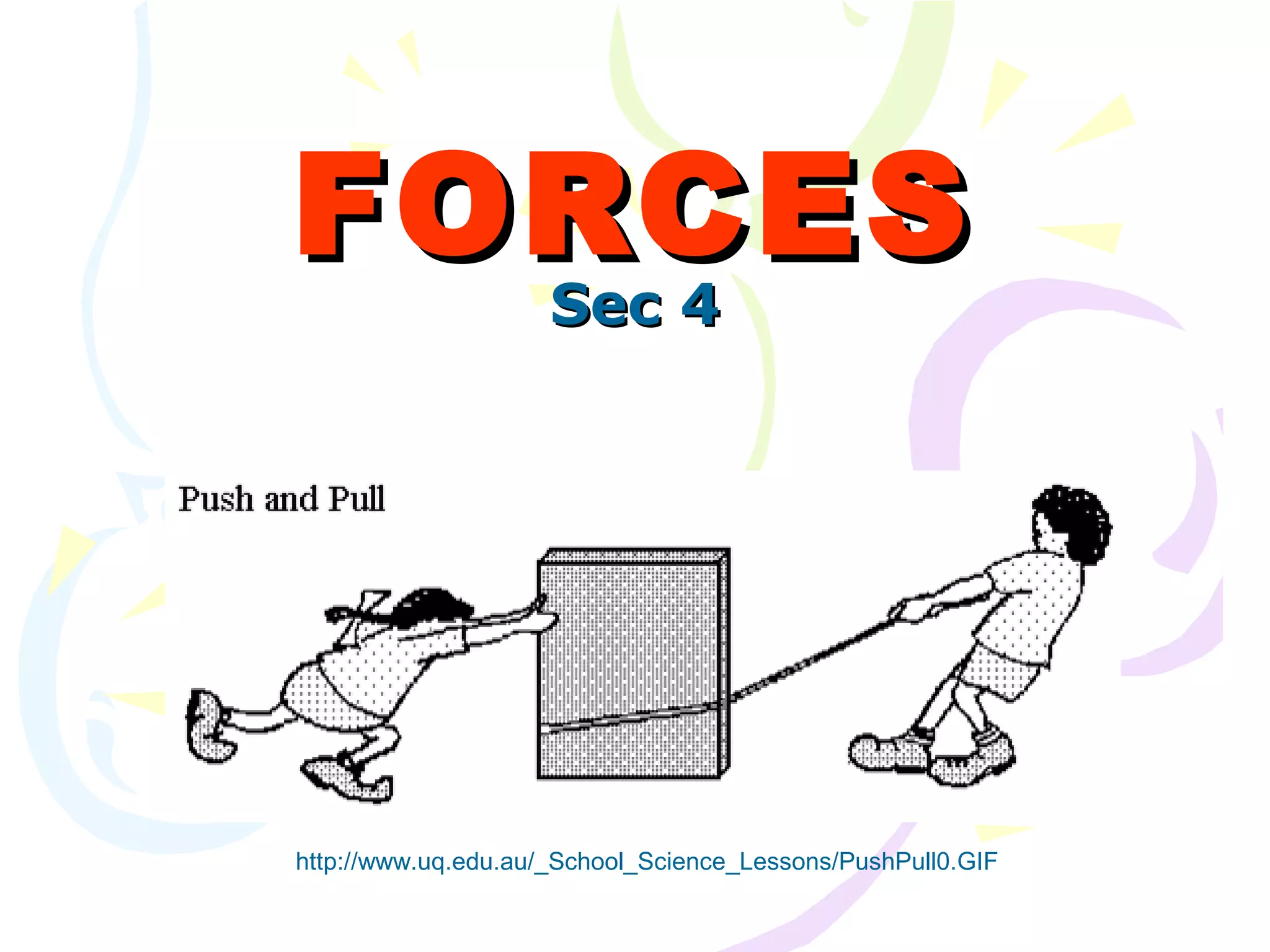
http://www.uq.edu.au/_School_Science_Lessons/PushPull0.GIF
BTEC, you should be able to:

 Describe the effects of a force
 Recall the relationship resultant force =
  mass x acceleration (F = m x a)
 Solve related problems with above
  relationships
 Understand mass, weight and acceleration
 Understand weight and able to differentiate
  weight and mass
 Recall the relationship weight = mass x
  gravity Understand Inertia
Force
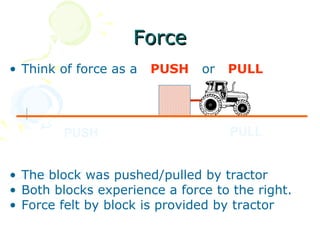
• Think of force as a   PUSH   or   PULL


        PUSH                        PULL


• The block was pushed/pulled by tractor
• Both blocks experience a force to the right.
• Force felt by block is provided by tractor
Types of Forces
• Magnetic force
  – force due to magnetic attraction and repulsion
• Weight
  – force acting on a body due to gravitational pull
• Tension
  – force at the ends of a stretched string, spring or
    rope
• Contact force
  – force that appears only when there is contact
    between two bodies
• Friction
  – force due to roughness of surfaces
Force
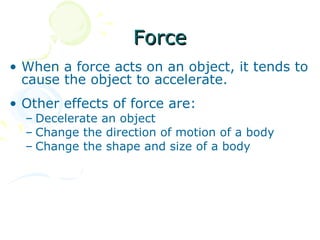
• When a force acts on an object, it tends to
  cause the object to accelerate.
• Other effects of force are:
  – Decelerate an object
  – Change the direction of motion of a body
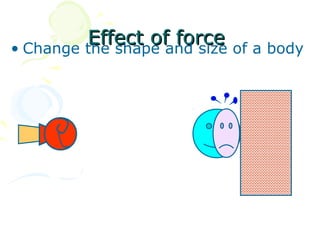
  – Change the shape and size of a body
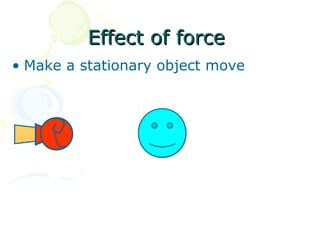
Effect of force
• Make a stationary object move
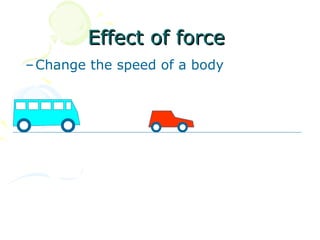
Effect of force
– Change the speed of a body
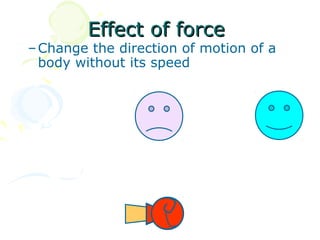
Effect of force
– Change the direction of motion of a
  body without its speed
Effect ofand size of a body
• Change the shape
                   force
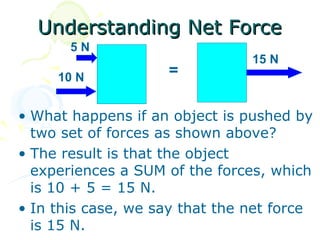
Understanding Net Force
       5N
                                15 N
     10 N           =

• What happens if an object is pushed by
  two set of forces as shown above?
• The result is that the object
  experiences a SUM of the forces, which
  is 10 + 5 = 15 N.
• In this case, we say that the net force
  is 15 N.
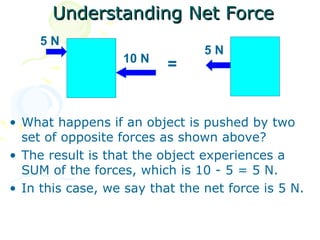
Understanding Net Force
     5N
                                5N
                  10 N
                          =


• What happens if an object is pushed by two
  set of opposite forces as shown above?
• The result is that the object experiences a
  SUM of the forces, which is 10 - 5 = 5 N.
• In this case, we say that the net force is 5 N.
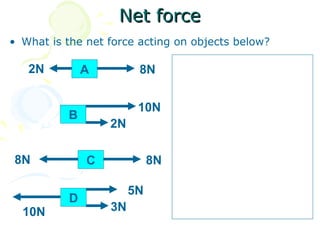
Net force
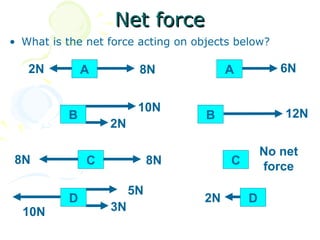
• What is the net force acting on objects below?

   2N         A         8N               A          6N


                        10N
          B                         B                12N
                  2N

                                                 No net
8N            C             8N           C       force
                       5N
          D                         2N       D
  10N             3N
Net force
• What is the net force acting on objects below?

   2N         A         8N               A          6N


                        10N
          B                         B                12N
                  2N

                                                 No net
8N            C             8N           C       force
                       5N
          D                         2N       D
  10N             3N
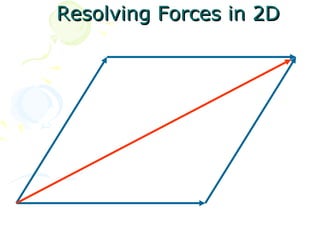
Resolving Forces in 2D
Force
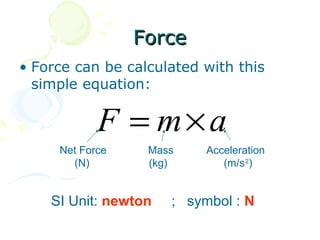
• Force can be calculated with this
  simple equation:

            F = m×a
     Net Force    Mass     Acceleration
       (N)        (kg)        (m/s 2)


    SI Unit: newton   ; symbol : N
Quick Check
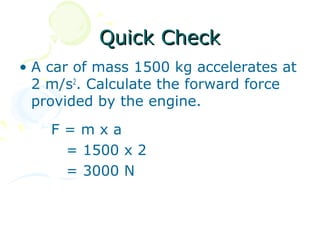
• A car of mass 1500 kg accelerates at
  2 m/s2. Calculate the forward force
  provided by the engine.
    F=mxa
     = 1500 x 2
     = 3000 N
Quick Check
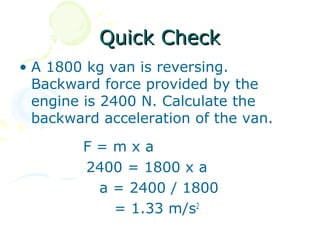
• A 1800 kg van is reversing.
  Backward force provided by the
  engine is 2400 N. Calculate the
  backward acceleration of the van.

        F=mxa
        2400 = 1800 x a
         a = 2400 / 1800
           = 1.33 m/s2
Quick Check
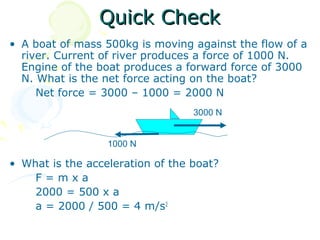
• A boat of mass 500kg is moving against the flow of a
  river. Current of river produces a force of 1000 N.
  Engine of the boat produces a forward force of 3000
  N. What is the net force acting on the boat?
     Net force = 3000 – 1000 = 2000 N
                                  3000 N


                  1000 N

• What is the acceleration of the boat?
    F=mxa
    2000 = 500 x a
    a = 2000 / 500 = 4 m/s2
Quick Check
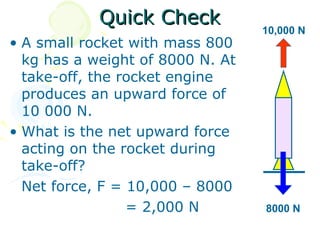
                                  10,000 N
• A small rocket with mass 800
  kg has a weight of 8000 N. At
  take-off, the rocket engine
  produces an upward force of
  10 000 N.
• What is the net upward force
  acting on the rocket during
  take-off?
  Net force, F = 10,000 – 8000
                 = 2,000 N        8000 N
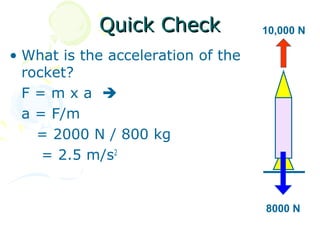
Quick Check             10,000 N

• What is the acceleration of the
  rocket?
  F=mxa 
  a = F/m
    = 2000 N / 800 kg
     = 2.5 m/s2


                                    8000 N
Mass and Weight
• In the study of mass and weight, you first
  need to forget the day-to-day understanding
  of weight.
• For example, “the weight of a pupil is 50 kg”
  is WRONG! FORGET THIS, at least
  temporarily.

• Mass of an object can be
  understood as the amount of atoms
  that makes up the object.*
* This is not strictly correct, but as a beginner
  it is useful to think of it this way
Mass
• Mass of a handphone is always 0.2
  kg, in Singapore, or US or Brazil or
  even on the Moon or Mars.

• A 1.5 liter PET bottle of Coke will
  always have the same mass even if
  the drink is poured out into a
  container. (shape of liquid has
  changed but not the mass)
Mass
• In Physics is defined as (this means that if
  asked in exams, please write this statement
  down)
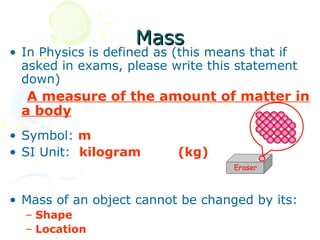
  A measure of the amount of matter in
 a body
• Symbol: m
• SI Unit: kilogram       (kg)
                                   Eraser


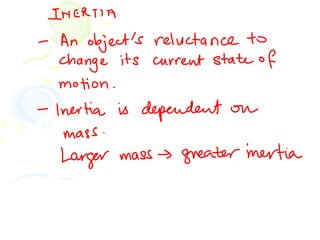
• Mass of an object cannot be changed by its:
  – Shape
  – Location
Weight
• Weight of an object is the effect of gravity
  on it.
• For instance, a box has a mass of 1 kg.
  (this means that the box has a great
  number of atoms worth 1 kg)
• For a 1kg box on Earth, it weighs 10 N.
  However if the box is on the Moon, where
  the gravity is only 1/6 of Earth, the box
  weighs only 10/6 N.
Weight
• In other words, you might not be
  able to lift a 60kg dumb-bell on Earth
  but on the Moon, you possibly can
  because it is now appears lighter.
• On Earth, the dumb-bell weighs 600
  N while on the Moon is only 100 N.
Weight
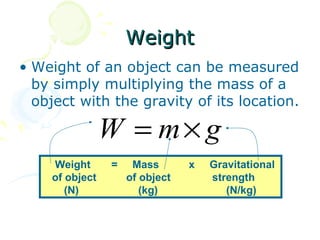
• Weight of an object can be measured
  by simply multiplying the mass of a
  object with the gravity of its location.

                W = m× g
    Weight      =    Mass       x   Gravitational
    of object       of object       strength
       (N)             (kg)            (N/kg)
Quick check
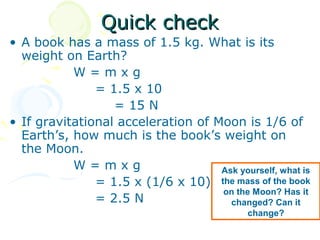
• A book has a mass of 1.5 kg. What is its
  weight on Earth?
           W=mxg
               = 1.5 x 10
                  = 15 N
• If gravitational acceleration of Moon is 1/6 of
  Earth’s, how much is the book’s weight on
  the Moon.
           W=mxg                    Ask yourself, what is
               = 1.5 x (1/6 x 10) the mass of the book
                                    on the Moon? Has it
               = 2.5 N                changed? Can it
                                             change?
Quick check
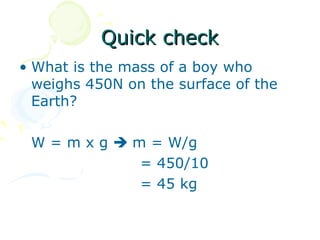
• What is the mass of a boy who
  weighs 450N on the surface of the
  Earth?

 W = m x g  m = W/g
              = 450/10
              = 45 kg
Friction
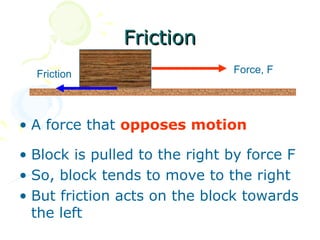
  Friction                     Force, F


• A force that opposes motion

• Block is pulled to the right by force F
• So, block tends to move to the right
• But friction acts on the block towards
  the left
Friction
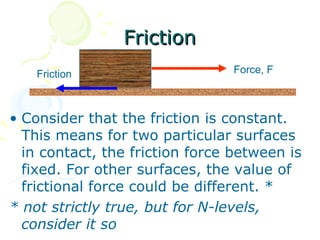
    Friction                     Force, F


• Consider that the friction is constant.
  This means for two particular surfaces
  in contact, the friction force between is
  fixed. For other surfaces, the value of
  frictional force could be different. *
* not strictly true, but for N-levels,
  consider it so
Friction
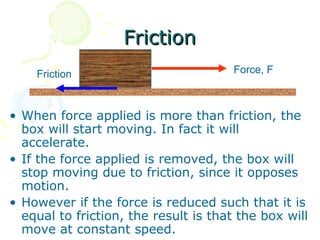
    Friction                           Force, F


• When force applied is more than friction, the
  box will start moving. In fact it will
  accelerate.
• If the force applied is removed, the box will
  stop moving due to friction, since it opposes
  motion.
• However if the force is reduced such that it is
  equal to friction, the result is that the box will
  move at constant speed.
Friction – What’s Good about
              it?
• Allows us to walk
• Allows a car to move
• Allows us to hold a chopstick
Friction – What’s bad about it?
• Causes wear and tear – brake pads of
  vehicles, soles of shoes
• Reduces efficiency of performance –
  traveling
Solutions to overcome
             friction
• Moving on air cushion or
  electromagnetic fields
• Use rollers or wheels
• Lubricate surface
• Smoothen surface
• Using materials with very low frictional
  resistance
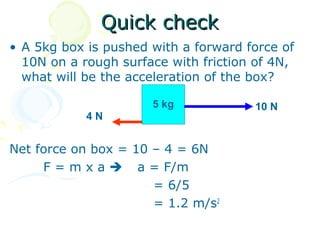
Quick check
• A 5kg box is pushed with a forward force of
  10N on a rough surface with friction of 4N,
  what will be the acceleration of the box?

                      5 kg            10 N
            4N


Net force on box = 10 – 4 = 6N
     F = m x a  a = F/m
                      = 6/5
                      = 1.2 m/s2
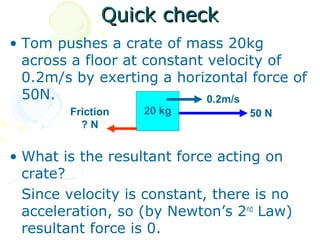
Quick check
• Tom pushes a crate of mass 20kg
  across a floor at constant velocity of
  0.2m/s by exerting a horizontal force of
  50N.                       0.2m/s
        Friction   20 kg          50 N
          ?N


• What is the resultant force acting on
  crate?
  Since velocity is constant, there is no
  acceleration, so (by Newton’s 2nd Law)
  resultant force is 0.
Quick check

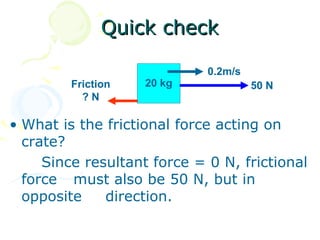
                             0.2m/s
         Friction   20 kg             50 N
           ?N

• What is the frictional force acting on
  crate?
     Since resultant force = 0 N, frictional
  force must also be 50 N, but in
  opposite    direction.
Quick check

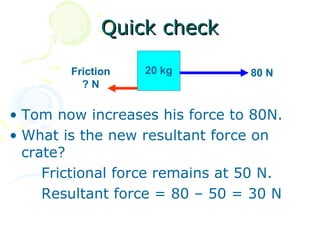
        Friction   20 kg         80 N
          ?N

• Tom now increases his force to 80N.
• What is the new resultant force on
  crate?
     Frictional force remains at 50 N.
     Resultant force = 80 – 50 = 30 N
Quick check

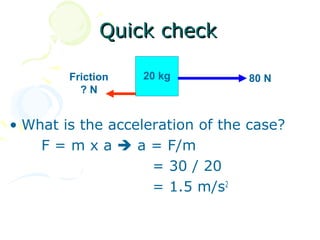
        Friction   20 kg         80 N
          ?N


• What is the acceleration of the case?
    F = m x a  a = F/m
                    = 30 / 20
                    = 1.5 m/s2
Forces dynamics

Forces dynamics

  • 1.
    FORCES Sec4 http://www.uq.edu.au/_School_Science_Lessons/PushPull0.GIF
  • 2.
    BTEC, you shouldbe able to:  Describe the effects of a force  Recall the relationship resultant force = mass x acceleration (F = m x a)  Solve related problems with above relationships  Understand mass, weight and acceleration  Understand weight and able to differentiate weight and mass  Recall the relationship weight = mass x gravity Understand Inertia
  • 3.
    Force • Think offorce as a PUSH or PULL PUSH PULL • The block was pushed/pulled by tractor • Both blocks experience a force to the right. • Force felt by block is provided by tractor
  • 4.
    Types of Forces •Magnetic force – force due to magnetic attraction and repulsion • Weight – force acting on a body due to gravitational pull • Tension – force at the ends of a stretched string, spring or rope • Contact force – force that appears only when there is contact between two bodies • Friction – force due to roughness of surfaces
  • 5.
    Force • When aforce acts on an object, it tends to cause the object to accelerate. • Other effects of force are: – Decelerate an object – Change the direction of motion of a body – Change the shape and size of a body
  • 6.
    Effect of force •Make a stationary object move
  • 7.
    Effect of force –Change the speed of a body
  • 8.
    Effect of force –Change the direction of motion of a body without its speed
  • 9.
    Effect ofand sizeof a body • Change the shape force
  • 10.
    Understanding Net Force 5N 15 N 10 N = • What happens if an object is pushed by two set of forces as shown above? • The result is that the object experiences a SUM of the forces, which is 10 + 5 = 15 N. • In this case, we say that the net force is 15 N.
  • 11.
    Understanding Net Force 5N 5N 10 N = • What happens if an object is pushed by two set of opposite forces as shown above? • The result is that the object experiences a SUM of the forces, which is 10 - 5 = 5 N. • In this case, we say that the net force is 5 N.
  • 12.
    Net force • Whatis the net force acting on objects below? 2N A 8N A 6N 10N B B 12N 2N No net 8N C 8N C force 5N D 2N D 10N 3N
  • 13.
    Net force • Whatis the net force acting on objects below? 2N A 8N A 6N 10N B B 12N 2N No net 8N C 8N C force 5N D 2N D 10N 3N
  • 14.
  • 15.
    Force • Force canbe calculated with this simple equation: F = m×a Net Force Mass Acceleration (N) (kg) (m/s 2) SI Unit: newton ; symbol : N
  • 16.
    Quick Check • Acar of mass 1500 kg accelerates at 2 m/s2. Calculate the forward force provided by the engine. F=mxa = 1500 x 2 = 3000 N
  • 17.
    Quick Check • A1800 kg van is reversing. Backward force provided by the engine is 2400 N. Calculate the backward acceleration of the van. F=mxa 2400 = 1800 x a a = 2400 / 1800 = 1.33 m/s2
  • 18.
    Quick Check • Aboat of mass 500kg is moving against the flow of a river. Current of river produces a force of 1000 N. Engine of the boat produces a forward force of 3000 N. What is the net force acting on the boat? Net force = 3000 – 1000 = 2000 N 3000 N 1000 N • What is the acceleration of the boat? F=mxa 2000 = 500 x a a = 2000 / 500 = 4 m/s2
  • 19.
    Quick Check 10,000 N • A small rocket with mass 800 kg has a weight of 8000 N. At take-off, the rocket engine produces an upward force of 10 000 N. • What is the net upward force acting on the rocket during take-off? Net force, F = 10,000 – 8000 = 2,000 N 8000 N
  • 20.
    Quick Check 10,000 N • What is the acceleration of the rocket? F=mxa  a = F/m = 2000 N / 800 kg = 2.5 m/s2 8000 N
  • 21.
    Mass and Weight •In the study of mass and weight, you first need to forget the day-to-day understanding of weight. • For example, “the weight of a pupil is 50 kg” is WRONG! FORGET THIS, at least temporarily. • Mass of an object can be understood as the amount of atoms that makes up the object.* * This is not strictly correct, but as a beginner it is useful to think of it this way
  • 22.
    Mass • Mass ofa handphone is always 0.2 kg, in Singapore, or US or Brazil or even on the Moon or Mars. • A 1.5 liter PET bottle of Coke will always have the same mass even if the drink is poured out into a container. (shape of liquid has changed but not the mass)
  • 23.
    Mass • In Physicsis defined as (this means that if asked in exams, please write this statement down) A measure of the amount of matter in a body • Symbol: m • SI Unit: kilogram (kg) Eraser • Mass of an object cannot be changed by its: – Shape – Location
  • 24.
    Weight • Weight ofan object is the effect of gravity on it. • For instance, a box has a mass of 1 kg. (this means that the box has a great number of atoms worth 1 kg) • For a 1kg box on Earth, it weighs 10 N. However if the box is on the Moon, where the gravity is only 1/6 of Earth, the box weighs only 10/6 N.
  • 25.
    Weight • In otherwords, you might not be able to lift a 60kg dumb-bell on Earth but on the Moon, you possibly can because it is now appears lighter. • On Earth, the dumb-bell weighs 600 N while on the Moon is only 100 N.
  • 26.
    Weight • Weight ofan object can be measured by simply multiplying the mass of a object with the gravity of its location. W = m× g Weight = Mass x Gravitational of object of object strength (N) (kg) (N/kg)
  • 27.
    Quick check • Abook has a mass of 1.5 kg. What is its weight on Earth? W=mxg = 1.5 x 10 = 15 N • If gravitational acceleration of Moon is 1/6 of Earth’s, how much is the book’s weight on the Moon. W=mxg Ask yourself, what is = 1.5 x (1/6 x 10) the mass of the book on the Moon? Has it = 2.5 N changed? Can it change?
  • 28.
    Quick check • Whatis the mass of a boy who weighs 450N on the surface of the Earth? W = m x g  m = W/g = 450/10 = 45 kg
  • 29.
    Friction Friction Force, F • A force that opposes motion • Block is pulled to the right by force F • So, block tends to move to the right • But friction acts on the block towards the left
  • 30.
    Friction Friction Force, F • Consider that the friction is constant. This means for two particular surfaces in contact, the friction force between is fixed. For other surfaces, the value of frictional force could be different. * * not strictly true, but for N-levels, consider it so
  • 31.
    Friction Friction Force, F • When force applied is more than friction, the box will start moving. In fact it will accelerate. • If the force applied is removed, the box will stop moving due to friction, since it opposes motion. • However if the force is reduced such that it is equal to friction, the result is that the box will move at constant speed.
  • 32.
    Friction – What’sGood about it? • Allows us to walk • Allows a car to move • Allows us to hold a chopstick
  • 33.
    Friction – What’sbad about it? • Causes wear and tear – brake pads of vehicles, soles of shoes • Reduces efficiency of performance – traveling
  • 34.
    Solutions to overcome friction • Moving on air cushion or electromagnetic fields • Use rollers or wheels • Lubricate surface • Smoothen surface • Using materials with very low frictional resistance
  • 35.
    Quick check • A5kg box is pushed with a forward force of 10N on a rough surface with friction of 4N, what will be the acceleration of the box? 5 kg 10 N 4N Net force on box = 10 – 4 = 6N F = m x a  a = F/m = 6/5 = 1.2 m/s2
  • 36.
    Quick check • Tompushes a crate of mass 20kg across a floor at constant velocity of 0.2m/s by exerting a horizontal force of 50N. 0.2m/s Friction 20 kg 50 N ?N • What is the resultant force acting on crate? Since velocity is constant, there is no acceleration, so (by Newton’s 2nd Law) resultant force is 0.
  • 37.
    Quick check 0.2m/s Friction 20 kg 50 N ?N • What is the frictional force acting on crate? Since resultant force = 0 N, frictional force must also be 50 N, but in opposite direction.
  • 38.
    Quick check Friction 20 kg 80 N ?N • Tom now increases his force to 80N. • What is the new resultant force on crate? Frictional force remains at 50 N. Resultant force = 80 – 50 = 30 N
  • 39.
    Quick check Friction 20 kg 80 N ?N • What is the acceleration of the case? F = m x a  a = F/m = 30 / 20 = 1.5 m/s2

Editor's Notes

  • #2 Add examples of problems