ATMIYA INSTITUTE OF TECHNOLOGY & SCIENCE
MECHANICAL DEPARTMENT
3rd SEMESTER
COPLANNER & NON-CONCURRENT
FORCES
(MECHANICS OF SOLIDS – 2130003)
PREPARED BY:
Akash Ambaliya (140030119003)
Akshay Amipara (140030119004)
GUIDED BY:
Sagar I. Shah
(Asst. Prof.)
MECH. DEPT.
Definition
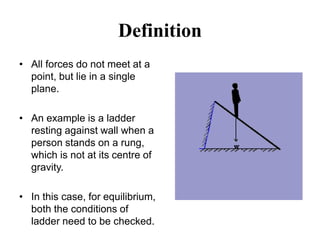
• All forces do not meet at a
point, but lie in a single
plane.
• An example is a ladder
resting against wall when a
person stands on a rung,
which is not at its centre of
gravity.
• In this case, for equilibrium,
both the conditions of
ladder need to be checked.
Definition
• The principles of equilibrium are also used to
determine the resultant of non-parallel, non-
concurrent systems of forces.
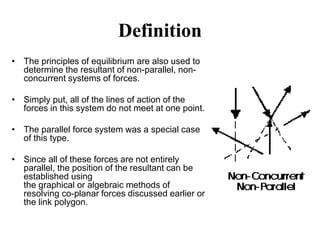
• Simply put, all of the lines of action of the
forces in this system do not meet at one point.
• The parallel force system was a special case
of this type.
• Since all of these forces are not entirely
parallel, the position of the resultant can be
established using
the graphical or algebraic methods of
resolving co-planar forces discussed earlier or
the link polygon.
Resultant of Non-concurrent Forces
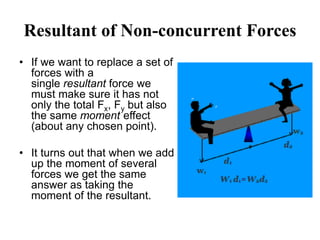
• If we want to replace a set of
forces with a
single resultant force we
must make sure it has not
only the total Fx, Fy but also
the same moment effect
(about any chosen point).
• It turns out that when we add
up the moment of several
forces we get the same
answer as taking the
moment of the resultant.
Resultant of Non-concurrent Forces
• To obtain the total moment of a system of
forces, we can either...
– Calculate the moment caused by the resultant
of the system of forces about that point (So
long as the resultant is in the RIGHT PLACE
to create the right rotation).
– Calculate each moment (from each force
separately) and add them up, keeping in mind
the CW and CCW sign convention.
Resultant of Non-concurrent Forces
• By using the principles of resolution composition &
moment it is possible to determine analytically the
resultant for coplanar non-concurrent system of forces.
• The procedure is as follows:
– Select a Suitable Cartesian System for the given problem.
– Resolve the forces in the Cartesian System
– Compute fxi and fyi
– Compute the moments of resolved components about any
point taken as the moment
– centre O. Hence find M0
Resultant of Non-concurrent Forces
Transformation of force to a force
couple system
• It is well known that moment of a force
represents its rotatary effect about an axis or
a point.
• This concept is used in determining the
resultant for a system of coplanar non-
concurrent forces.
• For ay given force it is possible to determine
an equivalent force – couple system.
Transformation of force to a force
couple system
Transformation of force to a force
couple system
• A force F applied to a rigid body at a
distance d from the centre of mass has the same
effect as the same force applied directly to the
centre of mass and a couple Cℓ = Fd.
• The couple produces an angular acceleration of
the rigid body at right angles to the plane of the
couple.
• The force at the centre of mass accelerates the
body in the direction of the force without change in
orientation.
Transformation of force to a force
couple system
• The general theorems are:
– A single force acting at any point O′ of a rigid body can be
replaced by an equal and parallel force F acting at any
given point O and a couple with forces parallel to F whose
moment is M = Fd, d being the separation of O and O′.
• Conversely, a couple and a force in the plane of the
couple can be replaced by a single force, appropriately
located.
• Any couple can be replaced by another in the same
plane of the same direction and moment, having any
desired force or any desired arm.
Transformation of force to a force a
couple system
Applications of Couple Forces
• Couples are very important in mechanical
engineering and the physical sciences. A few
examples are:
– The forces exerted by one's hand on a screw-
driver
– The forces exerted by the tip of a screw-driver on
the head of a screw
– Drag forces acting on a spinning propeller
– Forces on an electric dipole in a uniform electric
field.
– The reaction control system on a spacecraft.
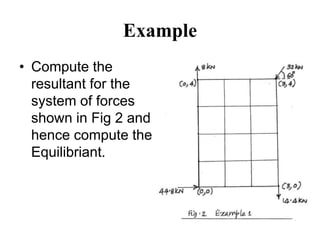
Example
• Compute the
resultant for the
system of forces
shown in Fig 2 and
hence compute the
Equilibriant.
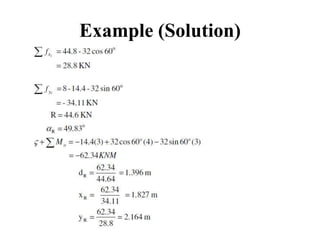
Example (Solution)
Thank You…

COPLANNER & NON-CONCURRENT FORCES

  • 1.
    ATMIYA INSTITUTE OFTECHNOLOGY & SCIENCE MECHANICAL DEPARTMENT 3rd SEMESTER COPLANNER & NON-CONCURRENT FORCES (MECHANICS OF SOLIDS – 2130003) PREPARED BY: Akash Ambaliya (140030119003) Akshay Amipara (140030119004) GUIDED BY: Sagar I. Shah (Asst. Prof.) MECH. DEPT.
  • 2.
    Definition • All forcesdo not meet at a point, but lie in a single plane. • An example is a ladder resting against wall when a person stands on a rung, which is not at its centre of gravity. • In this case, for equilibrium, both the conditions of ladder need to be checked.
  • 3.
    Definition • The principlesof equilibrium are also used to determine the resultant of non-parallel, non- concurrent systems of forces. • Simply put, all of the lines of action of the forces in this system do not meet at one point. • The parallel force system was a special case of this type. • Since all of these forces are not entirely parallel, the position of the resultant can be established using the graphical or algebraic methods of resolving co-planar forces discussed earlier or the link polygon.
  • 4.
    Resultant of Non-concurrentForces • If we want to replace a set of forces with a single resultant force we must make sure it has not only the total Fx, Fy but also the same moment effect (about any chosen point). • It turns out that when we add up the moment of several forces we get the same answer as taking the moment of the resultant.
  • 5.
    Resultant of Non-concurrentForces • To obtain the total moment of a system of forces, we can either... – Calculate the moment caused by the resultant of the system of forces about that point (So long as the resultant is in the RIGHT PLACE to create the right rotation). – Calculate each moment (from each force separately) and add them up, keeping in mind the CW and CCW sign convention.
  • 6.
    Resultant of Non-concurrentForces • By using the principles of resolution composition & moment it is possible to determine analytically the resultant for coplanar non-concurrent system of forces. • The procedure is as follows: – Select a Suitable Cartesian System for the given problem. – Resolve the forces in the Cartesian System – Compute fxi and fyi – Compute the moments of resolved components about any point taken as the moment – centre O. Hence find M0
  • 7.
  • 8.
    Transformation of forceto a force couple system • It is well known that moment of a force represents its rotatary effect about an axis or a point. • This concept is used in determining the resultant for a system of coplanar non- concurrent forces. • For ay given force it is possible to determine an equivalent force – couple system.
  • 9.
    Transformation of forceto a force couple system
  • 10.
    Transformation of forceto a force couple system • A force F applied to a rigid body at a distance d from the centre of mass has the same effect as the same force applied directly to the centre of mass and a couple Cℓ = Fd. • The couple produces an angular acceleration of the rigid body at right angles to the plane of the couple. • The force at the centre of mass accelerates the body in the direction of the force without change in orientation.
  • 11.
    Transformation of forceto a force couple system • The general theorems are: – A single force acting at any point O′ of a rigid body can be replaced by an equal and parallel force F acting at any given point O and a couple with forces parallel to F whose moment is M = Fd, d being the separation of O and O′. • Conversely, a couple and a force in the plane of the couple can be replaced by a single force, appropriately located. • Any couple can be replaced by another in the same plane of the same direction and moment, having any desired force or any desired arm.
  • 12.
    Transformation of forceto a force a couple system
  • 13.
    Applications of CoupleForces • Couples are very important in mechanical engineering and the physical sciences. A few examples are: – The forces exerted by one's hand on a screw- driver – The forces exerted by the tip of a screw-driver on the head of a screw – Drag forces acting on a spinning propeller – Forces on an electric dipole in a uniform electric field. – The reaction control system on a spacecraft.
  • 14.
    Example • Compute the resultantfor the system of forces shown in Fig 2 and hence compute the Equilibriant.
  • 15.
  • 16.