THE PLANT NUTRIENTS
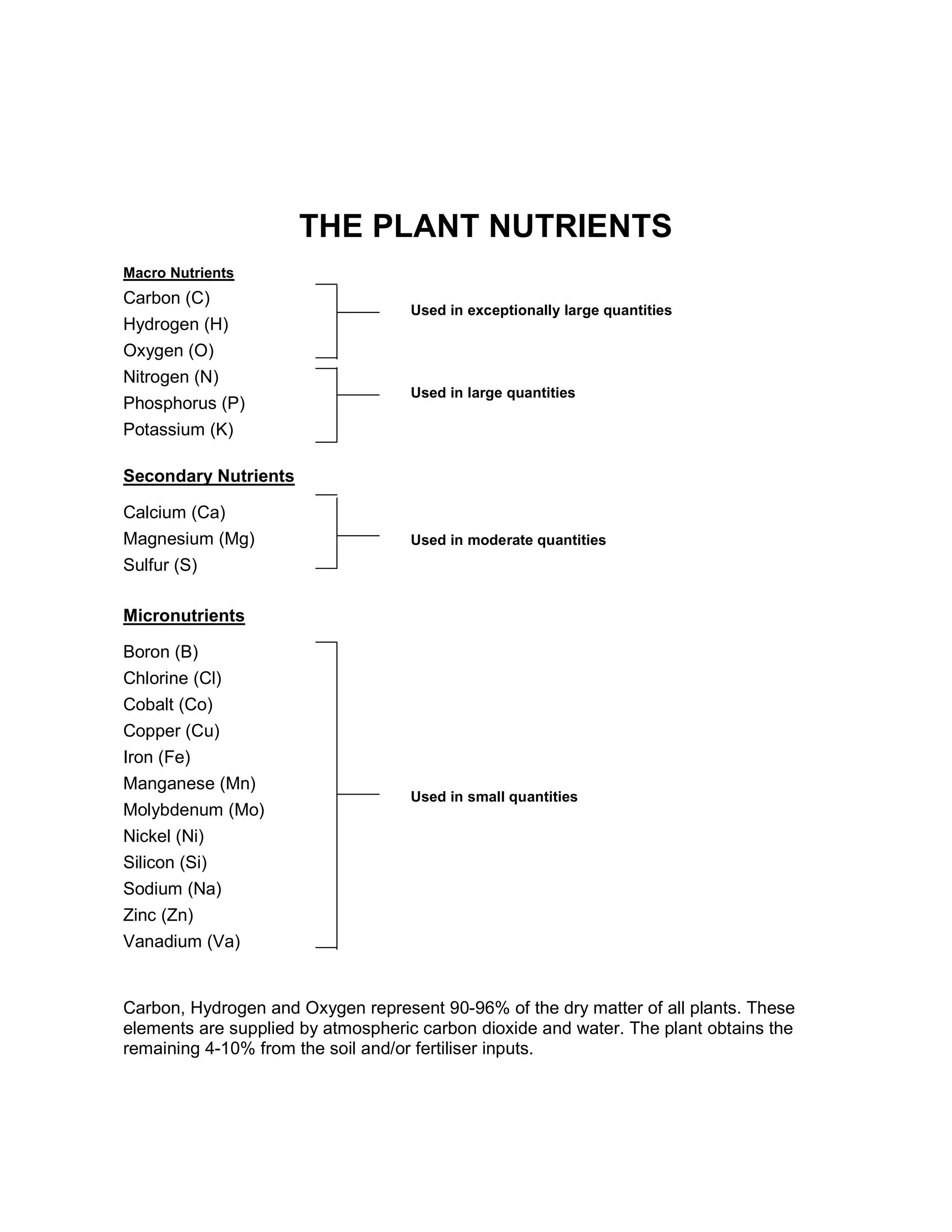
Macro Nutrients
Carbon (C)
                                   Used in exceptionally large quantities
Hydrogen (H)
Oxygen (O)
Nitrogen (N)
                                   Used in large quantities
Phosphorus (P)
Potassium (K)

Secondary Nutrients

Calcium (Ca)
Magnesium (Mg)                     Used in moderate quantities
Sulfur (S)

Micronutrients

Boron (B)
Chlorine (Cl)
Cobalt (Co)
Copper (Cu)
Iron (Fe)
Manganese (Mn)
                                   Used in small quantities
Molybdenum (Mo)
Nickel (Ni)
Silicon (Si)
Sodium (Na)
Zinc (Zn)
Vanadium (Va)


Carbon, Hydrogen and Oxygen represent 90-96% of the dry matter of all plants. These
elements are supplied by atmospheric carbon dioxide and water. The plant obtains the
remaining 4-10% from the soil and/or fertiliser inputs.
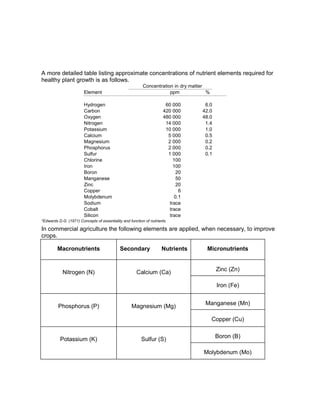
A more detailed table listing approximate concentrations of nutrient elements required for
healthy plant growth is as follows.
                                                         Concentration in dry matter
                        Element                                      ppm             %

                        Hydrogen                                      60 000       6.0
                        Carbon                                       420 000      42.0
                        Oxygen                                       480 000      48.0
                        Nitrogen                                      14 000       1.4
                        Potassium                                     10 000       1.0
                        Calcium                                        5 000       0.5
                        Magnesium                                      2 000       0.2
                        Phosphorus                                     2 000       0.2
                        Sulfur                                         1 000       0.1
                        Chlorine                                          100
                        Iron                                              100
                        Boron                                               20
                        Manganese                                           50
                        Zinc                                                20
                        Copper                                               6
                        Molybdenum                                         0.1
                        Sodium                                          trace
                        Cobalt                                          trace
                        Silicon                                         trace
*Edwards D.G. (1971) Concepts of essentiality and function of nutrients

In commercial agriculture the following elements are applied, when necessary, to improve
crops.

         Macronutrients                     Secondary               Nutrients       Micronutrients


            Nitrogen (N)                              Calcium (Ca)                        Zinc (Zn)

                                                                                          Iron (Fe)


         Phosphorus (P)                            Magnesium (Mg)                   Manganese (Mn)

                                                                                         Copper (Cu)


          Potassium (K)                                  Sulfur (S)                       Boron (B)

                                                                                   Molybdenum (Mo)
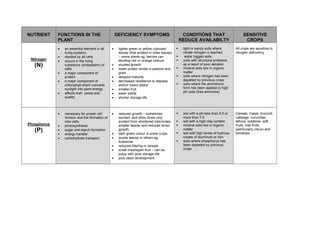
NUTRIENT     FUNCTIONS IN THE                        DEFICIENCY SYMPTOMS                        CONDITIONS THAT                         SENSITIVE
             PLANT                                                                             REDUCE AVAILABILTY                        CROPS
             •   an essential element in all     •    lighter green or yellow coloured          light or sandy soils where         All crops are sensitive to
                 living systems                       leaves (first evident in older leaves)    nitrate nitrogen is leached        nitrogen deficiency
             •   needed by all cells                  – some plants eg. berries can              water logged soils
 Nitrogen    •   occurs in the living                 develop red or orange colours             soils with structural problems
   (N)           substance (protoplasm) of       •    stunted growth
                                                      lower protein levels in pasture and
                                                                                                as a result of poor aeration
                                                                                                mineral soils low in organic
                 cells                           •
             •   a major component of                 grain                                     matter
                 protein                         •    delayed maturity                          soils where nitrogen has been
             •   a major component of            •    decreased resistance to disease           depleted by previous crops
                 chlorophyll which converts           and/or insect attack                      soils where the ammonium
                 sunlight into plant energy      •    smaller fruit                             form has been applied to high
             •   affects both yields and         •    lower yields                              pH soils (free ammonia)
                 quality.                        •    shorter storage life


             •   necessary for proper cell       •    reduced growth – sometimes                soil with a pH less than 5.5 or    Cereals, maize, broccoli,
                 division and the formation of        stunted and other times only              more than 7.0                      cabbage, cucumber,
                 new cells                            evident from shortened internodes,        soil with a high clay content      lettuce, potatoes, soft
Phosphorus   •   photosynthesis                       smaller leaves and reduced shoot          mineral soils low in organic       fruits, tree fruits
   (P)       •   sugar and starch formation
                                                 •
                                                      growth.
                                                      dark green colour in some crops
                                                                                                matter
                                                                                                soil with high levels of hydrous
                                                                                                                                   (particularly citrus) and
                                                                                                                                   tomatoes.
             •   energy transfer
             •   carbohydrate transport.         •    purple leaves in others eg.               oxides of aluminum or iron
                                                      brassicas                                 soils where phosphorus has
                                                 •    reduced tillering in cereals              been depleted by previous
                                                 •    small misshapen fruit – can be            crops
                                                      pulpy with poor storage life
                                                 •    poor seed development
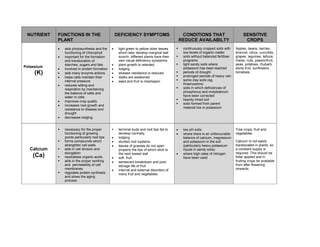
NUTRIENT   FUNCTIONS IN THE                        DEFICIENCY SYMPTOMS                         CONDITIONS THAT                          SENSITIVE
            PLANT                                                                              REDUCE AVAILABILTY                         CROPS
            •   aids photosynthesis and the     •    light green to yellow older leaves         continuously cropped soils with     Apples, beans, berries,
                functioning of chlorophyll           which later develop marginal leaf          low levels of organic matter        broccoli, citrus, cucurbits,
            •   important for the formation          scorch- different plants have their        soils without balanced fertiliser   grapes, legumes, lettuce,
                and translocation of                 own visual deficiency symptoms             programs                            maize, nuts, passionfruit,
                starches, sugars and fats       •    plant growth is retarded                   light sandy soils where             peas, potatoes, rhubarb,
Potassium                                                                                       potassium has been leached          stone fruit, sunflowers,
            •   involved in protein formation   •    lodging
     (K)    •   aids many enzyme actions        •    disease resistance is reduced              periods of drought
                                                                                                prolonged periods of heavy rain
                                                                                                                                    tomatoes.
            •   helps cells maintain their      •    stalks are weakened
                internal pressure               •    seed and fruit is misshapen                some clay soils (eg.
            •   reduces wilting and                                                             Krasnozems)
                respiration by maintaining                                                      soils in which deficiencies of
                the balance of salts and                                                        phosphorus and molybdenum
                water in cells                                                                  have been corrected
            •   improves crop quality                                                           heavily limed soil
                                                                                                soils formed from parent
            •   increases root growth and
                                                                                                material low in potassium
                resistance to disease and
                drought
            •   decreases lodging.


                necessary for the proper             terminal buds and root tips fail to   •    low pH soils.                       Tree crops, fruit and
                functioning of growing               develop normally.                     •    where there is an unfavourable      vegetables.
                points particularly root tips   •    lodging                                    balance of calcium, magnesium
                forms compounds which           •    stunted root systems                       and potassium in the soil           Calcium is not easily
                strenghten cell walls           •    leaves of grasses do not open              (particularly heavy potassium       translocated in plants, so
  Calcium       aids in cell division and            properly the tips of which stick to        inputs in sandy soils)              a constant supply is
                elongation                           the next lowest leaf                       where high rates of nitrogen        required. This should be
    (Ca)        neutralises organic acids       •    soft fruit
                                                                                           •
                                                                                                have been used                      foliar applied and in
                aids in the proper working      •    senescent breakdown and poor                                                   fruiting crops be available
                and permeability of cell             storage life of fruit                                                          from after flowering
                membranes                       •    internal and external disorders of                                             onwards.
                regulates protein synthesis          many fruit and vegetables
                and slows the aging
                process.
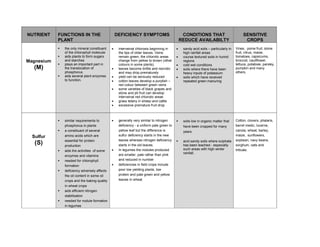
NUTRIENT    FUNCTIONS IN THE                     DEFICIENCY SYMPTOMS                          CONDITIONS THAT                           SENSITIVE
            PLANT                                                                            REDUCE AVAILABILTY                          CROPS
              the only mineral constituent   •    interveinal chlorosis beginning in     •    sandy acid soils – particularly in   Vines, pome fruit, stone
              of the chlorophyll molecule         the tips of older leaves. Veins             high rainfall areas                  fruit, citrus, maize,
              aids plants to form sugars          remain green, the chlorotic areas      •    course textured soils in humid       tomatoes, capsicums,
Magnesium     and starches                        change from yellow to brown (other          regions                              broccoli, cauliflower,
              plays an important part in          colours in some plants).               •    cold wet conditions                  lettuce, potatoes, parsley,
  (M)         the translocation of           •    leaves become brittle and necrotic     •    soils where there have been          pumpkin and many
              phosphorus                          and may drop prematurely                    heavy inputs of potassium            others.
              aids several plant enzymes     •    yield can be seriously reduced         •    soils which have received
              to function.                   •    cotton leaves develop a purplish –          repeated green manuring
                                                  red colour between green veins
                                             •    some varieties of black grapes and
                                                  stone and pit fruit can develop
                                                  interveinal red chlorotic areas
                                             •    grass tetany in sheep and cattle
                                             •    excessive premature fruit drop


              similar requirements to        •    generally very similar to nitrogen          soils low in organic matter that     Cotton, clovers, phalaris,
              phosphorus in plants                deficiency - a uniform pale green to        have been cropped for many           barrel medic, lucerne,
              a constituant of several            yellow leaf but the difference is           years.                               canola, wheat, barley,
  Sulfur      amino acids which are               sulfur deficiency starts in the new                                              maize, sunflowers,
              essential for protein               leaves whereas nitrogen deficiency          acid sandy soils where sulphate      soybean, navy beans,
   (S)        production                          starts in the old leaves.                   has been leached - especially        sorghum, oats and
              aids the activities of some    •    In legumes the nodules produced             such areas with high winter          triticale.
                                                  are smaller, pale rather than pink          rainfall.
              enzymes and vitamins
              needed for chlorophyll              and reduced in number
              formation                      •    deficiencies in field crops include
              deficiency adversely affects        poor low yielding plants, low
              the oil content in some oil         protein and pale green and yellow
              crops and the baking quality        leaves in wheat.
              in wheat crops
              aids efficient nitrogen
              stabilisation
              needed for nodule formation
              in legumes
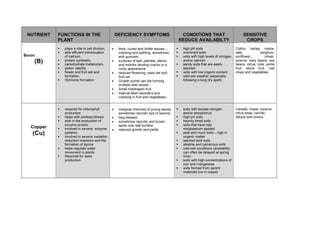
NUTRIENT   FUNCTIONS IN THE                       DEFICIENCY SYMPTOMS                     CONDITIONS THAT                           SENSITIVE
            PLANT                                                                         REDUCE AVAILABILTY                          CROPS
              plays a role in cell division,   •    thick, curled and brittle tissues –    high pH soils                        Cotton, barley, maize,
              aids efficient translocation          cracking and splitting, sometimes      overlimed soils                      oats,            sorghum,
Boron         of calcium,                           with gumosis                           soils with high levels of nitrogen   sunflower,          clover,
    (B)       protein synthesis,
              carbohydrate metabolism,
                                               •    surfaces of leaf, petioles, stems
                                                    and midribs develop cracks or a
                                                                                           and/or calcium
                                                                                           sandy soils that are easily
                                                                                                                                lucerne, navy beans, soy
                                                                                                                                beans, citrus, nuts, pome
              pollen viability                      corky appearance                       leached                              fruit, stone fruit, root
              flower and fruit set and         •    reduced flowering, seed set and        soils with low organic content       crops and vegetables.
              formation.                            fruit set.                             cold wet weather (especially
              Hormone formation                •    Growth points can die forming          following a long dry spell)
                                                    multiple side shoots
                                               •    Small misshapen fruit
                                               •    Internal flesh disorders and
                                                    cracking in fruit and vegetables


              required for chlorophyll         •    marginal chlorosis of young leaves     soils with excess nitrogen           Cereals, maize, lucerne,
              production                            sometimes necrotic tips (if severe)    and/or phosphorus                    citrus trees, carrots,
              helps with photosynthesis        •    twig dieback                           high pH soils                        lettuce and onions
              aids in the production of        •    sometimes necrotic and brown           heavily limed soils
              enzyme protein                        spots over leaf surface                soils that have had
   Copper     involved in several enzyme                                                   molybdenum applied
                                               •    reduced growth and yields
    (Cu)      systems
              involved in several oxidation
                                                                                           peat and muck soils – high in
                                                                                           organic matter
              reduction reactions and the                                                  leached acid soils
              formation of lignins                                                         alkaline and calcarious soils
              helps regulate water                                                         cold wet conditions (availability
              movement in plants.                                                          can often be delayed at spring
              Required for seed                                                            time)
              production                                                                   soils with high concentrations of
                                                                                           iron and manganese
                                                                                           soils formed from parent
                                                                                           materials low in copper
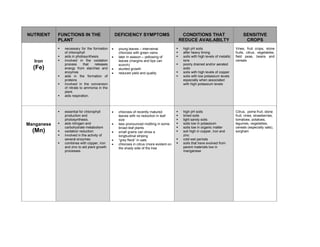
NUTRIENT    FUNCTIONS IN THE                     DEFICIENCY SYMPTOMS                      CONDITIONS THAT                           SENSITIVE
            PLANT                                                                        REDUCE AVAILABILTY                          CROPS
              necessary for the formation    •    young leaves – interveinal              high pH soils                        Vines, fruit crops, stone
              of chlorophyll                      chlorosis with green veins              after heavy liming                   fruits, citrus, vegetables,
              aids in photosynthesis         •    later in season – yellowing of          soils with high levels of metallic   field peas, beans and
  Iron        involved in the oxidation           leaves (margins and tips can            ions                                 cereals
              process      that  releases         scorch)                                 poorly drained and/or aerated
  (Fe)        energy from starches and       •    stunted growth                          soils
              enzymes                        •    reduced yield and quality               soils with high levels of copper
              aids in the formation of                                                    soils with low potassium levels
              proteins                                                                    especially when associated
              involved in the conversion                                                  with high potassium levels
              of nitrate to ammonia in the
              plant.
              aids respiration.


              essential for chlorophyll      •    chlorosis of recently matured           high pH soils                        Citrus, pome fruit, stone
              production and                      leaves with no reduction in leaf        limed soils                          fruit, vines, strawberries,
              photosynthesis.                     size                                    light sandy soils                    tomatoes, potatoes,
Manganese     aids nitrogen and              •    less pronounced mottling in some        soils low in potassium               legumes, vegetables,
              carbohydrate metabolism             broad leaf plants                       soils low in organic matter          cereals (especially oats),
  (Mn)        oxidation reduction            •    small grains can show a                 soil high in copper, iron and        sorgham
              involved in the activity of         longitudinal striping                   zinc
              several enzymes                •    “grey fleck” in oats                    cold wet periods
              combines with copper, iron     •    chlorosis in citrus (more evident on    soils that have evolved from
              and zinc to aid plant growth        the shady side of the tree              parent materials low in
              processes.                                                                  manganese
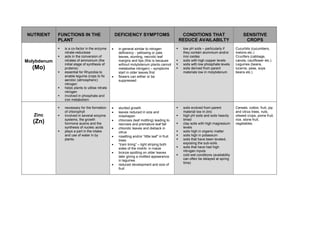
NUTRIENT     FUNCTIONS IN THE                        DEFICIENCY SYMPTOMS                         CONDITIONS THAT                          SENSITIVE
             PLANT                                                                              REDUCE AVAILABILTY                         CROPS
               is a co-factor in the enzyme      •    in general similar to nitrogen             low pH soils – particularly if      Cucurbits (cucumbers,
               nitrate-reductose                      deficiency - yellowing or pale             they contain aluminium and/or       melons etc.)
               aids in the conversion of              leaves, stunting, necrotic leaf            iron oxides                         Crucifers (cabbage,
Molybdenum     nitrates of ammonium (the              margins and tips (this is because          soils with high copper levels       canola, cauliflower etc.)
               initial stage of synthesis of          without molybdenum plants cannot           soils with low phosphate levels     Legumes (beans,
  (Mo)         proteins)                              metabolise nitrogen) – symptoms            soils derived from parent           lucerne, peas, soya
               essential for Rhyzobia to              start in older leaves first                materials low in molybdenum         beans etc.)
               enable legume crops to fix        •    flowers can wither or be
               aerobic (atmospheric)                  suppressed
               nitrogen
               helps plants to utilise nitrate
               nitrogen
               involved in phosphate and
               iron metabolism

               necessary for the formation       •    stunted growth                             soils evolved from parent           Cereals, cotton, fruit, pip
               of chlorophyll                    •    leaves reduced in size and                 material low in zinc                and citrus trees, nuts,
   Zinc        involved in several enzyme             misshapen                                  high pH soils and soils heavily     oilseed crops, pome fruit,
               systems, the growth                                                               limed                               rice, stone fruit,
  (Zn)         hormone auxins and the
                                                 •    chlorosis (leaf mottling) leading to
                                                      necrosis and premature leaf fall           clay soils with high magnesium      vegetables.
               synthesis of nucleic acids        •    chlorotic leaves and dieback in            levels
               plays a part in the intake             citrus                                     soils high in organic matter
               and use of water in by            •    rosetting and/or “little leaf” in fruit    soils high in potassium
               plants.                                trees                                      soils that have been leveled,
                                                 •    “tram lining” – light striping both        exposing the sub-soils
                                                      sides of the midrib- in maize              soils that have had high
                                                 •    bronze spotting on older leaves            nitrogen inputs
                                                      later giving a mottled appearance          cold wet conditions (availability
                                                      in legumes                                 can often be delayed at spring
                                                                                                 time)
                                                 •    reduced development and size of
                                                      fruit
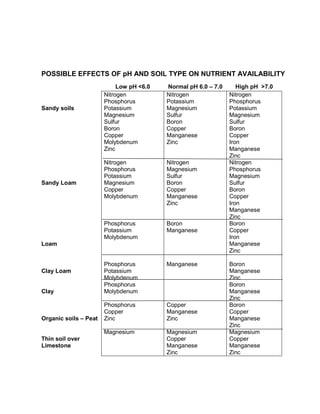
POSSIBLE EFFECTS OF pH AND SOIL TYPE ON NUTRIENT AVAILABILITY
                            Low pH <6.0   Normal pH 6.0 – 7.0      High pH >7.0
                       Nitrogen           Nitrogen              Nitrogen
                       Phosphorus         Potassium             Phosphorus
Sandy soils            Potassium          Magnesium             Potassium
                       Magnesium          Sulfur                Magnesium
                       Sulfur             Boron                 Sulfur
                       Boron              Copper                Boron
                       Copper             Manganese             Copper
                       Molybdenum         Zinc                  Iron
                       Zinc                                     Manganese
                                                                Zinc
                       Nitrogen           Nitrogen              Nitrogen
                       Phosphorus         Magnesium             Phosphorus
                       Potassium          Sulfur                Magnesium
Sandy Loam             Magnesium          Boron                 Sulfur
                       Copper             Copper                Boron
                       Molybdenum         Manganese             Copper
                                          Zinc                  Iron
                                                                Manganese
                                                                Zinc
                       Phosphorus         Boron                 Boron
                       Potassium          Manganese             Copper
                       Molybdenum                               Iron
Loam                                                            Manganese
                                                                Zinc

                       Phosphorus         Manganese             Boron
Clay Loam              Potassium                                Manganese
                       Molybdenum                               Zinc
                       Phosphorus                               Boron
Clay                   Molybdenum                               Manganese
                                                                Zinc
                       Phosphorus         Copper                Boron
                       Copper             Manganese             Copper
Organic soils – Peat   Zinc               Zinc                  Manganese
                                                                Zinc
                       Magnesium          Magnesium             Magnesium
Thin soil over                            Copper                Copper
Limestone                                 Manganese             Manganese
                                          Zinc                  Zinc
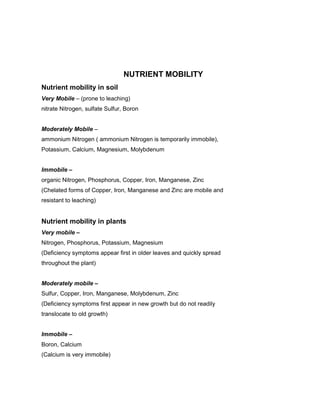
NUTRIENT MOBILITY
Nutrient mobility in soil
Very Mobile – (prone to leaching)
nitrate Nitrogen, sulfate Sulfur, Boron


Moderately Mobile –
ammonium Nitrogen ( ammonium Nitrogen is temporarily immobile),
Potassium, Calcium, Magnesium, Molybdenum


Immobile –
organic Nitrogen, Phosphorus, Copper, Iron, Manganese, Zinc
(Chelated forms of Copper, Iron, Manganese and Zinc are mobile and
resistant to leaching)


Nutrient mobility in plants
Very mobile –
Nitrogen, Phosphorus, Potassium, Magnesium
(Deficiency symptoms appear first in older leaves and quickly spread
throughout the plant)


Moderately mobile –
Sulfur, Copper, Iron, Manganese, Molybdenum, Zinc
(Deficiency symptoms first appear in new growth but do not readily
translocate to old growth)


Immobile –
Boron, Calcium
(Calcium is very immobile)
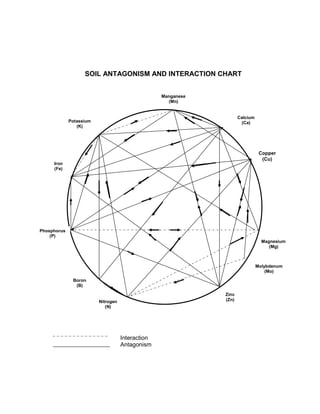
SOIL ANTAGONISM AND INTERACTION CHART


                                                  Manganese
                                                    (Mn)


                                                                     Calcium
             Potassium                                                (Ca)
                (K)


                                                                                Copper
                                                                                 (Cu)
     Iron
     (Fe)


Phosphorus
    (P)
                                                                                 Magnesium
                                                                                    (Mg)


                                                                               Molybdenum
                                                                                   (Mo)

              Boron
               (B)

                                                              Zinc
                         Nitrogen                             (Zn)
                            (N)


                                    Interaction
                                    Antagonism
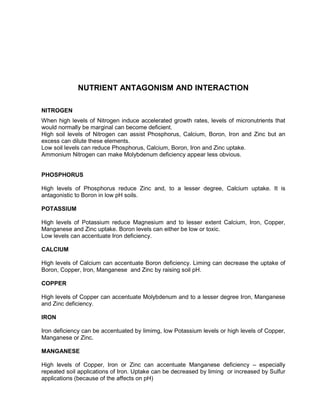
NUTRIENT ANTAGONISM AND INTERACTION

NITROGEN
When high levels of Nitrogen induce accelerated growth rates, levels of micronutrients that
would normally be marginal can become deficient.
High soil levels of Nitrogen can assist Phosphorus, Calcium, Boron, Iron and Zinc but an
excess can dilute these elements.
Low soil levels can reduce Phosphorus, Calcium, Boron, Iron and Zinc uptake.
Ammonium Nitrogen can make Molybdenum deficiency appear less obvious.


PHOSPHORUS

High levels of Phosphorus reduce Zinc and, to a lesser degree, Calcium uptake. It is
antagonistic to Boron in low pH soils.

POTASSIUM

High levels of Potassium reduce Magnesium and to lesser extent Calcium, Iron, Copper,
Manganese and Zinc uptake. Boron levels can either be low or toxic.
Low levels can accentuate Iron deficiency.

CALCIUM

High levels of Calcium can accentuate Boron deficiency. Liming can decrease the uptake of
Boron, Copper, Iron, Manganese and Zinc by raising soil pH.

COPPER

High levels of Copper can accentuate Molybdenum and to a lesser degree Iron, Manganese
and Zinc deficiency.

IRON

Iron deficiency can be accentuated by limimg, low Potassium levels or high levels of Copper,
Manganese or Zinc.

MANGANESE

High levels of Copper, Iron or Zinc can accentuate Manganese deficiency – especially
repeated soil applications of Iron. Uptake can be decreased by liming or increased by Sulfur
applications (because of the affects on pH)
MOLYBDENUM

Deficiencies can be accentuated by high levels of Copper and to a lesser degree
Mnaganese. Uptake can be adversely affected by sulfates. Uptake can be increased by
phosphates and liming.
Molybdenum can increase Copper deficiencies in animals.

ZINC

Uptake can be decreased by high Phosphorus levels, liming or high levels of Copper, Iron or
Manganese. Zinc deficiencies are often associated with Manganese deficiencies, especially
in citrus.
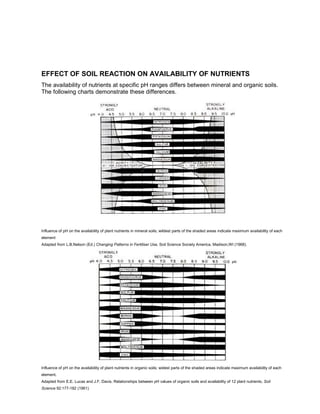
EFFECT OF SOIL REACTION ON AVAILABILITY OF NUTRIENTS
The availability of nutrients at specific pH ranges differs between mineral and organic soils.
The following charts demonstrate these differences.


Influence of pH on the availability of plant nutrients in mineral soils; wildest parts of the shaded areas indicate maximum availability of each
element
Adapted from L.B.Nelson (Ed.) Changing Patterns in Fertiliser Use, Soil Science Society America, Madison,WI (1968).


Influence of pH on the availability of plant nutrients in organic soils; widest parts of the shaded areas indicate maximum availability of each
element.
Adapted from E.E. Lucas and J.F. Davis. Relationships between pH values of organic soils and availability of 12 plant nutrients, Soil
Science 92:177-182 (1961)

The plant nutrients

  • 1.
    THE PLANT NUTRIENTS MacroNutrients Carbon (C) Used in exceptionally large quantities Hydrogen (H) Oxygen (O) Nitrogen (N) Used in large quantities Phosphorus (P) Potassium (K) Secondary Nutrients Calcium (Ca) Magnesium (Mg) Used in moderate quantities Sulfur (S) Micronutrients Boron (B) Chlorine (Cl) Cobalt (Co) Copper (Cu) Iron (Fe) Manganese (Mn) Used in small quantities Molybdenum (Mo) Nickel (Ni) Silicon (Si) Sodium (Na) Zinc (Zn) Vanadium (Va) Carbon, Hydrogen and Oxygen represent 90-96% of the dry matter of all plants. These elements are supplied by atmospheric carbon dioxide and water. The plant obtains the remaining 4-10% from the soil and/or fertiliser inputs.
  • 2.
    A more detailedtable listing approximate concentrations of nutrient elements required for healthy plant growth is as follows. Concentration in dry matter Element ppm % Hydrogen 60 000 6.0 Carbon 420 000 42.0 Oxygen 480 000 48.0 Nitrogen 14 000 1.4 Potassium 10 000 1.0 Calcium 5 000 0.5 Magnesium 2 000 0.2 Phosphorus 2 000 0.2 Sulfur 1 000 0.1 Chlorine 100 Iron 100 Boron 20 Manganese 50 Zinc 20 Copper 6 Molybdenum 0.1 Sodium trace Cobalt trace Silicon trace *Edwards D.G. (1971) Concepts of essentiality and function of nutrients In commercial agriculture the following elements are applied, when necessary, to improve crops. Macronutrients Secondary Nutrients Micronutrients Nitrogen (N) Calcium (Ca) Zinc (Zn) Iron (Fe) Phosphorus (P) Magnesium (Mg) Manganese (Mn) Copper (Cu) Potassium (K) Sulfur (S) Boron (B) Molybdenum (Mo)
  • 3.
    NUTRIENT FUNCTIONS IN THE DEFICIENCY SYMPTOMS CONDITIONS THAT SENSITIVE PLANT REDUCE AVAILABILTY CROPS • an essential element in all • lighter green or yellow coloured light or sandy soils where All crops are sensitive to living systems leaves (first evident in older leaves) nitrate nitrogen is leached nitrogen deficiency • needed by all cells – some plants eg. berries can water logged soils Nitrogen • occurs in the living develop red or orange colours soils with structural problems (N) substance (protoplasm) of • stunted growth lower protein levels in pasture and as a result of poor aeration mineral soils low in organic cells • • a major component of grain matter protein • delayed maturity soils where nitrogen has been • a major component of • decreased resistance to disease depleted by previous crops chlorophyll which converts and/or insect attack soils where the ammonium sunlight into plant energy • smaller fruit form has been applied to high • affects both yields and • lower yields pH soils (free ammonia) quality. • shorter storage life • necessary for proper cell • reduced growth – sometimes soil with a pH less than 5.5 or Cereals, maize, broccoli, division and the formation of stunted and other times only more than 7.0 cabbage, cucumber, new cells evident from shortened internodes, soil with a high clay content lettuce, potatoes, soft Phosphorus • photosynthesis smaller leaves and reduced shoot mineral soils low in organic fruits, tree fruits (P) • sugar and starch formation • growth. dark green colour in some crops matter soil with high levels of hydrous (particularly citrus) and tomatoes. • energy transfer • carbohydrate transport. • purple leaves in others eg. oxides of aluminum or iron brassicas soils where phosphorus has • reduced tillering in cereals been depleted by previous • small misshapen fruit – can be crops pulpy with poor storage life • poor seed development
  • 4.
    NUTRIENT FUNCTIONS IN THE DEFICIENCY SYMPTOMS CONDITIONS THAT SENSITIVE PLANT REDUCE AVAILABILTY CROPS • aids photosynthesis and the • light green to yellow older leaves continuously cropped soils with Apples, beans, berries, functioning of chlorophyll which later develop marginal leaf low levels of organic matter broccoli, citrus, cucurbits, • important for the formation scorch- different plants have their soils without balanced fertiliser grapes, legumes, lettuce, and translocation of own visual deficiency symptoms programs maize, nuts, passionfruit, starches, sugars and fats • plant growth is retarded light sandy soils where peas, potatoes, rhubarb, Potassium potassium has been leached stone fruit, sunflowers, • involved in protein formation • lodging (K) • aids many enzyme actions • disease resistance is reduced periods of drought prolonged periods of heavy rain tomatoes. • helps cells maintain their • stalks are weakened internal pressure • seed and fruit is misshapen some clay soils (eg. • reduces wilting and Krasnozems) respiration by maintaining soils in which deficiencies of the balance of salts and phosphorus and molybdenum water in cells have been corrected • improves crop quality heavily limed soil soils formed from parent • increases root growth and material low in potassium resistance to disease and drought • decreases lodging. necessary for the proper terminal buds and root tips fail to • low pH soils. Tree crops, fruit and functioning of growing develop normally. • where there is an unfavourable vegetables. points particularly root tips • lodging balance of calcium, magnesium forms compounds which • stunted root systems and potassium in the soil Calcium is not easily strenghten cell walls • leaves of grasses do not open (particularly heavy potassium translocated in plants, so Calcium aids in cell division and properly the tips of which stick to inputs in sandy soils) a constant supply is elongation the next lowest leaf where high rates of nitrogen required. This should be (Ca) neutralises organic acids • soft fruit • have been used foliar applied and in aids in the proper working • senescent breakdown and poor fruiting crops be available and permeability of cell storage life of fruit from after flowering membranes • internal and external disorders of onwards. regulates protein synthesis many fruit and vegetables and slows the aging process.
  • 5.
    NUTRIENT FUNCTIONS IN THE DEFICIENCY SYMPTOMS CONDITIONS THAT SENSITIVE PLANT REDUCE AVAILABILTY CROPS the only mineral constituent • interveinal chlorosis beginning in • sandy acid soils – particularly in Vines, pome fruit, stone of the chlorophyll molecule the tips of older leaves. Veins high rainfall areas fruit, citrus, maize, aids plants to form sugars remain green, the chlorotic areas • course textured soils in humid tomatoes, capsicums, Magnesium and starches change from yellow to brown (other regions broccoli, cauliflower, plays an important part in colours in some plants). • cold wet conditions lettuce, potatoes, parsley, (M) the translocation of • leaves become brittle and necrotic • soils where there have been pumpkin and many phosphorus and may drop prematurely heavy inputs of potassium others. aids several plant enzymes • yield can be seriously reduced • soils which have received to function. • cotton leaves develop a purplish – repeated green manuring red colour between green veins • some varieties of black grapes and stone and pit fruit can develop interveinal red chlorotic areas • grass tetany in sheep and cattle • excessive premature fruit drop similar requirements to • generally very similar to nitrogen soils low in organic matter that Cotton, clovers, phalaris, phosphorus in plants deficiency - a uniform pale green to have been cropped for many barrel medic, lucerne, a constituant of several yellow leaf but the difference is years. canola, wheat, barley, Sulfur amino acids which are sulfur deficiency starts in the new maize, sunflowers, essential for protein leaves whereas nitrogen deficiency acid sandy soils where sulphate soybean, navy beans, (S) production starts in the old leaves. has been leached - especially sorghum, oats and aids the activities of some • In legumes the nodules produced such areas with high winter triticale. are smaller, pale rather than pink rainfall. enzymes and vitamins needed for chlorophyll and reduced in number formation • deficiencies in field crops include deficiency adversely affects poor low yielding plants, low the oil content in some oil protein and pale green and yellow crops and the baking quality leaves in wheat. in wheat crops aids efficient nitrogen stabilisation needed for nodule formation in legumes
  • 6.
    NUTRIENT FUNCTIONS IN THE DEFICIENCY SYMPTOMS CONDITIONS THAT SENSITIVE PLANT REDUCE AVAILABILTY CROPS plays a role in cell division, • thick, curled and brittle tissues – high pH soils Cotton, barley, maize, aids efficient translocation cracking and splitting, sometimes overlimed soils oats, sorghum, Boron of calcium, with gumosis soils with high levels of nitrogen sunflower, clover, (B) protein synthesis, carbohydrate metabolism, • surfaces of leaf, petioles, stems and midribs develop cracks or a and/or calcium sandy soils that are easily lucerne, navy beans, soy beans, citrus, nuts, pome pollen viability corky appearance leached fruit, stone fruit, root flower and fruit set and • reduced flowering, seed set and soils with low organic content crops and vegetables. formation. fruit set. cold wet weather (especially Hormone formation • Growth points can die forming following a long dry spell) multiple side shoots • Small misshapen fruit • Internal flesh disorders and cracking in fruit and vegetables required for chlorophyll • marginal chlorosis of young leaves soils with excess nitrogen Cereals, maize, lucerne, production sometimes necrotic tips (if severe) and/or phosphorus citrus trees, carrots, helps with photosynthesis • twig dieback high pH soils lettuce and onions aids in the production of • sometimes necrotic and brown heavily limed soils enzyme protein spots over leaf surface soils that have had Copper involved in several enzyme molybdenum applied • reduced growth and yields (Cu) systems involved in several oxidation peat and muck soils – high in organic matter reduction reactions and the leached acid soils formation of lignins alkaline and calcarious soils helps regulate water cold wet conditions (availability movement in plants. can often be delayed at spring Required for seed time) production soils with high concentrations of iron and manganese soils formed from parent materials low in copper
  • 7.
    NUTRIENT FUNCTIONS IN THE DEFICIENCY SYMPTOMS CONDITIONS THAT SENSITIVE PLANT REDUCE AVAILABILTY CROPS necessary for the formation • young leaves – interveinal high pH soils Vines, fruit crops, stone of chlorophyll chlorosis with green veins after heavy liming fruits, citrus, vegetables, aids in photosynthesis • later in season – yellowing of soils with high levels of metallic field peas, beans and Iron involved in the oxidation leaves (margins and tips can ions cereals process that releases scorch) poorly drained and/or aerated (Fe) energy from starches and • stunted growth soils enzymes • reduced yield and quality soils with high levels of copper aids in the formation of soils with low potassium levels proteins especially when associated involved in the conversion with high potassium levels of nitrate to ammonia in the plant. aids respiration. essential for chlorophyll • chlorosis of recently matured high pH soils Citrus, pome fruit, stone production and leaves with no reduction in leaf limed soils fruit, vines, strawberries, photosynthesis. size light sandy soils tomatoes, potatoes, Manganese aids nitrogen and • less pronounced mottling in some soils low in potassium legumes, vegetables, carbohydrate metabolism broad leaf plants soils low in organic matter cereals (especially oats), (Mn) oxidation reduction • small grains can show a soil high in copper, iron and sorgham involved in the activity of longitudinal striping zinc several enzymes • “grey fleck” in oats cold wet periods combines with copper, iron • chlorosis in citrus (more evident on soils that have evolved from and zinc to aid plant growth the shady side of the tree parent materials low in processes. manganese
  • 8.
    NUTRIENT FUNCTIONS IN THE DEFICIENCY SYMPTOMS CONDITIONS THAT SENSITIVE PLANT REDUCE AVAILABILTY CROPS is a co-factor in the enzyme • in general similar to nitrogen low pH soils – particularly if Cucurbits (cucumbers, nitrate-reductose deficiency - yellowing or pale they contain aluminium and/or melons etc.) aids in the conversion of leaves, stunting, necrotic leaf iron oxides Crucifers (cabbage, Molybdenum nitrates of ammonium (the margins and tips (this is because soils with high copper levels canola, cauliflower etc.) initial stage of synthesis of without molybdenum plants cannot soils with low phosphate levels Legumes (beans, (Mo) proteins) metabolise nitrogen) – symptoms soils derived from parent lucerne, peas, soya essential for Rhyzobia to start in older leaves first materials low in molybdenum beans etc.) enable legume crops to fix • flowers can wither or be aerobic (atmospheric) suppressed nitrogen helps plants to utilise nitrate nitrogen involved in phosphate and iron metabolism necessary for the formation • stunted growth soils evolved from parent Cereals, cotton, fruit, pip of chlorophyll • leaves reduced in size and material low in zinc and citrus trees, nuts, Zinc involved in several enzyme misshapen high pH soils and soils heavily oilseed crops, pome fruit, systems, the growth limed rice, stone fruit, (Zn) hormone auxins and the • chlorosis (leaf mottling) leading to necrosis and premature leaf fall clay soils with high magnesium vegetables. synthesis of nucleic acids • chlorotic leaves and dieback in levels plays a part in the intake citrus soils high in organic matter and use of water in by • rosetting and/or “little leaf” in fruit soils high in potassium plants. trees soils that have been leveled, • “tram lining” – light striping both exposing the sub-soils sides of the midrib- in maize soils that have had high • bronze spotting on older leaves nitrogen inputs later giving a mottled appearance cold wet conditions (availability in legumes can often be delayed at spring time) • reduced development and size of fruit
  • 9.
    POSSIBLE EFFECTS OFpH AND SOIL TYPE ON NUTRIENT AVAILABILITY Low pH <6.0 Normal pH 6.0 – 7.0 High pH >7.0 Nitrogen Nitrogen Nitrogen Phosphorus Potassium Phosphorus Sandy soils Potassium Magnesium Potassium Magnesium Sulfur Magnesium Sulfur Boron Sulfur Boron Copper Boron Copper Manganese Copper Molybdenum Zinc Iron Zinc Manganese Zinc Nitrogen Nitrogen Nitrogen Phosphorus Magnesium Phosphorus Potassium Sulfur Magnesium Sandy Loam Magnesium Boron Sulfur Copper Copper Boron Molybdenum Manganese Copper Zinc Iron Manganese Zinc Phosphorus Boron Boron Potassium Manganese Copper Molybdenum Iron Loam Manganese Zinc Phosphorus Manganese Boron Clay Loam Potassium Manganese Molybdenum Zinc Phosphorus Boron Clay Molybdenum Manganese Zinc Phosphorus Copper Boron Copper Manganese Copper Organic soils – Peat Zinc Zinc Manganese Zinc Magnesium Magnesium Magnesium Thin soil over Copper Copper Limestone Manganese Manganese Zinc Zinc
  • 10.
    NUTRIENT MOBILITY Nutrient mobilityin soil Very Mobile – (prone to leaching) nitrate Nitrogen, sulfate Sulfur, Boron Moderately Mobile – ammonium Nitrogen ( ammonium Nitrogen is temporarily immobile), Potassium, Calcium, Magnesium, Molybdenum Immobile – organic Nitrogen, Phosphorus, Copper, Iron, Manganese, Zinc (Chelated forms of Copper, Iron, Manganese and Zinc are mobile and resistant to leaching) Nutrient mobility in plants Very mobile – Nitrogen, Phosphorus, Potassium, Magnesium (Deficiency symptoms appear first in older leaves and quickly spread throughout the plant) Moderately mobile – Sulfur, Copper, Iron, Manganese, Molybdenum, Zinc (Deficiency symptoms first appear in new growth but do not readily translocate to old growth) Immobile – Boron, Calcium (Calcium is very immobile)
  • 11.
    SOIL ANTAGONISM ANDINTERACTION CHART Manganese (Mn) Calcium Potassium (Ca) (K) Copper (Cu) Iron (Fe) Phosphorus (P) Magnesium (Mg) Molybdenum (Mo) Boron (B) Zinc Nitrogen (Zn) (N) Interaction Antagonism
  • 12.
    NUTRIENT ANTAGONISM ANDINTERACTION NITROGEN When high levels of Nitrogen induce accelerated growth rates, levels of micronutrients that would normally be marginal can become deficient. High soil levels of Nitrogen can assist Phosphorus, Calcium, Boron, Iron and Zinc but an excess can dilute these elements. Low soil levels can reduce Phosphorus, Calcium, Boron, Iron and Zinc uptake. Ammonium Nitrogen can make Molybdenum deficiency appear less obvious. PHOSPHORUS High levels of Phosphorus reduce Zinc and, to a lesser degree, Calcium uptake. It is antagonistic to Boron in low pH soils. POTASSIUM High levels of Potassium reduce Magnesium and to lesser extent Calcium, Iron, Copper, Manganese and Zinc uptake. Boron levels can either be low or toxic. Low levels can accentuate Iron deficiency. CALCIUM High levels of Calcium can accentuate Boron deficiency. Liming can decrease the uptake of Boron, Copper, Iron, Manganese and Zinc by raising soil pH. COPPER High levels of Copper can accentuate Molybdenum and to a lesser degree Iron, Manganese and Zinc deficiency. IRON Iron deficiency can be accentuated by limimg, low Potassium levels or high levels of Copper, Manganese or Zinc. MANGANESE High levels of Copper, Iron or Zinc can accentuate Manganese deficiency – especially repeated soil applications of Iron. Uptake can be decreased by liming or increased by Sulfur applications (because of the affects on pH)
  • 13.
    MOLYBDENUM Deficiencies can beaccentuated by high levels of Copper and to a lesser degree Mnaganese. Uptake can be adversely affected by sulfates. Uptake can be increased by phosphates and liming. Molybdenum can increase Copper deficiencies in animals. ZINC Uptake can be decreased by high Phosphorus levels, liming or high levels of Copper, Iron or Manganese. Zinc deficiencies are often associated with Manganese deficiencies, especially in citrus.
  • 14.
    EFFECT OF SOILREACTION ON AVAILABILITY OF NUTRIENTS The availability of nutrients at specific pH ranges differs between mineral and organic soils. The following charts demonstrate these differences. Influence of pH on the availability of plant nutrients in mineral soils; wildest parts of the shaded areas indicate maximum availability of each element Adapted from L.B.Nelson (Ed.) Changing Patterns in Fertiliser Use, Soil Science Society America, Madison,WI (1968). Influence of pH on the availability of plant nutrients in organic soils; widest parts of the shaded areas indicate maximum availability of each element. Adapted from E.E. Lucas and J.F. Davis. Relationships between pH values of organic soils and availability of 12 plant nutrients, Soil Science 92:177-182 (1961)