Mineral Nutrition
   Experiment 4
INTRODUCTION
Introductory Concepts

• Plant nutrition
 – Organic nutrition - focuses on the
   production of carbon compounds
 –Inorganic nutrition - concerned
  with the acquisition of mineral
  elements from the soil
Introductory Concepts

• Nutrient
  – A substance needed to survive or
    necessary for the synthesis of organic
    compounds
• Mineral
  – inorganic elements which come from the
    soil and are dissolved in water and
    absorbed through the roots of the plants
Introductory Concepts

• Mineral Nutrient
  –may be toxic to plants
  –may play no role in metabolism
  –may be essential for plant growth
• A mineral nutrient is regarded as
  essential if, in its absence, a plant
  cannot complete its life cycle.
Introductory Concepts

• Essential Elements (essential
  mineral nutrients)
 1. one whose absence prevents a
    plant from completing its life cycle
 2. one that has a clear physiological
    role
Introductory Concepts

• Classification of Essential Elements
  – Based on their abundance in plants
  1. Micronutrients
  2. Macronutrients
       Nitrogen
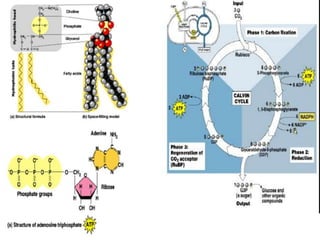
       Phosphorus
       Potassium
       Calcium, Magesium, Sulfur, Silicon
Introductory Concepts

• Nutrient Deficiency
 –concentration of a nutrient decreases
  below the typical range
 –lead to specific visual, often
  characteristic, symptoms reflective of
  the role of that particular nutrient in
  plant metabolism
Objectives

1. To become familiar with the method
   of growing plants by hydroponics
2. To observe deficiency symptoms
   associated with inadequate supplies
   of selected essential element
METHODOLOGY
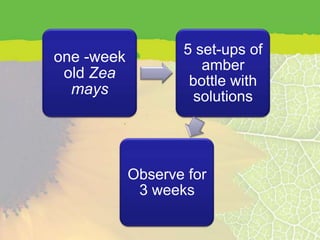
one -week          5 set-ups of
                      amber
 old Zea            bottle with
  mays               solutions


            Observe for
             3 weeks
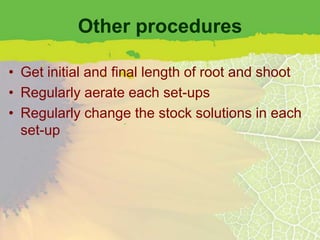
Other procedures

• Get initial and final length of root and shoot
• Regularly aerate each set-ups
• Regularly change the stock solutions in each
  set-up
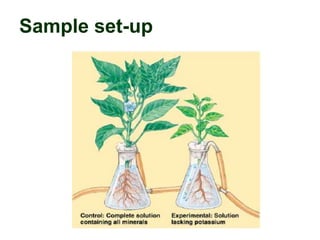
Sample set-up
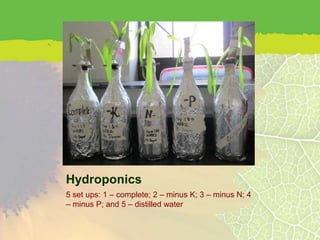
Hydroponics
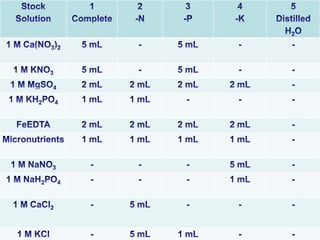
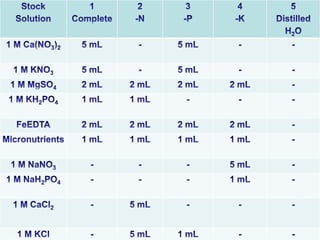
5 set ups: 1 – complete; 2 – minus K; 3 – minus N; 4
– minus P; and 5 – distilled water
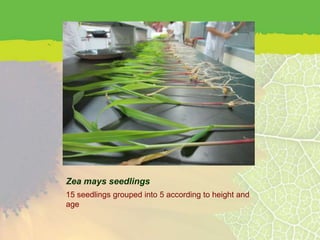
Zea mays seedlings
15 seedlings grouped into 5 according to height and
age
RESULTS
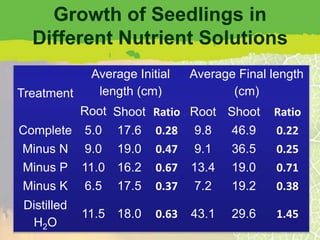
Growth of Seedlings in
  Different Nutrient Solutions
              Average Initial    Average Final length
Treatment      length (cm)              (cm)
             Root Shoot   Ratio Root Shoot     Ratio
Complete     5.0 17.6     0.28 9.8   46.9      0.22
Minus N      9.0 19.0     0.47 9.1   36.5      0.25
Minus P      11.0 16.2    0.67 13.4 19.0       0.71
Minus K      6.5 17.5     0.37 7.2   19.2      0.38
 Distilled
             11.5 18.0    0.63   43.1   29.6    1.45
  H2O
Observations in each set-up

• Complete
 –Short roots but high amounts of lateral
  roots
 –Good shoot growth
 –Lively green leaves
 –Minor chlorosis at leaf tips
 –Generally healthy
Observations in each set-up

• Minus Nitrogen
 –Very poor shoot growth
 –Interveinal Chlorosis
 –Violet leaf sheaths
Observations in each set-up

• Minus Phosphorus
 – Very minimal shoot growth
 – Very minimal root growth
 – Violet coloration of leaf sheaths
 – Root system is very fragile
 – Interveinal Chlorosis
 – Necrosis
Observations in each set-up

• Minus Potassium
 –Marginal Necrosis
 –Very poor root growth
 –Very poor shoot growth
 –Leaves were twisted, curled and fragile
 – Necrosis
Observations in each set-up

• Distilled Water
  –Chlorosis
  –Light green color
  –Very good root growth, but poor in
   lateral roots
  –Violet leaf sheaths
  –Fragile shoot system
DISCUSSION
Hydroponics – the set-up

• Soil-less culture
• Inorganic solution that contain nutrients
• Roots of plants are immersed on the
  solution
• Continually aerated and exposed to
  sunlight
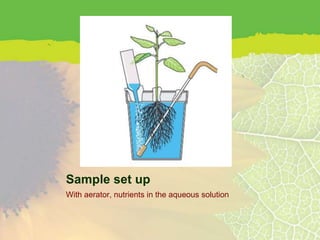
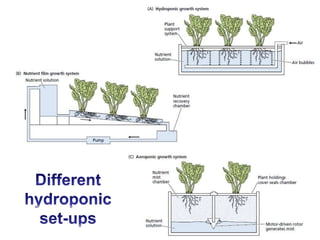
Sample set up
With aerator, nutrients in the aqueous solution
Hydroponics – the set-up

• Better than the soil
  – chronic and acute deficiencies of several
    elements may occur simultaneously
  – absence or excessive amounts of one
    element may induce deficiencies or excess
    accumulations of another
  – some virus-induced plant diseases may
    produce symptoms similar to those of
    nutrient deficiencies
Hydroponics – the solution

• Sachs’ solution - contributed a total of
  nine mineral nutrients
  (K, N, P, Ca, S, Na, Cl,Fe, Mg)
• Hoagland solution
  – contain all of the known mineral elements
    needed for rapid plant growth
  – Used in our experiment (slightly
    modified)
Hydroponics – the solution

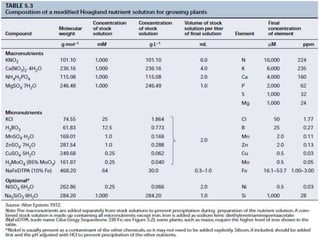
• Modified Hoagland Solution
 –Concentrations of the elements were
  set to their optimum levels in such a
  way that it will not produce any toxicity
  symptoms or salinity stress
 –E.g. source of nitrogen which is
  ammonium (NH4+) and nitrate (NO3-)
Hydroponics – the
             preparations
• Distilled water must be first placed in each
  bottle to prevent formation of precipitations
• one-week old germinating Zea mays
  – easily germinated
  – widely available
  – stored endosperm – food of the germinating
    seed
  – suitable height for the transport of the
    nutrients
Hydroponics – the
            preparations
• Proper aeration
  – provide the roots of the plants with sufficient
    oxygen for their aerobic respiration
• Maintenance of solution
  – to replenish the consumed nutrients
  – and to remove by-products of metabolism
• Maintenance of pH
  – within 5.5 to 6.5
  – element abundance is dependent to it
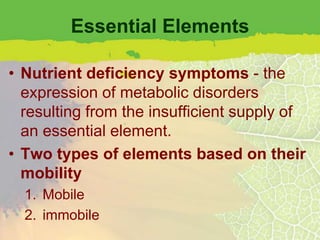
Essential Elements

• Nutrient deficiency symptoms - the
  expression of metabolic disorders
  resulting from the insufficient supply of
  an essential element.
• Two types of elements based on their
  mobility
  1. Mobile
  2. immobile
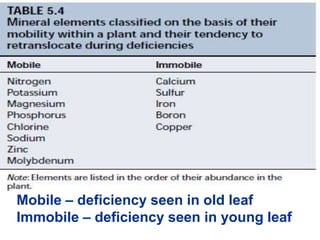
Mobile – deficiency seen in old leaf
Immobile – deficiency seen in young leaf
Essential Elements –
           Categories
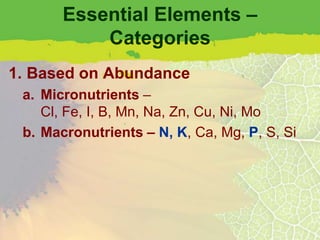
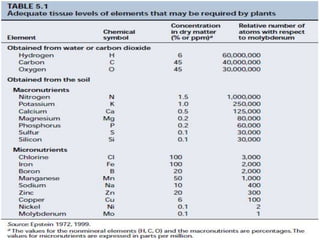
1. Based on Abundance
 a. Micronutrients –
    Cl, Fe, I, B, Mn, Na, Zn, Cu, Ni, Mo
 b. Macronutrients – N, K, Ca, Mg, P, S, Si
Essential Elements –
            Categories
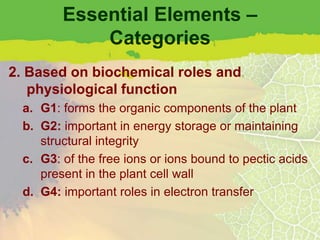
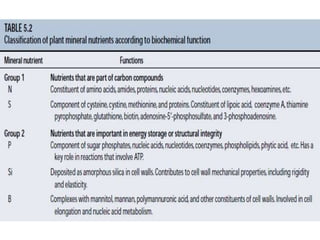
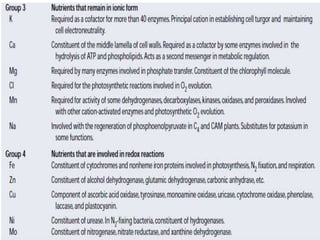
2. Based on biochemical roles and
   physiological function
 a. G1: forms the organic components of the plant
 b. G2: important in energy storage or maintaining
    structural integrity
 c. G3: of the free ions or ions bound to pectic acids
    present in the plant cell wall
 d. G4: important roles in electron transfer
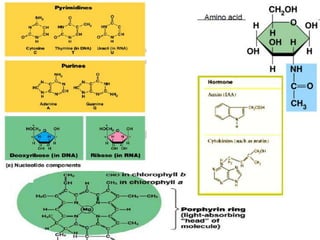
Nitrogen (NH4+, NO3-)

• Functions        • Deficiencies
  – constituent of   – inhibited plant
   many important      growth
   cell components   – Chlorosis
    • Amino acids       – woody stems
    • Nucleic acids     – formation of purple
    • Chlorophyll         pigmentation
    • hormones
Observations in each set-up

• Minus Nitrogen
 –Very poor shoot growth
 –Interveinal Chlorosis
 –Violet leaf sheaths
Phosphorus (HPO4−, HPO2−)

• Functions        • Deficiencies
  –DNA and RNA       –Stunted growth
  –Sugar-phosphate   –Necrosis
   int. :RuBP        –Purple
  –plant              coloration
   metabolism: ATP   –Slender stems
  –phospholipids     –Delayed
                      maturation
Observations in each set-up

• Minus Phosphorus
 – Very minimal shoot growth
 – Very minimal root growth
 – Violet coloration of leaf sheaths
 – Root system is very fragile
 – Interveinal Chlorosis
 – Necrosis
Potassium (K+)

• Functions        •   Deficiencies
  –regulation of       – chlorosis  necrosis
   osmotic potential   – Leaf curl and crinkle
   in plant cells      – slender and weak
  –Activation of       – abnormal short
   enzymes in            intermodal region
   respiration and     – roots susceptible to
   photosynthesis        rotting due to fungi
                       – tendency to lodge off
Observations in each set-up

• Minus Potassium
 –Marginal Necrosis
 –Very poor root growth
 –Very poor shoot growth
 –Leaves were twisted, curled and fragile
 – Necrosis
Observations in each set-up

• Complete
 –Short roots but high amounts of lateral
  roots
 –Good shoot growth
 –Lively green leaves
 –Minor chlorosis at leaf tips
 –Generally healthy
Observations in each set-up

• Distilled Water
  –Chlorosis
  –Light green color
  –Very good root growth, but poor in
   lateral roots
  –Violet leaf sheaths
  –Fragile shoot system
CONCLUSION
1. To become familiar with the method of
      growing plants by hydroponics

Hydroponics – uses a soil-less
culture that uses only inorganic
solutions as source of nutrients
where the roots of the plant are
immersed and are continually
aerated, and exposed to ample
sunlight
2. To observe deficiency symptoms
 associated with inadequate supplies
     of selected essential element

• Minus Nitrogen - inhibition of growth
  and yellowing of leaves
• Minus Phosphorus - dark green
  coloration of leaves or necrosis and
  stunted growth
• Minus Potassium - plant lodged off and
  exhibited curling and necrosis in leaf tips
The Conclusion
• Essential elements – needed by plants
  to grow and develop (N, P, K)
• Specific functions can be observed using
  methods such as hydroponics
• Deficiency symptoms are reflective of
  the nutrients’ functions
• Nitrogen influences plant
  growth, phosphorus stores energy, and
  potassium regulates osmotic potential
GUIDE QUESTIONS
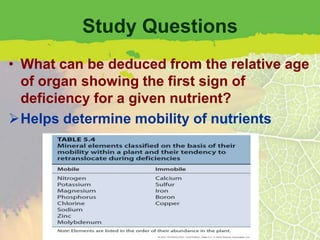
Study Questions
• What can be deduced from the relative age
  of organ showing the first sign of
  deficiency for a given nutrient?
Helps determine mobility of nutrients
Study questions

• Why are dark colored containers
  preferably used in culture solution
  studies?
In order to keep out light
reduce the growth of algae that would
  compete with the plants for nutrients
Prevent reactions of chemical that can
  be induced by light
Study questions

• Why is it necessary to observe
  aseptic protocols in the experiment?
to avoid contamination
even a little increase or decrease in the
  nutrient content can have a considerable
  effect on the results, making them
  unreliable
Study questions

• Give examples of plants that have
  been grown using hydroponics (not
  necessarily in the Philippines).
Watercress
Tomatoes
Pepper
Lettuce
Seedless cucumber
Study questions

• Soil-less agriculture is practiced
  extensively in Israel. Why do you
  think so?
country lacking in fertile agricultural land
deserts (not efficient in water retention)
less organic materials – less retention
  for nutrients (low CEC)
REFERENCES

• F. Evangelista. 2012. Lecture in Plant Nutrition in a
  plant physiology course. Gat Andres Bonifacio
  bldg., University of the Philippines, Manila
• Hopkins. 2009. Introduction to Plant Physiology 4th
  Edition. John Wiley & Sons, Inc. United States of
  America
• Taiz & Zeiger. 2002. Plant Physiology 3rd Edition.
  Sinauer Asssociates
  Inc., Publishers, Sutherland, Massachusetts
• Plant Mineral Nutrition PowerPoint. 2010
Prepared by
Uy, Masa, Josue, De layola, Cortez
  Plant Physiology Laboratory, WAB2
            August 8, 2012

Report mineral nutrition

  • 1.
    Mineral Nutrition Experiment 4
  • 2.
  • 3.
    Introductory Concepts • Plantnutrition – Organic nutrition - focuses on the production of carbon compounds –Inorganic nutrition - concerned with the acquisition of mineral elements from the soil
  • 4.
    Introductory Concepts • Nutrient – A substance needed to survive or necessary for the synthesis of organic compounds • Mineral – inorganic elements which come from the soil and are dissolved in water and absorbed through the roots of the plants
  • 5.
    Introductory Concepts • MineralNutrient –may be toxic to plants –may play no role in metabolism –may be essential for plant growth • A mineral nutrient is regarded as essential if, in its absence, a plant cannot complete its life cycle.
  • 6.
    Introductory Concepts • EssentialElements (essential mineral nutrients) 1. one whose absence prevents a plant from completing its life cycle 2. one that has a clear physiological role
  • 7.
    Introductory Concepts • Classificationof Essential Elements – Based on their abundance in plants 1. Micronutrients 2. Macronutrients  Nitrogen  Phosphorus  Potassium  Calcium, Magesium, Sulfur, Silicon
  • 8.
    Introductory Concepts • NutrientDeficiency –concentration of a nutrient decreases below the typical range –lead to specific visual, often characteristic, symptoms reflective of the role of that particular nutrient in plant metabolism
  • 9.
    Objectives 1. To becomefamiliar with the method of growing plants by hydroponics 2. To observe deficiency symptoms associated with inadequate supplies of selected essential element
  • 10.
  • 11.
    one -week 5 set-ups of amber old Zea bottle with mays solutions Observe for 3 weeks
  • 13.
    Other procedures • Getinitial and final length of root and shoot • Regularly aerate each set-ups • Regularly change the stock solutions in each set-up
  • 14.
  • 15.
    Hydroponics 5 set ups:1 – complete; 2 – minus K; 3 – minus N; 4 – minus P; and 5 – distilled water
  • 16.
    Zea mays seedlings 15seedlings grouped into 5 according to height and age
  • 17.
  • 18.
    Growth of Seedlingsin Different Nutrient Solutions Average Initial Average Final length Treatment length (cm) (cm) Root Shoot Ratio Root Shoot Ratio Complete 5.0 17.6 0.28 9.8 46.9 0.22 Minus N 9.0 19.0 0.47 9.1 36.5 0.25 Minus P 11.0 16.2 0.67 13.4 19.0 0.71 Minus K 6.5 17.5 0.37 7.2 19.2 0.38 Distilled 11.5 18.0 0.63 43.1 29.6 1.45 H2O
  • 19.
    Observations in eachset-up • Complete –Short roots but high amounts of lateral roots –Good shoot growth –Lively green leaves –Minor chlorosis at leaf tips –Generally healthy
  • 20.
    Observations in eachset-up • Minus Nitrogen –Very poor shoot growth –Interveinal Chlorosis –Violet leaf sheaths
  • 21.
    Observations in eachset-up • Minus Phosphorus – Very minimal shoot growth – Very minimal root growth – Violet coloration of leaf sheaths – Root system is very fragile – Interveinal Chlorosis – Necrosis
  • 22.
    Observations in eachset-up • Minus Potassium –Marginal Necrosis –Very poor root growth –Very poor shoot growth –Leaves were twisted, curled and fragile – Necrosis
  • 23.
    Observations in eachset-up • Distilled Water –Chlorosis –Light green color –Very good root growth, but poor in lateral roots –Violet leaf sheaths –Fragile shoot system
  • 24.
  • 25.
    Hydroponics – theset-up • Soil-less culture • Inorganic solution that contain nutrients • Roots of plants are immersed on the solution • Continually aerated and exposed to sunlight
  • 26.
    Sample set up Withaerator, nutrients in the aqueous solution
  • 27.
    Hydroponics – theset-up • Better than the soil – chronic and acute deficiencies of several elements may occur simultaneously – absence or excessive amounts of one element may induce deficiencies or excess accumulations of another – some virus-induced plant diseases may produce symptoms similar to those of nutrient deficiencies
  • 29.
    Hydroponics – thesolution • Sachs’ solution - contributed a total of nine mineral nutrients (K, N, P, Ca, S, Na, Cl,Fe, Mg) • Hoagland solution – contain all of the known mineral elements needed for rapid plant growth – Used in our experiment (slightly modified)
  • 32.
    Hydroponics – thesolution • Modified Hoagland Solution –Concentrations of the elements were set to their optimum levels in such a way that it will not produce any toxicity symptoms or salinity stress –E.g. source of nitrogen which is ammonium (NH4+) and nitrate (NO3-)
  • 33.
    Hydroponics – the preparations • Distilled water must be first placed in each bottle to prevent formation of precipitations • one-week old germinating Zea mays – easily germinated – widely available – stored endosperm – food of the germinating seed – suitable height for the transport of the nutrients
  • 34.
    Hydroponics – the preparations • Proper aeration – provide the roots of the plants with sufficient oxygen for their aerobic respiration • Maintenance of solution – to replenish the consumed nutrients – and to remove by-products of metabolism • Maintenance of pH – within 5.5 to 6.5 – element abundance is dependent to it
  • 35.
    Essential Elements • Nutrientdeficiency symptoms - the expression of metabolic disorders resulting from the insufficient supply of an essential element. • Two types of elements based on their mobility 1. Mobile 2. immobile
  • 36.
    Mobile – deficiencyseen in old leaf Immobile – deficiency seen in young leaf
  • 37.
    Essential Elements – Categories 1. Based on Abundance a. Micronutrients – Cl, Fe, I, B, Mn, Na, Zn, Cu, Ni, Mo b. Macronutrients – N, K, Ca, Mg, P, S, Si
  • 39.
    Essential Elements – Categories 2. Based on biochemical roles and physiological function a. G1: forms the organic components of the plant b. G2: important in energy storage or maintaining structural integrity c. G3: of the free ions or ions bound to pectic acids present in the plant cell wall d. G4: important roles in electron transfer
  • 42.
    Nitrogen (NH4+, NO3-) •Functions • Deficiencies – constituent of – inhibited plant many important growth cell components – Chlorosis • Amino acids – woody stems • Nucleic acids – formation of purple • Chlorophyll pigmentation • hormones
  • 44.
    Observations in eachset-up • Minus Nitrogen –Very poor shoot growth –Interveinal Chlorosis –Violet leaf sheaths
  • 45.
    Phosphorus (HPO4−, HPO2−) •Functions • Deficiencies –DNA and RNA –Stunted growth –Sugar-phosphate –Necrosis int. :RuBP –Purple –plant coloration metabolism: ATP –Slender stems –phospholipids –Delayed maturation
  • 47.
    Observations in eachset-up • Minus Phosphorus – Very minimal shoot growth – Very minimal root growth – Violet coloration of leaf sheaths – Root system is very fragile – Interveinal Chlorosis – Necrosis
  • 48.
    Potassium (K+) • Functions • Deficiencies –regulation of – chlorosis  necrosis osmotic potential – Leaf curl and crinkle in plant cells – slender and weak –Activation of – abnormal short enzymes in intermodal region respiration and – roots susceptible to photosynthesis rotting due to fungi – tendency to lodge off
  • 49.
    Observations in eachset-up • Minus Potassium –Marginal Necrosis –Very poor root growth –Very poor shoot growth –Leaves were twisted, curled and fragile – Necrosis
  • 50.
    Observations in eachset-up • Complete –Short roots but high amounts of lateral roots –Good shoot growth –Lively green leaves –Minor chlorosis at leaf tips –Generally healthy
  • 51.
    Observations in eachset-up • Distilled Water –Chlorosis –Light green color –Very good root growth, but poor in lateral roots –Violet leaf sheaths –Fragile shoot system
  • 52.
  • 53.
    1. To becomefamiliar with the method of growing plants by hydroponics Hydroponics – uses a soil-less culture that uses only inorganic solutions as source of nutrients where the roots of the plant are immersed and are continually aerated, and exposed to ample sunlight
  • 54.
    2. To observedeficiency symptoms associated with inadequate supplies of selected essential element • Minus Nitrogen - inhibition of growth and yellowing of leaves • Minus Phosphorus - dark green coloration of leaves or necrosis and stunted growth • Minus Potassium - plant lodged off and exhibited curling and necrosis in leaf tips
  • 55.
    The Conclusion • Essentialelements – needed by plants to grow and develop (N, P, K) • Specific functions can be observed using methods such as hydroponics • Deficiency symptoms are reflective of the nutrients’ functions • Nitrogen influences plant growth, phosphorus stores energy, and potassium regulates osmotic potential
  • 56.
  • 57.
    Study Questions • Whatcan be deduced from the relative age of organ showing the first sign of deficiency for a given nutrient? Helps determine mobility of nutrients
  • 58.
    Study questions • Whyare dark colored containers preferably used in culture solution studies? In order to keep out light reduce the growth of algae that would compete with the plants for nutrients Prevent reactions of chemical that can be induced by light
  • 59.
    Study questions • Whyis it necessary to observe aseptic protocols in the experiment? to avoid contamination even a little increase or decrease in the nutrient content can have a considerable effect on the results, making them unreliable
  • 60.
    Study questions • Giveexamples of plants that have been grown using hydroponics (not necessarily in the Philippines). Watercress Tomatoes Pepper Lettuce Seedless cucumber
  • 61.
    Study questions • Soil-lessagriculture is practiced extensively in Israel. Why do you think so? country lacking in fertile agricultural land deserts (not efficient in water retention) less organic materials – less retention for nutrients (low CEC)
  • 62.
    REFERENCES • F. Evangelista.2012. Lecture in Plant Nutrition in a plant physiology course. Gat Andres Bonifacio bldg., University of the Philippines, Manila • Hopkins. 2009. Introduction to Plant Physiology 4th Edition. John Wiley & Sons, Inc. United States of America • Taiz & Zeiger. 2002. Plant Physiology 3rd Edition. Sinauer Asssociates Inc., Publishers, Sutherland, Massachusetts • Plant Mineral Nutrition PowerPoint. 2010
  • 63.
    Prepared by Uy, Masa,Josue, De layola, Cortez Plant Physiology Laboratory, WAB2 August 8, 2012

Editor's Notes

  • #4 plants as an autotroph require inorganic materials for their survival. The means for making the inorganic materials such as mineral nutrients assimilated by plants in the soil, available to the organism is the subject of plant nutrition. Organic nutrition - incorporation of carbon, hydrogen, and oxygen via photosynthesis
  • #5 Mineral nutrient – an inorganic element derived from the soil that is needed for the synthesis of organic compunds
  • #6 Mineral nutrients may be toxic to plants: (a)specific nutrient interferes with plant metabolism (b)excessive concentration (specific nutrient + combination with others in solution) and interferes with the plant's water relations. In this experiment, we will tackle mineral nutrients that are essential – the essential elements
  • #7 This means that an element is essential if, first, it is part of an essential constituent or metabolite; and second, if it acts directly in the metabolism of the plant and does not simply corrects an unfavorable microbial or chemical condition in the nutrient medium. Beneficial: Often limited to a few speciesMay be required only in some speciesExamples: Sodium, Silicon and Selenium
  • #8 In this experiment, we will focus on the roles of nitrogen, phosphorus, and potassium which are all macronutrients
  • #9 how to study the desired nutrients? observing their deficienciesVisual - observableCharacteristic – defining for a certain nutrient
  • #19 Root to shoot ratio is taken in order to account the growth of the plant and be a basis of comparisonIdeally, the ratio should be relatively similar in the initial reading so that the changes after 3 weeks of exposure to different kinds of solution can give an insightful results
  • #26 uses a soil-less culture that uses only inorganic solutions where the roots of the plant are immersed and are continually aerated, and where the culture is also exposed to ample sunlight
  • #28 readily correlates the essential element to the symptoms of its deficiency which is related to its functions
  • #30 Carbon, hydrogen, and oxygen were excluded from this total because they were provided in the form of carbon dioxide and water and were not considered mineral elements (Hopkins, 2009). Denis R. Hoagland, a prominent researcher in the field of development of modern mineral nutrition in the United States (Taiz & Zeiger, 2002)
  • #32 Micronutrients – H3BO3, MnCl2*4H2O, ZnCl2, CuCl2*2H2O, NasMoO4*2H2O
  • #33 Nitrogen in this solution is optimal because this balanced mixtures of cations and anions would reduce rapid rise of pH which is commonly observed if the sole source of nitrogen is an anion according
  • #34 Distilled water must be first placed in each bottle before the addition of the reagents in order to prevent the reactions of the chemicals present in each reagent that could yield to the formation of precipitates (Evangelista, 2012). The element that reacted to form the precipitate would not be available for the plant to utilize, and since the chemicals in the precipitate cannot be completely isolated, its effects cannot be accounted, thus it can confound with the expected results of the studied nutrient. water would prevent the immediate interactions between the elements of the different reagents used. The plant must be only one-week old so that there is still stored endosperm – food of the germinating seed – that could sustain its growth while it is being transplanted to the hydroponic cultureThe seedlings must also be handled carefully to avoid any unwanted injuries that could be mistaken as a result for a deficient nutrient.
  • #35 . Maintenance of pH within 5.5 to 6.5 must be observed because the element abundance is dependent to it due to certain nutrients that can react or precipitate out at certain pH levels (Evangelista, 2012)Anoxia – condition wherein oxygen becomes depleted due to improper aeration. - inhibits respiration of root cells and reduces nutrient uptake.
  • #36 Even though the essential nutrient participates in a variety of metabolic reactions, there are particular symptoms that can be only correlated to a certain lack of an essential element which in turn can reveal its specific function. Thus, the symptoms are related to the roles of the essential elements. There are two types of elements that must be taken into consideration when dealing with the deficiencies. These two types are the following: the mobile element and the immobile element
  • #37 Mobility of elements affect the expression of their deficienciesA deficiency in an immobile element takes it effect on the younger leaves because the leaves are yet to acquire the nutrients when the deficiency occurredthe mobile ones affect the older leaves first because the mobile elements migrate from old to new leaves the elements under study are all mobile, therefore their effects were observed in the older leaves.
  • #43 found in group 1 element that plants requires the mostInhibited plant growth – lack of amino acids  proteinsChlorosis – lack of chlorophyll, formation of porphyrin rings affected by lack of nitrogenWoody stems – build up of carbohydrates that is not utilized to form amino acids or other nitrogen-derived compoundsPurple pigmentation – accumulation of carbohydrates  formation of anthocyanins
  • #46 Phosphorus is another macronutrient that belongs to group 2 or the energy storing and structural preserving mineralsIf: abundancepH > 6.8 – monovalent orthophosphate anion (H2PO4-) – readily absorbed6.8> pH >7.2 – bivalent (HPO4-2) - less readily absorbed – P forms insoluble complexes with Al and FepH>7.2 –trivalent form (HPO4-3) – virtually unavailable for plants – Ca and Mg will precipitate the PAcidic – good!Phosphodiester bonds – DNA, RNAsugar–phosphate intermediates of respiration and photosynthesis : ribulose bi-phosphate, phosphoglycerate, phosphoenolpyruvateStunted growth – lack RNA  proteinsPurple coloration – anthocyanins (like in nitrogen but not associated with chlorosis)Slender stems not woodyDelayed maturation – metabolism
  • #49 exists as a free ion, therefore belonging to the group 4.regulation of osmotic potential in plant cells – plant movements (opening and closing of stomata)Activation of enzymes in respiration and photosynthesis (function as cofactors)1. chlorosis which later on develops into necrosis especially in the leaf tips, margins and between veins of older leaves – affect enzymes in photosynthesis2. Leaves also curl and crinkle due to imbalance in osmoregulation 3. stems are slender and weak – imbalance in osmorgeulation4. abnormal short intermodal region due to lack of turgidity5. Also affects starch synthesis – due to its involvement in the activation of enzymes in photisynthesis
  • #51 Since it contains the most amounts of dissolved macro and micronutrients, then it has the greatest capacity to undergo biochemical reactions like photosynthesis thus a generally healthy plant, no or minor symptoms of any nutrient deficiency
  • #52 No nutrients present – should exhibit most of the deficiency symptomsThus, water alone cannot sustain healthy growth of plants
  • #60 * water used to prepare the nutrients solutions must be carefully distilled, avoiding metallic components in the distilled in the distillation apparatus as much as possible*
  • #61 *avoid large-rooted plants like carrots and radishes*