BIOMOLECULES
The Chemical Building
Blocks of Life
Biomolecules
• Atom-smallest unit of matter (carbon, hydrogen, oxygen,
nitrogen and phosphorus are the atoms that make up most
biomolecules)
• Molecule-group of atom bonded together
• Polymer-molecules of many repeating units
• Biomolecules-molecules needed for life
-Carbohydrate (sugar)
-Proteins
-Lipids (fats)
-Nucleic acid (DNA and RNA)
Families of Biomolecule
• Carbohydrates
• Lipids
• Proteins
• Nucleic Acids
Carbon is the central element
• All biomolecules contain a Carbon chain or ring
• Carbon (atomic number 6) has 4 outer shell
electrons (valence = 4)
• Therefore it’s bonding capacity is great
• It forms covalent bonds –hence, has strong bonds
• Once bound to other elements (or to other
Carbons), it is very stable
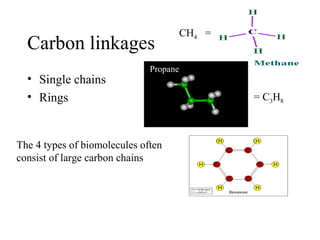
Carbon linkages
• Single chains
• Rings
Propane
The 4 types of biomolecules often
consist of large carbon chains
= C3H8
CH4 =
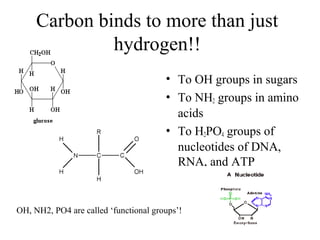
Carbon binds to more than just
hydrogen!!
• To OH groups in sugars
• To NH2 groups in amino
acids
• To H2PO4 groups of
nucleotides of DNA,
RNA, and ATP
Amino acid
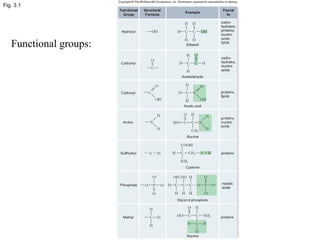
OH, NH2, PO4 are called ‘functional groups’!
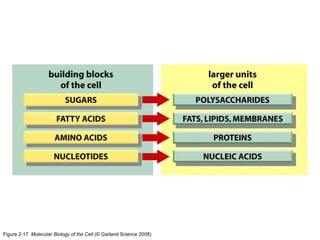
Figure 2-17 Molecular Biology of the Cell (© Garland Science 2008)
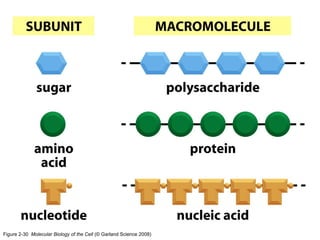
Figure 2-30 Molecular Biology of the Cell (© Garland Science 2008)
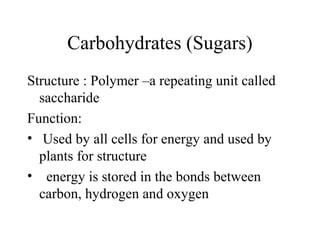
Carbohydrates (Sugars)
Structure : Polymer –a repeating unit called
saccharide
Function:
• Used by all cells for energy and used by
plants for structure
• energy is stored in the bonds between
carbon, hydrogen and oxygen
Carbohydrates
• Carbohydrate contain aldehyde (CHO)
and ketone (-c o) functional group.꞊
• Monosaccharides:[cn(H2O)n]
•Five carbone: Ribose
•Six carbone: Glucose and fructose
Carbohydrates
• Disaccharides [cn(H2O)n]
–Sucrose (glucose+glucose)
–Lactose (glucose+galactose)
–Maltose (glucose+fructose)
• Polysaccharides [c6(H10O)5]n
–Starch
–Cellulose
–Glycogen
• Oligosaccharides:
Oligosaccharides
• 3 to 10 monosaccharide units by glycosidic
bond:
-maltotriose
-raffinose
-blood group substance
Polysaccharides
Three Types
• Glycogen – animal storage product that
accumulates in the liver
Glucose→Glycogen→glucose→bloodstream
• Starch – plant energy storage
- Easily digested by animals through hydrolysis
• Cellulose- non digestable in human body
lacking of cellulase enzyme
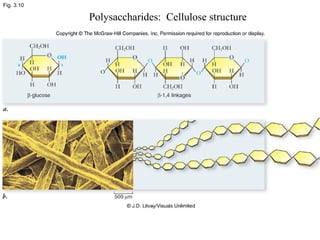
Cellulose
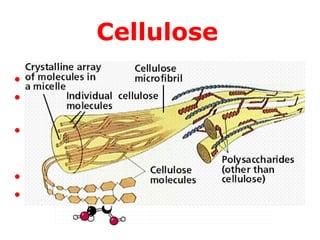
• Polysaccharide found in plant cell walls
• For humans cellulose is indigestible and
forms dietary fiber
• Made up entirely of β glucoses
– Structure is constrained into straight
microfibrils
• Not an energy source for animals
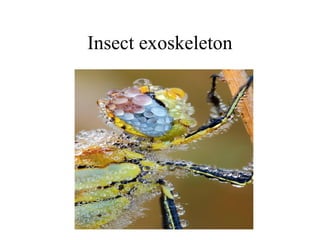
• Chitin – insect exoskeletons
Fig. 3.1
Functional groups:
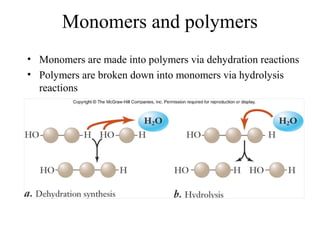
Monomers and polymers
• Monomers are made into polymers via dehydration reactions
• Polymers are broken down into monomers via hydrolysis
reactions
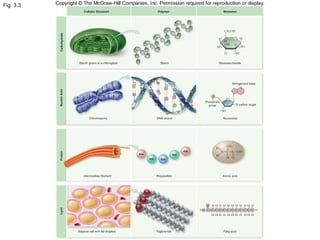
Fig. 3.3
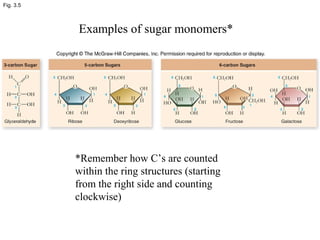
Fig. 3.5
Examples of sugar monomers*
*Remember how C’s are counted
within the ring structures (starting
from the right side and counting
clockwise)
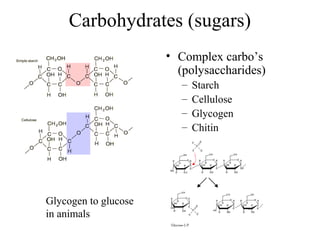
Carbohydrates (sugars)
• Complex carbo’s
(polysaccharides)
– Starch
– Cellulose
– Glycogen
– Chitin
Glycogen to glucose
in animals
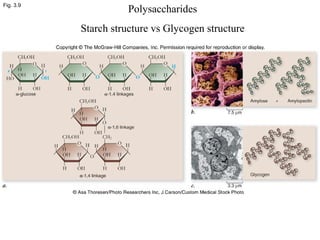
Fig. 3.9
Polysaccharides
Starch structure vs Glycogen structure
Fig. 3.10
Polysaccharides: Cellulose structure
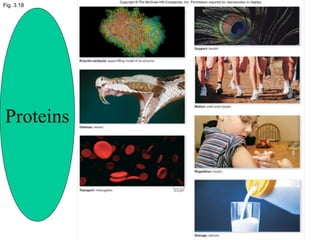
Fig. 3.18
Proteins
Proteins
• Mammal cell contains 10,000 proteins
• Control elements (enzymes)
– Organic catalysts
– Mediators of metabolism
– Direct development, maintenance, and growth
• Structural elements (cell membrane, muscles,
ligaments, hair, fingernails)
• Regulate what goes into/out of cells
Building Blocks of Proteins
Amino Acids
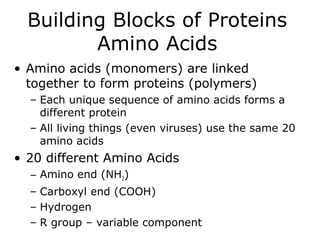
• Amino acids (monomers) are linked
together to form proteins (polymers)
– Each unique sequence of amino acids forms a
different protein
– All living things (even viruses) use the same 20
amino acids
• 20 different Amino Acids
– Amino end (NH2)
– Carboxyl end (COOH)
– Hydrogen
– R group – variable component
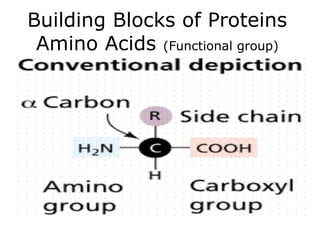
Building Blocks of Proteins
Amino Acids (Functional group)
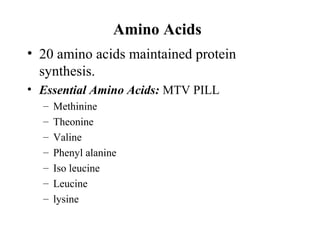
Amino Acids
• 20 amino acids maintained protein
synthesis.
• Essential Amino Acids: MTV PILL
– Methinine
– Theonine
– Valine
– Phenyl alanine
– Iso leucine
– Leucine
– lysine
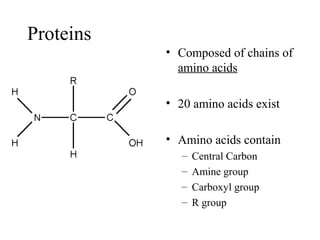
Proteins
• Composed of chains of
amino acids
• 20 amino acids exist
• Amino acids contain
– Central Carbon
– Amine group
– Carboxyl group
– R group
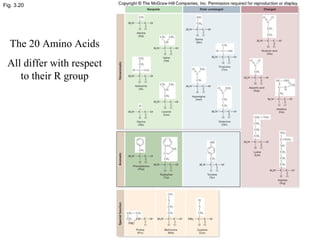
Fig. 3.20
The 20 Amino Acids
All differ with respect
to their R group
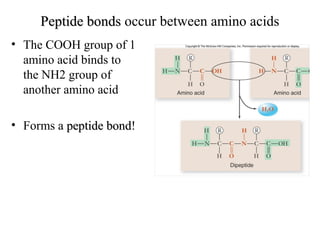
Peptide bondsPeptide bonds occur between amino acids
• The COOH group of 1
amino acid binds to
the NH2 group of
another amino acid
• Forms a peptide bondpeptide bond!
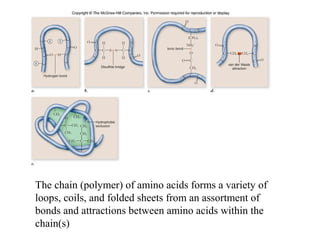
Fig. 3.21
The chain (polymer) of amino acids forms a variety of
loops, coils, and folded sheets from an assortment of
bonds and attractions between amino acids within the
chain(s)
Classification of Protein
• Simple protein:(depends on size and solubility)
– Fibrous protein (Ligament, Cartilage, hair, nail)
– Globular protein
• Albumin
• Globulin
• Histone
• Gliadine
Classification of Protein
• Conjugated protein:
– Nucleoprotein (RNA,DNA)
– Liporpotein (Lipid)
– Glycoprotein (CHO)
– Rhodopsin (Retinol)
– Feritin (Iron)
– Hemoglobin (Hb heme)
Classification depends on functions
• Structural protein (collagen, elastin)
• Catalytic protein (Enzyme)
• Transport protein (Alb, transferrine)
• Hormonal protein (regulation:insulin,glucagon)
• Gene regulatory (histone, protamin)
• Protective protein (prevent
infection:immunoglobulin-G)
• Receptor protein (LDL receptor)
• Contractile protein (muscle contraction: actine,
myocine)
There are at least 7 functions of proteins
• Enzyme catalysts – specific for 1 reaction
• Defense – antibody proteins, other proteins
• Transport- Hgb, Mgb, transferrins, etc
• Support – keratin, fibrin, collagen
• Motion – actin/myosin, cytoskeletal fibers
• Regulation- some hormones, regulatory proteins
on DNA, cell receptors
• Storage – Ca and Fe attached to storage proteins
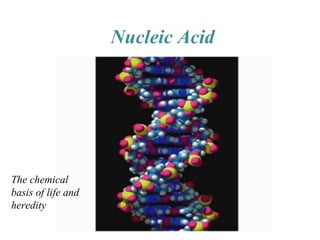
Nucleic Acid
The chemical
basis of life and
heredity
• Nucleic Acid: Polymer of Nucleotides connected
by 3/
, 5/
- phosphodiester bond.
• Types of Nucleic Acid: There are 2 types of NA
-RNA (Ribonucleic acid)
-DNA (Deoxyribonucleic acid)
Monomer/Building blocks
• RNA: Monomeric unit of RNA is ribonucleotide
• DNA: Monomeric unit of DNA is deoxy
ribonucleotide
Structure of Nucleotides
• Nucleoside: Nitrogen base + Ribose sugar
• Nucleotide: It is monomer of nucleic acid
and it contains: Nucleoside+Phosphate
group
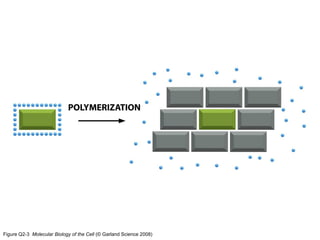
Figure Q2-3 Molecular Biology of the Cell (© Garland Science 2008)
Sugar
• Either ribose or deoxyribose pentoses in ring
form.
•Deoxyribose lacks one oxygen
Ribose sugar: C5H10O5 RNA
d-Ribose sugar: C5H10O4 DNA
Phosphate group
PO4
Nitrogen Bases
DNA and RNA contains the same
purines (nitrogen base) namely
• Adenine (A)
• Guanine (G)
• DNA and RNA contains the same
Pyrimidine (nitrogen base) namely
Cytocine (C)
However the nucleic acids differ with respect to the
second pyrimidine base-DNA contains Thymine
(T) where as RNA contains Uracil (U)
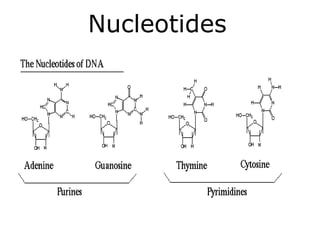
Nucleotides
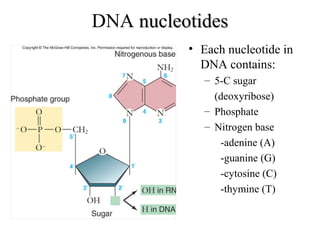
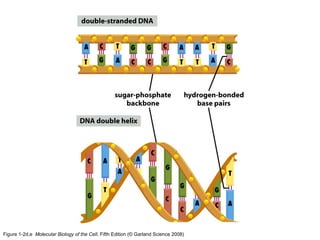
DNA nucleotidesnucleotides
• Each nucleotide in
DNA contains:
– 5-C sugar
(deoxyribose)
– Phosphate
– Nitrogen base
-adenine (A)
-guanine (G)
-cytosine (C)
-thymine (T)
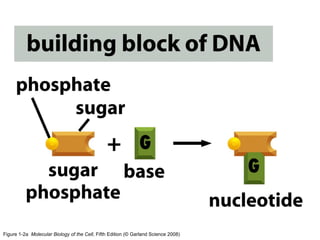
Figure 1-2a Molecular Biology of the Cell, Fifth Edition (© Garland Science 2008)
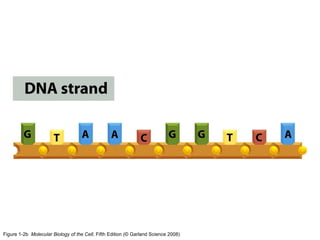
Figure 1-2b Molecular Biology of the Cell, Fifth Edition (© Garland Science 2008)
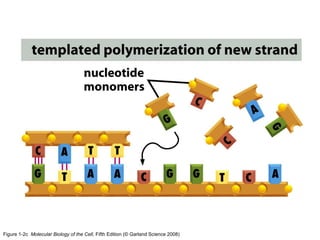
Figure 1-2c Molecular Biology of the Cell, Fifth Edition (© Garland Science 2008)
Figure 1-2d,e Molecular Biology of the Cell, Fifth Edition (© Garland Science 2008)
Nucleic Acids
• Polymers composed of monomer
units known as nucleotides
• Information storage
– DNA (deoxyribonucleic acid)
• Protein synthesis
– RNA (ribonucleic acid)
• Energy transfers
– ATP (adenosine tri-phosphate) and
NAD (nicotinamide adenine
dinucleotide)
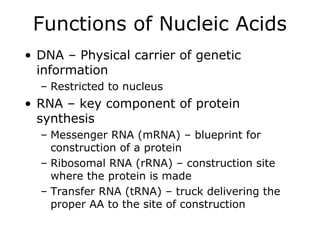
Functions of Nucleic Acids
• DNA – Physical carrier of genetic
information
– Restricted to nucleus
• RNA – key component of protein
synthesis
– Messenger RNA (mRNA) – blueprint for
construction of a protein
– Ribosomal RNA (rRNA) – construction site
where the protein is made
– Transfer RNA (tRNA) – truck delivering the
proper AA to the site of construction
Biological Function:
i. Conveys genetic information
ii. Act as co-enzymes e.g. NAD+, FAD, FMN,
NADP
iii. Participate in energy metabolism and serve as
energy store.
iv. Act as intracellular 2nd
mrssenger e.g. cAMP,
and cGMP
v. Regulation of coronary blood flow, e.g.
adinosine.
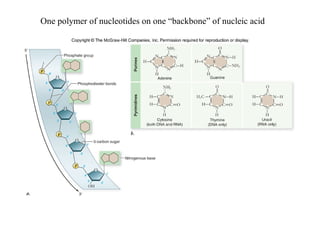
Fig. 3.14
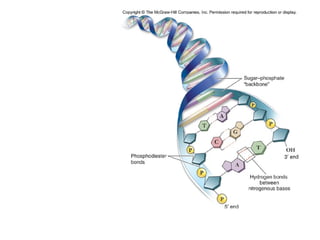
One polymer of nucleotides on one “backbone” of nucleic acid
Fig. 3.15
The DNA “double helix”
Lipids
Lipids
• Made of Carbon, Oxygen, Hydrogen.
• Lipids are not polymeric substances rather
they are mostly small molecules.
• Building blocks of most of the lipids are
fatty acid
• Some lipids such as cholesterol, lack fatty
acid.
Criteria of Lipids
• Insoluble in water but soluble in one or
more fat solvents.
• Common fat solvents (Non polar/ organic
solvent) are-
• Ether, Chloroform, Benzin, alcohol, acetone
and carbon tetra chloride.
• Heterogeneous substance
• Utilized by living organisms
Criteria of Lipids
• Saturated-Solid at room temperature. No
double bonds
• Unsaturated-liquid at room temperature.
Double bonds between carbons.
Classification of Lipids
• Simple:
-Esters of fatty acids with alcohol
-They do not contain any non lipid substance
-Basically composed of Fatty acid + alcohol
e.g. Neutral fat and wax
Classification of Lipids contd.
• Complex lipid or compound lipid-
-Esters of fatty acid with alcohol along with
other non lipid substances.
-Basically composed of fatty acid+ alcohol+
other non lipid substance.
-e.g.Phospholipid, glycolipid, lipoprotein,
sulfolipid.
Classification of Lipids contd.
• Derived lipid
-Derivative obtained by hydrolysis of simple
lipids and complex lipid which still possess
the general charecteristics of lipid, e.g. fatty
acid, alcohol, glycerol, steroid, fat soluble
vitamins, keton bodies etc.
Neutral fat and wax
• They are regarded as neutral because they
do not have any change at normal body pH.
• It is also known as oil or triglycerides
• Neutral fat of plant source have more
unsaturated FA and that of animal source
have more saturated FA
Triglycerides
• Fats and oils used for long term energy
storage
• 38 KJ of energy per gram (2x carbs)
• Slower to build up and break down than
carbohydrates
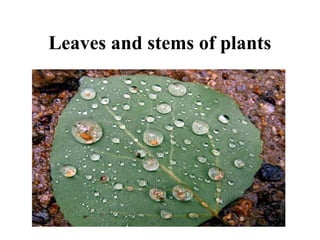
Waxes
• Composed of long hydrocarbon chains and
are strongly hydrophobic
• Highly saturated
• Solid at room temperature
• Form waterproof coatings
Leaves and stems of plants
Insect exoskeleton
Wax
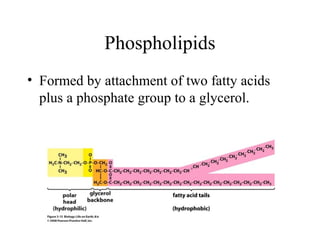
Phospholipids
• Formed by attachment of two fatty acids
plus a phosphate group to a glycerol.
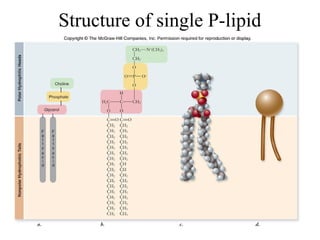
Structure of single P-lipid
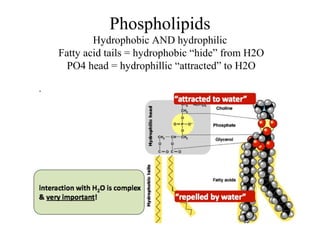
Phospholipids
Hydrophobic AND hydrophilic
Fatty acid tails = hydrophobic “hide” from H2O
PO4 head = hydrophillic “attracted” to H2O
Phospholipids and cell membranes
• P-lipids make up the majority of cell
membranes including:
– The plasma membrane
– Nuclear envelope
– Endoplasmic reticulum (ER)
– Golgi apparatus
– Membrane-bound vesicles
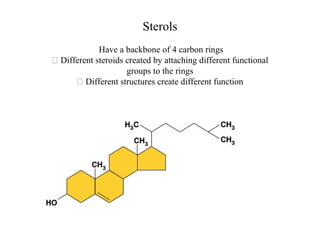
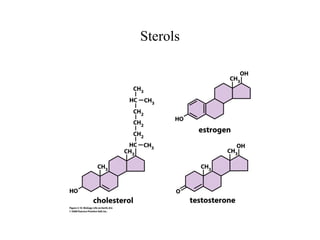
Sterols
Have a backbone of 4 carbon rings
 Different steroids created by attaching different functional
groups to the rings
 Different structures create different function
Sterols
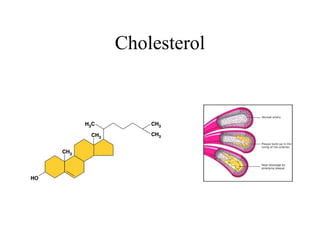
Cholesterol
• Important component of animal cell
membranes
• Precursor to all other steroids
• Participates in all chemical reactions that
make other steroids
• High levels in blood may contribute to
cardiovascular disease
Cholesterol
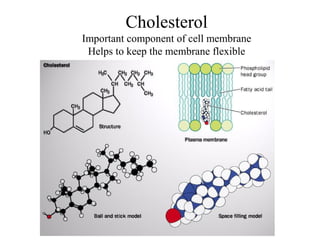
Cholesterol
Important component of cell membrane
Helps to keep the membrane flexible
Fatty acid
Classification of FA
A. Based on total number of carbon (chain
length)
1. Short chain FA (carbon number<10)
e.g. Acetic acid (2C), Caproic acid (6C)
2. Long chain FA (carbon number>10)
e.g. Palmitic acid (16C), Stearic acid (18 C)
B. Based on saturation of carbon:
1. Saturated Fatty acid:
• They do not contain any double bond in
their hydrocarbon chain
• They represent about 50% of body fatty
acid pool
• Common source:
Animal fat: butter, ghee
Vegetable oil: coconut oil, palm oil.
e.g.Palmitic acid, Stearic acid
• Unsaturated Fatty acid
• They contain one or more double bond in their
hydrocarbon chain
• With one double bond-Monounsaturated FA
(MUFA)
• e.g. Olive oil, canola oil (Oleic acid;18C)
• With 2 and more double bond-Polyunsaturated FA
(PUFA)
• e.g. Soybean oil, mustard oil, sunflower oil
(except palm and coconut)
• Also found in fish oil
• C. Nutritional classification
1. Non essential FA
• These are the fatty acids which body can
synthesize
• Palmitic acid, stearic acid, oleic acid etc.
2. Essential Fatty Acid
• These are the PUFA which are not
produced in human body but must be
supplied with diet
e.g. Linoleic acid:18 C Omega 6 FA with 2
double bonds
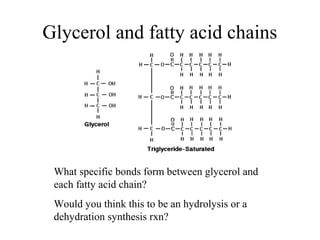
Glycerol and fatty acid chains
What specific bonds form between glycerol and
each fatty acid chain?
Would you think this to be an hydrolysis or a
dehydration synthesis rxn?
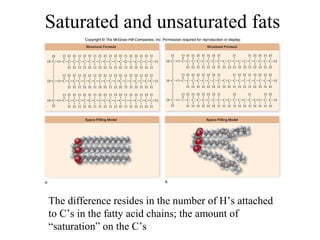
Saturated and unsaturated fats
The difference resides in the number of H’s attached
to C’s in the fatty acid chains; the amount of
“saturation” on the C’s
Saturated vs unsaturated fats and diet
• Saturated fatsSaturated fats raise LDL-cholesterol levels in the
blood (animal fats, dairy, coconut oil, cocoa
butter)
• Polyunsaturated fatsPolyunsaturated fats leave LDL-cholesterol
unchanged; but lower HDL-cholesterol (safflower
and corn oil)
• Monounsaturated fatsMonounsaturated fats leave LDL and HDL levels
unchanged (olive oil, canola, peanut oil, avocados)
• One variety of polyunsaturated fat (Omega-3 fattyOmega-3 fatty
acidsacids) guards against blood clot formation and
reduce fat levels in the blood (certain fish,
walnuts, almonds, and tofu)
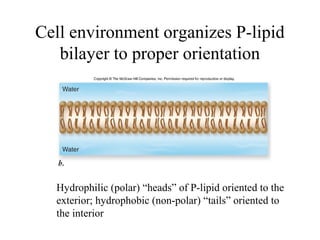
Cell environment organizes P-lipid
bilayer to proper orientation
Hydrophilic (polar) “heads” of P-lipid oriented to the
exterior; hydrophobic (non-polar) “tails” oriented to
the interior

2. biomolecule

  • 1.
  • 2.
    Biomolecules • Atom-smallest unitof matter (carbon, hydrogen, oxygen, nitrogen and phosphorus are the atoms that make up most biomolecules) • Molecule-group of atom bonded together • Polymer-molecules of many repeating units • Biomolecules-molecules needed for life -Carbohydrate (sugar) -Proteins -Lipids (fats) -Nucleic acid (DNA and RNA)
  • 3.
    Families of Biomolecule •Carbohydrates • Lipids • Proteins • Nucleic Acids
  • 4.
    Carbon is thecentral element • All biomolecules contain a Carbon chain or ring • Carbon (atomic number 6) has 4 outer shell electrons (valence = 4) • Therefore it’s bonding capacity is great • It forms covalent bonds –hence, has strong bonds • Once bound to other elements (or to other Carbons), it is very stable
  • 5.
    Carbon linkages • Singlechains • Rings Propane The 4 types of biomolecules often consist of large carbon chains = C3H8 CH4 =
  • 6.
    Carbon binds tomore than just hydrogen!! • To OH groups in sugars • To NH2 groups in amino acids • To H2PO4 groups of nucleotides of DNA, RNA, and ATP Amino acid OH, NH2, PO4 are called ‘functional groups’!
  • 7.
    Figure 2-17 MolecularBiology of the Cell (© Garland Science 2008)
  • 8.
    Figure 2-30 MolecularBiology of the Cell (© Garland Science 2008)
  • 9.
    Carbohydrates (Sugars) Structure :Polymer –a repeating unit called saccharide Function: • Used by all cells for energy and used by plants for structure • energy is stored in the bonds between carbon, hydrogen and oxygen
  • 10.
    Carbohydrates • Carbohydrate containaldehyde (CHO) and ketone (-c o) functional group.꞊ • Monosaccharides:[cn(H2O)n] •Five carbone: Ribose •Six carbone: Glucose and fructose
  • 11.
    Carbohydrates • Disaccharides [cn(H2O)n] –Sucrose(glucose+glucose) –Lactose (glucose+galactose) –Maltose (glucose+fructose) • Polysaccharides [c6(H10O)5]n –Starch –Cellulose –Glycogen • Oligosaccharides:
  • 12.
    Oligosaccharides • 3 to10 monosaccharide units by glycosidic bond: -maltotriose -raffinose -blood group substance
  • 13.
    Polysaccharides Three Types • Glycogen– animal storage product that accumulates in the liver Glucose→Glycogen→glucose→bloodstream • Starch – plant energy storage - Easily digested by animals through hydrolysis • Cellulose- non digestable in human body lacking of cellulase enzyme
  • 14.
    Cellulose • Polysaccharide foundin plant cell walls • For humans cellulose is indigestible and forms dietary fiber • Made up entirely of β glucoses – Structure is constrained into straight microfibrils • Not an energy source for animals • Chitin – insect exoskeletons
  • 15.
  • 16.
    Monomers and polymers •Monomers are made into polymers via dehydration reactions • Polymers are broken down into monomers via hydrolysis reactions
  • 17.
  • 18.
    Fig. 3.5 Examples ofsugar monomers* *Remember how C’s are counted within the ring structures (starting from the right side and counting clockwise)
  • 19.
    Carbohydrates (sugars) • Complexcarbo’s (polysaccharides) – Starch – Cellulose – Glycogen – Chitin Glycogen to glucose in animals
  • 20.
  • 21.
  • 22.
  • 23.
    Proteins • Mammal cellcontains 10,000 proteins • Control elements (enzymes) – Organic catalysts – Mediators of metabolism – Direct development, maintenance, and growth • Structural elements (cell membrane, muscles, ligaments, hair, fingernails) • Regulate what goes into/out of cells
  • 24.
    Building Blocks ofProteins Amino Acids • Amino acids (monomers) are linked together to form proteins (polymers) – Each unique sequence of amino acids forms a different protein – All living things (even viruses) use the same 20 amino acids • 20 different Amino Acids – Amino end (NH2) – Carboxyl end (COOH) – Hydrogen – R group – variable component
  • 25.
    Building Blocks ofProteins Amino Acids (Functional group)
  • 26.
    Amino Acids • 20amino acids maintained protein synthesis. • Essential Amino Acids: MTV PILL – Methinine – Theonine – Valine – Phenyl alanine – Iso leucine – Leucine – lysine
  • 27.
    Proteins • Composed ofchains of amino acids • 20 amino acids exist • Amino acids contain – Central Carbon – Amine group – Carboxyl group – R group
  • 28.
    Fig. 3.20 The 20Amino Acids All differ with respect to their R group
  • 29.
    Peptide bondsPeptide bondsoccur between amino acids • The COOH group of 1 amino acid binds to the NH2 group of another amino acid • Forms a peptide bondpeptide bond!
  • 30.
    Fig. 3.21 The chain(polymer) of amino acids forms a variety of loops, coils, and folded sheets from an assortment of bonds and attractions between amino acids within the chain(s)
  • 31.
    Classification of Protein •Simple protein:(depends on size and solubility) – Fibrous protein (Ligament, Cartilage, hair, nail) – Globular protein • Albumin • Globulin • Histone • Gliadine
  • 32.
    Classification of Protein •Conjugated protein: – Nucleoprotein (RNA,DNA) – Liporpotein (Lipid) – Glycoprotein (CHO) – Rhodopsin (Retinol) – Feritin (Iron) – Hemoglobin (Hb heme)
  • 33.
    Classification depends onfunctions • Structural protein (collagen, elastin) • Catalytic protein (Enzyme) • Transport protein (Alb, transferrine) • Hormonal protein (regulation:insulin,glucagon) • Gene regulatory (histone, protamin) • Protective protein (prevent infection:immunoglobulin-G) • Receptor protein (LDL receptor) • Contractile protein (muscle contraction: actine, myocine)
  • 34.
    There are atleast 7 functions of proteins • Enzyme catalysts – specific for 1 reaction • Defense – antibody proteins, other proteins • Transport- Hgb, Mgb, transferrins, etc • Support – keratin, fibrin, collagen • Motion – actin/myosin, cytoskeletal fibers • Regulation- some hormones, regulatory proteins on DNA, cell receptors • Storage – Ca and Fe attached to storage proteins
  • 35.
    Nucleic Acid The chemical basisof life and heredity
  • 36.
    • Nucleic Acid:Polymer of Nucleotides connected by 3/ , 5/ - phosphodiester bond. • Types of Nucleic Acid: There are 2 types of NA -RNA (Ribonucleic acid) -DNA (Deoxyribonucleic acid)
  • 37.
    Monomer/Building blocks • RNA:Monomeric unit of RNA is ribonucleotide • DNA: Monomeric unit of DNA is deoxy ribonucleotide
  • 38.
    Structure of Nucleotides •Nucleoside: Nitrogen base + Ribose sugar • Nucleotide: It is monomer of nucleic acid and it contains: Nucleoside+Phosphate group
  • 39.
    Figure Q2-3 MolecularBiology of the Cell (© Garland Science 2008)
  • 40.
    Sugar • Either riboseor deoxyribose pentoses in ring form. •Deoxyribose lacks one oxygen Ribose sugar: C5H10O5 RNA d-Ribose sugar: C5H10O4 DNA
  • 41.
  • 42.
    Nitrogen Bases DNA andRNA contains the same purines (nitrogen base) namely • Adenine (A) • Guanine (G) • DNA and RNA contains the same Pyrimidine (nitrogen base) namely Cytocine (C) However the nucleic acids differ with respect to the second pyrimidine base-DNA contains Thymine (T) where as RNA contains Uracil (U)
  • 43.
  • 44.
    DNA nucleotidesnucleotides • Eachnucleotide in DNA contains: – 5-C sugar (deoxyribose) – Phosphate – Nitrogen base -adenine (A) -guanine (G) -cytosine (C) -thymine (T)
  • 45.
    Figure 1-2a MolecularBiology of the Cell, Fifth Edition (© Garland Science 2008)
  • 46.
    Figure 1-2b MolecularBiology of the Cell, Fifth Edition (© Garland Science 2008)
  • 47.
    Figure 1-2c MolecularBiology of the Cell, Fifth Edition (© Garland Science 2008)
  • 48.
    Figure 1-2d,e MolecularBiology of the Cell, Fifth Edition (© Garland Science 2008)
  • 49.
    Nucleic Acids • Polymerscomposed of monomer units known as nucleotides • Information storage – DNA (deoxyribonucleic acid) • Protein synthesis – RNA (ribonucleic acid) • Energy transfers – ATP (adenosine tri-phosphate) and NAD (nicotinamide adenine dinucleotide)
  • 50.
    Functions of NucleicAcids • DNA – Physical carrier of genetic information – Restricted to nucleus • RNA – key component of protein synthesis – Messenger RNA (mRNA) – blueprint for construction of a protein – Ribosomal RNA (rRNA) – construction site where the protein is made – Transfer RNA (tRNA) – truck delivering the proper AA to the site of construction
  • 51.
    Biological Function: i. Conveysgenetic information ii. Act as co-enzymes e.g. NAD+, FAD, FMN, NADP iii. Participate in energy metabolism and serve as energy store. iv. Act as intracellular 2nd mrssenger e.g. cAMP, and cGMP v. Regulation of coronary blood flow, e.g. adinosine.
  • 52.
    Fig. 3.14 One polymerof nucleotides on one “backbone” of nucleic acid
  • 53.
    Fig. 3.15 The DNA“double helix”
  • 54.
  • 55.
    Lipids • Made ofCarbon, Oxygen, Hydrogen. • Lipids are not polymeric substances rather they are mostly small molecules. • Building blocks of most of the lipids are fatty acid • Some lipids such as cholesterol, lack fatty acid.
  • 56.
    Criteria of Lipids •Insoluble in water but soluble in one or more fat solvents. • Common fat solvents (Non polar/ organic solvent) are- • Ether, Chloroform, Benzin, alcohol, acetone and carbon tetra chloride. • Heterogeneous substance • Utilized by living organisms
  • 57.
    Criteria of Lipids •Saturated-Solid at room temperature. No double bonds • Unsaturated-liquid at room temperature. Double bonds between carbons.
  • 58.
    Classification of Lipids •Simple: -Esters of fatty acids with alcohol -They do not contain any non lipid substance -Basically composed of Fatty acid + alcohol e.g. Neutral fat and wax
  • 59.
    Classification of Lipidscontd. • Complex lipid or compound lipid- -Esters of fatty acid with alcohol along with other non lipid substances. -Basically composed of fatty acid+ alcohol+ other non lipid substance. -e.g.Phospholipid, glycolipid, lipoprotein, sulfolipid.
  • 60.
    Classification of Lipidscontd. • Derived lipid -Derivative obtained by hydrolysis of simple lipids and complex lipid which still possess the general charecteristics of lipid, e.g. fatty acid, alcohol, glycerol, steroid, fat soluble vitamins, keton bodies etc.
  • 61.
    Neutral fat andwax • They are regarded as neutral because they do not have any change at normal body pH. • It is also known as oil or triglycerides • Neutral fat of plant source have more unsaturated FA and that of animal source have more saturated FA
  • 62.
    Triglycerides • Fats andoils used for long term energy storage • 38 KJ of energy per gram (2x carbs) • Slower to build up and break down than carbohydrates
  • 63.
    Waxes • Composed oflong hydrocarbon chains and are strongly hydrophobic • Highly saturated • Solid at room temperature • Form waterproof coatings
  • 64.
  • 65.
  • 66.
  • 67.
    Phospholipids • Formed byattachment of two fatty acids plus a phosphate group to a glycerol.
  • 68.
  • 69.
    Phospholipids Hydrophobic AND hydrophilic Fattyacid tails = hydrophobic “hide” from H2O PO4 head = hydrophillic “attracted” to H2O
  • 70.
    Phospholipids and cellmembranes • P-lipids make up the majority of cell membranes including: – The plasma membrane – Nuclear envelope – Endoplasmic reticulum (ER) – Golgi apparatus – Membrane-bound vesicles
  • 71.
    Sterols Have a backboneof 4 carbon rings  Different steroids created by attaching different functional groups to the rings  Different structures create different function
  • 72.
  • 73.
    Cholesterol • Important componentof animal cell membranes • Precursor to all other steroids • Participates in all chemical reactions that make other steroids • High levels in blood may contribute to cardiovascular disease
  • 74.
  • 75.
    Cholesterol Important component ofcell membrane Helps to keep the membrane flexible
  • 76.
  • 77.
    Classification of FA A.Based on total number of carbon (chain length) 1. Short chain FA (carbon number<10) e.g. Acetic acid (2C), Caproic acid (6C) 2. Long chain FA (carbon number>10) e.g. Palmitic acid (16C), Stearic acid (18 C)
  • 78.
    B. Based onsaturation of carbon: 1. Saturated Fatty acid: • They do not contain any double bond in their hydrocarbon chain • They represent about 50% of body fatty acid pool • Common source: Animal fat: butter, ghee Vegetable oil: coconut oil, palm oil. e.g.Palmitic acid, Stearic acid
  • 79.
    • Unsaturated Fattyacid • They contain one or more double bond in their hydrocarbon chain • With one double bond-Monounsaturated FA (MUFA) • e.g. Olive oil, canola oil (Oleic acid;18C) • With 2 and more double bond-Polyunsaturated FA (PUFA) • e.g. Soybean oil, mustard oil, sunflower oil (except palm and coconut) • Also found in fish oil
  • 80.
    • C. Nutritionalclassification 1. Non essential FA • These are the fatty acids which body can synthesize • Palmitic acid, stearic acid, oleic acid etc.
  • 81.
    2. Essential FattyAcid • These are the PUFA which are not produced in human body but must be supplied with diet e.g. Linoleic acid:18 C Omega 6 FA with 2 double bonds
  • 82.
    Glycerol and fattyacid chains What specific bonds form between glycerol and each fatty acid chain? Would you think this to be an hydrolysis or a dehydration synthesis rxn?
  • 83.
    Saturated and unsaturatedfats The difference resides in the number of H’s attached to C’s in the fatty acid chains; the amount of “saturation” on the C’s
  • 84.
    Saturated vs unsaturatedfats and diet • Saturated fatsSaturated fats raise LDL-cholesterol levels in the blood (animal fats, dairy, coconut oil, cocoa butter) • Polyunsaturated fatsPolyunsaturated fats leave LDL-cholesterol unchanged; but lower HDL-cholesterol (safflower and corn oil) • Monounsaturated fatsMonounsaturated fats leave LDL and HDL levels unchanged (olive oil, canola, peanut oil, avocados) • One variety of polyunsaturated fat (Omega-3 fattyOmega-3 fatty acidsacids) guards against blood clot formation and reduce fat levels in the blood (certain fish, walnuts, almonds, and tofu)
  • 85.
    Cell environment organizesP-lipid bilayer to proper orientation Hydrophilic (polar) “heads” of P-lipid oriented to the exterior; hydrophobic (non-polar) “tails” oriented to the interior