1 ©Gabriel Chua, 2013
Chapter 4: Interdependence Among Living Organisms and Environment
4.1) Interdependence Among Living Organisms
1. Species is a group of _______________ living organisms who can ____________ together
to produce ______________ offsprings.
2. Population is a group of individuals of the same _____________ living in the same
_____________ at the same time.
3. Community is when different ________________ of organisms living together and
________________ with one another in the same habitat.
4. Ecosystem is when different __________________ interact with one another and with
_________________.
5. Habitat is the natural _____________ ____________ of organisms. It provides food,
_______________, ______________, _______________ and ______________.
6. Environment is made up of _______________ and _____-_______________ organisms.
4.2) Interactions Between Living Organisms
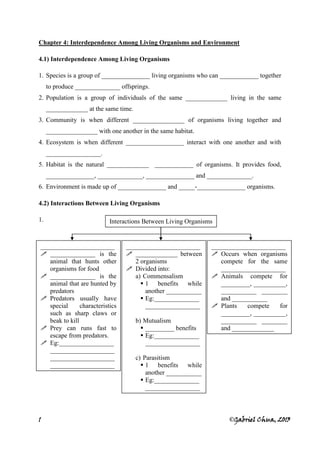
1. Interactions Between Living Organisms
_______________________
 ______________ is the
animal that hunts other
organisms for food
 ______________ is the
animal that are hunted by
predators
 Predators usually have
special characteristics
such as sharp claws or
beak to kill
 Prey can runs fast to
escape from predators.
 Eg:_________________
____________________
____________________
____________________
_______________________
 _____________ between
2 organisms
 Divided into:
a) Commensalism
 1 benefits while
another ___________
 Eg:______________
_________________
b) Mutualism
 _________ benefits
 Eg:______________
_________________
c) Parasitism
 1 benefits while
another ___________
 Eg:______________
_________________
_______________________
 Occurs when organisms
compete for the same
____________________
 Animals compete for
_________, __________,
___________ ________
and ___________
 Plants compete for
_________, __________,
___________ ________
and _____________
2 ©Gabriel Chua, 2013
2. Biological control
 The use of ________________ ________________ to control the population of pests.
 Eg: __________________________________________________________________
 Advantages:
a) Does not ____________ other organisms
b) Does not ____________ environment
c) Safe and cheap
4.3) Food Web
1. Food chain is the _________ ______________ among organisms.
2. Food web consists of several ____________ _______________ that are interlinked to one
another.
3. Producers are living organisms that are able to ______________ their own food.
4. Consumers are living organisms that are not able to make their own food. They get food
from by _________________ on other organisms.
5. Build your own food chain from the following organisms:
6. Build your own food web from the following organisms:
Snake, frog, owl, grass, grasshopper, decomposers
Snake, frog, owl, grass, grasshopper, decomposers, small bird, caterpillar, rabbit
3 ©Gabriel Chua, 2013
7. Pyramid of numbers show the _____________ of organisms at each stage of food chain.
4.4) Photosynthesis
1. Occurs in ___________ ____________ only.
2. It is the process of making own _____________ from ______________, _____________,
_____________ _______________ and ______________.
3. The process of photosynthesis:
4. Glucose is converted into ___________________
5. Role of photosynthesis:
a) Enable plants to make their own ____________
b) Regulate and maintain ________________ _______________ content in atmosphere
c) Increase ______________ content in atmosphere
6.
From the base to the peak:
a) Number of organisms __________________
b) Size of organisms _____________________
c) More energy is ______________
Carbon cycle
4 ©Gabriel Chua, 2013
7. Process that releases carbon dioxide are ___________________, __________________
and _______________________
8. Process that absorbs carbon dioxide is _______________________.
4.5) Conservation and Preservation of Living Organisms
1. Conservation is the action of ______________ plants and animals from being killed or
destroyed.
2. Preservation is the action of _______________ living organisms the way they are.
3. Steps taken to conserve and preserve living organisms:
Steps Explanations
Setting up protected areas
Setting up man-made habitats
Laws and regulations
Recycling and reusing
materials
Banning trade of exotic pets
Banning sales of products
made from endangered
organisms
Conservation and
preservation activities
4.6) Role of Humans in Maintaining the Balance in Nature
1. Some effects of human activities on nature are ____________________ of resources,
______ pollution, ___________ pollution and ____________ pollution.
2. Solving pollution:
Parties involved Explanation
Individual
Community
Government
5 ©Gabriel Chua, 2013

Chapter 4

  • 1.
    1 ©Gabriel Chua,2013 Chapter 4: Interdependence Among Living Organisms and Environment 4.1) Interdependence Among Living Organisms 1. Species is a group of _______________ living organisms who can ____________ together to produce ______________ offsprings. 2. Population is a group of individuals of the same _____________ living in the same _____________ at the same time. 3. Community is when different ________________ of organisms living together and ________________ with one another in the same habitat. 4. Ecosystem is when different __________________ interact with one another and with _________________. 5. Habitat is the natural _____________ ____________ of organisms. It provides food, _______________, ______________, _______________ and ______________. 6. Environment is made up of _______________ and _____-_______________ organisms. 4.2) Interactions Between Living Organisms 1. Interactions Between Living Organisms _______________________  ______________ is the animal that hunts other organisms for food  ______________ is the animal that are hunted by predators  Predators usually have special characteristics such as sharp claws or beak to kill  Prey can runs fast to escape from predators.  Eg:_________________ ____________________ ____________________ ____________________ _______________________  _____________ between 2 organisms  Divided into: a) Commensalism  1 benefits while another ___________  Eg:______________ _________________ b) Mutualism  _________ benefits  Eg:______________ _________________ c) Parasitism  1 benefits while another ___________  Eg:______________ _________________ _______________________  Occurs when organisms compete for the same ____________________  Animals compete for _________, __________, ___________ ________ and ___________  Plants compete for _________, __________, ___________ ________ and _____________
  • 2.
    2 ©Gabriel Chua,2013 2. Biological control  The use of ________________ ________________ to control the population of pests.  Eg: __________________________________________________________________  Advantages: a) Does not ____________ other organisms b) Does not ____________ environment c) Safe and cheap 4.3) Food Web 1. Food chain is the _________ ______________ among organisms. 2. Food web consists of several ____________ _______________ that are interlinked to one another. 3. Producers are living organisms that are able to ______________ their own food. 4. Consumers are living organisms that are not able to make their own food. They get food from by _________________ on other organisms. 5. Build your own food chain from the following organisms: 6. Build your own food web from the following organisms: Snake, frog, owl, grass, grasshopper, decomposers Snake, frog, owl, grass, grasshopper, decomposers, small bird, caterpillar, rabbit
  • 3.
    3 ©Gabriel Chua,2013 7. Pyramid of numbers show the _____________ of organisms at each stage of food chain. 4.4) Photosynthesis 1. Occurs in ___________ ____________ only. 2. It is the process of making own _____________ from ______________, _____________, _____________ _______________ and ______________. 3. The process of photosynthesis: 4. Glucose is converted into ___________________ 5. Role of photosynthesis: a) Enable plants to make their own ____________ b) Regulate and maintain ________________ _______________ content in atmosphere c) Increase ______________ content in atmosphere 6. From the base to the peak: a) Number of organisms __________________ b) Size of organisms _____________________ c) More energy is ______________ Carbon cycle
  • 4.
    4 ©Gabriel Chua,2013 7. Process that releases carbon dioxide are ___________________, __________________ and _______________________ 8. Process that absorbs carbon dioxide is _______________________. 4.5) Conservation and Preservation of Living Organisms 1. Conservation is the action of ______________ plants and animals from being killed or destroyed. 2. Preservation is the action of _______________ living organisms the way they are. 3. Steps taken to conserve and preserve living organisms: Steps Explanations Setting up protected areas Setting up man-made habitats Laws and regulations Recycling and reusing materials Banning trade of exotic pets Banning sales of products made from endangered organisms Conservation and preservation activities 4.6) Role of Humans in Maintaining the Balance in Nature 1. Some effects of human activities on nature are ____________________ of resources, ______ pollution, ___________ pollution and ____________ pollution. 2. Solving pollution: Parties involved Explanation Individual Community Government
  • 5.